Physics For Scientists And Engineers 6E - part 313
 

  Index      Production     Physics For Scientists And Engineers 6E


Search            


Content   ..  311  312  313  314   ..


Physics For Scientists And Engineers 6E - part 313


The  experiment  was  designed  to  determine  the  velocity  of  the  Earth  relative  to

that of the hypothetical ether. The experimental tool used was the Michelson interfer-
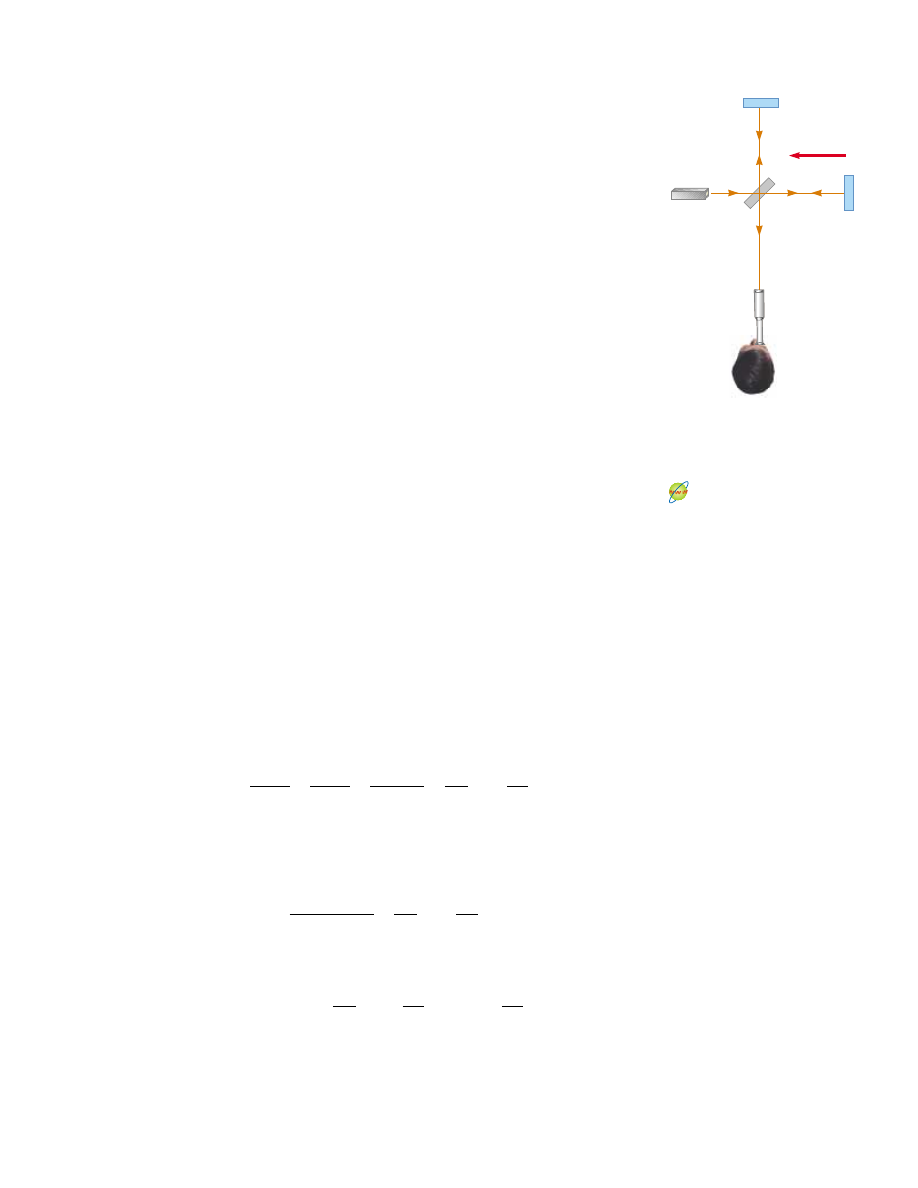
ometer, which was discussed in Section 37.7 and is shown again in Figure 39.4. Arm 2 is
aligned  along  the  direction  of  the  Earth’s  motion  through  space.  The  Earth  moving
through the ether at speed is equivalent to the ether flowing past the Earth in the
opposite direction with speed v. This ether wind blowing in the direction opposite the
direction  of  Earth’s  motion  should  cause  the  speed  of  light  measured  in  the  Earth
frame to be as the light approaches mirror M

2

and after reflection, where c

is the speed of light in the ether frame.

The two light beams reflect from M

1

and M

2

and recombine, and an interference

pattern  is  formed,  as  discussed  in  Section  37.7.  The  interference  pattern  is  observed
while the interferometer is rotated through an angle of 90°. This rotation interchanges
the  speed  of  the  ether  wind  between  the  arms  of  the  interferometer.  The  rotation
should cause the fringe pattern to shift slightly but measurably. Measurements failed,
however,  to  show  any  change  in  the  interference  pattern!  The  Michelson–Morley
experiment  was  repeated  at  different  times  of  the  year  when  the  ether  wind  was
expected to change direction and magnitude, but the results were always the same: 

no

fringe shift of the magnitude required was ever observed.

2

The  negative  results  of  the  Michelson–Morley  experiment  not  only  contradicted

the  ether  hypothesis  but  also  showed  that  it  was  impossible  to  measure  the  absolute
velocity  of  the  Earth  with  respect  to  the  ether  frame.  However,  Einstein  offered  a
postulate for his special theory of relativity that places quite a different interpretation
on these null results. In later years, when more was known about the nature of light,
the  idea  of  an  ether  that  permeates  all  of  space  was  abandoned. 

Light  is  now

understood  to  be  an  electromagnetic  wave,  which  requires  no  medium  for  its
propagation. As  a  result,  the  idea  of  an  ether  in  which  these  waves  travel  became
unnecessary.

Details of the Michelson–Morley Experiment

To understand the outcome of the Michelson–Morley experiment, let us assume that
the  two  arms  of  the  interferometer  in  Figure  39.4  are  of  equal  length  L.  We  shall
analyze the situation as if there were an ether wind, because that is what Michelson and
Morley  expected  to  find.  As  noted  above,  the  speed  of  the  light  beam  along  arm  2
should  be  as  the  beam  approaches  M

2

and  after  the  beam  is  reflected.

Thus,  the  time  interval  for  travel  to  the  right  is  L/(v),  and  the  time  interval  for
travel to the left is L/(v). The total time interval for the round trip along arm 2 is

Now  consider  the  light  beam  traveling  along  arm  1,  perpendicular  to  the  ether

wind. Because the speed of the beam relative to the Earth is (c

2

#

v

2

)

1/2

in this case

(see Fig. 39.3), the time interval for travel for each half of the trip is L/(c

2

#

v

2

)

1/2

,

and the total time interval for the round trip is

Thus,  the  time  difference  'between  the  horizontal  round  trip  (arm  2)  and  the
vertical round trip (arm 1) is

'

! 't


arm 2

# '

t


arm 1

!

2L

c


!

"

1 #

v


2

c


2

#

#

1

#

"

1 #

v


2

c


2

#

#

1/2

$

'

t


arm 1

!

2L

(c


2

#

v


2

)

1/2

!

2L

c


"

1 #

v


2

c


2

#

#

1/2

'

t


arm 2

!

L

v

&

L

v

!

2Lc

c


2

#

v


2

!

2L

c


"

1 #

v


2

c


2

#

#

1

S E C T I O N   3 9 . 2 •  The Michelson–Morley Experiment

1249

Telescope

Ether wind

M

1

M

2

M

0

v

Arm 2

Arm 1

Active Figure 39.4 According to

the ether wind theory, the speed of

light should be as the beam

approaches mirror M

2

and v

after reflection.

At the Active Figures link

at http://www.pse6.com, you

can adjust the speed of the

ether wind to see the effect on

the light beams if there were an

ether.

2

From an Earth observer’s point of view, changes in the Earth’s speed and direction of motion in

the course of a year are viewed as ether wind shifts. Even if the speed of the Earth with respect to the
ether were zero at some time, six months later the speed of the Earth would be 60 km/s with respect to
the ether, and as a result a fringe shift should be noticed. No shift has ever been observed, however.

Because  v

2

/c

2

((

1,  we  can  simplify  this  expression  by  using  the  following  binomial

expansion after dropping all terms higher than second order:

(1 # x)

n

% 1 # nx

(for (( 1)

In our case, v

2

/c

2

, and we find that

(39.3)

This time difference between the two instants at which the reflected beams arrive at

the viewing telescope gives rise to a phase difference between the beams, producing an
interference pattern when they combine at the position of the telescope. A shift in the
interference  pattern  should  be  detected  when  the  interferometer  is  rotated  through
90° in a horizontal plane, so that the two beams exchange roles. This rotation results in
a  time  difference  twice  that  given  by  Equation  39.3.  Thus,  the  path  difference  that
corresponds to this time difference is

Because  a  change  in  path  length  of  one  wavelength  corresponds  to  a  shift  of  one
fringe,  the  corresponding  fringe  shift  is  equal  to  this  path  difference  divided  by  the
wavelength of the light:

(39.4)

In  the  experiments  by  Michelson  and  Morley,  each  light  beam  was  reflected  by

mirrors  many  times  to  give  an  effective  path  length  of  approximately  11 m.  Using
this value and taking to be equal to 3.0 $ 10

4

m/s, the speed of the Earth around the

Sun, we obtain a path difference of

This  extra  travel  distance  should  produce  a  noticeable  shift  in  the  fringe  pattern.
Specifically, using 500-nm light, we expect a fringe shift for rotation through 90° of

The instrument used by Michelson and Morley could detect shifts as small as 0.01 fringe.
However, 

it  detected  no  shift  whatsoever  in  the  fringe  pattern. Since  then,  the

experiment has been repeated many times by different scientists under a wide variety of
conditions, and no fringe shift has ever been detected. Thus, it was concluded that the
motion of the Earth with respect to the postulated ether cannot be detected.

Many  efforts  were  made  to  explain  the  null  results  of  the  Michelson–Morley

experiment and to save the ether frame concept and the Galilean velocity transforma-
tion equation for light. All proposals resulting from these efforts have been shown to
be  wrong.  No  experiment  in  the  history  of  physics  received  such  valiant  efforts  to
explain  the  absence  of  an  expected  result  as  did  the  Michelson–Morley  experiment.
The stage was set for Einstein, who solved the problem in 1905 with his special theory
of relativity.

39.3 Einstein’s Principle of Relativity

In the previous section we noted the impossibility of measuring the speed of the ether
with  respect  to  the  Earth  and  the  failure  of  the  Galilean  velocity  transformation
equation  in  the  case  of  light.  Einstein  proposed  a  theory  that  boldly  removed  these

Shift !

'

d

)

!

2.2 $ 10

#

7

 m

5.0 $ 10

#

7

 m

% 0.44

'

!

2(11 m)(3.0 $ 10

4

 m/s)

2

(3.0 $ 10

8

 m/s)

2

!

2.2 $ 10

#

7

 m

Shift !

2Lv


2

)

c


2

'

c (2 't


) !

2Lv


2

c


2

'

! 't


arm 2

# '

t


arm 1

%

Lv


2

c


3

1250

C H A P T E R   3 9 •  Relativity

The first postulate asserts that all the laws of physics—those dealing with mechanics,

electricity  and  magnetism,  optics,  thermodynamics,  and  so  on—are  the  same  in  all
reference frames moving with constant velocity relative to one another. This postulate is
a sweeping generalization of the principle of Galilean relativity, which refers only to the
laws of mechanics. From an experimental point of view, Einstein’s principle of relativity
means  that  any  kind  of  experiment  (measuring  the  speed  of  light,  for  example)
performed in a laboratory at rest must give the same result when performed in a labora-
tory  moving  at  a  constant  velocity  with  respect  to  the  first  one.  Hence,  no  preferred
inertial reference frame exists, and it is impossible to detect absolute motion.

Note that postulate 2 is required by postulate 1: if the speed of light were not the

same in all inertial frames, measurements of different speeds would make it possible to
distinguish  between  inertial  frames;  as  a  result,  a  preferred,  absolute  frame  could  be
identified, in contradiction to postulate 1.

Although  the  Michelson–Morley  experiment  was  performed  before  Einstein

published his work on relativity, it is not clear whether or not Einstein was aware of the
details of the experiment. Nonetheless, the null result of the experiment can be readily
understood  within  the  framework  of  Einstein’s  theory.  According  to  his  principle  of
relativity,  the  premises  of  the  Michelson–Morley  experiment  were  incorrect.  In  the
process  of  trying  to  explain  the  expected  results,  we  stated  that  when  light  traveled
against  the  ether  wind  its  speed  was  v,  in  accordance  with  the  Galilean  velocity
transformation  equation.  However,  if  the  state  of  motion  of  the  observer  or  of  the
source has no influence on the value found for the speed of light, one always measures
the  value  to  be  c.  Likewise,  the  light  makes  the  return  trip  after  reflection  from  the
mirror at speed c, not at speed v. Thus, the motion of the Earth does not influence
the  fringe  pattern  observed  in  the  Michelson–Morley  experiment,  and  a  null  result
should be expected.

If  we  accept  Einstein’s  theory  of  relativity,  we  must  conclude  that  relative  motion  is

unimportant when measuring the speed of light. At the same time, we shall see that we
must  alter  our  common-sense  notion  of  space  and  time  and  be  prepared  for  some
surprising consequences. It may help as you read the pages ahead to keep in mind that
our  common-sense  ideas  are  based  on  a  lifetime  of  everyday  experiences  and  not  on
observations of objects moving at hundreds of thousands of kilometers per second. Thus,
these results will seem strange, but that is only because we have no experience with them.

39.4 Consequences of the Special

Theory of Relativity

Before  we  discuss  the  consequences  of  Einstein’s  special  theory  of  relativity,  we  must
first understand how an observer located in an inertial reference frame describes an
event.  As  mentioned  earlier,  an  event  is  an  occurrence  describable  by  three  space

S E C T I O N   3 9 . 4 •  Consequences of the Special Theory of Relativity

1251

1. The principle of relativity: The laws of physics must be the same in all inertial

reference frames.

2. The  constancy  of  the  speed  of  light:  The  speed  of  light  in  vacuum  has  the

same value, ! 3.00 $ 10

8

m/s, in all inertial frames, regardless of the velocity

of the observer or the velocity of the source emitting the light.

difficulties and at the same time completely altered our notion of space and time.

3

He

based his special theory of relativity on two postulates:

3

A. Einstein, “On the Electrodynamics of Moving Bodies,” Ann. Physik 17:891, 1905. For an English

translation of this article and other publications by Einstein, see the book by H. Lorentz, A. Einstein,
H. Minkowski, and H. Weyl, The Principle of Relativity, Dover, 1958.

Albert Einstein

German-American Physicist
(1879–1955)

Einstein, one of the greatest

physicists of all times, was born

in Ulm, Germany. In 1905, at

the age of 26, he published four

scientific papers that

revolutionized physics. Two of

these papers were concerned

with what is now considered his

most important contribution: the

special theory of relativity.

In 1916, Einstein published

his work on the general theory

of relativity. The most dramatic

prediction of this theory is the

degree to which light is

deflected by a gravitational

field. Measurements made by

astronomers on bright stars in

the vicinity of the eclipsed Sun

in 1919 confirmed Einstein’s

prediction, and as a result

Einstein became a world

celebrity.

Einstein was deeply

disturbed by the development

of quantum mechanics in the

1920s despite his own role as

a scientific revolutionary. In

particular, he could never

accept the probabilistic view of

events in nature that is a central

feature of quantum theory. The

last few decades of his life were

devoted to an unsuccessful

search for a unified theory that

would combine gravitation and

electromagnetism. (AIP Niels
Bohr Library)

coordinates  and  one  time  coordinate.  Observers  in  different  inertial  frames  will
describe the same event with coordinates that have different values.

As  we  examine  some  of  the  consequences  of  relativity  in  the  remainder  of  this

section, we restrict our discussion to the concepts of simultaneity, time intervals, and
lengths, all three of which are quite different in relativistic mechanics from what they
are  in  Newtonian  mechanics.  For  example,  in  relativistic  mechanics  the  distance
between two points and the time interval between two events depend on the frame of
reference in which they are measured. That is, 

in relativistic mechanics there is no

such thing as an absolute length or absolute time interval. Furthermore, events
at  different  locations  that  are  observed  to  occur  simultaneously  in  one  frame
are  not  necessarily  observed  to  be  simultaneous  in  another  frame  moving
uniformly with respect to the first.

Simultaneity and the Relativity of Time

A basic premise of Newtonian mechanics is that a universal time scale exists that is the
same  for  all  observers.  In  fact,  Newton  wrote  that  “Absolute,  true,  and  mathematical
time,  of  itself,  and  from  its  own  nature,  flows  equably  without  relation  to  anything
external.” Thus, Newton and his followers simply took simultaneity for granted. In his
special theory of relativity, Einstein abandoned this assumption.

Einstein devised the following thought experiment to illustrate this point. A boxcar

moves  with  uniform  velocity,  and  two  lightning  bolts  strike  its  ends,  as  illustrated  in
Figure  39.5a,  leaving  marks  on  the  boxcar  and  on  the  ground.  The  marks  on  the
boxcar  are  labeled  A" and  B",  and  those  on  the  ground  are  labeled  and  B.  An
observer  O" moving  with  the  boxcar  is  midway  between  A" and  B",  and  a  ground
observer is midway between and B. The events recorded by the observers are the
striking of the boxcar by the two lightning bolts.

The light signals emitted from and at the instant at which the two bolts strike

reach observer at the same time, as indicated in Figure 39.5b. This observer realizes
that  the  signals  have  traveled  at  the  same  speed  over  equal  distances,  and  so  rightly
concludes that the events at and occurred simultaneously. Now consider the same
events  as  viewed  by  observer  O".  By  the  time  the  signals  have  reached  observer  O,
observer  O" has  moved  as  indicated  in  Figure  39.5b.  Thus,  the  signal  from  B" has
already swept past O", but the signal from A" has not yet reached O". In other words, O"
sees the signal from B" before seeing the signal from A". According to Einstein, the two
observers  must  find  that  light  travels  at  the  same  speed.  
Therefore,  observer  O" concludes
that the lightning strikes the front of the boxcar before it strikes the back.

This  thought  experiment  clearly  demonstrates  that  the  two  events  that  appear

to be simultaneous to observer do not appear to be simultaneous to observer O".

1252

C H A P T E R   3 9 •  Relativity

v

A'

B'

O

A

B

(a)

v

A'

B'

O

A

B

(b)

O'

O'

Figure 39.5 (a) Two lightning bolts strike the ends of a moving boxcar. (b) The events

appear to be simultaneous to the stationary observer O, standing midway between A

and B. The events do not appear to be simultaneous to observer O", who claims that

the front of the car is struck before the rear. Note that in (b) the leftward-traveling light

signal has already passed O" but the rightward-traveling signal has not yet reached O".

PITFALL PREVENTION 

39.2 Who’s Right?

You might wonder which observer
in Fig. 39.5 is correct concerning
the two lightning strikes. Both are
correct
, because  the  principle  of
relativity  states  that  there  is  no
preferred  inertial  frame  of  reference.
Although the two observers reach
different  conclusions,  both  are
correct  in  their  own  reference
frame  because  the  concept  of
simultaneity is not absolute. This,
in  fact,  is  the  central  point  of
relativity—any  uniformly  moving
frame of reference can be used to
describe events and do physics.


Content   ..  311  312  313  314   ..