Physics For Scientists And Engineers 6E - part 311
 

  Index      Production     Physics For Scientists And Engineers 6E


Search            


Content   ..  309  310  311  312   ..


Physics For Scientists And Engineers 6E - part 311


Answers to Quick Quizzes

1241

aperture larger, relative to the light wavelength, increasing
the resolving power. Thus, we should choose a blue filter.

38.7 (b).  The  tracks  of  information  on  a  compact  disc  are

much closer together than on a phonograph record. As
a  result,  the  diffraction  maxima  from  the  compact  disc
will be farther apart than those from the record.

38.8 (c).  With  the  doubled  wavelength,  the  pattern  will  be

wider. Choices (a) and (d) make the pattern even wider.
From Equation 38.10, we see that choice (b) causes sin !
to  be  twice  as  large.  Because  we  cannot  use  the  small
angle approximation, however, a doubling of sin ! is not
the  same  as  a  doubling  of  !,  which  would  translate  to  a
doubling of the position of a maximum along the screen.
If we only consider small-angle maxima, choice (b) would
work, but it does not work in the large-angle case.

38.9 (b). Electric field vectors parallel to the metal wires cause

electrons  in  the  metal  to  oscillate  parallel  to  the  wires.
Thus, the energy from the waves with these electric field
vectors  is  transferred  to  the  metal  by  accelerating  these
electrons and is eventually transformed to internal energy
through  the  resistance  of  the  metal.  Waves  with  electric-
field  vectors  perpendicular  to  the  metal  wires  pass
through because they are not able to accelerate electrons
in the wires.

38.10 (c).  At  some  intermediate  distance,  the  light  rays  from

the fixtures will strike the floor at Brewster’s angle and
reflect to your eyes. Because this light is polarized hori-
zontally,  it  will  not  pass  through  your  polarized  sun-
glasses.  Tilting  your  head  to  the  side  will  cause  the
reflections to reappear.

0.012

14.5

0.016

15.3

0.015

16.1

0.010

16.9

0.004 4

17.7

0.000 6

18.5

0.000 3

19.3

0.003

20.2

Answers to Quick Quizzes
38.1 
(a). Equation 38.1 shows that a decrease in results in an

increase in the angles at which the dark fringes appear.

38.2 (c).  The  space  between  the  slightly  open  door  and  the

doorframe  acts  as  a  single  slit.  Sound  waves  have
wavelengths  that  are  larger  than  the  opening  and  so
are diffracted and spread throughout the room you are
in. Because light wavelengths are much smaller than the
slit  width,  they  experience  negligible  diffraction.  As  a
result, you must have a direct line of sight to detect the
light waves.

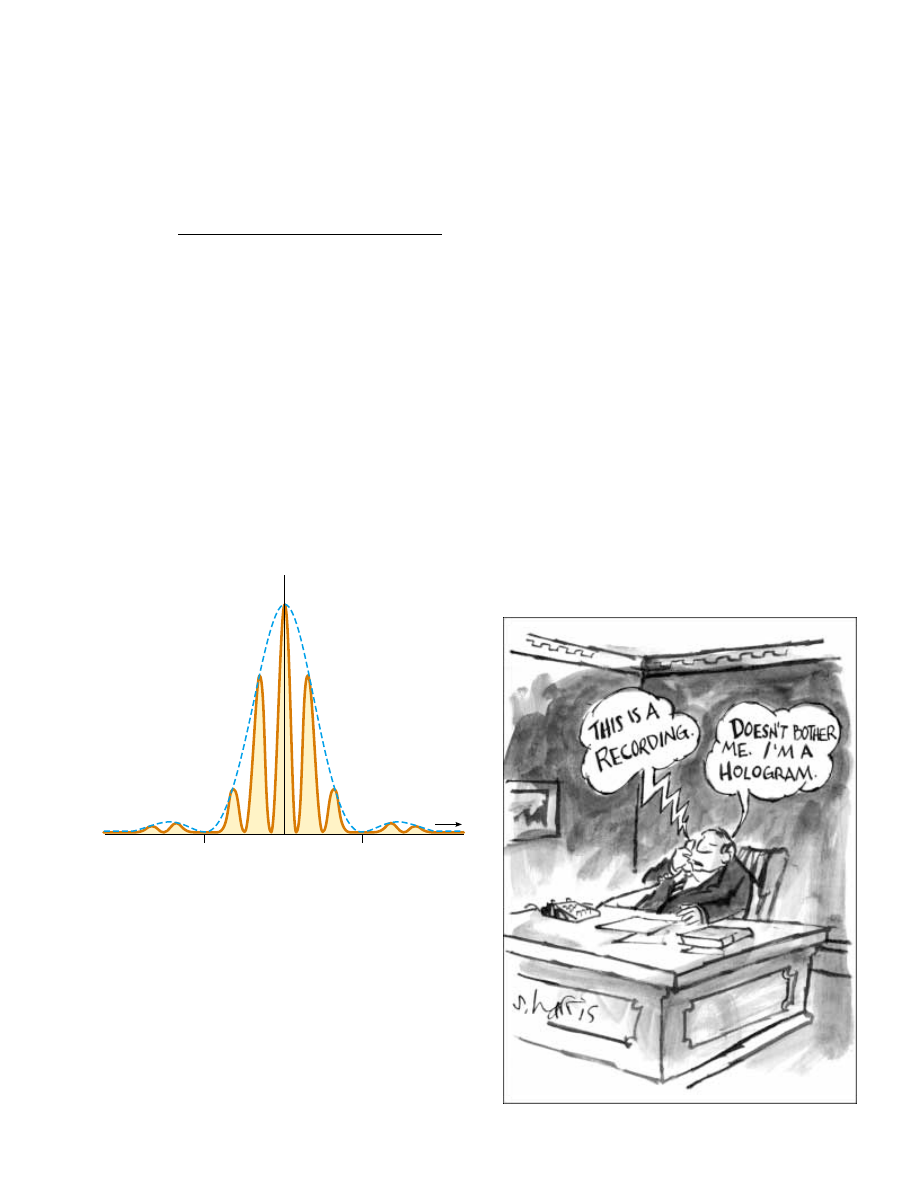
38.3 The situation is like that depicted in Figure 38.11 except

that now the slits are only half as far apart. The diffrac-
tion pattern is the same, but the interference pattern is
stretched out because is smaller. Because d/" 3, the
" 3  interference  maximum  coincides  with  the  first
diffraction  minimum.  Your  sketch  should  look  like  the
figure below.

π

I

/2

β

π

38.4 (c).  In  Equation  38.7,  the  ratio  d/is  independent  of

wavelength, so the number of interference fringes in the
central diffraction pattern peak remains the same. Equa-
tion 38.1 tells us that a decrease in wavelength causes a
decrease in the width of the central peak.

38.5 (b).  The  effective  slit  width  in  the  vertical  direction  of

the cat’s eye is larger than that in the horizontal direc-
tion. Thus, the eye has more resolving power for lights
separated  in  the  vertical  direction  and  would  be  more
effective at resolving the mast lights on the boat.

38.6 (a). We would like to reduce the minimum angular sepa-

ration  for  two  objects  below  the  angle  subtended  by  the
two stars in the binary system. We can do that by reducing
the  wavelength  of  the  light—this  in  essence  makes  the

© 

2003 by Sidney Harris

Modern Physics

t  the  end  of  the  nineteenth  century,  many  scientists  believed  that  they  had
learned most of what there was to know about physics. Newton’s laws of motion
and his  theory  of  universal  gravitation,  Maxwell’s  theoretical  work  in  unifying

electricity  and  magnetism,  the  laws  of  thermodynamics  and  kinetic  theory,  and  the
principles of optics were highly successful in explaining a variety of phenomena.

As  the  nineteenth century  turned  to  the  twentieth,  however,  a  major  revolution

shook the world of physics. In 1900 Planck provided the basic ideas that led to the
formulation  of  the  quantum  theory,  and  in  1905  Einstein  formulated  his  brilliant
special theory of relativity. The excitement of the times is captured in Einstein’s own
words:  “It  was  a  marvelous  time  to  be  alive.”  Both  ideas  were  to  have  a  profound
effect  on  our  understanding  of  nature.  Within  a  few  decades,  these  two  theories
inspired  new  developments  and  theories  in  the  fields  of  atomic  physics,  nuclear
physics, and condensed-matter physics.

In Chapter 39 we introduce the special theory of relativity. The theory provides us

with a new and deeper view of physical laws. Although the concepts underlying this
theory often violate our common sense, the theory correctly predicts the results of
experiments involving speeds near the speed of light. In the extended version of this
textbook, Physics for Scientists and Engineers with Modern Physics, we cover the
basic concepts of quantum mechanics and their application to atomic and molecular
physics, and we introduce solid-state physics, nuclear physics, particle physics, and
cosmology.

You  should  keep  in  mind  that,  although  the  physics  that  was  developed  during

the twentieth century has led to a multitude of important technological achievements,
the story is still incomplete. Discoveries will continue to evolve during our lifetimes,
and many of these discoveries will deepen or refine our understanding of nature and
the world around us. It is still a “marvelous time to be alive.”  

A

P A R T

6

!

A portion of the accelerator tunnel at Fermilab, near Chicago, Illinois. The tunnel is

circular and 1.9 km in diameter. Using electric and magnetic fields, protons and antiprotons
are accelerated to speeds close to that of light and then allowed to collide head-on, in order
to investigate the production of new particles. (Fermilab Photo)

1243

Chapter 39

Relativity

C H A P T E R   O U T L I N E

39.1 The Principle of Galilean

Relativity

39.2 The Michelson–Morley

Experiment

39.3 Einstein’s Principle of

Relativity

39.4 Consequences of the

Special Theory of Relativity

39.5 The Lorentz Transformation

Equations

39.6 The Lorentz Velocity

Transformation Equations

39.7 Relativistic Linear

Momentum and the
Relativistic Form of Newton’s
Laws

39.8 Relativistic Energy

39.9 Mass and Energy

39.10 The General Theory of

Relativity

1244

Standing on the shoulders of a giant. David Serway, son of one of the authors, watches

over his children, Nathan and Kaitlyn, as they frolic in the arms of Albert Einstein at the
Einstein memorial in Washington, D.C. It is well known that Einstein, the principal architect
of relativity, was very fond of children. (Emily Serway)


Content   ..  309  310  311  312   ..