Physics For Scientists And Engineers 6E - part 290
 

  Index      Production     Physics For Scientists And Engineers 6E


Search            


Content   ..  288  289  290  291   ..


Physics For Scientists And Engineers 6E - part 290


primary  colors,  our  eyes  can  be  made  to  see  any  color  in  the  rainbow.  Thus,  the
yellow  lemon  you  see  in  a  television  commercial  is  not  really  yellow,  it  is  red
and green!  The  paper  on  which  this  page  is  printed  is  made  of  tiny,  matted,
translucent fibers that scatter light in all directions; the resultant mixture of colors
appears white to the eye. Snow, clouds, and white hair are not really white. In fact,
there  is  no  such  thing  as  a  white  pigment.  The  appearance  of  these  things  is  a
consequence  of  the  scattering  of  light  containing  all  colors,  which  we  interpret  as
white.

Conditions of the Eye

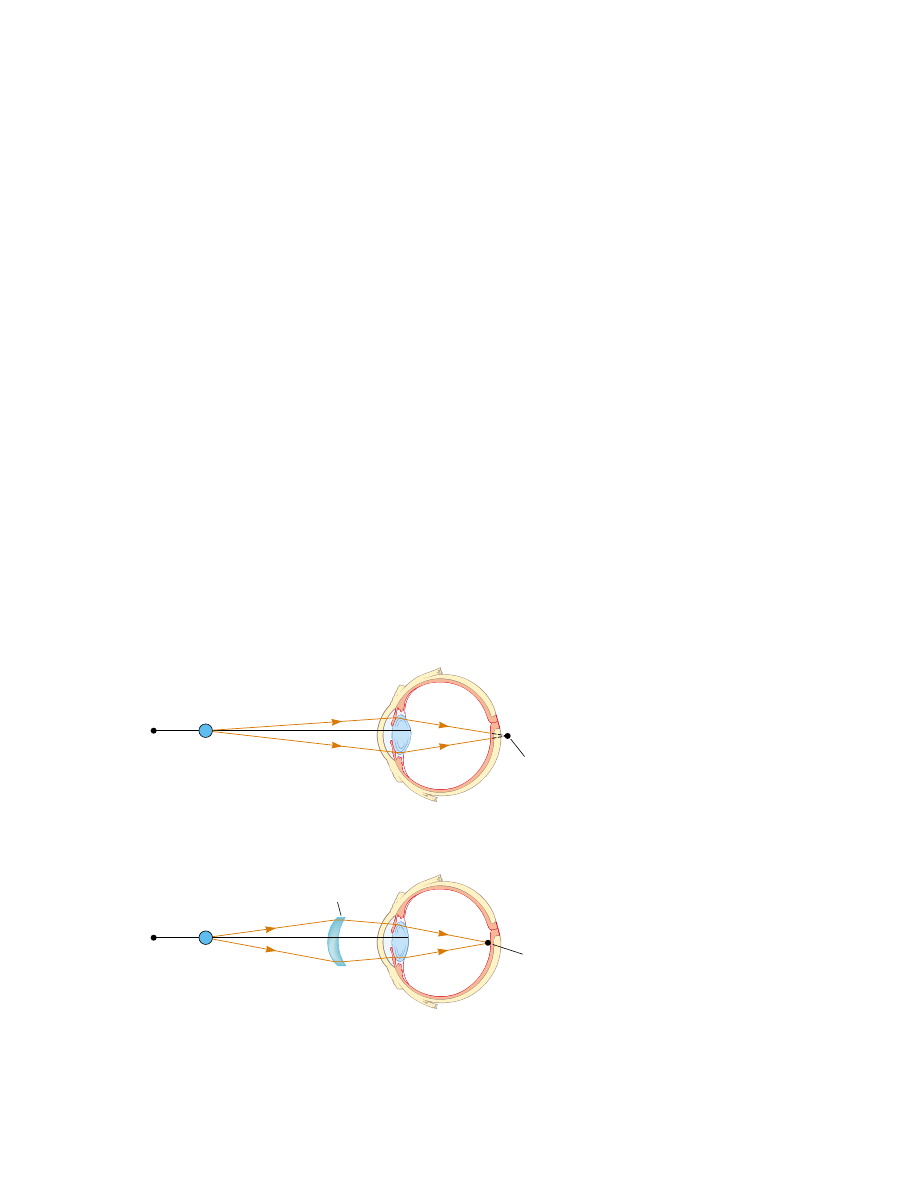
When  the  eye  suffers  a  mismatch  between  the  focusing  range  of  the  lens–cornea
system and the length of the eye, with the result that light rays from a near object reach
the retina before they converge to form an image, as shown in Figure 36.40a, the con-
dition is known as 

farsightedness (or hyperopia). A farsighted person can usually see

faraway objects clearly but not nearby objects. Although the near point of a normal eye
is  approximately  25 cm,  the  near  point  of  a  farsighted  person  is  much  farther  away.
The refracting power in the cornea and lens is insufficient to focus the light from all
but distant objects satisfactorily. The condition can be corrected by placing a converg-
ing lens in front of the eye, as shown in Figure 36.40b. The lens refracts the incoming
rays more toward the principal axis before entering the eye, allowing them to converge
and focus on the retina.

A  person  with 

nearsightedness (or  myopia),  another  mismatch  condition,  can

focus on nearby objects but not on faraway objects. The far point of the nearsighted
eye is not infinity and may be less than 1 m. The maximum focal length of the near-
sighted  eye  is  insufficient  to  produce  a  sharp  image  on  the  retina,  and  rays  from  a
distant  object  converge  to  a  focus  in  front  of  the  retina.  They  then  continue  past
that point,  diverging  before  they  finally  reach  the  retina  and  causing  blurred  vision

S E C T I O N   3 6 . 7 •  The Eye

1157

Converging

lens

Contracted

muscle

Image

behind retina

Image

at retina

(a)

(b)

Object

Near

point

Near

point

Object

Relaxed lens

Figure 36.40 (a) When a farsighted eye looks at an object located between the near

point and the eye, the image point is behind the retina, resulting in blurred vision. The

eye muscle contracts to try to bring the object into focus. (b) Farsightedness is cor-

rected with a converging lens.

(Fig.  36.41a).  Nearsightedness  can  be  corrected  with  a  diverging  lens,  as  shown  in
Figure 36.41b. The lens refracts the rays away from the principal axis before they enter
the eye, allowing them to focus on the retina.

Beginning in middle age, most people lose some of their accommodation ability as

the  ciliary  muscle  weakens  and  the  lens  hardens.  Unlike  farsightedness,  which  is  a
mismatch  between  focusing  power  and  eye  length, 

presbyopia (literally,  “old-age

vision”) is due to a reduction in accommodation ability. The cornea and lens do not
have  sufficient  focusing  power  to  bring  nearby  objects  into  focus  on  the  retina.  The
symptoms are the same as those of farsightedness, and the condition can be corrected
with converging lenses.

In the eye defect known as 

astigmatism, light from a point source produces a line

image on the retina. This condition arises when either the cornea or the lens or both
are not perfectly symmetric. Astigmatism can be corrected with lenses that have differ-
ent curvatures in two mutually perpendicular directions.

Optometrists  and  ophthalmologists  usually  prescribe  lenses

1

measured  in 

diopters:

the 

power of a lens in diopters equals the inverse of the focal length in meters: " 1/f.

For example, a converging lens of focal length & 20 cm has a power of & 5.0 diopters, and
a diverging lens of focal length $ 40 cm has a power of $ 2.5 diopters.

1158

C H A P T E R   3 6 •  Image Formation

(a)

(b)

Diverging

lens

Relaxed lens

Image in

front of retina

Image

at retina

Far point

Far point

Object

Object

1

The word lens comes from lentil, the name of an Italian legume. (You may have eaten lentil soup.)

Early  eyeglasses  were  called  “glass  lentils”  because  the  biconvex  shape  of  their  lenses  resembled  the
shape  of  a  lentil.  The  first  lenses  for  farsightedness  and  presbyopia  appeared  around  1280;  concave
eyeglasses for correcting nearsightedness did not appear for more than 100 years after that.

Figure 36.41 (a) When a nearsighted eye looks at an object that lies beyond the eye’s

far point, the image is formed in front of the retina, resulting in blurred vision.

(b) Nearsightedness is corrected with a diverging lens.

Quick  Quiz  36.11

Two  campers  wish  to  start  a  fire  during  the  day.  One

camper is nearsighted and one is farsighted. Whose glasses should be used to focus the
Sun’s  rays  onto  some  paper  to  start  the  fire?  (a)  either  camper  (b)  the  nearsighted
camper (c) the farsighted camper.

36.8 The Simple Magnifier

The  simple  magnifier  consists  of  a  single  converging  lens.  As  the  name  implies,  this
device increases the apparent size of an object.

Suppose  an  object  is  viewed  at  some  distance  from  the  eye,  as  illustrated  in

Figure 36.42. The size of the image formed at the retina depends on the angle # sub-
tended by the object at the eye. As the object moves closer to the eye, # increases and
a larger image is observed. However, an average normal eye cannot focus on an object
closer than about 25 cm, the near point (Fig. 36.43a). Therefore, # is maximum at the
near point.

To further increase the apparent angular size of an object, a converging lens can

be placed in front of the eye as in Figure 36.43b, with the object located at point O,
just  inside  the  focal  point  of  the  lens.  At  this  location,  the  lens  forms  a  virtual,
upright,  enlarged  image.  We  define 

angular  magnification as  the  ratio  of  the

angle subtended by an object with a lens in use (angle # in Fig. 36.43b) to the angle
subtended by the object placed at the near point with no lens in use (angle #

0

in Fig.

36.43a):

(36.20)

The angular magnification is a maximum when the image is at the near point of the
eye—that  is,  when  " $ 25 cm.  The  object  distance  corresponding  to  this  image

m 

#

#

0

S E C T I O N   3 6 . 8 •  The Simple Magnifier

1159

Example 36.15 A Case of Nearsightedness

We  use  a  negative  sign  for  the  image  distance  because  the
image is virtual and in front of the eye. As you should have
suspected, the lens must be a diverging lens (one with a neg-
ative focal length) to correct nearsightedness.

$

2.5 m

"

1
p

&

1

q

"

1

'

&

1

$

2.5 m

"

1
f

A  particular  nearsighted  person  is  unable  to  see  objects
clearly  when  they  are  beyond  2.5 m  away  (the  far  point  of
this  particular  eye).  What  should  the  focal  length  be  in  a
lens prescribed to correct this problem?

Solution The  purpose  of  the  lens  in  this  instance  is  to
“move” an object from infinity to a distance where it can be
seen  clearly.  This  is  accomplished  by  having  the  lens
produce  an  image  at  the  far  point.  From  the  thin  lens
equation, we have

θ

p

Figure 36.42 The size of the

image formed on the retina

depends on the angle 

#

subtended

at the eye.

θ

θ

25 cm

(a)

h

25 cm

h'

I

h

p

F O

θ

(b)

θ

0

θ

Figure 36.43 (a) An object

placed at the near point of the

eye (" 25 cm) subtends an

angle 

#

0

h/25 at the eye.

(b) An object placed near the

focal point of a converging

lens produces a magnified image

that subtends an angle 

#

h!/25 at the eye.

distance can be calculated from the thin lens equation:

where is the focal length of the magnifier in centimeters. If we make the small-angle
approximations

(36.21)

Equation 36.20 becomes

(36.22)

Although the eye can focus on an image formed anywhere between the near point

and infinity, it is most relaxed when the image is at infinity. For the image formed by
the magnifying lens to appear at infinity, the object has to be at the focal point of the
lens. In this case, Equations 36.21 become

and the magnification is

(36.23)

With a single lens, it is possible to obtain angular magnifications up to about 4 without
serious aberrations. Magnifications up to about 20 can be achieved by using one or two
additional lenses to correct for aberrations.

m

min

"

#

#


0

"

25 cm

f

#


0

#

h

25


and


#

#

h
f

m

max

"

1 &

25 cm

f

m

max

"

#

#


0

"

h/p

h/25

"

25

p

"

25

25f/(25 & f )

tan #


0

# #


0

#

h

25


and


tan #

# # #

h
p

"

25f

25 & f

1
p

&

1

$

25 cm

"

1
f

1160

C H A P T E R   3 6 •  Image Formation

A simple magnifier, also called a

magnifying glass, is used to view an

enlarged image of a portion of a

map.

Example 36.16 Maximum Magnification of a Lens

When the eye is relaxed, the image is at infinity. In this case,
we use Equation 36.23:

2.5

m

min

"

25 cm

f

"

25 cm
10 cm

"

What is the maximum magnification that is possible with a
lens having a focal length of 10 cm, and what is the magnifi-
cation of this lens when the eye is relaxed?

Solution The  maximum  magnification  occurs  when  the
image  is  located  at  the  near  point  of  the  eye.  Under  these
circumstances, Equation 36.22 gives

3.5

"

1 &

25 cm
10 cm

"

m

max

"

1 &

25 cm

f

36.9 The Compound Microscope

A  simple  magnifier  provides  only  limited  assistance  in  inspecting  minute  details  of
an object.  Greater  magnification  can  be  achieved  by  combining  two  lenses  in  a
device called  a 

compound  microscope, a  schematic  diagram  of  which  is  shown  in

Figure  36.44a.  It  consists  of  one  lens,  the  objective, that  has  a  very  short  focal
length f

o

*

1 cm  and  a  second  lens,  the  eyepiece, that  has  a  focal  length  f

e

of  a  few

George Semple


Content   ..  288  289  290  291   ..