Physics For Scientists And Engineers 6E - part 184
 

  Index      Production     Physics For Scientists And Engineers 6E


Search            


Content   ..  182  183  184  185   ..


Physics For Scientists And Engineers 6E - part 184


Problems

733

34.

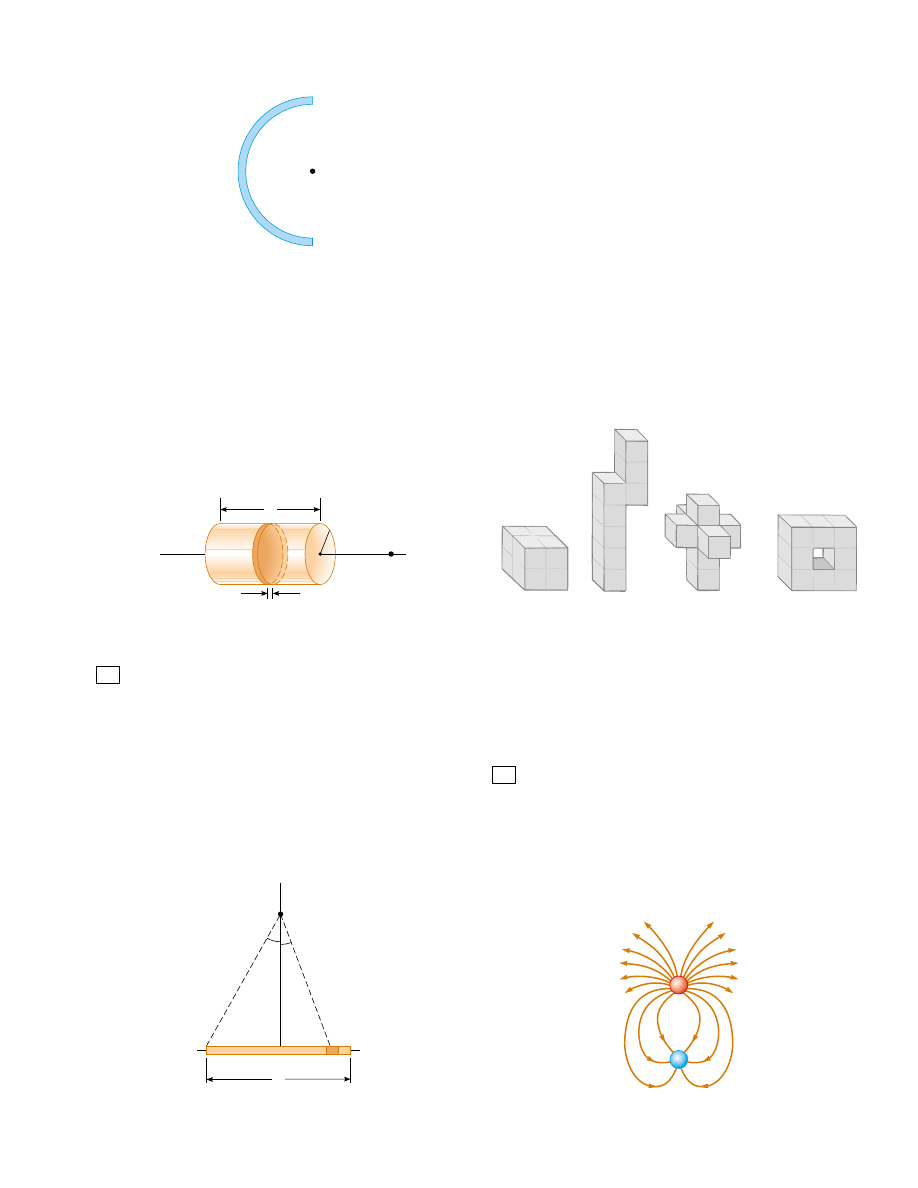
(a)  Consider  a  uniformly  charged  thin-walled  right  circu-
lar  cylindrical  shell  having  total  charge  ,  radius  R,  and
height h. Determine the electric field at a point a distance
from  the  right  side  of  the  cylinder  as  shown  in  Figure
P23.34.  (Suggestion: Use  the  result  of  Example  23.8  and
treat the cylinder as a collection of ring charges.) (b) What
If?  
Consider  now  a  solid  cylinder  with  the  same  dimen-
sions and carrying the same charge, uniformly distributed
through its volume. Use the result of Example 23.9 to find
the field it creates at the same point.

36. Three  solid  plastic  cylinders  all  have  radius  2.50 cm  and

length 6.00 cm. One (a) carries charge with uniform den-
sity  15.0 nC/m

2

everywhere  on  its  surface.  Another

(b) carries  charge  with  the  same  uniform  density  on  its
curved  lateral  surface  only.  The  third  (c)  carries  charge
with  uniform  density  500 nC/m

3

throughout  the  plastic.

Find the charge of each cylinder.

37. Eight  solid  plastic  cubes,  each  3.00 cm  on  each  edge,  are

glued together to form each one of the objects (i, ii, iii, and
iv) shown in Figure P23.37. (a) Assuming each object carries
charge  with  uniform  density  400 nC/m

3

throughout  its

volume, find the charge of each object. (b) Assuming each
object  carries  charge  with  uniform  density  15.0 nC/m

2

everywhere on its exposed surface, find the charge on each
object.  (c)  Assuming  charge  is  placed  only  on  the  edges
where  perpendicular  surfaces  meet,  with  uniform  density
80.0 pC/m, find the charge of each object.

Figure P23.33

Figure P23.34

Figure P23.35

O

R

d

dx

h

y

y

dx

x

P

O

!

θ

θ

0

θ

A thin rod of length ! and uniform charge per unit length
3

lies along the axis, as shown in Figure P23.35. (a) Show

that the electric field at P, a distance from the rod along
its  perpendicular  bisector,  has  no  component  and  is
given by ! 2k

e

3

sin +

0

/y. (b) What If? Using your result

to part (a), show that the field of a rod of infinite length is
! 2k

e

3

/y. (Suggestion: First calculate the field at due to

an  element  of  length  dx,  which  has  a  charge  3 dx. Then
change  variables  from  to  +,  using  the  relationships  !
tan + and dx sec

2

+

d+, and integrate over +.)

35.

Figure P23.37

(i)

(ii)

(iii)

(iv)

Section 23.6 Electric Field Lines

38. A  positively  charged  disk  has  a  uniform  charge  per  unit

area as described in Example 23.9. Sketch the electric field
lines  in  a  plane  perpendicular  to  the  plane  of  the  disk
passing through its center.
A  negatively  charged  rod  of  finite  length  carries  charge
with a uniform charge per unit length. Sketch the electric
field lines in a plane containing the rod.

40. Figure  P23.40  shows  the  electric  field  lines  for  two  point

charges  separated  by  a  small  distance.  (a)  Determine  the
ratio q

1

/q

2

. (b) What are the signs of q

1

and q

2

?

39.

q

2

q

1

Figure P23.40

734

C H A P T E R   2 3 •  Electric Fields

Three equal positive charges are at the corners of an

equilateral  triangle  of  side as  shown  in  Figure  P23.41.
(a) Assume that the three charges together create an electric
field. Sketch the field lines in the plane of the charges. Find
the  location  of  a  point  (other  than  4)  where  the  electric
field  is  zero.  (b)  What  are  the  magnitude  and  direction  of
the electric field at due to the two charges at the base?

41.

and  with  a  positive  charge  of  1.00 & 10

"

6

C  leaves  the

center of the bottom negative plate with an initial speed of
1.00 & 10

5

m/s at an angle of 37.0° above the horizontal.

Describe the trajectory of the particle. Which plate does it
strike? Where does it strike, relative to its starting point?

49.

Protons  are  projected  with  an  initial  speed  v

i

!

9.55 &

10

3

m/s  into  a  region  where  a  uniform  electric  field

E ! " 720 jˆ N/C is present, as shown in Figure P23.49. The
protons are to hit a target that lies at a horizontal distance
of  1.27 mm  from  the  point  where  the  protons  cross  the
plane  and  enter  the  electric  field  in  Figure  P23.49.  Find
(a) the two projection angles + that will result in a hit and
(b) the total time of flight (the time interval during which
the  proton  is  above  the  plane  in  Figure  P23.49)  for  each
trajectory.

Figure P23.52

q

q

a

q

a

a

P +

+

+

Figure P23.41

Figure P23.49

ˆ

θ

v

i

1.27 mm

Target

E = (–720 j) N/C

×

Proton

beam

0.800 m

y

3.00 nC

5.00 nC

0.500 m

– 4.00 nC

x

Section 23.7 Motion of Charged Particles 

in a Uniform Electric Field

42. An  electron  and  a  proton  are  each  placed  at  rest  in  an

electric field of 520 N/C. Calculate the speed of each par-
ticle 48.0 ns after being released.
A  proton  accelerates  from  rest  in  a  uniform  electric  field
of 640 N/C. At some later time, its speed is 1.20 & 10

6

m/s

(nonrelativistic,  because  is  much  less  than  the  speed
of light). (a) Find the acceleration of the proton. (b) How
long does it take the proton to reach this speed? (c) How
far has it moved in this time? (d) What is its kinetic energy
at this time?

44. A  proton  is  projected  in  the  positive  direction  into  a

region  of  a  uniform  electric  field  ! " 6.00 & 10

5

iˆ N/C

at ! 0. The proton travels 7.00 cm before coming to rest.
Determine (a) the acceleration of the proton, (b) its initial
speed, and (c) the time at which the proton comes to rest.

The electrons in a particle beam each have a kinetic

energy  K.  What  are  the  magnitude  and  direction  of  the
electric field that will stop these electrons in a distance ?

46.

A  positively  charged  bead  having  a  mass  of  1.00 g  falls
from  rest  in  a  vacuum  from  a  height  of  5.00 m  in  a  uni-
form  vertical  electric  field  with  a  magnitude  of  1.00 &
10

4

N/C. The bead hits the ground at a speed of 21.0 m/s.

Determine  (a)  the  direction  of  the  electric  field  (up  or
down), and (b) the charge on the bead.
A proton moves at 4.50 & 10

5

m/s in the horizontal direc-

tion. It enters a uniform vertical electric field with a magni-
tude of 9.60 & 10

3

N/C. Ignoring any gravitational effects,

find (a) the time interval required for the proton to travel
5.00 cm  horizontally,  (b)  its  vertical  displacement  during
the  time  interval  in  which  it  travels  5.00 cm  horizontally,
and  (c)  the  horizontal  and  vertical  components  of  its  ve-
locity after it has traveled 5.00 cm horizontally.

48.

Two  horizontal  metal  plates,  each  100 mm  square,  are
aligned 10.0 mm apart, with one above the other. They are
given  equal-magnitude  charges  of  opposite  sign  so  that  a
uniform downward electric field of 2 000 N/C exists in the
region  between  them.  A  particle  of  mass  2.00 & 10

"

16

kg

47.

45.

43.

Additional Problems

50.

Two  known  charges,  " 12.0 *C  and  45.0 *C,  and  an
unknown  charge  are  located  on  the  axis.  The  charge
"

12.0 *C is at the origin, and the charge 45.0 *C is at !

15.0 cm. The unknown charge is to be placed so that each
charge  is  in  equilibrium  under  the  action  of  the  electric
forces exerted by the other two charges. Is this situation pos-
sible? Is it possible in more than one way? Find the required
location, magnitude, and sign of the unknown charge.

51.

A  uniform  electric  field  of  magnitude  640 N/C  exists
between two parallel plates that are 4.00 cm apart. A proton
is  released  from  the  positive  plate  at  the  same  instant  that
an  electron  is  released  from  the  negative  plate.  (a)  Deter-
mine the distance from the positive plate at which the two
pass  each  other.  (Ignore  the  electrical  attraction  between
the proton and electron.) (b) What If? Repeat part (a) for a
sodium ion (Na

#

) and a chloride ion (Cl

"

).

52.

Three point charges are aligned along the axis as shown
in Figure P23.52. Find the electric field at (a) the position
(2.00, 0) and (b) the position (0, 2.00).

Problems

735

53.

A researcher studying the properties of ions in the upper
atmosphere wishes to construct an apparatus with the fol-
lowing  characteristics:  Using  an  electric  field,  a  beam
of ions, each having charge q, mass m, and initial velocity
v,  is  turned  through  an  angle  of  90° as  each  ion  under-
goes displacement Riˆ . The ions enter a chamber as
shown  in  Figure  P23.53,  and  leave  through  the  exit  port
with  the  same  speed  they  had  when  they  entered  the
chamber.  The  electric  field  acting  on  the  ions  is  to  have
constant magnitude. (a) Suppose the electric field is pro-
duced by two concentric cylindrical electrodes not shown
in  the  diagram,  and  hence  is  radial.  What  magnitude
should the field have? What If? (b) If the field is produced
by  two  flat  plates  and  is  uniform  in  direction,  what  value
should the field have in this case?

the  angle  +.  Find  (a)  the  charge  on  the  ball  and  (b)  the
tension in the string.

Figure P23.53

Figure P23.54

+

R

R

y

x

v

v

y

x

15.0

°

20.0 cm

m = 2.00 g

E = 1.00 

× 10

3

i N/C

ˆ

x

y

E

q

θ

Figure P23.55 Problems 55 and 56.

Figure P23.58

54.

A small, 2.00-g plastic ball is suspended by a 20.0-cm-long
string  in  a  uniform  electric  field  as  shown  in  Figure
P23.54. If the ball is in equilibrium when the string makes
a  15.0° angle  with  the  vertical,  what  is  the  net  charge  on
the ball?

q

q

q

q

y

x

L

W

Figure P23.57

58.

Inez is putting up decorations for her sister’s quinceañera
(fifteenth birthday party). She ties three light silk ribbons
together  to  the  top  of  a  gateway  and  hangs  a  rubber  bal-
loon  from  each  ribbon  (Fig.  P23.58).  To  include  the

57.

Four  identical  point  charges  (! # 10.0 *C)  are  located
on  the  corners  of  a  rectangle  as  shown  in  Figure  P23.57.
The  dimensions  of  the  rectangle  are  ! 60.0 cm  and
! 15.0 cm.  Calculate  the  magnitude  and  direction  of
the  resultant  electric  force  exerted  on  the  charge  at  the
lower left corner by the other three charges.

A charged cork ball of mass 1.00 g is suspended on a

light  string  in  the  presence  of  a  uniform  electric  field
as shown  in  Figure  P23.55.  When    ! (3.00iˆ # 5.00) &
10

5

N/C,  the  ball  is  in  equilibrium  at  + ! 37.0°.  Find

(a) the charge on the ball and (b) the tension in the string.
A  charged  cork  ball  of  mass  m  is  suspended  on  a  light
string in the presence of a uniform electric field as shown
in  Figure  P23.55.  When    ! (Aiˆ B) N/C,    where  A
and are  positive  numbers,  the  ball  is  in  equilibrium  at

56.

55.

736

C H A P T E R   2 3 •  Electric Fields

effects of the gravitational and buoyant forces on it, each
balloon can be modeled as a particle of mass 2.00 g, with
its center 50.0 cm from the point of support. To show off
the colors of the balloons, Inez rubs the whole surface of
each  balloon  with  her  woolen  scarf,  to  make  them  hang
separately  with  gaps  between  them.  The  centers  of  the
hanging  balloons  form  a  horizontal  equilateral  triangle
with sides 30.0 cm long. What is the common charge each
balloon carries?

59.

Review problem. Two identical metallic blocks resting on a
frictionless  horizontal  surface  are  connected  by  a  light
metallic  spring  having  a  spring  constant  as  shown  in 
Figure  P23.59a  and  an  unstretched  length  L

i

.  A  total

charge is slowly placed on the system, causing the spring
to stretch to an equilibrium length L, as shown in Figure
P23.59b. Determine the value of , assuming that all the
charge  resides  on  the  blocks  and  modeling  the  blocks  as
point charges.

62.

Two small spheres, each of mass 2.00 g, are suspended by
light  strings  10.0 cm  in  length  (Fig.  P23.62).  A  uniform
electric  field  is  applied  in  the  direction.  The  spheres
have  charges  equal  to  " 5.00 & 10

"

8

C  and  # 5.00 &

10

"

8

C.  Determine  the  electric  field  that  enables  the

spheres to be in equilibrium at an angle + ! 10.0°.

Figure P23.59

(a)

(b)

m

m

k

m

m

k

60.

Consider  a  regular  polygon  with  29  sides.  The  distance
from the center to each vertex is a. Identical charges are
placed at 28 vertices of the polygon. A single charge  is
placed at the center of the polygon. What is the magnitude
and  direction  of  the  force  experienced  by  the  charge
? (Suggestion: You  may  use  the  result  of  Problem  63  in
Chapter 3.)

61.

Identical  thin  rods  of  length  2carry  equal  charges  # Q
uniformly  distributed  along  their  lengths.  The  rods  lie
along the axis with their centers separated by a distance
- 2(Fig. P23.61). Show that the magnitude of the force
exerted by the left rod on the right one is given by

!

&

k

e

Q


2

4a


2

'

 ln 

&

b

2

b

2

"

4a


2

'

b

y

a

a

 a

+ a

x

Figure P23.61

Figure P23.62

θ

E

θ

+

63.

A line of positive charge is formed into a semicircle of ra-
dius  ! 60.0 cm  as  shown  in  Figure  P23.63.  The  charge
per unit length along the semicircle is described by the ex-
pression 3 ! 3

0

cos +. The total charge on the semicircle is

12.0 *C. Calculate the total force on a charge of 3.00 *C
placed at the center of curvature.

Figure P23.63

y

R

x

θ

64.

Three charges of equal magnitude are fixed in posi-

tion at the vertices of an equilateral triangle (Fig. P23.64).
A fourth charge is free to move along the positive axis

x

+Q

+q

+q

q

a

2

a

2

s

r

a

θ

y

a   3

2

Figure P23.64


Content   ..  182  183  184  185   ..