Physics For Scientists And Engineers 6E - part 125
S E C T I O N 16 . 3 • The Speed of Waves on Strings
497
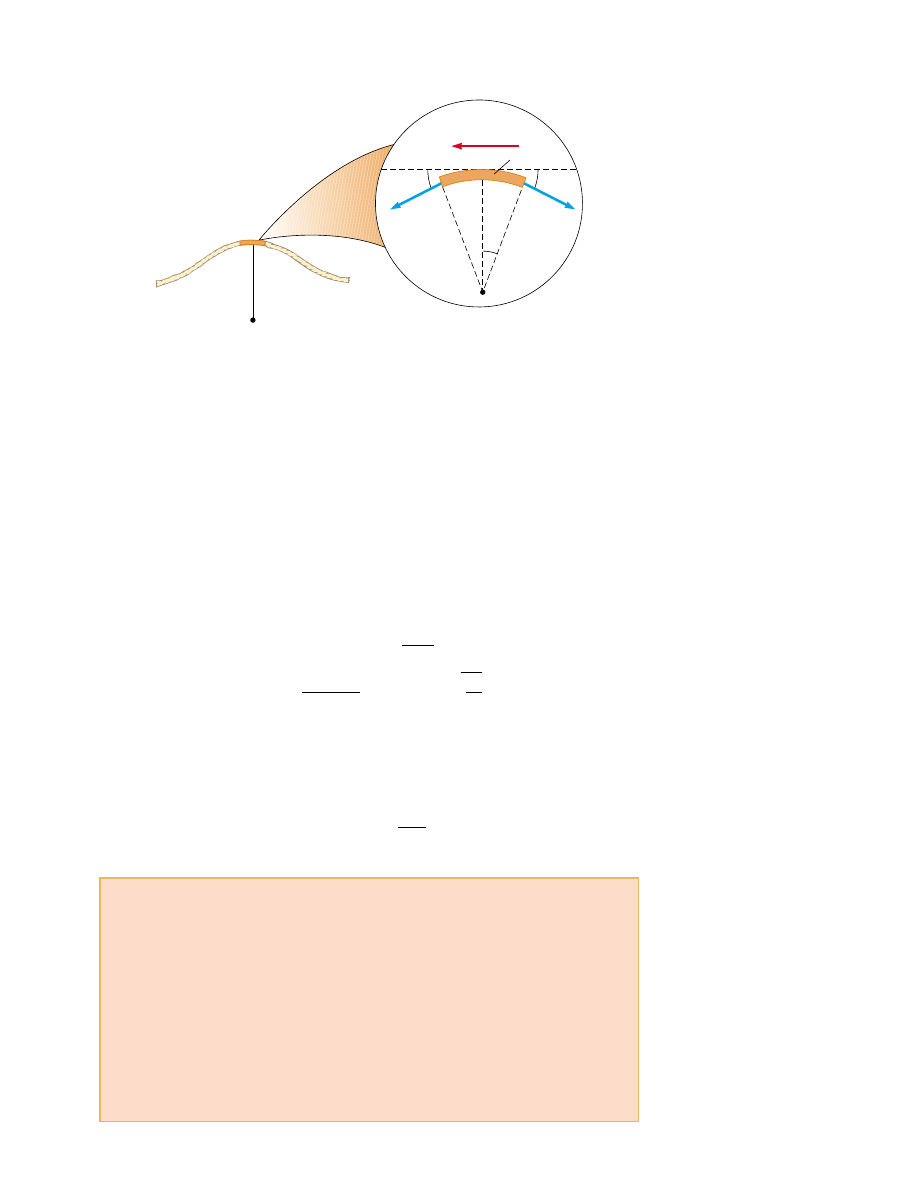
radial force on the element is 2T sin $. Because the element is small, $ is small, and we
can use the small-angle approximation sin $
& $. Therefore, the total radial force is
F
r
!
2T sin $
& 2T$
The element has a mass m ! + ,s. Because the element forms part of a circle and sub-
tends an angle 2$ at the center, ,s ! R(2$), we find that
m ! + ,s ! 2+R$
If we apply Newton’s second law to this element in the radial direction, we have
This expression for v is Equation 16.18.
Notice that this derivation is based on the assumption that the pulse height is small
relative to the length of the string. Using this assumption, we were able to use the approxi-
mation sin $
& $. Furthermore, the model assumes that the tension T is not affected by
the presence of the pulse; thus, T is the same at all points on the string. Finally, this proof
does not assume any particular shape for the pulse. Therefore, we conclude that a pulse of
any shape travels along the string with speed
without any change in pulse shape.
v !
√
T/+
2T
$ !
2+R
$
v
2
R
9:
v !
√
T
+
F
r
!
ma !
mv
2
R
∆s
R
O
(a)
(b)
O
v
θ
∆s
θ
R
θ
T
T
Figure 16.11 (a) To obtain the speed v of a wave on a stretched string, it is convenient
to describe the motion of a small element of the string in a moving frame of reference.
(b) In the moving frame of reference, the small element of length ,s moves to the left
with speed v. The net force on the element is in the radial direction because the hori-
zontal components of the tension force cancel.
Quick Quiz 16.7
Suppose you create a pulse by moving the free end of a taut
string up and down once with your hand beginning at t ! 0. The string is attached at its
other end to a distant wall. The pulse reaches the wall at time t. Which of the following
actions, taken by itself, decreases the time interval that it takes for the pulse to reach the
wall? More than one choice may be correct. (a) moving your hand more quickly, but still
only up and down once by the same amount (b) moving your hand more slowly, but still
only up and down once by the same amount (c) moving your hand a greater distance
up and down in the same amount of time (d) moving your hand a lesser distance up
and down in the same amount of time (e) using a heavier string of the same length and
under the same tension (f) using a lighter string of the same length and under the same
tension (g) using a string of the same linear mass density but under decreased tension
(h) using a string of the same linear mass density but under increased tension