Physics For Scientists And Engineers 6E - part 96
 

  Index      Production     Physics For Scientists And Engineers 6E


Search            


Content   ..  94  95  96  97   ..


Physics For Scientists And Engineers 6E - part 96


Problems

381

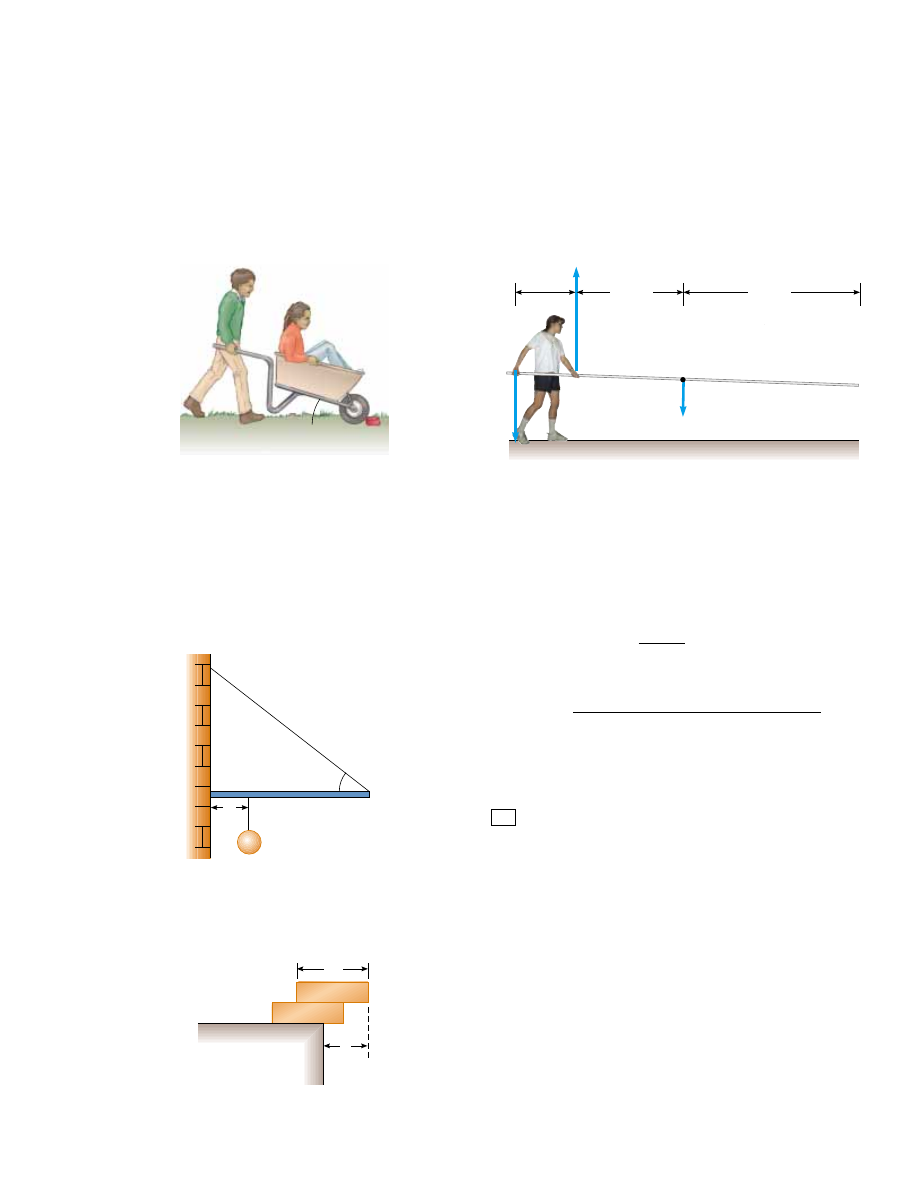
23.

One end of a uniform 4.00-m-long rod of weight F

g

is sup-

ported  by  a  cable.  The  other  end  rests  against  the  wall,
where it is held by friction, as in Figure P12.23. The coeffi-
cient of static friction between the wall and the rod is +

s

!

0.500. Determine the minimum distance from point at
which  an  additional  weight  F

g

(the  same  as  the  weight  of

the  rod)  can  be  hung  without  causing  the  rod  to  slip  at
point A.

24.

Two  identical  uniform  bricks  of  length  are  placed  in  a
stack over the edge of a horizontal surface with the maxi-

mum  overhang  possible  without  falling,  as  in  Figure
P12.24. Find the distance x.

25. A vaulter holds a 29.4-N pole in equilibrium by exerting an

upward  force  with  her  leading  hand  and  a  downward
force with her trailing hand, as shown in Figure P12.25.
Point is the center of gravity of the pole. What are the
magnitudes of and D?

x

L

Figure P12.24

2.25 m

0.750 m

A

1.50 m

U

D

B

C

F

g

Figure P12.25

The  handles  make  an  angle  of  15.0° below  the  horizon-
tal. A downward force of 400 N is exerted on the wheel,
which  has  a  radius  of  20.0 cm.  (a)  What  force  must
Stephen apply along the handles in order to just start the
wheel  over  the  brick?  (b)  What  is  the  force  (magnitude
and direction) that the brick exerts on the wheel just as
the  wheel  begins  to  lift  over  the  brick?  Assume  in  both
parts  that  the  brick  remains  fixed  and  does  not  slide
along the ground.

B

x

A

37.0

°

F

g

Figure P12.23

Figure P12.22

15.0

°

26.

In  the  What  If? section  of  Example  12.3,  let  represent
the distance in meters between the person and the hinge
at  the  left  end  of  the  beam.  (a)  Show  that  the  cable  ten-
sion in newtons is given by ! 93.9$ 125. Argue that T
increases as increases. (b) Show that the direction angle
)

of the hinge force is described by

How does ) change as increases? (c) Show that the mag-
nitude of the hinge force is given by

How does change as increases?

Section 12.4 Elastic Properties of Solids

A 200-kg load is hung on a wire having a length of 4.00 m,
cross-sectional  area  0.200 - 10

'

4

m

2

,  and  Young’s  modu-

lus 8.00 - 10

10

N/m

2

. What is its increase in length?

28. Assume  that  Young’s  modulus  is  1.50 - 10

10

N/m

2

for

bone and that the bone will fracture if stress greater than
1.50 - 10

8

N/m

2

is  imposed  on  it.  (a)  What  is  the  maxi-

mum force that can be exerted on the femur bone in the
leg  if  it  has  a  minimum  effective  diameter  of  2.50 cm?
(b) If  this  much  force  is  applied  compressively,  by  how
much does the 25.0-cm-long bone shorten?

29. Evaluate  Young’s  modulus  for  the  material  whose  stress-

versus-strain curve is shown in Figure 12.15.

30. A  steel  wire  of  diameter  1 mm  can  support  a  tension  of

0.2 kN. A cable to support a tension of 20 kN should have
diameter of what order of magnitude?

31. A  child  slides  across  a  floor  in  a  pair  of  rubber-soled

shoes.  The  friction  force  acting  on  each  foot  is  20.0 N.

27.

!

8.82 - 10

3

x

2

'

9.65 - 10

4

$ 4.96 - 10

5

tan ) !

"

32

3$ 4

'

1

#

 tan 53.0*

382

C H A P T E R   1 2 •  Static Equilibrium and Elasticity

The  footprint  area  of  each  shoe  sole  is  14.0 cm

2

,  and

the thickness of each sole is 5.00 mm. Find the horizontal
distance  by  which  the  upper  and  lower  surfaces  of  each
sole  are  offset.  The  shear  modulus  of  the  rubber  is
3.00 MN/m

2

.

32.

Review problem. A 30.0-kg hammer strikes a steel spike
2.30 cm in diameter while moving with speed 20.0 m/s.
The  hammer  rebounds  with  speed  10.0 m/s  after
0.110 s.  What  is  the  average  strain  in  the  spike  during
the impact?

If the shear stress in steel exceeds 4.00 - 10

8

N/m

2

,

the steel ruptures. Determine the shearing force necessary
to  (a)  shear  a  steel  bolt  1.00 cm  in  diameter  and
(b) punch  a  1.00-cm-diameter  hole  in  a  steel  plate
0.500 cm thick.

34.

Review problem. A 2.00-m-long cylindrical steel wire with a
cross-sectional diameter of 4.00 mm is placed over a light
frictionless pulley, with one end of the wire connected to a
5.00-kg  object  and  the  other  end  connected  to  a  3.00-kg
object.  By  how  much  does  the  wire  stretch  while  the  ob-
jects are in motion?

When  water  freezes,  it  expands  by  about  9.00%.  What

pressure increase would occur inside your automobile en-
gine block if the water in it froze? (The bulk modulus of
ice is 2.00 - 10

9

N/m

2

.)

36. The deepest point in the ocean is in the Mariana Trench,

about  11 km  deep.  The  pressure  at  this  depth  is  huge,
about  1.13 - 10

8

N/m

2

.  (a)  Calculate  the  change  in  vol-

ume of 1.00 m

3

of seawater carried from the surface to this

deepest point in the Pacific ocean. (b) The density of sea-
water  at  the  surface  is  1.03 - 10

3

kg/m

3

.  Find  its  density

at the bottom. (c) Is it a good approximation to think of
water as incompressible?

37.

A walkway suspended across a hotel lobby is supported at
numerous points along its edges by a vertical cable above
each  point  and  a  vertical  column  underneath.  The  steel
cable  is  1.27 cm  in  diameter  and  is  5.75 m  long  before
loading. The aluminum column is a hollow cylinder with
an  inside  diameter  of  16.14 cm,  an  outside  diameter  of
16.24 cm, and unloaded length of 3.25 m. When the walk-
way exerts a load force of 8 500 N on one of the support
points, how much does the point move down?

Additional Problems

38.

A lightweight, rigid beam 10.0 m long is supported by a ca-
ble attached to a spring of force constant ! 8.25 kN/m
as shown in Figure P12.38. When no load is hung on the
beam  (F

g

!

0),  the  length  is  equal  to  5.00 m.  (a)  Find

the angle ) in this situation. (b) Now a load of F

g

!

250 N

is  hung  on  the  end  of  the  beam.  Temporarily  ignore  the
extension of the spring and the change in the angle ). Cal-
culate  the  tension  in  the  cable  with  this  approximation.
(c) Use the answer to part (b) to calculate the spring elon-
gation and a new value for the angle ). (d) With the value
of  ) from  part  (c),  find  a  second  approximation  for  the
tension in the cable. (e) Use the answer to part (d) to cal-
culate  more  precise  values  for  the  spring  elongation  and

35.

33.

40.

Refer to Figure 12.18(c). A lintel of prestressed reinforced
concrete  is  1.50 m  long.  The  cross-sectional  area  of  the
concrete is 50.0 cm

2

. The concrete encloses one steel rein-

forcing  rod  with  cross-sectional  area  1.50 cm

2

.  The  rod

joins two strong end plates. Young’s modulus for the con-
crete is 30.0 - 10

9

N/m

2

. After the concrete cures and the

original tension T

1

in the rod is released, the concrete is to

be under compressive stress 8.00 - 10

6

N/m

2

. (a) By what

distance will the rod compress the concrete when the orig-
inal tension in the rod is released? (b) The rod will still be
under  what  tension  T

2

?  (c)  The  rod  will  then  be  how

much  longer  than  its  unstressed  length?  (d)  When  the
concrete was poured, the rod should have been stretched
by  what  extension  distance  from  its  unstressed  length?
(e) Find the required original tension T

1

in the rod.

3.00 m

7.00 m

4.00 m

L

θ

F

g

Figure P12.38

A

B

15.0 m

50.0 m

Figure P12.39

A  bridge  of  length  50.0 m  and  mass  8.00 - 10

4

kg  is  sup-

ported on a smooth pier at each end as in Figure P12.39. A
truck  of  mass  3.00 - 10

4

kg  is  located  15.0 m  from  one

end.  What  are  the  forces  on  the  bridge  at  the  points  of
support? 

39.

the angle ). (f) To three-digit precision, what is the actual
value of ) under load?

Problems

383

41.

A uniform pole is propped between the floor and the ceil-
ing of a room. The height of the room is 7.80 ft, and the
coefficient of static friction between the pole and the ceil-
ing is 0.576. The coefficient of static friction between the
pole and the floor is greater than that. What is the length
of the longest pole that can be propped between the floor
and the ceiling?

42.

A  solid  sphere  of  radius  and  mass  is  placed  in  a
trough  as  shown  in  Figure  P12.42.  The  inner  surfaces  of
the  trough  are  frictionless.  Determine  the  forces  exerted
by the trough on the sphere at the two contact points.

43.

A hungry bear weighing 700 N walks out on a beam in an
attempt to retrieve a basket of food hanging at the end of
the  beam  (Fig.  P12.43).  The  beam  is  uniform,  weighs
200 N,  and  is  6.00 m  long;  the  basket  weighs  80.0 N.
(a) Draw  a  free-body  diagram  for  the  beam.  (b)  When
the bear is at ! 1.00 m, find the tension in the wire and
the  components  of  the  force  exerted  by  the  wall  on  the
left  end  of  the  beam.  (c)  What  If? If  the  wire  can  with-
stand  a  maximum  tension  of  900 N,  what  is  the  maxi-
mum distance the bear can walk before the wire breaks?

44.

A farm gate (Fig. P12.44) is 3.00 m wide and 1.80 m high,
with hinges attached to the top and bottom. The guy wire
makes  an  angle  of  30.0° with  the  top  of  the  gate  and  is
tightened by a turnbuckle to a tension of 200 N. The mass
of  the  gate  is  40.0 kg.  (a)  Determine  the  horizontal  force
exerted by the bottom hinge on the gate. (b) Find the hori-
zontal force exerted by the upper hinge. (c) Determine the
combined vertical force exerted by both hinges. (d) What
If? 
What  must  be  the  tension  in  the  guy  wire  so  that  the
horizontal force exerted by the upper hinge is zero?

d

θ

2L

Figure P12.45

Figure P12.46

Figure P12.44

30.0

°

3.00 m

1.80 m

25

°

65

°

2000 N

!

3

4

!

A  uniform  sign  of  weight  F

g

and  width  2hangs

from a light, horizontal beam, hinged at the wall and sup-
ported  by  a  cable  (Fig.  P12.45).  Determine  (a)  the  ten-
sion in the cable and (b) the components of the reaction
force exerted by the wall on the beam, in terms of F

g

d,

L, and ).

45.

α

β

Figure P12.42

Figure P12.43

60.0

°

x

Goodies

46.

A  1 200-N  uniform  boom  is  supported  by  a  cable  as  in
Figure P12.46. The boom is pivoted at the bottom, and a
2 000-N object hangs from its top. Find the tension in the
cable and the components of the reaction force exerted by
the floor on the boom.

384

C H A P T E R   1 2 •  Static Equilibrium and Elasticity

10 000 kg

(3 000 kg)g

B

A

2.00 m

6.00 m

1.00 m

Figure P12.47

60.0

°

10 000 N

20.0

°

Figure P12.49

Figure P12.50

and 

R is the force exerted by the tibia on the foot. Find

the values of T, R, and ) when F

g

!

700 N.

15.0

°

R

T

90.0

°

25.0 cm

(b)


θ

18.0 cm

n

Achilles

tendon

Tibia

(a)

R

y

R

x

T

12.0

°

200 N

350 N

Pivot

Back muscle

(a)

(b)

Figure P12.51

47.

A crane of mass 3 000 kg supports a load of 10 000 kg as in
Figure P12.47. The crane is pivoted with a frictionless pin
at and rests against a smooth support at B. Find the reac-
tion forces at and B.

48.

A ladder of uniform density and mass rests against a fric-
tionless  vertical  wall,  making  an  angle  of  60.0° with  the
horizontal. The lower end rests on a flat surface where the
coefficient  of  static  friction  is  +

s

!

0.400.  A  window

cleaner  with  mass  ! 2attempts  to  climb  the ladder.
What fraction of the length of the ladder will the worker
have reached when the ladder begins to slip?

A  10 000-N  shark  is  supported  by  a  cable  attached  to

a 4.00-m  rod  that  can  pivot  at  the  base.  Calculate  the
tension in the tie-rope between the rod and the wall if it is
holding the system in the position shown in Figure P12.49.
Find the horizontal and vertical forces exerted on the base
of the rod. (Neglect the weight of the rod.)

49.

50.

When  a  person  stands  on  tiptoe  (a  strenuous  position),
the position of the foot is as shown in Figure P12.50a. The
gravitational  force  on  the  body 

F

g

is  supported  by  the

force 

n exerted  by  the  floor  on  the  toe.  A  mechanical

model for the situation is shown in Figure P12.50b, where

T is the force exerted by the Achilles tendon on the foot

51.

A  person  bending  forward  to  lift  a  load  “with  his  back”
(Fig. P12.51a) rather than “with his knees” can be injured
by large forces exerted on the muscles and vertebrae. The
spine  pivots  mainly  at  the  fifth  lumbar  vertebra,  with  the
principal supporting force provided by the erector spinalis
muscle in the back. To see the magnitude of the forces in-
volved,  and  to  understand  why  back  problems  are  com-
mon among humans, consider the model shown in Figure
P12.51b  for  a  person  bending  forward  to  lift  a  200-N  ob-
ject. The spine and upper body are represented as a uni-
form  horizontal  rod  of  weight  350 N,  pivoted  at  the  base
of  the  spine.  The  erector  spinalis  muscle,  attached  at  a


Content   ..  94  95  96  97   ..