Physics For Scientists And Engineers 6E - part 85
T
he central topic of this chapter is angular momentum, a quantity that plays a key
role in rotational dynamics. In analogy to the principle of conservation of linear mo-
mentum, we find that the angular momentum of a system is conserved if no external
torques act on the system. Like the law of conservation of linear momentum, the law of
conservation of angular momentum is a fundamental law of physics, equally valid for
relativistic and quantum systems.
11.1 The Vector Product and Torque
An important consideration in defining angular momentum is the process of multiply-
ing two vectors by means of the operation called the vector product. We will introduce
the vector product by considering torque as introduced in the preceding chapter.
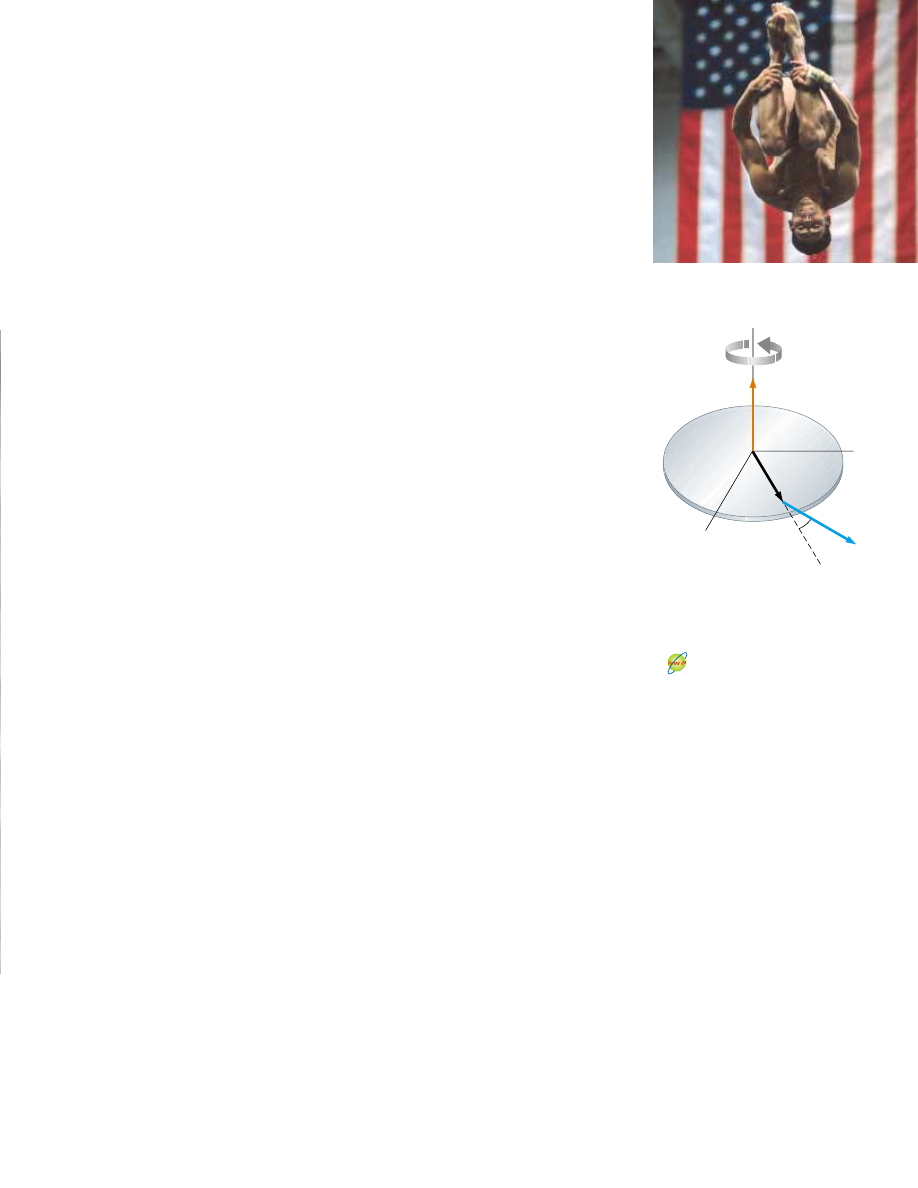
Consider a force
F acting on a rigid object at the vector position r (Fig. 11.1). As we
saw in Section 10.6, the magnitude of the torque due to this force relative to the origin
is r F sin !, where ! is the angle between
r and F. The axis about which F tends to pro-
duce rotation is perpendicular to the plane formed by
r and F.
The torque vector ! is related to the two vectors
r and F. We can establish a mathe-
matical relationship between !,
r, and F using a mathematical operation called the
vector product, or cross product:
!
! r " F
(11.1)
We now give a formal definition of the vector product. Given any two vectors
A and
B, the vector product A " B is defined as a third vector C, which has a magnitude of
AB sin ", where " is the angle between
A
and
B. That is, if C is given by
C # A " B
(11.2)
then its magnitude is
C
! AB sin "
(11.3)
The quantity AB sin " is equal to the area of the parallelogram formed by
A and B, as
shown in Figure 11.2. The direction of
C is perpendicular to the plane formed by A and
B, and the best way to determine this direction is to use the right-hand rule illustrated
in Figure 11.2. The four fingers of the right hand are pointed along
A and then
“wrapped” into
B through the angle ". The direction of the upright thumb is the direc-
tion of
A " B # C. Because of the notation, A " B is often read “A cross B”; hence,
the term cross product.
Some properties of the vector product that follow from its definition are as follows:
1. Unlike the scalar product, the vector product is not commutative. Instead, the or-
der in which the two vectors are multiplied in a cross product is important:
A " B # $ B " A
(11.4)
337
O
r
P
φ
x
F
y
τ
=
r
×
F
z
τ
Active Figure 11.1 The torque
vector
!
lies in a direction perpen-
dicular to the plane formed by the
position vector r and the applied
force vector F.
At the Active Figures link
at http://www.pse6.com, you
can move point P and change
the force vector F to see the
effect on the torque vector.
▲
PITFALL PREVENTION
11.1 The Cross Product is
a Vector
Remember that the result of tak-
ing a cross product between two
vectors is a third vector. Equation
11.3 gives only the magnitude of
this vector.