Physics For Scientists And Engineers 6E - part 67
 

  Index      Production     Physics For Scientists And Engineers 6E


Search            


Content   ..  65  66  67  68   ..


Physics For Scientists And Engineers 6E - part 67


S E C T I O N   9 . 3 •  Collisions in One Dimension

265

Solving for v

1

A

, we obtain

To finalize this problem, note that we had to solve this

problem in two steps. Each step involved a different system
and  a  different  conservation  principle.  Because  the  colli-
sion was assumed to be perfectly inelastic, some mechanical
energy  was  converted  to  internal  energy.  It  would  have
been incorrect to equate the initial kinetic energy of the in-
coming bullet to the final gravitational potential energy of
the bullet–block–Earth combination.

v

1

A

!

#

m

1

#

m

2

m

1

$


2gh

Substituting  the  value  of  v

B

from  Equation  (1)  into  Equa-

tion (2) gives

This  kinetic  energy  immediately  after  the  collision  is  less
than the initial kinetic energy of the bullet, as expected in
an inelastic collision.

We  define  the  gravitational  potential  energy  of  the

system for configuration " to be zero. Thus, U

B

!

0 while

U

C

!

(m

1

#

m

2

)gh. Conservation of energy now leads to

m

1

2

v

1

A

2

2(m

1

#

m

2

)

#

0 ! 0 # (m

1

#

m

2

)gh

K

B

!

m

1

2

v

1

A

2

2(m

1

#

m

2

)

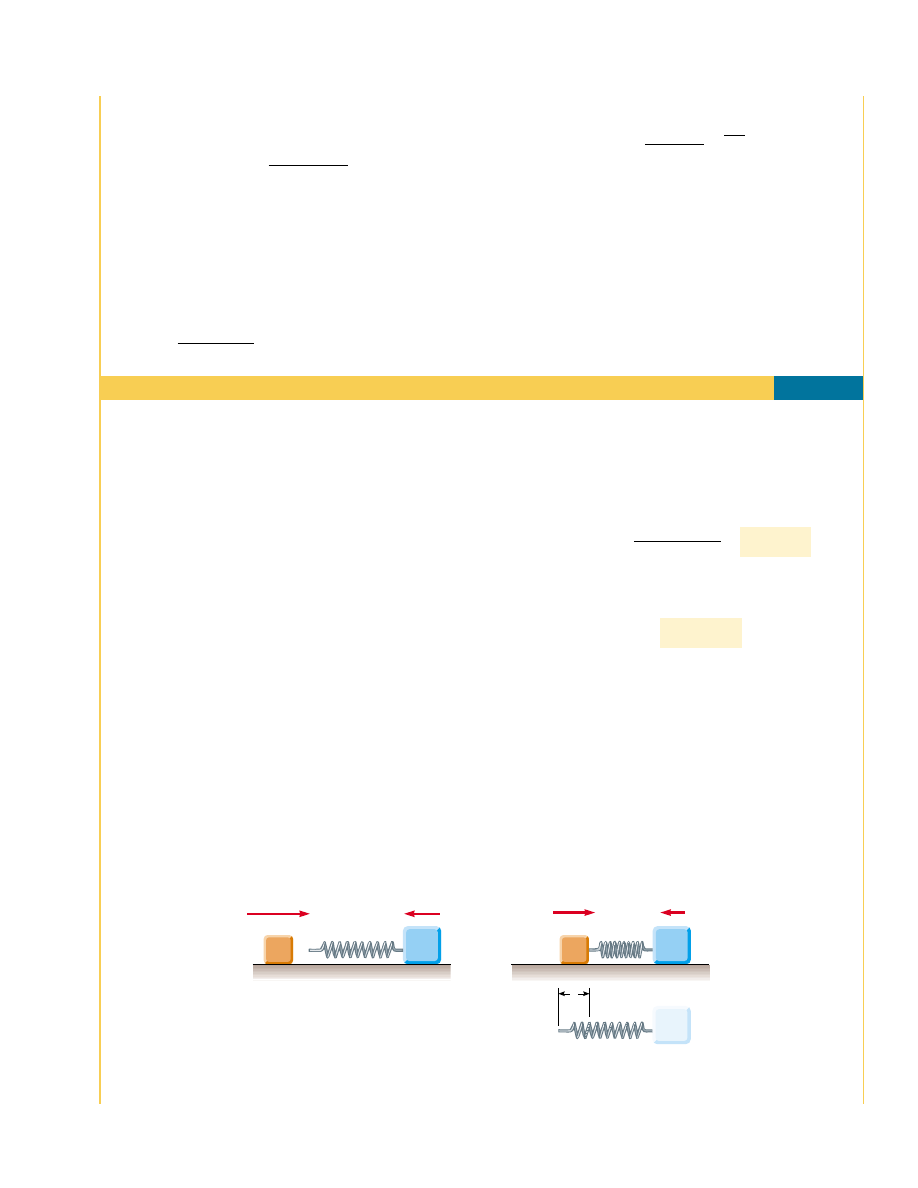
Example 9.8 A Two-Body Collision with a Spring

Multiplying Equation (2) by 1.60 kg gives us

Adding Equations (1) and (3) allows us to find v

2f

:

Now, Equation (2) allows us to find v

1f

:

(B)

During the collision, at the instant block 1 is moving to

the  right  with  a  velocity  of  #3.00 m/s,  as  in  Figure  9.12b,
determine the velocity of block 2.

Solution Because  the  momentum  of  the  system  of  two
blocks  is  conserved  throughout the  collision  for  the  sys-
tem of  two  blocks,  we  have,  for  any instant  during  the
collision,

We  choose  the  final  instant  to  be  that  at  which  block  1  is
moving with a velocity of # 3.00 m/s:

m

1

v

1i

#

m

2

v

2i

!

m

1

v

1f

#

m

2

v

2f

"


3.38 m/s

v

1f

!

6.50 m/s ! "v

1f

#

3.12 m/s

3.12 m/s

v

2f

!

11.55 kg)m/s

3.70 kg

!

11.55 kg)m/s ! (3.70 kg)v

2f

(3)

            10.4 kg)m/s ! "(1.60 kg)v

1f

#

(1.60 kg)v

2f

A block of mass m

1

!

1.60 kg initially moving to the right

with a speed of 4.00 m/s on a frictionless horizontal track
collides  with  a  spring  attached  to  a  second  block  of  mass
m

2

!

2.10 kg  initially  moving  to  the  left  with  a  speed  of

2.50 m/s, as shown in Figure 9.12a. The spring constant is
600 N/m.

(A)

Find the velocities of the two blocks after the collision.

Solution Because  the  spring  force  is  conservative,  no  ki-
netic energy is converted to internal energy during the com-
pression of the spring. Ignoring any sound made when the
block  hits  the  spring,  we  can  model  the  collision  as  being
elastic. Equation 9.15 gives us

Equation 9.19 gives us

(2)

            6.50 m/s ! "


v

1f

#

v

2f

4.00 m/s " ("2.50 m/s) ! "v

1f

#

v

2f

v

1i

"

v

2i

! "

(v

1f

"

v

2f

)

(1)

            1.15 kg)m/s ! (1.60 kg)v

1f

#

(2.10 kg)v

2f

!

(1.60 kg)v

1f

#

(2.10 kg)v

2f

(1.60 kg)(4.00 m/s) # (2.10 kg)("2.50 m/s)

m

1

v

1i

#

m

2

v

2i

!

m

1

v

1f

#

m

2

v

2f

Interactive

x

k

v

1f


= (3.00) m/s

v

2f

m

1

m

2

m

1

m

2

k

v

1i


= (4.00) m/s

v

2i


= (–2.50) m/s

(a)

(b)

Figure 9.12 (Example 9.8) A moving block approaches a second moving block that is

attached to a spring.

266

C H A P T E R   9 •  Linear Momentum and Collisions

Example 9.9 Slowing Down Neutrons by Collisions

Equation 9.22:

Therefore,  the  fraction  f

n

of  the  initial  kinetic  energy  pos-

sessed by the neutron after the collision is

From  this  result,  we  see  that  the  final  kinetic  energy  of
the neutron is small when m

m

is close to m

n

and zero when

m

n

!

m

m

.

We can use Equation 9.23, which gives the final speed of

the particle that was initially at rest, to calculate the kinetic
energy of the moderator nucleus after the collision:

Hence,  the  fraction  f

m

of  the  initial  kinetic  energy  trans-

ferred to the moderator nucleus is

(2)

          f

m

!


K

mf

K

ni


!

4m

n

m

m

(m

n

#

m

m

)

2

K

mf

!


1

2

m

m

v

mf

2

!


2m

n

2

m

m

(m

n

#

m

m

)

2


v

ni

2

(1)

            f

n

!


K

nf

K

ni


!

#

m

n

"

m

m

m

n

#

m

m

$

2

K

nf

!


1

2

m

n

v

nf

2

!


1

2

m

n


#

m

n

"

m

m

m

n

#

m

m

$

2

 v

ni

2

In a nuclear reactor, neutrons are produced when an atom
splits in a process called fission. These neutrons are moving
at  about  10

7

m/s  and  must  be  slowed  down  to  about 

10

3

m/s before they take part in another fission event. They

are slowed down by passing them through a solid or liquid
material  called  a  moderator.  The  slowing-down  process  in-
volves  elastic  collisions.  Show  that  a  neutron  can  lose  most
of its kinetic energy if it collides elastically with a moderator
containing light nuclei, such as deuterium (in “heavy water,”
D

2

O) or carbon (in graphite).

Solution Let us assume that the moderator nucleus of mass
m

m

is at rest initially and that a neutron of mass m

n

and ini-

tial speed v

ni

collides with it head-on. Because these are elas-

tic  collisions,  both  momentum  and  kinetic  energy  of  the
neutron–nucleus  system  are  conserved.  Therefore,  Equa-
tions 9.22 and 9.23 can be applied to the head-on collision
of  a  neutron  with  a  moderator  nucleus. We  can  represent
this process by a drawing such as Figure 9.9 with 

v

2i

!

0.

The initial kinetic energy of the neutron is

After the collision, the neutron has kinetic energy 

,

and  we  can  substitute  into  this  the  value  for  v

nf

given  by


1

2

m

n

v

nf

2

K

ni

!

1

2

m

n

v

ni

2

At the Interactive Worked Example link at http://www.pse6.com, you can change the masses and speeds of the blocks and
freeze the motion at the maximum compression of the spring.

(D)

What is the maximum compression of the spring during

the collision?

Solution The maximum compression would occur when the
two blocks are moving with the same velocity. The conserva-
tion of momentum equation for the system can be written

where the initial instant is just before the collision and the
final  instant  is  when  the  blocks  are  moving  with  the  same
velocity v

f

. Solving for v

f

,

Now,  we  apply  conservation  of  mechanical  energy  between
these two instants as in part (C):

Substituting the given values into this expression gives

! 0.253 m

1

2

m

1

v

2

1i

#

1

2

m

2

v

2

2i

#

0 !

1

2

(m

1

#

m

2

)v

f

2

#

1

2

kx

2

K

i

#

U

i

!

K

f

#

U

f

!

0.311 m/s

!

(1.60 kg)(4.00 m/s) # (2.10 kg)("2.50 m/s)

1.60 kg # 2.10 kg

v

f

!

m

1

v

1i

#

m

2

v

2i

m

1

#

m

2

m

1

v

1i

#

m

2

v

2i

!

(m

1

#

m

2

)v

f

The negative value for v

2f

means that block 2 is still moving

to the left at the instant we are considering.

(C)

Determine the distance the spring is compressed at that

instant.

Solution To determine the distance that the spring is com-
pressed, shown as in Figure 9.12b, we can use the principle
of conservation of mechanical energy for the system of the
spring and two blocks because no friction or other noncon-
servative forces are acting within the system. We choose the
initial configuration of the system to be that existing just be-
fore block 1 strikes the spring and the final configuration to
be  that  when  block  1  is  moving  to  the  right  at  3.00  m/s.
Thus, we have

Substituting the given values and the result to part (B) into
this expression gives

! 0.173 m

1

2

m

1

v

2

1i

#

1

2

m

2

v

2

2i

#

0 !

1

2

m

1

v

1f

2

#

1

2

m

2

v

2f

2

#

1

2

kx

2

K

i

#

U

i

!

K

f

#

U

f

"

1.74 m/s

v

2f

!

!

(1.60 kg)(3.00 m/s) # (2.10 kg)v

2f

(1.60 kg)(4.00 m/s) # (2.10 kg)("2.50 m/s)

S E C T I O N   9 . 4 •  Two-Dimensional Collisions

267

9.4 Two-Dimensional Collisions

In Section 9.1, we showed that the momentum of a system of two particles is conserved
when the system is isolated. For any collision of two particles, this result implies that
the momentum in each of the directions xy, and is conserved. An important subset
of collisions takes place in a plane. The game of billiards is a familiar example involv-
ing multiple collisions of objects moving on a two-dimensional surface. For such two-
dimensional  collisions,  we  obtain  two  component  equations  for  conservation  of 
momentum:

where  we  use  three  subscripts  in  these  equations  to  represent,  respectively,  (1)
the identification  of  the  object,  (2)  initial  and  final  values,  and  (3)  the  velocity
component.

Let us consider a two-dimensional problem in which particle 1 of mass m

1

collides

with particle 2 of mass m

2

, where particle 2 is initially at rest, as in Figure 9.13. After

the collision, particle 1 moves at an angle & with respect to the horizontal and parti-
cle 2 moves at an angle + with respect to the horizontal. This is called a glancing colli-
sion. Applying the law of conservation of momentum in component form and noting
that the initial component of the momentum of the two-particle system is zero, we
obtain

(9.24)

(9.25)

where the minus sign in Equation 9.25 comes from the fact that after the collision, par-
ticle 2 has a component of velocity that is downward. We now have two independent
equations. As long as no more than two of the seven quantities in Equations 9.24 and
9.25 are unknown, we can solve the problem.

If the collision is elastic, we can also use Equation 9.16 (conservation of kinetic en-

ergy) with v

2i

!

0 to give

(9.26)

1

2

m

1

v

2

1i

!

1

2

m

1

v

2

1f

#

1

2

m

2

v

2

2f

0 ! m

1

v

1f

  sin & " m

2

v

2f

  sin +

m

1

v

1i

!

m

1

v

1f

  cos & # m

2

v

2f

  cos +

m

1

v

1iy

#

m

2

v

2iy

!

m

1

v

1f y

#

m

2

v

2f y

m

1

v

1ix

#

m

2

v

2ix

!

m

1

v

1f x

#

m

2

v

2f x

neutron’s kinetic energy is transferred to the deuterium nu-
cleus.  In  practice,  the  moderator  efficiency  is  reduced  be-
cause head-on collisions are very unlikely.

How do the results differ when graphite (

12

C, as found

in pencil lead) is used as the moderator?

Because the total kinetic energy of the system is conserved,
Equation  (2) can  also  be  obtained  from  Equation  (1) with
the condition that f

n

#

f

m

!

1, so that f

m

!

1 " f

n

.

Suppose that heavy water is used for the moderator. For

collisions  of  the  neutrons  with  deuterium  nuclei  in  D

2

O

(m

m

!

2m

n

),  f

n

!

1/9  and  f

m

!

8/9.  That  is,  89%  of  the

(a) Before the collision

v

1i

(b) After the collision

θ

φ

v

2f

 cos

v

1f

 cos

v

1f

 sin

v

1f

v

2f

–v

2f

 sin

φ

φ

θ

θ

Active Figure 9.13 An elastic glancing collision between two particles. 

At the Active Figures link

at http://www.pse6.com, you
can adjust the speed and
position of the blue particle
and the masses of both
particles to see the effects.

PITFALL PREVENTION

9.5 Don’t Use 

Equation 9.19

Equation 9.19, relating the initial
and final relative velocities of two
colliding objects, is only valid for
one-dimensional  elastic  colli-
sions.  Do  not  use  this  equation
when  analyzing  two-dimensional
collisions.

268

C H A P T E R   9 •  Linear Momentum and Collisions

Example 9.10 Collision at an Intersection

A  1 500-kg  car  traveling  east  with  a  speed  of  25.0  m/s  col-
lides at an intersection with a 2 500-kg van traveling north at
a speed of 20.0 m/s, as shown in Figure 9.14. Find the direc-
tion and magnitude of the velocity of the wreckage after the
collision,  assuming  that  the  vehicles  undergo  a  perfectly
inelastic collision (that is, they stick together).

Solution Let  us  choose  east  to  be  along  the  positive  di-
rection and north to be along the positive direction. Be-
fore the collision, the only object having momentum in the
direction is the car. Thus, the magnitude of the total ini-
tial momentum of the system (car plus van) in the direc-
tion is

Let  us  assume  that  the  wreckage  moves  at  an  angle  & and
speed v

f

after the collision. The magnitude of the total mo-

mentum in the direction after the collision is

"

p

xi

!

(1 500 kg)(25.0 m/s) ! 3.75 * 10

4

 kg)m/s

θ

(25.0) m/s

y

x

v

f

(20.0) m/s

Figure 9.14 (Example 9.10) An eastbound car colliding with

a northbound van.

Knowing the initial speed of particle 1 and both masses, we are left with four unknowns
(v

1f

v

2f

, &, and +). Because we have only three equations, one of the four remaining

quantities  must  be  given  if  we  are  to  determine  the  motion  after  the  collision  from
conservation principles alone.

If the collision is inelastic, kinetic energy is not conserved and Equation 9.26 does

not apply.

P R O B L E M - S O LV I N G   H I N T S

Two-Dimensional Collisions

The following procedure is recommended when dealing with problems involving
two-dimensional collisions between two objects:

Set up a coordinate system and define your velocities with respect to that
system. It is usually convenient to have the axis coincide with one of the
initial velocities.

In your sketch of the coordinate system, draw and label all velocity vectors and
include all the given information.

Write expressions for the and components of the momentum of each
object before and after the collision. Remember to include the appropriate
signs for the components of the velocity vectors.

Write expressions for the total momentum of the system in the direction
before and after the collision and equate the two. Repeat this procedure for
the total momentum of the system in the direction.

If the collision is inelastic, kinetic energy of the system is not conserved, and
additional information is probably required. If the collision is perfectly
inelastic, the final velocities of the two objects are equal. Solve the momentum
equations for the unknown quantities.

If the collision is elastic, kinetic energy of the system is conserved, and you can
equate the total kinetic energy before the collision to the total kinetic energy
after the collision to obtain an additional relationship between the velocities.


Content   ..  65  66  67  68   ..