Physics For Scientists And Engineers 6E - part 66
 

  Index      Production     Physics For Scientists And Engineers 6E


Search            


Content   ..  64  65  66  67   ..


Physics For Scientists And Engineers 6E - part 66


the collision is called 

perfectly inelastic. When the colliding objects do not stick to-

gether, but some kinetic energy is lost, as in the case of a rubber ball colliding with a
hard  surface,  the  collision  is  called 

inelastic  (with no modifying adverb). When the

rubber ball collides with the hard surface, some of the kinetic energy of the ball is lost
when the ball is deformed while it is in contact with the surface.

In most collisions, the kinetic energy of the system is not conserved because some of

the energy is converted to internal energy and some of it is transferred away by means
of sound. Elastic and perfectly inelastic collisions are limiting cases; most collisions fall
somewhere between them.

In the remainder of this section, we treat collisions in one dimension and consider

the two extreme cases—perfectly inelastic and elastic collisions. The important distinc-
tion  between  these  two  types  of  collisions  is  that 

momentum  of  the  system  is  con-

served  in  all  collisions,  but  kinetic  energy  of  the  system  is  conserved  only  in
elastic collisions.

Perfectly Inelastic Collisions

Consider  two  particles  of  masses  m

1

and  m

2

moving  with  initial  velocities 

v

1i

and 

v

2i

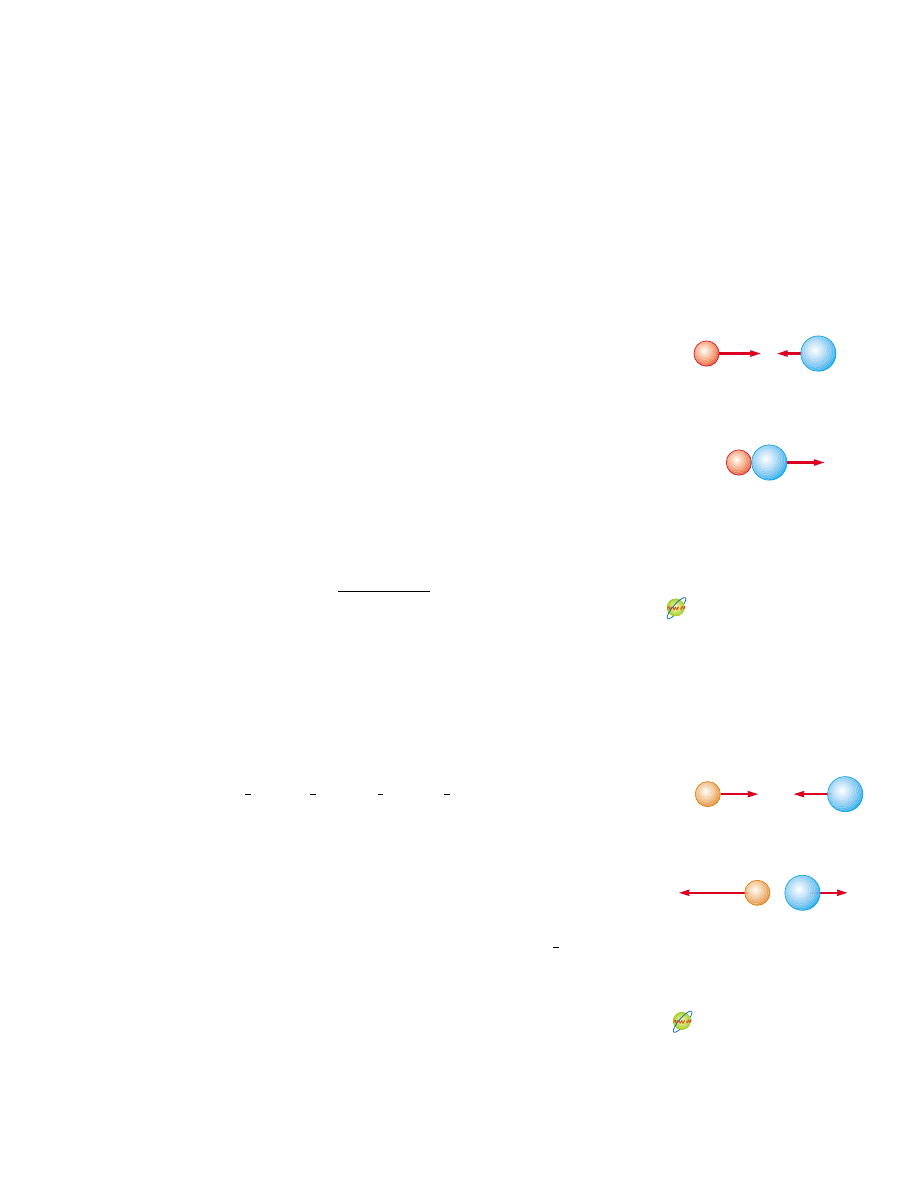
along the same straight line, as shown in Figure 9.8. The two particles collide head-on,
stick  together,  and  then  move  with  some  common  velocity 

v

f

after  the  collision.  Be-

cause  the  momentum  of  an  isolated  system  is  conserved  in  any collision,  we  can  say
that the total momentum before the collision equals the total momentum of the com-
posite system after the collision:

(9.13)

Solving for the final velocity gives

(9.14)

Elastic Collisions

Consider  two  particles  of  masses  m

1

and  m

2

moving  with  initial  velocities 

v

1i

and 

v

2i

along the same straight line, as shown in Figure 9.9. The two particles collide head-on
and then leave the collision site with different velocities, 

v

1f

and 

v

2f

. If the collision is

elastic, both the momentum and kinetic energy of the system are conserved. Therefore,
considering velocities along the horizontal direction in Figure 9.9, we have

(9.15)

(9.16)

Because all velocities in Figure 9.9 are either to the left or the right, they can be repre-
sented  by  the  corresponding  speeds  along  with  algebraic  signs  indicating  direction.
We shall indicate as positive if a particle moves to the right and negative if it moves to
the left.

In a typical problem involving elastic collisions, there are two unknown quantities,

and Equations 9.15 and 9.16 can be solved simultaneously to find these. An alternative
approach, however—one that involves a little mathematical manipulation of Equation
9.16—often simplifies this process. To see how, let us cancel the factor  in Equation
9.16 and rewrite it as

and then factor both sides:

(9.17)

Next, let us separate the terms containing m

1

and m

2

in Equation 9.15 to obtain

(9.18)

m

1

(v

1i

"

v

1f

) ! m

2

(v

2f

"

v

2i

)

 m

1

(v

1i

"

v

1f

)(v

1i

#

v

1f

) ! m

2

(v

2f

"

v

2i

)(v

2f

#

v

2i

)

m

1

(v

1i

2

"

v

1f

2

) ! m

2

(v

2f

2

"

v

2i

2

)

1

2

1

2

m

1

v

1i

2

#

1

2

m

2

v

2i

2

!

1

2

m

1

v

1f

2

#

1

2

m

2

v

2f

2

m

1

v

1i

#

m

2

v

2i

!

m

1

v

1f

#

m

2

v

2f

v

f

!

m

1

v

1i

#

m

2

v

2i

m

1

#

m

2

m

1

v

1i

#

m

2

v

2i

!

(m

1

#

m

2

)

v

f

S E C T I O N   9 . 3 •  Collisions in One Dimension

261

PITFALL PREVENTION

9.2 Inelastic Collisions

Generally,  inelastic  collisions  are
hard to analyze unless additional
information is provided. This ap-
pears in the mathematical repre-
sentation  as  having  more  un-
knowns than equations.

m

1

m

2

v

1i

Before collision

v

2i

v

1f

v

2f

After collision

(a)

(b)

Active Figure 9.9 Schematic rep-

resentation of an elastic head-on

collision between two particles:

(a) before collision and (b) after

collision.

At the Active Figures link 

at http://www.pse6.com, you

can adjust the masses and

velocities of the colliding ob-

jects to see the effect on the

final velocities.

Before collision

(a)

m

1

m

2

v

1i

v

2i

After collision

(b)

v

f

m

1

 + m

2

Active Figure 9.8 Schematic rep-

resentation of a perfectly inelastic

head-on collision between two

particles: (a) before collision and

(b) after collision.

At the Active Figures link 

at http://www.pse6.com, you

can adjust the masses and

velocities of the colliding ob-

jects to see the effect on the

final velocity.

To obtain our final result, we divide Equation 9.17 by Equation 9.18 and obtain

(9.19)

This equation, in combination with Equation 9.15, can be used to solve problems deal-
ing  with  elastic  collisions.  According  to  Equation  9.19,  the  relative velocity  of  the  two
particles before the collision, v

1i

"

v

2i

, equals the negative of their relative velocity af-

ter the collision, "(v

1f

"

v

2f

).

Suppose  that  the  masses  and  initial  velocities  of  both  particles  are  known.  Equa-

tions 9.15 and 9.19 can be solved for the final velocities in terms of the initial velocities
because there are two equations and two unknowns:

(9.20)

(9.21)

It is important to use the appropriate signs for v

1i

and v

2i

in Equations 9.20 and 9.21.

For example, if particle 2 is moving to the left initially, then v

2i

is negative.

Let us consider some special cases. If m

1

!

m

2

, then Equations 9.20 and 9.21 show

us  that  v

1f

!

v

2i

and  v

2f

!

v

1i

.  That  is,  the  particles  exchange  velocities  if  they  have

equal  masses.  This  is  approximately  what  one  observes  in  head-on  billiard  ball  colli-
sions—the cue ball stops, and the struck ball moves away from the collision with the
same velocity that the cue ball had.

If particle 2 is initially at rest, then v

2i

!

0, and Equations 9.20 and 9.21 become

(9.22)

(9.23)

If m

1

is much greater than m

2

and v

2i

!

0, we see from Equations 9.22 and 9.23 that

v

1f

v

1i

and v

2f

& 2v

1i

. That is, when a very heavy particle collides head-on with a very

light one that is initially at rest, the heavy particle continues its motion unaltered after
the collision and the light particle rebounds with a speed equal to about twice the ini-
tial speed of the heavy particle. An example of such a collision would be that of a mov-
ing heavy atom, such as uranium, striking a light atom, such as hydrogen.

If m

2

is much greater than m

1

and particle 2 is initially at rest, then v

1f

& " v

1i

and

v

2f

& 0. That is, when a very light particle collides head-on with a very heavy particle

that is initially at rest, the light particle has its velocity reversed and the heavy one re-
mains approximately at rest.

v

2f

!

#

2m

1

m

1

#

m

2

$

v

1i

v

1f

!

#

m

1

"

m

2

m

1

#

m

2

$

v

1i

v

2f

!

#

2m

1

m

1

#

m

2

$

v

1i

#

#

m

2

"

m

1

m

1

#

m

2

$

v

2i

v

1f

!

#

m

1

"

m

2

m

1

#

m

2

$

v

1i

#

#

2m

2

m

1

#

m

2

$

v

2i

v

1i

"

v

2i

! "

(v

1f

"

v

2f

)

v

1i

#

v

1f

!

v

2f

#

v

2i

262

C H A P T E R   9 •  Linear Momentum and Collisions

Quick  Quiz  9.8

In  a  perfectly  inelastic  one-dimensional  collision  between

two objects, what condition alone is necessary so that all of the original kinetic energy
of  the  system  is  gone  after  the  collision?  (a)  The  objects  must  have  momenta  with
the same magnitude but opposite directions. (b) The objects must have the same mass.
(c) The objects must have the same velocity. (d) The objects must have the same speed,
with velocity vectors in opposite directions.

Quick Quiz 9.9

A table-tennis ball is thrown at a stationary bowling ball. The

table-tennis  ball  makes  a  one-dimensional  elastic  collision  and  bounces  back  along
the same line. After the collision, compared to the bowling ball, the table-tennis ball
has  (a)  a  larger  magnitude  of  momentum  and  more  kinetic  energy  (b)  a  smaller

PITFALL PREVENTION

9.3 Not a General

Equation

We have spent some effort on de-
riving Equation 9.19, but remem-
ber  that  it  can  only  be  used  in  a
very  specific situation—a  one-di-
mensional,  elastic  collision  be-
tween  two  objects.  The  general
concept  is  conservation  of  mo-
mentum (and conservation of ki-
netic  energy  if  the  collision  is
elastic) for an isolated system.

Elastic collision: particle 2

initially at rest

PITFALL PREVENTION

9.4 Momentum and

Kinetic Energy in
Collisions

Momentum of an isolated system
is  conserved  in  all collisions.  Ki-
netic energy of an isolated system
is  conserved  only in  elastic  colli-
sions.  Why?  Because  there  are
several types of energy into which
kinetic  energy  can  transform,  or
be  transferred  out  of  the  system
(so that the system may not be iso-
lated  in  terms  of  energy  during
the  collision).  However,  there  is
only one type of momentum.

S E C T I O N   9 . 3 •  Collisions in One Dimension

263

magnitude of momentum and more kinetic energy (c) a larger magnitude of momen-
tum  and  less  kinetic  energy  (d)  a  smaller  magnitude  of  momentum  and  less  kinetic
energy (e) the same magnitude of momentum and the same kinetic energy.

Example 9.5 The Executive Stress Reliever

What If?

Consider what would happen if balls 4 and 5 are

glued  together  so  that  they  must  move  together.  Now  what
happens when ball 1 is pulled out and released?

Answer We are now forcing balls 4 and 5 to come out to-
gether.  We  have  argued  that  we  cannot  conserve  both  mo-
mentum and energy in this case. However, we assumed that
ball 1 stopped after striking ball 2. What if we do not make
this  assumption?  Consider  the  conservation  equations  with
the assumption that ball 1 moves after the collision. For con-
servation of momentum,

where v

4,5f

refers to the final speed of the ball 4–ball 5 com-

bination. Conservation of kinetic energy gives us

Combining these equations, we find

Thus,  balls  4  and  5  come  out  together  and  ball  1  bounces
back from the collision with one third of its original speed.

v

4,5f

!

2

3

v

1i


v

1f

! "

1

3

v

1i

1

2

mv

2

1i

!

1

2

mv

2

1f

#

1

2

(2m)v

2

4,5f

K

i

!

K

f

mv

1i

!

mv

1f

#

2mv

4,5f

p

i

!

p

f

An ingenious device that illustrates conservation of momen-
tum and kinetic energy is shown in Figure 9.10. It consists of
five  identical  hard  balls  supported  by  strings  of  equal
lengths. When ball 1 is pulled out and released, after the al-
most-elastic collision between it and ball 2, ball 5 moves out,
as shown in Figure 9.10b. If balls 1 and 2 are pulled out and
released, balls 4 and 5 swing out, and so forth. Is it ever pos-
sible that when ball 1 is released, balls 4 and 5 will swing out
on the opposite side and travel with half the speed of ball 1,
as in Figure 9.10c?

Solution No,  such  movement  can  never  occur  if  we  as-
sume  the  collisions  are  elastic.  The  momentum  of  the
system  before  the  collision  is  mv,  where  is  the  mass  of
ball 1 and is its speed just before the collision. After the
collision, we would have two balls, each of mass moving
with  speed  v/2.  The  total  momentum  of  the  system  after
the collision would be m(v/2) # m(v/2) ! mv. Thus, mo-
mentum  of  the  system  is  conserved.  However,  the  kinetic
energy  just  before  the  collision  is 

and  that 

after the  collision  is 
Thus, kinetic energy of the system is not conserved. The only
way to have both momentum and kinetic energy conserved
is  for  one  ball  to  move  out  when  one  ball  is  released,  two
balls to move out when two are released, and so on.

K

f

!

1

2

m(v/2)

2

#

1

2

m(v/2)

2

!

1

4

mv

2

.

K

i

!

1

2

mv

2

(a)

This can happen.

(b)

v

v

4

5

2 3 4 5

1 2 3 4

1

5

2 3 4 5

1 2 3

1

v/2

v

Can this happen?

(c)

Figure 9.10 (Example 9.5) An executive stress reliever.

At the Interactive Worked Example link at http://www.pse6.com, you can “glue” balls 4 and 5 together to see the situation
discussed above.

Interactive

264

C H A P T E R   9 •  Linear Momentum and Collisions

Example 9.7 The Ballistic Pendulum

The  ballistic  pendulum  (Fig.  9.11)  is  an  apparatus  used  to
measure the speed of a fast-moving projectile, such as a bul-
let. A bullet of mass m

1

is fired into a large block of wood of

mass  m

2

suspended  from  some  light  wires.  The  bullet  em-

beds  in  the  block,  and  the  entire  system  swings  through  a
height  h.  How  can  we  determine  the  speed  of  the  bullet
from a measurement of h?

Solution Figure 9.11a helps to conceptualize the situation.
Let  configuration  ! be  the  bullet  and  block  before  the
collision,  and  configuration  " be  the  bullet  and  block  im-
mediately after colliding. The bullet and the block form an
isolated  system,  so  we  can  categorize  the  collision  between
them  as  a  conservation  of  momentum  problem.  The  colli-
sion  is  perfectly  inelastic.  To  analyze  the  collision, we  note
that Equation 9.14 gives the speed of the system right after
the  collision  when  we  assume  the  impulse  approximation.
Noting that v

2

A

!

0, Equation 9.14 becomes

For the process during which the bullet–block combina-

tion swings upward to height (ending at configuration #),
we focus on a different system—the bullet, the block, and the
Earth. This is an isolated system for energy, so we categorize
this part of the motion as a conservation of mechanical en-
ergy problem:

We  begin  to  analyze  the  problem  by  finding  the  total

kinetic energy of the system right after the collision:

(2)

            K

B

!

1

2

(m

1

#

m

2

)v

B

2

K

B

#

U

B

!

K

C

#

U

C

(1)

            v

B

!

m

1

v

1

A

m

1

#

m

2

m

1

v

1A

v

B

m

1

 + 

m

2

m

2

h

(a)

!

"

#

(b)

Figure 9.11 (Example 9.7) (a) Diagram of a ballistic pendu-

lum. Note that v

1

A

is the velocity of the bullet just before the

collision and v

B

is the velocity of the bullet-block system just af-

ter the perfectly inelastic collision. (b) Multiflash photograph

of a ballistic pendulum used in the laboratory. 

Courtesy of Central Scientific Company

Example 9.6 Carry Collision Insurance!

Equating the initial and final momenta of the system and

solving for v

f

, the final velocity of the entangled cars, we have

Because the final velocity is positive, the direction of the final
velocity is the same as the velocity of the initially moving car.

What  If?

Suppose  we  reverse  the  masses  of  the  cars—a

stationary 900-kg car is struck by a moving 1 800-kg car. Is
the final speed the same as before?

Answer Intuitively, we can guess that the final speed will be
higher,  based  on  common  experiences  in  driving.  Mathe-
matically,  this  should  be  the  case  because  the  system  has  a
larger  momentum  if  the  initially  moving  car  is  the  more
massive one. Solving for the new final velocity, we find

which is indeed higher than the previous final velocity.

v

f

!

p

i

m

1

#

m

2

!

(1


800 kg)(20.0 m/s)

2 700 kg

!

13.3 m/s

6.67 m/s

v

f

!

p

i

m

1

#

m

2

!

1.80 * 10

4

 kg)m/s

2 700 kg

!

An 1 800-kg car stopped at a traffic light is struck from the
rear by a 900-kg car, and the two become entangled, moving
along  the  same  path  as  that  of  the  originally  moving  car. 
If  the  smaller  car  were  moving  at  20.0  m/s  before  the 
collision, what is the velocity of the entangled cars after the
collision?

Solution The phrase “become entangled” tells us that this
is a perfectly inelastic collision. We can guess that the final
speed is less than 20.0 m/s, the initial speed of the smaller
car.  The  total  momentum  of  the  system  (the  two  cars)  be-
fore the collision must equal the total momentum immedi-
ately  after  the  collision  because  momentum  of  an  isolated
system is conserved in any type of collision. The magnitude
of  the  total  momentum  of  the  system  before  the  collision
is equal to that of the smaller car because the larger car is
initially at rest:

After the collision, the magnitude of the momentum of

the entangled cars is

p

f

!

(m

1

#

m

2

)v

f

!

(2 700 kg)v

f

p

i

!

m

1

v

i

!

(900 kg)(20.0 m/s) ! 1.80 * 10

4

 kg)m/s


Content   ..  64  65  66  67   ..