Physics For Scientists And Engineers 6E - part 63
Problems
249
72.
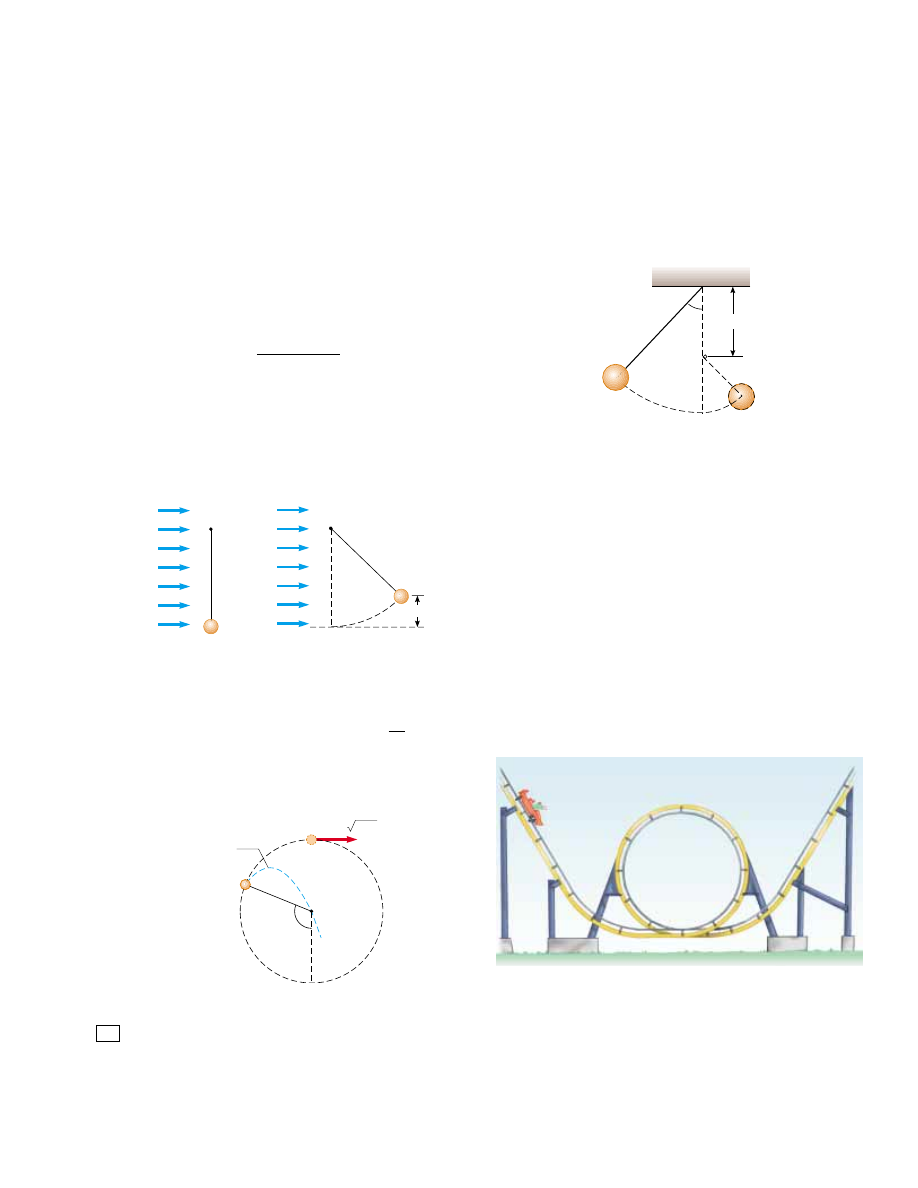
A pendulum, comprising a string of length L and a small
sphere, swings in the vertical plane. The string hits a peg
located a distance d below the point of suspension (Fig.
P8.72). (a) Show that if the sphere is released from a
height below that of the peg, it will return to this height af-
ter striking the peg. (b) Show that if the pendulum is re-
leased from the horizontal position (& " 90°) and is to
swing in a complete circle centered on the peg, then the
minimum value of d must be 3L/5.
74.
Review problem. In 1887 in Bridgeport, Connecticut, C. J.
Belknap built the water slide shown in Figure P8.74. A
rider on a small sled, of total mass 80.0 kg, pushed off to
start at the top of the slide (point !) with a speed of
2.50 m/s. The chute was 9.76 m high at the top, 54.3 m
long, and 0.51 m wide. Along its length, 725 wheels made
L
(a)
F
m
L
Pivot
(b)
F
Pivot
H
m
Figure P8.69
68.
A block of mass M rests on a table. It is fastened to the
lower end of a light vertical spring. The upper end of the
spring is fastened to a block of mass m. The upper block is
pushed down by an additional force 3mg, so the spring
compression is 4mg/k. In this configuration the upper
block is released from rest. The spring lifts the lower block
off the table. In terms of m, what is the greatest possible
value for M ?
69.
A ball having mass m is connected by a strong string of
length L to a pivot point and held in place in a vertical posi-
tion. A wind exerting constant force of magnitude F is blow-
ing from left to right as in Figure P8.69a. (a) If the ball is
released from rest, show that the maximum height H
reached by the ball, as measured from its initial height, is
Check that the above result is valid both for cases when
0 2 H 2 L and for L 2 H 2 2L. (b) Compute the value of
H using the values m " 2.00 kg, L " 2.00 m, and F "
14.7 N. (c) Using these same values, determine the equilib-
rium height of the ball. (d) Could the equilibrium height
ever be larger than L? Explain.
H "
2L
1 % (mg/F )
2
The path
after string
is cut
R
θ
C
m
v
i
= Rg
Figure P8.70
d
L
Peg
θ
Figure P8.72
73.
A roller-coaster car is released from rest at the top of the
first rise and then moves freely with negligible friction.
The roller coaster shown in Figure P8.73 has a circular
loop of radius R in a vertical plane. (a) Suppose first that
the car barely makes it around the loop: at the top of the
loop the riders are upside down and feel weightless. Find
the required height of the release point above the bottom
of the loop in terms of R. (b) Now assume that the release
point is at or above the minimum required height. Show
that the normal force on the car at the bottom of the loop
exceeds the normal force at the top of the loop by six
times the weight of the car. The normal force on each
rider follows the same rule. Such a large normal force is
dangerous and very uncomfortable for the riders. Roller
coasters are therefore not built with circular loops in verti-
cal planes. Figure P6.20 and the photograph on page 157
show two actual designs.
70.
A ball is tied to one end of a string. The other end of the
string is held fixed. The ball is set moving around a vertical
circle without friction, and with speed
at the top
of the circle, as in Figure P8.70. At what angle & should the
string be cut so that the ball will then travel through the
center of the circle?
v
i
"
√R
g
A ball whirls around in a vertical circle at the end of a
string. If the total energy of the ball–Earth system remains
constant, show that the tension in the string at the bottom
is greater than the tension at the top by six times the
weight of the ball.
71.
Figure P8.73