Physics For Scientists And Engineers 6E - part 52
SECTION 7.9 • Energy and the Automobile
205
7.9 Energy and the Automobile
Automobiles powered by gasoline engines are very inefficient machines. Even under
ideal conditions, less than 15% of the chemical energy in the fuel is used to power the
vehicle. The situation is much worse than this under stop-and-go driving conditions in
a city. In this section, we use the concepts of energy, power, and friction to analyze au-
tomobile fuel consumption.
Many mechanisms contribute to energy loss in an automobile. About 67% of the
energy available from the fuel is lost in the engine. This energy ends up in the atmos-
phere, partly via the exhaust system and partly via the cooling system. (As explained in
Chapter 22, energy loss from the exhaust and cooling systems is required by a funda-
mental law of thermodynamics.) Approximately 10% of the available energy is lost to
friction in the transmission, drive shaft, wheel and axle bearings, and differential. Fric-
tion in other moving parts transforms approximately 6% of the energy to internal en-
ergy, and 4% of the energy is used to operate fuel and oil pumps and such accessories
as power steering and air conditioning. This leaves a mere 13% of the available energy
to propel the automobile! This energy is used mainly to balance the energy loss due to
flexing of the tires and the friction caused by the air, which is more commonly referred
to as air resistance.
Let us examine the power required to provide a force in the forward direction that
balances the combination of the two friction forces. The coefficient of rolling friction
.
between the tires and the road is about 0.016. For a 1 450-kg car, the weight is
14 200 N and on a horizontal roadway the force of rolling friction has a magnitude of
.
n # .mg # 227 N. As the car’s speed increases, a small reduction in the normal force
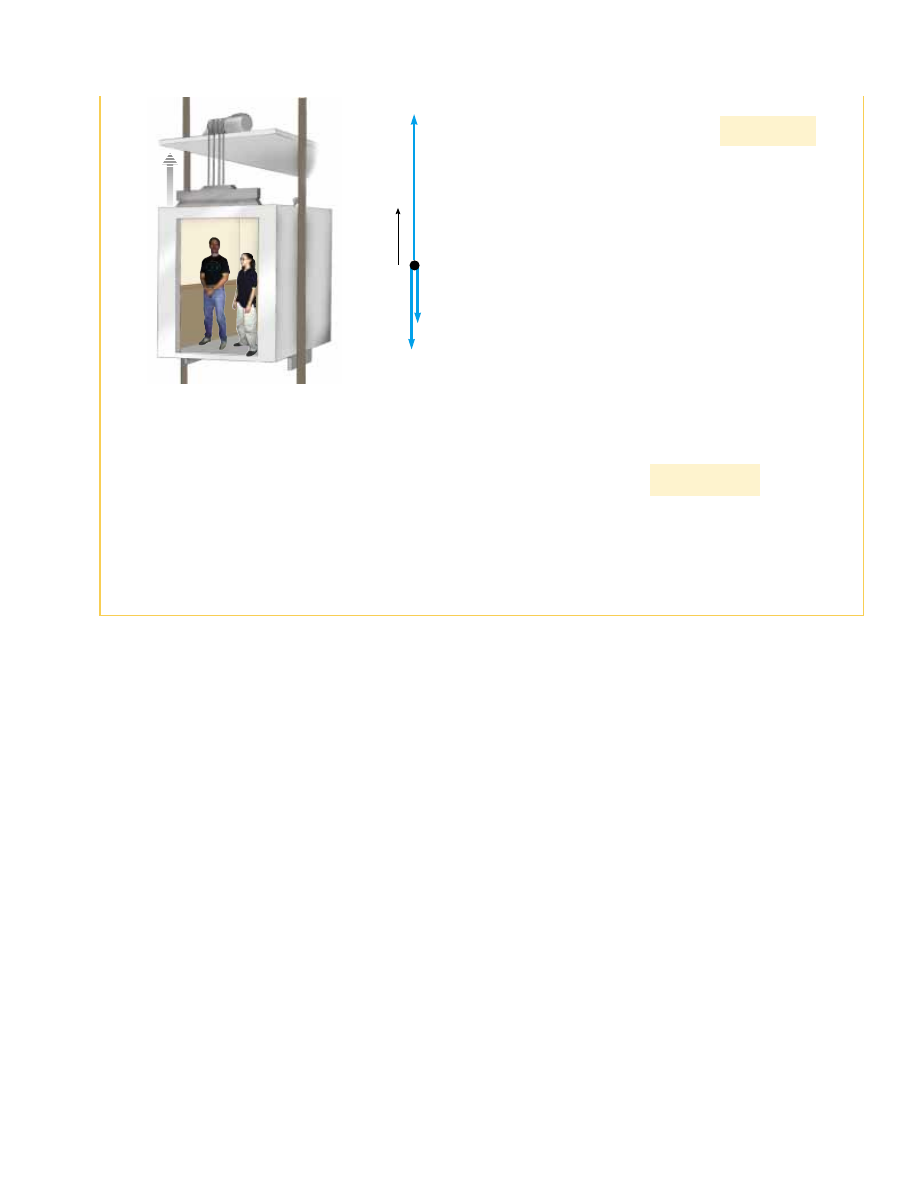
Figure 7.19 (Example 7.12) (a) The motor exerts an upward
force
T on the elevator car. The magnitude of this force is the
tension T in the cable connecting the car and motor. The down-
ward forces acting on the car are a friction force
f and the gravi-
tational force
F
g
#
M
g. (b) The free-body diagram for the ele-
vator car.
Motor
T
f
M g
+
(a)
(b)
Using Equation 7.23 and the fact that
T is in the same direc-
tion as
v, we find that
(B)
What power must the motor deliver at the instant the
speed of the elevator is v if the motor is designed to provide
the elevator car with an upward acceleration of 1.00 m/s
2
?
Solution We expect to obtain a value greater than we did in
part (A), where the speed was constant, because the motor
must now perform the additional task of accelerating the car.
The only change in the setup of the problem is that in this
case, a , 0. Applying Newton’s second law to the car gives
Therefore, using Equation 7.23, we obtain for the required
power
where v is the instantaneous speed of the car in meters per
second. To compare to part (A), let v # 3.00 m/s, giving a
power of
This is larger than the power found in part (A), as we expect.
! #
(2.34 * 10
4
N)(3.00 m/s) # 7.02 * 10
4
W
(2.34 * 10
4
N)v
! #
Tv #
# 2.34 * 10
4
N
)
4.00 * 10
3
N
# (1.80 * 10
3
kg)(1.00 m/s
2
)
9.80 m/s
2
)
T # M(a ) g) ) f
#
F
y
#
T & f & Mg # Ma
6.48 * 10
4
W
#
(2.16 * 10
4
N)(3.00 m/s) #
! #
T ! v # Tv