Toyota Prius Plug-in Hybrid (2023 year). Manual in english - page 11
 

  Index      Toyota     Toyota Prius Plug-in Hybrid (2023 year). Manual in english


Search            copyright infringement  


Content      ..     9      10      11      12     ..


Toyota Prius Plug-in Hybrid (2023 year). Manual in english - page 11


176

2-2. Charging

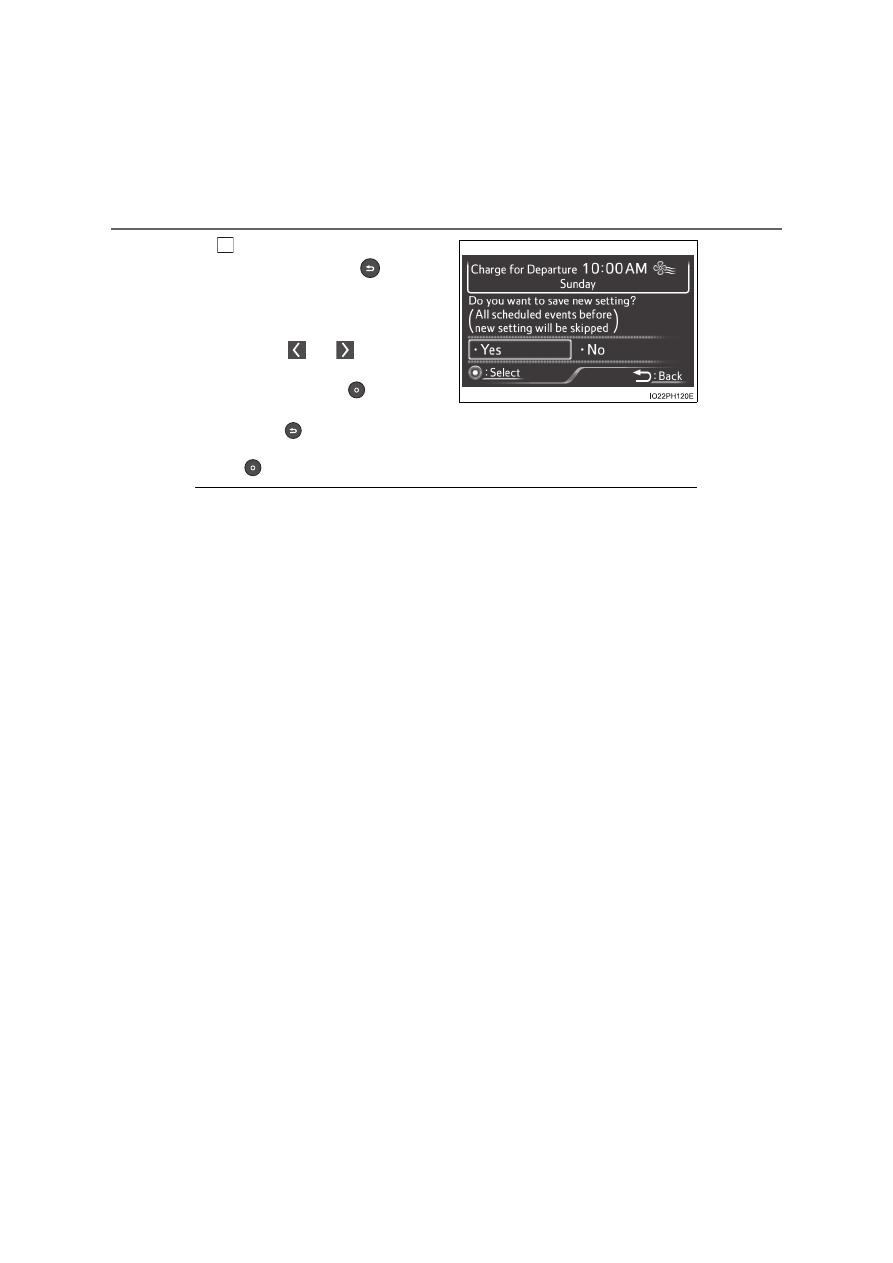
After setting operations are
complete, press 

.

A confirmation screen of chang-
ing “Next Charging Event” will
display.

Press 

 or 

 of the meter

control switches to select “Yes”,
and then press 

 to save the

charging schedule.
Press 

 to return to the previous screen.

When canceling the “Next Charging Event”, select “No” and then press

.

Charging schedule switch

The charging schedule switch functions regardless of the condition of the
power switch.
However, when the charging schedule switch is pressed while the power
switch is not turned to ON mode, if the meter control switches are not oper-
ated for a certain amount of time after the charging schedule setting screen
is displayed, the display automatically turns off.

The charging schedule switch cannot be used while driving.

When charging schedule setting operations are canceled

When the vehicle is in the following conditions, charging schedule setting
operations are canceled.

A message is displayed while performing a setting operation

The power switch is operated before the settings are confirmed

The vehicle starts off

A display with a higher priority than that of the charging schedule setting is
shown

Charging schedule

The “Charge Schedule” screen can be displayed and setting operations can
be performed from the “Vehicle Settings” setting on the multi-information dis-
play. (

P. 726)

“Next Charging Event”

After charging completes, the “Next Charging Event” displayed on the multi-
information display will not change until the charging cable is removed, even
after charging is performed according to the “Next Charging Event” schedule.

To return to original setting after changing “Next Charging Event” set-
ting

Turning the setting of “Charge Now” on and then off can return the setting of
“Next Charging Event” to its original setting.

4

177

2-2. Charging

2

P

lu

g

-in

 hy
br

id

 s

ys

tem

When “Next Charging Event” is changed while charging

When the charging mode is “Departure”, the current charging is interrupted
or continued depending on the remaining time until the charging is com-
pleted.

When the charging mode is “Start”, the current charging is interrupted, the
next charging will start at the set time.

When the power switch is turned off

It is possible to check the next charge
schedule (“Next Charging Event”) by oper-
ating 

 or 

 of the meter control

switches while the power switch is turned
off and the “Ending” screen

*

1

 (

P. 198) is

displayed.

*

2

*

1

: The “Ending” screen may not be dis-

played during charging.

*

2

: When the power switch is turned off, the “Next Charging Event” confir-

mation screen may be displayed.

WARNING

Cautions while performing the setting operation

When performing the setting operation while the hybrid system is operated,
ensure that the vehicle is parked in a place with adequate ventilation. In a
closed area such as a garage, exhaust gases including harmful carbon
monoxide (CO) may collect and enter the vehicle. This may lead to death or
a serious health hazard.

NOTICE

While performing the setting operation

When performing the setting operation while the hybrid system is stopped,
be careful that the 12-volt battery will not be discharged.

178

2-2. Charging

Solar charging system

This system generates solar power with the solar panel equipped to
the roof of the vehicle (solar roof).

The hybrid battery (traction battery) is charged

*

 while parking.

After the solar power is stored in the solar battery, it is transferred
all at once to the hybrid battery (traction battery) to reduce the sys-
tem electrical consumption and charge the battery efficiently.

The electrical consumption of the hybrid battery (traction battery) is
reduced during driving.
The electrical consumption of the hybrid battery (traction battery) is
suppressed increasing EV driving distance and fuel economy by
supplementing power consumption for the auxiliary systems using
solar power.

*

: The maximum charge amount of the solar charging system is approxi-

mately 90% of the fully charged capacity for the charging from an external
power source.

: If equipped

A system that provides power to the hybrid battery (traction bat-
tery) and auxiliary systems by performing solar charging via the
large solar panel (solar roof) equipped on the vehicle roof.

Even when a parking lot does not have charging equipment and in
the event of a disaster, it is possible to charge

*

 the hybrid battery

(traction battery) without any special operations as long as sunlight
is available.

*

: The charging amount via the solar charging system differs depending on

conditions, such as season and weather. Also, there is a limit on the
amount of charging possible per day. It requires at least approximately 10
days to charge to the maximum possible charging amount via the solar
charging system.

Solar charging system operation

179

2-2. Charging

2

P

lu

g

-in

 hy
br

id

 s

ys

tem

12-volt battery
Solar roof
Solar battery (inside console box)
Solar ECU
Hybrid battery (traction battery)

Information related to the solar
charging system can be checked

with 

 (Drive information) on

the multi-information display. 
(

P. 225, 238)

Displaying information related to the solar charging system

1
2
3
4
5

180

2-2. Charging

Solar charging system

In the following cases, charging the hybrid battery (traction battery) via the
solar charging system is not performed. Solar power generation stops when
the solar battery becomes fully charged.
• Charging via an external power source
• The power switch is not off
• The “Traction Battery Heater” is operating (

P. 144)

• The Remote Air Conditioning System is operating
• When the amount of remaining charge in the hybrid battery (traction bat-

tery) is approximately 90% or more of the fully charged capacity for the
charging from an external power source

In the following cases, the solar charging system stops solar power genera-
tion and power supply to the hybrid battery (traction battery) and auxiliary
systems.
• The temperature preservation function of the solar charging system oper-

ates

• There is a malfunction in the solar charging system
• When the 12-volt battery terminals are disconnected

The amount of power generated by the solar roof differs according to the
season, climate, weather conditions, vehicle angle and surrounding condi-
tions.

If even part of the solar roof is in the shade, there may be an extreme drop
in power generation.

Please adhere to the following in order to allow full performance of the solar
roof.
• Clean the roof on a routine basis (Especially fallen leaves and bird drop-

pings can lead to a substantial decrease in power generation)

• Remove snow from the roof as soon as possible
• Do not attach any seals or stickers to the roof

It is recommended not to install a roof carrier etc. unless it is necessary

When the hybrid battery (traction battery) is fully charged, charging the bat-
tery via the solar charging system is not performed. When it is not neces-
sary to perform charging from an external power source, charge the vehicle
as much as possible using the solar charging system during the day and
use the external power source only at night. As a result, the solar charging
system can be used effectively.

When the vehicle is left in the hot weather, the temperature preservation
function of the solar charging system becomes easy to operate due to high
temperature of the vehicle interior. The solar charging system can be used
effectively by using a sunshade or parking the vehicle facing north, etc.

181

2-2. Charging

2

P

lu

g

-in

 hy
br

id

 s

ys

tem

Solar battery

When the solar roof is not exposed to sunlight or the vehicle is not driven for a
long period of time, the solar battery may be discharged, negatively affecting
the system.
If storing the vehicle inside of a garage away from the sun or if the vehicle will
not be used for a long period of time, use one of the following methods to
charge the solar battery at least once every 2 to 3 months.

Start the hybrid system and keep the READY indicator turned on for approx-
imately 60 minutes or more

Park the vehicle outside of the garage so that the solar roof is in direct sun-
light for approximately 2 hours or more 
(In this case, it is not necessary to start the hybrid system)

NOTICE

To protect the solar charging system from damage

Make sure to observe the following precautions.
• Do not modify the solar roof
• Do not condense sunlight onto the solar roof
• Do not place anything on top of the solar roof
• Do not subject the solar roof to strong impacts or apply force with sharp

objects from the inside roof of the vehicle.

If the solar roof is damaged, do not touch the damaged area and immedi-
ately request repairs from any authorized Toyota retailer or Toyota autho-
rized repairer, or any reliable repairer.

If luggage is loaded on the roof 

P. 321

182

2-2. Charging

When normal charging cannot be carried 

out

Refer to the following table and carry out the appropriate correction
procedure.

When charging does not start, even though the normal proce-
dure is followed, check each of the following items.

If a message is shown on the multi-information display, also refer to
P. 187.

When normal charging cannot be carried out

Likely cause

Correction procedure

The power source indicator on the CCID (Charging Circuit Interrupting
Device) does not illuminate, even though the plug is connected to an
external power source.

Plug is not properly con-
nected to socket

Check that the plug is properly connected to
the socket.

Power is out

After power is restored, carry out the
charging procedure again.

Remote switch is off

If the remote switch is equipped, turn the
switch on.

Building breaker is tripped
and power is cut off

Check that the breaker is connected and if
there is no malfunction, check if the vehicle
can be charged through another socket.
If charging is possible, the first socket may
have a malfunction. Contact the building or
facility manager, or an electrician.

Short circuit between CCID
(Charging Circuit Interrupting
Device) and plug

Immediately stop charging and contact any
authorized Toyota retailer or Toyota autho-
rized repairer, or any reliable repairer.

183

2-2. Charging

2

P

lu

g

-in

 hy
br

id

 s

ys

tem

The error warning indicator on the CCID (Charging Circuit Interrupting
Device) flashes.

Electrical leakage detection
function or self- diagnostic
function operates and power
is cut off

When the voltage is insufficient, the error
warning indicator may flash when there is
noise interference. Perform a reset and con-
nect to a proper power source. (

P. 120)

If charging does not start, immediately stop
charging and contact any authorized Toyota
retailer or Toyota authorized repairer, or any
reliable repairer.

Charging indicator does not illuminate, even though charging connector
is connected.

The plug is not properly con-
nected to the socket

Check whether the plug is properly con-
nected to the socket.

Charging connector is not
securely connected to
charging inlet

Check the connection status of the charging
connector.
• When connecting the charging connec-

tor, insert the charging connector
securely.

• After connecting the charging connector,

check that the charging indicator is turned
on.

If the charging indicator does not illuminate,
even though the charging connector is
securely connected, there may be a mal-
function in the system. Immediately stop
charging and contact any authorized Toyota
retailer or Toyota authorized repairer, or any
reliable repairer.

Hybrid battery (traction bat-
tery) is already fully charged

When the hybrid battery (traction battery) is
fully charged, charging is not performed.

The charger does not oper-
ate

Please contact the facility manager when
there is a problem with charger.

Likely cause

Correction procedure

184

2-2. Charging

*

: Refer to P. 115 for details regarding charging indicator illumination and

flashing.

Refer to the following table and carry out the appropriate correction
procedure.

Charging indicator flashes and charging cannot be carried out.

When charging indicator
flashes

*

:

Charge schedule is regis-
tered

When you wish to charge according to the
charging schedule, wait until the set time.
To start charging, set “Charge Now” to “On”.
(

P. 174)

When charging indicator rap-
idly flashes

*

:

Malfunction occurred in an
external power source or the
vehicle

Start the hybrid system and follow the
instructions displayed by the message on
the multi-information display. (

P. 187)

When charging schedule function does not operate normally

Likely cause

Correction procedure

Cannot charge at desired time

Vehicle clock is not properly
adjusted

Check the clock settings and adjust it to the
proper time. (

P. 200)

The vehicle calendar is not
set correctly.

Check the calendar setting and set it to the
correct date. (

P. 202)

Charging cable is not con-
nected to vehicle

Before using the charging schedule, con-
nect the charging cable.

Incorrect charging mode
selected

Check the charging mode setting. (

P. 166)

When the charging mode is “Start”, charging
starts at the set time, but when it is “Depar-
ture”, charging is completed by the set time.
(The charging start time is automatically
controlled by the system.)

Likely cause

Correction procedure

185

2-2. Charging

2

P

lu

g

-in

 hy
br

id

 s

ys

tem

Charging starts, even though charge schedule is registered

“Charge Now” is set to “On”

When charging according to the charging
schedule, set “Charge Now” to “Off”. 
(

P. 174)

Charge schedule is set to
“Off”

Check that charge schedule is not set to
“Off”. (

P. 172)

Charging mode is set to
“Departure” and schedule
departure time is close to
current time

When the system determines that there is
no time to finish charging by the set sched-
uled departure time, it starts charging.
Check the charge schedules.

Charging cable was
removed and reinserted
while charging indicator was
flashing

If the charging cable is removed and rein-
serted while the charging indicator is flash-
ing, the charging schedule is canceled 
(

P. 158). Temporarily remove the charging

cable, and then reconnect it.

The Remote Air Conditioning
System was operated

When the Remote Air Conditioning System
is operated, the system will start charging,
even if the charge schedule is registered. To
carry out charging using the charging
schedule, stop the Remote Air Conditioning
System, and then reconnect the charging
cable.

“Traction Battery Heater”
(

P. 144) operated

When the charging mode is set to “Depar-
ture”, “Traction Battery Heater” may operate
before charging starts. Check the status of
the charging indicator. (

P. 115)

Charging ends earlier than time set in “Departure”

Charging end time does not
match estimated end time
due to condition of power
source or outside tempera-
ture

If sudden changes in temperature or
changes in the condition of the power
source occur while charging, charging may
end earlier than the time estimated by the
system.

Likely cause

Correction procedure

186

2-2. Charging

Charging is not complete, even though it is time set in “Departure”

“Climate Prep” is set to “On”
(vehicles with “Climate Prep”
function)

When “Climate Prep” is set to “On”, the air
conditioning operates until the set departure
time. Therefore, charging may not complete
by the set time due to charging conditions.
To have the hybrid battery (traction battery)
fully charged, allow charging to continue.

Charging end time does not
match estimated end time
due to condition of power
source or outside tempera-
ture

If sudden changes in temperature or
changes in the condition of the power
source occur while charging, charging may
not end exactly at the time estimated by the
system.

Charging does not start, even though it is time set in “Start”

Charging cable was con-
nected after set time

Connect the charging cable before the time
set in “Start”.

Likely cause

Correction procedure

187

2-2. Charging

2

P

lu

g

-in

 hy
br

id

 s

ys

tem

When the hybrid system is started
after charging, a message is dis-
played in the multi-information dis-
play.

When this occurs, follow the
instructions displayed on the
screen.

When charging-related message is displayed

Likely cause

Correction procedure

If “Charging Stopped Due to Pulled Charging Connector” is shown

Charging connector is
removed while charging

When the charging connector is removed
while charging, charging stops. If you want
to fully charge the hybrid battery (traction
battery), reconnect the charging connector.

After the hybrid battery (trac-
tion battery) is fully charged,
the charging connector is
removed while the hybrid
battery (traction battery) is
being recharged again
because electricity-consum-
ing functions

*

 have been

used and the remaining
charge is now reduced.

*

:Electricity is consumed

when operating “Traction
Battery Heater” (

P. 144),

the air conditioning-linked
function (

P. 166) or

Remote Air  Conditioning
System (

P. 535).

188

2-2. Charging

If “Charging Stopped Due to Pulled Charging Connector” is shown

Charging connector is not
securely connected

Check the connection status of the charging
connector.
• When connecting the charging connec-

tor, insert the charging connector
securely.

• After connecting the charging connector,

check that the charging indicator is turned
on.

If charging cannot be carried out, even
though the proper procedures were fol-
lowed, have the vehicle inspected by any
authorized Toyota retailer or Toyota autho-
rized repairer, or any reliable repairer.

Charging connector was
unlocked while charging

When the charging connector is unlocked
while charging, charging stops. To continue
charging, reconnect the charging connector.

If “Charging Complete Limited Due to Battery Temp” is shown

Charging was stopped to
protect the hybrid battery
(traction battery) as it contin-
ued to remain hot for a cer-
tain period of time.

Allow the hybrid battery (traction battery) to
cool down and perform charging again if the
charging amount has not reached the
desired amount.

Likely cause

Correction procedure

189

2-2. Charging

2

P

lu

g

-in

 hy
br

id

 s

ys

tem

If “Charging Stopped Check Charging Source” is shown (1)

Problem in power supply
from external power source

Check the following items.
• Plug is not disconnected
• Remote switch is not off
• Power source indicator on the CCID

(Charging Circuit Interrupting Device) is
illuminated

• The circuit breaker has not tripped
If there is no problem with any of the above
items, there may be a problem with the
socket of the building. Contact an electrician
and request an inspection. (Contact the
facility manager of the charging station
when there is a problem with charging sta-
tion.)
If charging cannot be carried out, even
though there is no problem with the power
source path, there may be a malfunction in
the system. Have the vehicle inspected by
any authorized Toyota retailer or Toyota
authorized repairer, or any reliable repairer.
Furthermore, if the error warning indicator
on the CCID (Charging Circuit Interrupting
Device) is flashing, there may be an electri-
cal leakage. Consult any authorized Toyota
retailer or Toyota authorized repairer, or any
reliable repairer.

Charger has stopped
charging

• Charging may be canceled by an interrup-

tion of power supply depending on specifi-
cations of a charger. Refer to the
instructions of the charger.
• When charging is stopped using the

charger

• Equipment with charging schedule func-

tion

• Equipment that is not compatible with

the charging schedule function of the
vehicle

• Check if it is possible to charge with the

charging cable equipped to the vehicle.
If charging cannot be carried out, even
when using the genuine charging cable,
consult any authorized Toyota retailer or
Toyota authorized repairer, or any reliable
repairer.

Likely cause

Correction procedure

190

2-2. Charging

If “Charging Stopped Check Charging Source” is shown (2)

Charger is not compatible
with vehicle

Check if it is possible to charge with the
charging cable equipped to the vehicle.
If charging cannot be carried out, even
when using the genuine charging cable,
consult any authorized Toyota retailer or
Toyota authorized repairer, or any reliable
repairer.

Charger has stopped
charging

If “Charging Stopped Check Charging Source” is shown (3)

Problem in power supply
from external power source

Check the following items.
• Plug is securely inserted
• Extension cord is not used and socket is

not overloaded

• Connected to a dedicated power line
• Electrical leakage has occurred or not
If there is no problem with any of the above
items, there may be a problem with the
socket of the building. Contact an electrician
to request an inspection.
If charging cannot be carried out, even
though there is no problem with the power
source path, there may be a malfunction in
the system. Have the vehicle inspected by
any authorized Toyota retailer or Toyota
authorized repairer, or any reliable repairer.

Charger has stopped
charging

Check if it is possible to charge with the
charging cable equipped to the vehicle.
If charging cannot be carried out, even
when using the genuine charging cable,
consult any authorized Toyota retailer or
Toyota authorized repairer, or any reliable
repairer.

Likely cause

Correction procedure

191

2-2. Charging

2

P

lu

g

-in

 hy
br

id

 s

ys

tem

If “Charging Stopped High Energy Use See Owner’s Manual” is shown

Power is being consumed by
electrical components of
vehicle

Check the following items, and then carry
out charging again.
• If the headlights and audio are turned on,

turn them off.

• Turn the power switch off.
If charging cannot be carried out, even after
performing the above, the auxiliary battery
may not be sufficiently charged. Operate
the hybrid system for approximately 15 min-
utes or more to charge the auxiliary battery.

If “Charging System Malfunction See Owner’s Manual” is shown

Malfunction occurred in
charging system

Have the vehicle inspected by any autho-
rized Toyota retailer or Toyota authorized
repairer, or any reliable repairer.

Likely cause

Correction procedure


Content      ..     9      10      11      12     ..