Toyota Land Cruiser Prado (2023 year). Manual in english - page 45
 

  Index      Manuals     Toyota Land Cruiser Prado (2023 year). Manual in english


Search            copyright infringement  


Content      ..     43      44      45      46     ..


Toyota Land Cruiser Prado (2023 year). Manual in english - page 45


724

8-2. Steps to take in an emergency

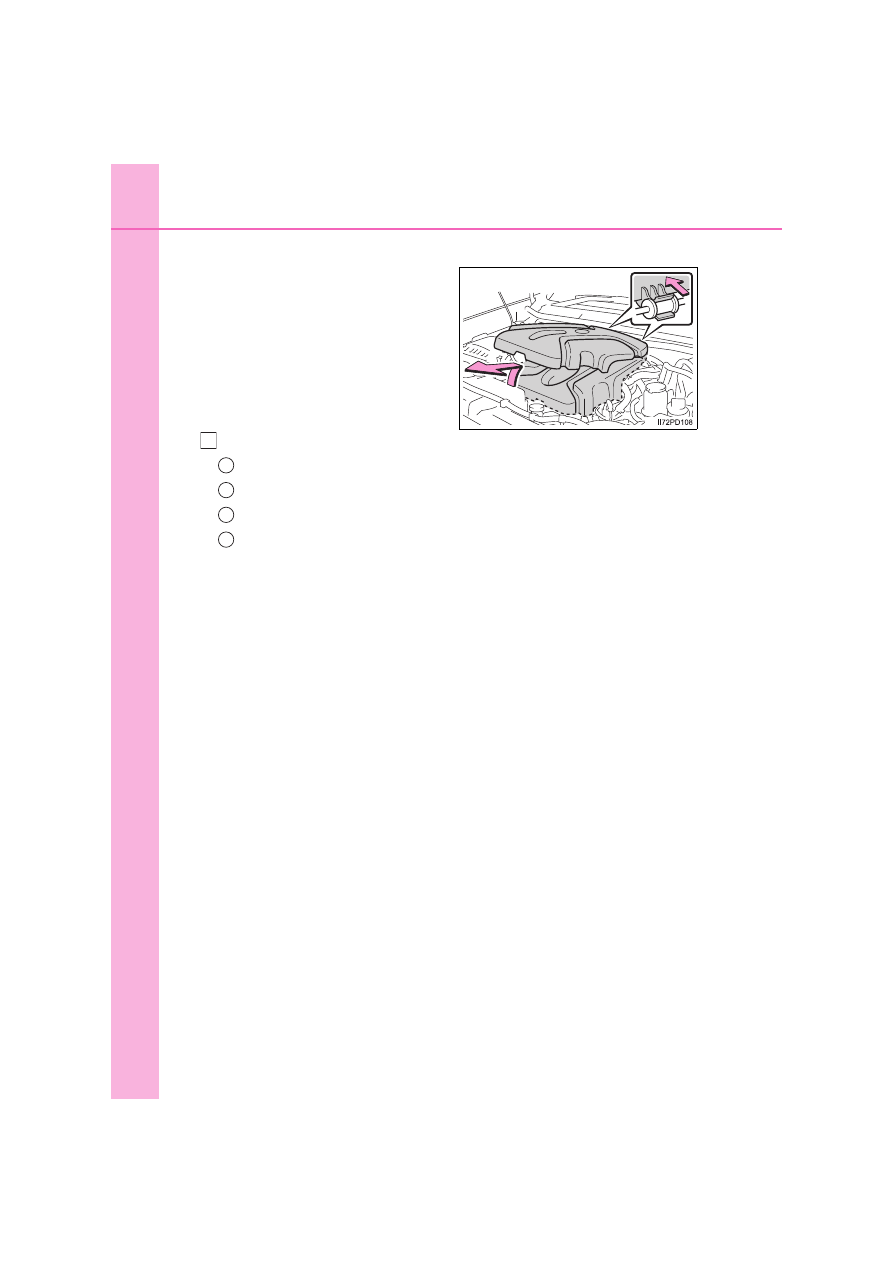
Vehicles with 1GD-FTV engine

Lift the edge of the cover to disen-
gage the fixed pins, and then pull
the cover towards you to remove it.

Connect the jumper cables according to the following procedures:

Positive (+) battery terminal on your vehicle
Positive (+) battery terminal on the second vehicle
Negative (-) battery terminal on the second vehicle
Connect the jumper cable to ground on your vehicle as shown in
the illustration.

4

1
2
3
4

725

8-2. Steps to take in an emergency

8

W

hen
 trou

bl

e ari

se

s

1GR-FE engine

2TR-FE engine

726

8-2. Steps to take in an emergency

1GD-FTV engine

Start the engine of the second vehicle. Increase the engine speed
slightly and maintain at that level for approximately 5 minutes to
recharge the battery of your vehicle.
Vehicles with a smart entry & start system and steering lock sys-
tem: Open and close any of the doors with the engine switch off.
Vehicles without a smart entry & start system: Maintain the engine
speed of the second vehicle and start the engine of your vehicle.
Vehicles with a smart entry & start system: Maintain the engine
speed of the second vehicle and start the engine of your vehicle by
turning the engine switch to IGNITION ON mode.
Once the vehicle’s engine has started, remove the jumper cables in
the exact reverse order in which they were connected.
Vehicles with 1GR-FE and 1GD-FTV engines: To install the engine
cover, conduct the removal procedure in reverse. After installing,
check that the fixed pins are inserted securely.

Once the engine starts, have the vehicle checked at any authorized
Toyota retailer or Toyota authorized repairer, or any reliable repairer,
as soon as possible.

5

6

7

8

9

727

8-2. Steps to take in an emergency

8

W

hen
 trou

bl

e ari

se

s

Starting the engine when the battery is discharged (vehicles with an
automatic transmission)

The engine cannot be started by push-starting.

To prevent battery discharge

Turn off the headlights and the audio system while the engine is off. 
(Vehicles with Stop & Start system: Except when the engine is stopped due
to the Stop & Start system)

Turn off any unnecessary electrical components when the vehicle is running
at a low speed for an extended period, such as in heavy traffic.

Charging the battery 

The electricity stored in the battery will discharge gradually even when the
vehicle is not in use, due to natural discharge and the draining effects of cer-
tain electrical appliances. If the vehicle is left for a long time, the battery may
discharge, and the engine may be unable to start. (The battery recharges
automatically during driving.)

When recharging or replacing the battery (vehicles with a smart entry &
start system)

In some cases, it may not be possible to unlock the doors using the smart
entry & start system when the battery is discharged. Use the wireless
remote control or the mechanical key to lock or unlock the doors.

The engine may not start on the first attempt after the battery has recharged
but will start normally after the second attempt. This is not a malfunction.

The engine switch mode is memorized by the vehicle. When the battery is
reconnected, the system will return to the mode it was in before the battery
was discharged. Before disconnecting the battery, turn the engine switch off.
If you are unsure what mode the engine switch was in before the battery dis-
charged, be especially careful when reconnecting the battery.

Vehicles with Stop & Start system: The Stop & Start system may not auto-
matically stop the engine for up to an hour.

728

8-2. Steps to take in an emergency

When exchanging the battery

Use a battery with the same case size as the previous battery and an equiv-
alent 20 hour rate capacity (20HR) or greater.
• If the sizes differ, the battery cannot be properly secured.
• If the 20 hour rate capacity is low, even if the time period where the vehi-

cle is not used is a short time, the battery may discharge and the engine
may not be able to start.

Vehicles with Stop & Start system: Use a genuine battery specifically
designed for use with the Stop & Start system or a battery with equivalent
specifications to a genuine battery. If an unsupported battery is used, Stop &
Start system functions may be restricted to protect the battery.
Also, battery performance may decrease and the engine may not be able to
restart. Contact any authorized Toyota retailer or Toyota authorized
repairer, or any reliable repairer for details.

For details, consult any authorized Toyota retailer or Toyota authorized
repairer, or any reliable repairer.

729

8-2. Steps to take in an emergency

8

W

hen
 trou

bl

e ari

se

s

WARNING

Avoiding battery fires or explosions

Observe the following precautions to prevent accidentally igniting the flam-
mable gas that may be emitted from the battery:

Make sure the jumper cable is connected to the correct terminal and that it
is not unintentionally in contact with any other than the intended terminal.

Do not allow the + and - clamps of the jumper cables to come into contact
with each other.

Do not smoke, use matches, cigarette lighters or allow open flame near
the battery.

Battery precautions

The battery contains poisonous and corrosive acidic electrolyte, while
related parts contain lead and lead compounds. Observe the following pre-
cautions when handling the battery:

When working with the battery, always wear safety glasses and take care
not to allow any battery fluids (acid) to come into contact with skin, clothing
or the vehicle body.

Do not lean over the battery.

In the event that battery fluid comes into contact with the skin or eyes,
immediately wash the affected area with water and seek medical attention.
Place a wet sponge or cloth over the affected area until medical attention
can be received.

Always wash your hands after handling the battery support, terminals, and
other battery-related parts.

Do not allow children near the battery.

To prevent damaging the vehicle (vehicles with a manual transmission)

Do not pull- or push-start the vehicle, because the catalytic converter may
overheat and become a fire hazard.

NOTICE

When handling jumper cables

When connecting the jumper cables, ensure that they do not become entan-
gled in the cooling fans or belt.

To prevent damage to the engine cover

When removing the cover, make sure that you pull the cover towards you
after lifting the front edge to remove the fixed pins.

When installing the cover, do not force the cover or subject it to strong
shocks.

730

8-2. Steps to take in an emergency

If your vehicle overheats

Stop the vehicle in a safe place and turn off the air conditioning sys-
tem, and then stop the engine.
If you see steam: 
Carefully lift the hood after the steam subsides.
If you do not see steam: 
Carefully lift the hood.
After the engine has cooled down sufficiently, inspect the hoses and
radiator core (radiator) for any leaks.

Radiator
Radiator cooling fan
Cooling fan (if equipped)

If a large amount of coolant
leaks, immediately contact any
authorized Toyota retailer or
Toyota authorized repairer, or
any reliable repairer.

The following may indicate that your vehicle is overheating.

The needle of the engine coolant temperature gauge (

P. 131)

enters the red zone or a loss of engine power is experienced. (For
example, the vehicle speed does not increase.)

Steam is coming from under the hood.

Correction procedures

1

2

3

1
2
3

731

8-2. Steps to take in an emergency

8

W

hen
 trou

bl

e ari

se

s

The coolant level is satisfactory if it is between the “FULL” and
“LOW”/“F” and “L” lines on the reservoir.

Engine coolant

Reservoir
“FULL” or “F”
“LOW” or “L”
Radiator cap (if equipped)

Intercooler coolant (1GD-FTV engine with water-cooled inter-
cooler)

Engine coolant reservoir
“FULL”
“LOW”
Intercooler coolant reservoir

4

1
2
3
4

1
2
3
4

732

8-2. Steps to take in an emergency

Add coolant if necessary.

Water can be used in an emergency if coolant is unavailable.

Diesel engine (for 1GD-FTV engine with water-cooled inter-
cooler)

Start the engine and turn the air conditioning system on to check
that the radiator cooling fans operate and to check for coolant leaks
from the radiator or hoses.

The fans operate when the air conditioning system is turned on immedi-
ately after a cold start. Confirm that the fans are operating by checking the
fan sound and air flow. If it is difficult to check these, turn the air condition-
ing system on and off repeatedly. (The fans may not operate in freezing
temperatures.)

5

Gasoline engine

Diesel engine (except for
1GD-FTV engine with water-
cooled intercooler)

6

733

8-2. Steps to take in an emergency

8

W

hen
 trou

bl

e ari

se

s

If the fans are not operating: 
Stop the engine immediately and contact any authorized Toyota
retailer or Toyota authorized repairer, or any reliable repairer.
If the fans are operating: 
Have the vehicle inspected at the nearest authorized Toyota retailer
or Toyota authorized repairer, or any reliable repairer.

WARNING

When inspecting under the hood of your vehicle

Observe the following precautions. 
Failure to do so may result in serious injury such as burns.

If steam is seen coming from under the hood, do not open the hood until
the steam has subsided. The engine compartment may be very hot.

Keep hands and clothing (especially a tie, a scarf or a muffler) away from
the fans and belts. Failure to do so may cause the hands or clothing to be
caught, resulting in serious injury.

Do not loosen the radiator cap (if equipped) or the coolant reservoir cap
while the engine and radiator are hot. High temperature steam or coolant
could spray out.

NOTICE

When adding engine coolant

Add coolant slowly after the engine has cooled down sufficiently. Adding
cool coolant to a hot engine too quickly can cause damage to the engine.

To prevent damage to the cooling system

Observe the following precautions:

Avoid contaminating the coolant with foreign matter (such as sand or dust
etc.).

Do not use any coolant additive.

7

734

8-2. Steps to take in an emergency

If you run out of fuel and the engine stalls 

(diesel engine only)

If you run out of fuel and the engine stalls:

Refuel your vehicle.

To bleed the fuel system, oper-
ate the priming pump until you
feel more resistance.

Start the engine. (

P. 266, 270)

If the engine does not start after the above steps have been performed,
wait for 10 seconds and try step   and   again. If the engine still does
not start, contact any authorized Toyota retailer or Toyota authorized
repairer, or any reliable repairer.

After starting the engine, depress the accelerator pedal lightly until the
engine runs smoothly.

1

2

NOTICE

When restarting the engine

Do not crank the engine before refueling and operating the priming pump.
This may damage the engine and fuel system.

Do not crank the engine for more than 30 seconds at a time. This may
overheat the starter and wiring system.

3

2

3

735

8-2. Steps to take in an emergency

8

W

hen
 trou

bl

e ari

se

s

If the vehicle becomes stuck

Stop the engine. Set the parking brake and put the shift lever in P
(automatic transmission) or N (manual transmission).
Remove the mud, snow, or sand from around the stuck tire.
Place wood, stones or some other material to help provide traction
under the tires.
Restart the engine.
Shift the shift lever to D or R (automatic transmission) or 1 or R
(manual transmission) and release the parking brake. Then, while
exercising caution, depress the accelerator pedal.

When it is difficult to free the vehicle

Turn off TRC and/or VSC if these functions are hampering your attempts to
free the vehicle. (

P. 418)

Carry out the following procedures if the tires spin or the vehicle
becomes stuck in mud, dirt, or snow:

Press 

 or 

 to turn off TRC.

1

2

3

4

5

736

8-2. Steps to take in an emergency

WARNING

When attempting to free a stuck vehicle

If you choose to push the vehicle back and forth to free it, make sure the
surrounding area is clear, to avoid striking other vehicles, objects or people.
The vehicle may also lunge forward or lunge back suddenly as it becomes
free. Use extreme caution.

When shifting the shift lever

For vehicles with an automatic transmission, be careful not to shift the shift
lever with the accelerator pedal depressed.
This may lead to unexpected rapid acceleration of the vehicle that may
cause an accident and result in death or serious injury.

NOTICE

To avoid damaging the transmission and other components

Avoid spinning the wheels and depressing the accelerator pedal more
than necessary.

If the vehicle remains stuck even after these procedures are performed,
the vehicle may require towing to be freed.

Vehicles with the multi-information display type A: When the automatic
transmission fluid temperature warning light comes on while attempting to
free a stuck vehicle, immediately remove your foot from the accelerator
pedal and wait until the warning light turns off. Otherwise, the transmission
may become damaged. (

P. 660)

Vehicles with the multi-information display type B: When a warning mes-
sage for the automatic transmission fluid temperature is displayed while
attempting to free a stuck vehicle, immediately remove your foot from the
accelerator pedal and wait until the warning message disappears. Other-
wise, the transmission may become damaged. (

P. 672)

737

9

Vehicle specifications

9-1. Specifications

Maintenance data 

(fuel, oil level, etc.)...........738

Fuel information .................765

9-2. Customization

Customizable features .......769

9-3. Items to initialize

Items to initialize ................783

738

9-1. Specifications

Maintenance data (fuel, oil level, etc.)

Dimensions and weights

Overall length

5-door models

4840 mm (190.6 in.)

3-door models

4565 mm (179.7 in.)

*

1

4395 mm (173.0 in.)

*

2

Overall width

1885 mm (74.2 in.)

Overall height

*

3

5-door models
(Vehicles with-
out rear height
control air sus-
pension)

1845 mm (72.6 in.)

*

4, 6

1855 mm (73.0 in.)

*

4, 7

1890 mm (74.4 in.)

*

4, 8

1895 mm (74.6 in.)

*

5

5-door models
(Vehicles with
rear height con-
trol air suspen-
sion)

1835 mm (72.2 in.)

*

4, 6

1845 mm (72.6 in.)

*

4, 7

1880 mm (74.0 in.)

*

4, 8

1885 mm (74.2 in.)

*

5

3-door models

1845 mm (72.6 in.)

*

6

1875 mm (73.8 in.)

*

8

Wheelbase

5-door models

2790 mm (109.8 in.)

3-door models

2450 mm (96.5 in.)

Front and rear tread

1605 mm (63.2 in.)

*

9

1585 mm (62.4 in.)

*

10

Gross
vehicle 
mass

1GR-FE engine

Except for 2-seat models
2900 kg (6393 lb.)
For 2-seat models
2830 kg (6239 lb.)

2TR-FE engine

2850 kg (6283 lb.)

1GD-FTV 
engine

5-door models

2990 kg (6592 lb.)

*

11

2950 kg (6504 lb.)

*

12

2930 kg (6460 lb.)

*

13

3-door models

2600 kg (5732 lb.)

Maximum 
permissible axle 
capacity

Front

1450 kg (3197 lb.)

Rear

1800 kg (3968 lb.)

*

14

1730 kg (3814 lb.)

*

15

739

9-1. Specifications

9

V

eh

icl

e s
pe

cif

ic

at

io

ns

*

1

: Vehicles with back door mounted spare tire with the spare tire cover

*

2

: Vehicles without a spare tire

*

3

: Unladen vehicles

*

4

: Vehicles without roof antenna

*

5

: Vehicles with roof antenna

*

6

: Vehicles without roof rail

*

7

: Vehicles with flat type roof rail

*

8

: Vehicles with bridge type roof rail

*

9

: P245/70R17 or 245/70R17 tires

*

10

: P265/65R17, 265/65R17, P265/60R18, 265/60R18 or 265/55R19 tires

*

11

: Vehicles except 2-seat models

*

12

: Vehicles with an automatic transmission (2-seat models)

*

13

: Vehicles with a manual transmission (2-seat models)

*

14

: Vehicles with 17-inch or 18-inch tires

*

15

: Vehicles with 19-inch tires

*

16

: Except for vehicles with model code

*

20

 that has “K” as the last letter

*

17

: Vehicles with model code

*

20

 that has “K” as the last letter

*

18

: Vehicles with 1GD-FTV engine or GRJ150L-GKTEKW and

GRJ150L-GKTEKX models

*

20

*

19

: Vehicles with 2TR-FE engine or GRJ150L-GKTEK model

*

20

*

20

: The model code is indicated on the manufacturer’s label. (

P. 740)

Drawbar load

120 kg (265 lb.)

*

16

60 kg (132 lb.)

*

17

Towing capacity

With brake

3000 kg (6614 lb.)

*

18

1500 kg (3307 lb.)

*

19

Without brake

750 kg (1653 lb.)


Content      ..     43      44      45      46     ..