Toyota Tundra (2023 year). Manual in english - page 28
 

  Index      Toyota     Toyota Tundra (2023 year). Manual in english


Search            copyright infringement  


Content      ..     26      27      28      29     ..


Toyota Tundra (2023 year). Manual in english - page 28


449

5-4. Using the other interior features

5

Interior

 featur

es

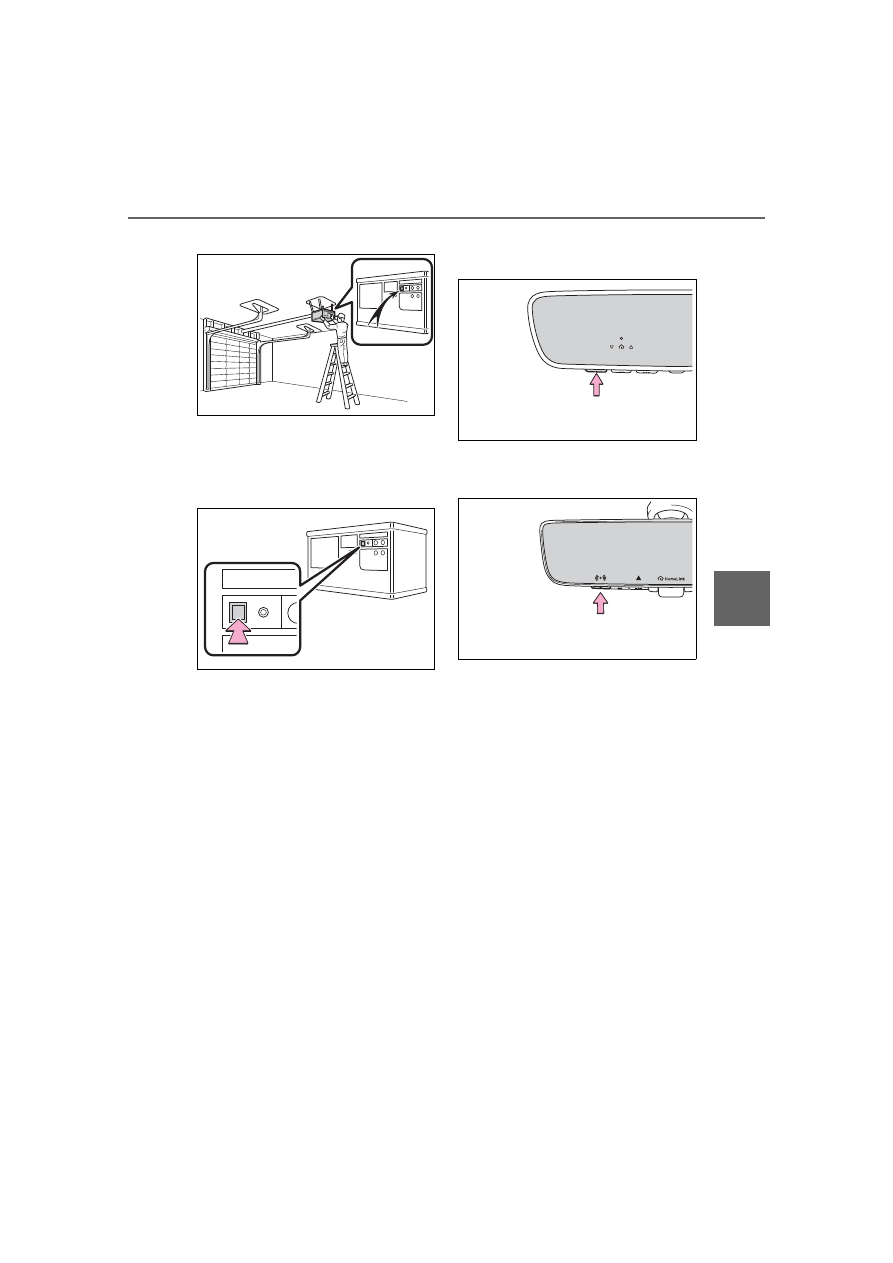
door opener motor for details.

2

Press and release the 
“Learn” or “Smart” button.

Perform 

3

 within 30 seconds after 

performing 

2

.

3

Press and hold the desired 
HomeLink

®

 button (inside the 

vehicle) for 2 seconds and 
release it. Repeat this 
sequence 
(press/hold/release) up to 3 
times to complete program-
ming.
If the garage door opener 
motor operates when the 
HomeLink

®

 button is 

pressed, the garage door 
opener motor recognizes the 
HomeLink

®

 signal.

Vehicles with auto anti-glare 
inside rear view mirror

Vehicles with Digital Rear-
view Mirror

Enabling 2-way communi-
cation with a garage door 
(only available for compati-
ble devices)

When enabled, 2-way communi-
cation allows you to check the 
status of the opening and clos-
ing of a garage door through 
indicators in your vehicle.
2-way communication is only 
available if the garage door 
opener motor used is a compati-
ble device. (To check device 
compatibility, refer to 
www.homelink.com.)

1

Within 5 seconds after pro-
gramming the garage door 
opener has been completed, 

450

5-4. Using the other interior features

if the garage door opener 
motor is trained to Home-
Link

®

, both garage door 

operation indicators will flash 
rapidly (green) and the light 
on the garage door opener 
motor will blink twice, indicat-
ing that 2-way communica-
tion is enabled.

If the indicators do not flash, per-

form 

2

 and 

3

 within the first 10 

presses of the HomeLink

®

 button 

after programming has been com-

pleted.

2

Press a programmed Home-
Link

®

 button to operate a 

garage door.

3

Within 1 minute of pressing 
the HomeLink

®

 button, after 

the garage door operation 
has stopped, press the 
“Learn” or “Smart” button on 
the garage door opener 
motor. Within 5 seconds of 
the establishment of 2-way 
communication with the 
garage door opener, both 
garage door operation indica-
tors in the vehicle will flash 
rapidly (green) and the light 
on the garage door opener 
motor will blink twice, indicat-
ing that 2-way communica-
tion is enabled.

Reprogramming a single 
HomeLink

®

 button

When the following procedure is 
performed, buttons which 
already have devices registered 

to them can be overwritten:

1

Press and hold the desired 
HomeLink

®

 button.

2

When the HomeLink

®

 indica-

tor starts flashing orange, 
release the HomeLink

®

 but-

ton and perform “Program-
ming HomeLink

®

” 

1

 (it takes 

20 seconds for the Home-
Link

®

 indicator to start flash-

ing).

Before programming

Install a new battery in the trans-

mitter.

The battery side of the transmitter 

must be pointed away from the 
HomeLink

®

 buttons.

Press the appropriate Home-
Link

®

 button. The HomeLink

®


indicator light should turn on.
The status of the opening and 
closing of a garage door is 
shown by the garage door 
opener indicators.

Vehicles with auto anti-glare 
inside rear view mirror

Operating HomeLink

®

451

5-4. Using the other interior features

5

Interior

 featur

es

Opening

Closing

Vehicles with Digital Rear-
view Mirror

Opening

Closing

This function is only available if the 
garage door opener motor used is a 
compatible device. (To check 
device compatibility, refer to 
www.homelink.com.)

The indicators can operate 
within approximately 820 ft. (250 
m) of the garage door. However, 
if there are obstructions 
between the garage door and 
the vehicle, such as houses and 
trees, feedback signals from the 
garage door may not be 
received.

To recall the previous door oper-
ation status, press and release 
either HomeLink

®

 buttons 


and 

 or 

 and 

 (vehicles 

with auto anti-glare inside rear 
view mirror), 

 and 


or 

 and 

 (vehicles 

with Digital Rear-view Mirror), 
simultaneously. The last 
recorded status will be dis-
played for 3 seconds.

Press and hold the 2 outside 
buttons for 10 seconds until the 
HomeLink

®

 indicator light 

changes from continuously lit 
(orange) to rapidly flashing 
(green).

If you sell your vehicle, be sure to 
erase the programs stored in the 
HomeLink

®

 memory.

Vehicles with auto anti-glare 
inside rear view mirror

Color

Status

Orange (flash-

ing)

Currently open-

ing/closing

Green

Opening/closing 

has completed

Red (flashing)

Feedback sig-

nals cannot be 

received

Erasing the entire Home-
Link

®

 memory (all three 

codes)

452

5-4. Using the other interior features

Vehicles with Digital Rear-
view Mirror

453

6

6

Maintena

nce
 a

nd ca

re

Maintenance and care

6-1. Maintenance and care

Cleaning and protecting the 

vehicle exterior ..........

454

Cleaning and protecting the 

vehicle interior ...........

458

6-2. Maintenance

Maintenance requirements

..................................

461

General maintenance..

462

Emission inspection and 

maintenance (I/M) pro-
grams ........................

465

6-3. Do-it-yourself mainte-

nance

Do-it-yourself service pre-

cautions.....................

466

Hood ...........................

468

Engine compartment...

469

Tires ............................

477

Tire inflation pressure..

487

Wheels ........................

489

Air conditioning filter....

491

Electronic key battery..

492

Checking and replacing 

fuses..........................

494

Light bulbs...................

498

454

6-1. Maintenance and care

6-1.Maintenance and care

Working from top to bottom, 
liberally apply water to the 
vehicle body, wheel wells and 
underside of the vehicle to 
remove any dirt and dust.

Wash the vehicle body using 
a sponge or soft cloth, such 
as a chamois.

For hard-to-remove marks, 
use car wash soap and rinse 
thoroughly with water.

Wipe away any water.

Wax the vehicle when the 
waterproof coating deterio-
rates.

If water does not bead on a clean 
surface, apply wax when the vehi-
cle body is cool.

Automatic car washes

Fold the mirrors before washing 

the vehicle.

Start washing from the front of the 
vehicle. Extend the mirrors before 
driving.

Brushes used in automatic car 

washes may scratch the vehicle 

surface, parts (wheel, etc.) and 

harm your vehicle’s paint.

High pressure car washes

As water may enter the cabin, do 

not bring the nozzle tip near the 

gaps around the doors or perimeter 

of the windows, or spray these 

areas continuously.

When using a car wash

If the door handle becomes wet 

while the electronic key is within the 

effective range, the door may lock 

and unlock repeatedly. In that case, 

follow the following correction pro-

cedures to wash the vehicle:

Place the key in a position 6 ft. (2 

m) or more separate from the 

vehicle while the vehicle is being 

washed. (Take care to ensure that 

the key is not stolen.)

Set the electronic key to battery-

saving mode to disable the Smart 

key system. (

P.127)

Wheels and wheel ornaments

Remove any dirt immediately by 

using a neutral detergent.

Wash detergent off with water 

immediately after use.

To protect the paint from damage, 

make sure to observe the follow-

ing precautions.

• Do not use acidic, alkaline or 

abrasive detergent

• Do not use hard brushes

• Do not use detergent on the 

wheels when they are hot, such 

as after driving or parking in hot 

weather

Brake pads and calipers

Rust may form if the vehicle is 

parked with wet brake pads or disc 

rotors, causing them to stick. Before 

parking the vehicle after it is 

washed, drive slowly and apply the 

brakes several times to dry the 

parts.

Bumpers and wheel arch mold-

ings

Do not scrub with abrasive cleaners.

Cleaning and protect-

ing the vehicle exte-

rior

Perform cleaning in a man-
ner appropriate to each 
component and its material.

Cleaning instructions

455

6-1. Maintenance and care

6

Maintena

nce
 a

nd ca

re

Plated portions

If dirt cannot be removed, clean the 

parts as follows:

Use a soft cloth dampened with an 

approximately 5% solution of neu-

tral detergent and water to clean 

the dirt off.

Wipe the surface with a dry, soft 

cloth to remove any remaining 

moisture.

To remove oily deposits, use alco-

hol wet wipes or a similar product.

WARNING

When washing the vehicle

Do not apply water to the inside of 

the engine compartment. Doing 

so may cause the electrical com-

ponents, etc. to catch fire.

Precautions regarding the 

exhaust pipe

Exhaust gases cause the exhaust 

pipe to become quite hot. When 

washing the vehicle, be careful 

not to touch the pipe until it has 

cooled sufficiently, as touching hot 

exhaust pipe can cause burns.

When cleaning the windshield 

(vehicles with rain-sensing 

windshield wipers)

Set the wiper switch to off.

If the wiper switch is in “AUTO”, 

the wipers may operate unexpect-

edly in the following situations, 

and may result in hands being 

caught or other serious injuries 

and cause damage to the wiper 

blades.

Off

“AUTO”

When the upper part of the 

windshield where the raindrop 

sensor is located is touched by 

hand

When a wet rag or similar is 

held close to the raindrop sen-

sor

If something bumps against the 

windshield

If you directly touch the raindrop 

sensor body or if something 

bumps into the raindrop sensor

Precaution regarding the rear 

bumper with Blind Spot Moni-

tor (vehicles with painted rear 

bumper)

If the paint of the rear bumper is 

chipped or scratched, the follow-

ing systems may not function cor-

rectly. If this occurs, consult your 

Toyota dealer.

BSM

RCTA

456

6-1. Maintenance and care

WARNING

PKSB

NOTICE

To prevent paint deteriora-

tion and corrosion on the 

body and components (alumi-

num wheels, etc.)

Wash the vehicle immediately in 

the following cases:

• After driving near the sea coast

• After driving on salted roads

• If coal tar or tree sap is present 

on the paint surface

• If dead insects, insect droppings 

or bird droppings are present on 

the paint surface

• After driving in an area contami-

nated with soot, oily smoke, 

mine dust, iron powder or chem-

ical substances

• If the vehicle becomes heavily 

soiled with dust or mud

• If liquids such as benzene and 

gasoline are spilled on the paint 

surface

If the paint is chipped or 

scratched, have it repaired 

immediately.

To prevent the wheels from cor-

roding, remove any dirt and 

store in a place with low humid-

ity when storing the wheels.

Cleaning the exterior lights

Wash carefully. Do not use 

organic substances or scrub 

with a hard brush.

This may damage the surfaces 

of the lights.

Do not apply wax to the sur-

faces of the lights.

Wax may cause damage to the 

lenses.

When using an automatic car 

wash (vehicles with rain-

sensing windshield wipers)

Set the wiper switch to the off 

position.

If the wiper switch is in “AUTO”, 

the wipers may operate and the 

wiper blades may be damaged.

When using a high pressure 

car wash

When washing the vehicle, do 

not spray the camera or its sur-

rounding area directly with a 

high pressure washer. Shock 

applied from high pressure 

water may cause the device to 

not operate normally.

On vehicles with Toyota Safety 

Sense 2.5, do not spray water 

directly on the radar which is 

equipped behind the emblem. 

Otherwise it may cause the 

device to be damaged.

Do not bring the nozzle tip close 

to boots (rubber or resin manu-

factured cover), connectors or 

the following parts. The parts 

may be damaged if they come 

into contact with high-pressure 

water.

• Traction related parts

• Steering parts

• Suspension parts

• Brake parts

457

6-1. Maintenance and care

6

Maintena

nce
 a

nd ca

re

NOTICE

Keep the cleaning nozzle at 

least 11.9 in. (30 cm) away from 

the vehicle body. Otherwise 

resin section, such as moldings 

and bumpers, may be deformed 

and damaged.

Also, do not continuously hold the 
nozzle in the same place.

Do not spray the lower part of 

the windshield continuously.

If water enters the air conditioning 
system intake located near the 
lower part of the windshield, the 
air conditioning system may not 
operate correctly.

Do not wash the underside of 

the vehicle using a high pres-

sure car washer.

When raising the windshield 

wiper arms

Make sure to hold the hook parts 

of the wiper arms to raise them.

Do not hold only the wiper blades 

when raising them, or it may 

cause deformation of the wiper 

blades.

Hook parts

Cleaning the high mounted 

stoplight and cargo lamps

When using high-pressured car 

washers, the tip of the nozzle 

should be at least 20 in. (50 cm) 

from the car body. Water can 

seep lamp housing or the vehicle 

cabin if the nozzle is closer to the 

car body.

458

6-1. Maintenance and care

Remove dirt and dust using a 
vacuum cleaner. Wipe dirty 
surfaces with a cloth damp-
ened with lukewarm water.

If dirt cannot be removed, 
wipe it off with a soft cloth 
dampened with neutral deter-
gent diluted to approximately 
1%.
Wring out any excess water 
from the cloth and thoroughly 
wipe off remaining traces of 
detergent and water.

Shampooing the carpets

There are several commercial foam-

ing-type cleaners available. Use a 

sponge or brush to apply the foam. 

Rub in overlapping circles. Do not 

use water. Wipe dirty surfaces and 

let them dry. Excellent results are 

obtained by keeping the carpet as 

dry as possible.

Handling the seat belts

Clean with mild soap and lukewarm 

water using a cloth or sponge. Also 

check the belts periodically for 

excessive wear, fraying or cuts.

Cleaning and protect-

ing the vehicle interior

Perform cleaning in a man-
ner appropriate to each 
component and its material.

Protecting the vehicle 
interior

WARNING

Water in the vehicle

Do not get any of the SRS compo-

nents or wiring in the vehicle inte-

rior wet. (

P.36)

An electrical malfunction may 

cause the airbags to deploy or not 

function properly, resulting in 

death or serious injury.

Cleaning the interior (espe-

cially instrument panel)

Do not use a polish wax or polish 

cleaner. The instrument panel 

may reflect off the windshield, 

obstructing the driver’s view and 

leading to an accident, resulting in 

death or serious injury.

NOTICE

Cleaning detergents

Do not use the following types 

of detergent, as they may dis-

color the vehicle interior or 

cause streaks or damage to 

painted surfaces:

• Areas other than the seats and 

steering wheel: Organic sub-

stances such as benzene or 

gasoline, alkaline or acidic solu-

tions, dye, and bleach

• Seats: Alkaline or acidic solu-

tions, such as thinner, benzene, 

and alcohol

• Steering wheel: Organic sub-

stances, such as thinner, and 

cleaner that contains alcohol

Do not use a polish wax or pol-

ish cleaner. The instrument 

panel’s or other interior part’s 

painted surface may be dam-

aged.

459

6-1. Maintenance and care

6

Maintena

nce
 a

nd ca

re

Remove dirt using a water-
dampened soft cloth or syn-
thetic chamois.

Wipe the surface with a dry, 
soft cloth to remove any 
remaining moisture.

Cleaning the areas with satin-

finish metal accents

The metal areas use a layer of real 

metal for the surface. It is necessary 

to clean them regularly. If dirty areas 

are left uncleaned for long periods 

of time, they may be difficult to 

clean.

Remove dirt and dust using a 
vacuum cleaner.

Wipe off any excess dirt and 
dust with a soft cloth damp-
ened with diluted detergent.

Use a diluted water solution of 
approximately 5% neutral wool 

NOTICE

Preventing damage to leather 

surfaces

Observe the following precautions 

to avoid damage to and deteriora-

tion of leather surfaces:

Remove any dust or dirt from 

leather surfaces immediately.

Do not expose the vehicle to 

direct sunlight for extended peri-

ods of time. Park the vehicle in 

the shade, especially during 

summer.

Do not place items made of 

vinyl, plastic, or containing wax 

on the upholstery, as they may 

stick to the leather surface if the 

vehicle interior heats up signifi-

cantly.

Water on the floor

Do not wash the vehicle floor with 

water.

Vehicle systems such as the 

audio system may be damaged if 

water comes into contact with 

electrical components such as the 

audio system above or under the 

floor of the vehicle. Water may 

also cause the body to rust.

When cleaning the inside of 

the windshield (vehicles with 

Toyota Safety Sense 2.5)

Do not allow glass cleaner to con-

tact the lens. Also, do not touch 

the lens. (

P.230)

Cleaning the inside of the 

back window

Do not use a glass cleaner to 

clean the back window, as this 

may cause damage to the back 

window defogger heater wires 

or antenna. Use a cloth damp-

ened with lukewarm water to 

gently wipe the window clean. 

Wipe the window in strokes run-

ning parallel to the heater wires 

or antenna.

Be careful not to scratch or 

damage the heater wires or 

antenna.

Cleaning the areas with 
satin-finish metal accents

Cleaning the leather areas

460

6-1. Maintenance and care

detergent.

Wring out any excess water 
from the cloth and thoroughly 
wipe off all remaining traces 
of detergent.

Wipe the surface with a dry, 
soft cloth to remove any 
remaining moisture. Allow the 
leather to dry in a shaded and 
ventilated area.

Caring for leather areas

Toyota recommends cleaning the 

interior of the vehicle at least twice a 

year to maintain the quality of the 

vehicle’s interior.

Remove dirt and dust using a 
vacuum cleaner.

Wipe it off with a soft cloth 
dampened with neutral deter-
gent diluted to approximately 
1%.

Wring out any excess water 
from the cloth and thoroughly 
wipe off remaining traces of 
detergent and water.

Cleaning the synthetic 
leather areas

461

6-2. Maintenance

6

Maintena

nce
 a

nd ca

re

6-2.Maintenance

Repair and replacement

It is recommended that genuine 

Toyota parts be used for repairs to 

ensure performance of each sys-

tem. If non-Toyota parts are used in 

replacement or if a repair shop other 

than a Toyota dealer performs 

repairs, confirm the warranty cover-

age.

Allow inspection and repairs to 

be performed by a Toyota 

dealer

Toyota technicians are well-

trained specialists and are kept up 

to date with the latest service 

information. They are well 

informed about the operation of all 

systems on your vehicle.

Keep a copy of the repair order. It 

proves that the maintenance that 

has been performed is under war-

ranty coverage. If any problem 

should arise while your vehicle is 

under warranty, your Toyota 

dealer will promptly take care of it.

General maintenance should be 
performed on a daily basis. This 
can be done by yourself or by a 
Toyota dealer.

Scheduled maintenance should 
be performed at specified inter-
vals according to the mainte-
nance schedule.

For details about maintenance 
items and schedules, refer to the 
“Scheduled Maintenance Guide” or 
“Owner’s Manual Supplement”.

Maintenance require-

ments

To ensure safe and econom-
ical driving, day-to-day care 
and regular maintenance 
are essential. It is the 
owner’s responsibility to 
perform regular checks. 
Toyota recommends the 
maintenance below.

WARNING

If your vehicle is not properly 

maintained

Improper maintenance could 

result in serious damage to the 

vehicle and possible death or seri-

ous injury.

Handling of the battery

Engine exhaust, some of its 

constituents, and a wide variety 

of automobile components con-

tain or emit chemicals known to 

the State of California to cause 

cancer and birth defects and 

other reproductive harm. Work 

in a well ventilated area.

Oils, fuels and fluids contained 

in vehicles as well as waste pro-

duced by component wear con-

tain or emit chemicals known to 

the State of California to cause 

cancer and birth defects or 

other reproductive harm. Avoid 

exposure and wash any 

affected area immediately.

Battery posts, terminals and 

related accessories contain lead 

and lead compounds which are 

known to cause brain damage. 

Wash your hands after han-

dling. (

P.474)

General maintenance

Scheduled maintenance

462

6-2. Maintenance

Resetting the message indicat-

ing maintenance is required

After the required maintenance is 

performed according to the mainte-

nance schedule, please reset the 

message.

To reset the message, follow the 

procedure described below:

1

Press 

 or 

 of meter control 

switches and select 

 on the 

multi-information display.

2

Press 

 or 

 of meter control 

switches and select “Vehicle Set-
tings”, and then press and hold 

.

3

Press 

 or 

 of meter control 

switches and select “Scheduled 
Maintenance”, and then press 

.

4

Select the “Yes” and press 

.

You can perform some mainte-
nance procedures by yourself.
Please be aware that do-it-your-
self maintenance may affect 
warranty coverage.

The use of Toyota repair manuals is 
recommended.
For details about warranty cover-
age, refer to the separate “Owner’s 
Warranty Information Booklet” or 
“Owner’s Manual Supplement”.

Do-it-yourself mainte-
nance

General maintenance

Listed below are the general 
maintenance items that 
should be performed at the 
intervals specified in the 
“Owner’s Warranty Informa-
tion Booklet” or “Owner’s 
Manual Supplement/Sched-
uled Maintenance Guide”. It 
is recommended that any 
problem you notice should 
be brought to the attention 
of your Toyota dealer or 
qualified service shop for 
advice.

WARNING

If the engine is operating

Turn the engine off and ensure 

that there is adequate ventilation 

before performing maintenance 

checks.

Engine compartment

Items

Check points

Battery

Check the connec-
tions. (

P.474)

Brake fluid

Is the brake fluid at 
the correct level? 
(

P.473)

Engine coolant

Is the engine cool-
ant at the correct 
level? (

P.472)

Engine oil

Is the engine oil at 
the correct level? 
(

P.470)

463

6-2. Maintenance

6

Maintena

nce
 a

nd ca

re

Exhaust sys-
tem

There should not 
be any fumes or 
strange sounds.

Radiator/con-
denser

The radiator and 
condenser should 
be free from for-
eign objects. 
(

P.473)

Washer fluid

Is there sufficient 
washer fluid? 
(

P.476)

Vehicle interior

Items

Check points

Accelerator 
pedal

• The accelerator 

pedal should 
move smoothly 
(without uneven 
pedal effort or 
catching).

Automatic 
transmission 
“Park” mecha-
nism

• When parked on 

a slope and the 
shift lever is in P, 
is the vehicle 
securely 
stopped?

Brake pedal

• Does the brake 

pedal move 
smoothly?

• Does the brake 

pedal have 
appropriate 
clearance from 
the floor?

• Does the brake 

pedal have the 
correct amount 
of free play?

Items

Check points

Brakes

• The vehicle 

should not pull to 
one side when 
the brakes are 
applied.

• The brakes 

should work 
effectively.

• The brake pedal 

should not feel 
spongy.

• The brake pedal 

should not get 
too close to the 
floor when the 
brakes are 
applied.

Head 
restraints

• Do the head 

restraints move 
smoothly and 
lock securely?

Indica-
tors/buzzers

• Do the indica-

tors and buzzers 
function prop-
erly?

Parking brake

• Does the park-

ing brake oper-
ate normally?

• When parked on 

a slope and the 
parking brake is 
on, is the vehicle 
securely 
stopped?

Seat belts

• Do the seat belts 

operate 
smoothly?

• The seat belts 

should not be 
damaged.

Items

Check points

464

6-2. Maintenance

Seats

• Do the seat con-

trols operate 
properly?

Steering wheel

• Does the steer-

ing wheel rotate 
smoothly?

• Does the steer-

ing wheel have 
the correct 
amount of free 
play?

• There should not 

be any strange 
sounds coming 
from the steer-
ing wheel.

Vehicle exterior

Items

Check points

Doors

• Do the doors 

operate 
smoothly?

Engine hood

• Does the hood 

lock system work 
properly?

Fluid leaks

• There should not 

be any signs of 
fluid leakage 
after the vehicle 
has been parked.

Lights

• Do all the lights 

come on?

Items

Check points

Tires

• Is the tire infla-

tion pressure 
correct?

• The tires should 

not be damaged 
or excessively 
worn.

• Have the tires 

been rotated 
according to the 
maintenance 
schedule?

• The wheel nuts 

should not be 
loose.

Windshield 
wipers

• The wiper blades 

should not show 
any signs of 
cracking, split-
ting, wear, con-
tamination or 
deformation.

• The wiper blades 

should clear the 
windshield with-
out streaking or 
skipping.

Items

Check points


Content      ..     26      27      28      29     ..