Toyota Tacoma (2023 year). Manual in english - page 18
 

  Index      Toyota     Toyota Tacoma (2023 year). Manual in english


Search            copyright infringement  


Content      ..     16      17      18      19     ..


Toyota Tacoma (2023 year). Manual in english - page 18


300

4-5. Using the driving support systems

When towing a trailer

When there is a significant difference in height between your vehicle and the
vehicle that enters the detection area

When a sensor or the area around a sensor is extremely hot or cold

If the suspension has been modified or tires of a size other than specified
are installed

If the front of the vehicle is raised or lowered due to the carried load

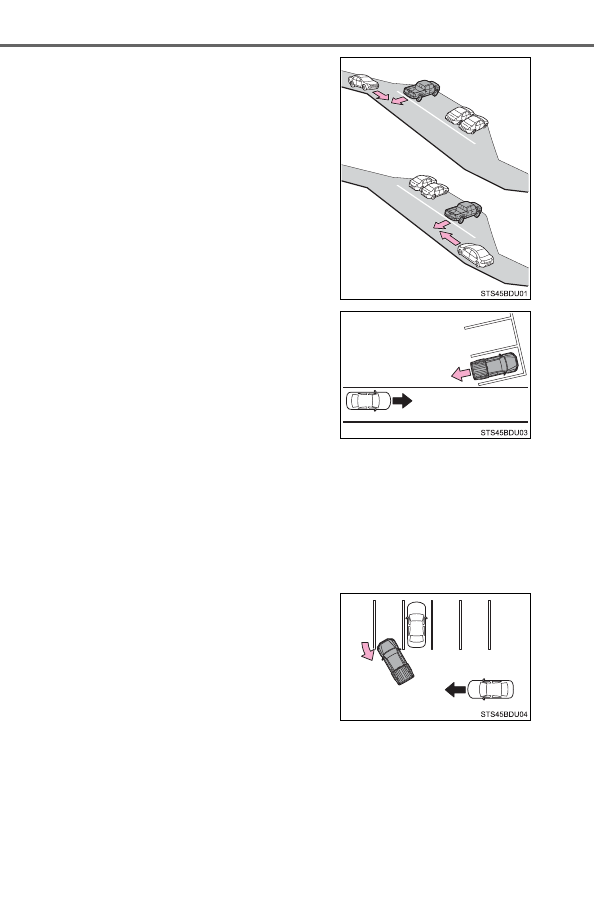
When  backing  up  on  a  slope  with  a
sharp change in grade

When backing out of a sharp angle park-
ing spot

When turning while backing up

301

4-5. Using the driving support systems

4

Dr

ivi

ng

Situations in which the system may operate even if there is no possibil-
ity of a collision

Instances of the RCTA function unnecessary detecting a vehicle and/or object
may increase in the following situations:

When equipment that may obstruct a sensor is installed, such as a towing
eyelet,  bumper  protector  (an  additional  trim  strip,  etc.),  bicycle  carrier,  or
snow plow

Vehicles that the sensors cannot detect
due to obstructions

When  the  parking  space  faces  a  street
and  vehicles  are  being  driven  on  the
street

When the distance between your vehicle
and  metal  objects,  such  as  a  guardrail,
wall, sigh, or parked vehicle, which may
reflect  electrical  waves  toward  the  rear
of the vehicle, is short

When  a  vehicle  passes  by  the  side  of
your vehicle

302

4-5. Using the driving support systems

When there are spinning objects near your vehicle such as the fan of an air
conditioning unit

When water is splashed or sprayed toward the rear bumper, such as from a
sprinkler

Moving objects (flags, exhaust fumes, large rain droplets or snowflakes, rain
water on the road surface, etc.)

When  the  distance  between  your  vehicle  and  a  guardrail,  wall,  etc.,  that
enters the detection area is short

Gratings and gutters

When a sensor or the area around a sensor is extremely hot or cold

If the suspension has been modified or tires of a size other than specified
are installed

If the front of the vehicle is raised or lowered due to the carried load

When  a  detected  vehicle  turns  while
approaching the vehicle

303

4-5. Using the driving support systems

4

Dr

ivi

ng

Four-wheel drive system

Use the front-wheel drive control switch to select the following transfer
modes:

“2WD” (high speed position, two-wheel drive)

Use  this  for  normal  driving  on  dry  hard-surfaced  roads.  This  position
gives greater economy, quietest ride and least wear.

“4H” (high speed position, four-wheel drive)

Use this for driving only on tracks that permit the tires slide, like off-road,
icy or snow-covered roads. This position provides greater traction than
two-wheel drive.
The four-wheel drive indicator will come on.

“4L” (low speed position, four-wheel drive)

Use  this  for  maximum  power  and  traction.  Use  “4L”  for  climbing  or
descending steep hills, off-road driving, and hard pulling in sand, mud or
deep snow.
The four-wheel drive and “4LO” indicator will come on.

: If equipped

Summary of functions

1

2

3

304

4-5. Using the driving support systems

Shifting from “2WD” to “4H”

Reduce vehicle speed to less than 62 mph (100 km/h).
Turn the front-wheel drive control switch to “4H”.

The four-wheel drive indicator will come on.

Shifting from “4H” to “2WD”

Turn the front-wheel drive control switch to “2WD”. 
This can be done at any speed. You need not depress the clutch
pedal. (manual transmission only)

The four-wheel drive indicator will go off.

Shifting from “4H” to “4L”

Automatic transmission
Stop  the  vehicle  completely  and  continue  to  depress  the  brake
pedal.
Shift the shift lever to N.
Push and turn the front-wheel drive control switch to “4L”.

The “4LO” indicator will come on. 
If the four-wheel drive indicator flashes and the buzzer sounds, try the
above steps again.

Manual transmission
Stop the vehicle or reduce your speed to less than 2 mph (3 km/h).
Depress and hold the clutch pedal.
Push and turn the front-wheel drive control switch to “4L”.

The “4LO” indicator will come on. 
If the four-wheel drive indicator flashes and the buzzer sounds, try the
above steps again.

Shifting between “2WD” and “4H”

Shifting between “4H” and “4L”

1

2

1

2

3

1

2

3

305

4-5. Using the driving support systems

4

Dr

ivi

ng

Shifting from “4L” to “4H”

Automatic transmission
Stop  the  vehicle  completely  and  continue  to  depress  the  brake
pedal.
Shift the shift lever to N.
Push and turn the front-wheel drive control switch to “4H”.

The “4LO” indicator will go off. 
If the four-wheel drive indicator flashes and the buzzer sounds, try the
above steps again.

Manual transmission
Stop the vehicle or reduce your speed to less than 2 mph (3 km/h).
Depress and hold the clutch pedal.
Push and turn the front-wheel drive control switch to “4H”.

The “4LO” indicator will go off. 
If the four-wheel drive indicator flashes and the buzzer sounds, try the
above steps again.

If the four-wheel drive indicator light or the “4LO” indicator light blinks

Shifting from “2WD” to “4H”
• If  the  four-wheel  drive  indicator  continues  to  blink,  drive  straight  ahead

while accelerating or decelerating.

• If the four-wheel drive indicator continues to blink and the buzzer sounds,

stop  the  vehicle  or  reduce  the  vehicle  speed  to  less  than  62  mph
(100 km/h). Operate the switch again.

Shifting from “4H” to “2WD”
If  the  four-wheel  drive  indicator  continues  to  blink,  drive  straight  ahead
while accelerating or decelerating, or drive forward or backward in a short
distance.

1

2

3

1

2

3

306

4-5. Using the driving support systems

Shifting to “4H” or “4L”

Automatic transmission

If the “4LO” indicator continues to blink when you operate the front-wheel
drive control switch to the “4H” or “4L” position, drive forward or backward
in  a  short  distance,  then  stop  the  vehicle  completely,  shift  the  shift  lever
securely to N and operate the switch again.

Manual transmission

If the “4LO” indicator continues to blink when you operate the front-wheel
drive control switch to the “4H” or “4L” position, drive forward or backward
in  a  short  distance,  then  stop  the  vehicle  completely,  depress  the  clutch
pedal and operate the switch again.

If the indicator light continues to blink even if doing so, contact your Toyota
dealer as soon as possible. There may be a trouble in the four-wheel drive
system.

Shifting to “4L”

VSC is automatically turned off.

Four-wheel drive usage frequency

You should drive in four-wheel drive for at least 10 miles (16 km) each month.
This will assure that the front drive components are lubricated.

WARNING

Caution while driving

Never shift the front-wheel drive control switch from “2WD” to “4H” if the
wheels are slipping. 
Stop the slipping or spinning before shifting.

For  normal  driving  on  dry  and  hard  surface  roads,  use  “2WD”  position.
Driving on dry and hard surface roads in “4H” or “4L” position may cause
drive  component  oil  leakage,  seizure,  or  other  problems  resulting  in  an
accident. Further, it may cause tire wear and increased fuel consumption.

Avoid turning suddenly in “4H” or “4L” position. If you do turn suddenly, the
difference in turning speeds between the front and rear wheels may have
a similar effect to braking, thus making driving difficult.

Do not shift the front-wheel drive control switch when the vehicle is turning
or when its wheels are spinning freely off the ground.

307

4-5. Using the driving support systems

4

Dr

ivi

ng

AUTO LSD system

The system can be used on 2WD models and in 2WD mode on 4WD
models.
Press  the  VSC  off  switch  to  turn
on the system.

At  this  time,  the  “AUTO  LSD”  and
VSC  off  indicators  will  come  on
simultaneously. 
To  turn  off  the  system,  push  the
switch again. 
If the engine is turned off while the
“AUTO  LSD”  indicator  is  on  and
then  restarted,  the  indicator  will
turn off automatically.

If  the  rear  wheels  spin,  the  slip
indicator  flashes  to  indicate  that
the AUTO  LSD  system  has  been
controlled the spinning of the rear
wheels.

The AUTO LSD system aids traction by using the traction con-
trol  system  to  control  engine  performance  and  braking  when
one of the rear wheels begins to spin.
The  system  should  be  used  only  when  one  of  the  rear  wheels
spinning occurs in a ditch or rough surface.

System operation

When the AUTO LSD system is operating

308

4-5. Using the driving support systems

If the engine is turned off and restarted

The AUTO LSD system and the indicators are automatically turned off.

Reactivation of the VSC system linked to vehicle speed

When the AUTO LSD system is turned on, the VSC and TRAC systems will
turn on automatically if vehicle speed increases.

If the brake system overheats

The system will cease operation and a buzzer will sound to alert the driver.
Stop the vehicle in a safe place. (There is no problem with continuing normal
driving.) The system will be automatically restored after a short time.

WARNING

To avoid an accident

Do not use the AUTO LSD system in conditions other than the above. 
A much greater steering effort and more careful cornering control will be
required.

Do not drive with the AUTO LSD system continuously turned on.

309

4-5. Using the driving support systems

4

Dr

ivi

ng

Rear differential lock system

The  rear  differential  lock  system  is  effective  in  case  one  of  the  rear
wheels is spinning.
Press  the  rear  differential  lock
switch to lock the rear differential.

At  this  time,  the  rear  differential
lock indicator will blink. Wait a few
seconds  for  the  system  to  com-
plete  operation. After  the  rear  dif-
ferential is locked, the indicator will
stop blinking and remain on.
To  unlock  the  rear  differential,
press the switch again.

Automatic transmission
4WD models: Before using the rear differential lock system.
Stop the vehicle, shift the shift lever to N and turn the front-wheel
drive control switch in the “4L” position to see if this is sufficient. If
this has no effect, additionally use the rear differential lock system.
Be sure to stop the wheels.
Press the rear differential lock switch.

After the rear differential is locked, the indicator will come on.

Gently depress the accelerator pedal. 

Unlock the rear differential as soon as the vehicle moves.
To unlock the rear differential, press the switch again.

: If equipped

The rear differential lock system is provided for use only when
wheel spinning occurs in a ditch or on a slippery or rugged sur-
face.

Using the rear differential lock system

1

2

3

4

310

4-5. Using the driving support systems

Manual transmission
Before using the rear differential lock system.
Stop the vehicle or reduce your speed to less than 2 mph (3 km/h).
Depress  the  clutch  pedal  and  turn  the  front-wheel  drive  control
switch in the “4L” position to see if this is sufficient. If this has no
effect, additionally use the rear differential lock system.
Be sure to stop the wheels.
Depress the clutch pedal.
Press the rear differential lock switch.

After the rear differential is locked, the indicator will come on.

Slowly release the clutch pedal. 

Unlock the rear differential as soon as the vehicle moves.
To unlock the rear differential, press the switch again.

Locking the rear differential

When the rear differential is locked, VSC is automatically turned off.
(The rear differential lock and VSC off indicators come on.)

The following systems do not operate when the rear differential is locked. It
is normal operation for the ABS warning light and VSC off indicator to be on
at this time.
• ABS
• Multi Terrain ABS (if equipped)
• Brake assist system
• VSC
• TRAC
• Pre-Collision System (if equipped)
• Dynamic radar cruise control system (if equipped)
• Cruise control system (if equipped)
• Hill-start assist control (if equipped on 4WD models)

The rear differential lock is disengaged when

Vehicles without a smart key system: When the engine switch is turned to
the “LOCK” position

Vehicles with a smart key system: When the engine switch is turned off

4WD models only: Turn the front-wheel drive control switch to “2WD” or “4H”
position.

Never forget to turn off the switch after using this feature.

1

2

3

4

5

311

4-5. Using the driving support systems

4

Dr

ivi

ng

After unlocking the rear differential

Vehicles without a smart key system

To check that the indicator goes off, turn the engine switch to the “ON” posi-
tion, but do not start the engine.

Vehicles with a smart key system

To check that the indicator goes off, turn the engine switch to IGNITION ON
mode, but do not start the engine.

WARNING

To avoid an accident

Do not use the rear differential lock system except when wheel spinning
occurs in a ditch or on a slippery or ragged surface. Large steering effort
and careful cornering control will be required.

Do not lock the rear differential until the wheels have stopped spinning.
Otherwise, the vehicle may move in an unexpected direction when the dif-
ferential lock is engaged, resulting in an accident. This may also lead to
possible damage to differential lock component parts.

Do not drive over 5 mph (8 km/h) when the differential is locked.

Do not keep driving with the rear differential lock switch on.

312

4-5. Using the driving support systems

Active traction control system

Stop the vehicle or reduce your speed to less than 2 mph (3 km/h).
Depress  the  clutch  pedal  and  turn  the  front-wheel  drive  control
switch in the “4L” position.
Press  the  “A-TRAC”  switch  to
activate the system.

At this time, the “A-TRAC” indicator
will come on.
To  cancel  the  system,  press  the
switch again.

If four wheels spin, the slip indica-
tor  flashes  to  indicate  that  the
active traction control system has
been engaged.

: If equipped

The  active  traction  control  system  automatically  helps  prevent
the spinning of 4 wheels when the vehicle is started or acceler-
ated on slippery road surfaces.

System operation

1

2

When the active traction control system is operating

313

4-5. Using the driving support systems

4

Dr

ivi

ng

When  the  rear  differential  is  locked  (vehicles  with  the  rear  differential
lock system)

The active traction control system is activated only when the vehicle speed is
less than 3 mph (6 km/h).

Sounds and vibrations caused by the active traction control system

A  sound  may  be  heard  from  the  engine  compartment  when  the  engine  is
started or just after the vehicle begins to move. This sound does not indicate
that a malfunction has occurred in the system.

Vibrations may be felt through the vehicle body and steering. It may occur
when the system is operating.

If the brake system overheats

The system will cease operation, a buzzer will sound to alert the driver. Stop
the vehicle in a safe place. (There is no problem with continuing normal driv-
ing.) 
The system will be automatically restored after a short time.

WARNING

The active traction control system may not operate effectively when

Directional control and power may not be achievable while driving on slip-
pery road surfaces, even if the active traction control system is operating.
Do not drive the vehicle in conditions where stability and power may be lost.

314

4-5. Using the driving support systems

Multi-terrain Select

Select a mode that most closely matches the type of terrain on which
you are driving from among 5 modes. 
Brake control can be optimized in accordance with the selected mode.

Multi-terrain Select on/off switch
Mode selector dial
Multi-terrain Select indicator

Multi-terrain Select indicator comes on when operating.

Mode indicator
Multi-information display

Displays status information including operating status and road type selec-
tion.

: If equipped

Multi-terrain Select is a system that improves driveability in off-
road situations. 

Multi-terrain Select switch/indicators

1

2

3

4

5

315

4-5. Using the driving support systems

4

Dr

ivi

ng

A  mode  which  matches  the  road
conditions  can  be  selected  from
among the following 5 modes.

Selectable modes

Position Symbol

Mode

Road conditions

“Mud & Sand”

Suitable  for  muddy  roads,  sandy
roads,  snow-covered  roads,  dirt
trails and other slippery or dirty con-
ditions

“Loose Rock”

Suitable for slippery conditions con-
sisting  of  mixtures  of  earth  and
loose rock

“Mogul”

Suitable for very bumpy road condi-
tions, such as mogul roads

“Rock & Dirt”

Suitable for very bumpy road condi-
tions, such as mogul or rocky roads

“Rock”

Suitable for rocky terrain

1

2

3

4

5


Content      ..     16      17      18      19     ..