Toyota RAV4 Prime (2023 year). Manual in english - page 24
 

  Index      Toyota     Toyota RAV4 Prime (2023 year). Manual in english


Search            copyright infringement  


Content      ..     22      23      24      25     ..


Toyota RAV4 Prime (2023 year). Manual in english - page 24


387

5-5. Using the driving support systems

5

Dr

iv

ing

When there are spinning objects 

near your vehicle such as the fan 

of an air conditioning unit.

When water is splashed or 

sprayed toward the rear bumper, 

such as from a sprinkler.

Moving objects (flags, exhaust 

fumes, large rain droplets or 

snowflakes, rain water on the road 

surface, etc.).

When the distance between your 

vehicle and a guardrail, wall, etc., 

that enters the detection area is 

short.

Gratings and gutters.

When a sensor or the area around 

a sensor is extremely hot or cold.

If the suspension has been modi-

fied or tires of a size other than 

specified are installed.

If the front of the vehicle is raised 

or lowered due to the carried load.

*

: If equipped

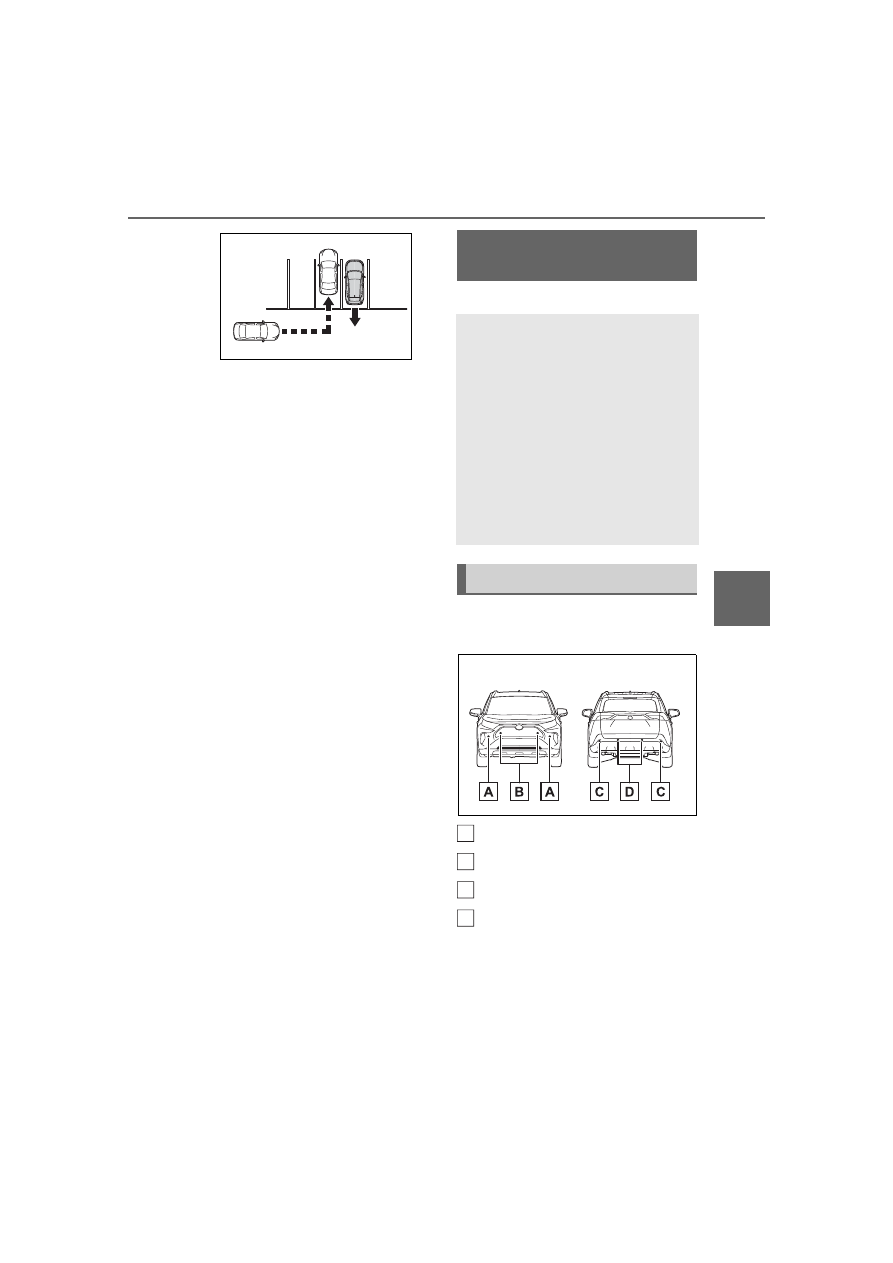
Location and types of sen-
sors

Front corner sensors

Front center sensors

Rear corner sensors

Rear center sensors

Display (Multi-information 
display)

When the sensors detect an 
object, such as a wall, a graphic 
is shown on the multi-informa-

Intuitive parking 

assist

*

The distance from your 
vehicle to objects, such as a 
wall, when parallel parking 
or maneuvering into a 
garage is measured by the 
sensors and communicated 
via the multi-information 
display or Multimedia Dis-
play and a buzzer. Always 
check the surrounding area 
when using this system.

System components

A

B

C

D

388

5-5. Using the driving support systems

tion display depending on the 
position and distance to the 
object.

Front corner sensor detection

Front center sensor detec-
tion

*1

Rear corner sensor detec-
tion

*2

Rear center sensor detec-
tion

*2

*1

:Displayed when the shift lever is 

in a driving position

*2

:Displayed when the shift lever is 

in R

Display (Multimedia Dis-
play)

When the sensors detect an 
object, such as a wall, a graphic 
is shown on the Multimedia Dis-
play depending on the position 
and distance to the object.

When the Toyota parking 
assist monitor (if equipped) is 
displayed

A simplified image is displayed on 
the upper corner of the screen 
when an obstacle is detected.

When the panoramic view 
monitor (if equipped) is dis-
played

Panoramic view

A graphic is shown when the pan-
oramic view monitor is displayed.

Except panoramic view

A simplified image is displayed on 
the upper corner of the screen 
when an obstacle is detected.

A

B

C

D

389

5-5. Using the driving support systems

5

Dr

iv

ing

The Intuitive parking assist can 
be enabled/disabled on the 


screen of the multi-information 
display. (

P.191, 203)

When the intuitive parking assist 
function is disabled, the intuitive 
parking assist OFF indicator 
(

P.170) illuminates on the multi-

information display.

To re-enable the system, select 


on the multi-information display, 
select 

 and turn it on.

If the system is disabled, it will 
remain off even if the power switch 
is turned to ON after the power 
switch has been turned off.

Turning intuitive parking 
assist on/off

WARNING

Cautions regarding the use of 

the system

There is a limit to the degree of 

recognition accuracy and control 

performance that this system can 

provide, do not overly rely on this 

system. The driver is always 

responsible for paying attention to 

the vehicle’s surroundings and 

driving safely.

To ensure the system can 

operate properly

Observe the following precau-

tions. 

Failing to do so may result in the 

vehicle being unable to be driven 

safely and possibly cause an acci-

dent.

Do not damage the sensors, 

and always keep them clean.

Do not attach a sticker or install 

an electronic component, such 

as a backlit license plate (espe-

cially fluorescent type), fog 

lights, fender pole or wireless 

antenna near a radar sensor.

Do not subject the surrounding 

area of the sensor to a strong 

impact. If subjected to an 

impact, have the vehicle 

inspected by your Toyota 

dealer. If the front or rear 

bumper needs to be 

removed/installed or replaced, 

contact your Toyota dealer.

Do not modify, disassemble or 

paint the sensors.

Do not attach a license plate 

cover.

Keep your tires properly 

inflated.

When to disable the function

In the following situations, disable 

the function as it may operate 

even though there is no possibility 

of a collision.

Failing to observe the warnings 

above.

A non-genuine Toyota suspen-

sion (lowered suspension, etc.) 

is installed.

Notes when washing the vehi-

cle

Do not apply intensive bursts of 

water or steam to the sensor 

area.
Doing so may result in the sensor 

malfunctioning.

When using a high pressure 

washer to wash the vehicle, do 

not spray the sensors directly, 

as doing so may cause a sensor 

to malfunction.

390

5-5. Using the driving support systems

The system can be operated 

when

The power switch is in ON.

Intuitive parking assist function is 

on.

The vehicle speed is less than 

about 6 mph (10 km/h).

The shift lever is in a position 

other than P.

If “Clean Parking Assist Sen-

sor” is displayed on the multi-

information display

A sensor may be covered with ice, 

snow, dirt, etc. Remove the ice, 

snow, dirt, etc., from the sensor to 

return the system to normal.
Also, due to ice forming on a sensor 

at low temperatures, a warning 

message may be displayed or the 

sensor may not be able to detect an 

object. Once the ice melts, the sys-

tem will return to normal.
If a warning message is displayed 

even if the sensor is clean, there 

may be a sensor malfunction. Have 

the vehicle inspected by your 

Toyota dealer.

If “Parking Assist Unavailable” 

is displayed on the multi-infor-

mation display

Water may be continuously flowing 

over the sensor surface, such as in 

a heavy rain. When the system 

determines that it is normal, the sys-

tem will return to normal.

Sensor detection information

The sensor’s detection areas are 

limited to the areas around the 

vehicle’s front and rear bumpers.

The following situations may occur 

during use.

• Depending on the shape of the 

object and other factors, the 

detection distance may shorten, 

or detection may be impossible.

• Detection may be impossible if 

static objects draw too close to the 

sensor.

• There will be a short delay 

between static object detection 

and display (warning buzzer 

sounds). Even at low speeds, 

there is a possibility that the object 

will come within 9.8 in. (25 cm) 

before the display is shown and 

the warning buzzer sounds.

• It might be difficult to hear the 

buzzer due to the volume of the 

audio system or air flow noise of 

the air conditioning system.

• It may be difficult to hear the 

sound of this system due to the 

buzzers of other systems.

Objects which the system may 

not properly detect

The shape of the object may pre-

vent the sensor from detecting it. 

Pay particular attention to the fol-

lowing objects:

Wires, fences, ropes, etc.

Cotton, snow and other materials 

that absorb sound waves

Sharply-angled objects

Low objects

Tall objects with upper sections 

projecting outwards in the direc-

tion of your vehicle

People may not be detected if they 

are wearing certain types of cloth-

ing.

WARNING

When using steam to clean the 

vehicle, do not direct steam too 

close to the sensors as doing so 

may cause a sensor to malfunc-

tion.

391

5-5. Using the driving support systems

5

Dr

iv

ing

Situations in which the system 

may not operate properly

Certain vehicle conditions and the 

surrounding environment may affect 

the ability of a sensor to correctly 

detect objects. Particular instances 

where this may occur are listed 

below.

There is dirt, snow or ice on a sen-

sor. (Cleaning the sensors will 

resolve this problem.)

A sensor is frozen. (Thawing the 

area will resolve this problem.) 

In especially cold weather, if a 

sensor is frozen the sensor dis-

play may be displayed abnor-

mally, or objects, such as a wall, 

may not be detected.

When a sensor or the area around 

a sensor is extremely hot or cold.

On an extremely bumpy road, on 

an incline, on gravel, or on grass.

When vehicle horns, vehicle 

detectors, motorcycle engines, air 

brakes of large vehicles, the clear-

ance sonar of other vehicles or 

other devices which produce ultra-

sonic waves are near the vehicle.

A sensor is coated with a sheet of 

spray or heavy rain.

If objects draw too close to the 

sensor.

When a pedestrian is wearing 

clothing that does not reflect ultra-

sonic waves (ex. skirts with gath-

ers or frills).

When objects that are not perpen-

dicular to the ground, not perpen-

dicular to the vehicle traveling 

direction, uneven, or waving are in 

the detection range.

Strong wind is blowing.

When driving in inclement weather 

such as fog, snow or a sandstorm.

When an object that cannot be 

detected is between the vehicle 

and a detected object.

If an object such as a vehicle, 

motorcycle, bicycle or pedestrian 

cuts in front of the vehicle or runs 

out from the side of the vehicle.

If the orientation of a sensor has 

been changed due to a collision or 

other impact.

When equipment that may 

obstruct a sensor is installed, such 

as a towing eyelet, bumper pro-

tector (an additional trim strip, 

etc.), bicycle carrier, or snow 

plow.

If the front of the vehicle is raised 

or lowered due to the carried load.

If the vehicle cannot be driven in a 

stable manner, such as when the 

vehicle has been in an accident or 

is malfunctioning.

When tire chains, a compact 

spare tire or an emergency tire 

puncture repair kit are used.

Situations in which the system 

may operate even if there is no 

possibility of a collision

In some situations, such as the fol-

lowing, the system may operate 

even though there is no possibility of 

a collision.

When driving on a narrow road.

When driving toward a banner, 

flag, low-hanging branch or boom 

barrier (such as those used at rail-

road crossings, toll gates and 

392

5-5. Using the driving support systems

parking lots).

When there is a rut or hole in the 

surface of the road.

When driving on a metal cover 

(grating), such as those used for 

drainage ditches.

When driving up or down a steep 

slope.

If a sensor is hit by a large amount 

of water, such as when driving on 

a flooded road.

There is dirt, snow, water drops or 

ice on a sensor. (Cleaning the 

sensors will resolve this problem.)

A sensor is coated with a sheet of 

spray or heavy rain.

When driving in inclement weather 

such as fog, snow or a sandstorm.

When strong winds are blowing.

When vehicle horns, vehicle 

detectors, motorcycle engines, air 

brakes of large vehicles, the clear-

ance sonar of other vehicles or 

other devices which produce ultra-

sonic waves are near the vehicle.

If the front of the vehicle is raised 

or lowered due to the carried load.

If the orientation of a sensor has 

been changed due to a collision or 

other impact.

The vehicle is approaching a tall 

or curved curb.

Driving close to columns (H-

shaped steel beams, etc.) in multi-

story parking garages, construc-

tion sites, etc.

If the vehicle cannot be driven in a 

stable manner, such as when the 

vehicle has been in an accident or 

is malfunctioning.

On an extremely bumpy road, on 

an incline, on gravel, or on grass.

When tire chains, a compact 

spare tire or an emergency tire 

puncture repair kit are used.

Detection range of the sen-
sors

Approximately 3.3 ft. (100 
cm)

Approximately 4.9 ft. (150 
cm)

Approximately 2.0 ft. (60 cm)

The diagram shows the detection 
range of the sensors. Note that the 
sensors cannot detect objects that 

Sensor detection display, 
object distance

A

B

C

393

5-5. Using the driving support systems

5

Dr

iv

ing

are extremely close to the vehicle.
The range of the sensors may 

change depending on the shape of 
the object, etc.

Distance display

When an object is detected by a sensor, the approximate distance to 
the object will be displayed on the multi-information display or Multi-
media Display. (As the distance to the object becomes short, the dis-
tance segments may blink.)

The images may differ from that shown in the illustrations.

Approximate distance to object

• Front center sensor: 3.3 ft. (100 cm) to 2.0 ft. (60 cm)
• Rear center sensor: 4.9 ft. (150 cm) to 2.0 ft. (60 cm)

*1

:Vehicles with 7-inch multi-information display

*2

:Vehicles with 12.3-inch multi-information display

Approximate distance to object: 2.0 ft. (60 cm) to 1.5 ft. (45 cm)

*1

:Vehicles with 7-inch multi-information display

*2

:Vehicles with 12.3-inch multi-information display

Approximate distance to object: 1.5 ft. (45 cm) to 1.0 ft. (30 cm)

*1

:Vehicles with 7-inch multi-information display

*2

:Vehicles with 12.3-inch multi-information display

Multi-information display

Multimedia Display

*1

*2

Multi-information display

Multimedia Display

*1

*2

Multi-information display

Multimedia Display

*1

*2

394

5-5. Using the driving support systems

Approximate distance to object: 1.0 ft. (30 cm) to 0.5 ft. (15 cm)

*1

:Vehicles with 7-inch multi-information display

*2

:Vehicles with 12.3-inch multi-information display

*3

:The distance segments will blink slowly.

Approximate distance to object: Less than 0.5 ft. (15 cm)

*1

:Vehicles with 7-inch multi-information display

*2

:Vehicles with 12.3-inch multi-information display

*3

:The distance segments will blink rapidly.

Buzzer operation and dis-
tance to an object

A buzzer sounds when the sen-
sors are operating.

The buzzer beeps faster as 
the vehicle approaches an 
object.
When the vehicle comes 
within approximately 1.0 ft. 
(30 cm) of the object, the 
buzzer sounds continuously.

When 2 or more sensors 
simultaneously detect a static 
object, the buzzer sounds for 
the nearest object.

Even when the sensors are 
operating, the buzzer will be 

muted in some situations. 
(automatic buzzer mute func-
tion)

Muting the buzzer sound

Automatic buzzer mute function

Even when the sensors are operat-
ing, the buzzer will be muted in the 
following situations:
• The distance between the vehicle 

and the detected object does not 

become shorter (except when the 

distance between the vehicle and 

object is 1.0 ft. [30 cm] or less).

• Your vehicle is moving away from 

the object.

• There are no detectable objects 

entering the path of your vehicle.

However, if another object is 
detected or the situation changes 
while the buzzer is muted, the 

Multi-information display

*3

Multimedia Display

*1

*2

Multi-information display

*3

Multimedia Display

*1

*2

395

5-5. Using the driving support systems

5

Dr

iv

ing

buzzer begins sounding again.

To mute the buzzer sound

The buzzer can be temporarily 
muted by pressing 

 of the meter 

control switches while a suggestion 
that says mute is available is shown 
on the multi-information display.

When the mute is canceled

Mute will be automatically canceled 
in the following situations.
• When the shift position is changed

• When the vehicle speed has 

reached or exceeded a certain 

speed

• When the Intuitive parking assist 

is turned off once and turned on 

again

• When the power switch is turned 

off once and turned to ON again

Customization

The buzzer volume can be adjusted 

on the multi-information display. 

(

P.191, 203)

*

: If equipped

Parking Support Brake 
function (static objects)

P.400

Parking Support Brake 
function (rear-crossing 
vehicles)

P.402

PKSB (Parking Sup-

port Brake)

*

The Parking Support Brake 
system consists of the fol-
lowing functions that oper-
ate when driving at a low 
speed or backing up, such 
as when parking. When the 
system determines that the 
possibility of a collision 
with a detected object is 
high, a warning operates to 
urge the driver to take eva-
sive action. If the system 
determines that the possi-
bility of a collision with a 
detected object is extremely 
high, the brakes are auto-
matically applied to help 
avoid the collision or help 
reduce the impact of the 
collision.

PKSB (Parking Support 
Brake) system

396

5-5. Using the driving support systems

WARNING

Cautions regarding the use of 

the system

Do not overly rely on the system, 

as doing so may lead to an acci-

dent.
Always drive while checking the 

safety of the surroundings of the 

vehicle.

Depending on the vehicle and 

road conditions, weather, etc., the 

system may not operate.

The detection capabilities of sen-

sors and radars are limited. 

Always drive while checking the 

safety of the surroundings of the 

vehicle.

The driver is solely responsible 

for safe driving. Always drive 

carefully, taking care to observe 

your surroundings. The Parking 

Support Brake system is 

designed to provide support to 

lessen the severity of collisions. 

However, it may not operate in 

some situations.

The Parking Support Brake sys-

tem is not designed to stop the 

vehicle completely. Addition-

ally, even if the system has 

stopped the vehicle, it is neces-

sary to depress the brake pedal 

immediately as brake control 

will be canceled after approxi-

mately 2 seconds.

It is extremely dangerous to 

check the system operations by 

intentionally driving the vehicle 

into the direction of a wall, etc. 

Never attempt such actions.

When to disable the Parking 

Support Brake

In the following situations, disable 

the Parking Support Brake as the 

system may operate even though 

there is no possibility of a colli-

sion.

When inspecting the vehicle 

using a chassis roller, chassis 

dynamo or free roller.

When loading the vehicle onto a 

boat, truck or other transport 

vessel.

If the suspension has been 

modified or tires of a size other 

than specified are installed.

If the front of the vehicle is 

raised or lowered due to the 

carried load.

When equipment that may 

obstruct a sensor is installed, 

such as a towing eyelet, bumper 

protector (an additional trim 

strip, etc.), bicycle carrier, or 

snow plow.

When using automatic car 

washing devices.

If the vehicle cannot be driven in 

a stable manner, such as when 

the vehicle has been in an acci-

dent or is malfunctioning.

When the vehicle is driven in a 

sporty manner or off-road.

When the tires are not properly 

inflated.

When the tires are very worn.

When tire chains, a compact 

spare tire or an emergency tire 

puncture repair kit are used.

When your vehicle is towing a 

trailer or during emergency tow-

ing.

397

5-5. Using the driving support systems

5

Dr

iv

ing

The Parking Support Brake can 
be enabled/disabled on the 


screen of the multi-information 
display. All of the Parking Sup-
port Brake functions (static 
objects and rear-crossing vehi-
cles) are enabled/disabled 
simultaneously. (

P.191, 203)

When the Parking Support Brake is 
disabled, the PKSB OFF indicator 
(

P.170) illuminates on the multi-

information display.

To re-enable the system, select 


on the multi-information display, 
select 

 and turn it on.

If the system is disabled, it will 
remain off even if the power switch 
is turned to ON after the power 
switch has been turned off.

If the hybrid system output 
restriction control or brake con-
trol operates, a buzzer will 
sound and a message will be 
displayed on the multi-informa-
tion display, head-up display (if 
equipped) or Multimedia Dis-
play, to alert the driver.

Depending on the situation, hybrid 
system output restriction control will 
operate to either limit acceleration 
or restrict output as much as possi-
ble.

Hybrid system output restric-
tion control is operating 
(acceleration restriction)

Acceleration greater than a certain 
amount is restricted by the system.
Multi-information display and head-
up display: “Object Detected Accel-
eration Reduced” (no warning dis-
played on the head-up display)
Multimedia Display: No warning 
displayed
PKSB OFF indicator: Not illumi-
nated
Buzzer: Does not sound

Hybrid system output restric-
tion control is operating (out-
put restricted as much as 
possible)

The system has determined that 
stronger-than-normal brake opera-
tion is necessary.

NOTICE

If “Parking Support Brake 

Unavailable” is displayed on 

the multi-information display 

and the PKSB OFF indicator 

illuminates

If this message is displayed 

immediately after the power 

switch is changed to ON, operate 

the vehicle carefully, paying atten-

tion to your surroundings. It may 

be necessary to drive the vehicle 

for a certain amount of time 

before the system returns to nor-

mal. (If the system does not return 

to normal after driving for a while, 

clean the sensors and their sur-

rounding area on the bumpers.)

Enabling/Disabling the 
Parking Support Brake

Display and buzzer for 
hybrid system output 
restriction control and 
brake control

398

5-5. Using the driving support systems

Multi-information display and head-
up display: “BRAKE!”
Multimedia Display: “BRAKE!”
PKSB OFF indicator: Not illumi-
nated
Buzzer: Short beep

Brake control is operating

The system determined that emer-
gency braking is necessary.
Multi-information display and head-
up display: “BRAKE!”
Multimedia Display: “BRAKE!”
PKSB OFF indicator: Illuminated
Buzzer: Short beep

Vehicle stopped by system 
operation

The vehicle has been stopped by 
brake control operation.
Multi-information display and head-
up display: “Switch to Brake” (If the 
accelerator pedal is not depressed, 
“Press Brake Pedal” will be dis-
played.)
Multimedia Display: “Press Brake 
Pedal”
PKSB OFF indicator: Illuminated (If 
the accelerator pedal is not 
depressed, the indicator is not illu-
minated.)
Buzzer: Short beep

If the Parking Support Brake 
determines that a collision with a 
detected object is possible, the 
hybrid system output will be 
restricted to restrain any 
increase in the vehicle speed. 

(Hybrid system output restriction 
control: See figure 2.)
Additionally, if the accelerator 
pedal continues to be 
depressed, the brakes will be 
applied automatically to reduce 
the vehicle speed. (Brake con-
trol: See figure 3.)

Figure 1: When the PKSB 
(Parking Support Brake) is not 
operating

Hybrid system output

Braking force

Time

Figure 2: When hybrid system 
output restriction control oper-
ates

Hybrid system output

Braking force

Time

System overview

A

B

C

A

B

C

399

5-5. Using the driving support systems

5

Dr

iv

ing

Hybrid system output restric-
tion control begins operating 
(System determines that pos-
sibility of collision with 
detected object is high)

Figure 3: When hybrid system 
output restriction control and 
brake control operates

Hybrid system output

Braking force

Time

Hybrid system output restric-
tion control begins operating 
(System determines that pos-
sibility of collision with 
detected object is high)

Brake control begins operat-
ing (System determines that 
possibility of collision with 
detected object is extremely 
high)

If the Parking Support Brake 

has operated

If the vehicle is stopped due to oper-

ation of the Parking Support Brake, 

the Parking Support Brake will be 

disabled and the PKSB OFF indica-

tor will illuminate. If the Parking Sup-

port Brake operates unnecessarily, 

brake control can be canceled by 

depressing the brake pedal or wait-

ing for approximately 2 seconds for 

it to automatically be canceled. 

Then, the vehicle can be operated 

by depressing the accelerator pedal.

Re-enabling the Parking Sup-

port Brake

To re-enable the Parking Support 

Brake when it is disabled due to 

operation of the Parking Support 

Brake, either enable the system 

again (

P.397), or turn the power 

switch off and then back to ON. 

Additionally, if the object becomes 

no longer in the traveling direction of 

the vehicle or if the traveling direc-

tion of the vehicle changes (such as 

changing from moving forward to 

backing up, or from backing up to 

moving forward), the system will be 

re-enabled automatically.

If “Parking Support Brake 

Unavailable” is displayed on 

the multi-information display 

and the PKSB OFF indicator 

illuminates

If “Clean Parking Assist Sensor” is 

displayed simultaneously, a sen-

sor may be covered with ice, 

snow, dirt, etc. In this case, 

remove the ice, snow, dirt, etc., 

from the sensor to return the sys-

tem to normal. If this message is 

shown even after removing dirt 

from the sensor, or shown when 

the sensor was not dirty to begin 

with, have the vehicle inspected at 

your Toyota dealer.

If “Parking Assist Unavailable” is 

displayed simultaneously, water 

may be continuously flowing over 

the sensor surface, such as in a 

heavy rain. When the system 

determines that it is normal, the 

system will return to normal.

D

A

B

C

D

E

400

5-5. Using the driving support systems

*

: If equipped

This function will operate in situ-
ations such as the following if an 
object is detected in the travel-
ing direction of the vehicle.

When traveling at a low 
speed and the brake pedal 
is not depressed, or is 
depressed late

When the accelerator pedal 
is depressed excessively

Parking Support Brake 

function (static 

objects)

*

If the sensors detect a static 
object, such as a wall, in the 
traveling direction of the 
vehicle and the system 
determines that a collision 
may occur due to the vehi-
cle suddenly moving for-
ward due to an accidental 
accelerator pedal opera-
tion, the vehicle moving the 
unintended direction due to 
the wrong shift position 
being selected, or while 
parking or traveling at low 
speeds, the system will 
operate to lessen the impact 
with the detected static 
object and reduce the 
resulting damage.

Examples of function 
operation

401

5-5. Using the driving support systems

5

Dr

iv

ing

When the vehicle moves in 
the unintended direction 
due to the wrong shift posi-
tion being selected

P.387

The Parking Support Brake 

function (static object) will 

operate when

The function will operate when the 

PKSB OFF indicator is not illumi-

nated (

P.168, 170) and all of the 

following conditions are met:

Hybrid system output restriction 

control

• The Parking Support Brake is 

enabled.

• The vehicle speed is approxi-

mately 9 mph (15 km/h) or less.

• There is a static object in the trav-

eling direction of the vehicle and 

approximately 6 to 13 ft. (2 to 4 m) 

away.

• The Parking Support Brake deter-

mines that a stronger-than-nor-

mal brake operation is necessary 

to avoid a collision.

Brake control

• Hybrid system output restriction 

control is operating

• The Parking Support Brake deter-

mines that an immediate brake 

operation is necessary to avoid a 

collision.

The Parking Support Brake 

function (static objects) will 

stop operating when

The function will stop operating if 

any of the following conditions are 

met:

Hybrid system output restriction 

control

• The Parking Support Brake is dis-

abled.

• The system determines that the 

collision has become avoidable 

with normal brake operation.

• The static object is no longer 

approximately 6 to 13 ft. (2 to 4 m) 

away from the vehicle or in the 

traveling direction of the vehicle.

Brake control

• The Parking Support Brake is dis-

abled.

• Approximately 2 seconds have 

elapsed since the vehicle was 

stopped by brake control.

• The brake pedal is depressed 

after the vehicle is stopped by 

brake control.

• The static object is no longer 

approximately 6 to 13 ft. (2 to 4 m) 

away from the vehicle or in the 

traveling direction of the vehicle.

Types of sensors

WARNING

To ensure the system can 

operate properly

P.389

If the Parking Support Brake 

function (static objects) oper-

ates unnecessarily, such as 

at a railroad crossing

P.399

Notes when washing the vehi-

cle

P.389

402

5-5. Using the driving support systems

Detection range of the Parking 

Support Brake function (static 

objects)

The detection range of the Parking 

Support Brake function (static 

objects) differs from the detection 

range of the intuitive parking assist. 

(

P.392) Therefore, even if the 

intuitive parking assist detects an 

object and provides a warning, the 

Parking Support Brake function 

(static objects) may not start operat-

ing.

Situations in which the Parking 

Support Brake function (static 

objects) may not operate

When the shift lever is in N

Situations in which the system 

may not operate properly

P.391

Situations in which the system 

may operate even if there is no 

possibility of a collision

P.391

*

: If equipped

This function will operate in situ-
ations such as the following if a 
vehicle is detected in the travel-
ing direction of the vehicle.

When reversing, a vehicle is 
approaching and the brake 
pedal is not depressed, or 
is depressed late

Parking Support Brake 

function (rear-crossing 

vehicles)

*

If a rear radar sensor 
detects a vehicle approach-
ing from the right or left at 
the rear of the vehicle and 
the system determines that 
the possibility of a collision 
is high, this function will 
perform brake control to 
reduce the likelihood of an 
impact with the approach-
ing vehicle.

Examples of function 
operation


Content      ..     22      23      24      25     ..