Toyota RAV4 (2023 year). Manual in english - page 21
 

  Index      Toyota     Toyota RAV4 (2023 year). Manual in english


Search            copyright infringement  


Content      ..     19      20      21      22     ..


Toyota RAV4 (2023 year). Manual in english - page 21


337

5-1. Using the air conditioning system and defogger

5

Interior

 featur

es

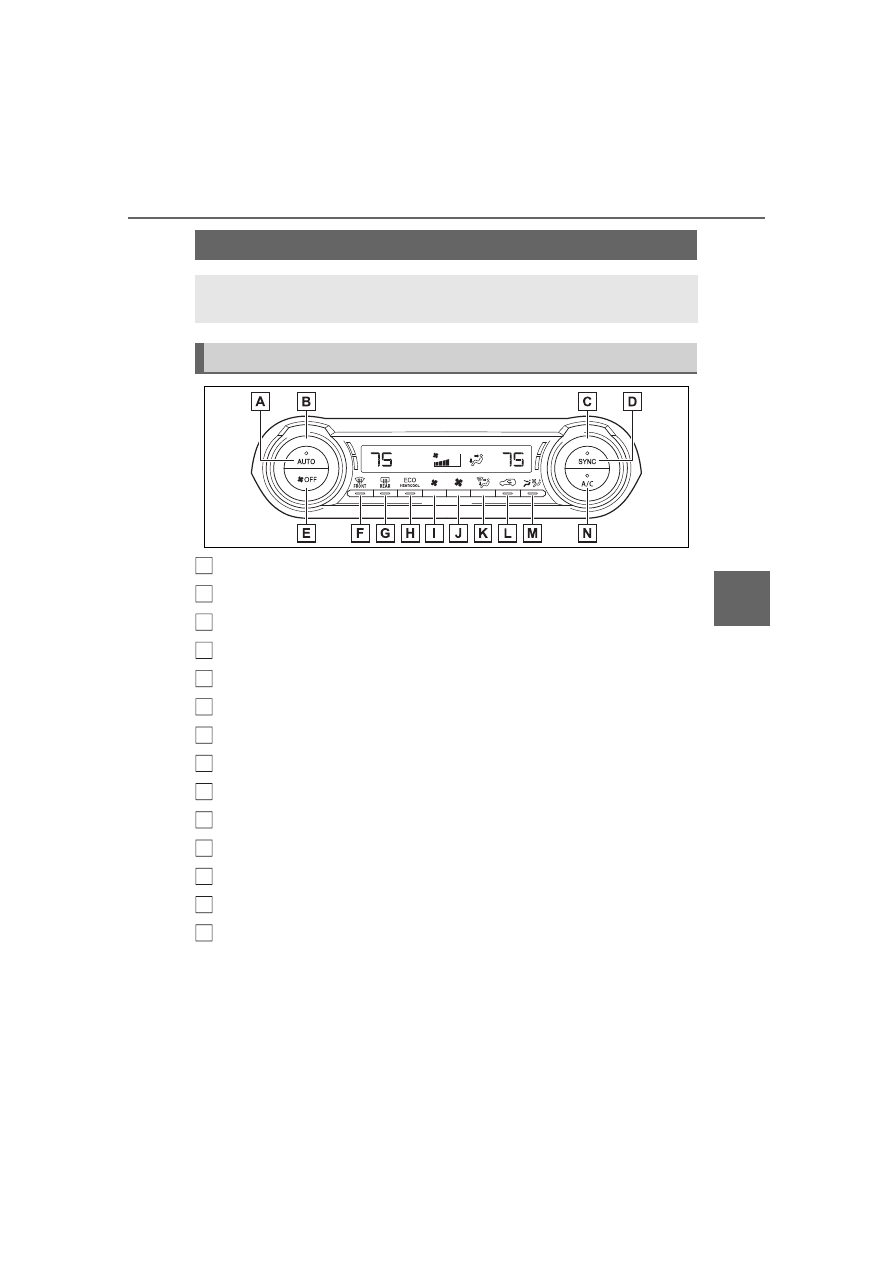
Automatic mode switch

Left-hand side temperature control knob

Right-hand side temperature control knob

“SYNC” switch

“OFF” switch

Windshield defogger switch

Rear window and outside rear view mirror defoggers switch

Eco air conditioning mode switch

Fan speed decrease switch

Fan speed increase switch

Airflow mode control switch

Outside/recirculated air mode switch

Front seat concentrated airflow mode (S-FLOW) switch

“A/C” switch

Adjusting the temperature 
setting

Turn driver’s side temperature 
control dial clockwise to 

increases the temperature and 
turn the dial counterclockwise to 
decreases the temperature.

The air conditioning system 

Automatic air conditioning system

Air outlets and fan speed are automatically adjusted accord-
ing to the temperature setting.

Air conditioning controls

A

B

C

D

E

F

G

H

I

J

K

L

M

N

338

5-1. Using the air conditioning system and defogger

switches between individual and 
simultaneous modes each time the 
“SYNC” switch is pressed.
Simultaneous mode (the indicator 
on the “SYNC” switch is on):
The driver’s side temperature con-
trol dial can be used to adjust the 
temperature for the driver’s and 
passenger’s side. At this time, 
operate the passenger’s side tem-
perature control dial to enter indi-
vidual mode.
Individual mode (the indicator on 
the “SYNC” switch is off):
The temperature for the driver’s 
and passenger’s side can be 
adjusted separately.

Setting the fan speed

Press the fan speed increase 
switch to increase the fan speed 
and the fan speed decrease 
switch to decrease the fan 
speed.

Pressing the “OFF” switch to turns 
off the fan.

Change the airflow mode

Press the airflow mode control 
switch.

The airflow mode changes as fol-
lows each time the switch is 
pressed.

1

Upper body

2

Upper body and feet

3

Feet

4

Feet and the windshield 
defogger operates

Switching between outside 
air and recirculated air 
modes

Press the outside/recirculated 
air mode switch.

The mode switches between out-
side air mode and recirculated air 
mode each time the switch is oper-
ated.
When recirculated air mode is 
selected, the indicator illuminates 
on the outside/ recirculated air 
mode switch.

Set cooling and dehumidifi-
cation function

Press the “A/C” switch.

When the function is on, the indica-
tor illuminates on the “A/C” switch.

Eco air conditioning mode

The air conditioning is controlled 
with low fuel consumption priori-

1

1

2

2

3

3

4

4

339

5-1. Using the air conditioning system and defogger

5

Interior

 featur

es

tized such as reducing fan 
speed, etc.
Press the eco air conditioning 
mode switch.

When the eco air conditioning 
mode is on, the indicator illumi-
nates on the eco air conditioning 
mode switch.

Defogging the windshield

Defoggers are used to defog the 
windshield and front side win-
dows.
Press the windshield defogger 
switch.

Set the outside/recirculated air 
mode switch to outside air mode if 
the recirculated air mode is used. (It 
may switch automatically.)
To defog the windshield and the 
side windows quickly, turn the air 
flow and temperature up.
To return to the previous mode, 
press the windshield defogger 
switch again when the windshield is 
defogged.
When the windshield defogger 
switch is on, the indicator illumi-
nates on the windshield defogger 
switch.

Defogging the rear window 
and outside rear view mir-
rors (if equipped)

Defoggers are used to defog the 
rear window and to remove rain-
drops, dew and frost from the 
outside rear view mirrors (if 
equipped).
Press the rear window and out-
side rear view mirror defoggers 

switch.

The rear window and rear view mir-
ror defoggers automatically turn off 
after approximately 60 minutes.
However, the rear window and rear 
view mirror defoggers might auto-
matically turn off after approxi-
mately 15 minutes depending on 
conditions including the outside 
temperature and charging system 
conditions.
When the rear window and outside 
rear view mirror defoggers switch is 
on, the indicator illuminates on the 
rear window and outside rear view 
mirror defoggers switch.

Fogging up of the windows

The windows will easily fog up 

when the humidity in the vehicle is 

high. Turning “A/C” switch on will 

dehumidify the air from the outlets 

and defog the windshield effec-

tively.

If you turn “A/C” switch off, the 

windows may fog up more easily.

The windows may fog up if the 

recirculated air mode is used.

When driving on dusty roads

Close all windows. If dust thrown up 

by the vehicle is still drawn into the 

vehicle after closing the windows, it 

is recommended that the air intake 

mode be set to outside air mode 

and the fan speed to any setting 

except off.

Outside/recirculated air mode

Setting to the recirculated air 

mode temporarily is recom-

mended in preventing dirty air 

from entering the vehicle interior 

and helping to cool the vehicle 

when the outside air temperature 

is high.

Outside/recirculated air mode may 

automatically switch depending on 

340

5-1. Using the air conditioning system and defogger

the temperature setting or the 

inside temperature.

When the outside temperature 

exceeds 75°F (24°C) and the air 

conditioning system is on

In order to reduce the air condi-

tioning power consumption, the air 

conditioning system may switch to 

recirculated air mode automati-

cally. This may also reduce fuel 

consumption.

Recirculated air mode is selected 

as a default mode when the 

engine switch is turned to ON.

It is possible to switch to outside 

air mode at any time by pressing 

the outside/recirculated air mode 

switch.

Operation of the air condition-

ing system in Eco drive mode

In Eco drive mode, the air condi-

tioning system is controlled as fol-

lows to prioritize fuel efficiency:

• Engine speed and compressor 

operation controlled to restrict 

heating/cooling capacity

• Fan speed restricted when auto-

matic mode is selected

To improve air conditioning perfor-

mance, perform the following 

operations:

• Adjust the fan speed

• Turn off Eco drive mode (

P.310)

• Turn off Eco air conditioning mode

When the driving mode is set to 

Eco driving mode, the Eco air con-

ditioning mode will be turned on 

automatically. Even in this case, 

the Eco air conditioning mode can 

be turned off by pressing the Eco 

air conditioning mode switch.

When the outside temperature 

falls to nearly 32°F (0°C)

The dehumidification function may 

not operate even when “A/C” switch 

is pressed.

Ventilation and air conditioning 

odors

To let fresh air in, set the air condi-

tioning system to the outside air 

mode.

During use, various odors from 

inside and outside the vehicle may 

enter into and accumulate in the 

air conditioning system. This may 

then cause odor to be emitted 

from the vents.

To reduce potential odors from 

occurring:

• It is recommended that the air 

conditioning system be set to out-

side air mode prior to turning the 

vehicle off.

• The start timing of the blower may 

be delayed for a short period of 

time immediately after the air con-

ditioning system is started in auto-

matic mode.

When parking, the system auto-

matically switches to outside air 

mode to encourage better air cir-

culation throughout the vehicle, 

helping to reduce odors that occur 

when starting the vehicle.

Air conditioning system opera-

tions when the engine is 

stopped due to the Stop & Start 

system (vehicles with Stop & 

Start system)

When the engine is stopped due to 

Stop & Start system operations, the 

automatic air conditioning cooling, 

heating and dehumidification func-

tions turn off and the fan speed is 

decreased according to the outside 

temperature etc. or air blowing 

stops. To stop the air conditioning 

system from turning off, press the 

Stop & Start cancel switch and 

refrain from using the Stop & Start 

system.

When the windshield is fogged 

up and the engine is stopped 

due to the Stop & Start system 

(vehicles with Stop & Start sys-

tem)

Press the windshield defogger 

switch to restart the engine and 

defog the windshield.
If the windshield continuously fogs 

341

5-1. Using the air conditioning system and defogger

5

Interior

 featur

es

up, press the Stop & Start cancel 

switch and refrain from using the 

Stop & Start system.

When an odor comes from the 

air conditioning system while 

the engine is stopped due to the 

Stop & Start system (vehicles 

with Stop & Start system)

Press the Stop & Start cancel switch 

to restart the engine.

Using the Intelligent Assistant 

(if equipped)

Air conditioning system can be 

operated using the Intelligent Assis-

tant.
For details regarding the Intelligent 

Assistant, refer to the “MULTIME-

DIA OWNER’S MANUAL”.

Air conditioning filter

P.420

Air conditioning system refrig-

erant

A label regarding the refrigerant of 

the air conditioning system is 

attached to the hood at the loca-

tion shown in the following illustra-

tion.

The meaning of each symbol on 

the label are as follows:

Customization

Some functions can be customized.

(Customizable features: 

P.521)

Caution

Air conditioning system

Air conditioning system 
lubricant type

Requires registered tech-
nician to service air con-
ditioning system

Flammable refrigerant

WARNING

To prevent the windshield 

from fogging up

Do not use the windshield defog-

ger switch during cool air opera-

tion in extremely humid weather.

The difference between the tem-

perature of the outside air and 

that of the windshield can cause 

the outer surface of the wind-

shield to fog up, blocking your 

vision.

When the outside rear view 

mirror defoggers are operat-

ing (if equipped)

Do not touch the rear view mirror 

surfaces when the outside rear 

view mirror defoggers are on.

NOTICE

To prevent battery discharge

Do not leave the air conditioning 

system on longer than necessary 

when the engine is off.

When repairing/replacing 

parts of the air conditioning 

system

Have repair/replacement per-

formed by your Toyota dealer. 

When a part of the air condition-

ing system, such as the evapora-

tor, is to be replaced, it must be 

replaced with a new one.

342

5-1. Using the air conditioning system and defogger

1

Press the “AUTO” switch.

The dehumidification function 

begins to operate. Air outlets and 

fan speed are automatically 

adjusted according to the tempera-

ture setting and humidity.

2

Adjust the temperature set-
ting.

3

To stop the operation, press 
the “OFF” switch.

If the fan speed setting or air 
flow modes are operated, the 
automatic mode indicator goes 
off. However, automatic mode 
for functions other than that 
operated is maintained.

Using automatic mode

Fan speed is adjusted automati-

cally according to the temperature 

setting and the ambient conditions.
Therefore, the fan may stop for a 

while until warm or cool air is ready 

to flow immediately after the auto-

matic mode switch is pressed.

This function automatically con-
trols the air conditioning airflow 
so that priority is given to the 
front seats. Unnecessary air 
conditioning is suppressed, con-
tributing to increased fuel effi-
ciency.
Front seat concentrated airflow 
mode operates in the following 
situations.

No passengers are detected 
in the rear seats

The windshield defogger is 
not operating

While operating, 

 illumi-

nates.

Manually turning front seat 
concentrated airflow mode 
on/off

In front seat concentrated air-
flow mode, directing airflow to 
the front seats only and to all 
seats can be switched via switch 
operation. When the mode has 
been switched manually, auto-
matic airflow control stops oper-
ating.

Press 

 on the air condition-

ing operation panel and switch 
the airflow.

Indicator illuminated: Airflow 
to the front seats only

Indicator off: Airflow to all the 
seats

Operation of automatic airflow 

control

In order to maintain a comfortable 

interior, airflow may be directed to 

seats without passengers immedi-

ately after the engine is started 

and at other times depending on 

the outside temperature.

After the engine is started, if pas-

sengers move around inside or 

enter/exit the vehicle, the system 

cannot accurately detect the pres-

ence of passengers and auto-

matic airflow control will not 

Using automatic mode

Front seat concentrated 
airflow mode (S-FLOW)

343

5-1. Using the air conditioning system and defogger

5

Interior

 featur

es

operate.

Operation of manual airflow 

control

Even if the function is manually 

switched to directing airflow to only 

the front seats, when a rear seat is 

occupied, it may automatically direct 

airflow to all seats.

To return to automatic airflow 

control

1

With the indicator off, turn the 

engine switch to OFF.

2

After 60 minutes or more elapse, 

turn the engine switch to ON.

This feature is used to prevent 
ice from building up on the wind-
shield and wiper blades.
Press the switch to turn the sys-
tem on/off.

The indicator comes on when the 
system is on.
The windshield wiper de-icer will 
automatically turn off after a period 
of time.

Location of air outlets

The air outlets and air volume 
change according to the 
selected air flow mode.

Adjusting the air flow direc-
tion and opening/closing 
the air outlets

Front

1

Direct air flow to the left or 
right, up or down

2

Open the vent

*

Windshield wiper de-icer 
(if equipped)

WARNING

To prevent burns

Do not touch the glass at lower 

part of the windshield or to the 

side of the front pillars when the 

windshield wiper deicer is on.

Air outlet layout and oper-
ations

344

5-1. Using the air conditioning system and defogger

3

Close the vent

*

*

: If equipped (center air outlets 

only)

Rear

1

Direct air flow to the left or 
right, up or down

2

Open the vent

3

Close the vent

*

: If equipped

WARNING

To not interrupt the wind-

shield defogger from operat-

ing

Do not place anything on the 

instrument panel which may cover 

the air outlets. Otherwise, air flow 

may be obstructed, preventing the 

windshield defoggers from defog-

ging.

Heated steering 

wheel

*

/seat heat-

ers

*

/seat ventilators

*

Heated steering wheel

Warm up the grip of the steer-
ing wheel

Seat heaters

Warm up the seat upholstery

Seat ventilators

Maintain good ventilation by 
pulling air through the seat 
upholstery

WARNING

To prevent minor burn inju-

ries

Care should be taken if anyone in 

the following categories comes in 

contact with the steering wheel or 

seats when the heater is on:

Babies, small children, the 

elderly, the sick and the physi-

cally challenged

Persons with sensitive skin

Persons who are fatigued

Persons who have taken alco-

hol or drugs that induce sleep 

(sleeping drugs, cold remedies, 

etc.)

345

5-1. Using the air conditioning system and defogger

5

Interior

 featur

es

Turns the heated steering wheel 
on/off

The indicator light comes on when 
the heated steering wheel is oper-
ating.

Operation condition

The engine switch is in ON.

Front

Turns the seat heaters on/off

1

High temperature

2

Low temperature

When the seat heater is on, the 
indicator illuminates on the seat 
heater switch.
When not in use, put the switch 
in the neutral position. The indi-
cator will turn off.

Rear

Turns the seat heaters on/off
The indicator light comes on 
when the seat heater is operat-
ing.

Operation condition

The engine switch is in ON.

NOTICE

To prevent damage to the 

seat heaters and seat ventila-

tors

Do not put heavy objects that 

have an uneven surface on the 

seat and do not stick sharp 

objects (needles, nails, etc.) into 

the seat.

To prevent battery discharge

Do not use the functions when the 

engine is not running.

Heated steering wheel

Operating the seat heat-
ers

346

5-1. Using the air conditioning system and defogger

Turns the seat heaters and ven-
tilators on/off

The level indicators 

 come on 

during operation.
Each time the switch is pressed, 
the operation condition changes as 
follows.
Hi (3 segments lit) 

 Mid (2 seg-

ments lit) 

 Lo (1 segment lit) 


Off

1

Turns the seat heater on

The level indicators 

 come on 

yellow during operation.

2

Turns the seat ventilator on

The level indicators 

 come on 

green during operation.

Operation condition

The engine switch is in ON.

Air conditioning system-linked 

control mode

When a seat ventilator is set to Hi, 

the fan speed of the seat ventilator 

may increase according to the fan 

speed of the air conditioning sys-

tem.

WARNING

To prevent causes of over-

heating and minor burn inju-

ries

Observe the following precautions 

when using a seat heater:

Do not cover the seat with a 

blanket or cushion when using 

the seat heater.

Do not use seat heater more 

than necessary.

Seat heaters and ventila-
tors

A

A

A

WARNING

To prevent causes of over-

heating and minor burn inju-

ries

Observe the following precautions 

when using a seat heater:

Do not cover the seat with a 

blanket or cushion when using 

the seat heater.

Do not use seat heater more 

than necessary.

347

5-2. Using the interior lights

5

Interior

 featur

es

5-2.Using the interior lights

Rear interior light (

P.349)

Front interior lights/personal lights (

P.349)

Open tray lights (if equipped)

*

Footwell lights (if equipped)

*

Front cup holder lights (if equipped)

*

*

: These lights turn on when a door is unlocked.

When the shift lever is in a position other than P, the brightness of these 
lights will reduce intensity.

Illuminated entry system (vehi-

cles with smart key system)

The lights automatically turn on/off 

according to the engine switch 

mode, the presence of the elec-

tronic key, whether the doors are 

locked/unlocked, and whether the 

doors are opened/closed.

To prevent the battery from 

being discharged

If the interior lights remain on when 

the engine switch is turned to OFF, 

the lights will go off automatically 

after 20 minutes.

The interior lights may turn on 

automatically when

If any of the SRS airbags deploy 

(inflate) or in the event of a strong 

rear impact, the interior lights will 

Interior lights list

Location of the interior lights

A

B

C

D

E

348

5-2. Using the interior lights

turn on automatically.
The interior lights will turn off auto-

matically after approximately 20 

minutes.
The interior lights can be turned off 

manually. However, in order to help 

prevent further collisions, it is rec-

ommended that they be left on until 

safety can be ensured.

(The interior lights may not turn on 

automatically depending on the 

force of the impact and conditions of 

the collision.)

Customization

Setting (e.g. the time elapsed before 

the lights turn off) can be changed. 

(Customizable features: 

P.521)

Front interior lights

Turns the lights on/off

Turns the switch to the door 
position (door linked)

When a door is opened while the 
door position is on, the lights turn 
on.

1

Turns the door position on

2

Turns the lights off

Rear interior light

1

Turns the light on

2

Turns the door-linked func-
tion on (door position)

The light turns on/off according to 
the opening/closing of the doors.

Turns the lights on/off

NOTICE

To prevent battery discharge

Do not leave the lights on longer 

than necessary when the engine 

is not running.

Operating interior lights

Operating personal lights

349

5-3. Using the storage features

5

Interior

 featur

es

5-3.Using the storage features

Open tray (

P.353)

Auxiliary boxes (

P.352)

Bottle holders (

P.352)

Console box (

P.351)

Cup holders (

P.351)

Glove box (

P.351)

List of storage features

Location of the storage features

A

B

C

D

E

F

WARNING

Items that should not be left 

in the vehicle

Do not leave glasses, lighters or 

spray cans in the storage spaces, 

as this may cause the following 

when cabin temperature becomes 

high:

Glasses may be deformed by 

heat or cracked if they come 

into contact with other stored 

items.

Lighters or spray cans may 

explode. If they come into con-

tact with other stored items, the 

lighter may catch fire or the 

spray can may release gas, 

causing a fire hazard.

350

5-3. Using the storage features

Unlock with the mechanical 
key

Lock with the mechanical key

Open (pull up the lever)

Lift the lid while pushing the but-
ton to release the lock.

Console box tray (if equipped)

The tray can be removed and stored 

in the bottom of the console box.

Front

Rear

Pull the armrest down.

Glove box

WARNING

Caution while driving

Keep the glove box closed. In the 

event of sudden braking or sud-

den swerving, an accident may 

occur due to an occupant being 

struck by the open glove box or 

the items stored inside.

Console box

A

B

C

WARNING

Caution while driving

Keep the console box closed.
Injuries may result in the event of 

an accident or sudden braking.

Cup holders

351

5-3. Using the storage features

5

Interior

 featur

es

Front

Rear

Bottle holders

When storing a bottle, close the 

cap.

The bottle may not be stored 

depending on its size or shape.

Push the lid.

WARNING

Items unsuitable for the cup 

holders

Do not place anything other than 

cups or beverage cans in the cup 

holders.

Inappropriate items must not be 

stored in the cup holders even if 

the lid is closed.

Other items may be thrown out of 

the holders in the event of an 

accident or sudden braking and 

cause injury. If possible, cover hot 

drinks to prevent burns.

Bottle holders

WARNING

Items unsuitable for the bottle 

holders

Do not place anything other than 

a bottle in the bottle holders.

Other items may be thrown out of 

the holders in the event of an 

accident or sudden braking and 

cause injury.

NOTICE

Items that should be not 

stowed in the bottle holders

Do not place open bottles or glass 

and paper cups containing liquid 

in the bottle holders. The contents 

may spill and glasses may break.

Auxiliary boxes

WARNING

Caution while driving

Do not leave the auxiliary box 

open while driving.
Injuries may result in the event of 

an accident or sudden braking.

352

5-3. Using the storage features

Driver’s side

Front passenger’s side

Front of console

Vehicles with wireless charger: 

P.362

WARNING

Items unsuitable for storing

Do not store items heavier than 

0.4 lb. (0.2 kg).
Doing so may cause the auxiliary 

box to open and the items inside 

may fall out, resulting in an acci-

dent.

Open tray

WARNING

Items unsuitable for the open 

tray

Observe the following precautions 

when putting items in the open 

tray. Failure to do so may cause 

items to be thrown out of the tray 

in the event of sudden braking or 

steering. In these cases, the items 

may interfere with pedal operation 

or cause driver distraction, result-

ing in an accident.

Do not store items in the tray 

that can easily shift or roll out.

Do not stack items in the tray 

higher than the tray’s edge.

Do not put items in the tray that 

may protrude over the tray’s 

edge.


Content      ..     19      20      21      22     ..