Toyota Raize (2023 year). Manual in english - page 25
 

  Index      Toyota     Toyota Raize (2023 year). Manual in english


Search            copyright infringement  


Content      ..     23      24      25      26     ..


Toyota Raize (2023 year). Manual in english - page 25


402

7-2. Steps to take in an emergency

WARNING

Failure to follow these precautions could cause the wheel nuts to loosen and
the tire to fall off, resulting in death or serious injury.

Have the wheel nuts tightened with a torque wrench to 103 N·m (10.5

kgf·m, 76 ft·lbf) as soon as possible after changing wheels.

When installing a tire, only use wheel nuts that have been specifically

designed for that wheel.

If there are any cracks or deformations in the bolt screws, nut threads or

bolt holes of the wheel, have the vehicle inspected by your Toyota dealer.

When installing the wheel nuts, be sure to install them with the tapered

ends facing inward. (

P. 337)


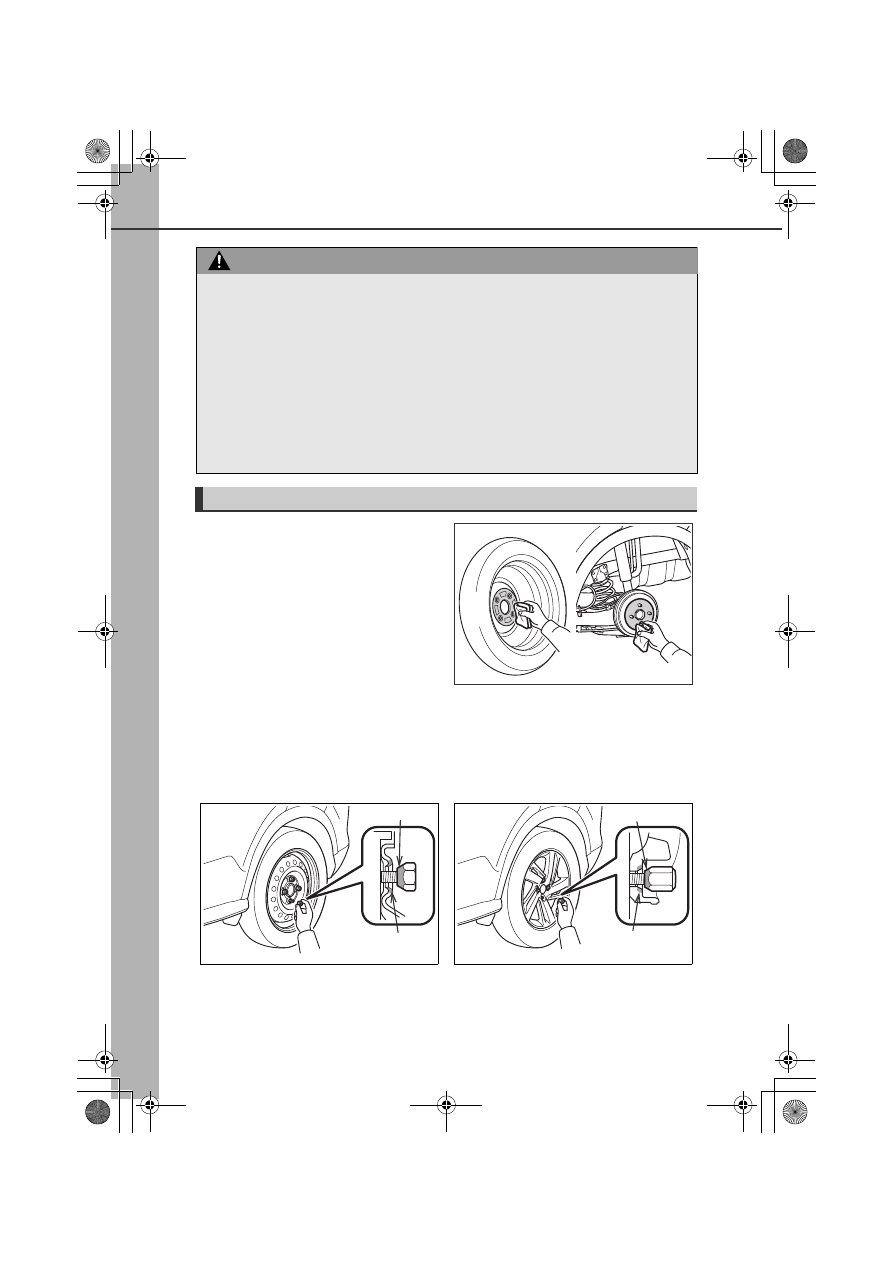
Installing the spare tire


a

Remove any dirt or foreign mat-

ter from the wheel contact sur-

face

If the wheel contact surface is dirty, the

wheel nuts may loosen while the vehi-

cle is in motion, causing the tire to

come off.


b

Install the spare tire and loosely tighten each wheel nut by hand to the

extent that the tire does not rattle

Tighten the wheel nuts until the tapered portion comes into loose contact with the

wheel seat


Vehicles with steel wheels

Vehicles with aluminum wheels


KBRO720419

KBRO720425N

Tapered portion

Seat portion

KBRO720426N

Tapered portion

Seat portion

Emergency.fm  402 ページ  2022年6月17日 金曜日 午前9時4分

403

7-2. Steps to take in an emergency

When t

roubl
e arises

7

c

Lower the vehicle body

d

Tighten the nuts firmly 2 or 3

times in the order shown in the

illustration

Tightening torque: 103 N·m (10.5

kgf·m, 76 ft·lbf)

e

Attach the wheel ornament*

*

For steel wheels only

Align the tire valve (air inlet) with the

notch on the wheel ornament, and

press the periphery portions of the

wheel ornament to attach it.

f

Store the flat tire

KBRO720427N

3

1

4

2

KBRO720428N

KBRO720423N

Notch

Periphery portions

Valve

404

7-2. Steps to take in an emergency

Stowing the jack and tools

a

Put the arm onto portion B of the

bracket, as shown in the illustra-

tion.

Be sure to adjust the arm so that

portions A of the bracket are

inside the arm.

b

Turn the joint until the arm is

brought into contact with the

bracket.

c

Stow the tools.

Spare tires

Make sure to check the tire pressure. (

P. 428)

A

B

KBRO620604N

KBRO620605N

405

7-2. Steps to take in an emergency

When t

roubl
e arises

7

If the engine does not start

If the engine does not start even though correct starting procedures

are being followed (

P. 184), consider each of the following points:

The engine does not start even though the starter motor operates 

normally

One of the following may be the cause of the problem:

There may not be sufficient fuel in the vehicle’s tank.
Refuel the vehicle.

The engine may be flooded.
Try to restart the engine again following correct starting procedures

(

P. 184).

There may be a malfunction in the engine immobilizer system. (

P. 72)

The starter motor runs slowly, the interior light and headlights are 

dim, or the horn does not sound or sounds at a low volume

One of the following may be the cause of the problem:

The battery may be discharged. (

P. 408)

The battery terminal connections may be loose.

If the starter does not operate (vehicles with key-free system)

There may be an issue in the electrical system, such as a disconnected

electrical component or blown fuse. Depending on the cause, you may

be able to start the engine using temporary measures. (

P. 406)

There may be a malfunction in the steering wheel lock system.

The starter motor does not run, the interior light and headlights do 

not turn on, or the horn does not sound

One of the following may be the cause of the problem:

There may be a disconnected battery terminal.

The battery may be discharged. (

P. 408)

Contact your Toyota dealer if the procedures are not clear, or if the engine does not

start even after the measures have been taken.

406

7-2. Steps to take in an emergency

If the electronic key does not work properly 

(vehicles with key-free system)

The key-free system and wireless remote control cannot be used

when communication between the electronic key and vehicle is

blocked (

P. 125) or when the electronic key battery is dead. In such

cases, you can open the doors or start the engine by following the

steps below.

Locking and unlocking the doors

Using the emergency key (

P. 118),

you can:

a

Lock all doors

b

Unlock all doors

If set, the alarm will sound. (

P. 73)

Starting the engine

a

Continuously variable transmission vehicles: Step on the brake pedal

with the shift lever placed in P

Manual transmission vehicles: Step on the clutch pedal with the shift

lever placed in N

b

Touch the electronic key to the

engine switch, as shown in the

illustration

The indicator of the engine switch

lights up in green.

The alarm will shut off. (

P. 73)

c

Press the engine switch

If you are still unable to start the engine after following the above steps,

contact your Toyota dealer.

1

2

KBRO720801E

KBRO820801E

407

7-2. Steps to take in an emergency

When t

roubl
e arises

7

Stopping the engine

As you usually would when stopping the engine, set the shift lever to P for con-

tinuously variable transmission vehicles, and set it to N for manual transmis-

sion vehicles, then press the engine switch.

Replacing the battery

The method to start the engine described here is a temporary workaround. We

recommend that you replace dead batteries immediately. (

P. 344)

Changing the engine switch mode

In step 

c

 of “Starting the engine”, if you press the engine switch by releasing

your foot from the clutch pedal for manual transmission vehicles and from the

brake pedal for continuously variable transmission vehicles, the engine will not

start. Instead, the mode changes each time you press the switch. (

P. 185)

If the electronic key does not work properly

Check whether the electronic key is set to battery-saving mode. If the mode is

set, cancel it (

P. 125)

408

7-2. Steps to take in an emergency

If the vehicle battery is discharged

If the battery is discharged, you can start the engine by following the

steps below.
You can also call your Toyota dealer or a qualified repair shop.

If you have a booster cable and a second vehicle with a 12 V battery, you

can start your vehicle by following the steps below.

a

Open the cover of the positive (+) battery terminal

Hold down the claw and open it.

b

Connect the jumper cables according to the following procedure:

a

Connect a positive jumper cable clamp to the positive (+) battery ter-

minal on your vehicle.

b

Connect the clamp on the other end of the positive cable to the pos-

itive (+) battery terminal on the second vehicle.

c

Connect a negative cable clamp to the negative (-) battery terminal

on the second vehicle.

d

Connect the clamp at the other end of the negative cable to a solid,

stationary, unpainted metallic point away from the battery and any

moving parts, as shown in the illustration.

WA-VE engine

4

1

3

2

KBRO720901N

409

7-2. Steps to take in an emergency

When t

roubl
e arises

7

1KR-VET engine

c

Start the engine of the second vehicle. Increase the engine speed

slightly and maintain at that level for approximately 5 minutes to

recharge the battery of your vehicle.

d

Maintain the engine speed of the second vehicle and turn the engine

switch to “ON”.

e

Once the vehicle’s engine has started, remove the jumper cables in the

exact reverse order from which they were connected.

f

Close the cover of the positive (+) battery terminal

Even if you are able to start the engine, have the vehicle inspected at your

Toyota dealer as soon as possible.

Starting the engine when the battery is discharged

For this vehicle, the engine cannot be started by push-starting.

If the vehicle battery is discharged

The data stored in the computer will be erased. If your vehicle’s battery dis-

charges, have the vehicle inspected at your Toyota dealer.

Charging the battery

The electricity stored in the battery will discharge gradually even when the

vehicle is not in use, due to natural discharge and the draining effects of cer-

tain electrical appliances. If the vehicle is left for a long time, the battery may

discharge, and the engine may be unable to start. (The battery recharges auto-

matically during driving)

4

1

3

2

KBRO720901

410

7-2. Steps to take in an emergency

When your battery is discharged/removed (vehicles with key-free system)

You may not be able to unlock the vehicle doors using the key-free system
immediately after battery discharge. In such cases, lock and unlock the

doors using the wireless remote control or emergency key.

The vehicle engine may not start on the first try after battery discharge. This
is to be expected, and the engine will start properly on the second try

onward.

The vehicle consistently keeps track of its engine switch mode. Even after a
discharged battery is removed, the engine mode returns to the state before

removing the battery. Please remove the battery after turning the engine

switch “OFF”.
If you are not sure of the engine switch mode prior to battery discharge, be

especially careful when connecting the battery.

WARNING

Avoiding battery fires or explosions

Observe the following precautions to prevent the fire and sparks to be gener-

ated as these may ignite the flammable gas emitted from the battery of the

second vehicle and cause an explosion:

Make sure each jumper cable is connected to the correct terminal and that it
is not unintentionally in contact with any other than the intended terminal.

Do not allow the other end of the jumper cable connected to the “+” terminal
to come into contact with any other parts or metal surfaces in the area, such

as brackets or unpainted metal.

Do not allow the + and - clamps of the jumper cables to come into contact
with each other.

Do not smoke, use matches, cigarette lighters or allow open flame near the
battery

Do not use or charge the battery when the battery level is lower than the
LOWER LEVEL displayed on the side of the battery

Battery precautions

The battery contains poisonous and corrosive acid electrolyte, while related

parts contain lead and lead compounds. Observe the following precautions

when handling the battery:

When working with the battery, always wear safety glasses and take care not
to allow any battery fluids (acid) to come into contact with skin, clothing or

the vehicle body

Keep your face and head away from the battery as much as possible

411

7-2. Steps to take in an emergency

WARNING

When t

roubl
e arises

7

In the event that battery fluid comes into contact with the skin or eyes,
immediately wash the affected area with plenty of water and seek medical

attention
Place a wet sponge or cloth over the affected area until medical attention

can be received

If you accidentally swallow electrolyte
Drink a large quantity of water or milk. Get emergency medical attention

immediately.

Always wash your hands after handling the battery and other peripheral
components

Do not allow children near the battery

After removing the battery fixing bracket and the battery terminal nut

Tighten them securely. If the nuts loosen while driving, it may cause a short cir-

cuit and result in a fire.

To prevent damage to the vehicle

Do not start the vehicle by pushing or pulling it.
The catalytic converter may overheat and cause a fire.

NOTICE

To prevent battery discharge

Turn off the lights and air conditioning system when the engine is not run-
ning.

If you stop for a long time due to a traffic jam or other situations, turn off
unnecessary electrical components.

When handling jumper cables

When connecting the jumper cables, ensure that they do not become entan-

gled in the cooling fans or engine drive belt.

412

7-2. Steps to take in an emergency

If your vehicle overheats

The following may indicate that your vehicle is overheating:

High coolant temperature warning light (

P. 379) is flashing or lit in red

Vehicles with TFT color multi-information display: “Engine Coolant

Temp High” warning message (

P. 387) is displayed

A loss of engine power is experienced (the vehicle cannot reach

higher speeds, etc.)

Steam comes out from the engine compartment 

Measures to take

The high coolant temperature warning light is flashing or lit

a

Stop the vehicle in a safe place and turn OFF the air conditioning sys-

tem, and then stop the engine

b

If you see steam:

After making sure that the steam has stopped, carefully lift the hood

If you do not see steam:

Carefully lift the hood

c

After the engine has cooled

down sufficiently, inspect the

hoses and radiator core (radiat-

ing part) for any leaks

a

Cooling fan

b

Radiator

If a large amount of coolant has leaked,

immediately contact your Toyota

dealer.

d

Check that the amount of coolant

in the reservoir tank is between

“F” (upper limit) and “L” (lower

limit)

a

Reservoir tank

b

“F” (upper limit)

c

“L” (lower limit)

d

Radiator cap

1

2

KBRO721001N

1

3

4

2

KBRO721002N

413

7-2. Steps to take in an emergency

When t

roubl
e arises

7

e

Add coolant if necessary

Water can be used in an emergency if

coolant is unavailable.

f

Start the engine and turn the air conditioning system on to check that

the radiator cooling fan operates and to check again for coolant leaks

from the radiator core or hoses

The fan operates when the air conditioning system is turned on immediately after a

cold start. Confirm that the fan is operating by checking the fan sound and air flow.

If it is difficult to check them, turn the air conditioning system ON and OFF repeat-

edly.
(The fan may not operate in freezing temperatures)

g

If the fan is not operating:

Stop the engine immediately and contact your Toyota dealer

If the fan is operating:

Have the vehicle inspected at the nearest Toyota dealer

WARNING

Before taking measures

Do not remove the radiator cap if the coolant is hot. The radiator cap is under

the pressure of the coolant. Therefore, steam or hot water may spurt out of it,

causing serious injury such as burns.

To prevent an accident or injury when inspecting under the hood of your 
vehicle

Observe the following precautions.
Failure to do so may result in serious injury such as burns.

If steam is seen coming from under the hood, do not open the hood until
the steam has subsided. The engine compartment may be very hot.

Keep hands and clothing (especially a tie, a scarf or a muffler) away from the
fan and belts. Failure to do so may cause the hands or clothing to be caught,

resulting in serious injury.

Do not loosen the radiator cap and the coolant reservoir cap while the
engine and radiator are hot. High temperature steam or coolant could spray

out.

KBRO721003N

414

7-2. Steps to take in an emergency

NOTICE

When adding engine coolant

Wait until the engine has sufficiently cooled down before adding engine cool-

ant.
When adding coolant, do so slowly.
Suddenly adding cool coolant to a hot engine can cause damage to the

engine.

To prevent damage to the cooling system

Observe the following precautions.

Avoid contaminating the coolant with foreign matter (such as sand or dust,
etc.)

Do not use any commercially available coolant additive

415

7-2. Steps to take in an emergency

When t

roubl
e arises

7

If the vehicle has become stuck

Carry out the following procedures if the tires spin or the vehicle has

become stuck in mud, sand or snow:

a

Make sure that the parking brake is applied. For continuously variable

transmission vehicles, set the shift lever to P, and for the manual trans-

mission vehicles, set it to N, then stop the engine

b

Remove the dirt and snow from around the wheels

c

Place wood, stones or some other material under the rear wheels to

help provide traction

d

Restart the engine

e

For continuously variable transmission vehicles, set the shift lever to D

or R. For the manual transmission vehicles, make sure to set the gear

to 1 or R. Then, step on the accelerator pedal while exercising caution

If VSC/TRC is making it difficult to extricate the vehicle, turn off TRC or VSC/TRC.

(

P. 233)

WARNING

When attempting to free a stuck vehicle

If you choose to push the vehicle back and forth to free it, make sure the sur-

rounding area is clear to avoid striking other vehicles, objects or people.
The vehicle may also lunge forward or lunge back suddenly as it becomes free.

Use extreme caution.

When shifting the shift lever

Be careful not to shift the shift lever with the accelerator pedal depressed.
This may lead to unexpected rapid acceleration of the vehicle that may cause

an accident resulting in death or serious injury.

To avoid damage to the transmission and other components

Avoid spinning the wheels and depressing the accelerator pedal more than
necessary to race the engine. The transmission or other parts may be dam-

aged, which may lead to an accident.

Do not spin the wheels at high speed. The tires may rupture or overheat,
which may lead to an accident.

416

7-2. Steps to take in an emergency

NOTICE

If the vehicle remains stuck even after these procedures are performed, the vehi-

cle may require towing to be freed.

418

8-1. List of specifications

Maintenance data (specified fuel, oil capacity, 

etc.)

Dimensions and weights

*1

Unladen vehicles

*2

Vehicles with the pole antenna

*3

Vehicles without the pole antenna

Vehicle identification

Vehicle identification number

The vehicle identification number (VIN) is the legal identifier for your vehi-

cle. This is the primary identification number for your Toyota. It is used in

registering the ownership of your vehicle.
This number is stamped in the

engine compartment.

Overall length

4030 mm (158.7 in.)

Overall width

1710 mm (67.3 in.)

Overall height

*1

1605 mm (63.2 in.)

*2

1635 mm (64.4 in.)

*3

Wheelbase

2525 mm (99.4 in.)

Tread

Front

1475 mm (58.1 in.)

Rear

1470 mm (57.9 in.)

KBRO810101N


Content      ..     23      24      25      26     ..