Toyota Raize (2023 year). Manual in english - page 10
 

  Index      Toyota     Toyota Raize (2023 year). Manual in english


Search            copyright infringement  


Content      ..     8      9      10      11     ..


Toyota Raize (2023 year). Manual in english - page 10


160

3-5. Opening and closing the windows

Power windows

Opening and closing procedures

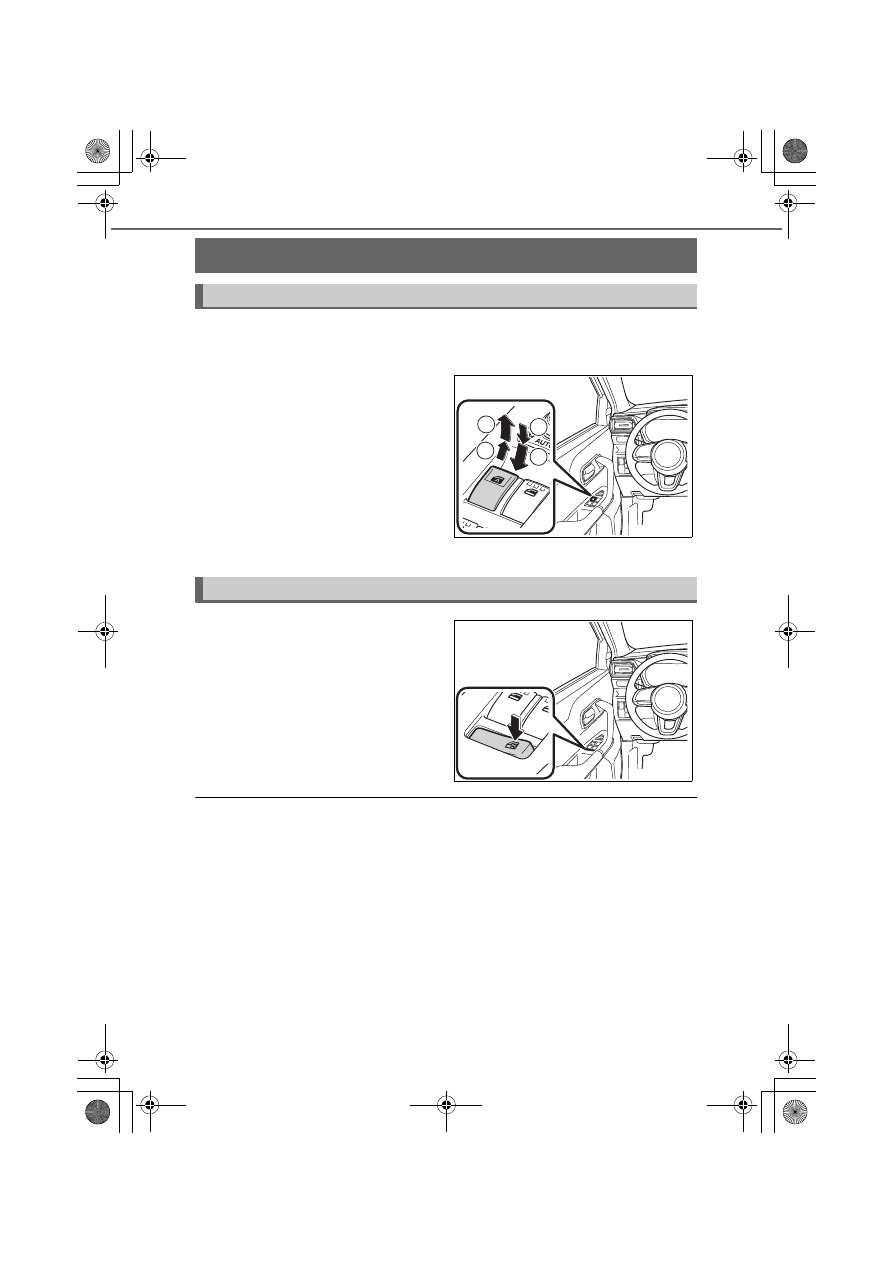
You can use the switch to open and close the door windows.
Using the switch, you can move the door windows as specified below.

a

Close

b

Automatic full close (driver’s seat

only)*

c

Open

d

Automatic full open (driver’s seat

only)*

*

To interrupt the operation, lightly
move the switch to the opposite side.

Window lock switch

Pressing the switch disables opera-

tions of all the door windows except

the driver’s door window.

This function can prevent children from

accidentally opening and closing the

door windows.

Operating conditions

When the engine switch is “ON”

Operation after stopping the engine (driver’s seat only)

Even after turning the engine switch to “ACC” or “OFF”, you can still open and

close the door windows for approximately 40 seconds.

Jam protection function (driver’s seat only)

When a foreign object gets trapped between the window frame and the door

window while the door window is closing, the door window remains slightly

open, and the power window operation stops.

1

2

4

3

KBRO350102E

KBRO350105E

161

3-5. Opening and closing the windows

Oper

ati

on of each com

ponent

3

Overheat protection function of the power window motor

The power window motor has a built-in overheat protection function. If the

power window motor continues to run at a high load, the overheat protection

function may get activated and temporarily stops the power window opera-

tion. After a dozen seconds, it starts working normally again.

When the driver’s door window will not close

When the driver’s door window will not close all the way due to the jam protec-

tion function being activated abnormally, perform the following operations

using the window switch on the driver’s door.

a

Stop the vehicle and turn the engine switch to “ON”

b

Pull the window switch on the driver’s door until it reaches the “automatic

full close” position, close the door window all the way, and keep holding the

switch for 6 seconds

If you release your hand from the switch while the door window is moving, you

need to start over from the beginning.
If these operations do not close the door window all the way and the window

still moves in a reverse direction, bring your vehicle to a Toyota dealer for

inspection.

Reconnecting the battery

Follow the steps described below and configure the initial settings to ensure

proper operation of the power windows.

a

Turn the engine switch to “ON”

b

Hold down the window switch of the driver’s door to open the window all

the way

c

Pull the window switch on the driver’s door until it reaches the “automatic

full close” position, close the door window all the way, and keep holding the

switch for 2 seconds

If you release your hands from the switch while the door window is moving,

you need to start over from the step 

b

.

162

3-5. Opening and closing the windows

WARNING

Observe the following precautions.
Failure to do so may cause death or serious injury.

Closing the windows

The driver is responsible for all the power window operations, including the
operation for the passengers. In order to prevent accidental operation,

especially by a child, do not let a child operate the power windows. It is possi-

ble for children and other passengers to have body parts caught in the

power window.
Also, when riding with a child, it is recommended to use the window lock

switch. (

P. 160)

Check to make sure that all passen-
gers do not have any part of their

body in a position where it could be

caught when a window is being

operated.

When exiting the vehicle, turn the engine switch off, carry the key and exit
the vehicle along with the child. There may be accidental operation, due to

mischief, etc., that may possibly lead to an accident.

Jam protection function (driver’s seat only)

Never try to have the passengers put their hands, arms, heads, and necks
out to be caught in the glass window so as to activate the jam protection

function.

The jam protection function may not be activated if a foreign object gets
caught right before the door windows close completely. In addition, the jam

protection function will not be activated if the switch is kept being pulled. Be

careful not to get your fingers caught.

Especially when a small object gets caught, the jam protection function may
not be activated.

KBRO350103E

163

3-5. Opening and closing the windows

Oper

ati

on of each com

ponent

3

NOTICE

Observe the following precautions. Failure to do so will lead to malfunction.

To prevent malfunction of the power windows

Do not operate the driver’s door window switch and the other switches in the
opposite direction at the same time

Do not keep operating the window switch while the door windows are fully
open or closed

Do not keep operating the window switch when the window glass is frozen
and does not move

To prevent battery discharge

Do not open or close the power windows unnecessarily when the engine is

stopped.

165

4

Driving

4-1. Driving the vehicle

Driving the vehicle .....................166
Precautions when loading 

luggage .....................................177

Trailer towing..............................179

4-2. Driving procedures

Engine (ignition) switch 

(vehicles without key-free 

system) ......................................180

Engine (ignition) switch 

(vehicles with key-free 

system) ......................................184

Continuously variable 

transmission.............................189

Driving the manual transmission 

vehicle........................................194

Turn signal lever.........................196
Parking brake..............................197

4-3. Operating the lights and 

windshield wipers

Headlight switch........................ 198
Fog light switch.......................... 201
Windshield wipers and washer 

(front)......................................... 203

Windshield wipers and washer 

(rear).......................................... 205

4-4. Refueling

Opening the fuel tank cap....... 207

4-5. Using the driving support 

systems

BSM (Blind Spot Monitor) ........ 211
Front corner sensors/

Reverse sensors...................... 221

Rear-view camera...................... 228
Driving assist systems .............. 232

4-6. Driving tips

Winter driving tips..................... 238
Eco-friendly driving tips ........... 241

166

4-1. Driving the vehicle

Driving the vehicle

The following procedures should be observed to ensure safe driving:

Starting the engine

P. 180, 184

Starting the vehicle

Continuously variable transmission vehicles

a

With the brake pedal depressed, set the shift lever to D (

P. 189)

b

Release the parking brake (

P. 197)

c

Gradually release the brake pedal and gently depress the accelerator

pedal to start off the vehicle

Manual transmission vehicles

a

With the clutch pedal depressed, set the shift lever to the gear 1

(

P. 194)

b

Release the parking brake (

P. 197)

c

Gradually release your foot from the clutch pedal and gently depress

the accelerator pedal to start moving the vehicle

Stopping the vehicle

Continuously variable transmission vehicles

a

With the shift lever in D, depress the brake pedal

b

If necessary, apply the parking brake

If the vehicle is to be stopped for an extended period of time, set the shift lever to P

or N. (

P. 189)

Manual transmission vehicles

a

Depress the brake pedal while stepping on the clutch pedal

b

If necessary, apply the parking brake

If you plan to stop the vehicle for an extended period, set the shift lever to N.

(

P. 194)

167

4-1. Driving the vehicle

D

riv

in

g

4

Parking the vehicle

Continuously variable transmission vehicles

a

With the shift lever in D, depress the brake pedal to stop the vehicle

completely

b

With the brake pedal depressed, apply the parking brake (

P. 197),

and set the shift lever in P (

P. 189)

c

Turn “OFF” the engine switch to stop the engine

d

Release your foot gradually from the brake pedal

e

Lock the door, making sure that you have the key on your person

When you park the vehicle in the middle of a hill, use wheel chocks as needed.

Manual transmission vehicles

a

Depress the brake pedal while stepping on the clutch pedal

b

Apply the parking brake

c

Set the shift lever to N (

P. 194)

d

Turn “OFF” the engine switch to stop the engine

e

Lock the door, making sure that you have the key on your person

When you park the vehicle in the middle of a hill, set the shift lever to the gear 1

(uphill) or R (downhill) and use wheel chocks as needed.

Starting off on an uphill

Continuously variable transmission vehicles

a

Make sure that the parking brake is applied and set the shift lever to D

b

Gently depress the accelerator pedal

c

When you feel the vehicle start to move, release the parking brake and

start off

Manual transmission vehicles

a

Make sure to apply the parking brake all the way and set the shift lever

to the gear 1

b

Lightly step on the accelerator pedal and release your foot from the

clutch pedal at the same time

c

When you feel the vehicle start to move, release the parking brake and

start off

168

4-1. Driving the vehicle

Starting off on an uphill

The hill-start assist control will be activated. (

P. 232)

Driving in the rain

Drive carefully when it is raining, because visibility will be reduced, the win-
dows may become fogged-up, and the road will be slippery.

Drive carefully when it starts to rain, because the road surface will be espe-
cially slippery.

Refrain from driving at high speeds on an expressway in the rain, because
there may be a layer of water between the tires and the road surface, pre-

venting the steering and brakes from operating properly.

Engine speed while driving (continuously variable transmission vehicles)

In the following conditions, the engine speed may become high while driving.

This is due to automatic up-shifting restriction or down-shifting implementa-

tion to meet driving conditions. It does not indicate sudden acceleration.

The vehicle is judged to be driving uphill or downhill

When the accelerator pedal is released

Engine power suppression control (Brake Override System)

When the accelerator pedal and the brake pedal are depressed simultane-

ously, the engine output may be suppressed.

Vehicles without TFT color multi-information display

When the Brake Override System is operating, the warning light turns on.
(

P. 381)

Vehicles with TFT color multi-information display

When the Brake Override System is operating, the warning message is dis-
played. (

P. 390)

Idling before stopping the engine (turbo vehicles)

Immediately after driving at high-speed or climbing on a hill, idle the engine

for approx. 1 minute and then stop the engine in order to prevent the turbo

system from being damaged.

Overheating

The following severe driving situations can cause overheating.

Driving up a long uphill on a hot day

Sudden deceleration or stop immediately after high-speed driving

169

4-1. Driving the vehicle

: If equipped

D

riv

in

g

4

Breaking in your new Toyota

To extend the life of the vehicle, observing the following precautions is recom-

mended:

For the first 300 km (186 miles):
Avoid sudden stops.

For the first 1000 km (621 miles):

Do not drive at extremely high speeds.

Avoid sudden acceleration.

Do not drive continuously in low gears.

Do not drive at a constant speed for extended periods.

Eco-friendly driving

Vehicles without TFT color multi-information display

During eco-friendly driving, Eco Driv-

ing Indicator Light turns on.

When the accelerator pedal is

stepped on stronger than necessary

or when the vehicle is stopped, the

light turns off.

In the following cases, Eco Driving

Indicator Light will not be activated.

When the shift lever is set in other
than D (continuously variable trans-

mission vehicles)

When the shift lever is set to the 1st
gear, N or R (manual transmission

vehicles)

When the vehicle speed is approx.
110 km/h (68 mph) or greater

When the driving mode is set to
Power mode

 (

P. 190)

On/Off of Eco Driving Indicator Light can be set. (

P. 92)

Vehicles with TFT color multi-information display

P. 98

Operating your vehicle in a foreign country

Comply with the relevant vehicle registration laws and confirm the availability

of the correct fuel. (

P. 429)

KBRO410101

KBRO410102E

170

4-1. Driving the vehicle

WARNING

Observe the following precautions. Failure to do so may cause death or serious

injury.

When starting to move the vehicle (continuously variable transmission 
vehicles)

Always depress the brake pedal while stopped with the engine running. This

prevents the vehicle from creeping.

When driving the vehicle

Do not drive if you are unfamiliar with the location of the brake and accelera-
tor pedals to avoid depressing the wrong pedal.

Accidentally depressing the accelerator pedal instead of the brake pedal

will result in sudden acceleration that may lead to an accident.

When backing up, you may twist your body around, leading to difficulty in

operating the pedals. Make sure to operate the pedals properly.

Make sure to keep a correct driving posture even when moving the vehicle

only slightly. This allows you to depress the brake and accelerator pedals

properly.

Depress the brake pedal using your right foot. Depressing the brake pedal

using your left foot may delay response in an emergency, resulting in an

accident.

Do not drive the vehicle over or stop the vehicle near flammable materials.
The exhaust pipes and exhaust gases can be extremely hot, and may cause a

fire if there is any flammable material nearby.

During normal driving, do not turn off the engine. Turning the engine off
while driving will not cause loss of steering or braking control, but the power

assist to these systems will be lost. This will make it more difficult to steer

and brake, so you should pull over and stop the vehicle as soon as it is safe

to do so.
However, in the event of an emergency, such as if it becomes impossible to

stop the vehicle in the normal way: 

P. 367

Use engine braking to maintain a safe speed when driving down a steep hill.
Using a foot brake continuously may cause the brake to overheat and lose

effectiveness. (

P. 189)

Depending on the road surface and speed, shift down as follows and also
use engine braking.

Set the shift lever to S (continuously variable transmission vehicles)

Set Manual Mode (

P. 190) and downshift by 1 gear at a time (continu-

ously variable transmission vehicles)

Lower the gear by 1 level (Manual transmission vehicles)

171

4-1. Driving the vehicle

WARNING

D

riv

in

g

4

Avoid sudden engine braking (shift lever operation). The tires may lock and
slip, causing an accident.

Do not adjust the positions of the steering wheel, the seat, or the inside or
outside rear view mirrors while driving.
Doing so could cause the driver to mishandle the vehicle.

Always check that all occupants’ arms, heads or other parts of their bodies
are not outside the vehicle.

Do not drive off-road.
If you must drive off-road, drive carefully.

Do not drive underwater such as crossing a river.
It may cause a serious vehicle failure such as short-circuiting of electrical

components or damage to the engine.

Do not drive with luggage on or near the seats.
If the vehicle brakes or turns suddenly, the luggage may be thrown out and

hit occupants, the luggage may be damaged, or the driver may be distracted

by the luggage, which may lead to an unforeseen accident.

Drive carefully where there are large steps or where there are wheel chocks.
The bumper may be damaged.

Do not release the clutch pedal all the way at once. Doing so could move the
vehicle forward and may lead to an unforeseen accident. (

P. 194)

When driving on slippery road surfaces

Sudden braking, acceleration or steering may cause tire slippage and reduce
your ability to control the vehicle.

Sudden acceleration, engine braking due to shifting, or changes in engine
speed could cause the vehicle to skid.

After driving through a puddle, lightly depress the brake pedal to make sure
that the brakes are functioning properly. Wet brake pads may prevent the

brakes from functioning properly. If the brakes on only one side are wet and

not functioning properly, steering control may be affected.

When operating the shift lever

For the continuously variable transmission vehicles, never let the vehicle roll
backward while the shift lever is in a driving position, or roll forward while the

shift lever is in R.
Doing so may cause the engine to stall or lead to poor brake and steering

performance, resulting in an accident or damage to the vehicle.

172

4-1. Driving the vehicle

WARNING

On vehicles with continuously variable transmission, do not shift the shift
lever to P while the vehicle is moving.
Doing so can damage the transmission and may result in a loss of vehicle

control.

Do not shift the shift lever to R while the vehicle is moving forward.
Doing so can damage the transmission and may result in a loss of vehicle

control.

Do not shift the shift lever to a driving position while the vehicle is moving
backward.
Doing so can damage the transmission and may result in a loss of vehicle

control.

Moving the shift lever to N while the vehicle is moving will disengage the
engine from the transmission. Engine braking is not available when N is

selected.

Be careful not to set the shift lever with the accelerator pedal depressed.
Setting the shift lever to a gear other than P (continuously variable transmis-

sion vehicles) or N is dangerous, as it could lead to unexpected rapid acceler-

ation of the vehicle that may cause an unforeseen accident.

If you hear a continuous squealing noise from around the brakes

Have the brake pads checked and replaced by your Toyota dealer as soon as

possible.
Damage to the disc rotor may result if the pads are not replaced when needed.
Parts such as pads and rotors wear out as they are used. Riding beyond the

limits of wear will not only cause malfunctions, but may also lead to an acci-

dent.

When stopping the vehicle

Do not depress the accelerator pedal unnecessarily.
Setting the shift lever to a gear other than P (continuously variable transmis-

sion vehicles) or N is dangerous, as it could lead to unexpected rapid acceler-

ation of the vehicle that may cause an unforeseen accident.

In order to prevent accidents due to the vehicle rolling away, always keep
depressing the brake pedal while the engine is running, and apply the park-

ing brake as necessary.

If the vehicle is stopped on an incline, in order to prevent accidents caused
by the vehicle rolling forward or backward, always depress the brake pedal

and securely apply the parking brake as needed.

173

4-1. Driving the vehicle

WARNING

D

riv

in

g

4

Avoid revving or racing the engine.
Running the engine at high speed while the vehicle is stopped may cause

the exhaust system to overheat, which could result in a fire if combustible

material is nearby.

When parking the vehicle

Do not leave glasses, cigarette lighters, aerosol cans, or carbonated bever-
age cans in the vehicle under the scorching sun.
Doing so may result in the following:

Gas may leak from a cigarette lighter or aerosol can, and may lead to a fire

The glasses with plastic lenses and plastic material may deform or crack

Carbonated beverage cans may fracture, causing the contents to spill over

the interior of the vehicle, and may also cause a short circuit in the vehi-

cle’s electrical components

Do not leave cigarette lighters in the vehicle. If a cigarette lighter is in a stor-
age compartment or on the floor, it may be lit accidentally when luggage is

loaded or the seat is adjusted, causing a fire.

Do not attach adhesive discs to the windshield or windows. Do not place
containers such as fragrance on the instrument panel or dashboard.
Adhesive discs or containers may act as lenses, causing a fire in the vehicle.

Do not leave a door or window open if the curved glass is coated with a
metallized film such as a silver-colored one.
Reflected sunlight may cause the glass to act as a lens, causing a fire.

For continuously variable transmission vehicles, always apply the parking
brake, set the shift lever to P, stop the engine, and lock the vehicle when

leaving the vehicle unattended.
Do not leave the vehicle unattended while the engine is running.
If the vehicle is parked with the shift lever in P but the parking brake is not

set, the vehicle may start to move, possibly leading to an accident.

Do not touch the exhaust pipes while the engine is running or immediately
after turning the engine off.
Doing so may cause burns.

When taking a nap in the vehicle

Always turn the engine off.
Otherwise, if you accidentally move the shift lever or depress the accelerator

pedal, this could cause an accident or fire due to engine overheating. Addition-

ally, if the vehicle is parked in a poorly ventilated area, exhaust gases may enter

the vehicle, leading to death or a serious health hazard.

174

4-1. Driving the vehicle

WARNING

When braking

When the brakes are wet, drive more cautiously.
Braking distance increases when the brakes are wet, and this may cause one

side of the vehicle to brake differently than the other side. Also, the parking

brake may not securely hold the vehicle.

If the brake booster device does not operate, do not follow other vehicles
closely and avoid hills or sharp turns that require braking.
In this case, braking is still possible, but the brake pedal should be

depressed more firmly than usual. Also, the braking distance will increase.
Have your brakes fixed immediately.

Do not pump the brake pedal if the engine stalls.
Each push on the brake pedal uses up the reserve for the power-assisted

brakes.

The brake system consists of 2 individual hydraulic systems; if one of the sys-
tems fails, the other will still operate. In this case, the brake pedal should be

depressed more firmly than usual and the braking distance will increase.
Have your brakes fixed immediately.

If you get a flat tire while driving

A flat or damaged tire may cause the following situations. Hold the steering

wheel firmly and gradually depress the brake pedal to slow down the vehicle. It

is dangerous to apply the brakes suddenly, as it may be difficult to control your

vehicle, which may lead to an accident.

It is difficult to control your vehicle

The vehicle is making abnormal sounds or vibrations

The vehicle leans abnormally

For information on what to do in case of a flat tire, see P. 396.

175

4-1. Driving the vehicle

D

riv

in

g

4

NOTICE

Driving (continuously variable transmission vehicles)

Do not depress the accelerator and brake pedals at the same time during
driving.
Depressing the accelerator and brake pedals at the same time may restrain

the engine output.

Do not use the accelerator pedal or depress the accelerator and brake ped-
als at the same time to hold the vehicle on a hill.

Driving (Manual transmission vehicles)

Do not depress the accelerator and brake pedals at the same time during
driving. Depressing the accelerator and brake pedals at the same time may

restrain the engine output.

Do not move the shift lever without stepping on the clutch pedal all the way.
Doing so could damage the clutch or transmission.

To prevent the clutch from being damaged, observe the following precau-
tions.

Do not drive with your foot placed on the clutch pedal

Avoid starting to move the vehicle when the shift lever is set to other than

the gear 1

Do not ride the clutch more than necessary especially when starting to

move the vehicle on a hill

Do not set the shift lever to R while the vehicle is still moving. Doing so could
damage the clutch, transmission, or the gear.

Parking (continuously variable transmission vehicles)

Always apply the parking brake, and set the shift lever to P. If the parking brake

is not applied and the shift lever is not set to P, it may cause the vehicle to

move or the vehicle may accelerate suddenly if the accelerator pedal is acci-

dentally depressed.

Avoiding damage to vehicle parts

Do not turn the steering wheel fully in either direction and hold it there for
an extended period of time. Doing so may damage the electric power steer-

ing motor.

When driving over bumps in the road, drive as slowly as possible to avoid
damaging the disc wheels, etc.

176

4-1. Driving the vehicle

NOTICE

If you feel the clutch is slipping (Manual transmission vehicles)

Have the vehicle inspected at your Toyota dealer as soon as possible. If your

vehicle does not accelerate by stepping on the accelerator pedal even when

the clutch is engaged, the clutch may be slipping and the vehicle may no

longer be able to run.

To prevent damage to the turbo system (Turbo vehicles)

Immediately after driving at high speed or climbing on a hill, do not stop the
engine. Make sure to idle the engine for approx. 1 minute to cool down the

turbo system, and then stop the engine.

Do not use any parts other than those specified for the exhaust pipes.

Never alter the exhaust pipes.

Never race or accelerate suddenly when the engine is cold.

Make sure to change the oil periodically. (

P. 418)

When encountering flooded roads

Do not drive on a road that has flooded after heavy rain, etc. Doing so may

cause the following serious damage to the vehicle:

Engine stalling

Short in electrical components

Engine damage caused by water immersion

In the event that you drive on a flooded road and the vehicle is flooded, be

sure to have your Toyota dealer check the following:

Brake function

Changes in quantity and quality of oils and fluids such as engine oil,
transaxle oil, and differential oil

Poor lubrication of the bearings and joints, etc.


Content      ..     8      9      10      11     ..