Toyota Mirai (2023 year). Manual in english - page 18
 

  Index      Toyota     Toyota Mirai (2023 year). Manual in english


Search            copyright infringement  


Content      ..     16      17      18      19     ..


Toyota Mirai (2023 year). Manual in english - page 18


291

5-5. Using the driving support systems

5

Dr

iv

ing

with normal brake operation.

• A vehicle is no longer approaching 

from the right or left at the rear of 

the vehicle.

Brake control

• The Parking Support Brake is dis-

abled.

• Approximately 2 seconds have 

elapsed since the vehicle was 

stopped by brake control.

• The brake pedal is depressed 

after the vehicle is stopped by 

brake control.

• A vehicle is no longer approaching 

from the right or left at the rear of 

the vehicle.

Detection range

The detection range of the moving 

vehicles rear of the vehicle differs 

from the detection area of the RCTA 

function (

P.274). Therefore, even 

if the RCTA function detects a vehi-

cle and provides an alert, the mov-

ing vehicles rear of the vehicle may 

not start operating.

RCTA buzzer

Regardless of weather the RCTA 

function is on or off, if the PKSB 

(Parking Support Brake) system is 

not disabled, when the brake control 

operates, the buzzer will sounds to 

alert the driver.

Situations in which the system 

may not operate properly

P.275

Situations in which the system 

may operate even if there is no 

possibility of a collision

P.276

*

: If equipped

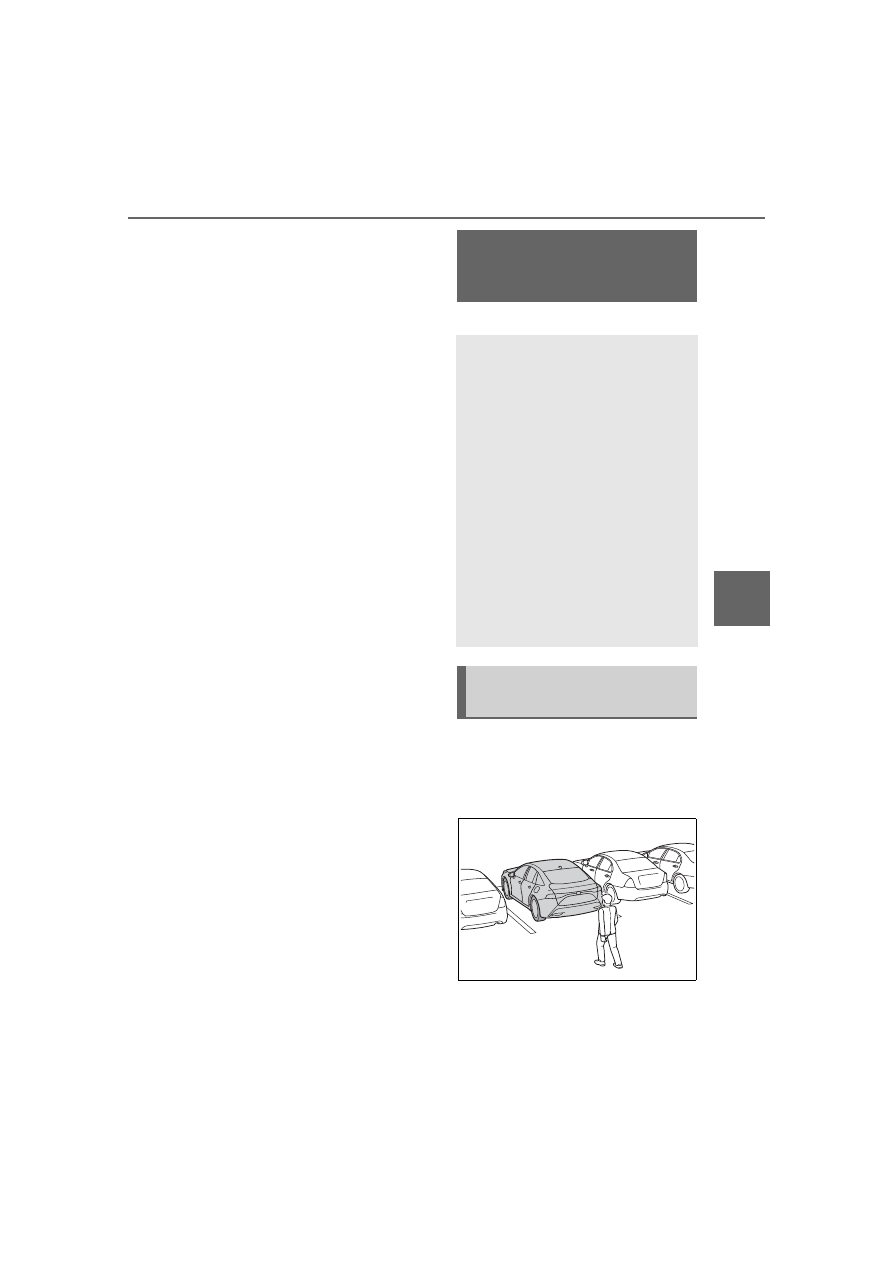
When a pedestrian is detected 
behind the vehicle while backing 
up, the brake pedal is not 
depressed or is depressed late.

Parking Support Brake 

function (pedestrians 

rear of the vehicle)

*

If the rear camera sensor 
detects a pedestrian behind 
the vehicle while backing 
up and the system deter-
mines that the possibility of 
colliding with the detected 
pedestrian is high, a buzzer 
will sound. If the system 
determines that the possi-
bility of colliding with the 
detected pedestrian is 
extremely high, the brakes 
will be applied automati-
cally to help reduce the 
impact of the collision.

Examples of system oper-
ation

292

5-5. Using the driving support systems

Displays a message to urge the 
driver to take evasive action 
when a pedestrian is detected in 
the detection area behind the 
vehicle. (A message will also be 
displayed on the multi-informa-
tion display and head-up display 
[if equipped].)

Pedestrian detection icon

“BRAKE”

The system will operate when

The function will operate when the 

PKSB OFF indicator is not illumi-

nated (

P.97, 457) and all of the 

following conditions are met:

Fuel cell system output restriction 

control

• The Parking Support Brake is 

enabled.

• The vehicle speed is 9 mph (15 

km/h) or less.

• The shift position is in R.

• The rear camera sensor detects a 

pedestrian behind the vehicle 

while backing up and the system 

determines that the possibility of 

colliding with the detected pedes-

trian is high.

• When a pedestrian is detected 

behind the vehicle.

• The PKSB (Parking Support 

Brake) determines that a stronger-

than-normal brake operation is 

necessary to avoid a collision.

Brake control

• Fuel cell system output restriction 

control is operating.

• The Parking Support Brake deter-

mines that an emergency brake 

operation is necessary to avoid a 

collision with a pedestrians.

The system will stop operating 

when

The function will stop operating if 

any of the following conditions are 

met:

Multimedia display

WARNING

If the PKSB (Parking Support 

Brake) operates unnecessar-

ily

Depress the brake pedal immedi-

ately after the PKSB (Parking 

Support Brake) system operates. 

(Operation of the function is can-

celed by depressing the brake 

pedal.)

Correct use of the PKSB 

(Parking Support Brake) sys-

tem

P.277

NOTICE

If “Parking Support Brake 

Unavailable Remove the Dirt 

of Rear Camera” is displayed 

on the multi-information dis-

play and the PKSB OFF indi-

cator is illuminated

If this message is displayed 

immediately after the power 

switch is changed to ON, operate 

the vehicle carefully, paying atten-

tion to your surroundings.

293

5-5. Using the driving support systems

5

Dr

iv

ing

Fuel cell system output restriction 

control

• The Parking Support Brake is dis-

abled.

• The collision becomes avoidable 

with normal brake operation.

• The pedestrian is no longer 

detected behind your vehicle.

Brake control

• The Parking Support Brake is dis-

abled.

• Approximately 2 seconds have 

elapsed since the vehicle was 

stopped by brake control.

• The brake pedal is depressed 

after the vehicle is stopped by 

brake control.

• The pedestrian is no longer 

detected behind your vehicle.

Re-enabling the pedestrians of 

the vehicle

P.285

Detection range

The detection area of the pedestri-

ans rear of the vehicle differs from 

the detection area of the RCD func-

tion (

P.278). Therefore, even if the 

RCD function detects a pedestrian 

and provides an alert, the pedestri-

ans rear of the vehicle may not start 

operating.

Situations in which the system 

may not operate properly

P.280

Situations in which the system 

may operate unexpectedly

P.280

*

: If equipped

The Advanced Park is a system 
which assists in a safe and 
smooth parking or exiting from a 
parking space by displaying the 
blind spots around the vehicle 
and the target parking spot 
through a bird’s eye view, deliv-
ering operation guidance 
through displays and buzzer 
operation, and changing the 
shift position, operating the 
steering wheel, accelerator 
pedal, and brake pedal.
Additionally, the panoramic view 
monitor

*

 can display the area in 

front, behind, and from above 
the vehicle, helping confirm the 
condition of the area around the 
vehicle.
Depending on the condition of 
the road surface or the vehicle, 
the distance between the vehi-
cle and a parking space, etc., it 
may not be possible to assist in 
parking in the target space.

*

: For details on the panoramic view 

monitor refer to “MULTIMEDIA 
OWNER’S MANUAL”.

Toyota Teammate 

Advanced Park

*

Function description

294

5-5. Using the driving support systems

Perpendicular parking (for-
ward/reverse) function

Assistance is provided from the 
position the vehicle is stopped 
near the target parking space 
until the vehicle is in the parking 
space. (

P.301)

Perpendicular exiting (for-
ward/reverse) function

Assistance is provided from the 
parked position until the vehicle 
is in a position where you can 
easily exit from the parking 
space. (

P.304)

Parallel parking function

Assistance is provided from the 
position the vehicle is stopped 
near the target parking space 
until the vehicle is in the parking 
space. (

P.306)

Parallel exiting function

Assistance is provided from the 
parked position until the vehicle 
is in a position where you can 
easily exit from the parking 
space. (

P.309)

Memory function

Assistance is provided until the 
vehicle is guided into a previ-
ously registered parking space. 
(

P.311)

Functions

WARNING

Cautions regarding the use of 

the system

The recognition and control capa-

bilities for this system are limited. 

The driver should always drive 

safety by always being responsi-

ble without over relying on the 

system and have a understanding 

of the surrounding situations.

As with a normal vehicle, take 

care to observe your surround-

ings while the vehicle is moving.

Always pay attention to the 

vehicle’s surroundings while the 

system is operating and 

depress the brake pedal as nec-

essary to slow or stop the vehi-

cle.

When parking, make sure that 

the vehicle can be parked in the 

target parking space before 

beginning operation.

Depending on the condition of 

the road surface or the vehicle, 

the distance between the vehi-

cle and a parking space, etc., it 

may not be possible to detect a 

parking space or the system 

may not be able to provide 

assistance to the point the vehi-

cle is fully parked.

This system will guide the vehi-

cle to appropriate positions for 

changing the direction of travel, 

however, if you feel that the 

vehicle is approaching too close 

to an adjacent parked vehicle at 

any time, depress the brake 

pedal and change the shift posi-

tion. However, if this is per-

formed, the number of times the 

vehicle changes direction may 

increase, and the vehicle may 

be parked at an angle.

295

5-5. Using the driving support systems

5

Dr

iv

ing

WARNING

As following objects may not be 

detected, make sure to check 

the safety of the area around 

your vehicle and depress the 

brake pedal to stop the vehicle if 

it may collide with an object.

• Wires, fences, ropes, etc.

• Cotton, snow and other materi-

als that absorb sound waves

• Sharply-angled objects

• Low objects (curb stones, park-

ing blocks, etc.)

• Tall objects with upper sections 

projecting outwards in the direc-

tion of your vehicle

Even if there is an object in the 

target parking space, it may not 

be detected and assistance 

may be performed.

While the system is operating, if 

it is likely that your vehicle will 

collide with a nearby vehicle, 

parking block, object, or person, 

depress the brake pedal to stop 

the vehicle and press the 

Advanced Park main switch to 

disable the system.

Never use only the multimedia 

display to view the area behind 

the vehicle. The image dis-

played may differ than the 

actual situation. Using only the 

screen when backing up may 

lead to an accident, such as a 

collision with another vehicle. 

When backing up, make sure to 

look directly or use the mirrors 

to check the safety of the area 

around your vehicle, especially 

behind the vehicle.

When the ambient temperature 

is extremely low, the screen 

may appear dark or the dis-

played image may become 

unclear. Also, as moving objects 

may appear distorted or may 

not be able to be seen on the 

screen, make sure to directly 

check the safety of the area 

around your vehicle.

In the following situations, while 

the vehicle is stopped and held 

by Advanced Park, it may be 

canceled and the vehicle may 

start moving. Immediately 

depress the brake pedal. Fail-

ure to do so may lead to an 

accident.

• When the driver’s door is 

opened

• When operations instructed by 

the system are not performed 

within a certain amount of time

• When the brake pedal is 

depressed and the vehicle is 

stopped for a certain amount of 

time

• When the system malfunctions

As the steering wheel will turn 

while this system is operating, 

pay attention to the following.

• Be careful so that a necktie, 

scarf, or arm does not get 

caught. Keep your upper body 

away from the steering wheel. 

Also, keep children away from 

the steering wheel.

• Long fingernails may be caught 

and when the steering wheel is 

rotating, leading to injury.

• In an emergency, depress the 

brake pedal to stop the vehicle, 

and then press the Advanced 

Park main switch to disable the 

system.

296

5-5. Using the driving support systems

WARNING

Do not allow anyone to put their 

hands outside of a window while 

this system is operating.

To ensure correct operation 

of the Advanced Park

Observe the following precau-

tions.

Failing to do so may result in the 

vehicle being unable to be driven 

safely and possibly cause an acci-

dent.

Do not use this system in situa-

tions such as the following:

• When in areas other than com-

mon parking spaces

• When the surface of the parking 

space is sand or gravel and is 

not clearly defined with parking 

space lines

• When the parking space is not 

level, such as when on a slope 

or has differences in height

• Mechanical parking system

• Parking lot with a device which 

raises to contact the bottom of 

the vehicle

• When the road surface is fro-

zen, slick, or covered with snow

• When it is extremely hot and the 

asphalt is melting

• When there are objects around 

the vehicle

• When there is an object 

between your vehicle and the 

target parking spot or within the 

target parking spot (within the 

displayed blue box)

• When there is a gutter between 

your vehicle and the target park-

ing space or within the target 

parking spot (within the dis-

played blue box)

• When there is a hole or gutter in 

the exit direction

• When in high pedestrian or 

vehicle traffic areas

• When the parking space is in a 

location that is difficult to park in 

(too narrow for your vehicle, 

etc.)

• When images are unclear due 

to dirt or snow attached to the 

camera lens, light being shined 

into the camera or shadows

• When tire chains or a compact 

spare tire is installed to the vehi-

cle

• When the doors or trunk are not 

completely closed

• When an arm is held outside of 

a window

• In inclement weather such as 

heavy rain or snow

Make sure to use only standard 

sized tires, such as those that 

were installed to the vehicle 

when it was shipped from the 

factory. Otherwise, Advanced 

Park may not operate properly. 

Also, when the tires have been 

replaced, the displayed position 

of the lines or box displayed on 

the screen may become incor-

rect. When replacing the tires, 

contact your Toyota dealer.

In situations such as the follow-

ing, it may not be possible for 

the system to provide assis-

tance to a registered parking 

spot:

297

5-5. Using the driving support systems

5

Dr

iv

ing

Cameras and sensors are used 

to detect parked vehicles, mak-
ing it easier to identify parking 
spaces.

Front camera

Side cameras

Rear camera

Sensors

P.261

Camera images

As special cameras are used, the 

colors in displayed images may dif-

fer from the actual color.

WARNING

• When the tires are extremely 

worn or the tire inflation pres-

sure is low

• When carrying a heavy load

• When the vehicle is tilted due to 

the carried load

• When a heater is installed in the 

surface of the parking space 

(road surface freeze prevention 

heater)

• When the wheels are mis-

aligned, such after a wheel has 

been subjected to a strong 

impact

• When a pedestrian or passing 

vehicle is detected during assis-

tance

• When something is incorrectly 

detected as a parking line (light, 

reflections from a building, dif-

ference in height on the parking 

surface, a gutter, painted road 

lines, redrawn lines, etc.)

If the vehicle deviates greatly from 

the set parking space in any situa-

tion other than the above, have 

the vehicle inspected by your Toy-

ota dealer.

NOTICE

Precautions for use 

Advanced Park

If the 12-volt battery was dis-

charged or has been removed 

and installed, fold and extend the 

outside rear view mirrors.

Type of cameras and sen-
sors used for the 
Advanced Park

298

5-5. Using the driving support systems

Precautions for use

For details on the following, refer to 

“Panoramic view monitor” of “Pan-

oramic view monitor functions” in 

the “MULTIMEDIA OWNER’S MAN-

UAL”.

Displayable range of the screens

Cameras

Differences between displayed 

images and the actual road

Differences between displayed 

images and the actual objects

Detection range of the cameras 

and sensors

If a parked vehicle is behind the 

target parking space and the dis-

tance between it and the vehicle 

becomes far, it may no longer be 

able to be detected. Depending on 

shape or condition of a parked 

vehicle, the detection range may 

become short or the vehicle may 

not be detected.

Objects other than parked vehi-

cles, such as columns, walls, etc., 

may not be detected. Also, if they 

are detected, they may cause the 

target parking space to be mis-

aligned.

Situations in which parking 

space lines may not be recog-

nized properly

In situations such as the following, 

parking space lines on the road 

surface may not be detected:

• When the parking space does not 

use lines (parking space boundar-

ies are marked with rope, blocks, 

etc.)

• When the parking space lines are 

faded or dirty, making them 

unclear

• When the road surface is bright, 

such as concrete, and the contrast 

between it and the white parking 

space lines is small

• When the parking space lines are 

any color other than yellow or 

white

• When the area surrounding the 

parking space is dark, such as at 

night, in an underground parking 

lot, parking garage, etc.

• When it is raining or has rained 

and the road surface is wet and 

reflective or there are puddles

• When the sun is shining directly 

into a camera, such as in the early 

morning or evening

• When the parking space is cov-

ered with snow or de-icing agent

• When there marks from repairs or 

other marks on the road surface, 

or there is a traffic bollard, or other 

object on the road surface

• When the color or brightness of 

the road surface is uneven

• When a camera has been 

splashed by hot or cold water and 

the lens has fogged up

• When the appearance of the park-

ing space is affected by the 

shadow of the vehicle or trees

• When a camera lens is dirty or 

covered with water droplets

In situations such as the following, 

the target parking space may not 

be recognized correctly:

• When there marks from repairs or 

other marks on the road surface, 

or there is a parking block, traffic 

bollard, or other object on the road 

surface

• When it is raining or has rained 

and the road surface is wet and 

reflective or there are puddles

• When the area around the vehicle 

is dark or backlit

• When the color or brightness of 

the road surface is uneven

• When the parking space is on a 

slope

• When there are diagonal lines 

(access aisle) near the parking 

space

• When the appearance of the park-

ing space is affected by the 

shadow of a parked vehicle (such 

as shadows from the grille, side 

step, etc.)

• When accessories which obstruct 

the view of the camera are 

installed

• When the parking space lines are 

299

5-5. Using the driving support systems

5

Dr

iv

ing

faded or dirty, making them 

unclear

• When the appearance of the park-

ing space is affected by the 

shadow of the vehicle or trees

Sensor detection information

P.264

Objects which the sensor may 

not be properly detected

P.264

Situations in which the sensor 

may not operate properly

P.264

Situations in which parking 

assistance may operate even if 

there is no possibility of a colli-

sion

P.265

Press the Advanced Park main 
switch.

If the switch is pressed while assis-
tance is being performed, the assis-
tance will be canceled.

Operating conditions of the 

Advanced Park

Assistance will begin when all of the 

following conditions are met:

The brake pedal is depressed

The vehicle is stopped

The driver’s seat belt is fastened

The steering wheel is not being 

operated

The accelerator pedal is not 

depressed

All of the doors and the trunk are 

closed

WARNING

Precautions for the cameras 

and sensors

Due to the characteristics of the 

camera lens, the position of and 

distance to people and objects 

displayed on the screen may 

differ from the actual situation. 

For details, refer to “MULTIME-

DIA OWNER’S MANUAL”.

Make sure to observe the pre-

cautions for using the intuitive 

parking assist (

P.262), other-

wise a sensor may not operate 

correctly, possibly leading to an 

accident.

In situations such as the follow-

ing, the sensors may not oper-

ate correctly, possibly leading to 

an accident. Proceed carefully.

• When there is a parked vehicle 

next to the target parking space, 

if the displayed target parking 

space is far from the actual tar-

get parking space, a sensor 

may be misaligned. Have the 

vehicle inspected by your Toy-

ota dealer.

• Do not install any accessories 

near the detection area of the 

sensors.

Turning the Advanced 
Park system on/off

300

5-5. Using the driving support systems

The outside rear view mirrors are 

not folded

The parking brake is not engaged

The dynamic radar cruise control 

are not operating

ABS, VSC, TRAC, PCS and 

PKSB are not operating

The vehicle is not on a steep 

slope

The VSC and TRAC are not 

turned off

If assistance cannot be started, 
check the message displayed on 
the multimedia display (

P.319)

Guidance screens are displayed 
on the multimedia display.

Guidance screen (When 
assistance starts)

Target parking space box 
(blue)

Advice display

Parking type change button

If multiple buttons are displayed, 
depending on the condition of the 
button its function differs as follows.

 or 

: Change the target to 

another parking space.

 or 

: Select the current 

target parking space.

: Select to change to the par-

allel parking function

: Change the perpendicular 

parking (forward/reverse) function

“MODE” button

Select to change between the 
memory function and the perpen-
dicular parking (forward/reverse) 
function and parallel parking func-
tion. (

P.314)

“Start” button

Select to start parking assistance.

Perpendicular parking direc-
tion change button

Select to change between the park-
ing (forward) function and parking 
(reverse) function

: Change the perpendicular 

parking (forward) function

: Change the perpendicular 

parking (reverse) function

Customize setting button

Select to display the Advanced 
Park setting screen. (

P.317)

Registration button

Select to begin registering a park-
ing space.

Advanced Park guidance 
screens

301

5-5. Using the driving support systems

5

Dr

iv

ing

Guidance screen (When 
reversing)

Operation icon

Displayed when the Advanced Park 
is operating.

Guide lines (yellow and red)

Display points from the center of 
the edge of the front or rear bumper 
to the target stopping position (yel-
low)

*

 and approximately 1 ft. (0.3 

m) (red) from the vehicle.

Moving object warning icon

Emergency support brake 
control operation display

“BRAKE!” is displayed.

Intuitive parking assist dis-
play

P.262

*

: The yellow lateral line is not dis-

played when the target stopping 
position is approximately 8.2 ft. 
(2.5 m) or more away from the 
vehicle.

Intuitive parking assist pop-up 

display

Regardless of whether the intuitive 

parking assist is off or on (

P.262)

if an object is detected by the intui-

tive parking assist when the 

Advanced Park is operating, the 

intuitive parking assist pop up dis-

play will automatically be displayed 

over the guidance display.

Brake control operation when 

Advanced Park is operating

While the Advanced Park is operat-

ing, if the system determines that 

the possibility of collision with 

detected moving or stationary object 

is high, the fuel cell system output 

restriction control and brake control 

will operate.
If brake control operates, Advanced 

Park operation will be suspended 

and a message will be displayed on 

the multi-information display.

Buzzer

Depending on surrounding sounds 

or sounds from other systems, it 

may be difficult to hear the buzzer of 

this system.

If a black screen is displayed on 

the multimedia display when 

the Advanced Park is operating

The system is being affected by 

radio waves or may be malfunction-

ing. If a radio antenna is installed 

near a camera, move it to a location 

as far from the cameras as possible. 

If a radio antenna is not installed 

near a camera, and the screen does 

not return to normal after turning the 

power switch off and then starting 

the fuel cell system again, have the 

vehicle inspected by your Toyota 

dealer.

The perpendicular parking (for-
ward/reverse) function can be 
used if the target parking space 
can be detected when the vehi-
cle is stopped close and perpen-
dicular to the center of the 
parking space. Also, depending 

Perpendicular parking 
(forward/reverse) function

302

5-5. Using the driving support systems

on the condition of the parking 
space, etc., if it is necessary to 
change the direction of travel of 
the vehicle, the shift position can 
be changed by assistance con-
trol.

Parking using the perpen-
dicular parking (for-
ward/reverse) function

1

Stop the vehicle at a position 
close and perpendicular to 
the center of the target park-
ing space.

If there are parking space 
lines

Approximately 3.3 ft. (1 m)

*

Approximately 8.2 ft. (2.5 m)

*

Approximately 19.7 ft. (6 m) 
or more

*

Approximately 18.0 ft. (5.5 m) 
or more

*

The system can operate even if 
there is a parking space line on only 
one side of the target parking 
space.

*

: This is a reference measurement 

for detection of a parking space. 
Depending on the surrounding 
environment, detection may not 

be possible.

If there is an adjacent parked 
vehicle

Approximately 3.3 ft. (1 m)

*

Approximately 9.8 ft. (3 m) or 
more

*

Approximately 19.7 ft. (6 m) 
or more

*

Approximately 18.0 ft. (5.5 m) 
or more

*

The system can operate even if 
there is a vehicle on only one side 
of the target parking space.

*

: This is a reference measurement 

for detection of a parking space. 
Depending on the surrounding 
environment, detection may not 
be possible.

2

Press the Advanced Park 
main switch and check that a 
possible parking space is dis-

303

5-5. Using the driving support systems

5

Dr

iv

ing

played on the multimedia dis-
play.

If a space which your vehicle 
can be parked is detected, a 
target parking space box will 
be displayed.

If it is possible to parallel park 
in the space, select the park-
ing space, and then select 

 to change to the paral-

lel parking function.

If it is possible to change the 
direction which a parking 
space is entered, select the 
parking space, and then 

select 

 or 

 change 

the direction.

Depending on the surround-
ing environment, it may not be 
possible to use this function. 
According to the information 
displayed on the multimedia 
display, use the function on 
another parking space.

3

Select “Start” button.

A buzzer will sound, an operation 

message will be displayed on the 

multi-information display, and assis-

tance will begin operating.

When the brake pedal is 
released, “Moving Forward...”, 
“Backing Up...” will be dis-
played and the vehicle will 
begin moving for-
ward/reverse.

To cancel assistance, press 
the Advanced Park main 
switch.

If assistance is canceled, 
“Advanced Park Cancel” will be dis-
played.
If you feel that the vehicle is 
approaching close to a surround-
ing vehicle, object, person, or gut-
ter: 

P.304

4

Perform operations as indi-
cated by the advice displays 
until the vehicle stops in the 
target parking space.

When the vehicle stops, “Advanced 

Park Finished” will be displayed 

and parking assistance will end.

If you select 

 on the multimedia 

display, the vehicle displayed on 
the parking assist completion 

304

5-5. Using the driving support systems

screen will rotate.

If you feel that the vehicle is 

approaching close to a sur-

rounding vehicle, object, per-

son, or gutter

Depress the brake pedal to stop the 

vehicle and then change the shift 

position to change the direction of 

travel of the vehicle. At this time, 

assist will be suspended. However, 

if the “Start” button is selected, 

assist will resume and the vehicle 

will move in the direction corre-

sponding to the selected shift posi-

tion.

When the brakes have been 

operated

When the brakes have been oper-

ated, brake operation sound may be 

heard. This does not indicate a mal-

function.

When exiting from a perpendic-
ular parking space, if the system 
determines that exit is possible 
the perpendicular exiting (for-
ward/reverse) function can be 
used. Also, depending on the 
surrounding environment, if it is 
necessary to change the direc-
tion of travel of the vehicle, the 
shift position can be changed by 
assistance control.

NOTICE

When using the perpendicu-

lar parking (forward/reverse) 

function

Make sure that there are no 

obstructions within the yellow 

guide lines and between the 

vehicle and target parking spot. 

If there are any obstructions 

between the vehicle and the tar-

get parking space, or between 

the yellow guide lines, cancel 

the function.

As the target parking space will 

not be able to be set correctly if 

the surface of the parking space 

is on a slope or has differences 

in height, the vehicle may stray 

from the target parking space or 

be slanted. Therefore, do not 

use the function for this kind of 

parking spot.

When parking in a narrow park-

ing space, the vehicle may 

closely approach an adjacent 

parked vehicle. If a collision 

seems likely, depress the brake 

pedal to stop the vehicle.

If a detected parked vehicle is 

narrow or parked extremely 

close to the curb, the position at 

which assistance will park the 

vehicle will also be close to the 

curb. If it seems likely the vehi-

cle will collide with something or 

drive off of the road, depress 

the brake pedal to stop the vehi-

cle, and then press the Advance 

Park main switch to disable the 

system.

Advanced Park perpen-
dicular exiting (for-
ward/reverse) function

305

5-5. Using the driving support systems

5

Dr

iv

ing

Leaving a parking space 
using the perpendicular 
exiting (forward/reverse) 
function

1

With the brake pedal 
depressed and P shift posi-
tion selected, press the 
Advanced Park main switch 
and check that the exit direc-
tion selection screen is dis-
played on the multimedia 
display.

2

Select an arrow on the multi-
media display to select the 
direction you wish to exit.

If the turn signal lever is operated, 

only exit to the left or right can be 

selected.

3

Depress the brake pedal and 
select “Start” button.

A buzzer will sound, an operation 

message will be displayed on the 

multi-information display, and assis-

tance will begin operating.

To cancel assistance, press the 

Advanced Park main switch. If 

assistance is canceled, “Advanced 

Park Cancel” will be displayed.
If you feel that the vehicle is 

approaching close to a surround-

ing vehicle, object, person, or gut-

ter: 

P.304

4

Perform operations as indi-
cated by the advice displays 
until the vehicle is in a posi-
tion where exit is possible.

When the vehicle reaches a posi-

tion where exit is possible, “You can 

exit by moving the steering wheel” 

will be displayed. If the steering 

wheel is operated, “Advanced Park 

Finished” will be displayed and 

assistance will end. As assistance 

will end while the vehicle is moving, 

grip the steering wheel and drive 

forward.
If the steering wheel is not oper-

ated, the vehicle will stop at the exit 

position. Assistance can be ended 

by depressing the accelerator pedal 

or brake pedal.

306

5-5. Using the driving support systems

If you feel that the vehicle is 

approaching close to a sur-

rounding vehicle, object, per-

son, or gutter

P.304

Perpendicular exiting (for-

ward/reverse) function

Do not use exiting (for-

ward/reverse) function in any situa-

tion other than when exiting a 

parallel parking spot. If assistance is 

started unintentionally, depress the 

brake pedal and stop the vehicle, 

then press the Advanced Park main 

switch to cancel assistance.

Situations in which the perpen-

dicular exiting (forward / 

reverse) function will not oper-

ate

In situations such as the following, 

the perpendicular exiting (for-

ward/reverse) function will not oper-

ate:

When a vehicle which is waiting to 

park is in the exit direction

When a wall, column, or person is 

detected as near a front or rear 

center or corner sensor

When the brakes have been 

operated

P.304

The parallel parking function can 
be used if the target parking 
space can be detected when the 
vehicle is stopped close and 
aligned with the center of the 
parking space. Also, depending 
on the condition of the parking 
space, etc., if it is necessary to 
change the direction of travel of 
the vehicle, the shift position can 
be changed by assistance con-
trol.

Parking using the parallel 
parking function

1

Stop the vehicle with it 
aligned near the center of the 
target parking space.

If there are parking space 
lines

Advanced Park Parallel 
parking function


Content      ..     16      17      18      19     ..