Toyota Corolla Hybrid (2023 year). Manual in english - page 25
 

  Index      Toyota     Toyota Corolla Hybrid (2023 year). Manual in english


Search            copyright infringement  


Content      ..     23      24      25      26     ..


Toyota Corolla Hybrid (2023 year). Manual in english - page 25


402

7-2. Steps to take in an emergency

5

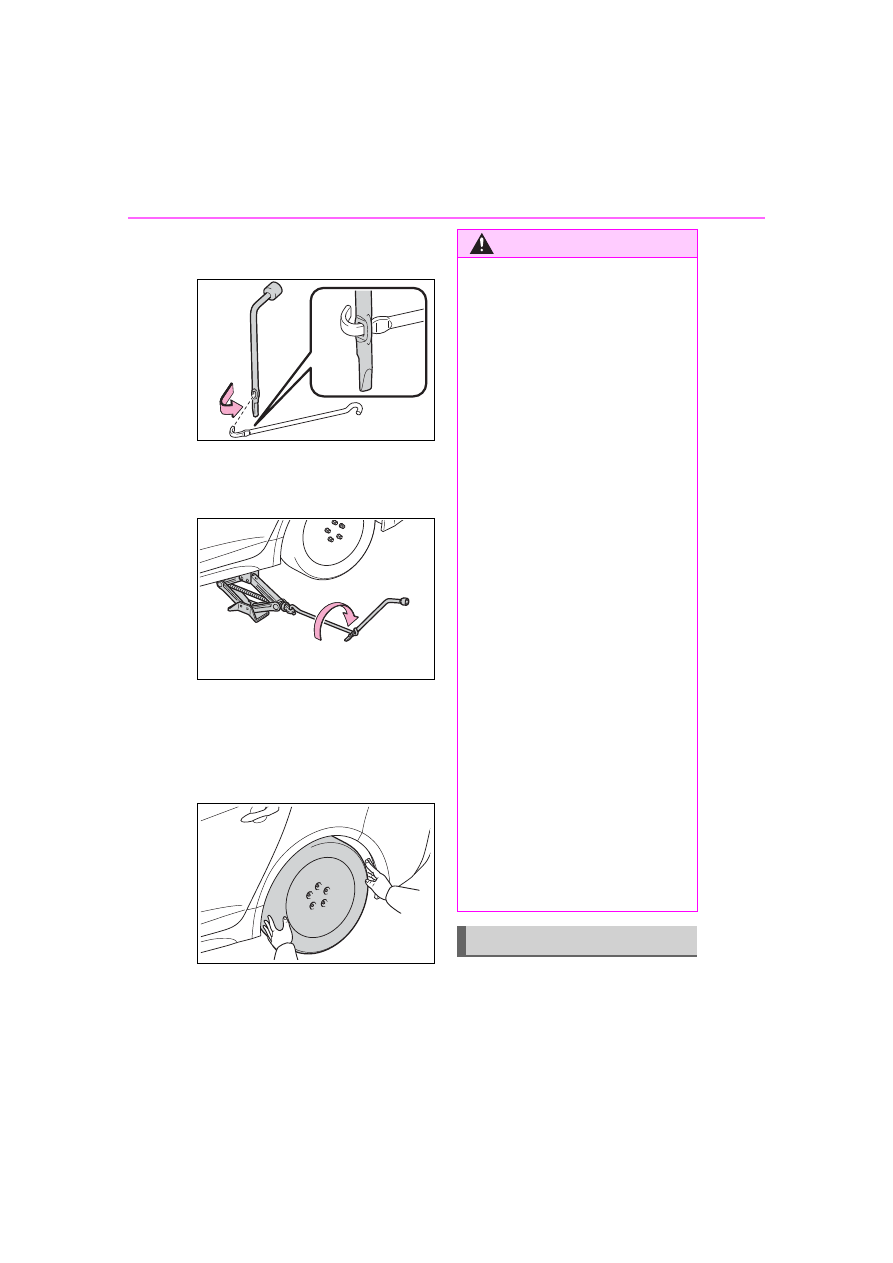
Assemble the jack handle 
extension.

6

Raise the vehicle until the tire 
is slightly raised off the 
ground.

7

Remove all the wheel nuts 
and the tire.

When resting the tire on the 

ground, place the tire so that the 

wheel design faces up to avoid 

scratching the wheel surface.

1

Remove any dirt or foreign 
matter from the wheel con-
tact surface.

WARNING

Replacing a flat tire

Do not touch the disc wheels or 

the area around the brakes 

immediately after the vehicle 

has been driven. After the vehi-

cle has been driven the disc 

wheels and the area around the 

brakes will be extremely hot. 

Touching these areas with 

hands, feet or other body parts 

while changing a tire, etc. may 

result in burns.

Failure to follow these precau-

tions could cause the wheel 

nuts to loosen and the tire to fall 

off, resulting in death or serious 

injury.

• Have the wheel nuts tightened 

with a torque wrench to 76 ft•lbf 

(103 N•m, 10.5 kgf•m) as soon 

as possible after changing 

wheels.

• Do not attach a heavily dam-

aged wheel ornament, as it may 

fly off the wheel while the vehi-

cle is moving.

• When installing a tire, only use 

wheel nuts that have been spe-

cifically designed for that wheel.

• If there are any cracks or defor-

mations in the bolt screws, nut 

threads or bolt holes of the 

wheel, have the vehicle 

inspected by your Toyota 

dealer.

• When installing the wheel nuts, 

be sure to install them with the 

tapered ends facing inward.

Installing the spare tire

403

7-2. Steps to take in an emergency

7

Whe

n tr

ouble

 ar

ises

If foreign matter is on the wheel 

contact surface, the wheel nuts 

may loosen while the vehicle is in 

motion, causing the tire to come off.

2

Install the tire and loosely 
tighten each wheel nut by 
hand by approximately the 
same amount.

When replacing a steel wheel with 

a steel wheel (including a compact 

spare tire), tighten the wheel nuts 
until the tapered portion 

 comes 

into loose contact with the disc 
wheel seat 

.

When replacing an aluminum wheel 

with a steel wheel (including a com-

pact spare tire), tighten the wheel 
nuts until the tapered portion 


comes into loose contact with the 

disc wheel seat 

.

3

Lower the vehicle.

4

Firmly tighten each wheel nut 
two or three times in the 
order shown in the illustra-
tion.

Tightening torque:

76 ft•lbf (103 N•m, 10.5 kgf•m)

5

Stow the flat tire, tire jack and 
all tools.

The compact spare tire

The compact spare tire is identi-

fied by the label “TEMPORARY 

404

7-2. Steps to take in an emergency

USE ONLY” on the tire sidewall. 

Use the compact spare tire tempo-

rarily, and only in an emergency.

Make sure to check the tire infla-

tion pressure of the compact 

spare tire. (

P.426)

When the compact spare tire is 

equipped

The vehicle becomes lower when 

driving with the compact spare tire 

compared to when driving with stan-

dard tires.

After completing the tire 

change

The tire pressure warning system 

must be reset. (

P.333)

When using the compact spare 

tire

As the compact spare tire is not 

equipped with a tire pressure warn-

ing valve and transmitter, low infla-

tion pressure of the spare tire will 

not be indicated by the tire pressure 

warning system. Also, if you replace 

the compact spare tire after the tire 

pressure warning light comes on, 

the light remains on.

If you have a flat front tire on a 

road covered with snow or ice

Install the compact spare tire on one 

of the rear wheels of the vehicle. 

Perform the following steps and fit 

tire chains to the front tires:

1

Replace a rear tire with the com-

pact spare tire.

2

Replace the flat front tire with the 

tire removed from the rear of the 

vehicle.

3

Fit tire chains to the front tires.

When reinstalling the wheel cap 

(steel wheels except compact 

spare tire)

Align the cutout of the wheel cap 

with the valve stem as shown in the 

illustration.

WARNING

When using the compact 

spare tire

Remember that the compact 

spare tire provided is specifi-

cally designed for use with your 

vehicle. Do not use your com-

pact spare tire on another vehi-

cle.

Do not use more than one com-

pact spare tires simultaneously.

Replace the compact spare tire 

with a standard tire as soon as 

possible.

Avoid sudden acceleration, 

abrupt steering, sudden brak-

ing and shifting operations that 

cause sudden engine braking.

When the compact spare tire 

is attached

The vehicle speed may not be 

correctly detected, and the follow-

ing systems may not operate cor-

rectly:

• ABS & Brake assist

• VSC

• TRAC

• Automatic High Beam

• Dynamic radar cruise control

• EPS

• PCS (Pre-Collision System)

• LDA (Lane Departure Alert)

405

7-2. Steps to take in an emergency

7

W

he

tro

ub

le

 ar

is

es

WARNING

• LTA (Lane Tracing Assist)

• Tire pressure warning system

• BSM (if equipped)

• RCTA (if equipped)

• SEA (if equipped)

• Rear view monitor system

• Navigation system (if equipped)

Also, not only can the following 

systemsnot be utilized fully, but 

theymay actually negatively affect 

thedrive-train components

• E-Four (Electronic On-Demand 

AWD system) (if equipped)

Speed limit when using the 

compact spare tire

Do not drive at speeds in excess 

of 50 mph (80 km/h) when a com-

pact spare tire is installed on the 

vehicle.

The compact spare tire is not 

designed for driving at high 

speeds. Failure to observe this 

precaution may lead to an acci-

dent causing death or serious 

injury.

After using the tools and jack

Before driving, make sure all the 

tools and jack are securely in 

place in their storage location to 

reduce the possibility of personal 

injury during a collision or sudden 

braking.

NOTICE

Be careful when driving over 

bumps with the compact 

spare tire installed on the 

vehicle.

The vehicle becomes lower when 

driving with the compact spare tire 

compared to when driving with 

standard tires. Be careful when 

driving over uneven road sur-

faces.

Driving with tire chains and 

the compact spare tire

Do not fit tire chains to the com-

pact spare tire. Tire chains may 

damage the vehicle body and 

adversely affect driving perfor-

mance.

When replacing the tires

When removing or fitting the 

wheels, tires or the tire pressure 

warning valve and transmitter, 

contact your Toyota dealer as the 

tire pressure warning valve and 

transmitter may be damaged if not 

handled correctly.

To avoid damage to the tire 

pressure warning valves and 

transmitters

When a tire is repaired with liquid 

sealants, the tire pressure warn-

ing valve and transmitter may not 

operate properly. If a liquid seal-

ant is used, contact your Toyota 

dealer or other qualified service 

shop as soon as possible. Make 

sure to replace the tire pressure 

warning valve and transmitter 

when replacing the tire.

406

7-2. Steps to take in an emergency

One of the following may be the 
cause of the problem:

Vehicles with a smart key sys-
tem: The electronic key may 
not be functioning properly. 
(

P.408)

There may not be sufficient 
fuel in the vehicle’s tank. 
Refuel the vehicle.

There may be a malfunction 
in the immobilizer system. 
(

P.87)

Vehicles without a smart key 
system: There may be a mal-
function in the steering lock 
system.

Vehicles with a smart key sys-
tem: The hybrid system may 
be malfunctioning due to an 
electrical problem such as 
electronic key battery deple-
tion or a blown fuse. However, 
depending on the type of mal-

function, an interim measure 
is available to start the hybrid 
system. (

P.406)

One of the following may be the 
cause of the problem:

The 12-volt battery may be 
discharged. (

P.410)

The 12-volt battery terminal 
connections may be loose or 
corroded. (

P.323)

One of the following may be the 
cause of the problem:

The 12-volt battery may be 
discharged. (

P.410)

One or both of the 12-volt bat-
tery terminals may be discon-
nected. (

P.323)

Contact your Toyota dealer if the 
problem cannot be repaired, or if 
repair procedures are unknown.

When the hybrid system does 
not start, the following steps can 

If the hybrid system 

will not start

Reasons for the hybrid sys-
tem not starting vary 
depending on the situation. 
Check the following and 
perform the appropriate 
procedure:

The hybrid system will not 
start even though the cor-
rect starting procedure is 
being followed. (

P.172)

The interior lights and 
headlights are dim, or the 
horn does not sound or 
sounds at a low volume.

The interior lights and 
headlights do not turn on, 
or the horn does not 
sound.

Emergency start function 
(vehicles with a smart key 
system)

407

7-2. Steps to take in an emergency

7

W

he

tro

ub

le

 ar

is

es

be used as an interim measure 
to start the hybrid system if the 
power switch is functioning nor-
mally.
Do not use this starting proce-
dure except in case of emer-
gency.

1

Set the parking brake. 
(

P.183)

2

Check that the shift lever is in 
P.

3

Turn the power switch to 
ACC

*

.

4

Press and hold the power 
switch for about 15 seconds 
while depressing the brake 
pedal firmly.

Even if the hybrid system can be 
started using the above steps, the 
system may be malfunctioning. 
Have the vehicle inspected by your 
Toyota dealer.

*

: ACC mode can be enabled/dis-

abled on the customize menu. 
(

P.442)

If you lose your keys

New genuine keys can be 
made by your Toyota dealer 
using the other key (vehi-
cles without a smart key 
system) or mechanical key 
(vehicles with a smart key 
system) and the key number 
stamped on your key num-
ber plate.

Keep the plate in a safe 
place such as your wallet, 
not in the vehicle.

NOTICE

When an electronic key is lost 

(vehicles with a smart key 

system)

If the electronic key remains lost, 

the risk of vehicle theft increases 

significantly. Visit your Toyota 

dealer immediately with all 

remaining electronic keys that 

were provided with your vehicle.

408

7-2. Steps to take in an emergency

When the electronic key does 

not work properly

Make sure that the smart key sys-

tem has not been deactivated in 

the customization setting. If it is 

off, turn the function on. (Custom-

izable features: 

P.442)

Check if battery-saving mode is 

set. If it is set, cancel the function. 

(

P.137)

The electronic key function may 

be suspended. (

P.123)

Use the mechanical key 
(

P.125) in order to perform the 

following operations:

1

Locks all the doors

2

Unlocks all the doors

Turning the key unlocks the driver’s 
door. Turning the key again unlocks 
the other doors.

Key linked functions

1

Closes the windows and moon 
roof

*1

 (turn and hold)

*2

2

Opens the windows and moon 
roof

*1

 (turn and hold)

*2

*1

:If equipped

*2

:This setting must be customized 

at your Toyota dealer.

If the electronic key 

does not operate prop-

erly (vehicles with a 

smart key system)

If communication between 
the electronic key and vehi-
cle is interrupted (

P.137) 

or the electronic key cannot 
be used because the battery 
is depleted, the smart key 
system and wireless remote 
control cannot be used. In 
such cases, the doors can 
be opened and the hybrid 
system can be started by 
following the procedure 
below.

NOTICE

In case of a smart key system 

malfunction or other 

key-related problems

Take your vehicle with all the elec-

tronic keys provided with your 

vehicle to your Toyota dealer.

Locking and unlocking 
the doors

409

7-2. Steps to take in an emergency

7

W

he

tro

ub

le

 ar

is

es

1

Ensure that the shift lever is 
in P and depress the brake 
pedal.

2

Touch the electronic key to 
the power switch.

When the electronic key is 

detected, a buzzer sounds and the 

power switch will turn to ON.
When the smart key system is 

deactivated in customization set-

ting, the power switch will turn to 

ACC.

3

Firmly depress the brake 
pedal and check that 

 is 

shown on the multi-informa-
tion display.

4

Press the power switch 
shortly and firmly.

In the event that the hybrid sys-
tem still cannot be started, con-
tact your Toyota dealer.

Stopping the hybrid system

Shift the shift lever to P and press 

the power switch as you normally do 

when stopping the hybrid system.

Electronic key battery

As the above procedure is a tempo-

rary measure, it is recommended 

that the electronic key battery be 

replaced immediately when the bat-

tery is depleted. (

P.350)

Changing power switch modes

Release the brake pedal and press 

the power switch in step 

3

 above.

The hybrid system does not start 

and modes will be changed each 

time the switch is pressed. (

P.176)

WARNING

When using the mechanical 

key and operating the power 

windows or moon roof (if 

equipped)

Operate the power window or 

moon roof after checking to make 

sure that there is no possibility of 

any passenger having any of their 

body parts caught in the window 

or moon roof.

Also, do not allow children to 

operate the mechanical key. It is 

possible for children and other 

passengers to get caught in the 

power window or moon roof.

Starting the hybrid sys-
tem

410

7-2. Steps to take in an emergency

If you have a set of jumper (or 
booster) cables and a second 
vehicle with a 12-volt battery, 
you can jump start your vehicle 
by following the steps below.

1

Confirm that the electronic 
key (vehicles with a smart 
key system) or key (vehicles 
without a smart key system) 
is being carried.

When connecting the jumper (or 

booster) cables, depending on the 

situation, the alarm may activate 

and doors locked. (

P.89)

2

Open the hood. (

P.316)

3

Connect a positive jumper cable clamp to   on your vehicle and 
connect the clamp on the other end of the positive cable to   on 
the second vehicle. Then, connect a negative cable clamp to   

If the 12-volt battery is 

discharged

The following procedures 
may be used to start the 
hybrid system if the 12-volt 
battery is discharged.
You can also call your Toy-
ota dealer or a qualified 
repair shop.

Restarting the hybrid sys-
tem

411

7-2. Steps to take in an emergency

7

Whe

n tr

ouble

 ar

ises

on the second vehicle and connect the clamp at the other end of 
the negative cable to  .

Positive (+) battery terminal (your vehicle)
Positive (+) battery terminal (second vehicle)
Negative (-) battery terminal (second vehicle)
Solid, stationary, unpainted metallic point away from the battery 
and any moving parts as shown in the illustration

4

Start the engine of the sec-
ond vehicle. Increase the 
engine speed slightly and 
maintain at that level for 
approximately 5 minutes to 
recharge the 12-volt battery 
of your vehicle.

5

Vehicles with a smart key 
system: Open and close any 
of the doors of your vehicle 
with the power switch OFF.

6

Maintain the engine speed of 
the second vehicle and start 
the hybrid system of your 
vehicle by turning the power 
switch to ON.

7

Make sure the “READY” indi-
cator comes on. If the indica-

tor does not come on, contact 
your Toyota dealer.

8

Once the hybrid system has 
started, remove the jumper 
cables in the exact reverse 
order from which they were 
connected.

Once the hybrid system starts, 
have the vehicle inspected at 
your Toyota dealer as soon as 
possible.

Starting the hybrid system 

when the 12-volt battery is dis-

charged

The hybrid system cannot be started 

by push-starting.

412

7-2. Steps to take in an emergency

To prevent 12-volt battery dis-

charge

Turn off the headlights and the 

audio system while the hybrid sys-

tem is off.

Turn off any unnecessary electri-

cal components when the vehicle 

is running at a low speed for an 

extended period, such as in heavy 

traffic.

When the 12-volt battery is 

removed or discharged

Information stored in the ECU is 

cleared. When the 12-volt battery 

is depleted, have the vehicle 

inspected at your Toyota dealer.

Some systems may require initial-

ization. (

P.452)

When removing the 12-volt bat-

tery terminals

When the 12-volt battery terminals 

are removed, the information stored 

in the ECU is cleared. Before 

removing the 12-volt battery termi-

nals, contact your Toyota dealer.

Charging the 12-volt battery

The electricity stored in the 12-volt 

battery will discharge gradually even 

when the vehicle is not in use, due 

to natural discharge and the drain-

ing effects of certain electrical appli-

ances. If the vehicle is left for a long 

time, the 12-volt battery may dis-

charge, and the hybrid system may 

be unable to start. (The 12-volt bat-

tery recharges automatically while 

the hybrid system is operating.)

When recharging or replacing 

the 12-volt battery (vehicles 

with a smart key system)

In some cases, it may not be pos-

sible to unlock the doors using the 

smart key system when the 

12-volt battery is discharged. Use 

the wireless remote control or the 

mechanical key to lock or unlock 

the doors.

The hybrid system may not start 

on the first attempt after the 

12-volt battery has recharged but 

will start normally after the second 

attempt. This is not a malfunction.

The power switch mode is memo-

rized by the vehicle. When the 

12-volt battery is reconnected, the 

system will return to the mode it 

was in before the 12-volt battery 

was discharged. Before discon-

necting the 12-volt battery, turn 

the power switch off.

If you are unsure what mode the 

power switch was in before the 

12-volt battery discharged, be 

especially careful when recon-

necting the 12-volt battery.

When replacing the 12-volt bat-

tery

Use a 12-volt battery that con-

forms to European regulations.

Use a 12-volt battery that the case 

size is same as the previous one 

(LN1), 20 hour rate capacity 

(20HR) is equivalent (45Ah) or 

greater, and performance rating 

(CCA) is equivalent (295A) or 

greater.

• If the sizes differ, the 12-volt bat-

tery cannot be properly secured.

• If the 20 hour rate capacity is low, 

even if the time period where the 

vehicle is not used is a short time, 

the 12-volt battery may discharge 

and the hybrid system may not be 

able to start.

For details, consult your Toyota 

dealer.

WARNING

When removing the 12-volt 

battery terminals

Always remove the negative (-) 

terminal first. If the positive (+) ter-

minal contacts any metal in the 

surrounding area when the posi-

tive (+) terminal is removed, a 

spark may occur, leading to a fire 

in addition to electrical shocks 

and death or serious injury.

413

7-2. Steps to take in an emergency

7

W

he

tro

ub

le

 ar

is

es

WARNING

Avoiding 12-volt battery fires 

or explosions

Observe the following precautions 

to prevent accidentally igniting the 

flammable gas that may be emit-

ted from the 12-volt battery:

Make sure each jumper cable is 

connected to the correct termi-

nal and that it is not unintention-

ally in contact with any other 

than the intended terminal.

Do not allow the other end of 

the jumper cable connected to 

the “+” terminal to come into 

contact with any other parts or 

metal surfaces in the area, such 

as brackets or unpainted metal.

Do not allow the + and - clamps 

of the jumper cables to come 

into contact with each other.

Do not smoke, use matches, 

cigarette lighters or allow open 

flame near the 12-volt battery.

12-volt battery precautions

The 12-volt battery contains poi-

sonous and corrosive acidic elec-

trolyte, while related parts contain 

lead and lead compounds. 

Observe the following precautions 

when handling the 12-volt battery:

When working with the 12-volt 

battery, always wear safety 

glasses and take care not to 

allow any battery fluids (acid) to 

come into contact with skin, 

clothing or the vehicle body.

Do not lean over the 12-volt bat-

tery.

In the event that battery fluid 

comes into contact with the skin 

or eyes, immediately wash the 

affected area with water and 

seek medical attention. Place a 

wet sponge or cloth over the 

affected area until medical 

attention can be received.

Always wash your hands after 

handling the 12-volt battery sup-

port, terminals, and other bat-

tery-related parts.

Do not allow children near the 

12-volt battery.

NOTICE

When handling jumper cables

When connecting the jumper 

cables, ensure that they do not 

become entangled in the cooling 

fans, etc.

414

7-2. Steps to take in an emergency

If the engine coolant tempera-
ture gauge enters the red 
zone or “Engine Coolant 
Temp High Stop in a Safe 
Place See Owner’s Manual” 
is shown on the multi-informa-
tion display

1

Stop the vehicle in a safe 
place and turn off the air con-
ditioning system, and then 
stop the hybrid system.

2

If you see steam: Carefully lift 
the hood after the steam sub-

sides.
If you do not see steam: 
Carefully lift the hood.

3

After the hybrid system has 
cooled down sufficiently, 
inspect the hoses and radia-
tor core (radiator) for any 
leaks.

Radiator
Cooling fans

If a large amount of coolant leaks, 
immediately contact your Toyota 
dealer.

4

The coolant level is satisfac-
tory if it is between the “MAX” 
and “MIN” lines on the reser-
voir.

Reservoir
“MAX” line
“MIN” line

5

Add coolant if necessary.

If your vehicle over-

heats

The following may indicate 
that your vehicle is over-
heating.

The engine coolant tem-
perature gauge (

P.99) is 

in the red zone or a loss of 
hybrid system power is 
experienced. (For example, 
the vehicle speed does not 
increase.)

“Engine Coolant Temp High 
Stop in a Safe Place See 
Owner’s Manual” or “Hybrid 
System Overheated Output 
Power Reduced” is shown 
on the multi-information dis-
play.

Steam comes out from 
under the hood.

Correction procedures

415

7-2. Steps to take in an emergency

7

Whe

n tr

ouble

 ar

ises

Water can be used in an emer-

gency if coolant is unavailable.

6

Start the hybrid system and 
turn the air conditioning sys-
tem on to check that the radi-
ator cooling fans operate and 
to check for coolant leaks 
from the radiator or hoses.

The fans operate when the air con-

ditioning system is turned on imme-

diately after a cold start. Confirm 

that the fans are operating by 

checking the fan sound and air flow. 

If it is difficult to check these, turn 

the air conditioning system on and 

off repeatedly. (The fans may not 

operate in freezing temperatures.)

7

If the fans are not operating: 
Stop the hybrid system 
immediately and contact your 
Toyota dealer.
If the fans are operating: 
Have the vehicle inspected at 
the nearest Toyota dealer.

If “Hybrid System Over-
heated Output Power 
Reduced” is shown on the 
multi-information display

1

Stop the vehicle in a safe 
place.

2

Stop the hybrid system and 
carefully lift the hood.

3

After the hybrid system has 
cooled down, inspect the 
hoses and radiator core (radi-
ator) for any leaks.

Radiator
Cooling fans

If a large amount of coolant leaks, 
immediately contact your Toyota 
dealer.

4

The coolant level is satisfac-
tory if it is between the “MAX” 
and “MIN” lines on the reser-
voir.

Reservoir
“MAX” line
“MIN” line

5

Add coolant if necessary.

If coolant is unavailable, use water 

as an emergency measure, and 

have the vehicle inspected at your 

416

7-2. Steps to take in an emergency

Toyota dealer as soon as possible.

6

After stopping the hybrid sys-
tem and waiting for 5 minutes 
or more, start the hybrid sys-
tem again and check for the 
multi-information display.
If the message does not dis-
appear: Stop the hybrid sys-
tem and contact your Toyota 
dealer.
If the message is not dis-
played: The hybrid system 
temperature has dropped 
and the vehicle may be 
driven normally.

However, if the message appears 

again frequently, contact your Toy-

ota dealer.

WARNING

When inspecting under the 

hood of your vehicle

Observe the following precau-

tions. Failure to do so may result 

in serious injury such as burns.

If steam is seen coming from 

under the hood, do not open the 

hood until the steam has sub-

sided. The engine compart-

ment may be very hot.

After the hybrid system has 

been turned off, check that the 

“READY” indicator is off. When 

the hybrid system is operating, 

the gasoline engine may auto-

matically start, or the cooling 

fans may suddenly operate 

even if the gasoline engine 

stops. Do not touch or approach 

rotating parts such as the fan, 

which may lead to fingers or 

clothing (especially a tie, a scarf 

or a muffler) getting caught, 

resulting in serious injury.

Do not loosen the coolant reser-

voir caps while the hybrid sys-

tem and radiator are hot.

High temperature steam or 

coolant could spray out.

NOTICE

When adding engine/power 

control unit coolant

Add coolant slowly after the 

hybrid system has cooled down 

sufficiently. Adding cool coolant to 

a hot hybrid system too quickly 

can cause damage to the hybrid 

system.

To prevent damage to the 

cooling system

Observe the following precau-

tions:

Avoid contaminating the coolant 

with foreign matter (such as 

sand or dust etc.).

Do not use any coolant additive.

417

7-2. Steps to take in an emergency

7

W

he

tro

ub

le

 ar

is

es

1

Stop the hybrid system. Set 
the parking brake and shift 
the shift lever to P.

2

Remove the mud, snow or 
sand from around the front 
wheels.

3

Place wood, stones or some 
other material under the front 
wheels to help provide trac-
tion.

4

Restart the hybrid system.

5

Shift the shift lever to D or R 
and release the parking 
brake. Then, while exercising 
caution, depress the acceler-
ator pedal.

When it is difficult to free the 

vehicle

Press the 

 switch to turn off 

TRAC.

Type A

Type B

If the vehicle becomes 

stuck

Carry out the following pro-
cedures if the tires spin or 
the vehicle becomes stuck 
in mud, dirt or snow:

Recovering procedure

WARNING

When attempting to free a 

stuck vehicle

If you choose to push the vehicle 

back and forth to free it, make 

sure the surrounding area is clear 

to avoid striking other vehicles, 

objects or people. The vehicle 

may also lunge forward or lunge 

back suddenly as it becomes free. 

Use extreme caution.

When shifting the shift lever

Be careful not to shift the shift 

lever with the accelerator pedal 

depressed.

This may lead to unexpected 

rapid acceleration of the vehicle 

that may cause an accident 

resulting in death or serious injury.

NOTICE

To avoid damaging the trans-

mission and other compo-

nents

Avoid spinning the front wheels 

and depressing the accelerator 

pedal more than necessary.


Content      ..     23      24      25      26     ..