Toyota Prius Prime (2022 year). Manual in english - page 38
 

  Index      Toyota     Toyota Prius Prime (2022 year). Manual in english


Search            copyright infringement  


Content      ..     36      37      38      39     ..


Toyota Prius Prime (2022 year). Manual in english - page 38


615

7-3. Do-it-yourself maintenance

7

Mainten

ance an

d ca

re

When to replace your vehicle’s tires

Tires should be replaced if:

The treadwear indicators are showing on a tire.

You  have  tire  damage  such  as  cuts,  splits,  cracks  deep  enough  to

expose the fabric, and bulges indicating internal damage.

A tire goes flat repeatedly or cannot be properly repaired due to the size

or location of a cut or other damage.

If you are not sure, consult with your Toyota dealer.

Replacing tires and wheels

If the ID code of the tire pressure warning valve and transmitter is not reg-

istered, the tire pressure warning system will not work properly. After driv-

ing  for  about  20  minutes,  the  tire  pressure  warning  light  blinks  for  1

minute and stays on to indicate a system malfunction.

Tire life

Any tire over 6 years old must be checked by a qualified technician even

if it has seldom or never been used or damage is not obvious.

Routine tire inflation pressure checks

The  tire  pressure  warning  system  does  not  replace  routine  tire inflation

pressure  checks.  Make  sure  to  check  tire  inflation  pressure  as  part  of

your routine of daily vehicle checks.

Maximum load of tire

Check that the maximum load of the replacement tire is greater than 1/2

of the Gross Axle Weight Ratings (GAWR) of either the front axle or the

rear axle, whichever is greater.
For  the  GAWR,  see  the  Certification

Label. For the maximum load of the tire,

see the load limit at maximum cold tire

inflation  pressure  mentioned  on  the

sidewall of the tire. (

P. 738)

616

7-3. Do-it-yourself maintenance

Tire types

Summer tires
Summer tires are high-speed performance tires best suited to highway

driving under dry conditions. Since summer tires do not have the same

traction  performance  as  snow  tires,  summer  tires  are  inadequate  for

driving  on  snow-covered  or  icy  roads.  For  driving  on  snow-covered

roads or icy roads, the use of snow tires is recommended. When install-

ing snow tires, be sure to replace all four tires.

All season tires
All season tires are designed to provide better traction in snow and to

be  adequate  for  driving  in  most  winter  conditions  as  well  as  for  use

year-round. All  season  tires,  however,  do  not  have  adequate  traction

performance compared with snow tires in heavy or loose snow. Also, all

season tires fall short in acceleration and handling performance com-

pared with summer tires in highway driving.

Snow tires
For driving on snow-covered roads or icy roads, we recommend using

snow tires. If you need snow tires, select tires of the same size, con-

struction and load capacity as the originally installed tires. Since your

vehicle  has  radial  tires  as  original  equipment,  make  sure  your  snow

tires also have radial construction. Do not install studded tires without

first  checking  local  regulations  for  possible  restrictions.  Snow  tires

should be installed on all wheels. (

P. 502)

If the tread on snow tires wears down below 0.16 in. (4 mm)

The effectiveness of the tires as snow tires is lost.

617

7-3. Do-it-yourself maintenance

7

Mainten

ance an

d ca

re

Situations in which the tire pressure warning system may not oper-

ate properly

In the following cases, the tire pressure warning system may not operate

properly.
• If non-genuine Toyota wheels are used.

• When  a  replacement  tire  is  used,  the  system  may  not  operate  cor-

rectly due to the structure of the replacement tire.

• A tire has been replaced with a tire that is not of the specified size.

• Tire chains etc. are equipped.

• An auxiliary-supported run-flat tire is equipped.

• If a window tint that affects the radio wave signals is installed.

• If there is a lot of snow or ice on the vehicle, particularly around the

wheels or wheel housings.

• If  the  tire  inflation  pressure  is  extremely  higher  than  the  specified

level.

• If  wheel  without  the  tire  pressure  warning  valve  and  transmitter  is

used.

• If the ID code on the tire pressure warning valves and transmitters is

not registered in the tire pressure warning computer.

Performance may be affected in the following situations.
• Near a TV tower, electric power plant, gas station, radio station, large

display, airport or other facility that generates strong radio waves or

electrical noise

• When  carrying  a  portable  radio,  cellular  phone,  cordless  phone  or

other wireless communication device

When the vehicle is parked, the time taken for the warning to start or go

off could be extended.

When tire inflation pressure declines rapidly for example when a tire has

burst, the warning may not function.

The initialization operation

Make sure to carry out initialization after adjusting the tire inflation pres-

sure.

Also, make sure the tires are cold before carrying out initialization or tire

inflation pressure adjustment.

If you have accidentally turned the power switch off during initialization,

it  is  not  necessary  to  press  the  reset  switch  again  as  initialization  will

restart  automatically  when  the  power  switch  has  been  turned  to  ON

mode for the next time.

If you accidentally press the reset switch when initialization is not neces-

sary,  adjust  the  tire  inflation  pressure  to  the  specified  level  when  the

tires are cold, and conduct initialization again.

618

7-3. Do-it-yourself maintenance

When initialization of the tire pressure warning system has failed

Initialization can be completed in a few minutes. However, in the following

cases, the settings have not been recorded and the system will not oper-

ate properly. If repeated attempts to record tire inflation pressure settings

are unsuccessful, have the vehicle inspected by your Toyota dealer.

When operating the initialization of the system, the tire pressure warning

light does not flash 3 times and the setting message does not appear on

the multi-information display.

After driving for a certain period of time since the initialization has been

completed, the warning light comes on after blinking for 1 minute.

WARNING

When inspecting or replacing tires

Observe the following precautions to prevent accidents.

Failure to do so may cause damage to parts of the drive train as well as

dangerous  handling  characteristics,  which  may  lead  to  an  accident

resulting in death or serious injury.

Do not mix tires of different makes, models or tread patterns.

Also, do not mix tires of remarkably different treadwear.

Do not use tire sizes other than those recommended by Toyota.

Do not mix differently constructed tires (radial, bias-belted or bias-ply

tires).

Do not mix summer, all season and snow tires.

Do not use tires that have been used on another vehicle.

Do not use tires if you do not know how they were used previously. 

When initializing the tire pressure warning system

Do not initialize the tire pressure warning system without first adjusting

the tire inflation pressure to the specified level. Otherwise, the tire pres-

sure warning light may not come on even if the tire inflation pressure is

low, or it may come on when the tire inflation pressure is actually nor-

mal.

619

7-3. Do-it-yourself maintenance

7

Mainten

ance an

d ca

re

NOTICE

Repairing or replacing tires, wheels, tire pressure warning valves,

transmitters and tire valve caps

When removing or fitting the wheels, tires or the tire pressure warning

valves  and  transmitters,  contact  your Toyota  dealer  as  the  tire  pres-

sure warning valves and transmitters may be damaged if not handled

correctly.

Make sure to install the tire valve caps. If the tire valve caps are not

installed,  water  could  enter  the  tire  pressure  warning  valves  and  the

tire pressure warning valves could be bound.

When replacing tire valve caps, do not use tire valve caps other than

those specified. The cap may become stuck.

To avoid damage to the tire pressure warning valves and transmit-

ters

When  a  tire  is  repaired  with  liquid  sealants,  the  tire  pressure  warning

valve  and  transmitter  may  not  operate  properly.  If  a  liquid  sealant  is

used, contact your Toyota dealer or other qualified service shop as soon

as  possible. After  use  of  liquid  sealant,  make  sure  to  replace  the  tire

pressure warning valve and transmitter when repairing or replacing the

tire. (

P. 613)

Driving on rough roads

Take particular care when driving on roads with loose surfaces or pot-

holes.

These conditions may cause losses in tire inflation pressure, reducing

the  cushioning  ability  of  the  tires.  In  addition,  driving  on  rough  roads

may  cause  damage  to  the  tires  themselves,  as  well  as  the  vehicle’s

wheels and body.

If tire inflation pressure of each tire becomes low while driving

Do not continue driving, or your tires and/or wheels may be ruined.

620

7-3. Do-it-yourself maintenance

Tire inflation pressure

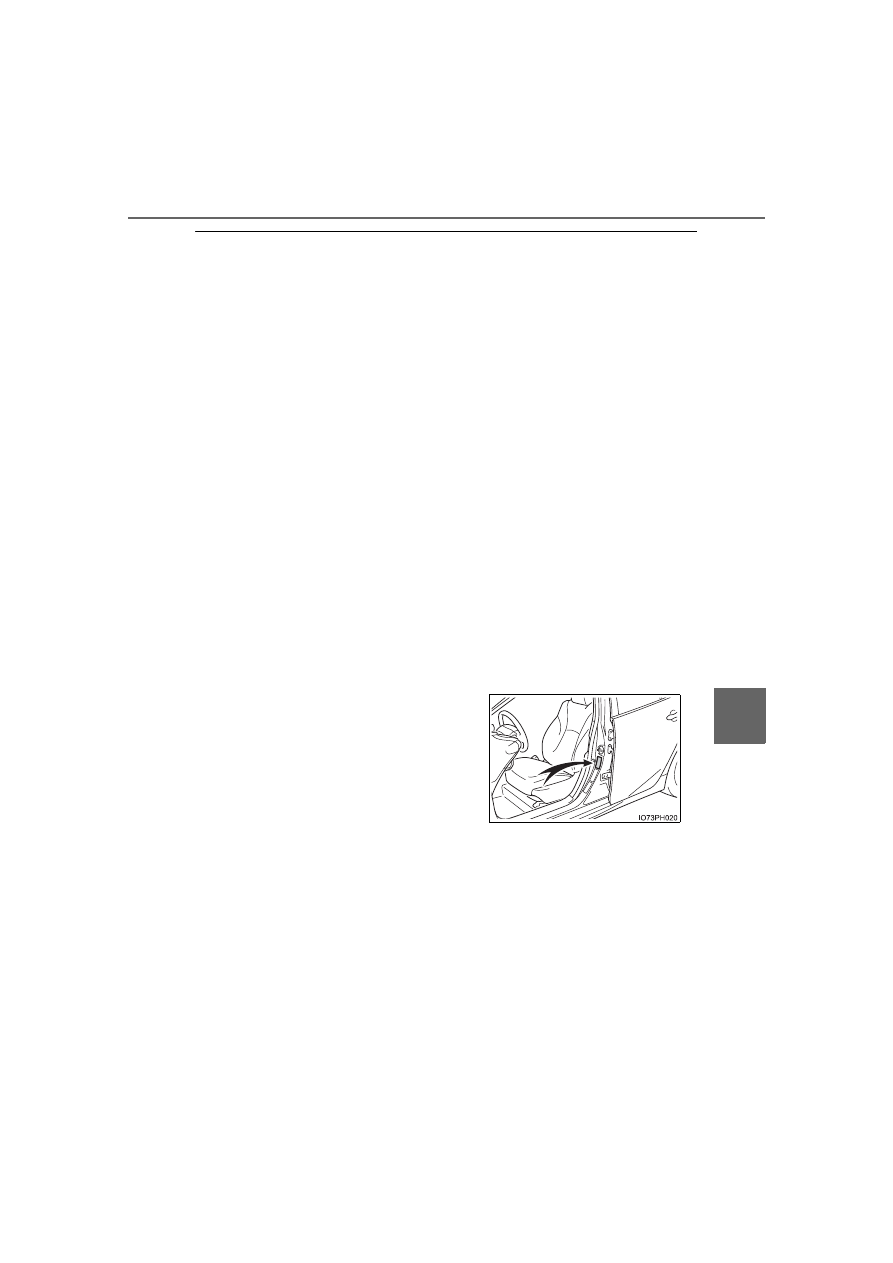
The  recommended  cold  tire  infla-
tion pressure and tire size are dis-
played  on  the  tire  and  loading
information label. (

P. 733)

Tire inflation pressure

621

7-3. Do-it-yourself maintenance

7

Mainten

ance an

d ca

re

Tire valve
Tire pressure gauge

Remove the tire valve cap.
Press the tip of the tire pressure gauge onto the tire valve.
Read the pressure using the gauge gradations.
If the tire inflation pressure is not at the recommended level, adjust
the pressure.
If you add too much air, press the center of the valve to deflate.
After  completing  the  tire  inflation  pressure  measurement  and
adjustment, apply soapy water to the valve and check for leakage.
Put the tire valve cap back on.

Tire inflation pressure check interval

You should check tire inflation pressure every two weeks, or at least once

a month.

Do not forget to check the spare.

Effects of incorrect tire inflation pressure

Driving with incorrect tire inflation pressure may result in the following:

Reduced fuel economy

Reduced driving comfort and poor handling

Reduced tire life due to wear

Reduced safety

Damage to the drive train

If a tire needs frequent inflating, have it checked by your Toyota dealer.

Inspection and adjustment procedure

1
2

1

2

3

4

5

6

622

7-3. Do-it-yourself maintenance

Instructions for checking tire inflation pressure

When checking tire inflation pressure, observe the following:

Check only when the tires are cold.

If  your  vehicle  has  been  parked  for  at  least  3  hours  or  has  not  been

driven for more than 1 mile or 1.5 km, you will get an accurate cold tire

inflation pressure reading.

Always use a tire pressure gauge.

It is difficult to judge if a tire is properly inflated based only on its appear-

ance.

It  is  normal  for  the  tire  inflation  pressure  to  be  higher  after  driving  as

heat is generated in the tire. Do not reduce tire inflation pressure after

driving.

Never exceed the vehicle capacity weight.

Passengers and luggage weight should be placed so that the vehicle is

balanced.

WARNING

Proper inflation is critical to save tire performance

Keep your tires properly inflated.

If the tires are not properly inflated, the following conditions may occur

which could lead to an accident resulting in death or serious injury:

Excessive wear

Uneven wear

Poor handling

Possibility of blowouts resulting from overheated tires

Air leaking from between tire and wheel

Wheel deformation and/or tire damage

Greater possibility of tire damage while driving (due to road hazards,

expansion joints, sharp edges in the road, etc.)

NOTICE

When inspecting and adjusting tire inflation pressure

Be sure to put the tire valve caps back on.

If a valve cap is not installed, dirt or moisture may get into the valve and

cause an air leak, resulting in decreased tire inflation pressure.

623

7-3. Do-it-yourself maintenance

7

Mainten

ance an

d ca

re

Wheels

When replacing wheels, care should be taken to ensure that they are
equivalent to those removed in load capacity, diameter, rim width and
inset

*

.

Replacement wheels are available at your Toyota dealer.

*

: Conventionally referred to as “offset”.

Toyota does not recommend using the following:

Wheels of different sizes or types

Used wheels

Bent wheels that have been straightened

Use  only Toyota  wheel  nuts  and  wrenches  designed  for  use  with
your aluminum wheels.

When  rotating,  repairing  or  changing  your  tires,  check  that  the
wheel nuts are still tight after driving 1000 miles (1600 km).

Be  careful  not  to  damage  the  aluminum  wheels  when  using  tire
chains.

Use only Toyota genuine balance weights or equivalent and a plas-
tic or rubber hammer when balancing your wheels.

If  a  wheel  is  bent,  cracked  or  heavily  corroded,  it  should  be
replaced.  Otherwise,  the  tire  may  separate  from  the  wheel  or
cause a loss of handling control.

Wheel selection

Aluminum wheel precautions

624

7-3. Do-it-yourself maintenance

When replacing wheels

The  wheels  of  your  vehicle  are  equipped  with  tire  pressure  warning

valves  and  transmitters  that  allow  the  tire  pressure  warning  system  to

provide advance warning in the event of a loss in tire inflation pressure.

Whenever wheels are replaced, tire pressure warning valves and trans-

mitters must be installed. (

P. 613)

WARNING

When replacing wheels

Do not use wheels that are a different size from those recommended in

the Owner’s Manual, as this may result in a loss of handling control.

Never  use  an  inner  tube  in  a  leaking  wheel  which  is  designed  for  a

tubeless tire. Doing so may result in an accident, causing death or seri-

ous injury.

When installing the wheel nuts

Never use oil or grease on the wheel bolts or wheel nuts.

Oil and grease may cause the wheel nuts to be excessively tightened,

leading to bolt or disc wheel damage. In addition, the oil or grease can

cause the wheel nuts to loosen and the wheel may fall off, causing an

accident  and  resulting  in  death  or  serious  injury.  Remove  any  oil  or

grease from the wheel bolts or wheel nuts.

Use of defective wheels prohibited

Do not use cracked or deformed wheels.

Doing so could cause the tire to leak air during driving, possibly causing

an accident.

625

7-3. Do-it-yourself maintenance

7

Mainten

ance an

d ca

re

NOTICE

Replacing tire pressure warning valves and transmitters

Because tire repair or replacement may affect the tire pressure warn-

ing valves and transmitters, make sure to have tires serviced by your

Toyota dealer or other qualified service shop. In addition, make sure to

purchase  your  tire  pressure  warning  valves  and  transmitters  at  your

Toyota dealer.

Ensure that only genuine Toyota wheels are used on your vehicle.

Tire pressure warning valves and transmitters may not work properly

with non-genuine wheels. 

626

7-3. Do-it-yourself maintenance

Replacing the tire

Stop the vehicle in a safe place on a hard, flat surface.

Set the parking brake.

Shift the shift position to P.

Stop the hybrid system.

When  raising  your  vehicle  with  a  jack,  position  the  jack  cor-
rectly.
Improper placement may damage your vehicle or cause injury.

Before jacking up the vehicle

627

7-3. Do-it-yourself maintenance

7

Mainten

ance an

d ca

re

Location of the jack and tools

Jack
Tool bag
Towing eyelet

Jack handle
Wheel nut wrench

1
2
3

4
5

628

7-3. Do-it-yourself maintenance

WARNING

Using the tire jack

Observe the following precautions. 

Improper use of the tire jack may cause the vehicle to suddenly fall off

the jack, leading to death or serious injury.

Only use the tire jack that comes with this vehicle for replacing a tire. 

Do  not  use  it  on  other  vehicles,  and  do  not  use  other  tire  jacks  for

replacing tires on this vehicle.

Do not raise the vehicle while someone is inside.

Do not use the tire jack for any purpose other than replacing tires or

installing and removing tire chains.

Do not put any part of your body under the vehicle while it is supported

by the jack.

Do not start the hybrid system or drive the vehicle while the vehicle is

supported by the jack.

When raising the vehicle, do not put an object on or under the jack.

Do  not  raise  the  vehicle  to  a  height  greater  than  that  required  to

replace the tire.

Use a jack stand if it is necessary to get under the vehicle.

When  lowering  the  vehicle,  make  sure  that  there  is  no-one  near  the

vehicle. If there are people nearby, warn them vocally before lowering.

When removing the jack from the storage location

The jack may be hot due to heat from the charging equipment during or

after charging. Please use gloves when handling the jack. If it is touched

with bare hands, it may result in burns.

Put the jack properly in its jack point.

(

P. 632)

629

7-3. Do-it-yourself maintenance

7

Mainten

ance an

d ca

re

Open the back door. (

P. 285)

Lift  the  deck  under  box  cover
up and take out the tool bag.

Open the tool bag and then take out the jack handle and wheel nut
wrench.

After using the tools, stow them by reversing the steps listed.

Taking out the tools

1

2

3

630

7-3. Do-it-yourself maintenance

Pull the cover to disconnect the
tabs, and remove the cover.

Turn  the  portion 

  to  loosen

the jack, and slowly take out the
jack.

Be  careful  when  handling  the

jack,  as  it  may  become  hot

depending on conditions. 

(

P. 628)

If the portion 

 can not be loos-

ened,  turn  it  using  the  jack  han-

dle.

Taking out the jack

1

2

A

A


Content      ..     36      37      38      39     ..