Toyota Prius (2022 year). Manual in english - page 36
 

  Index      Toyota     Toyota Prius (2022 year). Manual in english


Search            copyright infringement  


Content      ..     34      35      36      37     ..


Toyota Prius (2022 year). Manual in english - page 36


583

7-2. Steps to take in an emergency

7

Wh
en tro

uble

 a

ris

es

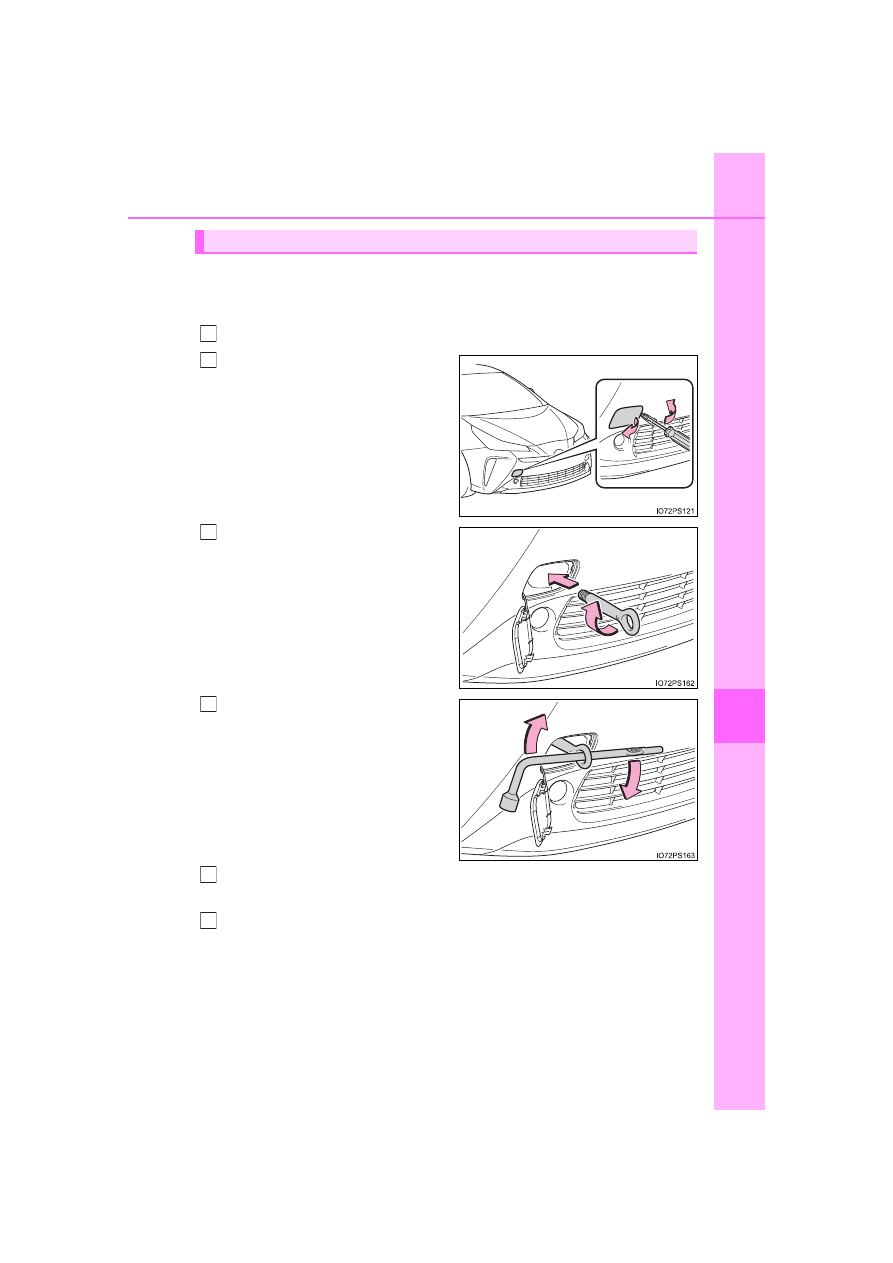
To have your vehicle towed by another vehicle, the towing eyelet must
be installed to your vehicle. Install the towing eyelet using the follow-
ing procedure.

Take out the wheel nut wrench and towing eyelet. (

P. 609, 628)

Remove the eyelet cover using
a flathead screwdriver. 

To  protect  the  bodywork,  place  a
rag  between  the  screwdriver  and
the  vehicle  body  as  shown  in  the
illustration.

Insert the towing eyelet into the
hole  and  tighten  partially  by
hand.

Tighten down the towing eyelet
securely  using  a  wheel  nut
wrench or hard metal bar.

When  tightening  with  a  wheel  nut
wrench  or  hard  metal  bar,  make
sure  not  to  damage  the  vehicle
body.

Securely attach cables or chains to the towing eyelet.

Take care not to damage the vehicle body.

Enter the vehicle being towed and start the hybrid system.

If the hybrid system does not start, turn the power switch to ON mode.
Turn off the Parking Support Brake function. (if equipped): 

P. 372

Emergency towing procedure

1

2

3

4

5

6

584

7-2. Steps to take in an emergency

Shift the shift position to N

*

 and release the parking brake.

*

: If the shift position cannot be changed or the current shift position

can not be confirmed, contact your Toyota dealer or commercial tow-
ing service before towing.

While towing

If the hybrid system is off, the power assist for the brakes and steering will not
function, making steering and braking more difficult.

Wheel nut wrench

Wheel nut wrench is installed in luggage compartment. (

P. 609, 628)

Towing eyelet installation hole on the rear of the vehicle

The  hole  is  equipped  for  fastening  the
vehicle  while  shipping.  Your  vehicle  can-
not tow another vehicle.

7

585

7-2. Steps to take in an emergency

7

Wh
en tro

uble

 a

ris

es

WARNING

Observe the following precautions.
Failure to do so may result in death or serious injury.

When towing the vehicle

2WD models

AWD models

Be sure to transport the vehicle with the
front wheels raised or with all four wheels
raised  off  the  ground.  If  the  vehicle  is
towed  with  the  front  wheels  contacting
the  ground,  the  drivetrain  and  related
parts may be damaged or electricity gen-
erated by the operation of the motor may
cause  a  fire  to  occur  depending  on  the
nature of the damage or malfunction.

Be  sure  to  transport  the  vehicle  with  all
four  wheels  raised  off  the  ground.  If  the
vehicle is towed with the tires contacting
the ground, the drivetrain or related parts
may be damaged, the vehicle may fly off
the  truck,  or  electricity  generated  by  the
operation  of  the  motor  may  cause  a  fire
to  occur  depending  on  the nature of  the
damage or malfunction.

586

7-2. Steps to take in an emergency

WARNING

Observe the following precautions. 
Failure to do so may result in death or serious injury.

While towing

When towing using cables or chains, avoid sudden starts, etc. which place
excessive stress on the towing eyelets, cables or chains. The towing eye-
lets, cables or chains may become damaged, broken debris may hit peo-
ple, and cause serious damage.

Do not turn the power switch off. 
This  may  lead  to  an  accident  as  the  front  wheels  will  be  locked  by  the
parking lock.

Installing towing eyelets to the vehicle

The towing eyelets are only for the vehicle equipped with them. Do not use
the towing eyelets for another vehicle, and do not use the towing eyelets
for this vehicle on another vehicle.

Make sure that towing eyelets are installed securely.
If not securely installed, towing eyelets may come loose during towing.

NOTICE

Towing with a sling-type truck

To prevent damage to the vehicle when towing using a wheel-lift type
truck

When raising the vehicle, ensure adequate ground clearance for towing at
the  opposite  end  of  the  raised  vehicle.  Without  adequate  clearance,  the
vehicle could be damaged while being towed.

To prevent damage to the vehicle when towing with a sling-type truck

Do not tow with a sling-type truck, either from the front or rear.

To prevent damage to the vehicle during emergency towing

Do not secure cables or chains to the suspension components.

Do not tow with a sling-type truck to pre-
vent body damage.

587

7

Wh
en tro

uble

 a

ris

es

7-2. Steps to take in an emergency

If you think something is wrong

Fluid leaks under the vehicle
(Water dripping from the air conditioning after use is normal.)

Flat-looking tires or uneven tire wear

High coolant temperature warning light flashes or comes on

Changes in exhaust sound

Excessive tire squeal when cornering

Strange noises related to the suspension system

Pinging or other noises related to the hybrid system

Engine missing, stumbling or running roughly

Appreciable loss of power

Vehicle pulls heavily to one side when braking

Vehicle pulls heavily to one side when driving on a level road

Loss of brake effectiveness, spongy feeling, pedal almost touches
the floor

If you notice any of the following symptoms, your vehicle proba-
bly  needs  adjustment  or  repair.  Contact  your  Toyota  dealer  as
soon as possible.

Visible symptoms

Audible symptoms

Operational symptoms

588

7-2. Steps to take in an emergency

If a warning light turns on or a warning 

buzzer sounds

Calmly perform the following actions if any of the warning lights
comes  on  or  flashes.  If  a  light  comes  on  or  flashes,  but  then
goes off, this does not necessarily indicate a malfunction in the
system.  However,  if  this  continues  to  occur,  have  the  vehicle
inspected by your Toyota dealer.

Warning light and warning buzzer list

Warning light

Warning light/Details/Actions

(U.S.A.)

(Canada)

Brake  system  warning  light  and  warning  buzzer  (red
indicator)

*

1

Indicates that:
• The brake fluid level is low; or
• The brake system is malfunctioning

Immediately stop the vehicle in a safe place and con-
tact your Toyota dealer. Continuing to drive the vehi-
cle may be dangerous.

Brake system warning light (yellow indicator)

Indicates a malfunction in:
• The regenerative braking system; or
• The electronically controlled brake system

Have  the  vehicle  inspected  by  your  Toyota  dealer
immediately.

Charging system warning light

Indicates a malfunction in the vehicle’s charging system

Immediately stop the vehicle in a safe place and con-
tact your Toyota dealer.

Low engine oil pressure warning light 
(warning buzzer)

*

2

Indicates that the engine oil pressure is too low

Immediately stop the vehicle in a safe place and con-
tact your Toyota dealer.

(U.S.A.)

(Canada)

Malfunction indicator lamp

Indicates a malfunction in:
• The hybrid system;
• The electronic engine control system; or
• The electronic throttle control system

Have  the  vehicle  inspected  by  your  Toyota  dealer
immediately.

589

7-2. Steps to take in an emergency

7

Wh
en tro

uble

 a

ris

es

SRS warning light

Indicates a malfunction in:
• The SRS airbag system;
• The front passenger occupant classification system; or
• The seat belt pretensioner system

Have  the  vehicle  inspected  by  your  Toyota  dealer
immediately.

(U.S.A.)

(Canada)

ABS warning light

Indicates a malfunction in:
• The ABS; or
• The brake assist system

Have  the  vehicle  inspected  by  your  Toyota  dealer
immediately.

(Red/yellow)

Electric  power  steering  system  warning  light  (warning
buzzer)

Indicates a malfunction in the EPS (Electric Power Steer-
ing) system

Have  the  vehicle  inspected  by  your  Toyota  dealer
immediately.

(Flashes or 

illuminates)

(If equipped)

PCS warning light

• When a buzzer sounds simultaneously:

Indicates  a  malfunction  has  occurred  in  the  PCS  (Pre-
Collision System).

Have  the  vehicle  inspected  by  your  Toyota  dealer
immediately.

• When a buzzer does not sound:

The PCS (Pre-Collision System) has become temporar-
ily unavailable, corrective action may be necessary.

Follow  the  instructions  displayed  on  the  multi-infor-
mation display. (

P. 289, 605)

If the PCS (Pre-Collision System) or VSC (Vehicle Stability
Control) system is disabled, the PCS warning light will illu-
minate.

P. 301

(Orange)

(If equipped)

LTA indicator (warning buzzer)

Indicates a malfunction in the LTA (Lane Tracing Assist)

Follow  the  instructions  displayed  on  the  multi-infor-
mation display. (

P. 316)

Warning light

Warning light/Details/Actions

590

7-2. Steps to take in an emergency

Slip indicator light

Indicates a malfunction in:
• The VSC system;
• The TRAC system; or
• The hill-start assist control system

Have  the  vehicle  inspected  by  your  Toyota  dealer
immediately.

The light will flash when the ABS, VSC or TRAC system is
operating.

High coolant temperature warning light

• When the light flashes:

Indicates that the engine coolant temperature is too high 
The light changes from a flashing to a solid light when
the temperature further increases

Immediately stop the vehicle in a safe place. (

P. 652)

• When the light comes on without flashing:

Indicates a malfunction in the exhaust heat recirculator
system

Have  the  vehicle  inspected  by  your  Toyota  dealer
immediately.

(Flashes)

(If equipped)

PKSB OFF indicator

Indicates a malfunction in the Parking Support Brake func-
tion

Have the vehicle inspected by your Toyota dealer.

The  warning  light will  operate  as  follows,  even when  the
system is not malfunctioning:
• The light will come on when the Parking Support Brake

function is turned off (

P. 372)

• The light will come on when the Parking Support Brake

function is operating (

P. 376)

• The light will flash when the system cannot be temporar-

ily used (

P. 378)

Open door warning light (warning buzzer)

*

3

Indicates that a door is not fully closed

Check that all the doors are closed.

Low fuel level warning light

Indicates  that  remaining  fuel  is  approximately  1.7  gal.
(6.4 L, 1.4 Imp.gal.) or less

Refuel the vehicle.

Warning light

Warning light/Details/Actions

591

7-2. Steps to take in an emergency

7

Wh
en tro

uble

 a

ris

es

Driver’s  and  front  passenger’s  seat  belt  reminder  light
(warning buzzer)

*

4

Warns  the  driver  and/or  front  passenger  to  fasten  their
seat belts

Fasten the seat belt.
If  the  front  passenger’s  seat  is  occupied,  the  front
passenger’s  seat  belt  also  needs  to  be  fastened  to
make the warning light (warning buzzer) turn off.

(U.S.A.)

(Canada)

Rear  passengers’  seat  belt  reminder  lights  (warning
buzzer)

*

5

Warns the rear passengers to fasten their seat belts

Fasten the seat belt.

Master warning light

A  buzzer  sounds  and  the  warning  light  comes  on  and
flashes  to  indicate  that  the  master  warning  system  has
detected a malfunction.

P. 599

Tire pressure warning light

When the light comes on:

Low tire inflation pressure such as

• Natural causes (

P. 595)

• Flat tire (

P. 607, 627)

Adjust  the  tire  inflation  pressure  to  the  specified

level.

The light will turn off after a few minutes. In case

the light does not turn off even if the tire inflation

pressure is adjusted, have the system checked by

your Toyota dealer.

When the light comes on after blinking for 1 minute:

Malfunction in the tire pressure warning system 

(

P. 595)

Have the system checked by your Toyota dealer.

(Flashes)

(If equipped)

“AFS OFF” indicator

Indicates  a malfunction  in  the adaptive  front-lighting  sys-
tem

Have  the  vehicle  inspected  by  your  Toyota  dealer
immediately.

Warning light

Warning light/Details/Actions

592

7-2. Steps to take in an emergency

Inappropriate pedal operation warning light

*

6

 (warning

buzzer)

When a buzzer sounds:
Indicates a malfunction in:
• The Brake Override System
• The Drive-Start Control

Have  the  vehicle  inspected  by  your  Toyota  dealer
immediately.

Indicates  that  the  shift  position  was  changed  and  Drive-
Start Control was operated while depressing the accelera-
tor pedal.

Momentarily release the accelerator pedal.

Indicates  that  the  Parking  Support  Brake  function  (if
equipped) is operating (

P. 376)

Follow the instruction that is displayed on the multi-
information display.

When a buzzer does not sound:
Indicates that the accelerator and brake pedals are being
depressed  simultaneously,  and  the  Brake  Override  Sys-
tem is operating.

Release the accelerator pedal and depress the brake
pedal.

(Canada only)

Low engine oil pressure warning (symbol display)

*

6

Indicates that the engine oil pressure is too low

Immediately stop the vehicle in a safe place and con-
tact your Toyota dealer.

Warning light

Warning light/Details/Actions

593

7-2. Steps to take in an emergency

7

Wh
en tro

uble

 a

ris

es

*

1

: Brake system warning buzzer:

When there is a possible problem that could affect braking performance,
the warning light will come on and a warning buzzer will sound.

*

2

: Low engine oil pressure warning buzzer:

A buzzer also sounds continuously for approximately 30 seconds at maxi-
mum  in  addition  to  the  low  engine  oil  pressure  warning  light  when  the
“READY” indicator is illuminated.

*

3

: Open door warning buzzer: 

The open door warning buzzer sounds to alert one or more of the doors is
not fully closed (with the vehicle having reached a speed of 3 mph [5 km/h]).

*

4

: Driver’s seat belt warning buzzer: 

The driver’s seat belt warning buzzer sounds to alert the driver that his or
her seat belt is not fastened. Once the power switch is turned to ON mode,
the buzzer sounds. If the seat belt is still unfastened, the buzzer sounds
intermittently for a certain period of time after the vehicle reaches a certain
speed.
Front passenger’s seat belt warning buzzer:
The  front  passenger’s  seat  belt  warning  buzzer  sounds  to  alert  the  front
passenger that his or her seat belt is not fastened. If the seat belt is unfas-
tened, the buzzer sounds intermittently for a certain period of time after the
vehicle reaches a certain speed.

*

5

: Rear passengers’ seat belt warning buzzer:

The  rear  passengers’  seat  belt  warning  buzzer  sounds  to  alert  the  rear
passenger that his or her seat belt is not fastened. If the seat belt is unfas-
tened,  the  buzzer sounds  intermittently for  a  certain period  of time,  after
the seat belt is fastened and unfastened and the vehicle reaches a certain
speed.

*

6

: This symbol is displayed on the multi-information display.

594

7-2. Steps to take in an emergency

SRS warning light

This warning light system monitors the airbag sensor assembly, front impact
sensors,  side  impact  sensors  (front  door),  side  impact  sensors  (front),  side
impact sensors (rear), driver’s seat belt buckle switch, front passenger occu-
pant classification system (ECU and sensors), “AIR BAG ON” indicator light,
“AIR BAG OFF” indicator light, front passenger’s seat belt buckle switch, seat
belt pretensioners, airbags, interconnecting wiring and power sources. 
(

P. 35)

Front  passenger  detection  sensor,  seat  belt  reminder  and  warning
buzzer

If luggage is placed on the front passenger seat, the front passenger detec-
tion sensor may cause the warning light to flash and the warning buzzer to
sound even if a passenger is not sitting in the seat.

If a cushion is placed on the seat, the sensor may not detect a passenger,
and the warning light may not operate properly.

Electric power steering system warning light (warning buzzer)

When the 12-volt battery charge becomes insufficient or the voltage tempo-
rarily  drops,  the  electric  power  steering  system  warning  light  may  come  on
and the warning buzzer may sound.

If the malfunction indicator lamp comes on while driving

First check the following:

Is the fuel tank empty?
If it is, fill the fuel tank immediately.

Is the fuel tank cap loose?
If it is, tighten it securely.

The malfunction indicator lamp will go off after several driving trips.
If the malfunction indicator lamp does not go off even after several trips, con-
tact your Toyota dealer as soon as possible.

595

7-2. Steps to take in an emergency

7

Wh
en tro

uble

 a

ris

es

When the tire pressure warning light comes on

Inspect the appearance of the tire to check that the tire is not punctured.
If the tire is punctured: 

P. 607, 627

If the tire is not punctured: 
Check the tire inflation pressure and adjust to the appropriate level. Initial-

izing  the  tire  pressure  warning  system  will  not  turn  off the  tire  pressure

warning light.

The tire pressure warning light may come on due to natural causes

The tire pressure warning light may come on due to natural causes such

as  natural  air  leaks  and  tire  inflation  pressure  changes  caused  by  tem-

perature. In this case, adjusting the tire inflation pressure will turn off the

warning light (after a few minutes).

When a tire is replaced with a spare tire

Vehicles with compact spare tire: The compact spare tire is not equipped

with a tire pressure warning valve and transmitter. If a tire goes flat, the

tire  pressure  warning  light  will  not  turn  off  even  though  the  flat  tire  has

been replaced with the spare tire. Replace the spare tire with the repaired

tire and adjust the tire inflation pressure. The tire pressure warning light

will go off after a few minutes.
Vehicles with full-size spare tire: The spare tire is also equipped with a tire

pressure  warning  valve  and  transmitter. The  tire  pressure  warning  light

will turn on if the tire inflation pressure of the spare tire is low. If a tire goes

flat, the tire pressure warning light will not turn off even though the flat tire

has  been  replaced  with  the  spare  tire.  Replace  the  spare  tire  with  the

repaired tire and adjust the tire inflation pressure. The tire pressure warn-

ing light will go off after a few minutes.

Conditions  that  the  tire  pressure  warning  system may  not function

properly

P. 534

If the tire pressure warning light frequently comes on after blinking

for 1 minute

If  the  tire  pressure  warning  light  frequently  comes  on  after  blinking  for

1 minute when the power switch is turned to ON mode, have it checked

by your Toyota dealer.

Warning buzzer

In some cases, the buzzer may not be heard due to being in a noisy location
or audio sound.

596

7-2. Steps to take in an emergency

WARNING

When the electric power steering system warning light comes on

When  the  light  comes  on  yellow,  the  assist  to  the  power  steering  is
restricted. When the light comes on red, the assist to the power steering is
lost  and  handling  operations  of  the  steering  wheel  become  extremely
heavy.  When  steering  wheel  operations  are  heavier  than  usual,  grip  the
steering wheel firmly and operate it using more force than usual.

If the tire pressure warning light comes on

Be  sure  to  observe  the  following  precautions.  Failure  to  do  so  could

cause a loss of vehicle control and result in death or serious injury.

Stop your vehicle in a safe place as soon as possible. Adjust the tire

inflation pressure immediately. 

Vehicles  with  emergency  tire  puncture  repair  kit:  If  the  tire  pressure

warning light comes on even after tire inflation pressure adjustment, it

is  probable  that  you  have  a  flat  tire.  Check  the  tires.  If  a  tire  is  flat,

repair the flat tire by using emergency tire puncture repair kit.

Vehicles  with  spare  tire:  If  the  tire  pressure  warning  light  comes  on

even  after  tire  inflation  pressure  adjustment,  it  is  probable  that  you

have a flat tire. Check the tires. If a tire is flat, change it with the spare

tire and have the flat tire repaired by the nearest Toyota dealer.

Avoid abrupt maneuvering and braking. If the vehicle tires deteriorate,

you could lose control of the steering wheel or the brakes.

If a blowout or sudden air leakage should occur

The tire pressure warning system may not activate immediately.

597

7-2. Steps to take in an emergency

7

Wh
en tro

uble

 a

ris

es

WARNING

Maintenance of the tires

Each tire, including the spare (if provided), should be checked monthly

when  cold  and  inflated  to  the  inflation  pressure  recommended  by  the

vehicle  manufacturer  on  the  vehicle  placard  or  tire  inflation  pressure

label (tire and load information label). (If your vehicle has tires of a dif-

ferent size than the size indicated on the vehicle placard or tire inflation

pressure  label  [tire  and  load  information  label],  you  should  determine

the proper tire inflation pressure for those tires.)
As an added safety feature, your vehicle has been equipped with a tire

pressure monitoring system (TPMS-tire pressure warning system) that

illuminates a low tire pressure telltale (tire pressure warning light) when

one  or  more  of  your  tires  is  significantly  under-inflated.  Accordingly,

when  the  low  tire  pressure  telltale  (tire  pressure  warning  light)  illumi-

nates, you should stop and check your tires as soon as possible, and

inflate  them  to  the  proper  pressure.  Driving  on  a  significantly  under-

inflated  tire  causes  the  tire  to  overheat  and  can  lead  to  tire  failure.

Under-inflation also reduces fuel efficiency and tire tread life, and may

affect the vehicle’s handling and stopping ability.
Please note that the TPMS (tire pressure warning system) is not a sub-

stitute for proper tire maintenance, and it is the driver’s responsibility to

maintain  correct  tire  pressure,  even  if  under-inflation  has  not  reached

the level to trigger illumination of the TPMS low tire pressure telltale (tire

pressure warning light).
Your vehicle has also been equipped with a TPMS (tire pressure warn-

ing  system)  malfunction  indicator  to  indicate  when  the  system  is  not

operating properly. The TPMS (tire pressure warning system) malfunc-

tion indicator is combined with the low tire pressure telltale (tire pressure

warning light). When the system detects a malfunction, the telltale will

flash for approximately one minute and then remain continuously illumi-

nated. This sequence will continue upon  subsequent vehicle  start-ups

as long as the malfunction exists. When the malfunction indicator is illu-

minated, the system may not be able to detect or signal low tire pres-

sure as intended.
TPMS (tire pressure warning system) malfunctions may occur for a vari-

ety of reasons, including the installation of replacement or alternate tires

or wheels on the vehicle that prevent the TPMS (tire pressure warning

system)  from  functioning  properly. Always  check  the TPMS  (tire  pres-

sure  warning  system)  malfunction  telltale  after  replacing  one  or  more

tires or wheels on your vehicle to ensure that the replacement or alter-

nate tires and wheels allow the TPMS (tire pressure warning system) to

continue to function properly.

598

7-2. Steps to take in an emergency

NOTICE

To ensure the tire pressure warning system operates properly

Do  not  install  tires  with  different  specifications  or  makers,  as  the  tire

pressure warning system may not operate properly.


Content      ..     34      35      36      37     ..