Toyota GR Supra (2022 year). Manual in english - page 13
 

  Index      Toyota     Toyota GR Supra (2022 year). Manual in english


Search            copyright infringement  


Content      ..     11      12      13      14     ..


Toyota GR Supra (2022 year). Manual in english - page 13


196

3-1. CONTROLS

Loss of traction of the front 

wheels, which can lead to 

understeering.

When VSC is deactivated, driv-

ing stability is reduced during 

acceleration and when driving in 

curves.
To increase vehicle stability, 

activate VSC again as soon as 

possible.

When VSC is deactivated, VSC 

OFF is displayed in the instru-

ment cluster.

Safety information

WARNING

The system cannot serve as a 

substitute for the driver’s personal 

judgment in assessing the traffic 

conditions. Based on the limits of 

the system, it cannot inde-

pendently react to all traffic situa-

tions. There is a risk of accident. 

Adjust driving style to traffic condi-

tions. Watch traffic closely and 

actively intervene where appropri-

ate.

WARNING

When driving with a roof load, for 

instance with roof-mounted lug-

gage rack, the vehicle's center of 

gravity is higher, which increases 

the risk of the vehicle tipping in 

critical driving situations. There is 

a risk of accidents or risk of dam-

age to property. Do not deactivate 

VSC Vehicle Stability Control Sys-

tem when driving with roof load.

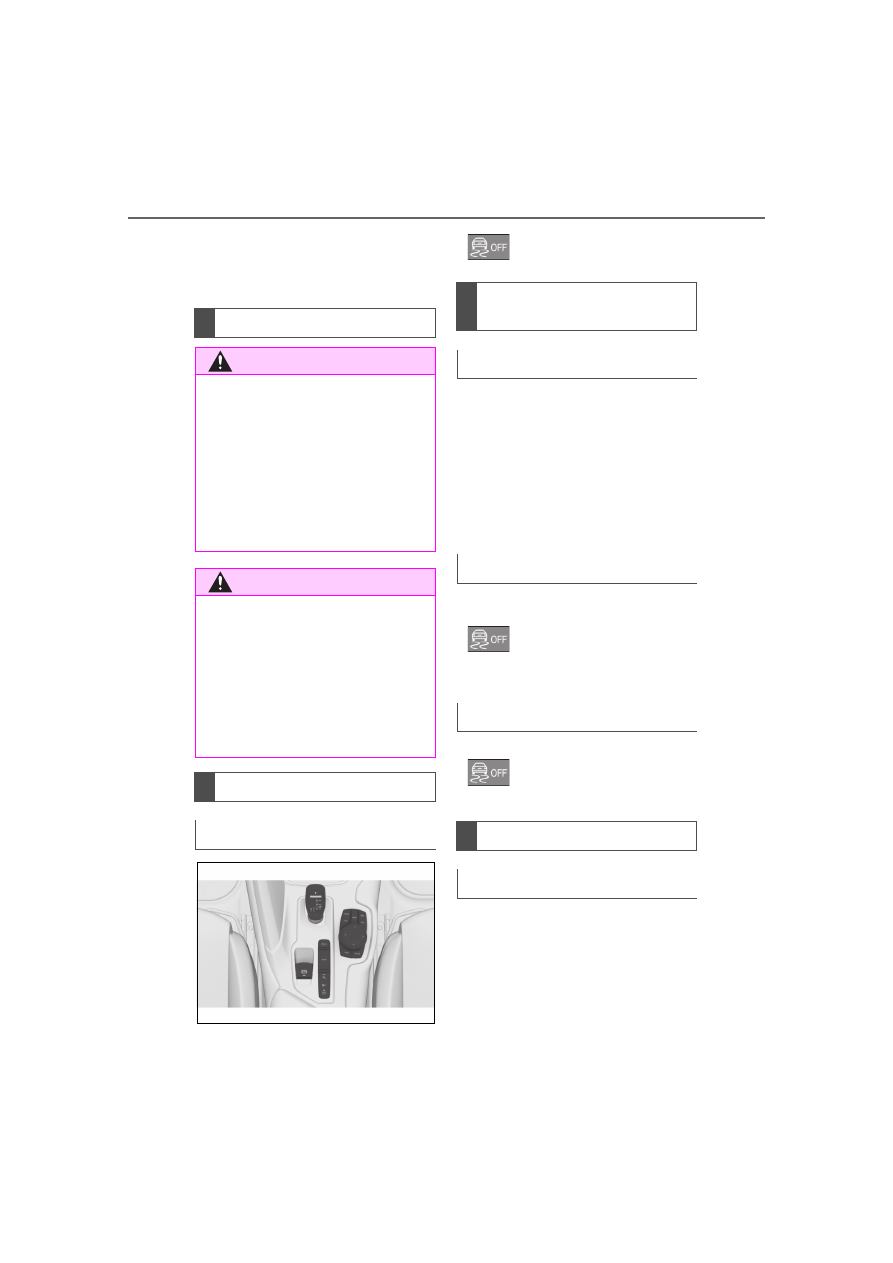
Overview

Button in the vehicle

VSC OFF

Deactivating/activating 

VSC

General information

Deactivating VSC

Hold the button down until 

VSC OFF is displayed in 

the instrument cluster and 

the VSC OFF indicator 

light is illuminated.

Activating VSC

Press the button.
VSC OFF and the VSC 

OFF indicator light go out.

Display

In the instrument cluster

197

3-1. CONTROLS

3

CON

T

ROLS

When entering a curve at an 
excessively high rate of speed

In this case, even if the VSC oper-
ates, it cannot operate sufficiently 
to avoid a possible dangerous situ-
ation. The driver is solely responsi-
ble for understanding their 
surroundings and driving at a safe 
speed.

Traction mode is a version of the 
VSC Vehicle Stability Control 
System where forward momen-
tum is optimized.

The system ensures maximum 
headway on special road condi-
tions or loose road surfaces, for 
instance unplowed snowy 
roads, but with somewhat lim-
ited driving stability.

When Traction mode is acti-
vated, the vehicle has maximum 
traction. Driving stability is lim-
ited during acceleration and 
when driving in curves.

You may find it useful to briefly 
activate Traction mode in the 
following situations:

When driving in slush or on 
uncleared, snow-covered 
roads.

When driving off from deep 
snow or loose ground.

When driving with snow 
chains.

Indicator/warning lights

The indicator light lights 
up: VSC is deactivated.

The indicator light flashes: 
VSC controls the drive 
and braking forces.

The indicator light lights 
up: VSC has malfunc-
tioned.

Situations which the VSC 
cannot operate sufficiently

Traction mode

Concept

General information

Overview

Button in the vehicle

VSC OFF

198

3-1. CONTROLS

If Traction mode is activated, 
TRACTION is displayed in the 
instrument cluster.

In certain situations, the VSC is 
activated automatically:

If Dynamic radar cruise con-
trol with full-speed range is 
activated.

On a braking intervention by 
the Toyota Supra Safety sys-
tems.

The vehicle has a flat tire.

*

: if equipped

The active differential step-
lessly locks the rear axle 
depending on the driving condi-
tions. This provides optimal 
power transfer in all driving con-
ditions by helping prevent wheel 
spin at either rear wheel.

The driver is responsible adapt-
ing his or her driving style to the 
situation.

Activating/deactivating 
Traction mode

Activating Traction mode

Press the button.

TRACTION is displayed in 
the instrument cluster and 
the indicator light for VSC 
OFF lights up.

Deactivating Traction mode

Press the button again.

TRACTION and the VSC 
OFF indicator light go out.

Display

Display in the instrument 
cluster

Indicator/warning lights

The indicator light lights 
up: Traction mode is acti-
vated.

Automatic program 
change

Active differential*

199

3-1. CONTROLS

3

CON

TROLS

This chapter describes all stan-

dard, country-specific and 

optional features offered with 

the series. It also describes fea-

tures and functions that are not 

necessarily available in your 

vehicle, e.g., due to the selected 

options or country versions. This 

also applies to safety-related 

functions and systems. When 

using these functions and sys-

tems, the applicable laws and 

regulations must be observed.

*

: if equipped

Using this system, a desired 

speed can be adjusted using the 

buttons on the steering wheel. 

The system maintains the 

desired speed. The system 

accelerates and brakes auto-

matically as needed.

The system can be activated 

starting at 20 mph/30 km/h.
Depending on the vehicle set-

tings, the characteristics of the 

Cruise Control may change.

Driver assistance sys-

tems

Vehicle features and 

options

Cruise control*

Concept

General information

Safety information

WARNING

The system cannot serve as a 

substitute for the driver’s personal 

judgment in assessing the traffic 

conditions. Based on the limits of 

the system, it cannot inde-

pendently react to all traffic situa-

tions. There is a risk of accident. 

Adjust driving style to traffic condi-

tions. Watch traffic closely and 

actively intervene where appropri-

ate.

WARNING

The use of the system can lead to 

an increased risk of accidents in 

the following situations, for 

instance:

On winding roads.

In heavy traffic.

On slippery roads, in fog, snow, 

or wet conditions, or on a loose 

road surface.

There is a risk of accidents or risk 

of damage to property. Only use 

the system if driving at constant 

speed is possible.

WARNING

The desired speed can be incor-

rectly adjusted or called up by 

mistake. There is a risk of an acci-

dent. Adjust the desired speed to 

the traffic conditions. Watch traf-

fic closely and actively intervene 

where appropriate.

200

3-1. CONTROLS

The indicator will come on.

Cruise control is active. The cur-
rent speed is maintained and 
stored as desired speed.

VSC Vehicle Stability Control 
System is switched on, if neces-
sary.

The displays go out. The stored 
desired speed is deleted.

The system is automatically 
interrupted in the following situa-
tions, for example:

When the driver applies the 
brakes.

When selector lever position 
D is disengaged.

Traction mode is activated or 
VSC Vehicle Stability Control 
System is deactivated.

If VSC Vehicle Stability Con-
trol System intervenes.

Overview

Buttons on the steering 
wheel

Button

Function

Cruise control on/off, 
refer to page 200.

Press the button with 
the system interrupted: 
Continue cruise control 
with the last setting, 
refer to page 202.

When active, press the 
button: Pause cruise 
control, refer to page 
200.

Store current speed.

Rocker switch:

Set speed, refer to 
page 201.

Switching cruise control 
on/off

Switching on

Press the button on the 
steering wheel.

Switching off

Press the button on the 
steering wheel.

Pausing cruise control

Interrupting manually

When active, press the 
button.

Interrupting automatically

201

3-1. CONTROLS

3

CON

T

ROLS

Press the rocker switch up or 
down once while the system is 
interrupted.

When the system is switched 
on, the current speed is main-
tained and stored as the desired 
speed.

The stored speed is displayed, 
refer to page 202, on the speed-
ometer.

VSC Vehicle Stability Control 
System is switched on, if neces-
sary.

The speed can also be stored 
by pressing a button.

Press the rocker switch up or 
down repeatedly until the 
desired speed is set.

If active, the displayed speed is 
stored and the vehicle reaches 
the stored speed when the road 
is clear.

Each time the rocker switch is 
pressed to the resistance 
point, the desired speed 
increases or decreases by 1 
mph/1 km/h.

Each time the rocker switch is 
pressed past the resistance 
point, the desired speed 
changes by a maximum of 5 
mph/10 km/h.

The maximum speed that can be 
set depends on the vehicle.

Pressing the rocker switch to 
the resistance point and hold-
ing it accelerates or deceler-
ates the vehicle without 
requiring pressure on the 
accelerator pedal.

Setting the speed

Maintaining and storing the 
speed

Press the button.

Changing the speed

202

3-1. CONTROLS

After the rocker switch is released, 
the vehicle maintains its final 
speed. Pressing the switch beyond 
the resistance point causes the 
vehicle to accelerate more rapidly.

An interrupted cruise control can 
be continued by calling up the 
stored speed.

Make sure that the difference 
between current speed and 
stored speed is not too large 
before calling up the stored 
speed. Otherwise, unintentional 
braking or accelerating may 
occur.

Cruise control is continued with 
the stored values.

In the following cases, the 
stored speed value is deleted 
and cannot be called up again:

When the system is switched 
off.

When drive-ready state is 
switched off.

With the proper equipment, the 
value of the selected speed is 
briefly displayed digitally.

Some system information can 
also be displayed in the 
Head-up Display.

The desired speed is also main-
tained downhill.

The speed may not be main-
tained on uphill grades if the 
engine power is insufficient.

Continuing cruise control

Press the button with the 
system interrupted.

Displays in the instrument 
cluster

Indicator light

Indicator light green: 
system is active.

Gray indicator light: the 
system has been inter-
rupted.

No indicator light: sys-
tem is switched off.

Status display

Displays in the Head-up 
Display

The symbol is displayed 
when the set desired 
speed is reached.

System limits

203

3-1. CONTROLS

3

CON

TROLS

*

: if equipped

Using this system, a desired 

speed and a distance to a vehi-

cle ahead can be adjusted using 

the buttons on the steering 

wheel.
The system maintains the 

desired speed on clear roads. 

For this purpose, the vehicle 

accelerates or brakes automati-

cally.
If a vehicle is driving ahead of 

you, the system adjusts the 

speed of your vehicle so that the 

set distance to the vehicle 

ahead is maintained. The speed 

is adjusted as far as the given 

situation allows.

Depending on the vehicle set-

tings, the characteristics of the 

Cruise Control may change.
The distance can be adjusted in 

several steps. For safety rea-

sons, it depends on the respec-

tive speed.
If the vehicle ahead of you 

brakes to a halt, and then pro-

ceeds to drive again within a 

brief period, the system is able 

to detect this within the given 

system limits.

Dynamic radar cruise 

control with full-speed 

range*

Concept

General information

Safety information

WARNING

The system cannot serve as a 

substitute for the driver’s personal 

judgment in assessing the traffic 

conditions. Based on the limits of 

the system, it cannot inde-

pendently react to all traffic situa-

tions. There is a risk of accident. 

Adjust driving style to traffic condi-

tions. Watch traffic closely and 

actively intervene where apaprk-

ing sensorspropriate.

WARNING

An unsecured vehicle can begin 

to move and possibly roll away. 

There is a risk of an accident. 

Before exiting, secure the vehicle 

against rolling.
In order to ensure that the vehicle 

is secured against rolling away, 

follow the following:

Set the parking brake.

On uphill grades or on a down-

hill slope, turn the front wheels 

in the direction of the curb.

On uphill grades or on a down-

hill slope, also secure the vehi-

cle, for instance with a wheel 

chock.

WARNING

The desired speed can be incor-

rectly adjusted or called up by 

mistake. There is a risk of an acci-

dent. Adjust the desired speed to 

the traffic conditions. Watch traf-

fic closely and actively intervene 

where appropriate.

204

3-1. CONTROLS

The system is controlled by the 

following sensors:

• Cameras behind the wind-

shield.

• Front radar sensor.
Additional information:

Sensors of the vehicle, refer to 

page 40.

The system is best used on 

well-constructed roads.
The system is functional at 

speeds beginning at approx. 20 

mph/30 km/h.
The maximum speed that can 

be set is limited and, e.g., 

depends on the vehicle and the 

vehicle equipment version.
The system can also be acti-

vated when stationary.

WARNING

Risk of accident due to too high 

speed differences to other vehi-

cles, for instance in the following 

situations:

When fast approaching a slowly 

moving vehicle.

There is a risk of injuries or dan-

ger to life. Watch traffic closely 

and actively intervene where 

appropriate.

Vehicle suddenly swerving into 

own lane.

When fast approaching stand-

ing vehicles.

Overview

Buttons on the steering 

wheel

Button

Function

Cruise control on/off, 

refer to page 205.

Store current speed.

When active, press the 

button: Pause cruise 

control, refer to page 

205.
Press the button with 

the system interrupted: 

Continue cruise control 

with the last setting, 

refer to page 207.
Increase distance, refer 

to page 207.
Switch distance control 

on/off.

Reduce distance, refer 

to page 207.
Switch distance control 

on/off.
Rocker switch:
Set speed, refer to 

page 206.

Sensors

Area of application

Button

Function

205

3-1. CONTROLS

3

CON

T

ROLS

The indicator will come on.

Cruise control is active. The cur-
rent speed is maintained and 
stored as desired speed.

VSC Vehicle Stability Control 
System is switched on, if neces-
sary.

To switch off the system while 
standing, step on brake pedal at 
the same time.

Press the following button on 
the steering wheel again:

The displays go out. The stored 
desired speed is deleted.

When active, press the following 
button on the steering wheel:

If interrupting the system while 
stationary, press on the brake 
pedal at the same time.

The system is automatically 
interrupted in the following situa-
tions:

When the driver applies the 
brakes.

When selector lever position 
D is disengaged.

Traction mode is activated or 
VSC Vehicle Stability Control 
System is deactivated.

If VSC Vehicle Stability Con-
trol System intervenes.

If the safety belt is unbuckled 
and the driver's door is 
opened while the vehicle is 
standing still.

If the system has not detected 
objects for an extended 
period, for instance on a road 
with very little traffic without 
curb or shoulder markings.

If the detection range of the 
radar is impaired, for instance 
by dirt or heavy fog.

After a longer stationary 
period when the vehicle has 
been braked to a stop by the 
system.

Switching on/off and inter-
rupting cruise control

Switching on

Press the button on the 
steering wheel.

Switching off

Button on the steering 
wheel.

Interrupting manually

Button on the steering 
wheel.

Interrupting automatically

206

3-1. CONTROLS

Press the rocker switch up or 
down once while the system is 
interrupted. The system will be 
activated.

The current speed is maintained 
and stored as desired speed.

The stored speed is displayed 
on the speedometer.

VSC Vehicle Stability Control 
System is switched on, if neces-
sary.

The speed can also be stored 
by pressing a button.

Press the rocker switch up or 
down repeatedly until the 
desired speed is set.

If active, the displayed speed is 
stored and the vehicle reaches 
the stored speed when the road 
is clear.

Each time the rocker switch is 
pressed to the resistance 
point, the desired speed 
increases or decreases by 1 
mph/1 km/h.

Each time the rocker switch is 
pressed past the resistance 
point, the desired speed 
changes by a maximum of 5 
mph/10 km/h.

Hold the rocker switch in posi-
tion to repeat the action.

Setting the speed

Maintaining and storing the 
speed

Press the button.

Changing the speed

207

3-1. CONTROLS

3

CON

TROLS

Instrument cluster will display 

selected distance, refer to page 

207.

Instrument cluster will display 

selected distance, refer to page 

207.

An interrupted cruise control can 

be continued by calling up the 

stored speed.
Make sure that the difference 

between current speed and 

stored speed is not too large 

before calling up the stored 

speed. Otherwise, unintentional 

braking or accelerating may 

occur.

Cruise control is continued with 

the stored values.
In the following cases, the 

stored speed value is deleted 

and cannot be called up again:

When the system is switched 

off.

When drive-ready state is 

switched off.

Selected distance to the vehicle 

ahead of you is shown.

Adjusting distance

Safety information

WARNING

The system cannot serve as a 

substitute for the driver’s personal 

judgment. Due to the system lim-

its, braking can be late. There is a 

risk of accidents or risk of damage 

to property. Be aware to the traffic 

situation at all times. Adjust the 

distance to the traffic and weather 

conditions and maintain the pre-

scribed safety distance, possibly 

by braking.

Reduce distance

Press the button repeat-

edly until the desired dis-

tance is set.

Increase distance

Press the button repeat-

edly until the desired dis-

tance is set.

Continuing cruise control

Press the button to 

resume system operation 

when it is canceled.

Displays in the instrument 

cluster

Status display

The selected desired 

speed will be displayed.

Distance to vehicle ahead of 

you

SET

110

208

3-1. CONTROLS

As soon as the detected vehicle 
drives off, the vehicle symbol in 
the distance indicator will move 
away.

To accelerate, activate ACC, for 
instance by briefly stepping on 
the accelerator pedal or press-
ing the rocker switch.

Symbol

Description

Distance 1

Distance 2

Distance 3

Distance 4

This value is set 
automatically after 
the system is 
switched on.

System interrupted.

No distance control 
display, as the accel-
erator pedal is being 
pressed.

Detected vehicle

Symbol

Description

Green symbol:

A vehicle has been 
detected ahead of 
you. The system 
maintains the set dis-
tance to the vehicle 
in front.

209

3-1. CONTROLS

3

CON

T

ROLS

Some system information can 
also be displayed in the 
Head-up Display.

The distance information is 
active in the following situations:

Dynamic radar cruise control 
switched off.

Display in the Head-up Dis-
play selected, refer to page 
150.

Distance too short.

Speed greater than approx. 
40 mph/70 km/h.

Additional information:
• Cameras, refer to page 40.
• Radar sensors, refer to page 

41.

Indicator/warning lights

Symbol

Description

Indicator light green: 
system is active.

No indicator light: 
system is switched 
off.

Vehicle symbol 
flashes:

The conditions are 
not adequate for the 
system to work.

The system was 
deactivated but 
applies the brakes 
until you actively 
resume control by 
pressing on the 
brake pedal or accel-
erator pedal.

The vehicle symbol 
and distance bars 
flash red and an 
acoustic signal 
sounds:

Brake and make an 
evasive maneuver, if 
necessary.

Displays in the Head-up 
Display

Desired speed

The symbol is displayed 
when the set desired 
speed is reached.

Distance information

The symbol is displayed 
when the distance from 
the vehicle traveling 
ahead is too short.

System limits

System limits of the sensors

210

3-1. CONTROLS

The detection capacity of the 
system and the automatic brak-
ing capacity are limited.

Two-wheeled vehicles for 
instance might not be detected.

The system does not decelerate 
in the following situations:

For pedestrians or similarly 
slow-moving road users.

For red traffic lights.

For cross traffic.

For oncoming traffic.

If a vehicle driving ahead of you 
suddenly swerves into your 

lane, the system may not be 
able to automatically restore the 
selected distance. It may not be 
possible to restore the selected 
distance in certain situations, 
including if you are driving sig-
nificantly faster than vehicles 
driving ahead of you, for 
instance when rapidly approach-
ing a truck. When a vehicle driv-
ing ahead of you is reliably 
detected, the system requests 
that the driver intervene by brak-
ing and carrying out evasive 
maneuvers, if needed.

When the desired speed is too 
high for a curve, the speed is 
reduced slightly. Because 
curves may not be anticipated in 
advance, drive into a curve at an 
appropriate speed.

The system has a limited detec-
tion range. Situations can arise 
in tight curves where a vehicle 
driving ahead will not be 
detected or will be detected very 
late.

Detection range

Deceleration

Swerving vehicles

Cornering

211

3-1. CONTROLS

3

CON

T

ROLS

When you approach a curve the 
system may briefly report vehi-
cles in the next lane due to the 
bend of the curve. If the system 
decelerates you may compen-
sate it by briefly accelerating. 
After releasing the accelerator 
pedal the system is reactivated 
and controls speed inde-
pendently.

In some situations, the vehicle 
cannot drive off automatically; 
for example:

On steep uphill grades.

From bumps in the road.

In these cases, step on the 
accelerator pedal.

The following restrictions can 
occur under unfavorable 
weather or light conditions:

Poorer vehicle recognition.

Short-term interruptions for 
vehicles that are already rec-
ognized.

Drive attentively, and react to 
the current traffic situation. If 
necessary, intervene actively, 
for instance by braking, steering 
or evading.

The desired speed is also main-
tained downhill. The speed may 
not be maintained on uphill 
grades if the engine power is 
insufficient.

When the systems in the vehicle 
e.g., Speed Limit Info, detect a 
change of the speed limit along 
the route, this new speed value 
ca be applied for the following 
systems:

Manual Speed Limiter.

Cruise Control.

Dynamic radar cruise control 
with full-speed range.

The speed value is suggested 
as the new desired speed to be 
applied. To apply the speed 
value, the corresponding system 
must be activated.

Driving off

Weather

Engine power

Speed Limit Assist

Concept


Content      ..     11      12      13      14     ..