Toyota Hilux (2022 year). Manual in english - page 22
9-1. Specifications
635
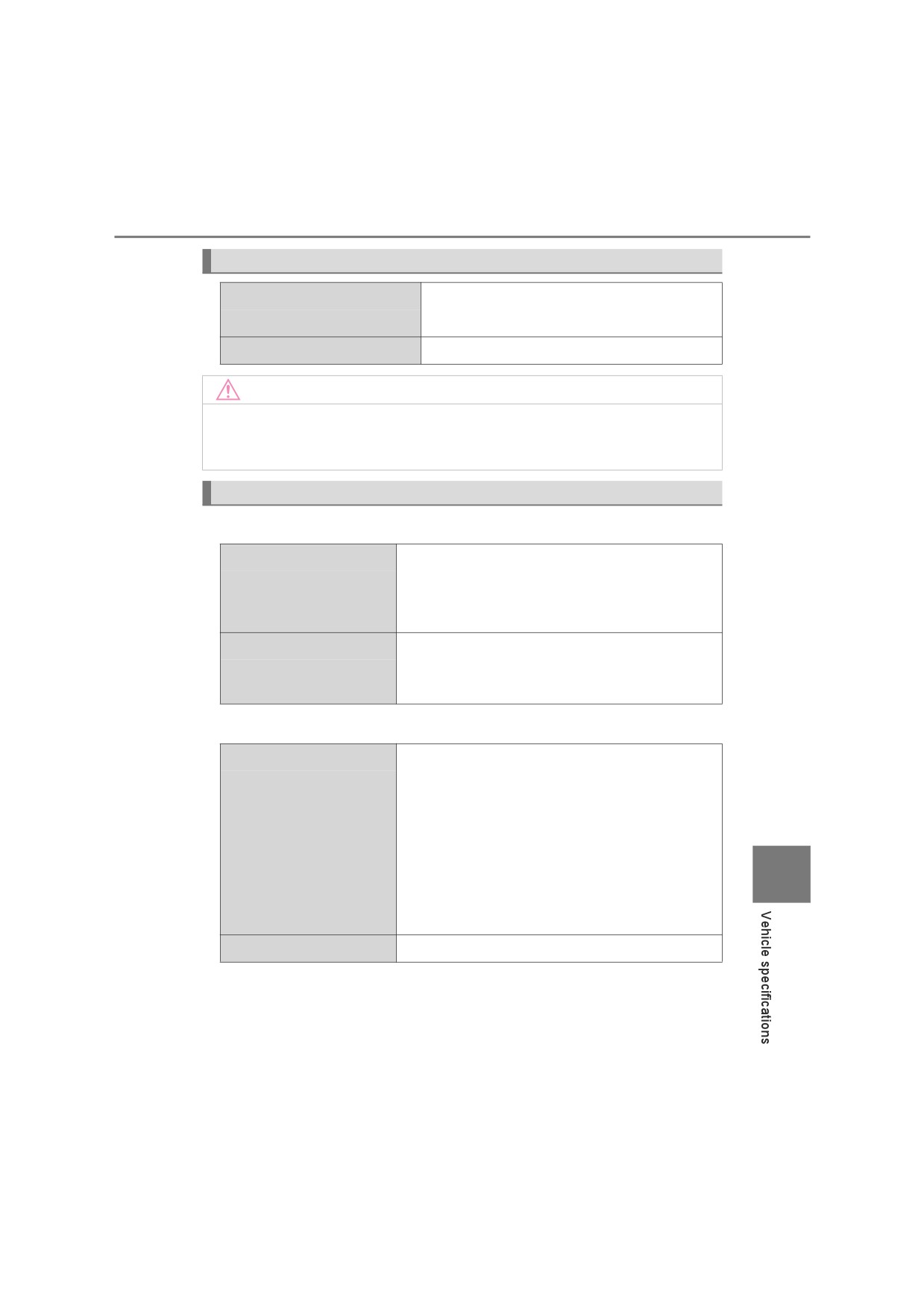
Ignition system (gasoline engine)
Spark plug
Make
DENSO FK20HR-A8
Gap
0.8 mm (0.031 in.)
NOTICE
Q Iridium-tipped spark plugs
Use only iridium-tipped spark plugs. Do not adjust the spark plug gap.
Electrical system
Vehicles with maintenance type battery
Battery
Specific gravity reading
1.25 or higher
at 20C (68F):
If the specific gravity is lower than the standard
value, charge the battery.
Charging rates
Quick charge
15 A max.
Slow charge
5 A max.
Vehicles with maintenance-free type battery
Battery
12.3 V or higher
Open voltage at
20C
If the voltage is lower than the standard value,
(68F):
charge the battery.
(After charging the battery, turn on the high
beam headlights for 30 seconds with the engine
switch in the “LOCK” position [vehicles without
9
smart entry & start system] or off [vehicles with
smart entry & start system], and turn the head-
lights off.)
Charging rates
5 A max.
636
9-1. Specifications
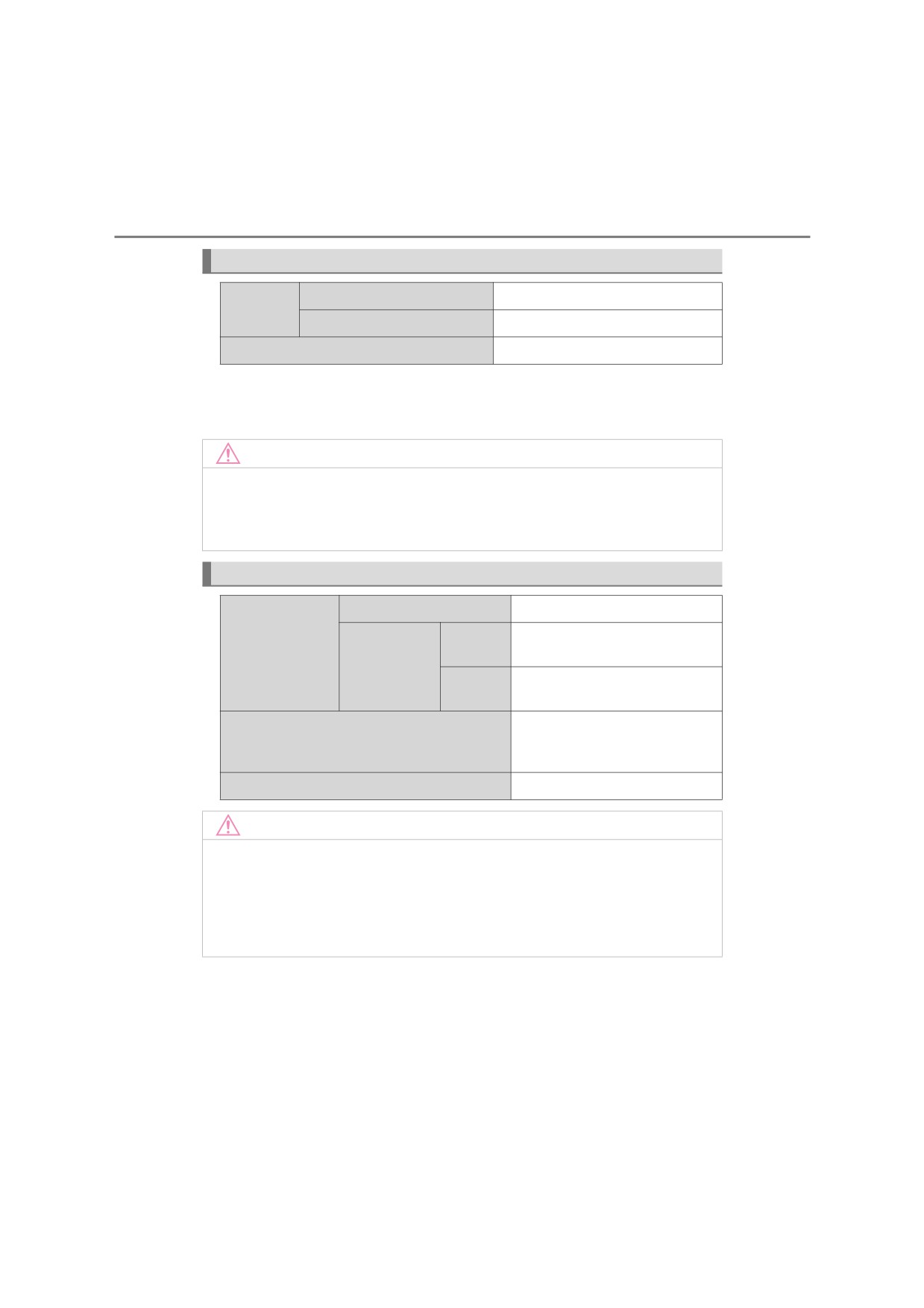
Automatic transmission
Gasoline engine
8.5 L (9.0 qt., 7.5 Imp.qt.)
Fluid
capacity*
Diesel engine
9.5 L (10.0 qt., 8.4 Imp.qt.)
Fluid type
Toyota Genuine ATF WS
*: The fluid capacity is the quantity of reference.
If replacement is necessary, contact any authorized Toyota retailer or
Toyota authorized repairer, or any reliable repairer.
NOTICE
Q Automatic transmission fluid type
Using transmission fluid other than the above type may cause abnormal
noise or vibration, or damage the transmission of your vehicle.
Manual transmission
5-speed models
2.2 L (2.3 qt., 1.9 Imp.qt.)
4WD
2.5 L (2.6 qt., 2.2 Imp.qt.)
Oil capacity
models
6-speed
models
Pre
2.7 L (2.9 qt., 2.4 Imp.qt.)
Runner
TOYOTA Genuine Manual
Oil type
Transmission Gear Oil API
GL-3 (GL-4) or equivalent
Recommended oil viscosity
SAE 75W-90
NOTICE
Q Manual transmission gear oil
Please be aware that depending on the particular characteristics of the gear
oil used or the operating conditions, idle sound, shift feeling and/or fuel effi-
ciency may be different or affected. Toyota recommends to use “TOYOTA
Genuine Manual Transmission Gear Oil” to achieve optimal performance.
9-1. Specifications
637
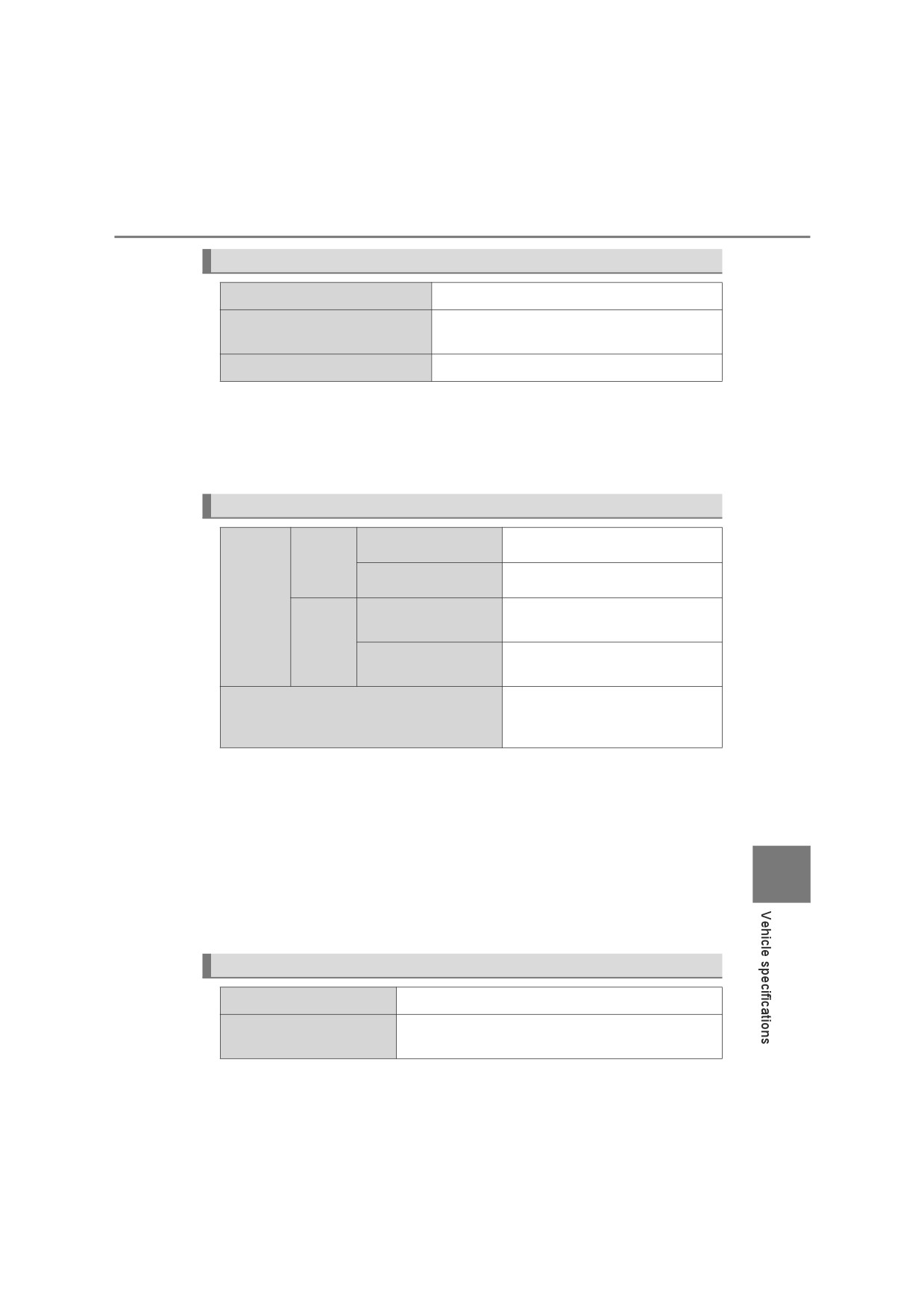
Transfer (4WD models)
Oil capacity
1.0 L (1.1 qt., 0.9 Imp.qt.)
Toyota Genuine Transfer Gear oil LF or
Oil type*
equivalent
Recommended oil viscosity
SAE 75W
*: Your Toyota vehicle is filled with “Toyota Genuine Transfer Gear oil LF” at
the factory. Use Toyota approved “Toyota Genuine Transfer Gear oil LF” or
an equivalent oil of matching quality that satisfies the above specifications.
Please contact any authorized Toyota retailer or Toyota authorized
repairer, or any reliable repairer for further details.
Differential
Front
Without A.D.D.
1.45 L (1.53 qt., 1.28 Imp.qt.)
(4WD
models)
With A.D.D.
1.60 L (1.69 qt., 1.41 Imp.qt.)
Oil
Without rear differ-
3.65 L (3.86 qt., 3.21 Imp.qt.)*2
capacity
ential lock system
3.75 L (3.96 qt., 3.30 Imp.qt.)*3
Rear
With rear differential
3.60 L (3.80 qt., 3.17 Imp.qt.)
lock system
Toyota Genuine Differential
Oil type*1 and oil viscosity
gear oil LT
75W-85 GL-5 or
equivalent
1: Your Toyota vehicle is filled with “Toyota Genuine Differential Gear Oil” at
the factory. Use Toyota approved “Toyota Genuine Differential Gear Oil” or
an equivalent oil of matching quality that satisfies the above specifications.
Please contact any authorized Toyota retailer or Toyota authorized
repairer, or any reliable repairer for further details.
*2: Models made in Thailand*4
9
*3: Models made in South Africa*4
*4: See “Checking your vehicle’s model” if you are not sure of which model
your vehicle is. (P. 12)
Clutch (vehicles with manual transmission)
Pedal free play
5 15 mm (0.2 0.6 in.)
SAE J1703 or FMVSS No.116 DOT 3 or
Fluid type
SAE J1704 or FMVSS No.116 DOT 4

638
9-1. Specifications
Brakes
82 mm (3.2 in.)*3
Without VSC
Pedal
92 mm (3.6 in.)*4
clearance*1
With VSC
82 mm (3.2 in.)
1.0 6.0 mm
Pedal free play
(0.04 0.24 in.)
Parking brake lever travel*2
7 9 clicks
SAE J1703 or FMVSS No.116
Fluid type
DOT 3 or SAE J1704 or FMVSS
No.116 DOT 4
*1: Minimum pedal clearance when depressed with a force of 490 N (50 kgf,
110 lbf) while the engine is running
*2: Parking brake lever travel when pulled up with a force of 200 N (20 kgf,
45 lbf)
*3: Without 205R16C tires
*4: With 205R16C tires
Chassis lubrication
Lithium base chassis grease,
Spider
NLGI No.2
Front
(4WD
Molybdenum-disulfide
lithium
models)
Propeller
Slide
base chassis grease, NLGI No.2
shafts
yoke*1
or lithium base chassis grease,
NLGI No.2
Lithium base chassis grease,
Rear
Spider*2
NLGI No.2
*1: Models made in Thailand*3
*2: With grease fitting only
*3: See “Checking your vehicle’s model” if you are not sure of which model
your vehicle is. (P. 12)
9-1. Specifications
639
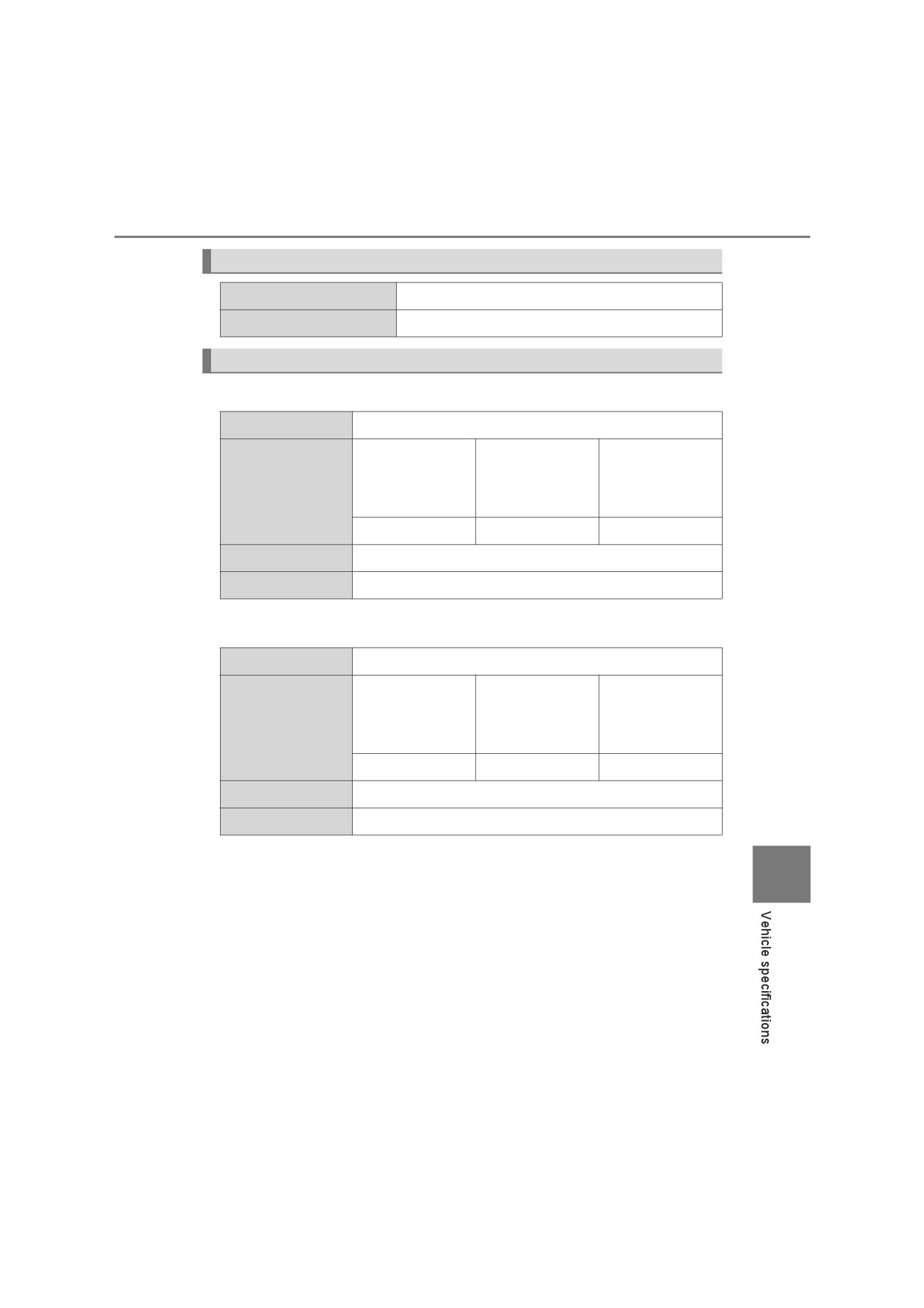
Steering
Free play
Less than 30 mm (1.2 in.)
Power steering fluid type
Automatic transmission fluid DEXRON® II or III
Tires and wheels
16 inch tires
Tire size
205R16C 8PR 110/108S
Rear wheel
Rear wheel
Tire inflation
Front wheel
(unladen)
(full load)
pressure
kPa (kgf/cm2 or
kPa (kgf/cm2 or
kPa (kgf/cm2 or
(Recommended
bar, psi)
bar, psi)
bar, psi)
cold tire inflation
pressure)
270 (2.7, 39)
270 (2.7, 39)
340 (3.4, 49)
Wheel size
16 6J
Wheel nut torque
105 N•m (10.7 kgf•m, 77 ft•lbf)
17 inch tires (type A)
Tire size
225/70R17C 108/106S
Rear wheel
Rear wheel
Tire inflation
Front wheel
(unladen)
(full load)
pressure
kPa (kgf/cm2 or
kPa (kgf/cm2 or
kPa (kgf/cm2 or
(Recommended
bar, psi)
bar, psi)
bar, psi)
cold tire inflation
pressure)
240 (2.4, 35)
240 (2.4, 35)
300 (3.0, 44)
Wheel size
17 6J
Wheel nut torque
105 N•m (10.7 kgf•m, 77 ft•lbf)
9

640
9-1. Specifications
17 inch tires (type B)
Tire size
265/65R17 112S
Tire inflation
Front wheel
Front wheel
Rear wheel
Rear wheel
pressure
(unladen)
(full load)
(unladen)
(full load)
(Recommended
kPa
kPa
kPa
kPa
cold tire inflation
(kgf/cm2 or
(kgf/cm2 or
(kgf/cm2 or
(kgf/cm2 or
pressure)
bar, psi)
bar, psi)
bar, psi)
bar, psi)
Except
for
Kazakhstan,
and
except
200
230
200
250
models
for
(2.0, 29)
(2.3, 33)
(2.0, 29)
(2.5, 36)
model code
destination W*
For Kazakh-
stan,
and
230
230
230
250
models
for
(2.3, 33)
(2.3, 33)
(2.3, 33)
(2.5, 36)
model code
destination W*
Wheel size
17 7 1/2J
Wheel nut torque
105 N•m (10.7 kgf•m, 77 ft•lbf)
*: See “Checking your vehicle’s model” if you are not sure of which model
your vehicle is. (P. 12)
9-1. Specifications
641
18 inch tires
Tire size
265/60R18 110H
Tire inflation
Front wheel
Front wheel
Rear wheel
Rear wheel
pressure
(unladen)
(full load)
(unladen)
(full load)
(Recommended
kPa
kPa
kPa
kPa
cold tire inflation
(kgf/cm2 or
(kgf/cm2 or
(kgf/cm2 or
(kgf/cm2 or
pressure)
bar, psi)
bar, psi)
bar, psi)
bar, psi)
Except
for
Kazakhstan,
and
except
200
230
200
250
models
for
(2.0, 29)
(2.3, 33)
(2.0, 29)
(2.5, 36)
model code
destination W*
For Kazakh-
stan,
and
230
230
230
250
models
for
(2.3, 33)
(2.3, 33)
(2.3, 33)
(2.5, 36)
model code
destination W*
Wheel size
18 7 1/2J
Wheel nut torque
105 N•m (10.7 kgf•m, 77 ft•lbf)
*: See “Checking your vehicle’s model” if you are not sure of which model
your vehicle is. (P. 12)
QWhen towing a trailer (with towing hitch)
Add 20.0 kPa (0.2 kgf/cm2 or bar, 3 psi) to the recommended tire inflation
pressure and drive at speeds below 100 km/h (62 mph).
9

642
9-1. Specifications
Light bulbs
Light bulbs
W
Type
Headlights
High/low beams
(halogen headlights
type A)
60/55
A
Low beams (halogen headlights type B)
55
B
High beams (halogen headlights type B)
60
C
Halogen front fog lights*
19
D
Front position lights (halogen headlights)
Without daytime running lights
5
E
With daytime running lights
21/5
E
Front turn signal lights (halogen headlights
21
F
Exterior
type A)
Front turn signal lights (halogen headlights
21
G
type B)
Rear turn signal lights
21
F
Back-up lights (without LED stop lights)
21
H
Rear fog light (without LED stop lights)*
21
H
Stop/tail lights (without LED stop lights)
21/5
H
License plate light
5
E
Outer foot lights*
5
E
Interior light*
8
I
Interior
Personal/interior lights
5
E
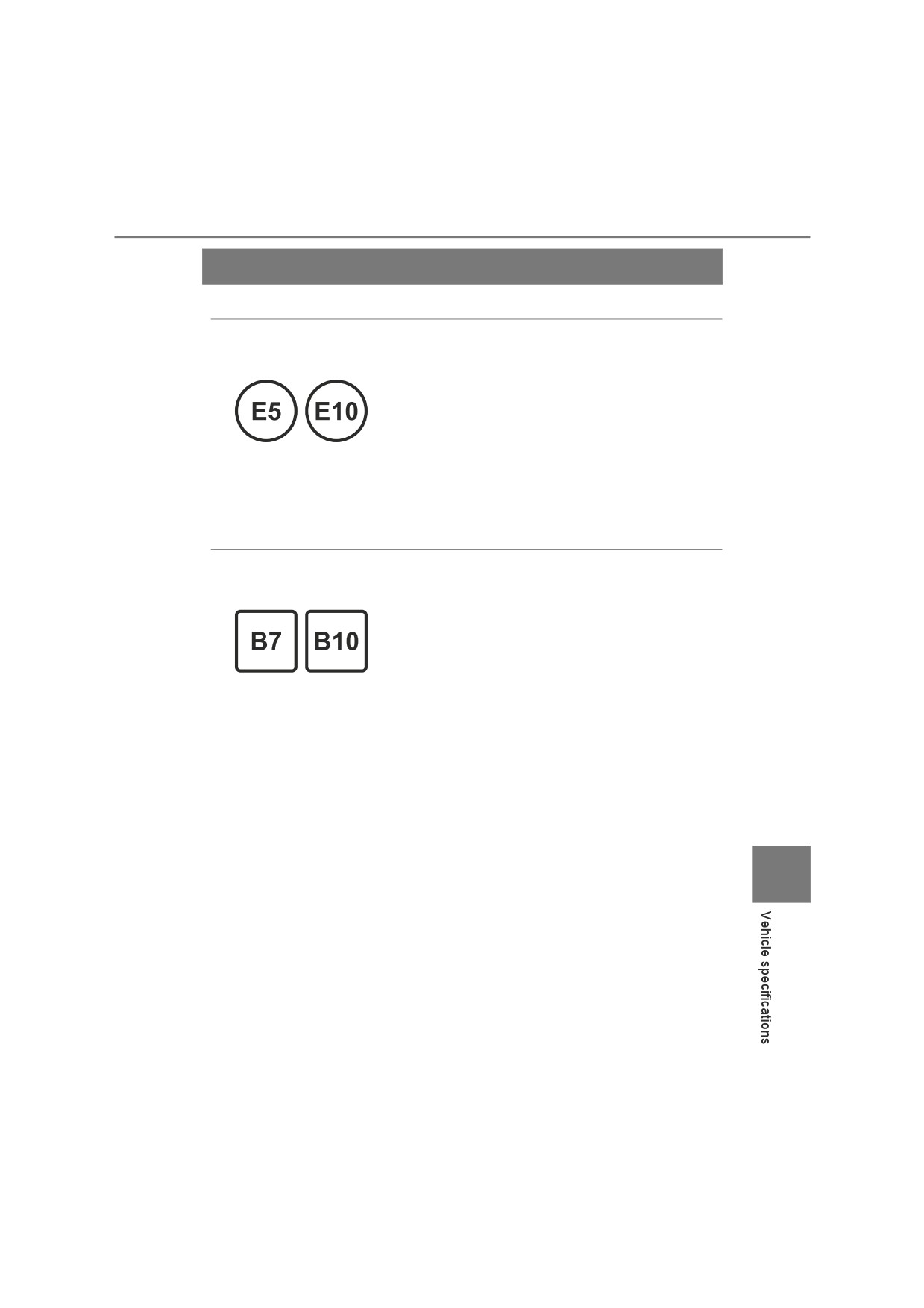
A: H4 halogen bulbs
F: Single end bulbs (amber)
B: H11 halogen bulbs
G: Wedge base bulbs (amber)
C: HB3 halogen bulbs
H: Single end bulbs (clear)
D: H16 halogen bulbs
I: Double end bulbs
E: Wedge base bulbs (clear)
*: If equipped
9-1. Specifications
643
Fuel information
X Gasoline engine
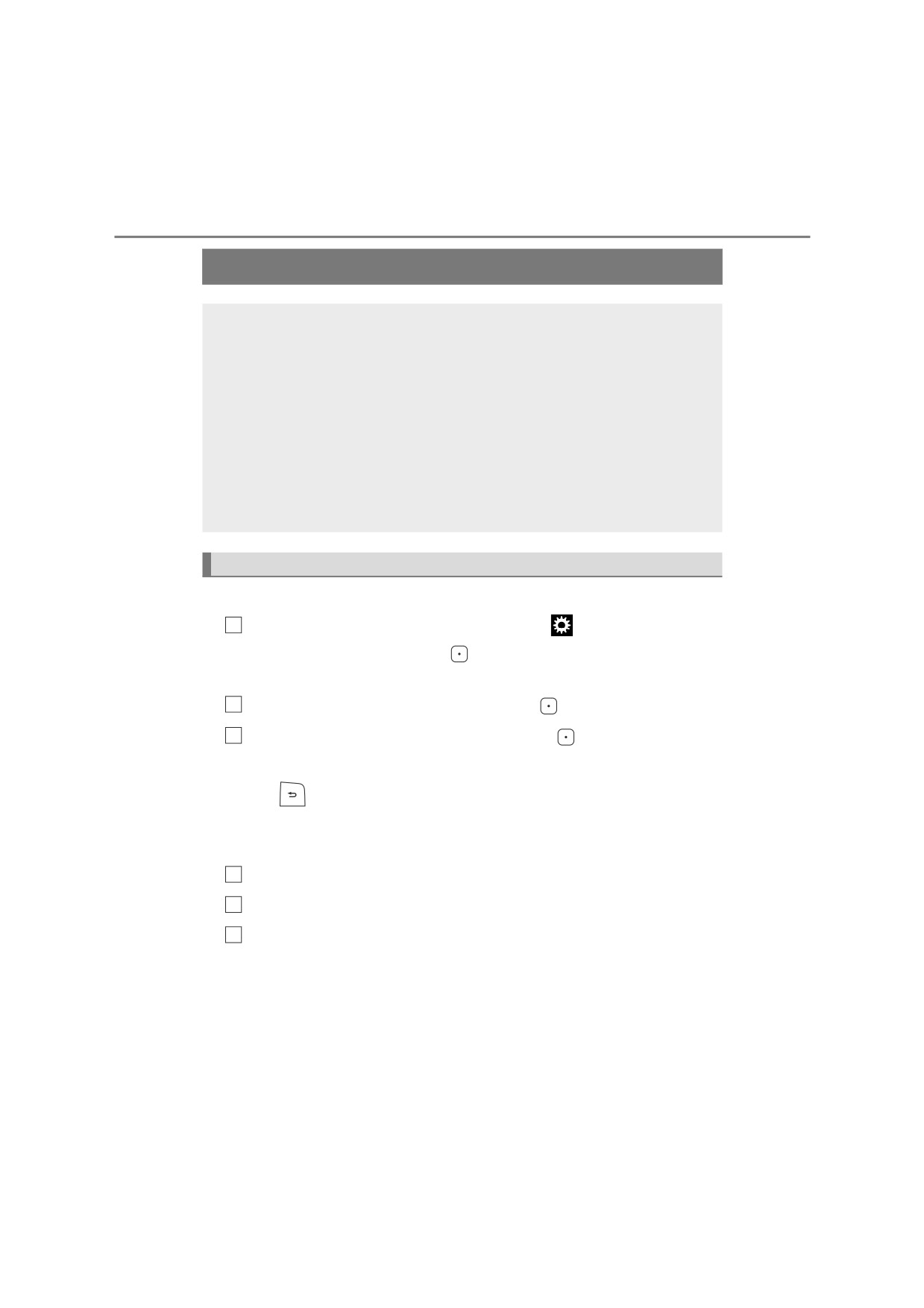
When you find these types of fuel label at the gas station, use only
the fuel with one of the following labels.
You must only use unleaded gasoline.
Select unleaded gasoline with a Research Octane Number of 91 or
higher for optimum engine performance.
X Diesel engine
When you find these types of fuel label at the gas station, use only
the fuel with one of the following labels.
EU area:
You must use diesel fuel conforming to European standard EN590
or EN16734.
Except EU area (vehicles without DPF system):
You must use only diesel fuel with a cetane number of 48 or higher.
Except EU area (vehicles with DPF system):
You must use only diesel fuel that contains 10 ppm or less of sulfur
with a cetane number of 48 or higher.
9
644
9-1. Specifications
Q Use of ethanol blended gasoline in a gasoline engine
Toyota allows the use of ethanol blended gasoline where the ethanol content
is up to 10%. Make sure that the ethanol blended gasoline to be used has a
Research Octane Number that follows the above.
Q If you plan to drive in foreign countries (vehicles with DPF system)
Low sulfur diesel fuel may not be available, so please check the availability
with your distributor.
Q If your engine knocks
OConsult any authorized Toyota retailer or Toyota authorized repairer, or any
reliable repairer.
O You may occasionally notice light knocking for a short time while accelerat-
ing or driving uphill. This is normal and there is no need for concern.
NOTICE
Q Notice on gasoline fuel quality
ODo not use improper fuels. If improper fuels are used, the engine will be
damaged.
ODo not use gasoline with metallic additives, for example manganese, iron
or lead, otherwise it may cause damage on your engine or emission con-
trol system.
ODo not add aftermarket fuel additives which contain metallic additives.
ODo not use the methanol blended gasoline such as M15, M85, M100. The
use of gasoline containing methanol may cause engine damage or failure.
OBioethanol fuel sold under names such as “E50” or “E85” and fuel contain-
ing a large amount of ethanol should not be used. Your vehicle can use
gasoline mixed with 10% max ethanol. The use of fuel with more than 10%
ethanol content (E10) will damage the vehicle’s fuel system. You must
ensure that refueling is carried out only from a source where fuel specifica-
tion and quality can be guaranteed. In case of any doubt, ask any autho-
rized Toyota retailer or Toyota authorized repairer, or any reliable repairer.
9-1. Specifications
645
NOTICE
Q Notice on diesel fuel quality
ODo not use improper fuels. If improper fuels are used, the engine will be
damaged.
O Vehicles with DPF system: Do not use a fuel that contains more than 10
ppm of sulfur. Use of such a high sulfur fuel may damage the engine.
O EU area: FAME (Fatty Acid Methyl Ester) fuel sold under names such as
“B30” or “B100” and fuel containing a large amount of FAME should not be
used. The use of these fuels will damage the vehicle’s fuel system. In case
of any doubt, ask any authorized Toyota retailer or Toyota authorized
repairer, or any reliable repairer.
O Except EU area: FAME (Fatty Acid Methyl Ester) fuel sold under names
such as “B30” or “B100” and fuel containing a large amount of FAME
should not be used. Your vehicle can use diesel mixed with 5% max
biodiesel FAME (B5) or diesel equivalent to EN590/EN16734. The use of
fuel with more than 5% FAME content (B5) or diesel not equivalent to
EN590/EN16734 will damage the vehicle’s fuel system. You must ensure
that refueling is carried out only from a source where fuel specification and
quality can be guaranteed.
In case of any doubt, ask any authorized Toyota retailer or Toyota autho-
rized repairer, or any reliable repairer.
9
646
9-2. Customization
Customizable features
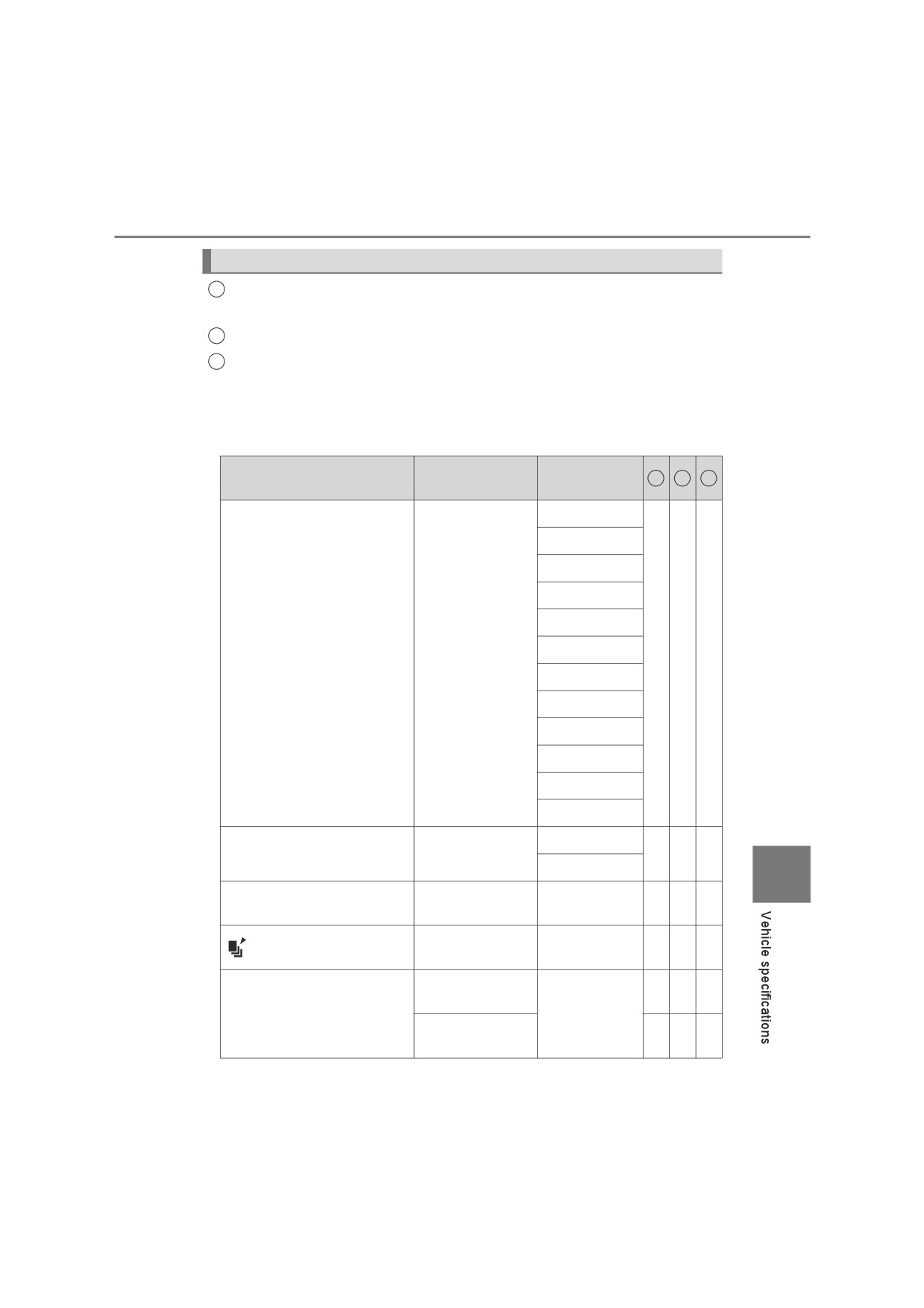
Your vehicle includes a variety of electronic features that can be
personalized to your preferences. The settings of these features
can be changed using the multi-information display, navigation
system, multimedia system type A* or at any authorized Toyota
retailer or Toyota authorized repairer, or any reliable repairer.
Some function settings are changed simultaneously with other func-
tions being customized. Contact any authorized Toyota retailer or
Toyota authorized repairer, or any reliable repairer for further details.
*: See “How to identify multimedia system type” to check the type of your
multimedia system. (P. 652)
Customizing vehicle features
Q Changing using the multi-information display
1
Use the meter control switches to select
while the vehicle is
stopped, and then press
to display the customize mode
screen.
2
Select the desired item, and then press
3
Select the desired setting, and then press
To go back to the previous screen or exit the customize mode,
press
Q Changing using the navigation system or multimedia system
type A
1
Press the “SETUP” button while the vehicle is stopped.
2
Select “Vehicle”.
3
Select “TOYOTA park assist”.
9-2. Customization
647
Customizable features
1
Settings that can be changed using navigation system or multime-
dia system type A
Settings that can be changed using the multi-information display
2
Settings that can be changed by any authorized Toyota retailer or
3
Toyota authorized repairer, or any reliable repairer
Definition of symbols: O = Available, - = Not available
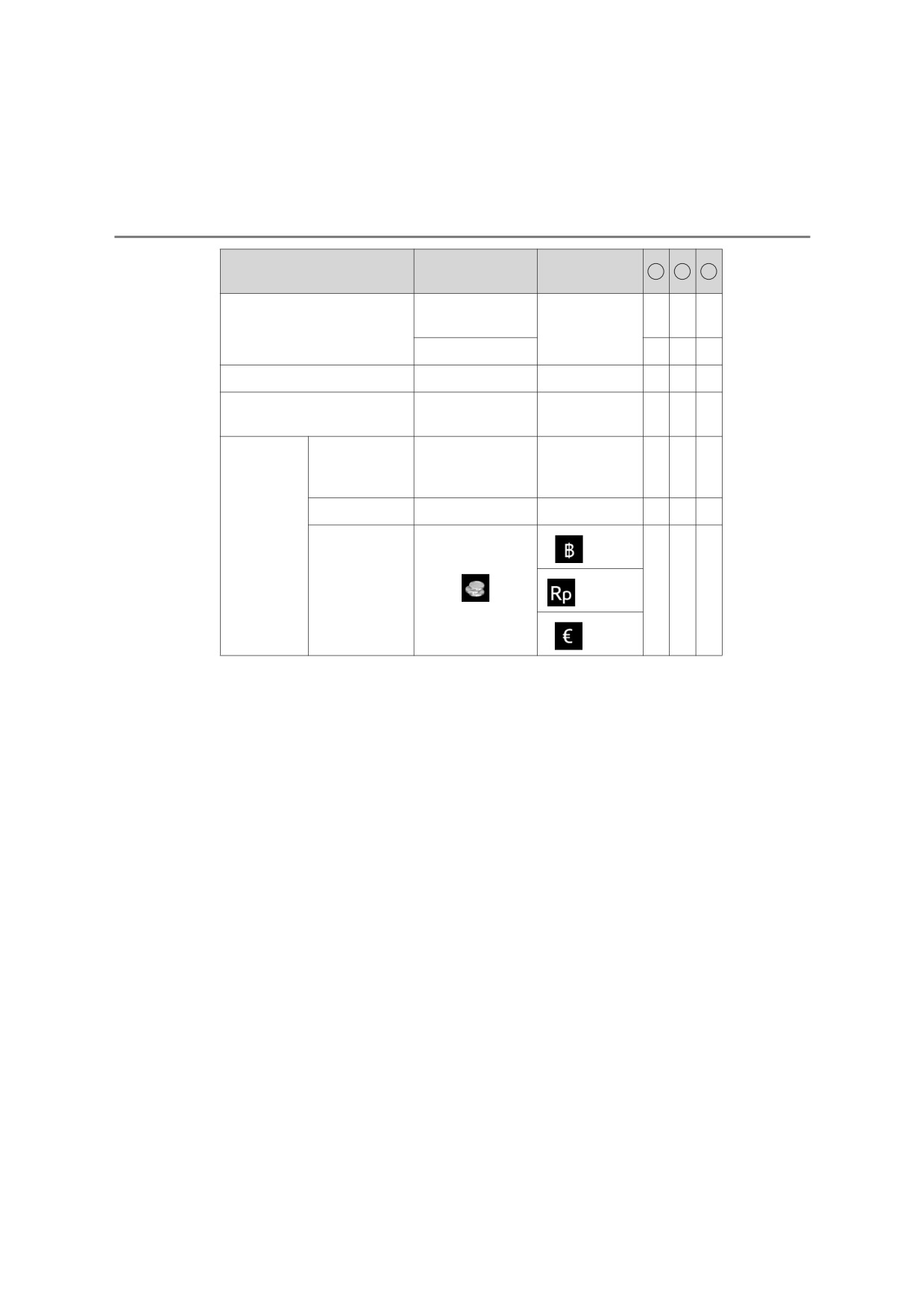
Q Gauges, meters and multi-information display*1 (P. 135)
Customized
Function*2
Default setting
1
2
3
setting
German
French
Spanish
Italian
Russian
Turkish
Language*3
English
-
O
-
Ukrainian
Thai
Portuguese
Indonesian
Arabic
Taiwanese
km (km/L)
Units*3
km (L/100 km)
-
O
-
miles (MPG)
9
On
Eco Driving Indicator Light
Off
-
O
-
(Self-lighting)
Drive
Desired status
switch settings
-
O
-
information 1
screen*4
Current fuel
-
O
-
economy
*5
Drive information 1
Average fuel
-
O
-
economy
648
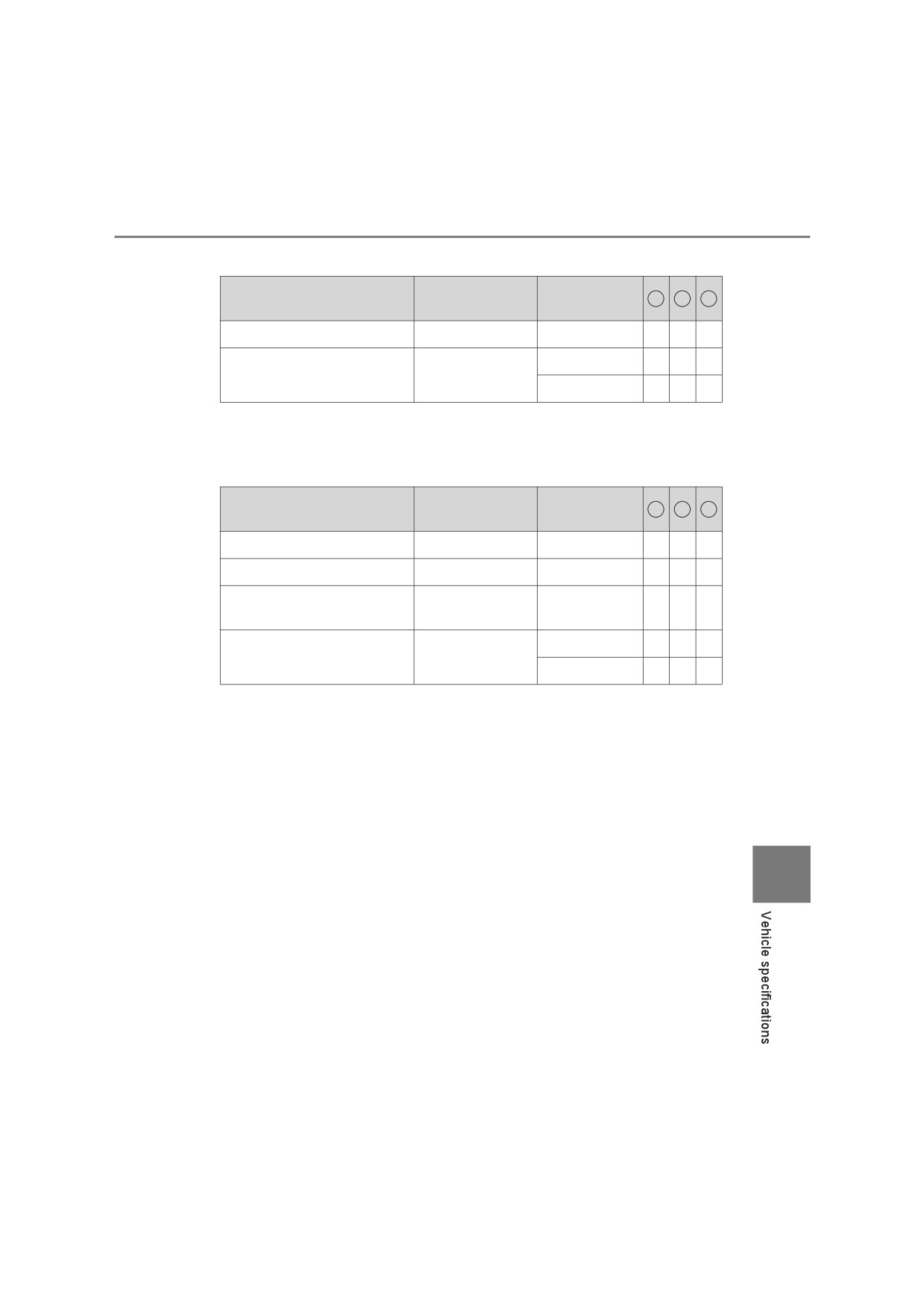
9-2. Customization
Customized
Function*2
Default setting
1
2
3
setting
Distance to
-
O
-
empty
*5
Drive information 2
Average speed
-
O
-
Pop-up display*1
On
Off
-
O
-
Color 1 to
Accent color*1, 3
Color 1
-
O
-
color 4
Fuel
*6
consumption
10.0
-
O
-
comparison
*6
Fuel price
150
-
O
-
Eco
(Baht)
Saving
Currency*3
(Rupiah)
-
O
-
(No currency unit)
(Euro)
*1: If equipped
*2: For details about each function: P. 135
*3: The default setting and the customized setting items that can be displayed
vary according to country.
*4: Some status screens cannot be registered (indicated on multi-information
display).
*5: Customized items are the following items except for default setting items:
current fuel economy (bar type), current fuel economy (value type), aver-
age fuel economy (after reset), average fuel economy (after start), average
fuel economy (after refuel), average speed (after reset), average speed
(after start), elapsed time (after reset), elapsed time (after start), distance
(range), distance (after start), blank.
*6: The values can be changed using the meter control switches.
9-2. Customization
649
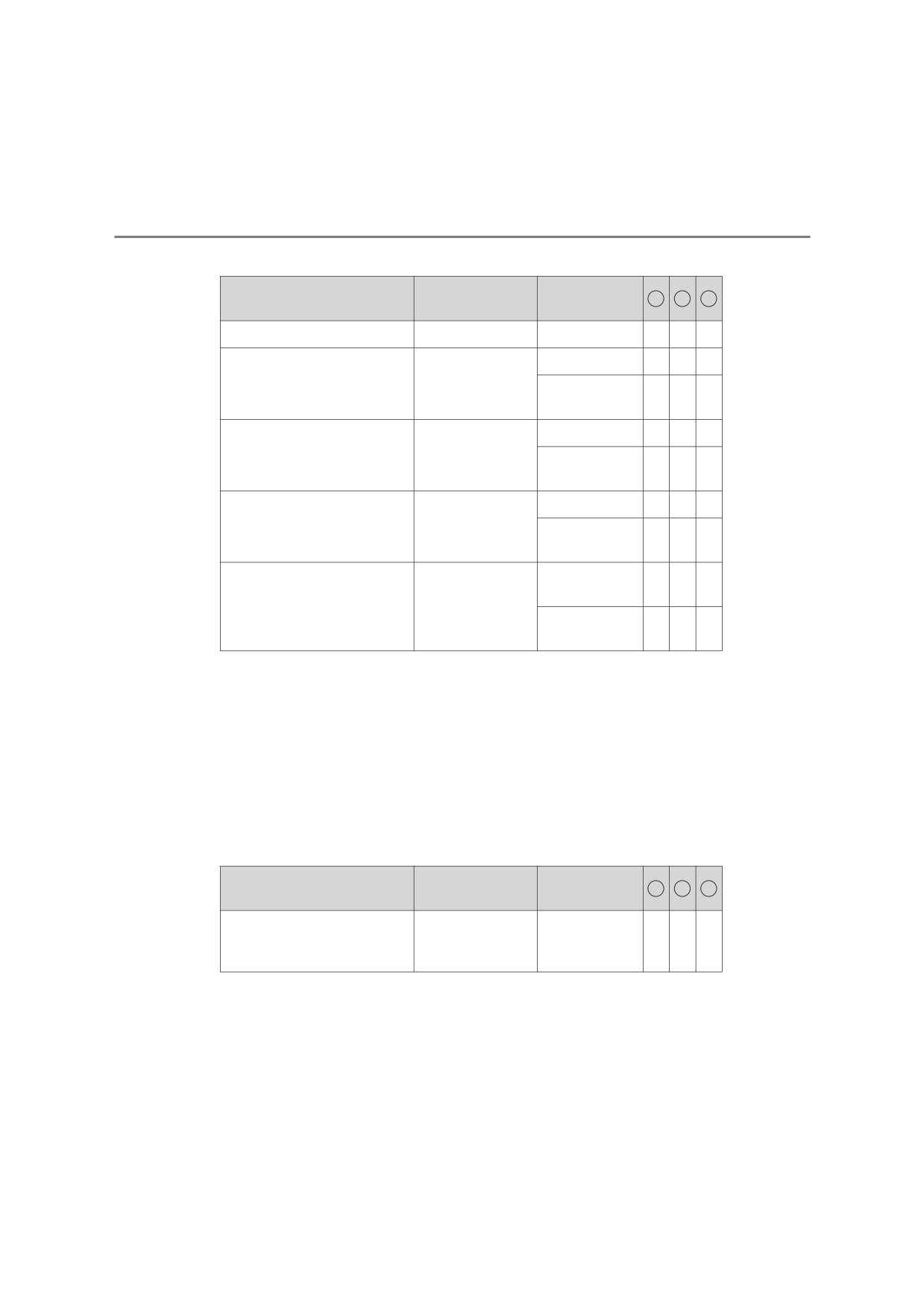
Q PCS (Pre-Collision System)* (P. 273)
Customized
Function
Default setting
1
2
3
setting
PCS (Pre-Collision System)
On
Off
-
O
-
Early
-
O
-
Sensitivity (adjust alert
Middle
timing)
Late
-
O
-
*: If equipped
Q LDA (Lane Departure Alert With Yaw Assist Function)*
(P. 284)
Customized
Function
Default setting
1
2
3
setting
Yaw Assist
On
Off
-
O
-
Warning sensitivity
Standard
High
-
O
-
Vehicle sway warning
On
Off
-
O
-
function
Low
-
O
-
Vehicle sway warning
Standard
sensitivity
High
-
O
-
*: If equipped
9
650
9-2. Customization
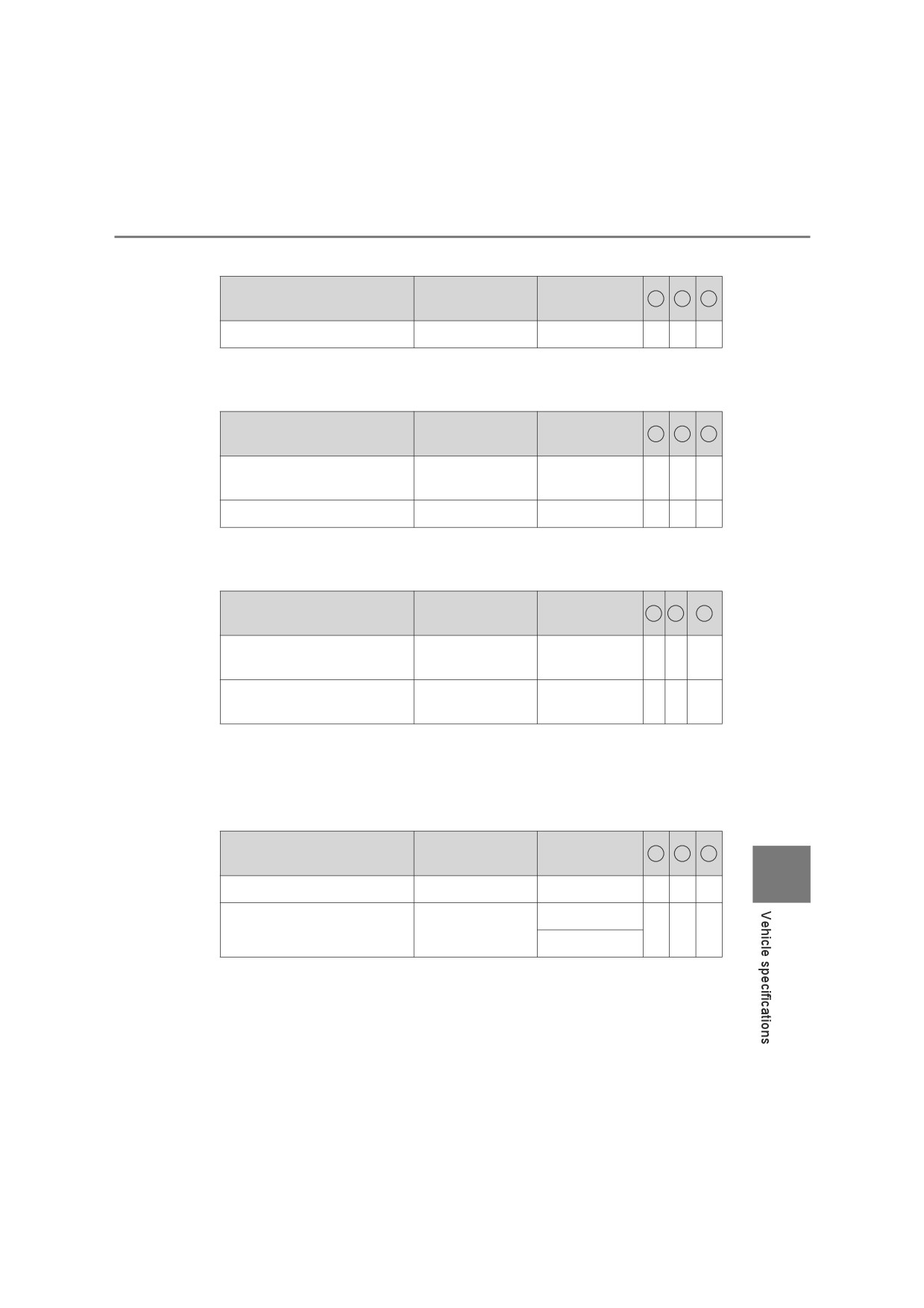
Q RSA (Road Sign Assist)*1 (P. 295)
Customized
Function
Default setting
1
2
3
setting
RSA (Road Sign Assist)*2
On
Off
-
O
-
No notification
-
O
-
Excess speed notification
Display only
method*3
Display and
-
O
-
buzzer
No notification
-
O
-
No overtaking notification
Display only
method
Display and
-
O
-
buzzer
No notification
-
O
-
Other notifications method
Display only
(No-entry notification)*4
Display and
-
O
-
buzzer
5 km/h (3
-
O
-
mph)
Excess speed notification
2 km/h (1 mph)
level
10 km/h (5
-
O
-
mph)
*1: If equipped
*2: RSA function becomes on when the engine switch is turned to the “ON”
position (vehicles without smart entry & start system) or IGNITION ON
mode (vehicles with smart entry & start system).
*3: If a speed limit with supplemental mark is exceeded, the notification buzzer
does not operate.
*4: Vehicles with navigation system
Q Dynamic Radar Cruise Control with Road Sign Assist*
(P. 312)
Customized
Function
Default setting
1
2
3
setting
Dynamic Radar Cruise
Control with Road Sign
On
Off
-
O
-
Assist
*: If equipped
9-2. Customization
651
Q Stop & Start system* (P. 345)
Customized
Function
Default setting
1
2
3
setting
Idling stop
Standard
Extended
-
O
-
*: If equipped
Q Toyota parking assist-sensor* (P. 321)
Customized
Function
Default setting
1
2
3
setting
Detection distance of the
Long
Short
O
-
O
rear center sensor
Buzzer volume
Level 2
Level 1 to 3
O
-
O
*: If equipped
Q Door lock (P. 157)
Customized
Function
Default setting
1
2
3
setting
Speed linked door locking
On
Off
-
-
O*2
function*1
Driver’s door linked door
*1
Off
On
-
-
O*2
unlocking function
*1: If equipped
*2: Setting that can be changed manually (P. 157) or at any authorized
Toyota retailer or Toyota authorized repairer, or any reliable repairer
Q Smart entry & start system* (P. 163)
Customized
Function
Default setting
1
2
3
setting
9
Smart entry & start system
On
Off
-
-
O
Off
Operational signal
Level 5
-
-
O
(buzzer)*
Level 1 to 7
*: If equipped
652
9-2. Customization
Q Automatic light control system* (P. 248)
Customized
Function
Default setting
1
2
3
setting
Light sensor sensitivity
Standard
-2 to 2
-
-
O
*: If equipped
Q Turn signal lever (P. 246)
Customized
Function
Default setting
1
2
3
setting
4
5
Times of flashing of the
3
6
-
-
O
lane change signal flashers
7
Off
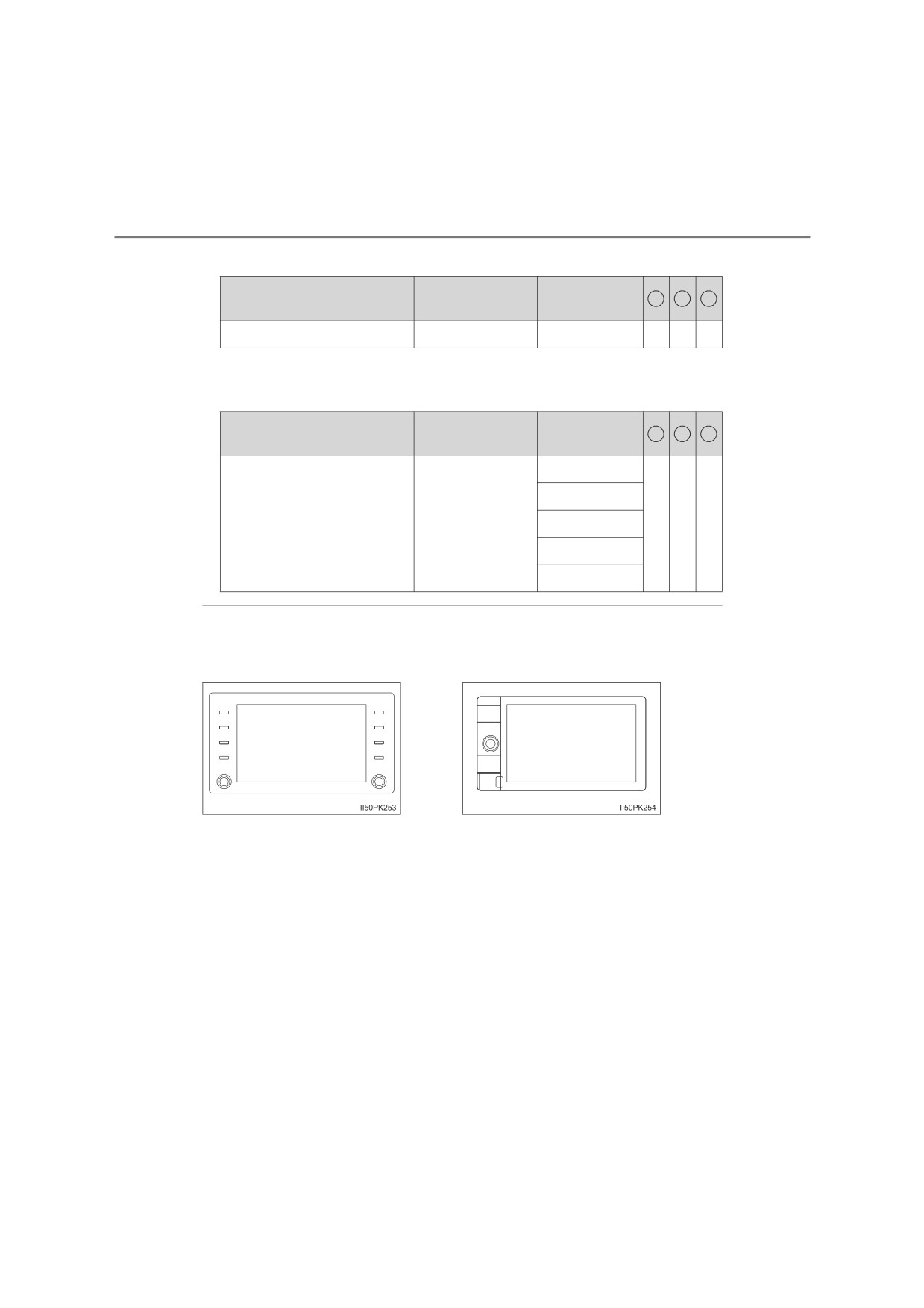
Q How to identify multimedia system type
Check the type of the multimedia system in the following illustrations.
Type A
Type B
9-2. Customization
653
WARNING
Q During customization
As the engine needs to be running during customization, ensure that the
vehicle is parked in a place with adequate ventilation. In a closed area such
as a garage, exhaust gases including harmful carbon monoxide (CO) may
collect and enter the vehicle. This may lead to death or a serious health
hazard.
NOTICE
Q During customization
To prevent battery discharge, ensure that the engine is running while cus-
tomizing features.
9

654
9-3. Initialization
Items to initialize
The following items must be initialized for normal system opera-
tion after such cases as the battery is reconnected, or mainte-
nance is performed on the vehicle.
Item
When to initialize
Reference
Engine oil
maintenance data
After changing engine oil
P. 491
(if equipped)
• The battery has been rein-
Refer to the “Navi-
stalled.
gation and multi-
Panoramic view
• The steering wheel has
media system
monitor (if equipped)
been moved while the bat-
Owner’s manual”
tery was being reinstalled.
or “Multimedia
• The battery power is low.
Owner’s Manual”
655
Index
What to do if...
(Troubleshooting)
656
Alphabetical index
660
For vehicles with navigation system or multimedia system,
refer to the
“Navigation and multimedia system Owner’s
manual” or
“Multimedia Owner’s Manual” for information
regarding the equipment listed below.
• Navigation system
• Audio system
• Panoramic view monitor
• Rear view monitor system
656
What to do if... (Troubleshooting)
What to do if... (Troubleshooting)
If you have a problem, check the following before contacting any
authorized Toyota retailer or Toyota authorized repairer, or any
reliable repairer.
The doors cannot be locked, unlocked, opened or closed
You lose your keys
O If you lose your keys or mechanical keys, new genuine keys or mechanical
keys can be made by any authorized Toyota retailer or Toyota authorized
repairer, or any reliable repairer. (P. 151)
O Vehicles with smart entry & start system:
If you lose your electronic keys, the risk of vehicle theft increases signifi-
cantly. Contact any authorized Toyota retailer or Toyota authorized
repairer, or any reliable repairer immediately. (P. 152)
The doors cannot be locked or unlocked
O Is the key battery weak or depleted? (P. 516)
O Vehicles with smart entry & start system:
Is the engine switch in IGNITION ON mode?
When locking the doors, turn the engine switch off. (P. 226)
O Vehicles with smart entry & start system:
Is the electronic key left inside the vehicle?
When locking the doors, make sure that you have the electronic key on
your person.
O The function may not operate properly due to the condition of the radio
wave. (P. 158, 166)
The rear door cannot be opened
(vehicles with rear door child-protector lock)
O Is the rear door child-protector lock set?
The rear door cannot be opened from inside the vehicle when the lock is
set. Open the rear door from outside and then unlock the rear door child-
protector lock. (P. 156)

What to do if... (Troubleshooting)
657
If you think something is wrong
The engine does not start
(vehicles without smart entry & start system)
O Vehicles with manual transmission:
Do you turn the key with the clutch pedal depressed firmly? (P. 220)
O Vehicles with automatic transmission:
Is the shift lever in P? (P. 220)
O Is the steering wheel unlocked? (P. 222)
O Is the battery discharged? (P. 604)
The engine does not start
(vehicles with smart entry & start system)
O Did you press the engine switch while firmly depressing the brake pedal?
(P. 223)
O Vehicles with automatic transmission:
Is the shift lever in P? (P. 223)
O Is the electronic key anywhere detectable inside the vehicle? (P. 164)
O Is the steering wheel unlocked? (P. 228)
O Is the electronic key battery weak or depleted?
In this case, the engine can be started in a temporary way. (P. 601)
O Is the battery discharged? (P. 604)
The shift lever cannot be shifted from P even if you depress
the brake pedal (vehicles with automatic transmission)
O Vehicles without smart entry & start system:
Is the engine switch in the “ON” position?
If you cannot release the shift lever by depressing the brake pedal with the
engine switch in the “ON” position: P. 237
O Vehicles with smart entry & start system:
Is the engine switch in IGNITION ON mode?
If you cannot release the shift lever by depressing the brake pedal with the
engine switch in IGNITION ON mode: P. 237
658
What to do if... (Troubleshooting)
The steering wheel cannot be turned after the engine is
stopped
O Vehicles without smart entry & start system:
It is locked to prevent theft of the vehicle if the key is removed from the
engine switch. (P. 222)
O Vehicles with smart entry & start system:
It is locked automatically to prevent theft of the vehicle. (P. 228)
The windows do not open or close by operating the power
window switches (if equipped)
O Is the window lock switch pressed?
The power window except for the one at the driver’s seat cannot be oper-
ated if the window lock switch is pressed. (P. 186)
The engine switch is turned off automatically
(vehicles with smart entry & start system)
O The auto power off function will be operated if the vehicle is left in ACCES-
SORY or IGNITION ON mode (the engine is not operating) for a period of
time. (P. 227)
A warning buzzer sounds during driving
O The seat belt reminder light is flashing
Are the driver and passengers wearing the seat belts? (P. 570)
O The parking brake indicator light is on
Is the parking brake released? (P. 247)
Depending on the situation, other types of warning buzzer may also sound.
(P. 566, 575)
An alarm is activated and the horn sounds (if equipped)
O Did anyone inside the vehicle open a door during setting the alarm?
The sensor detects it and the alarm sounds. (P. 117)
To stop the alarm, turn the engine switch to the “ON” position (vehicles with-
out smart entry & start system) or IGNITION ON mode (vehicles with smart
entry & start system) or start the engine.
What to do if... (Troubleshooting)
659
A warning buzzer sounds when leaving the vehicle
(vehicles with smart entry & start system)
O Is the message displayed on the multi-information display?
Check the message on the multi-information display.
A warning light turns on or a warning message is displayed
O When a warning light turns on or a warning message is displayed, refer to
P. 566, 575.
When a problem has occurred
If you have a flat tire
O Stop the vehicle in a safe place and replace the flat tire with the spare tire.
(P. 581)
The vehicle becomes stuck
O Try the procedure for when the vehicle becomes stuck in mud, dirt, or
snow. (P. 615)
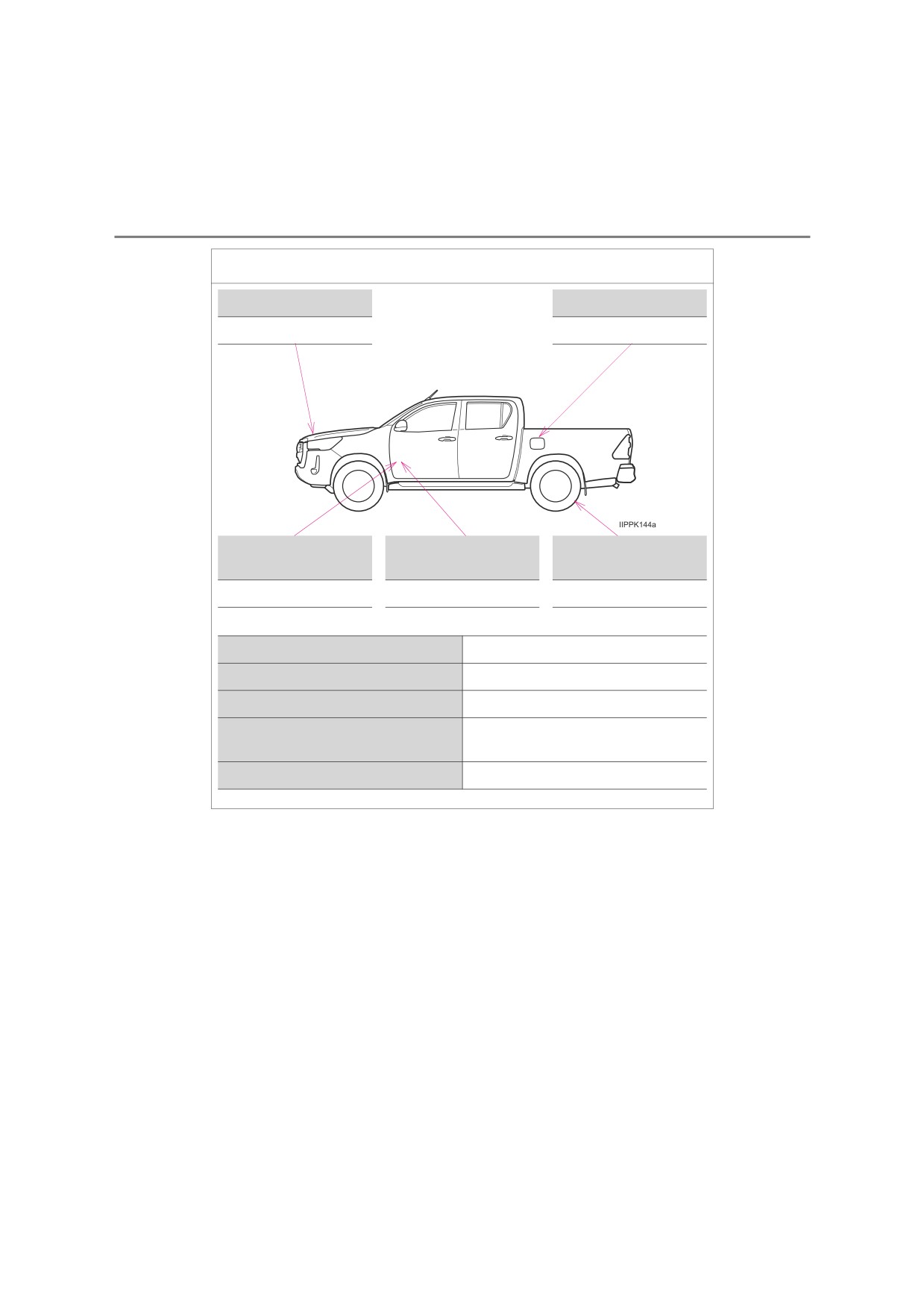
796
GAS STATION INFORMATION
Auxiliary catch lever
Fuel filler door*
P. 484
P. 263
Hood lock release
Fuel filler door
Tire inflation pressure
lever
opener*
P. 484
P. 263
P. 639
Fuel tank capacity (Reference)
80 L (21.1 gal., 17.6 Imp.gal.)
Fuel type
P. 627
Cold tire inflation pressure
P. 639
Engine oil capacity
P. 628
(Drain and refill — reference)
Engine oil type
P. 628
*: If equipped