Toyota Hilux (2022 year). Manual in english - page 7
182
3-4. Adjusting the steering wheel and mirrors
Outside rear view mirrors
Adjustment procedure
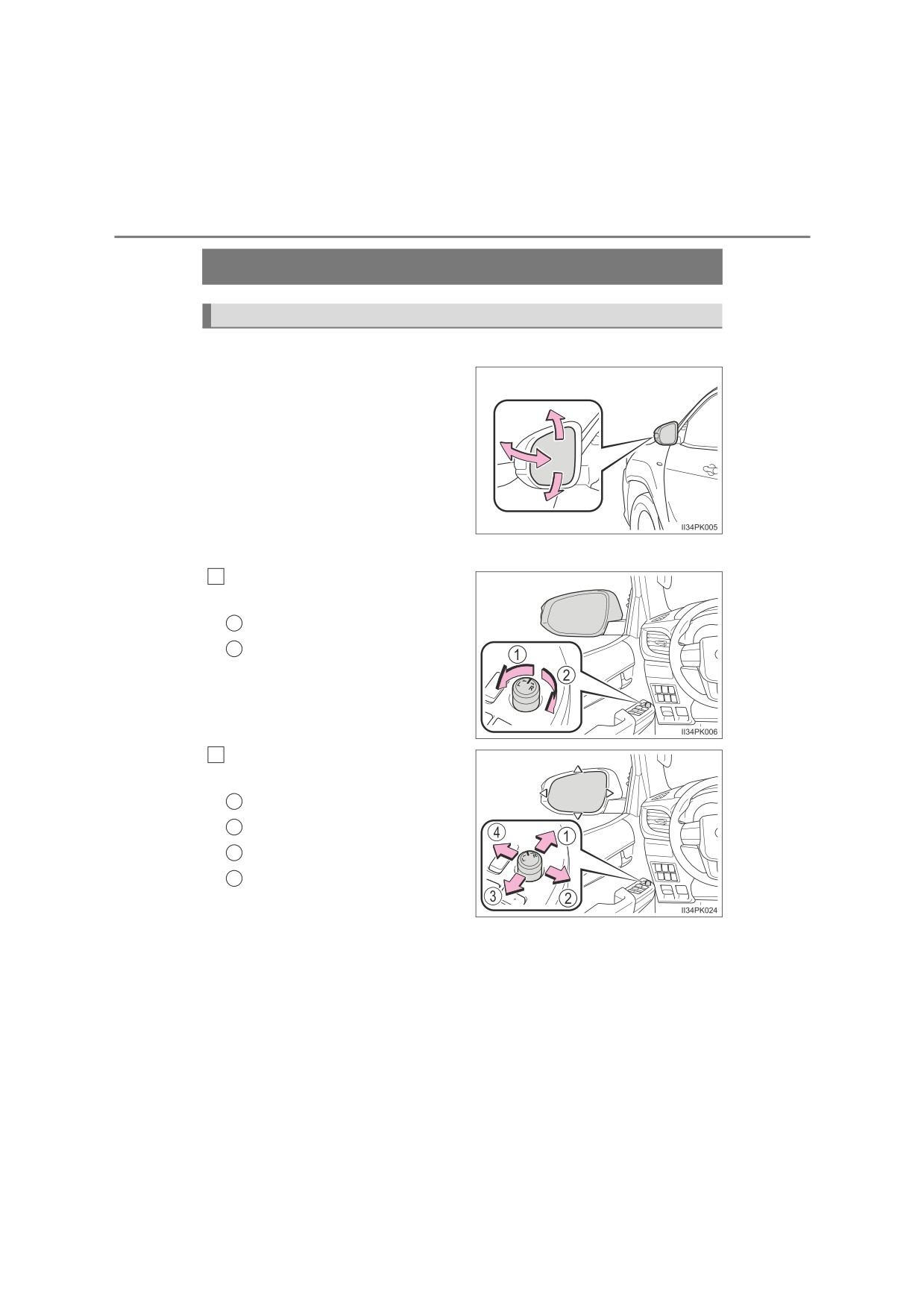
Manual adjustable type
Adjust a mirror.
Power adjustable type
1
To select a mirror to adjust, turn
the switch.
1
Left
2
Right
2
To adjust the mirror, move the
switch.
1
Up
2
Right
3
Down
4
Left
3-4. Adjusting the steering wheel and mirrors
183
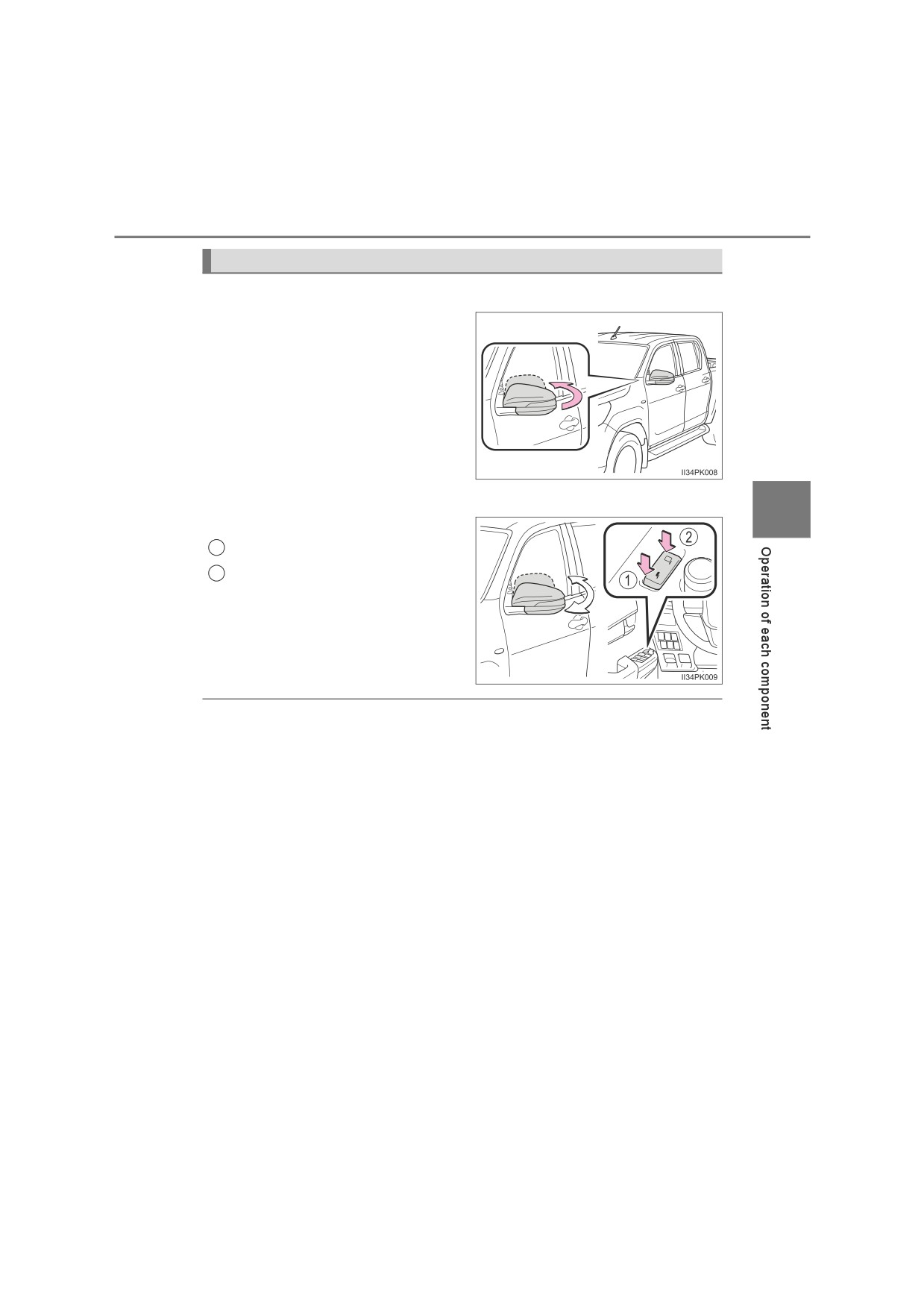
Folding the mirrors
Manual folding type
Push the mirror back in the direc-
tion of the vehicle’s rear.
Power folding type
3
Press the switch.
1
Folding
2
Extending
Q Mirror angle can be adjusted
when (power adjustable type)
Vehicles without smart entry & start system
The engine switch is in the “ACC” or “ON” position.
Vehicles with smart entry & start system
The engine switch is in ACCESSORY or IGNITION ON mode.
Q When the mirrors are fogged up (vehicles with outside rear view mirror
defoggers)
The outside rear view mirrors can be cleared using the mirror defoggers. Turn
on the rear window defogger to turn on the outside rear view mirror defog-
gers. (P. 435, 444)
184
3-4. Adjusting the steering wheel and mirrors
WARNING
Q Important points while driving
Observe the following precautions while driving.
Failure to do so may result in loss of control of the vehicle and cause an
accident, resulting in death or serious injury.
ODo not adjust the mirrors while driving.
ODo not drive with the mirrors folded.
O Both the driver and passenger side mirrors must be extended and properly
adjusted before driving.
Q When a mirror is moving (power adjustable type)
To avoid personal injury and mirror malfunction, be careful not to get your
hand caught by the moving mirror.
Q When the mirror defoggers are operating (vehicles with outside rear
view mirror defoggers)
Do not touch the rear view mirror surfaces, as they can become very hot
and burn you.
NOTICE
Q If ice should jam the mirror
Do not operate the control or scrape the mirror face. Use a spray de-icer to
free the mirror.
3-5. Opening and closing the windows
185
Power windows
Opening and closing procedures
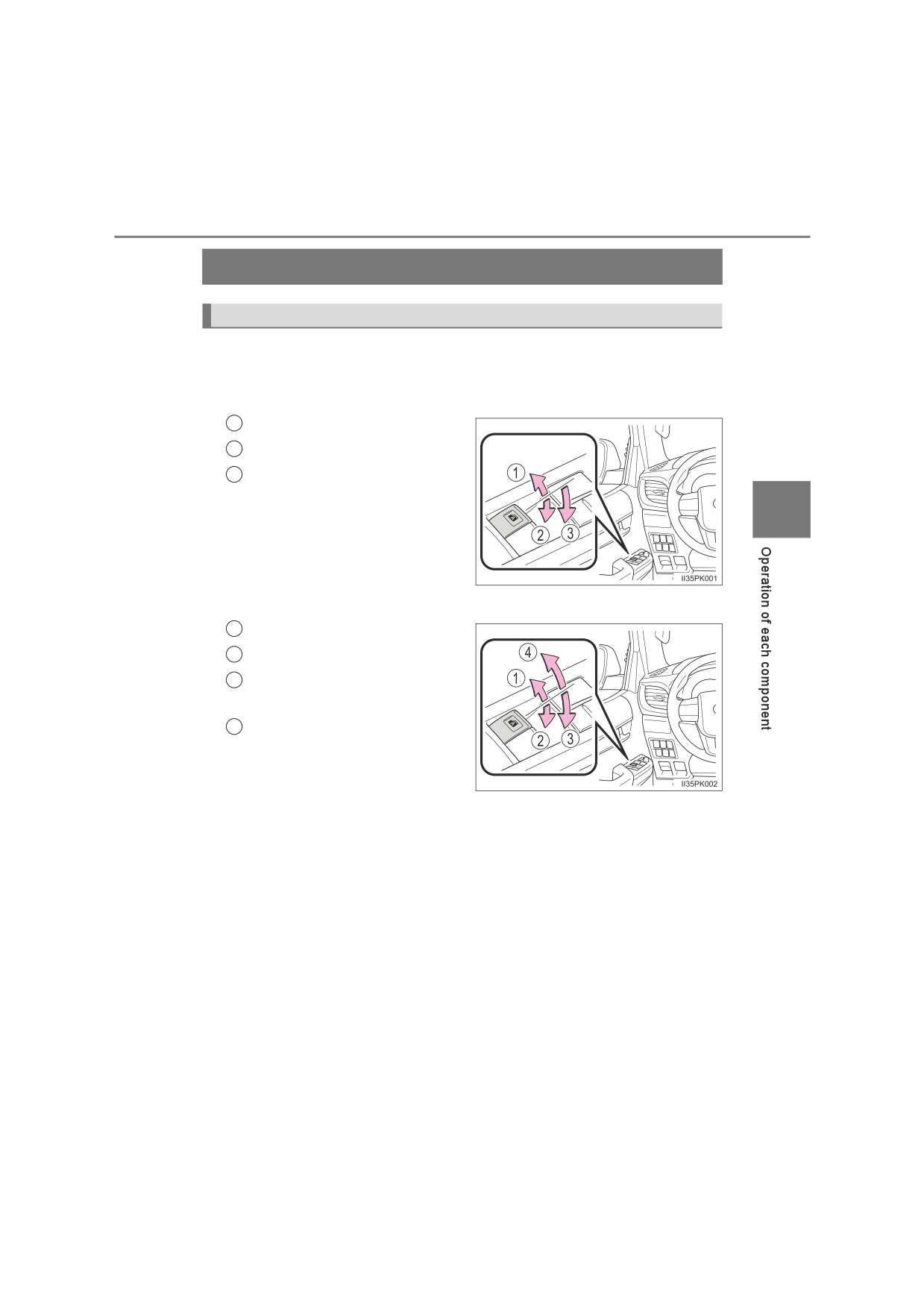
The power windows can be opened and closed using the switches.
Operating the switch moves the windows as follows:
Type A
1
Closing
2
Opening
3
One-touch opening*
(driver’s window only)
3
*: To stop the window partway,
operate the switch in the opposite
direction.
Type B
1
Closing
2
Opening
3
One-touch opening*
(driver’s window only)
One-touch closing*
4
(driver’s window only)
*: To stop the window partway,
operate the switch in the opposite
direction.
: If equipped
186
3-5. Opening and closing the windows
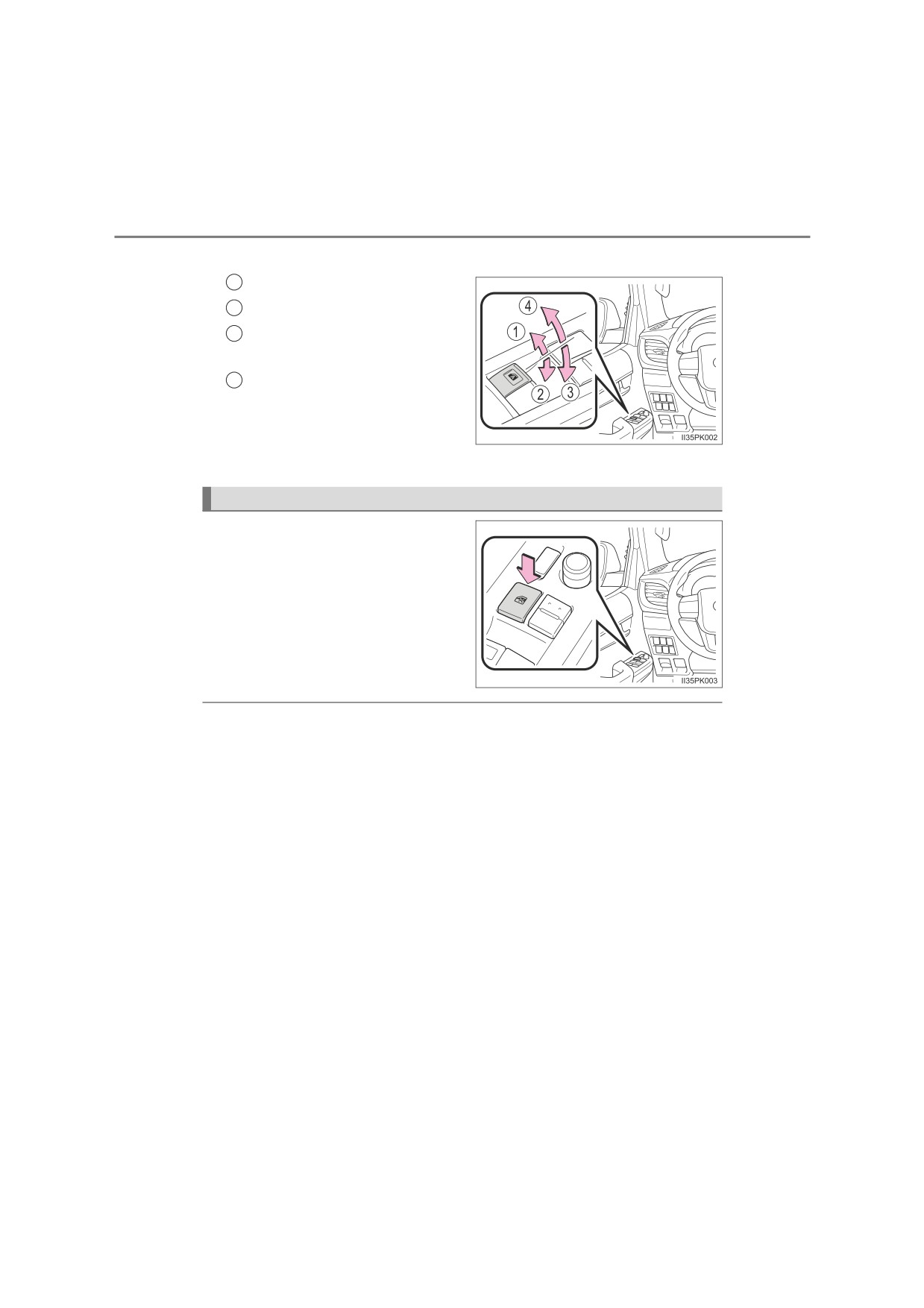
Type C
1
Closing
2
Opening
3
One-touch opening*
(all windows)
4
One-touch closing*
(all windows)
*: To stop the window partway,
operate the switch in the opposite
direction.
Window lock switch
Press the switch down to lock the
passenger window switches.
Use this switch to prevent children
from accidentally opening or clos-
ing a passenger window.
Q The power windows can be operated when
Vehicles without smart entry & start system
The engine switch is in the “ON” position.
Vehicles with smart entry & start system
The engine switch is in IGNITION ON mode.
Q Jam protection function (windows with one-touch function for type B
and C)
If an object becomes jammed between the window and the window frame
while the window is closing, window movement is stopped and the window is
opened slightly.
Q Catch protection function (windows with one-touch function for type B
and C)
If an object becomes caught between the door and window while the window
is opening, window movement is stopped.
3-5. Opening and closing the windows
187
Q Operating the power windows after turning the engine off
Vehicles without smart entry & start system
The power windows can be operated for approximately 45 seconds even
after the engine switch is turned to the “ACC” or “LOCK” position. They can-
not, however, be operated once either front door is opened.
Vehicles with smart entry & start system
The power windows can be operated for approximately 45 seconds even
after the engine switch is turned to ACCESSORY mode or turned off. They
cannot, however, be operated once either front door is opened.
Q When the window cannot be opened or closed (windows with one-touch
function for type B and C)
When the jam protection function or catch protection function operates
unusually and the window cannot be opened or closed, perform the following
operations with the power window switch of that door.
3
O Stop the vehicle. With the engine switch in the “ON” position (vehicles with-
out smart entry & start system) or IGNITION ON mode (vehicles with smart
entry & start system), within 4 seconds of the jam protection function or
catch protection function activating, continually operate the power window
switch in the one-touch closing direction or one-touch opening direction so
that the window can be opened and closed.
O If the window cannot be opened and closed even when performing the
above operations, perform the following procedure for function initialization.
Turn the engine switch to the “ON” position (vehicles without smart entry
1
& start system) or IGNITION ON mode (vehicles with smart entry & start
system).
2
Pull and hold the power window switch in the one-touch closing direction
and completely close the window.
Release the power window switch for a moment, resume pulling the
3
switch in the one-touch closing direction, and hold it there for approxi-
mately 6 seconds or more.
Press and hold the power window switch in the one-touch opening direc-
4
tion. After the window is completely opened, continue holding the switch
for an additional 1 second or more.
Release the power window switch for a moment, resume pushing the
5
switch in the one-touch opening direction, and hold it there for approxi-
mately 4 seconds or more.
Pull and hold the power window switch in the one-touch closing direction
6
again. After the window is completely closed, continue holding the switch
for a further 1 second or more.
If you release the switch while the window is moving, start again from the
beginning.
If the window reverses and cannot be fully closed or opened, have the vehi-
cle inspected by any authorized Toyota retailer or Toyota authorized
repairer, or any reliable repairer.
188
3-5. Opening and closing the windows
WARNING
Observe the following precautions.
Failure to do so may result in death or serious injury.
Q Closing the windows
OThe driver is responsible for all the power window operations, including the
operation for the passengers. In order to prevent accidental operation,
especially by a child, do not let a child operate the power windows. It is
possible for children and other passengers to have body parts caught in
the power window. Also, when riding with a child, it is recommended to use
the window lock switch. (P. 186)
OCheck to make sure that all passengers do not have any part of their body
in a position where it could be caught when a window is being operated.
O When exiting the vehicle, turn the engine switch off, carry the key and exit
the vehicle along with the child. There may be accidental operation, due to
mischief, etc., that may possibly lead to an accident.
Q Jam protection function (windows with one-touch function for type B
and C)
ONever use any part of your body to intentionally activate the jam protection
function.
OThe jam protection function may not work if something gets jammed just
before the window is fully closed. Be careful not to get any part of your
body jammed in the window.
Q Catch protection function (windows with one-touch function for type B
and C)
ONever use any part of your body or clothing to intentionally activate the
catch protection function.
OThe catch protection function may not work if something gets caught just
before the window is fully opened. Be careful not to get any part of your
body or clothing caught in the window.
NOTICE
Q Jam protection function and catch protection function (windows with
one-touch function for type B and C)
If the door is forcefully closed while the window is being opened or closed,
the jam protection function or catch protection function may operate and the
window may reverse directions or stop.
3-5. Opening and closing the windows
189
Quarter windows (smart-cab models)
Opening and closing procedures
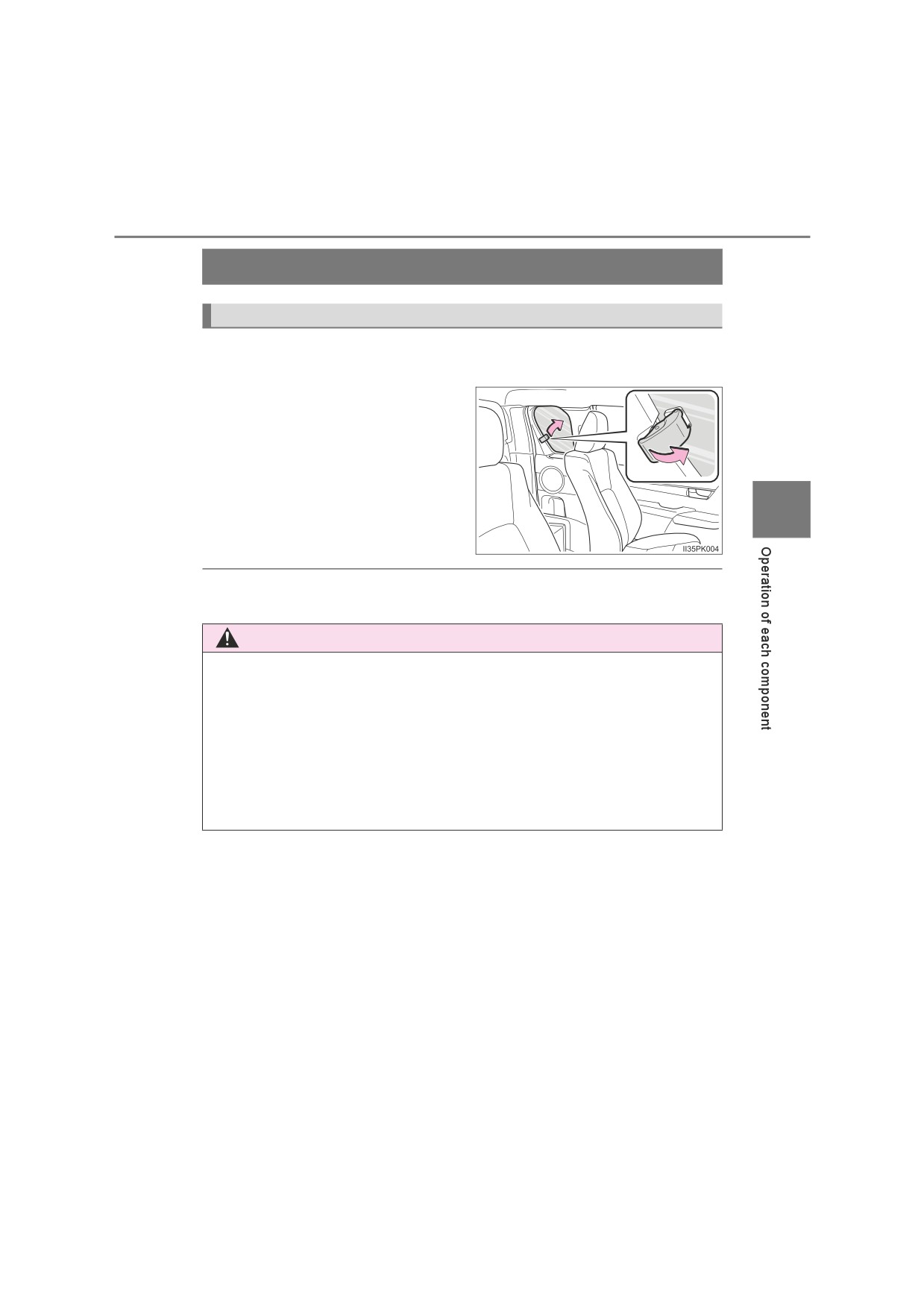
The quarter windows can be opened and closed using the latch han-
dle.
To open the quarter windows, pull
the latch handle toward you and
swing it fully out.
To close the quarter windows,
reverse the opening procedure.
3
Q Closing the quarter windows
Make sure that the quarter windows are securely closed after closing them.
WARNING
Q Opening or closing the quarter windows
Observe the following precautions.
Failure to do so may result in death or serious injury.
OCheck to make sure that all passengers do not have any part of their body
in a position where it could be caught when a window is being operated.
ODo not allow children to operate the quarter windows.
Closing a quarter window on someone can cause serious injury, and in
some instances, even death.
191
Driving
4
4-1.
Before driving
4-5.
Using the driving support
Driving the vehicle
192
systems
Cargo and luggage
205
Toyota Safety Sense
266
Trailer towing (without
PCS (Pre-Collision
towing hitch)
206
System)
273
Trailer towing (with towing
LDA (Lane Departure
hitch)
207
Alert With Yaw Assist
Function)
284
4-2.
Driving procedures
RSA (Road Sign Assist)
295
Engine (ignition) switch
Dynamic radar cruise
(vehicles without smart
control
301
entry & start system)
220
Cruise control
317
Engine (ignition) switch
(vehicles with smart
Toyota parking
entry & start system)
223
assist-sensor
321
Automatic transmission
231
Four-wheel drive
system
331
Manual transmission
239
Rear differential
Turn signal lever
246
lock system
341
Parking brake
247
Stop & Start system
345
4-3.
Operating the lights
Driving assist systems
355
and wipers
Downhill assist control
Headlight switch
248
system
364
Fog light switch
255
AUTO LSD
367
Windshield wipers and
DPF (Diesel Particulate
washer
258
Filter) system
369
4-4.
Refueling
4-6.
Driving tips
Opening the fuel tank
Winter driving tips
374
cap
261
192
4-1. Before driving
Driving the vehicle
The following procedures should be observed to ensure safe
driving:
Starting the engine
P. 220, 223
Driving
Automatic transmission
1
With the brake pedal depressed, shift the shift lever to D. (P. 231)
2
Release the parking brake. (P. 247)
3
Gradually release the brake pedal and gently depress the accelera-
tor pedal to accelerate the vehicle.
Manual transmission
1
While depressing the clutch pedal, shift the shift lever to 1.
(P. 239)
2
Release the parking brake. (P. 247)
3
Gradually release the clutch pedal. At the same time, gently
depress the accelerator pedal to accelerate the vehicle.
Stopping
Automatic transmission
1
With the shift lever in D, depress the brake pedal.
2
If necessary, set the parking brake.
If the vehicle is to be stopped for an extended period of time, shift the shift
lever to P or N. (P. 231)
Manual transmission
1
While depressing the clutch pedal, depress the brake pedal.
2
If necessary, set the parking brake.
If the vehicle is to be stopped for an extended period of time, shift the shift
lever to N. (P. 239)

4-1. Before driving
193
Parking the vehicle
Automatic transmission
1
With the shift lever in D, depress the brake pedal.
2
Set the parking brake (P. 247), and shift the shift lever to P
(P. 231).
Vehicles without smart entry & start system:
3
Turn the engine switch to the “LOCK” position to stop the engine.
Vehicles with smart entry & start system:
Press the engine switch to stop the engine.
Lock the door, making sure that you have the key on your person.
4
If parking on a hill, block the wheels as needed.
Manual transmission
1
While depressing the clutch pedal, depress the brake pedal.
4
2
Shift the shift lever to N. (P. 239)
If parking on a hill, shift the shift lever to 1 or R as needed.
3
Set the parking brake. (P. 247)
4
Vehicles without smart entry & start system:
Turn the engine switch to the “LOCK” position to stop the engine.
Vehicles with smart entry & start system:
Press the engine switch to stop the engine.
Lock the door, making sure that you have the key on your person.
5
If parking on a hill, block the wheels as needed.
194
4-1. Before driving
Starting off on a steep uphill
Automatic transmission
1
Make sure that the parking brake is set and shift the shift lever to D.
2
Gently depress the accelerator pedal.
3
Release the parking brake.
Manual transmission
1
With the parking brake firmly set and the clutch pedal fully
depressed, shift the shift lever to 1.
2
Lightly depress the accelerator pedal at the same time as gradually
releasing the clutch pedal.
3
Release the parking brake.
Q When starting off on an uphill (vehicles with hill-start assist control sys-
tem)
The hill-start assist control will activate. (P. 355)
Q Driving in the rain
ODrive carefully when it is raining, because visibility will be reduced, the win-
dows may become fogged-up, and the road will be slippery.
ODrive carefully when it starts to rain, because the road surface will be espe-
cially slippery.
O Refrain from high speeds when driving on an expressway in the rain,
because there may be a layer of water between the tires and the road sur-
face, preventing the steering and brakes from operating properly.
Q Engine speed while driving (automatic transmission)
In the following conditions, the engine speed may become high while driving.
This is due to automatic up-shifting control or down-shifting implementation to
meet driving conditions. It does not indicate sudden acceleration.
OThe vehicle is judged to be driving uphill or downhill
O When the accelerator pedal is released
4-1. Before driving
195
Q Restraining the engine output (Brake Override System)
O When the accelerator and brake pedals are depressed at the same time, the
engine output may be restrained.
O Vehicles without multi-information display: A warning light comes on while
the system is operating. (P. 569)
O Vehicles with multi-information display: A warning message is displayed on
the multi-information display while the system is operating. (P. 577)
Q Restraining sudden start (Drive-Start Control) (vehicles with automatic
transmission and VSC system)
O When the following unusual operation is performed, the engine output may
be restrained.
• When the shift lever is shifted from R to D, D to R, N to R, P to D, or P to
R (D includes S) with the accelerator pedal depressed, a warning mes-
sage is displayed on the multi-information display while the system is
operating. If a warning message is shown on the multi-information dis-
play, read the message and follow the instructions.
• When the accelerator pedal is depressed too much while the vehicle is in
4
reverse.
O While Drive-Start Control is being activated, your vehicle may have trouble
escaping from the mud or fresh snow. In such case, perform the following
actions to cancel Drive-Start Control so that the vehicle may become able to
escape from the mud or fresh snow.
• Deactivate TRC/A-TRC (P. 357)
• Turn the front-wheel drive control switch to L4. (if equipped) (P. 331)
O Vehicles with AUTO LSD system: Drive-Start Control does not work when
the AUTO LSD system is turned on. (P. 367)

196
4-1. Before driving
Q Breaking in your new Toyota
To extend the life of the vehicle, observing the following precautions is recom-
mended:
O For the first 300 km (200 miles):
Avoid sudden stops.
O For the first 800 km (500 miles) (with towing hitch):
Do not tow a trailer. (P. 207)
O For the first 1000 km (600 miles):
• Do not drive at extremely high speeds.
• Avoid sudden acceleration.
• Do not drive continuously in the low gears.
• Do not drive at a constant speed for extended periods.
• Do not drive slowly with the manual transmission in a high gear.
Q Idling time before engine stop (diesel engine only)
To prevent damage to the turbocharger, allow the engine to idle immediately
after high-load driving.
Driving condition
Idling time
Normal city driving or high-speed driving (at the
Not necessary
highway speed limit or recommended speed)
Steep hill driving, continuous driving (race track
Approximately
driving etc.), or towing a trailer or another vehicle
1 minute
(with towing hitch)
Q Operating your vehicle in a foreign country
Comply with the relevant vehicle registration laws and confirm the availability
of the correct fuel. (P. 627)
Q Eco-friendly driving
P. 128
Q After driving on muddy roads in poor condition (for EURO VI models*
with 1GD-FTV and 2GD-FTV engines)
Check the cooling fins of the urea injector and clear away any foreign objects
or substances such as leaves or mud. If any of the above parts is extremely
dirty or you are not sure of their condition, have your vehicle inspected by any
authorized Toyota retailer or Toyota authorized repairer, or any reliable
repairer.
*: EURO VI is an emission standard. If it is not clear that your vehicle meets
relevant standards, contact any authorized Toyota retailer or Toyota autho-
rized repairer, or any reliable repairer.
4-1. Before driving
197
WARNING
Observe the following precautions.
Failure to do so may result in death or serious injury.
Q When starting the vehicle
On vehicles with automatic transmission, always keep your foot on the
brake pedal while stopped with the engine running. This prevents the vehi-
cle from creeping.
Q When driving the vehicle
ODo not drive if you are unfamiliar with the location of the brake and accel-
erator pedals to avoid depressing the wrong pedal.
• Accidentally depressing the accelerator pedal instead of the brake
pedal will result in sudden acceleration that may lead to an accident.
• When backing up, you may twist your body around, leading to a diffi-
culty in operating the pedals. Make sure to operate the pedals properly.
• Make sure to keep a correct driving posture even when moving the
vehicle only slightly. This allows you to depress the brake and accelera-
4
tor pedals properly.
• Depress the brake pedal using your right foot. Depressing the brake
pedal using your left foot may delay response in an emergency, result-
ing in an accident.
ODo not drive the vehicle over or stop the vehicle near flammable materials.
The exhaust system and exhaust gases can be extremely hot. These hot
parts may cause a fire if there is any flammable material nearby.
ODuring normal driving, do not turn off the engine. Turning the engine off
while driving will not cause loss of steering or braking control, but the
power assist to these systems will be lost. This will make it more difficult to
steer and brake, so you should pull over and stop the vehicle as soon as it
is safe to do so.
However, in the event of an emergency, such as if it becomes impossible
to stop the vehicle in the normal way: P. 555
198
4-1. Before driving
WARNING
Observe the following precautions.
Failure to do so may result in death or serious injury.
Q When driving the vehicle
OUse engine braking (downshift) to maintain a safe speed when driving
down a steep hill.
Using the brakes continuously may cause the brakes to overheat and lose
effectiveness. (P. 232)
ODo not adjust the positions of the steering wheel, the seat, or the inside or
outside rear view mirrors while driving.
Doing so may result in a loss of vehicle control.
O Always check that all passengers’ arms, heads or other parts of their body
are not outside the vehicle.
OOn vehicles with manual transmission, observe the following to prevent
the clutch from being damaged.
• Do not operate the clutch halfway for a long period of time unless it is
necessary.
• Do not operate the clutch half or partial engaged to control the vehicle
speed, such as to drive the vehicle at a low speed, to hold the vehicle
on a slope, etc.
• Do not depress the brake pedal during operating the clutch half or par-
tial engaged.
Doing so could not only speed up the clutch wear, but also damage the
clutch or even cause a fatal accident such as vehicle fire.
Q When driving on slippery road surfaces
O Sudden braking, acceleration and steering may cause tire slippage and
reduce your ability to control the vehicle.
OSudden acceleration, engine braking due to shifting, or changes in engine
speed could cause the vehicle to skid.
O After driving through a puddle, lightly depress the brake pedal to make
sure that the brakes are functioning properly. Wet brake pads may prevent
the brakes from functioning properly. If the brakes on only one side are wet
and not functioning properly, steering control may be affected.
4-1. Before driving
199
WARNING
Observe the following precautions.
Failure to do so may result in death or serious injury.
Q When shifting the shift lever
OOn vehicles with automatic transmission, do not let the vehicle roll back-
wards while the shift lever is in a driving position, or roll forward while the
shift lever is in R.
Doing so may cause the engine to stall or lead to poor brake and steering
performance, resulting in an accident or damage to the vehicle.
OOn vehicles with automatic transmission, do not shift the shift lever to P
while the vehicle is moving.
Doing so can damage the transmission and may result in a loss of vehicle
control.
ODo not shift the shift lever to R while the vehicle is moving forward.
Doing so can damage the transmission and may result in a loss of vehicle
control.
4
ODo not shift the shift lever to a driving position while the vehicle is moving
backward.
Doing so can damage the transmission and may result in a loss of vehicle
control.
OMoving the shift lever to N while the vehicle is moving will disengage the
engine from the transmission. Engine braking is not available when N is
selected.
OOn vehicles with automatic transmission, be careful not to shift the shift
lever with the accelerator pedal depressed. Shifting the shift lever to a
gear other than P or N may lead to unexpected rapid acceleration of the
vehicle that may cause an accident.
Q If you hear a squealing or scraping noise (brake pad wear indicators)
Have the brake pads checked and replaced by any authorized Toyota
retailer or Toyota authorized repairer, or any reliable repairer as soon as
possible.
Rotor damage may result if the pads are not replaced when needed.
It is dangerous to drive the vehicle when the wear limits of the brake pads
and/or those of the brake discs are exceeded.
200
4-1. Before driving
WARNING
Observe the following precautions.
Failure to do so may result in death or serious injury.
Q When the vehicle is stopped
ODo not race the engine.
If the vehicle is in any gear other than P (vehicles with automatic transmis-
sion only) or N, the vehicle may accelerate suddenly and unexpectedly,
causing an accident.
OOn vehicles with automatic transmission, in order to prevent accidents due
to the vehicle rolling away, always keep depressing the brake pedal while
the engine is running, and apply the parking brake as necessary.
O If the vehicle is stopped on an incline, in order to prevent accidents caused
by the vehicle rolling forward or backward, always depress the brake pedal
and securely apply the parking brake as needed.
O Avoid revving or racing the engine.
Running the engine at high speed while the vehicle is stopped may cause
the exhaust system to overheat, which could result in a fire if combustible
material is nearby.
Q When the vehicle is parked
ODo not leave glasses, cigarette lighters, spray cans, or soft drink cans in
the vehicle when it is in the sun.
Doing so may result in the following:
• Gas may leak from a cigarette lighter or spray can, and may lead to a
fire.
• The temperature inside the vehicle may cause the plastic lenses and
plastic material of glasses to deform or crack.
• Soft drink cans may fracture, causing the contents to spray over the
interior of the vehicle, and may also cause a short circuit in the vehicle’s
electrical components.
ODo not leave cigarette lighters in the vehicle. If a cigarette lighter is in a
place such as the glove box or on the floor, it may be lit accidentally when
luggage is loaded or the seat is adjusted, causing a fire.
ODo not attach adhesive discs to the windshield or windows. Do not place
containers such as air fresheners on the instrument panel or dashboard.
Adhesive discs or containers may act as lenses, causing a fire in the vehi-
cle.
ODo not leave a door or window open if the curved glass is coated with a
metallized film such as a silver-colored one. Reflected sunlight may cause
the glass to act as a lens, causing a fire.
4-1. Before driving
201
WARNING
Observe the following precautions.
Failure to do so may result in death or serious injury.
Q When the vehicle is parked
O Always apply the parking brake, shift the shift lever to P (vehicles with
automatic transmission only), stop the engine and lock the vehicle.
Do not leave the vehicle unattended while the engine is running.
If the vehicle is parked with the shift lever in P but the parking brake is not
set, the vehicle may start to move, possibly leading to an accident.
ODo not touch the exhaust pipes while the engine is running or immediately
after turning the engine off.
Doing so may cause burns.
Q When taking a nap in the vehicle
Always turn the engine off. Otherwise, if you accidentally move the shift
lever or depress the accelerator pedal, this could cause an accident or fire
due to engine overheating. Additionally, if the vehicle is parked in a poorly
4
ventilated area, exhaust gases may collect and enter the vehicle, leading to
death or a serious health hazard.
Q When braking
O When the brakes are wet, drive more cautiously.
Braking distance increases when the brakes are wet, and this may cause
one side of the vehicle to brake differently than the other side. Also, the
parking brake may not securely hold the vehicle.
O If the brake booster device does not operate, do not follow other vehicles
closely and avoid hills or sharp turns that require braking. In this case,
braking is still possible, but the brake pedal should be depressed more
firmly than usual. Also, the braking distance will increase. Have your
brakes fixed immediately.
ODo not pump the brake pedal if the engine stalls.
Each push on the brake pedal uses up the reserve for the power-assisted
brakes.
OThe brake system consists of 2 individual hydraulic systems: If one of the
systems fails, the other will still operate. In this case, the brake pedal
should be depressed more firmly than usual and the braking distance will
increase.
Have your brakes fixed immediately.
Q If the vehicle becomes stuck (4WD models)
Do not spin the wheels excessively when any of the tires is up in the air, or
the vehicle is stuck in sand, mud, etc. This may damage the driveline com-
ponents or propel the vehicle forward or backward, causing an accident.
202
4-1. Before driving
NOTICE
Q When driving the vehicle
ODo not depress the accelerator and brake pedals at the same time during
driving, as this may restrain the engine output.
OOn vehicles with automatic transmission, do not use the accelerator pedal
or depress the accelerator and brake pedals at the same time to hold the
vehicle on a hill.
OOn vehicles with manual transmission, do not shift gears unless the clutch
pedal is fully depressed. After shifting, do not release the clutch pedal
abruptly. Doing so may damage the clutch, transmission and gears.
OOn vehicles with manual transmission, observe the following to prevent
the clutch from being damaged. Failure to do so may cause excessive pre-
mature wear or damage to the clutch, eventually making it difficult to accel-
erate and start off from a stop. Have the vehicle inspected by any
authorized Toyota retailer or Toyota authorized repairer, or any reliable
repairer.
• Do not rest your foot on the clutch pedal while driving.
Doing so may cause clutch trouble.
• Do not use any gear other than the 1st gear when starting off and mov-
ing forward.
Doing so may damage the clutch.
• Do not use the clutch to hold the vehicle when stopping on an uphill
grade.
Doing so may damage the clutch.
• Do not use the clutch pedal to adjust vehicle speed.
Doing so may damage the clutch.
• When stopping the vehicle with the shift lever in a position other than N,
make sure to fully depress the clutch pedal and stop the vehicle using
the brakes.
OOn vehicles with manual transmission, do not shift the shift lever to R with-
out the vehicle completely stopped. Doing so may damage the clutch,
transmission and gears.
OOn vehicles with manual transmission, if you cannot accelerate the vehicle
even when the clutch is engaged and the accelerator pedal is depressed,
this may mean that the clutch is slipping, and the vehicle may be rendered
undriveable. Have any authorized Toyota retailer or Toyota authorized
repairer, or any reliable repairer inspect the vehicle as soon as possible.

4-1. Before driving
203
NOTICE
Q When parking the vehicle
On vehicles with automatic transmission, always set the parking brake, and
shift the shift lever to P. Failure to do so may cause the vehicle to move or
the vehicle may accelerate suddenly if the accelerator pedal is accidentally
depressed.
Q Avoiding damage to vehicle parts
ODo not turn the steering wheel fully in either direction and hold it there for
an extended period of time.
Doing so may damage the power steering pump.
O When driving over bumps in the road, drive as slowly as possible to avoid
damaging the wheels, underside of the vehicle, etc.
ODiesel engine: Make sure to idle the engine immediately after high-load
driving. Stop the engine only after the turbocharger has cooled down.
Failure to do so may cause damage to the turbocharger.
ODiesel engine: In an extremely cold environment, idle the engine for more
4
than 30 seconds after starting the engine. Do not race the engine while
idling.
Q If you get a flat tire while driving
A flat or damaged tire may cause the following situations. Hold the steering
wheel firmly and gradually depress the brake pedal to slow down the vehi-
cle.
OIt may be difficult to control your vehicle.
OThe vehicle will make abnormal sounds or vibrations.
OThe vehicle will lean abnormally.
Information on what to do in case of a flat tire. (P. 581)
204
4-1. Before driving
NOTICE
Q When encountering flooded roads or waterlogged roads
Do not drive on a road that has flooded after heavy rain etc. Doing so may
cause the following serious damage to the vehicle:
OEngine stalling
OShort in electrical components
O Engine damage caused by water immersion
ORubber or mechanical part damage or poor lubrication due to grease
being washed away, or grease becoming contaminated with mud or dirt
In the event that you drive on a flooded road and the vehicle is flooded, or
on a sandy road, be sure to have any authorized Toyota retailer or Toyota
authorized repairer, or any reliable repairer check the following:
OBrake function
OChanges in quantity and quality of oil and fluid used for the engine, trans-
mission, transfer (4WD models), clutch, differential, etc.
O Lubricant condition for the propeller shaft, clutch fork, bearings and sus-
pension joints (where possible), and the function of all joints, bearings, etc.
Q Off-road driving (vehicles with type A wheel ornaments [P. 588])
When driving on muddy roads, rocky terrain or sand, or crossing rivers,
remove the wheel ornaments. Driving with the wheel ornaments installed
may cause the wheel ornaments to be damaged or even fall off.
After off-road driving with the wheel ornaments removed, remove dirt or for-
eign objects from the wheel before reinstalling the wheel ornaments.
4-1. Before driving
205
Cargo and luggage
Take notice of the following information about storage precau-
tions, cargo capacity and load.
WARNING
Q Things that must not be carried in the rear deck
The following things may cause a fire if loaded in the rear deck:
OReceptacles containing gasoline
OAerosol cans
Q Storage precautions
Observe the following precautions.
Failure to do so may prevent the pedals from being depressed properly,
may block the driver’s vision, or may result in items hitting the driver or pas-
4
sengers, possibly causing an accident.
O Stow cargo and luggage in the rear deck whenever possible.
O Except for single-cab models: Do not stack anything behind the front seats
higher than the seatbacks.
ODo not place cargo or luggage in or on the following locations.
• At the feet of the driver
• On the front passenger or rear seats (if equipped) (when stacking
items)
• On the instrument panel
• On the dashboard
OSecure all items in the occupant compartment.
ONever allow anyone to ride in the rear deck. It is not designed for passen-
gers. They should ride in their seats with their seat belts properly fastened.
Otherwise, they are much more likely to suffer death or serious bodily
injury, in the event of sudden braking, sudden swerving or an accident.
Q Load and distribution
ODo not overload your vehicle.
ODo not apply loads unevenly.
Improper loading may cause deterioration of steering or braking control
which may cause death or serious injury.
206
4-1. Before driving
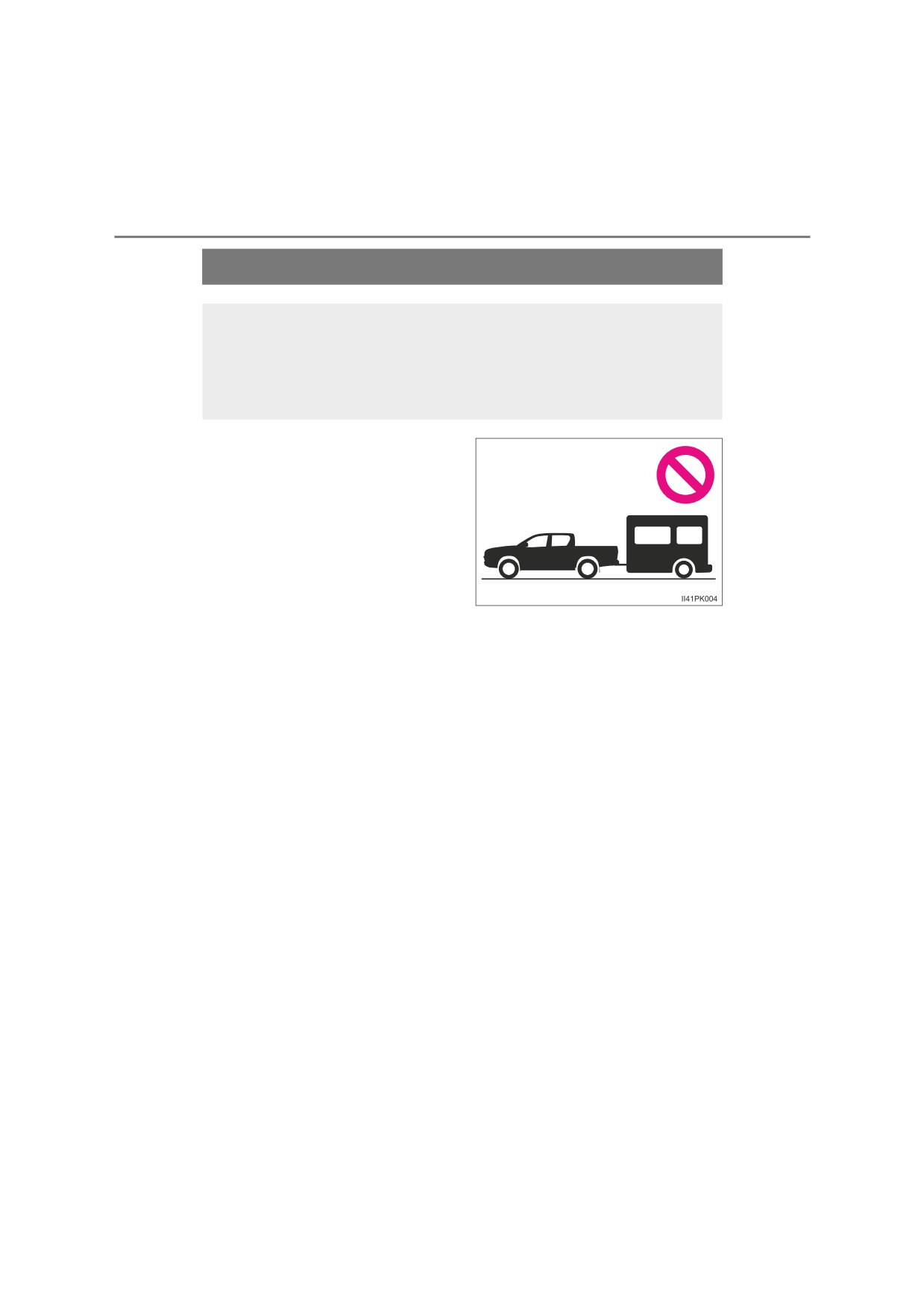
Trailer towing (without towing hitch)
Toyota does not recommend towing a trailer with your vehicle.
Toyota also does not recommend the installation of a tow hitch
or the use of a tow hitch carrier for a wheelchair, scooter, bicy-
cle, etc. Your vehicle is not designed for trailer towing or for the
use of tow hitch mounted carriers.
: For TGN126L-DTTHK models except for Kazakhstan, and GUN125L-DTFSX model.
The model code is indicated on the manufacturer’s plate or label. (P. 624)

4-1. Before driving
207
Trailer towing (with towing hitch)
Your vehicle is designed primarily as a passenger-and-load-car-
rying vehicle. Towing a trailer will have an adverse effect on han-
dling, performance, braking, durability, and fuel consumption.
Your safety and satisfaction depend on the proper use of correct
equipment and cautious driving habits. For your safety and the
safety of others, do not overload the vehicle or trailer.
To tow a trailer safely, use extreme care and drive the vehicle in
accordance with the trailer’s characteristics and operating con-
ditions.
Toyota warranties do not apply to damage or malfunction
caused by towing a trailer for commercial purposes.
4
Ask your local authorized Toyota retailer or Toyota authorized
repairer, or any reliable repairer for further details before towing,
as there are additional legal requirements in some countries.
X Weight limits
Check the allowable towing capacity, GVM (Gross Vehicle Mass),
MPAC (Maximum Permissible Axle Capacity), and permissible
drawbar load before towing. (P. 622)
X Towing hitch/bracket
Toyota recommends the use of the Toyota hitch/bracket for your
vehicle. Other products of a suitable nature and comparable quality
may also be used.
For vehicles where the towing device blocks any of the lights or
license plate, the following shall be observed:
O Do not use towing devices that cannot be easily removed or
repositioned.
O Towing devices must be removed or repositioned when not in
use.
: For Kazakhstan, and models for model code destination W
(See “Checking your vehicle’s model” if you are not
sure of which model your vehicle is. [P. 12]).
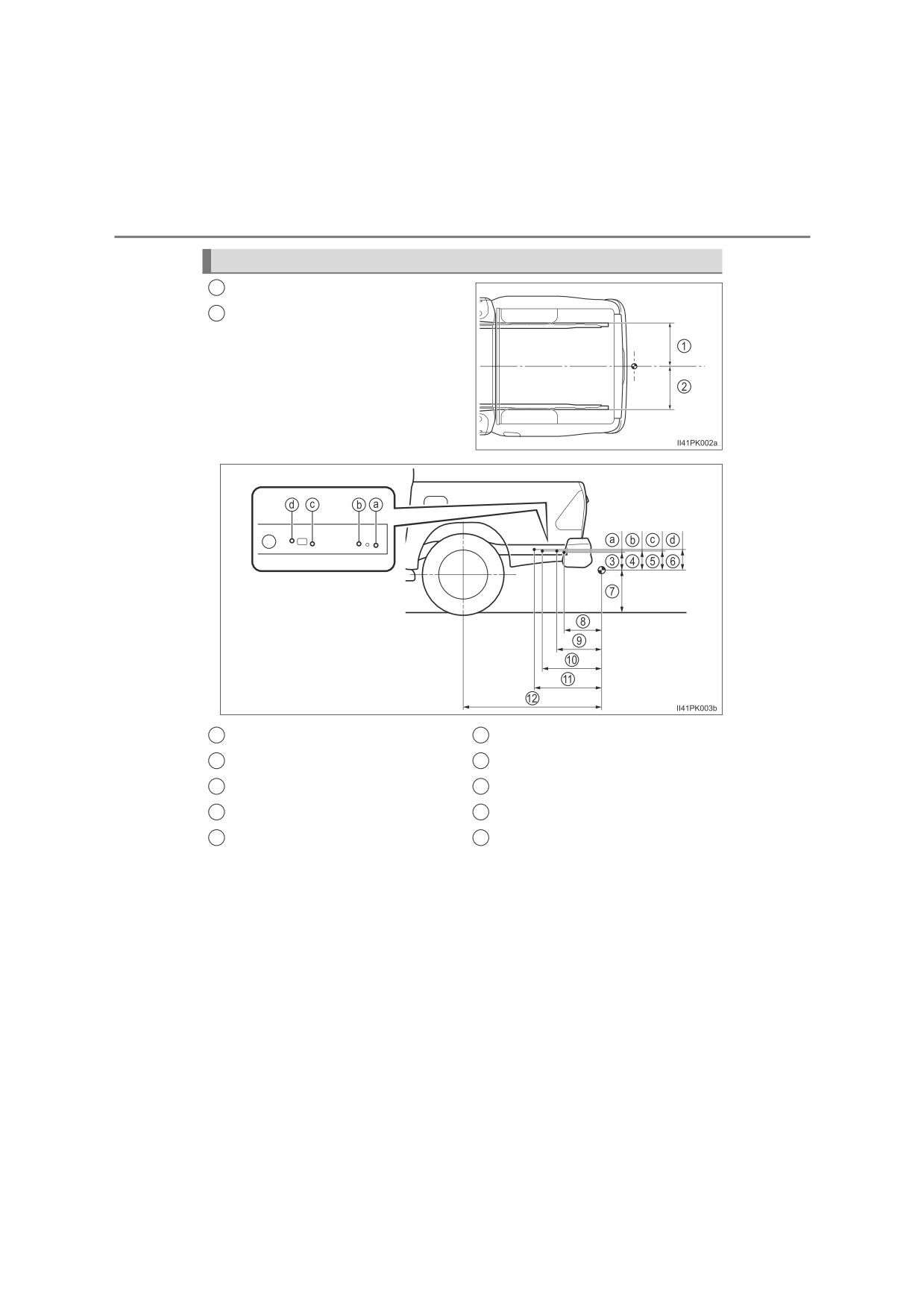
208
4-1. Before driving
Installation positions for the towing hitch/bracket and hitch ball
1
570 mm (22.4 in.)
2
570 mm (22.4 in.)
3
178 mm (7.0 in.)
8
373 mm (14.7 in.)
4
183 mm (7.2 in.)
9
427 mm (16.8 in.)
5
183 mm (7.2 in.)
10
576 mm (22.7 in.)
6
193 mm (7.6 in.)
11
641 mm (25.2 in.)
7
Except for Kazakhstan
(with
12
1343 mm (52.9 in.)
225/70R17C tires):
380 mm (15.0 in.)
Except for Kazakhstan
(with
265/65R17 or 265/60R18 tires):
365 mm (14.4 in.)
For Kazakhstan:
382 mm (15.0 in.)
4-1. Before driving
209
Guidance
Your vehicle will handle differently when towing a trailer. In order to
avoid accident death or serious injury, keep the following in mind
when towing:
Q Checking connections between trailer and lights
Stop the vehicle and check the operation of the connection between
the trailer and lights after driving for a brief period as well as before
starting off.
Q Practicing driving with a coupled trailer
O Get the feel for turning, stopping and reversing with the trailer
coupled by practicing in an area with no or light traffic.
O When reversing with a coupled trailer, hold the section of the
steering wheel nearest to you and rotate clockwise to turn the
trailer left or counterclockwise to turn it right. Always rotate a little
4
at a time to prevent steering error. Have someone guide you
when reversing to lessen the risk of accident.
Q Increasing vehicle-to-vehicle distance
At a speed of 10 km/h (6 mph), the distance to the vehicle running
ahead of you should be equivalent to or greater than the combined
length of your vehicle and trailer. Avoid sudden braking that may
cause skidding. Otherwise, the vehicle may spin out of control. This
is especially true when driving on wet or slippery road surfaces.
Q Sudden acceleration/steering input/cornering
Executing sharp turns when towing may result in the trailer colliding
with your vehicle. Decelerate well in advance when approaching
turns and take them slowly and carefully to avoid sudden braking.
Q Important points regarding turning
The wheels of the trailer will travel closer to the inside of the curve
than the wheels of the vehicle. To make allowance for this, take the
turns wider than you would normally do.
210
4-1. Before driving
Q Important points regarding stability
Vehicle movement resulting from uneven road surfaces and strong
crosswinds will affect handling. The vehicle may also be rocked by
passing buses or large trucks. Frequently check behind when mov-
ing alongside such vehicles. As soon as such vehicle movement
occurs, immediately start to decelerate smoothly by slowly applying
the brakes. Always steer the vehicle straight ahead while braking.
Q Passing other vehicles
Consider the total combined length of your vehicle and trailer and
ensure that the vehicle-to-vehicle distance is sufficient before exe-
cuting lane changes.
Q Transmission information
Vehicles with manual transmission: To maintain engine braking effi-
ciency when using engine braking, do not use 5th gear and 6th
gear.
Vehicles with automatic transmission: To maintain engine braking
efficiency when using engine braking, do not use the transmission
in D. Transmission shift range position must be in 4 or lower, in S
mode.
Q If the engine overheats
Towing a loaded trailer up a long, steep incline in temperatures
exceeding 30C (85F) may result in the engine overheating. If the
engine coolant temperature gauge indicates that the engine is over-
heating, turn the air conditioning off immediately, leave the road and
stop the vehicle in a safe place. (P. 610)
Q When parking the vehicle
Always place wheel chocks under the wheels of both the vehicle
and trailer. Firmly set the parking brake and shift the shift lever to P
for automatic transmissions, and 1 or R for manual transmissions.
4-1. Before driving
211
WARNING
Follow all the instructions described in this section. Failure to do so could
cause an accident resulting in death or serious injury.
Q Trailer towing precautions
When towing, make sure that none of the weight limits are exceeded.
(P. 212)
Q Vehicle speed in towing
Observe the legal maximum speeds for trailer towing.
Q Before descending hills or long declines
Reduce speed and downshift. However, never downshift suddenly while
descending steep or long down hill grades.
Q Operation of the brake pedal
Do not hold the brake pedal depressed often or for long periods of time.
Doing so may result in the brake overheating or reduce braking effects.
Q To avoid accident or injury
4
OThe gross combination mass (sum of your vehicle mass plus its load and
the total trailer mass) must not exceed the following:
Single-cab models
6000 kg (13228 lb.): 4WD models
Smart-cab models
6200 kg (13669 lb.): 4WD models
Double-cab models
6000 kg (13228 lb.): Pre Runner
6300 kg (13889 lb.): 4WD models except for Kazakhstan
ODo not use the following systems when trailer towing.
• Cruise control (if equipped)
• Dynamic radar cruise control (if equipped)
212
4-1. Before driving
Important points regarding trailer loads
(4WD models for
Kazakhstan and Pre Runner)
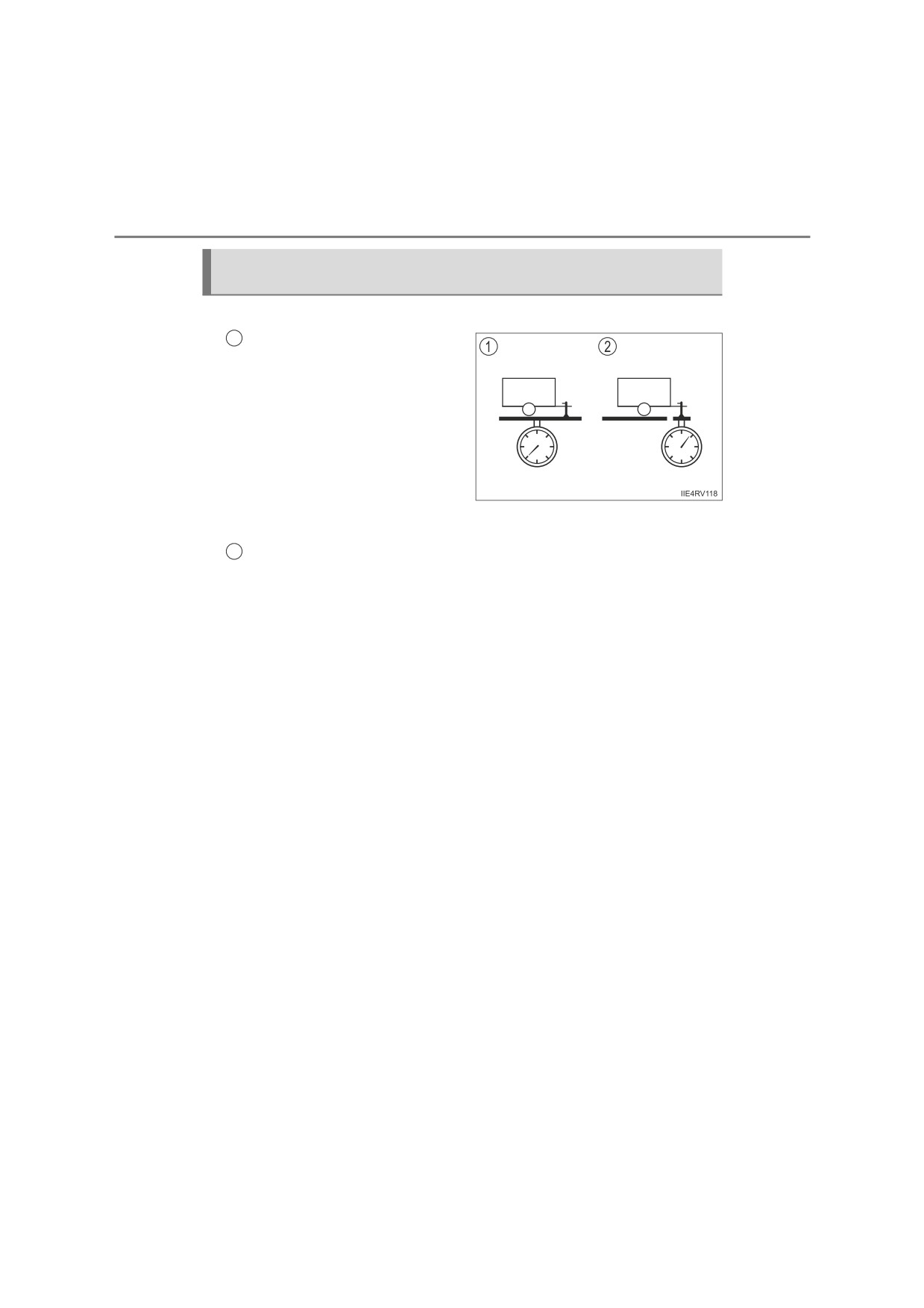
Q Total trailer weight and permissible drawbar load
1
Total trailer weight
Weight of the trailer itself plus
the trailer load should be within
the maximum towing capacity.
Exceeding this weight is danger-
ous. (P. 622)
When towing a trailer, use a fric-
tion coupler or friction stabilizer
(sway control device).
When the total trailer weight is over 2000 kg (4409 lb.), a friction stabi-
lizer (sway control device) is required.
Permissible drawbar load
2
Allocate the trailer load so that the drawbar load is greater than 25 kg
(55.1 lb.) or 4% of the towing capacity. Do not let the drawbar load
exceed the indicated weight. (P. 622)