Subaru Legacy (2023 year). Manual in english - page 29
 

  Index      Manuals     Subaru Legacy (2023 year). Manual in english


Search            copyright infringement  


Content      ..     27      28      29      30     ..


Subaru Legacy (2023 year). Manual in english - page 29


(458,1)

hazard.

.

Do not install a roof tent on the

vehicle. Doing so may damage
the vehicle and create a safety
hazard. SUBARU warranties do
not cover vehicle damage result-
ing from use of a roof tent.

Cargo can be carried after securing the
roof crossbar kit to the roof molding and
installing the appropriate carrying attach-
ment. When installing the roof crossbar kit,
follow the manufacturer’s instructions.

When carrying cargo on the roof using the
roof crossbar kit and carrying attachments,
never exceed the maximum load limit as
explained below. You should also be
careful that the vehicle does not exceed
the Gross Vehicle Weight Rating (GVWR)
and front and rear Gross Axle Weight
Rating (GAWR). For information about
loading cargo into or onto your vehicle,
refer to “Loading Your Vehicle”

P453.

The maximum total load on the roof
(including crossbars, carrying attachments
and cargo) must not exceed

88 lbs (40

kg)

. Refer to the crossbar installation

instructions for the maximum crossbar
capacity. Place the heaviest load at the
bottom, close to the roof, and evenly
distribute the cargo. Always properly se-
cure all cargo.

!

Installing carrying attachments on
the crossbars

When installing any carrying attachments
such as the load carriers, crossbars, bike
carrier, ski carrier, kayak carrier, cargo
basket, etc., follow the manufacturer’s
instructions for the load capacity and make
sure that the attachments are securely
installed. Use only attachments designed
specifically for the crossbars. Before oper-
ating the vehicle, make sure that the cargo
is properly secured on the attachment.

NOTE

Remember that the vehicle’s center of
gravity is altered with the weight of the
load on the roof, thus affecting the
driving characteristics.
Drive carefully. Avoid rapid starts, hard
cornering and abrupt stops. Crosswind
effects will be increased.

!

Removal and installation of the
crossbars

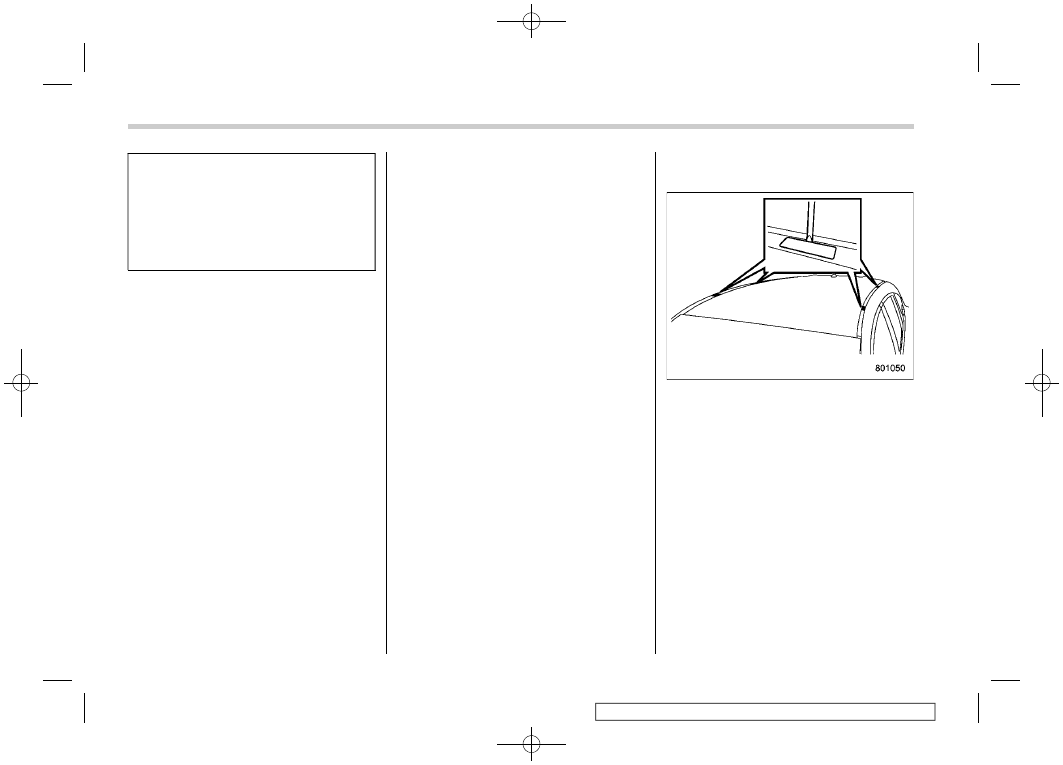
Each of the two roof moldings has two
mounting points for crossbars. Each
mounting point is fitted with a cover. Use
a screwdriver to open the covers. When
installing the crossbars on the roof mold-
ing, follow the manufacturer’s instructions.

Loading Your Vehicle

456

(459,1)

&

Roof Rails with Integrated
Crossbars (Outback)

1)

Integrated crossbars

CAUTION

.

For cargo carrying purposes, the

crossbars must be extended
across the roof and locked into
the roof rails. Cargo must be
attached to the crossbars using
genuine SUBARU accessory
crossbar attachments. The
crossbars must never be used
independently to carry cargo on
the roof. Otherwise, damage to
the roof or paint or a dangerous
road hazard due to loss of cargo
could result.

.

When loading cargo on the cross-

bars, using the genuine SUBARU
accessory crossbar attach-
ments, make sure the total weight
of the crossbar attachments, and
loaded cargo, does not exceed
the maximum load limit of 150 lbs
(67.5 kg). Overloading may cause
damage to the vehicle and create
a safety hazard.

.

Be careful not to damage the

vehicle body when passing the
rope through the front and rear
holes of the roof rails.

.

Do not install a roof tent on the

vehicle. Doing so may damage
the vehicle and create a safety
hazard. SUBARU warranties do
not cover vehicle damage result-
ing from use of a roof tent.

The crossbars must be extended across
the roof and locked into the roof rails to
carry cargo on the roof. Cargo can only be
carried on the crossbars using the genuine
SUBARU accessory crossbar attach-
ments.

When you carry cargo on the roof using the
crossbars and a carrying attachment,
never exceed the maximum load limit
explained in the following. You should also

be careful that your vehicle does not
exceed the Gross Vehicle Weight Rating
(GVWR) and front and rear Gross Axle
Weight Rating (GAWR). For information
on loading cargo into or onto your vehicle,
refer to “Loading Your Vehicle”

P453.

The maximum load limit of the cargo and
carrying attachment must not exceed the
allowable load limit described in the Own-
er’s Manual of a genuine SUBARU carry-
ing attachment. Place the heaviest load at
the bottom, nearest the roof, and evenly
distribute the cargo. Always properly se-
cure all cargo.

!

Installing carrying attachments on
the crossbars

When installing any carrying attachments
such as the load carriers, crossbars, bike
carrier, ski carrier, kayak carrier, cargo
basket, etc., follow the manufacturer’s
instructions of the load capacity and make
sure that the attachments are securely
installed. Use only attachments designed
specifically for the crossbars. Before oper-
ating the vehicle, make sure that the cargo
is properly secured on the attachment.

NOTE

.

Remember that the vehicle’s center

of gravity is altered with the weight of
the load on the roof, thus affecting the
driving characteristics. Drive carefully,

– CONTINUED –

Loading Your Vehicle

457

8

Driving

Tips

(460,1)

avoid rapid starts, hard cornering and
abrupt stops. Crosswind effects will be
increased.

.

Restore the bars to the original

position when the bars are not used
as crossbars.

!

How to use as crossbars

CAUTION

.

Do not raise the bar higher than

necessary. The base of the bar
may be damaged.

.

Be careful not to contact the bars

while sliding them. Otherwise,
the bars may be scratched or
the latch portions may be da-
maged.

.

Do not slide the bar more than

necessary when sliding the bar.
The base of the bar may be
damaged.

.

Do not allow the bar to fall on or

contact the roof panel or the
moonroof when sliding the bar.
Otherwise the roof panel may be
dented or the glass of the moon-
roof may be damaged.

.

Be careful hands do not become

pinched when operating the
cross bar. Hands becoming

pinched could result in injury.

1. Pull out the integrated crossbars from
the roof rail holders by pulling up the
covers.

2. Slide the bars in the direction shown in

the illustration.

3. Install the bars into the holders.
4. Make sure that the latches are fitted
securely.

!

How to change the position of the
crossbar

WARNING

Carefully read the warning label
attached to the roof rail.

You can change the position of the rear
crossbar. To change the position, perform
the following procedure.
1. Take out the torque wrench from the
under-floor storage compartment.

Loading Your Vehicle

458

(461,1)

2. Remove the plastic plug of the roof rail
holder by using the torque wrench.

3. Remove the bolt of the crossbar by
using the torque wrench and pull this side
out.

4. Pull out the other side of the crossbar
from the roof rail holder by pulling up the
cover.
5. Install both ends of the crossbar into
the other holders.

1)

Guide plate

2)

Torque wrench

6. Using the torque wrench, tighten the
crossbar bolts until the torque wrench hits
the guide plate.

– CONTINUED –

Loading Your Vehicle

459

8

Driving

Tips

(462,1)

NOTE

The tightening torque is approximately
8.9

+

2.2 lbf·ft (12

+

3.0 N·m, 1.2

+

0.3

kgf·m).

7. Install the plastic plug by pushing it into
the hole until it is fully seated.

!

How to re-stow bars

CAUTION

Do not use the bars as roof rails
when the bars are stowed.

1. Check that the rear crossbar is stowed
in the front side holder. If the rear crossbar
is stowed in the rear side holder, move it
back to the front side holder (original
position).

2. Pull out the crossbars from the roof rail

holders by pulling up the covers.

3. Slide the bars in the direction shown in
the illustration.

4. Install the bars into the holders.
5. Make sure that the latches are fitted
securely.

Loading Your Vehicle

460

(463,1)

&

Roof Rails with Ladder Type
(Subaru Outback Wilderness)

1)

Roof rails

Cargo can be carried on the roof after
securing the roof crossbars to the roof rails
and installing the appropriate carrying
attachments. When installing the roof
crossbars and the carrying attachments,
follow the manufacturer’s instructions. The
roof rail system is designed to carry loads
(cargo, roof crossbars and carrying attach-
ments) of no more than

220 lbs (100 kg)

.

Be sure not to exceed your vehicle’s
GVWR and GAWR.

CAUTION

.

When using the carrying attach-

ments, make sure that the total

carrying load of the cargo, roof
crossbars and carrying attach-
ments does not exceed 220 lbs
(100 kg). Overloading may cause
damage to the vehicle. Read the
manufacturer’s instructions and
pay attention to not exceed the
load limit of the parts.

.

For cargo carrying purposes, the

roof rails must be used together
with the SUBARU recommended
roof crossbars and any appropri-
ate carrying attachment that may
be needed. The roof rails must
never be used alone to carry
cargo. Otherwise, damage to the
roof or paint, or a dangerous road
hazard due to loss of cargo could
result.

NOTE

Remember that the vehicle’s center of
gravity is altered with the weight of the
load on the roof, thus affecting driving
characteristics.
Drive carefully. Avoid rapid starts, hard
cornering and abrupt stops. Crosswind
effects will be increased.

!

Rope hooks (attached to the roof
rails)

1)

Rope hooks

2)

Covers

CAUTION

.

When you use the rope hooks,

always secure the rope at all four
hook points.

.

The maximum load capacity is

176 lbs (80 kg) per hook.

.

The cover cannot be removed.

.

Do not tighten the rope exces-

sively. Otherwise, it may lead to
damage to the vehicle body or
cargo.

– CONTINUED –

Loading Your Vehicle

461

8

Driving

Tips

(464,1)

.

Check that the rope is not loose

before driving the vehicle.

.

When you use the rope hooks,

never exceed the maximum load
limit.

&

Roof Tent (Subaru Outback
Wilderness)

WARNING

Adding weight to the vehicle’s roof
can adversely affect handling, brak-
ing, and rollover resistance. The
vehicle must never be driven with a
total roof rail load in excess of 220
lbs (100 kg).

CAUTION

.

The roof rail load limit for sta-

tionary vehicles (700 lbs (317 kg))
applies only when the vehicle is
parked and the load is evenly
distributed left/right and front/
rear and the roof crossbars and
roof tent are tightly secured to
the vehicle. If these conditions
are not met, the load limit will be
lower.

.

The maximum load limit of the

roof crossbars must be obtained
from the manufacturer or retailer
of the roof rack. When driving the
vehicle, the maximum roof rail
load is 220 lbs (100 kg) or the
crossbar load limit (whichever is
lower).

Roof tents may be used under certain
conditions at your own risk.

!

When driving the vehicle

The total weight on the roof rails, including
the roof crossbars and roof tent, must not
exceed the vehicle’s roof rail load of 220
lbs (100 kg), evenly distributed.

A:

Roof rails

B:

Roof crossbars

C:

Roof tent

B + C < 220 lbs (100 kg)

Loading Your Vehicle

462

(465,1)

!

When the vehicle is parked on level
ground

A:

Roof rails

B:

Roof crossbars

C:

Roof tent

D:

Occupants in the roof tent

The total weight on the roof rails –
including the roof crossbars, roof tent,
and all occupants and contents in the roof
tent – must not exceed either the vehicle’s
roof rail load limit (700 lbs (317 kg)), evenly
distributed, or the load limit of the roof
crossbars, whichever is lower.

Load limit of the roof rail (A).
B + C + D < 700 lbs (317 kg)

Exceeding this load limit could cause
damage to the vehicle or racking system.
The vehicle must never be driven with
occupants in the roof tent. Before the
vehicle is driven, occupants and cargo
must be removed from the roof tent and
the roof rail load must be restored to within
the roof rail load limit of 220 lbs (100 kg).
Refer to the user manual that accompa-
nied the roof tent for important safety
information and instructions on the proper
installation and use of the tent.

8-11. Trailer Hitch (Outback/
Subaru Outback Wilderness –
If Equipped)

WARNING

.

Never exceed the maximum
weight specified for the trailer
hitch. Exceeding the maximum
weight could cause an accident
resulting in serious personal in-
juries. Permissible trailer weight
changes depending on the situa-
tion. For possible recommenda-
tions and limitations, refer to
“Trailer Towing (Outback/Subaru
Outback Wilderness)”

P467.

.

Never drill the frame or under-

body of your vehicle to install a
commercial trailer hitch. If you
do, dangerous exhaust gas,
water or mud may enter the
passenger compartment through
the drilled hole. Exhaust gas
contains carbon monoxide, a col-
orless and odorless gas which is
dangerous, or even lethal, if in-
haled. Also, drilling the frame or
underbody of your vehicle could
cause deterioration of strength of
your vehicle and cause corrosion

– CONTINUED –

Trailer Hitch (Outback/Subaru Outback Wilderness – If Equipped)

463

8

Driving

Tips

(466,1)

around the drilled hole.

.

Be sure your trailer has safety

chains and that each chain will
hold the trailer’s maximum gross
weight. Towing trailers without
safety chains could create a traf-
fic safety hazard if the trailer
separates from the hitch due to
coupling damage or hitch ball
damage.

.

Use only a ball mount that is

suitable for the trailer hitch. Use
the hitch only as a weight carry-
ing hitch. Do not use with any
type of weight distributing hitch.

.

The standard bumper beam must

be installed after you remove the
trailer hitch. Consult a SUBARU
dealer for purchase of a standard
bumper beam if you do not have
the original.

.

If a trailer hitch is installed, it is

not possible to install the rear
towing hook.

CAUTION

Do not modify the vehicle exhaust
system, brake system, or other sys-
tems when installing a hitch or other
trailer towing equipment.

When any of the tires are punctured, you
can seal the tire temporarily. However, do
not tow a trailer when a sealed tire is used.
We recommend that you consult the
nearest SUBARU dealer for details.
The maximum gross trailer weight and
maximum gross tongue weight are indi-
cated in the following table.

Maximum

gross trailer

weight

Maximum

gross tongue

weight

2.4 L models

3,500 lbs

(1,588 kg)

350 lbs

(159 kg)

2.5 L models

2,700 lbs

(1,224 kg)

270 lbs

(122 kg)

When towing a trailer, refer to “Trailer
To w i n g ( O u t b a c k / S u b a r u O u t b a c k
Wilderness)”

P467.

&

Connecting a SUBARU Gen-
uine Trailer Hitch

1. Remove the receiver cover from the
hitch receiver tube. Then insert the ball
mount into the hitch receiver tube.

2. Insert the hitch pin into the hole located
on the hitch receiver tube so that the pin
passes through the ball mount.

Trailer Hitch (Outback/Subaru Outback Wilderness – If Equipped)

464

(467,1)

3. Insert the safety pin through the pro-
vided hole on the hitch pin securely.
4. Check the ball mount assembly by
pulling on it to make sure it does not come
off the hitch receiver.

1)

Hitch ball installation point

2)

Hooks for safety chains

5. Use only a hitch ball that is appropriate
for the ball mount and your trailer. The
hitch ball must be securely installed on the
ball mount.
6. Connect your trailer to the hitch ball.
7. Connect the trailer and the hitch with
safety chains that will hold the trailer’s
maximum gross weight. In case the trailer
hitch connector or hitch ball should break
or become disconnected, the trailer could
get loose and create a traffic safety
hazard. For safety, always connect the
towing vehicle and trailer with trailer safety
chains.
Two chains should be used in total, one to
the right side and the other to the left side
trailer tongue. Pass the chains crossing

each other under the trailer tongue to
prevent the trailer from dropping onto the
ground in case the trailer tongue should
disconnect from the hitch ball. Allow
sufficient slack in the chains taking tight
turn situations into account; however, be
careful not to let them drag on the ground.

WARNING

.

For safety, always connect the

towing vehicle and trailer with
safety chains.

.

Do not connect safety chains to

any part of the vehicle other than
the safety chain hooks.

.

Be sure to check the hitch pin and

safety pin for positive locking
placement before towing a trailer.
If the ball mount comes off the
hitch receiver, the trailer could
get loose and create a traffic
safety hazard.

– CONTINUED –

Trailer Hitch (Outback/Subaru Outback Wilderness – If Equipped)

465

8

Driving

Tips

(468,1)

Hitch harness connector

8. Connect the hitch wire harness’s black
four-pin wire connector to the towing
trailer’s wire harness.
9. Confirm proper function of the hitch
wire harness by individually activating the
brake, stop and turn signal lights on the
trailer.

NOTE

.

A genuine SUBARU hitch is avail-

able from your SUBARU dealer.

.

Always disconnect the trailer wire

harness before launching or retrieving
a watercraft.

&

If Not Towing a Trailer

CAUTION

The housing should be kept clean at
the points of contact. The surfaces
only require cleaning with a cloth.
Grease or other lubricants should
never be used.

.

Remove the ball mount from the hitch

receiver tube and insert the receiver cover
onto the hitch receiver tube.

.

Place the dust cap over the four-pin

connector of the hitch wire harness to
protect against possible damage.

.

Occasionally lubricate terminals of the

four-pin connector using terminal grease.

8-12. Trailer Towing (Legacy)

CAUTION

Your vehicle is neither designed nor
intended to be used for trailer tow-
ing. Therefore, never tow a trailer
with your vehicle.

SUBARU assumes no responsibility for
injuries or vehicle damage that may result
from trailer towing, from any trailer towing
equipment or from any errors or omissions
in the instructions accompanying such
equipment. SUBARU warranties do not
apply to vehicle damage or malfunction
caused by trailer towing.

Trailer Towing (Legacy)

466

(469,1)

8-13. Trailer Towing
(Outback/Subaru Outback
Wilderness)

Your vehicle is designed and intended to
be used primarily as a passenger-carrying
vehicle. Towing a trailer puts additional
loads on your vehicle’s engine, drivetrain,
brakes, tires and suspension and has an
adverse effect on fuel economy and air
conditioning system cooling performance.
If you do decide to tow a trailer, your safety
and satisfaction depend upon proper use
of correct equipment and cautious opera-
tion of your vehicle. Drive carefully when
towing a trailer, and always consider the
following conditions.

.

Road conditions

.

Weather conditions

.

Vehicle load weight

.

Trailer load weight

Seek the advice of your SUBARU dealer to
assist you in purchasing a hitch and other
necessary towing equipment appropriate
for your vehicle. Do not use towing equip-
ment other than genuine SUBARU towing
equipment. In addition, be sure to follow
the instructions on correct installation and
use provided by SUBARU.

SUBARU assumes no responsibility for
injuries or vehicle damage that result from
trailer towing equipment, or from any
errors or omissions in the instructions
accompanying such equipment or for your
failure to follow the proper instructions.
Regularly check that the hitch mounting
bolts and nuts are tightened securely.

&

Warranties and Maintenance

SUBARU warranties do not apply to
vehicle damage or malfunction caused by
trailer towing. If you use your vehicle to tow
a trailer, more frequent maintenance will
be required due to the additional load.
Refer to “Maintenance schedule under
severe driving conditions” in the “Warranty
and Maintenance Booklet”.
Under no circumstances should a trailer be
towed with a new vehicle or a vehicle with
any new powertrain component (engine,
transmission, differential, wheel bearings,
etc.) for the first 1,000 miles (1,600 km) of
driving. After approximately the first 600
miles (1,000 km) of towing all trailer hitch
bolts should be re-tightened to the installa-
tion torque.

&

Maximum Load Limits

WARNING

Never exceed the maximum load
limits explained in the following.
Exceeding the maximum load limits
could cause personal injury and/or
vehicle damage.

CAUTION

Before towing a trailer, check the
trailer total weight, GVW, GAWs and
tongue load. Make sure the load and
its distribution in your vehicle and
trailer are acceptable.

– CONTINUED –

Trailer Towing (Outback/Subaru Outback Wilderness)

467

8

Driving

Tips

(470,1)

!

Total trailer weight

Total trailer weight

The total trailer weight (trailer weight plus
its cargo load) must never exceed the
maximum total trailer weight. The max-
imum total trailer weight is indicated in the
following tables.

2.4 L models

Conditions

Maximum total trailer weight

Maximum tongue weight

When towing a trailer without
brakes.

1,000 lbs (453 kg)

100 lbs (45 kg)

When towing a trailer with
brakes.

3,500 lbs (1,588 kg)

350 lbs (159 kg)

2.5 L models

Conditions

Maximum total trailer weight

Maximum tongue weight

When towing a trailer without
brakes.

1,000 lbs (453 kg)

100 lbs (45 kg)

When towing a trailer with
brakes.

2,700 lbs (1,224 kg)

270 lbs (122 kg)

Trailer Towing (Outback/Subaru Outback Wilderness)

468

(471,1)

!

Gross Vehicle Weight (GVW) and
Gross Vehicle Weight Rating
(GVWR)

Gross Vehicle Weight

The Gross Vehicle Weight (GVW) must
never exceed the Gross Vehicle Weight
Rating (GVWR).
Gross Vehicle Weight (GVW) is the com-
bined total of the weight of the vehicle,
driver, passengers, luggage, trailer hitch,
trailer tongue load and any other optional
equipment installed on your vehicle.
Therefore, the GVW changes depending
on the situation. Determine the GVW each
time before going on a trip by putting your
vehicle and trailer on a vehicle scale.
The GVWR of your vehicle that is set by
SUBARU is shown on the certification
label located on the driver’s door of your

vehicle.

Certification label

!

Gross Axle Weight (GAW) and
Gross Axle Weight Rating (GAWR)

Gross Axle Weight

The total weight applied to each axle
(GAW) must never exceed the Gross Axle
Weight Rating (GAWR). The front and rear
GAWs can be adjusted by relocating
passengers and luggage inside the vehi-
cle. The front and rear GAWR of your
vehicle that are set by SUBARU are also
shown on the certification label.

To check both GVWR and GAWR and to
confirm that the total weight and weight
distribution are within safe driving limits,
you should have your vehicle and trailer
weighed at a commercial weighing station.
Be sure that all cargo is firmly secured to
prevent a change in weight distribution
while driving.

!

Tongue load

Tongue load

– CONTINUED –

Trailer Towing (Outback/Subaru Outback Wilderness)

469

8

Driving

Tips

(472,1)

WARNING

If the trailer is loaded with more
weight in the back of trailer’s axle
than in the front, the load is taken off
the rear axle of the towing vehicle.
This may cause the rear wheels to
skid, especially during braking or
when vehicle speed is reduced dur-
ing cornering, resulting in over-
steer, spin out and/or jackknifing.

Ensure that the trailer tongue load is from
8% to 11% of the total trailer weight and
does not exceed the maximum value.
For details about the trailer tongue load,
refer to “Total trailer weight”

P468.

1)

Jack

2)

Bathroom scale

The tongue load can be weighed with a
bathroom scale as shown in the following
illustration. When weighing the tongue
load, be sure to position the towing coupler
at the height at which it would be during
actual towing, using a jack as shown.

F:

Front

The tongue load can be adjusted by proper
distribution of the load in the trailer. Never
load the trailer with more weight in the
back than in the front; approximately 60%
of the trailer load should be in the front and
approximately 40% in the rear. Also,
distribute the load as evenly as possible
on both the left and right sides.
Be sure that all cargo is firmly secured to
prevent a change in weight distribution
while driving.

&

Connecting a Trailer

!

Trailer brakes

WARNING

Do not directly connect your trailer’s
hydraulic brake system to the hy-
draulic brake system in your vehicle.
Direct connection would cause the
vehicle’s brake performance to de-
teriorate and could lead to an acci-
dent.

Check that your trailer’s brakes conform
with Federal, state/province and/or other
applicable regulations. Your SUBARU’s
brake system is not designed to be tapped
into the trailer’s hydraulic brake system.
Please ask your SUBARU dealer and
professional trailer supplier for more in-
formation about the trailer’s brake system.

Trailer Towing (Outback/Subaru Outback Wilderness)

470

(473,1)

!

Trailer safety chains

WARNING

Always use safety chains between
your vehicle and the trailer. Towing
trailer without safety chains could
create a traffic safety hazard if the
trailer separates from the hitch due
to coupling damage or hitch ball
damage.

In case the trailer hitch connector or hitch
ball should break or become discon-
nected, the trailer could get loose and
create a traffic safety hazard.
For safety, always connect the towing
vehicle and trailer with trailer safety
chains. Two chains should be used in
total, one to the right side and the other to
the left side trailer tongue. Pass the chains
crossing each other under the trailer
tongue to prevent the trailer from dropping
onto the ground in case the trailer tongue
should disconnect from the hitch ball.
Allow sufficient slack in the chains taking
tight turn situations into account; however,
be careful not to let them drag on the
ground.

!

Side mirrors

After hitching a trailer to your vehicle,
check that the standard side mirrors
provide a good rearward field of view
without significant blind spots. If significant
blind spots occur with the vehicle’s stan-
dard side mirrors, use towing mirrors that
conform with Federal, state/province and/
or other applicable regulations.

!

Trailer lights

CAUTION

Direct splicing or other improper
connection of trailer lights may
damage your vehicle’s electrical
system and cause a malfunction of
your vehicle’s lighting system.

Connection of trailer lights to your vehicle’s
electrical system requires modifications to
the vehicle’s lighting circuit to increase its
capacity and accommodate wiring
changes. To ensure the trailer lights are
connected properly, please consult your
SUBARU dealer. Check for proper opera-
tion of the turn signals and the stop lights
each time you connect a trailer to your
vehicle.

!

Tires

WARNING

Never tow a trailer when the tempor-
ary spare tire is used. The temporary
spare tire is not designed to sustain
the towing load. Use of the tempor-
ary spare tire when towing can result
in failure of the spare tire and/or less
stability of the vehicle.

Make sure that all the tires on your vehicle
are properly inflated. Refer to “Tires”

P566.

Trailer tire condition, size, load rating and
proper inflation pressure should be in
accordance with the trailer manufacturer’s
specifications.

In the event your vehicle gets a flat tire
when towing a trailer, ask a commercial

– CONTINUED –

Trailer Towing (Outback/Subaru Outback Wilderness)

471

8

Driving

Tips


Content      ..     27      28      29      30     ..