Subaru Solterra (2023 year). Manual in english - page 16
 

  Index      Manuals     Subaru Solterra (2023 year). Manual in english


Search            copyright infringement  


Content      ..     14      15      16      17     ..


Subaru Solterra (2023 year). Manual in english - page 16


257

5-3. Operating the lights and wipers

5

Dri
vin

g

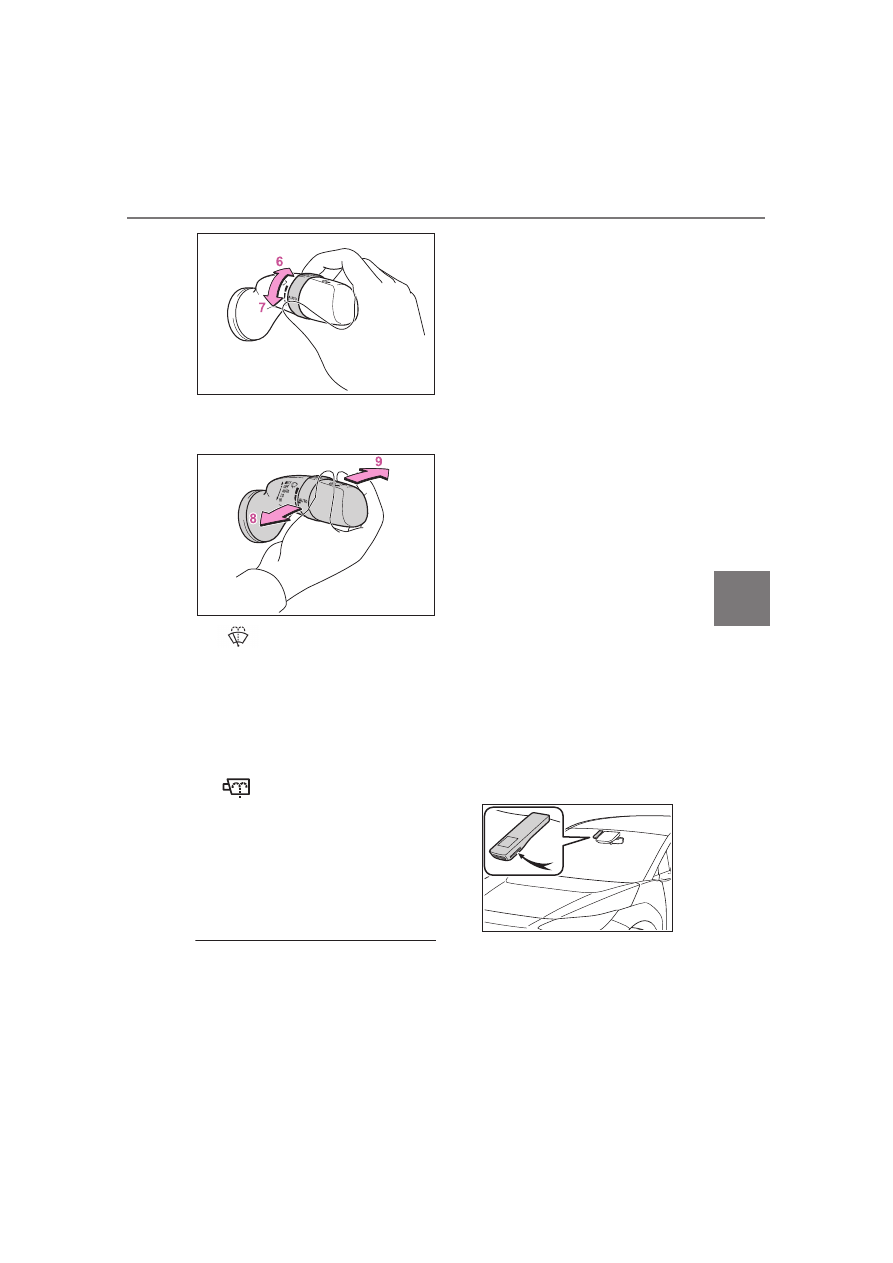
6

Increases the sensitivity

7

Decreases the sensitivity

8

 Washer/wiper dual 

operation

Pulling the lever operates the wip-
ers and washer.
The wipers will automatically oper-
ate a couple of times after the 
washer squirts.

9


*

 Digital inner mirror 

camera washer operation

Pushing the lever operates the Dig-
ital inner mirror camera washer and 
cleans the camera for the Digital 
inner mirror.

*

: Vehicles with Digital inner mirror

The windshield wipers and 

washer can be operated when

The power switch is in ON.

Effects of vehicle speed on 

wiper operation

Vehicles with intermittent wind-

shield wipers

With low speed windshield wiper 
operation selected, wiper operation 
will be switched from low speed to 
intermittent wiper operation when 
the vehicle is stationary. (However, 
when the wiper intervals are 
adjusted to highest level, the mode 
will not switch.)

Vehicles with rain-sensing wind-

shield wipers

With low speed windshield wiper 
operation selected, wiper operation 
will be switched from low speed to 
intermittent wiper operation when 
the vehicle is stationary. (However, 
when the sensor sensitivity is 
adjusted to the highest level, the 
mode will not switch.)

Raindrop sensor (vehicles with 

rain-sensing windshield wipers)

The raindrop sensor judges the 

amount of raindrops. An optical 

sensor is adopted. It may not 

operate properly when sunlight 

from the rising or setting of the 

sun intermittently strikes the wind-

shield, or if bugs, etc., are present 

on the windshield.

If the wiper switch is turned to the 

“AUTO” position while the power 

switch is in ON, the wipers will 

operate once to show that “AUTO” 

mode is activated.

If the wiper sensitivity is adjusted 

258

5-3. Operating the lights and wipers

to higher, the wiper may operate 

once to indicate the change of 

sensitivity.

If the temperature of the raindrop 

sensor is 194°F (90°C) or higher, 

or 5°F (-15°C) or lower, the auto-

matic operation may not occur. In 

this case, operate the wipers in 

any mode other than “AUTO”.

If no windshield washer fluid 

sprays

Check that the washer nozzles are 

not blocked if there is washer fluid in 

the windshield washer fluid reser-

voir.

WARNING

Caution regarding the use of 

windshield wipers in “AUTO” 

mode (vehicles with rain-

sensing windshield wipers)

The windshield wipers may oper-

ate unexpectedly if the sensor is 

touched or the windshield is sub-

ject to vibration in “AUTO” mode. 

Take care that your fingers or any-

thing else does not become 

caught in the windshield wipers.

Caution regarding the use of 

washer fluid

When it is cold, do not use the 

washer fluid until the windshield 

becomes warm. The fluid may 

freeze on the windshield and 

cause low visibility. This may lead 

to an accident, resulting in death 

or serious injury.

NOTICE

When the washer fluid tank is 

empty

Do not operate the switch continu-

ally as the washer fluid pump may 

overheat.

When a nozzle becomes 

blocked

In this case, contact your SUB-

ARU dealer.

Do not try to clear it with a pin or 

other object. The nozzle will be 

damaged.

To prevent 12-volt battery dis-

charge

Do not leave the wipers on longer 

than necessary when the EV sys-

tem is off.

259

5-4. Using the driving support systems

5

Dri
vin

g

5-4.Using the driving support systems

This Owner’s Manual contains 
information for Ver. 1. For the 
latest information about the con-
trols, use, warnings/precautions, 
etc., of each function of SUB-
ARU Safety Sense, refer to the 
Digital Owner’s Manual at the 
Owner’s Manual website.
If the software of this system 
has been updated after initial 
purchase of the vehicle, before 
using this system, be sure to 
read the Owner’s Manual which 

corresponds to the software ver-
sion of the system.

Precautions for use

Be aware that some functions 

may temporarily be disabled if a 

legal or safety related issue 

occurs.

If a connected services contract 

has not been entered or has 

expired, software updates will not 

be able to be performed wire-

lessly.

If the software of this system 
has been updated after initial 
purchase of the vehicle, to 
access the appropriate Owner’s 
Manual, it is necessary to check 
the software version of the sys-
tem and then visit the Owner’s 
Manual website.

Checking the version using 
SUBARU Solterra Connect 
Mobile App

The software version of the sys-
tem can be checked using One-
App.

Using your vehicle’s SUB-
ARU Safety Sense version

1

Access the following URL 
using a computer or smart-
phone:

SUBARU of America

https://www.subaru.com/
owners/vehicle-resources.html

Software update

It is necessary to enter a 
connected services con-
tract, provided by SUB-
ARU, to use these 
functions. For details, con-
tact your SUBARU dealer.

WARNING

For safe use

When the SUBARU Safety Sense 

software is updated, the operating 

methods of functions may 

change. Using this system without 

knowing the correct operating 

methods may lead to an accident 

resulting in death or serious injury.

Make sure to read the Digital 

Owner’s Manual which corre-

sponds to the software version 

of the system, available at the 

Owner’s Manual website, 

before using this system.

Content of the SUBARU 
Safety Sense Owner’s 
Manual

Checking your vehicle’s 
SUBARU Safety Sense 
version

260

5-4. Using the driving support systems

SUBARU Canada English

https://www.subaru.ca/manuals

SUBARU Canada French

https://www.subaru.ca/manuels

2

Select the file which includes 
the previously checked sys-
tem version.

If a software update is available, 
a notification will be displayed 
by SUBARU Solterra Connect 
Mobile App. Follow the instruc-
tions displayed on the screen.

Software update precautions

After a software update has been 

performed, it will not be possible 

to revert to a previous version.

Depending on the communication 

environment and the content of an 

update, a software update may 

take several hours. Although an 

update will be suspended when 

the power switch is turned off, it 

will resume when the power 

switch is changed back to ON.

SUBARU Safety Sense can still 

be used while a software update is 

being performed.

What can be checked using the 

SUBARU Solterra Connect 

Mobile App

The following items can be checked 

or performed.

Software version, update details, 

precautions, use methods, etc.

Software update

Updating the software

SUBARU Safety Sense

The SUBARU Safety Sense 
consists of the driving 
assist systems and contrib-
utes to a safe and comfort-
able driving experience:

WARNING

SUBARU Safety Sense

The SUBARU Safety Sense oper-

ates under the assumption that 

the driver will drive safely, and is 

designed to help reduce the 

impact to the occupants in a colli-

sion and assist the driver under 

normal driving conditions. As 

there is a limit to the degree of 

recognition accuracy and control 

performance that this system can 

provide, do not overly rely on this 

system. The driver is solely 

responsible for paying attention to 

the vehicle’s surroundings and 

driving safely.

For safe use

Do not overly rely on this sys-

tem. The driver is solely respon-

sible for paying attention to the 

vehicle’s surroundings and driv-

ing safely. This system may not 

operate in all situations and pro-

vided assistance is limited. 

Over-reliance on this system to 

drive the vehicle safely may 

lead to an accident resulting in 

death or serious injury.

Do not attempt to test the oper-

ation of the system, as it may 

not operate properly, possibly 

leading to an accident.

261

5-4. Using the driving support systems

5

Dri
vin

g

AHB (Automatic High 
Beam)

P.251

PCS (Pre-Collision System)

P.267

LTA (Lane Tracing Assist)

P.278

LDA (Lane Departure Alert)

P.283

RSA (Road Sign Assist)

P.288

WARNING

If attention is necessary while 

performing driving operations or 

a system malfunction occurs, a 

warning message or warning 

buzzer will be operated. If a 

warning message is displayed 

on the display, follow the 

instructions displayed.

Depending on external noise, 

the volume of the audio system, 

etc., it may be difficult to hear 

the warning buzzer. Also, 

depending on the road condi-

tions, it may be difficult to recog-

nize the operation of the 

system.

When it is necessary to dis-

able the system

In the following situations, make 

sure to disable the system.
Failure to do so may lead to the 

system not operating properly, 

possibly leading to an accident 

resulting in death or serious injury.

When the vehicle is tilted due to 

being overloaded or having a 

flat tire

When driving at extremely high 

speeds

When towing another vehicle

When the vehicle is being trans-

ported by a truck, ship, train, 

etc.

When the vehicle is raised on a 

lift and the tires are allowed to 

rotate freely

When inspecting the vehicle 

using a drum tester such as a 

chassis dynamometer or speed-

ometer tester, or when using an 

on vehicle wheel balancer

When the vehicle is driven in a 

sporty manner or off-road

When using an automatic car 

wash

When a sensor is misaligned or 

deformed due to a strong 

impact being applied to the sen-

sor or the area around the sen-

sor

When accessories which 

obstruct a sensor or light are 

temporarily installed to the vehi-

cle

When a compact spare tire or 

tire chains are installed to the 

vehicle or an emergency tire 

puncture repair kit has been 

used

When the tires are excessively 

worn or the inflation pressure of 

the tires is low

When tires other than the manu-

facturer specified size are 

installed

When the vehicle cannot be 

driven stably, due to a collision, 

malfunction, etc.

Driving assist systems

262

5-4. Using the driving support systems

Dynamic radar cruise con-
trol

P.290

Emergency Driving Stop 
System

P.301

Various sensors are used to 
obtain the necessary informa-
tion for system operation.

Sensors which detect the 
surrounding conditions

Front

Front radar sensor

Front camera

Rear (rear side radar sensors)

Sensors used by SUB-
ARU Safety Sense

WARNING

To prevent malfunction of the 

radar sensors

Observe the following precau-

tions. Failure to do so may lead to 

a radar sensor not operating prop-

erly, possibly leading to an acci-

dent resulting in death or serious 

injury.

Keep the radar sensors and 

radar sensor covers clean at all 

times.

Clean the front of a radar sensor 
or the front or back of a radar sen-
sor cover if it is dirty or covered 
with water droplets, snow, etc.
When cleaning the radar sensor 
and radar sensor cover, use a soft 
cloth to remove dirt so as to not 
damage them.

Radar sensor

Radar sensor cover

Do not attach accessories, 

stickers (including transparent 

stickers), aluminum tape, etc., 

to a radar sensor or radar sen-

sor cover and their surrounding 

area.

Do not subject a radar sensor or 

its surrounding area to impact. If 

a radar sensor, the front grille, 

or front bumper has been sub-

jected to a impact, have the 

vehicle inspected by your SUB-

ARU dealer.

263

5-4. Using the driving support systems

5

Dri
vin

g

WARNING

Do not disassemble the radar 

sensors.

Do not modify or paint the radar 

sensors or radar sensor cover, 

or replace them with anything 

other than SUBARU genuine 

parts.

In the following situations, recal-

ibration of the radar sensors will 

be necessary. For details, con-

tact by your SUBARU dealer.

• When a radar sensor is 

removed and installed, or 

replaced

• When the front bumper or the 

front grille has been replaced

Radar sensor cover with a 

heater

When the system determines that 

snow may pile up over the radar 

sensor cover, the heater will oper-

ate automatically. If the area 

around the radar sensor cover is 

to be touched, such as during 

cleaning, make sure that the radar 

sensor cover is cool enough to 

prevent burns.

To prevent malfunction of the 

front camera

Observe the following precau-

tions. Failure to do so may lead to 

the front camera not operating 

properly, possibly leading to an 

accident resulting in death or seri-

ous injury.

Always keep the windshield 

clean.

• If the windshield is dirty or cov-

ered with an oily film, water 

droplets, snow, etc., clean the 

windshield.

• Even if a glass coating agent is 

applied to the windshield, it will 

still be necessary to use the 

windshield wipers to remove 

water droplets, etc., from the 

area of the windshield in front of 

the front camera.

• If the inner side of the wind-

shield where the front camera is 

installed is dirty, contact your 

SUBARU dealer

Do not attach stickers (including 

transparent stickers) or other 

items to the area of the wind-

shield in front of the front cam-

era (shaded area in the 

illustration).

Approximately 1.6 in. (4 cm)

Approximately 1.6 in. (4 cm)

If the part of the windshield in 

front of the front camera is 

fogged up or covered with con-

densation or ice, use the wind-

shield defogger to remove the 

fog, condensation, or ice.

If water droplets cannot be 

properly removed from the area 

of the windshield in front of the 

front camera by the windshield 

wipers, replace the wiper insert 

or wiper blade.

264

5-4. Using the driving support systems

Situations in which the sensors 

may not operate properly

When the height or inclination of 

the vehicle has been changed due 

to modifications

When the windshield is dirty, 

fogged up, cracked or damaged

When the ambient temperature is 

high or low

When mud, water, snow, dead 

insects, foreign matter, etc., is 

attached to the front of the sensor

When in inclement weather such 

as heavy rain, fog, snow, or a 

sandstorm

When water, snow, dust, etc., is 

thrown up in front of the vehicle, or 

when driving through mist or 

smoke

When the headlights are not illu-

minated while driving in the dark, 

such as at night or when in a tun-

nel

When the lens of a headlight is 

dirty and illumination is weak

When the headlights are mis-

aligned

When a headlight is malfunction-

ing

When a the headlights of another 

vehicle, sunlight, or reflected light 

shines directly into the front cam-

WARNING

Do not attach window tint to the 

windshield.

Replace the windshield if it is 

damaged or cracked. If the 

windshield has been replaced, 

recalibration of the front camera 

will be necessary. For details, 

contact your SUBARU dealer.

Do not allow liquids to contact 

the front camera.

Do not allow bright lights to 

shine into the front camera.

Do not damage the lens of the 

front camera or allow it to 

become dirty. When cleaning 

the inside of the windshield, do 

not allow glass cleaner to con-

tact the lens of the front camera. 

Do not touch the lens of the 

front camera. If the lens of the 

front camera is dirty or dam-

aged, contact your SUBARU 

dealer.

Do not subject the front camera 

to a strong impact.

Do not change the position or 

orientation of the front camera 

or remove it.

Do not disassemble the front 

camera.

Do not modify any parts around 

the front camera, such as the 

inside rear view mirror or ceil-

ing.

Do not attach accessories 

which may obstruct the front 

camera to the hood, front grille, 

or front bumper. For details, 

contact your SUBARU dealer.

If a surfboard or other long 

object is to be mounted on the 

roof, make sure that it will not 

obstruct the front camera.

Do not modify or change the 

headlights and other lights.

Front camera installation area 

on the windshield

If the system determines that the 

windshield may be fogged up, it 

will automatically operate the 

heater to defog the part of the 

windshield around the front cam-

era. When cleaning, etc., be care-

ful not to touch the area around 

the front camera until the wind-

shield has cooled sufficiently, as 

touching it may cause burns.

265

5-4. Using the driving support systems

5

Dri
vin

g

era

When the brightness of the sur-

rounding area changes suddenly

When driving near a TV tower, 

broadcasting station, electric 

power plant, radar equipped vehi-

cles, etc., or other location where 

strong radio waves or electrical 

noise may be present

When a wiper blade is blocking 

the front camera

When in a location or near objects 

which strongly reflect radio waves, 

such as the following:

• Tunnels

• Truss bridges

• Gravel roads

• Rutted, snow-covered roads

• Walls

• Large trucks

• Manhole covers

• Guardrail

• Metal plates

When near a step or protrusion

When a detectable vehicle is nar-

row, such as a small mobility vehi-

cle

When a detectable vehicle has a 

small front or rear end, such as an 

unloaded truck

When a detectable vehicle has a 

low front or rear end, such as a 

low bed trailer

When a detectable vehicle has 

extremely high ground clearance

When a detectable vehicle is car-

rying a load which protrudes from 

its cargo area

When a detectable vehicle has lit-

tle exposed metal, such as a vehi-

cle which is partially covered with 

cloth, etc.

When a detectable vehicle is 

irregularly shaped, such as a trac-

tor, sidecar, etc.

When the distance between the 

vehicle and a detectable vehicle 

has become extremely short

When a detectable vehicle is at an 

angle

When snow, mud, etc., is attached 

to a detectable vehicle

When driving on the following 

kinds of roads:

• Roads with sharp curves or wind-

ing roads

• Roads with changes in grade, 

such as sudden inclines or 

declines

• Roads which is sloped to the left 

or right

• Roads with deep ruts

• Roads which are rough and 

unmaintained

• Roads which frequently undulate 

or are bumpy

When the steering wheel is being 

operated frequently or suddenly

When the vehicle is not in a con-

stant position within a lane

When parts related to this system, 

the brakes, etc., are cold or 

extremely hot, wet, etc.

When the wheels are misaligned

When driving on slick road sur-

266

5-4. Using the driving support systems

faces, such as when it is covered 

with ice, snow, gravel, etc.

When the course of the vehicle 

differs from the shape of a curve

When the vehicle speed is exces-

sively high when entering a curve

When entering/exiting a parking 

lot, garage, car elevator, etc.

When driving in a parking lot

When driving through an area 

where there are obstructions 

which may contact your vehicle, 

such as tall grass, tree branches, 

a curtain, etc.

Situations in which the lane 

may not be detected

When the lane is extremely wide 

or narrow

Immediately after changing lanes 

or passing through an intersection

When driving in a temporary lane 

or lane regulated by construction

When there are structures, pat-

terns, shadows which are similar 

to lane lines in the surrounding

When the lane lines are not clear 

or driving on a wet road surface

When a lane line is on a curb

When driving on a bright, reflec-

tive road surface, such as con-

crete

Situations in which some or all 

of the functions of the system 

cannot operate

When a malfunction is detected in 

this system or a related system, 

such as the brakes, steering, etc.

When the VSC, TRAC, or other 

safety related system is operating

When the VSC, TRAC, or other 

safety related system is off

Changes in brake operation 

sound and pedal response

When the brakes have been oper-

ated, brake operation sounds may 

be heard and the brake pedal 

response may change, but this 

does not indicate a malfunction.

When the system is operating, the 

brake pedal may feel stiffer than 

expected or sink. In either situa-

tion the brake pedal can be 

depressed further. Further 

depress the brake pedal as nec-

essary.

Certification

P.623

267

5-4. Using the driving support systems

5

Dri
vin

g

The system can detect the fol-
lowing as detectable objects. 
(Detectable objects differ 
depending on the function.)

Vehicles

Bicycles

*

Pedestrians

Motorcycles

*

PCS (Pre-Collision Sys-

tem)

The pre-collision system 
uses sensors to detect 
objects (

P.267) in the path 

of the vehicle. When the 
system determines that the 
possibility of a frontal colli-
sion with a detectable 
object is high, a warning 
operates to urge the driver 
to take evasive action and 
the potential brake pressure 
is increased to help the 
driver avoid the collision. If 
the system determines that 
the possibility of a collision 
is extremely high, the 
brakes are automatically 
applied to help avoid the 
collision or help reduce the 
impact of the collision.

The pre-collision system can 
be disabled/enabled and the 
warning timing can be 
changed. (

P.277)

WARNING

For safe use

Driving safely is solely the 

responsibility of the driver. Pay 

careful attention to the sur-

rounding conditions in order to 

ensure safe driving. Never use 

the pre-collision system in place 

of normal braking operations. 

This system cannot help avoid 

or reduce the impact of a colli-

sion in every situation. Over-

reliance on this system to drive 

the vehicle safely may lead to 

an accident resulting in death or 

serious injury.

Although the pre-collision sys-

tem is designed to help avoid or 

help reduce the impact of a col-

lision, its effectiveness may 

change according to various 

conditions. Therefore, it may not 

always be able to achieve the 

same level of performance. 

Read the following items care-

fully. Do not overly rely on this 

system and always drive care-

fully.

• For safe use: 

P.260

When to disable the pre-colli-

sion system

When it is necessary to disable 

the system: 

P.261

Detectable objects

268

5-4. Using the driving support systems

*

: Detected as a detectable object 

only when being ridden.

Pre-collision warning

When the system determines 
that the possibility of a collision 
is high, a buzzer will sound and 
an icon and warning message 
will be displayed on the multi-
information display to urge the 
driver to take evasive action.
If the detectable object is a vehi-
cle, moderate braking will be 
performed with the warning.

“Pre-Collision System”

If the system determines that 
the accelerator pedal is strongly 
depressed, the following icon 
and message will be displayed 
on the multi-information display.

“Accelerator Pedal is 
Pressed”

Pre-collision brake assist

If the system determines that 
the possibility of a collision is 
high and the brake operation by 
the driver is insufficient, the 
braking power will be increased.

Pre-collision brake control

If the system determines that 
the possibility of a collision is 
extremely high, the brakes are 
automatically applied to help 
avoid the collision or reduce the 
impact of the collision.

Emergency steering assist

If the system determines that 
the following conditions are met, 
assistance will be provided to 
help enhance vehicle stability 
and prevent lane departure. 
During assistance, in addition to 
the pre-collision warning, the fol-
lowing icon will be displayed on 
the multi-information display.

The possibility of a collision is 
high

There is sufficient space 
within the lane to perform 
evasive steering maneuvers

The driver is operating the 
steering wheel

During assistance, the pre-colli-
sion warning will operate and a 
message will be displayed to 
warn the driver.

System functions

269

5-4. Using the driving support systems

5

Dri
vin

g

Intersection collision avoid-
ance support (left/right 
turn)

In situations such as the follow-
ing, if the system determines 
that the possibility of a collision 
is high, the pre-collision warning 
and pre-collision braking will 
operate. Depending on the inter-
section, assistance may not 
operate correctly.

When turning left/right at an 
intersection and crossing the 
path of an oncoming vehicle

When turning left/right and an 
oncoming pedestrian or bicy-
cle is detected

Intersection collision avoid-
ance support (crossing 
vehicles)

At an intersection, etc., if the 
system determines that the pos-
sibility of a collision with an 
approaching vehicle or motorcy-
cle is high, the pre-collision 
warning and pre-collision brak-
ing will operate. Depending on 
the intersection, assistance may 
not operate correctly.

Acceleration Suppression 
at Low Speed

When driving at a low speed, if 
the accelerator pedal is strongly 
depressed and the system 
determines that there is a possi-
bility of a collision, EV system 
output will be restrained or the 
brakes will be applied weakly to 
restrict acceleration. During 

270

5-4. Using the driving support systems

operation, a buzzer will sound 
and a warning indicator and 
message will be displayed on 
the multi-information display.

“Accelerator Pedal is 
Pressed”

WARNING

Pre-collision braking

When the pre-collision braking 

function is operating, a large 

amount of braking force will be 

applied.

Pre-collision braking function is 

not intended for remain 

stopped. If the vehicle is 

stopped by pre-collision brak-

ing function, the driver should 

operate the brakes as neces-

sary.

The pre-collision braking func-

tion may not operate if certain 

operations are performed by the 

driver. If the accelerator pedal is 

being depressed strongly or the 

steering wheel is being turned, 

the system may determine that 

the driver is taking evasive 

action and possibly prevent the 

pre-collision braking function 

from operating.

If the brake pedal is being 

depressed, the system may 

determine that the driver is tak-

ing evasive action and possibly 

delay the operation timing of the 

pre-collision brake control.

Acceleration Suppression at 

Low Speed

If the steering wheel is being 

turned, the system may determine 

that the driver is taking evasive 

action and possibly prevent the 

Acceleration Suppression at Low 

Speed function from operating.

Emergency steering assist

The emergency steering assist 

will be canceled when the sys-

tem determines that lane depar-

ture prevention control has 

completed.

Depending on operations per-

formed by the driver, emer-

gency steering assist may not 

operate or operation may be 

canceled.

• If the accelerator pedal is 

depressed strongly, the steering 

wheel is turned heavily, the 

brake pedal is depressed, or the 

turn signal lever is operated, the 

system may determine that the 

driver is taking evasive action 

and the emergency steering 

assist may not operate.

• While the emergency steering 

assist is operating, if the accel-

erator pedal is depressed 

strongly, the steering wheel is 

turned heavily, or the brake 

pedal is depressed, the system 

may determine that the driver is 

taking evasive action and emer-

gency steering assist operation 

may be canceled.

271

5-4. Using the driving support systems

5

Dri
vin

g

Operating conditions of each function of the pre-collision system

The pre-collision system is enabled and the system determines that the pos-

sibility of a frontal collision with a detected object is high.
However, the system will not operate in the following situations:

When the vehicle has not been driven a certain amount after a terminal of 

the 12-volt battery has been disconnected and reconnected

When the shift position is in R

When the VSC OFF indicator is illuminated (only the pre-collision warning 

function will be operational)

The following are the operational speeds and cancelation conditions of each 

function:

Pre-collision warning

While the pre-collision warning is operating, if the steering wheel is operated 

heavily or suddenly, the pre-collision warning may be canceled.

WARNING

• While the emergency steering 

assist is operating, if the steer-

ing wheel is held or turned in the 

opposite direction of system 

operation, emergency steering 

assist operation will be can-

celed.

Detectable objects

Vehicle speed

Relative speed between 

your vehicle and object

Preceding vehicles, 

stopped vehicles

Approximately 3 to 110 

mph (5 to 180 km/h)

Approximately 3 to 110 

mph (5 to 180 km/h)

Oncoming vehicles

Approximately 20 to 110 

mph (30 to 180 km/h)

Approximately 50 to 130 

mph (80 to 220 km/h)

Bicycles

Approximately 3 to 50 

mph (5 to 80 km/h)

Approximately 3 to 50 

mph (5 to 80 km/h)

Pedestrians

Approximately 3 to 50 

mph (5 to 80 km/h)

Approximately 3 to 50 

mph (5 to 80 km/h)

Preceding motorcycles, 

stopped motorcycles

Approximately 3 to 110 

mph (5 to 180 km/h)

Approximately 3 to 50 

mph (5 to 80 km/h)

Oncoming motorcycles

Approximately 20 to 110 

mph (30 to 180 km/h)

Approximately 20 to 110 

mph (30 to 180 km/h)

272

5-4. Using the driving support systems

Pre-collision brake assist

Pre-collision braking

If either of the following occur while the pre-collision braking function is oper-

ating, it will be canceled:
• The accelerator pedal is strongly depressed
• The steering wheel is operated heavily or suddenly

Detectable objects

Vehicle speed

Relative speed between 

your vehicle and object

Preceding vehicles, 

stopped vehicles

Approximately 20 to 110 

mph (30 to 180 km/h)

Approximately 7 to 110 

mph (10 to 180 km/h)

Bicycles

Approximately 20 to 50 

mph (30 to 80 km/h)

Approximately 20 to 50 

mph (30 to 80 km/h)

Pedestrians

Approximately 20 to 50 

mph (30 to 80 km/h)

Approximately 20 to 50 

mph (30 to 80 km/h)

Preceding motorcycles, 

stopped motorcycles

Approximately 20 to 110 

mph (30 to 180 km/h)

Approximately 7 to 50 

mph (10 to 80 km/h)

Detectable objects

Vehicle speed

Relative speed between 

your vehicle and object

Preceding vehicles, 

stopped vehicles

Approximately 3 to 110 

mph (5 to 180 km/h)

Approximately 3 to 110 

mph (5 to 180 km/h)

Oncoming vehicles

Approximately 20 to 110 

mph (30 to 180 km/h)

Approximately 50 to 130 

mph (80 to 220 km/h)

Bicycles

Approximately 3 to 50 

mph (5 to 80 km/h)

Approximately 3 to 50 

mph (5 to 80 km/h)

Pedestrians

Approximately 3 to 50 

mph (5 to 80 km/h)

Approximately 3 to 50 

mph (5 to 80 km/h)

Preceding motorcycles, 

stopped motorcycles

Approximately 3 to 110 

mph (5 to 180 km/h)

Approximately 3 to 50 

mph (5 to 80 km/h)

Oncoming motorcycles

Approximately 20 to 110 

mph (30 to 180 km/h)

Approximately 20 to 110 

mph (30 to 180 km/h)


Content      ..     14      15      16      17     ..