Subaru Solterra (2023 year). Manual in english - page 14
 

  Index      Manuals     Subaru Solterra (2023 year). Manual in english


Search            copyright infringement  


Content      ..     12      13      14      15     ..


Subaru Solterra (2023 year). Manual in english - page 14


225

5-1. Before driving

5

Dri
vin

g

Cargo capacity

Total load capacity (vehicle 
capacity weight) (

P.554)

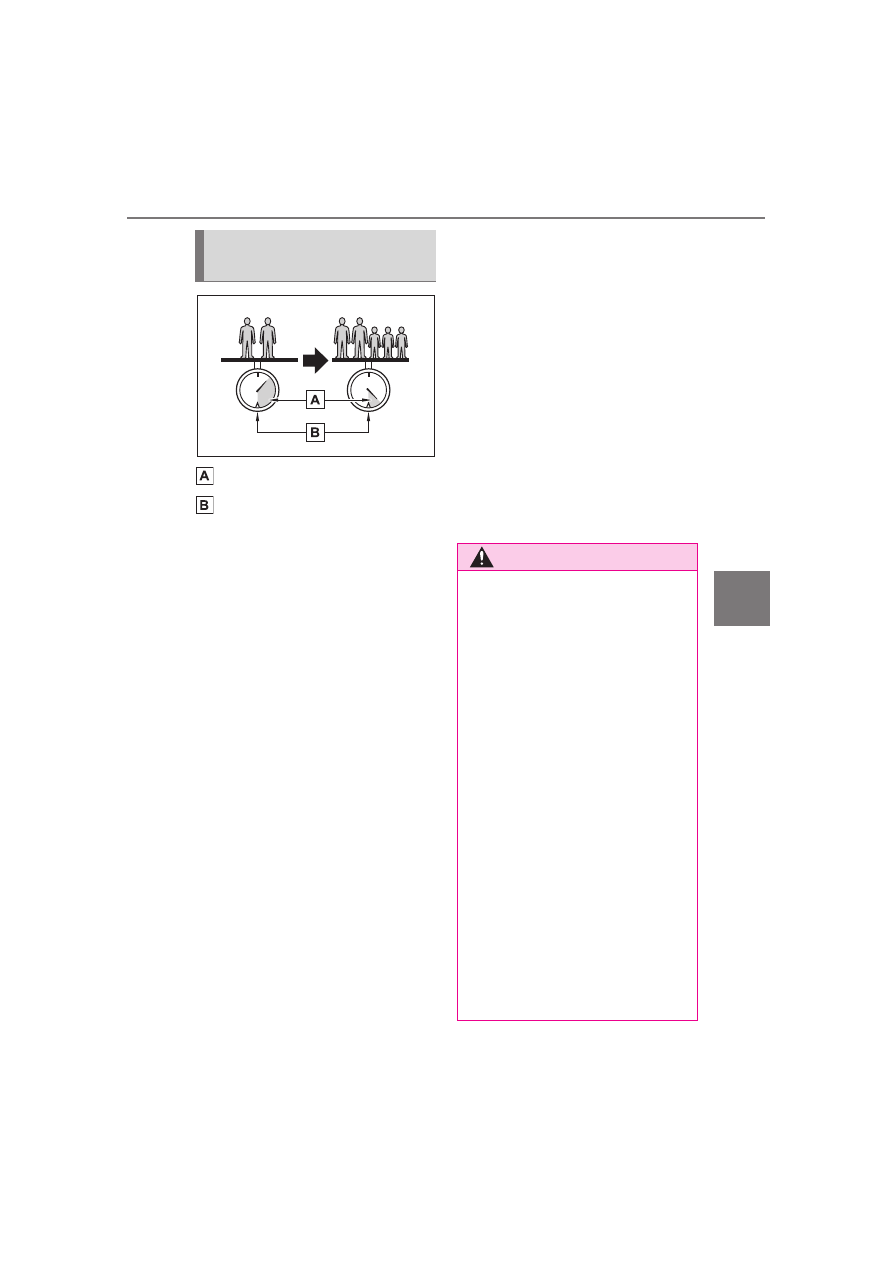
When 2 people with the com-
bined weight of A lb. (kg) are rid-
ing in your vehicle, which has a 
total load capacity (vehicle 
capacity weight) of B lb. (kg), 
the available amount of cargo 
and luggage load capacity will 
be C lb. (kg) as follows:

B

*2

 lb. (kg) - A

*1

 lb. (kg) = C

*3

 lb. 

(kg)

*1

:A = Weight of people

*2

:B = Total load capacity

*3

:C = Available cargo and luggage 

load

In this condition, if 3 more passen-
gers with the combined weight of D 
lb. (kg) get on, the available cargo 
and luggage load will be reduced E 
lb. (kg) as follows:

C lb. (kg) - D

*4

 lb. (kg) = E

*5

 lb. 

(kg)

*4

:D = Additional weight of people

*5

:E = Available cargo and luggage 

load

As shown in the example above, 
if the number of occupants 
increases, the cargo and lug-
gage load will be reduced by an 
amount that equals the 
increased weight due to the 
additional occupants. In other 
words, if an increase in the num-
ber of occupants causes an 
excess of the total load capacity 
(combined weight of occupants 
plus cargo and luggage load), 
you must reduce the cargo and 
luggage on your vehicle.

Calculation formula for 
your vehicle

WARNING

When loading cargo on the 

roof luggage carrier (if 

equipped)

Observe the following precau-

tions:

Place the cargo so that its 

weight is distributed evenly 

between the front and rear 

axles.

If loading long or wide cargo, 

never exceed the vehicle overall 

length or width. (

P.554)

Before driving, make sure the 

cargo is securely fastened on 

the roof luggage carrier.

Loading cargo on the roof lug-

gage carrier will make the cen-

ter of gravity of the vehicle 

higher. Avoid high speeds, sud-

den starts, sharp turns, sudden 

braking or abrupt maneuvers, 

otherwise it may result in loss of 

control or vehicle rollover due to 

failure to operate this vehicle 

correctly and result in death or 

serious injury.

226

5-1. Before driving

Roof tents may be used under 
certain conditions at your own 
risk.

When driving the vehicle

The total weight on the roof 
rails, including the roof cross-
bars and roof tent, must not 
exceed the vehicle’s roof rail 
load of 176 lb. (80 kg), evenly 
distributed.

WARNING

If driving for a long distance, on 

rough roads, or at high speeds, 

stop the vehicle now and then 

during the trip to make sure the 

cargo remains in its place.

The maximum load limit of the 

cargo, roof luggage carrier kit 

and carrying attachments must 

not exceed 176 lb. (80 kg).

NOTICE

When loading cargo on the 

roof luggage carrier (if 

equipped)

Be careful not to scratch the sur-

face of the panoramic moon roof 

(if equipped).

Roof tent (models with 
roof rails)

WARNING

For safe use

Adding weight to the vehicle’s roof 

can adversely affect handling, 

braking, and rollover resistance. 

The vehicle must never be driven 

with a total roof rail load in excess 

of 176 lb. (80 kg).

NOTICE

When loading cargo on the 

roof luggage carrier

The roof rail load limit for sta-

tionary vehicles (700 lb. [317 

kg]) applies only when the vehi-

cle is parked and the load is 

evenly distributed left/right and 

front/rear and the roof crossbars 

and roof tent are tightly secured 

to the vehicle. If these condi-

tions are not met, the load limit 

will be lower.

The maximum load limit of the 

roof crossbars must be obtained 

from the manufacturer or 

retailer of the roof rack. When 

driving the vehicle, the maxi-

mum roof rail load is 176 lb. (80 

kg) or the crossbar load limit 

(whichever is lower).

Roof tents can only be used on 

vehicles originally equipped with 

roof rails. Otherwise, damage to 

the vehicle’s roof may occur.

227

5-1. Before driving

5

Dri
vin

g

Roof rails

Roof crossbars

Roof tent

B + C < 176 lb. (80 kg)

When the vehicle is parked 
on level ground

Roof rails

Roof crossbars

Roof tent

Occupants in the roof tent

The total weight on the roof 
rails – including the roof 
crossbars, roof tent, and all 
occupants and contents in the 
roof tent – must not exceed 
either the vehicle’s roof rail 
load limit (700 lb. [317 kg]), 
evenly distributed, or the load 
limit of the roof crossbars, 
whichever is lower.

Load limit of the roof rail (A). 
B + C + D < 700 lb. (317 kg)

Exceeding this load limit could 
cause damage to the vehicle 
or racking system. The vehi-

228

5-1. Before driving

cle must never be driven with 
occupants in the roof tent. 
Before the vehicle is driven, 
occupants and cargo must be 
removed from the roof tent 
and the roof rail load must be 
restored to within the roof rail 
load limit of 176 lb. (80 kg). 
Refer to the user manual that 
accompanied the roof tent for 
important safety information 
and instructions on the proper 
installation and use of the 
tent.

Total load capacity and seating 

capacity

These details are also described on 

the tire and loading information 

label. (

P.494)

Vehicle load limits

Vehicle load limits include 
total load capacity, seating 
capacity, TWR (Trailer 
Weight Rating) and cargo 
capacity.

Total load capacity (vehicle 
capacity weight): 

P.554

Total load capacity means the 
combined weight of occu-
pants, cargo and luggage.

Seating capacity: 

P.554

Seating capacity means the 
maximum number of occu-
pants whose estimated aver-
age weight is 150 lb. (68 kg) 
per person.

TWR (Trailer Weight Rat-
ing)

SUBARU does not recom-
mend towing a trailer with 
your vehicle.

Cargo capacity

Cargo capacity may increase 
or decrease depending on the 
weight and the number of 
occupants.

229

5-1. Before driving

5

Dri
vin

g

WARNING

Overloading the vehicle

Do not overload the vehicle. It 

may not only cause damage to 

the tires, but also degrade steer-

ing and braking ability, resulting in 

an accident.

Trailer towing

SUBARU does not recom-
mend towing a trailer with 
your vehicle. SUBARU also 
does not recommend the 
installation of a tow hitch or 
the use of a tow hitch car-
rier for a wheelchair, 
scooter, bicycle, etc. Your 
vehicle is not designed for 
trailer towing or for the use 
of tow hitch mounted carri-
ers.

230

5-1. Before driving

Dinghy towing

Your vehicle is not designed 
to be dinghy towed (with 4 
wheels on the ground) 
behind a motor home.

NOTICE

To avoid serious damage to 

your vehicle

Do not tow your vehicle with 4 

wheels on the ground.

231

5-2. Driving procedures

5

Dri
vin

g

5-2.Driving procedures

1

Check that the charging 
cable is disconnected. 
(

P.103, 111)

2

Pull the parking brake switch 
to check that the parking 
brake is set. (

P.243)

The parking brake indicator will 

come on.

3

Firmly depress the brake 
pedal.

 and a message will be dis-

played on the multi-information dis-
play.
If it is not displayed, the EV system 
cannot be started.
When the shift position is in N, the 
EV system cannot start. Shift the 
shift position to P when starting the 
EV system. (

P.237)

4

Press the power switch 
shortly and firmly.

When operating the power switch, 

one short, firm press is enough. It is 

not necessary to press and hold the 

switch.
If the “READY” indicator turns on, 

the EV system will operate nor-

mally.

Continue depressing the brake 

pedal until the “READY” indicator is 

illuminated.
The EV system can be started from 

any power switch mode.

5

Check that the “READY” indi-
cator is illuminated.

The vehicle cannot be driven if the 

“READY” indicator is off.

Power switch illumination

According to the situation, the 

power switch illumination operates 

as follows.

When driver’s door or front pas-

senger’s door is opened, the 

power switch illumination illumi-

nates.

When the power switch is in OFF 

and depressing the brake pedal 

with carrying the electronic key on 

your person, the power switch illu-

mination blinks.

When the power switch is in ACC 

or ON, the power switch illumina-

tion illuminates.

When the power switch mode is 

changed from ACC or ON to OFF, 

the power switch illumination illu-

minates for a certain amount of 

time. Afterwards, the power switch 

illumination turns off.

If the EV system does not start

The immobilizer system may not 

have been deactivated. (

P.66)

Contact your SUBARU dealer.

The charging cable may be con-

Power (ignition) 

switch

Performing the following 
operations when carrying 
the electronic key on your 
person starts the EV system 
or changes power switch 
modes.

Starting the EV system

232

5-2. Driving procedures

nected to the vehicle. (

P.87)

If a message related to start-up is 

shown on the multi-information 

display, read the message and fol-

low the instructions.

If the door is unlocked with the 

mechanical key, the EV system 

cannot be started using the smart 

key system. Refer to P.543 to start 

the EV system. However, if the 

electronic key is carried inside the 

vehicle and the doors are locked 

(

P.168), the EV system can be 

started.

When the ambient temperature 

is low, such as during winter 

driving conditions

When starting the EV system, the 

flashing time of the “READY” indi-

cator may be long. Leave the 

vehicle as it is until the “READY” 

indicator is steady on, as steady 

means the vehicle is able to move.

When the traction battery is 

extremely cold (below approxi-

mately -22°F [-30°C]) under the 

influence of the outside tempera-

ture, it may not be possible to start 

the EV system. In this case, try to 

start the EV system again after the 

temperature of the traction battery 

increases due to the outside tem-

perature increase, etc.

Sounds and vibrations specific 

to a battery electric vehicle

P.72

If the 12-volt battery is dis-

charged

The EV system cannot be started 

using the smart key system. Refer 

to P.544 to restart the EV system.

Electronic key battery depletion

P.160

Conditions affecting operation

P.183

Note for the entry function

P.183

If there is a malfunction in the 

smart key system

If “Smart Key System Malfunction” 

is displayed on the multi-information 

display, the system may be malfunc-

tioning. Have the vehicle inspected 

by your SUBARU dealer immedi-

ately.

If the “READY” indicator does 

not come on

In the event that the “READY” indi-

cator does not come on even after 

performing the proper procedures 

for starting the vehicle, contact your 

SUBARU dealer immediately.

If the EV system is malfunction-

ing

P.78

Electronic key battery

P.500

Operation of the power switch

If the switch is not pressed shortly 

and firmly, the power switch mode 

may not change or the EV system 

may not start.

If attempting to restart the EV sys-

tem immediately after turning the 

power switch to OFF, the EV sys-

tem may not start in some cases. 

After turning the power switch to 

OFF, please wait a few seconds 

before restarting the EV system.

Customization

If the smart key system has been 

deactivated in a customized setting, 

refer to P.543.

WARNING

When starting the EV system

Always start the EV system while 

sitting in the driver’s seat. Do not 

depress the accelerator pedal 

while starting the EV system 

under any circumstances. 

Doing so may cause an accident 

resulting in death or serious injury.

233

5-2. Driving procedures

5

Dri
vin

g

1

Stop the vehicle completely.

2

Set the parking brake. 
(

P.243)

3

Press the P position switch. 
(

P.237)

Check that the shift position indica-

tor shows P and the parking brake 

indicator is illuminated.

4

Press the power switch.

The EV system will stop, and the 

meter display will be extinguished 

(the shift position indicator will be 

extinguished a few seconds after 

the meter display).

5

Release the brake pedal and 
check that “ACCESSORY” or 
“POWER ON” is not shown 
on the meter.

Automatic EV system shut off 

feature

The vehicle is equipped with a 

feature that automatically shuts off 

the EV system when the shift posi-

tion is in P with the EV system 

operating for an extended period.

The EV system will automatically 

shut off after approximately 1 hour 

if it has been left operating while 

the shift position is in P.

The timer for the automatic EV 

system shut off feature will reset if 

the brake pedal is depressed or if 

the shift position is in a position 

other than P.

After the vehicle is parked, if the 

door is locked with the door lock 

switch (

P.168) from the inside or 

the mechanical key (

P.542) from 

the outside, the automatic EV sys-

tem shut off feature will be dis-

abled. The timer for the automatic 

EV system shut off feature will be 

re-enabled if the driver’s door is 

opened.

When the shift control system 

malfunctions

When attempting to turn the power 

switch off while there is a malfunc-

tion in the shift control system, the 

power switch mode may change to 

ACC. In this case, ACC may be 

turned off by applying the parking 

brake and pressing the power 

switch again.

If there is a malfunction in the sys-

tem, have the vehicle inspected by 

your SUBARU dealer immediately.

Automatic P position selection 

function

P.238

NOTICE

When starting the EV system

If the EV system becomes difficult 

to start, have your vehicle 

checked by your SUBARU dealer 

immediately.

Symptoms indicating a mal-

function with the power 

switch

If the power switch seems to be 

operating somewhat differently 

than usual, such as the switch 

sticking slightly, there may be a 

malfunction. Contact your SUB-

ARU dealer immediately.

Stopping the EV system

234

5-2. Driving procedures

Modes can be changed by 
pressing the power switch with 
the brake pedal released. (The 
mode changes each time the 
switch is pressed.)

WARNING

Stopping the EV system in an 

emergency

If you want to stop the EV sys-

tem in an emergency while driv-

ing the vehicle, press and hold 

the power switch for more than 

2 seconds, or press it briefly 3 

times or more in succession. 

(

P.509)

However, do not touch the 

power switch while driving 

except in an emergency. Turn-

ing the EV system off while driv-

ing will not cause a loss of 

steering or braking control. 

However, power assist for the 

steering wheel may be lost mak-

ing it difficult to steer smoothly 

before stopping the vehicle 

depending on the remaining 

charge in the 12-volt battery or 

usage conditions. In this situa-

tion, you should pull over and 

stop the vehicle as soon as it is 

safe to do so.

If the power switch is operated 

while the vehicle is running, a 

warning message will be shown 

on the multi-information display 

and a buzzer sounds.

When restarting the EV system 

after an emergency shutdown, 

press the power switch shortly 

and firmly.

When parking

Exhaust gases include harmful 

carbon monoxide (CO), which is 

colorless and odorless. Observe 

the following precautions.
Failure to do so may cause 

exhaust gases to enter the vehicle 

and may lead to an accident 

caused by light-headedness, or 

may lead to death or a serious 

health hazard.

If the vehicle is in a poorly venti-

lated area or a closed area, 

such as a garage, stop the EV 

system.

Do not leave the vehicle with 

the EV system operating for a 

long time. If such a situation 

cannot be avoided, park the 

vehicle in an open space and 

ensure that exhaust fumes do 

not enter the vehicle interior.

Do not leave the EV system 

operating in an area with snow 

build-up, or where it is snowing. 

If snowbanks build up around 

the vehicle while the EV system 

is operating, exhaust gases 

may collect and enter the vehi-

cle.

Changing power switch 
modes

235

5-2. Driving procedures

5

Dri
vin

g

“ACCESSORY”

“POWER ON”

1

OFF

The emergency flashers can be 
used.

2

ACC

*

Some electrical components such 
as the audio system can be used.
“ACCESSORY” will be displayed 
on the multi-information display.

3

ON

All electrical components can be 
used.
“POWER ON” will be displayed on 
the multi-information display.

*

: Setting can be customized. 

(

P.576)

Auto power off function

If the vehicle is left in ACC for more 

than 20 minutes or ON (the EV sys-

tem is not operating) for more than 

an hour with the shift position in P, 

the power switch will automatically 

turn off. However, this function can-

not entirely prevent the 12-volt bat-

tery discharge. Do not leave the 

vehicle with the power switch in 

ACC or ON for long periods of time 

when the EV system is not operat-

ing.

NOTICE

To prevent 12-volt battery dis-

charge

Do not leave the power switch 

in ACC or ON for long periods of 

time without the EV system on.

If “ACCESSORY” or “POWER 

ON” is displayed on the multi-

information display, the power 

switch is not in OFF. Exit the 

vehicle after turning the power 

switch to OFF.

236

5-2. Driving procedures

Restraining sudden start (Drive-

Start Control)

P.223

If a message about a shift oper-

ation is shown

To prevent the shift position from 

being selected incorrectly or the 

vehicle from moving unexpectedly, 

the shift position may be changed 

automatically or operating the rotary 

shifter may be required. In this case, 

change the shift position following 

the messages on the multi-informa-

tion display.

After recharging/reconnecting 

the 12-volt battery

P.471

Transmission

Select the shift position 
depending on your pur-
pose and situation.

Shift position purpose 
and functions

Shift position Objective or function

P

Parking the vehi-

cle/starting the EV 

system

R

Reversing

N

Neutral 

(Condition in which 

the power is not 

transmitted)

D

Normal driving

WARNING

When driving on slippery 

road surfaces

Be careful of sudden acceleration, 

as this could result in the vehicle 

skidding to the side or spinning.

NOTICE

Situations where shift control 

system malfunctions are pos-

sible

If any of the following situations 

occur, shift control system mal-

functions are possible. Immedi-

ately stop the vehicle in a safe 

place on level ground, apply the 

parking brake, and then contact 

your SUBARU dealer.

When the warning message 

indicating the shift control sys-

tem malfunction appears on the 

multi-information display. 

(

P.525)

The display indicates that no 

shift position is selected for 

more than a few seconds.

237

5-2. Driving procedures

5

Dri
vin

g

Rotary shifter

Operate the dial shift slowly and 
securely.
To switch to N, hold down the dial 
shift and hold it for a while.
To switch to R or D, hold down the 
dial shift and turn left or right 
according to the arrow on the shift 
position indicator.
Release the rotary shifter after each 
shifting operation to allow it to 
return to its regular position.
When shifting from P to N, D or R, 
from N, D or R to P, from D to R, or 
from R to D, ensure that the brake 
pedal is being depressed and the 
vehicle is stationary.

Shift position indicator

Meter display:
The current shift position is illumi-

nated.
Rotary shifter display:
The current shift position is illumi-
nated.
When selecting the shift position, 
make sure that the shift position 
has been changed to the desired 
position by checking the shift posi-
tion indicator provided on the 
instrument cluster.

P position switch

Fully stop the vehicle and set the 
parking brake, and then press the P 
position switch.
When the shift position is changed 
to P, the switch illuminates.
Check that the shift position indica-
tor shows P.

Changing the shift position in 

each power switch mode

The shift position cannot be 

changed when the power switch is 

in ACC or off.

When the power switch is in ON, if 

the “READY” indicator is not illu-

minated, the shift position can 

only be changed to N.

When the “READY” indicator is 

illuminated, the shift position can 

be changed from P to D, N, or R.

When the “READY” indicator is 

flashing, the shift position cannot 

be changed from P to any other 

position, even if the rotary shifter 

is operated. Operate the rotary 

shifter again after the “READY” 

indicator changes from flashing to 

illuminated.

Shifting the shift position from 

P to other positions

While depressing the brake pedal 

firmly, operate the rotary shifter. If 

the rotary shifter is operated with-

out depressing the brake pedal, 

the buzzer will sound and the 

Shift position display and 
how to change the shift 
position

238

5-2. Driving procedures

shifting operation will be disabled.

When selecting the shift position, 

make sure that the shift position 

has been changed to the desired 

position by checking the shift posi-

tion indicator provided on the 

instrument cluster.

The shift position cannot be 

changed when

In the following situations, a buzzer 

will sound to inform you that the shift 

position cannot be changed. Use 

the appropriate operation to attempt 

to change the shift position again.

When attempting to change the 

shift position from P with the brake 

pedal not depressed

When attempting to change the 

shift position from P with the 

accelerator pedal depressed

When attempting to change the 

shift position from N while stopped 

or driving at an extremely low 

speed with the brake pedal not 

depressed

When attempting to change the 

shift position from N while stopped 

or driving at an extremely low 

speed with the accelerator pedal 

depressed

When the P position switch is 

pressed while driving

When driving at an extremely low 

speed, the shift position may 

change to P.

The shift position automatically 

changes to N when

In the following situations, a buzzer 

will sound to inform you that the shift 

position has been changed to N. 

Use the appropriate operation to 

attempt to change the shift position 

again.

When attempting to change the 

shift position to R while the vehicle 

is moving forward

When driving at a low speed, the 
shift position may change to R.

When attempting to change the 

shift position to D while the vehicle 

is moving backward

When driving at a low speed, the 
shift position may change to D.

When N is selected while driv-

ing

When selecting N while traveling at 

a speed above a certain level, hold 

the rotary shifter at the N position.

Automatic P position selection 

function

In the following situations, the shift 

position is automatically changed to 

P.

When pressing the power switch 

with the vehicle stopped while the 

power switch is in ON and the shift 

position is in a position other than 

P (after the shift position has been 

changed to P, the power switch 
will turn off)

*

If the driver’s door is opened and 

all of the following conditions are 

met, while the shift position is in a 

position other than P:

• The power switch is in ON.

• The driver is not wearing the seat 

belt.

• The brake pedal is not depressed.
To start off the vehicle after the shift 
position is changed to P, operate the 
rotary shifter again.

When the vehicle is stopped after 

the EV system has been stopped 

in an emergency while driving

When voltage of the 12-volt bat-

tery drops while the shift position 

is in a position other than P

*

: When the power switch is pressed 

while driving at extremely slow 
speeds, such as immediately 
before stopping the vehicle, the 
shift position may automatically 
change to P. Make sure that the 
vehicle is completely stopped 
before pressing the power switch.

239

5-2. Driving procedures

5

Dri
vin

g

If the shift position cannot be 

shifted from P

There is a possibility that the 12-volt 

battery is discharged. Check the 12-

volt battery in this situation. 

(

P.544)

Customization

Some functions can be customized. 

(

P.576)

By performing the following 
operation, the shift position 
can be held in N until the shift 
position switches to P without 
activating the automatic P 
position selection function.

1

Operate the rotary shifter and 
change the shift position to N 
when the EV system is oper-
ating.

2

Return the rotary shifter to its 
regular position.

3

Operate the rotary shifter to 
N and hold it there until the 
buzzer sounds.

4

Press the power switch within 
5 seconds after the buzzer 
sounds.

The EV system stops with the shift 
position in N

*

Make sure to check that the buzzer 

sounds and “Holding N Push P 

Switch When Done” is displayed on 

the multi-information display.

In order to shift to a position 
other than N, first press the P 

WARNING

For the rotary shifter

Do not remove the rotary shifter 

knob or use anything but a gen-

uine SUBARU rotary shifter 

knob. Also, do not hang any-

thing on the rotary shifter. 

Doing so could prevent the 

rotary shifter from returning to 

position, causing unexpected 

accidents to occur when the 

vehicle is in motion.

In order to prevent the shift 

position from accidentally being 

changed, do not touch the 

rotary shifter when not using it.

P position switch

Do not press the P position 

switch while the vehicle is mov-

ing.

If the P position switch is 

pressed when driving at very 

low speeds (for example, 

directly before stopping the 

vehicle), the vehicle may stop 

suddenly when the shift position 

switches to P, which could lead 

to an accident.

In order to prevent the shift 

position from accidentally being 

changed, do not touch the P 

position switch when not using 

it.

NOTICE

When exiting the vehicle 

(driver’s seat only)

Check that the shift position indi-

cator shows P and that the park-

ing brake indicator is illuminated 

before opening the door and exit-

ing the vehicle.

Keeping the shift position 
in N without activating the 
automatic P position 
selection function

240

5-2. Driving procedures

position switch to change the 
shift position to P.

If the automatic P position 
switching operation selection 
function is performed oper-
ated with the EV system 
stopped, the automatic P 
position selection function 
may not operate.
Always perform the operation 
with the EV system started.

*

: To keep this state, do not operate 

the power switch. If the power 
switch is operated repeatedly, the 
power switch will turn off after the 
shift position has automatically 
changed to P.

Drive mode select switch

P.384

“X-MODE”

P.385

By setting the shift position to D 
and operating the paddle shift 
switches, the vehicle can drive 
with the regenerative braking 
force fixed when the accelerator 
pedal is released.
The regenerative braking force 
can be selected from 4 levels.
By operating the “-” side of the 
paddle shift switch, the regener-

ative braking force can be made 
stronger than the current one.
By operating the “+” side of the 
paddle shift switch, the regener-
ative braking force can be made 
weaker than the current one.

The regenerative braking power 
becomes strong as the number 

of the arrows 

 of 


(regenerative braking power 
indicator) on the multi-informa-
tion display increases.

Paddle shift switch “-”

Paddle shift switch “+”

Indicator

How to cancel the regenerative 

braking force selection mode

In the following conditions, the 

regenerative braking force selection 

mode is canceled.

The shift position is shifted to a 

position other than D

The “+” paddle shift switch is 

pressed and held

When “X-MODE” is activated

When the “S PEDAL DRIVE” is 

operating

Selecting the drive mode

How to operation the 
regenerative braking 
force selection mode


Content      ..     12      13      14      15     ..