Peugeot 1007 Dag (2008.5). Instruction - part 9
 

  Index      Peugeot     Peugeot 1007 Dag 2008.5 - instruction in english


Search            


Content   ..  7  8  9  10   ..


Peugeot 1007 Dag (2008.5). Instruction - part 9


9

123

               CHANGING A FUSE 

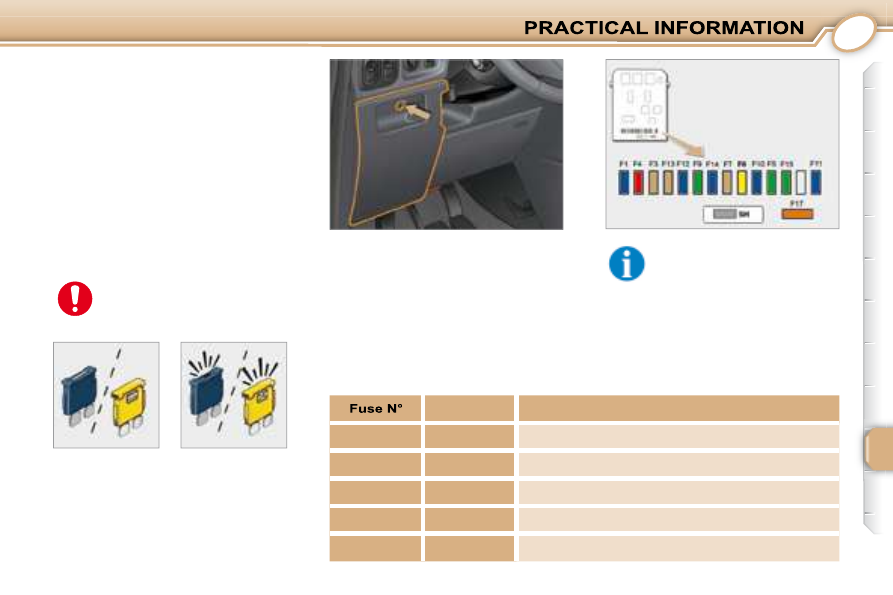
 The fuse boxes are located under the 
fascia on the left-hand side and in the 
engine compartment next to the bat-
tery. 

  Correct  

  Removing and fitting a fuse 

 Before changing a fuse you must fi nd 

out the cause of the fault and have it 
put right. The fuse numbers are indi-
cated on the fuse box. 

  Incorrect  

  *    The maxi fuses provide ad-

ditional  protection  for  the 
electrical systems. All work 
must  be  carried  out  by  a 
 PEUGEOT  dealer.  

  Always  replace  a  faulty 
fuse  with  one  of  the  same 
rating.
  

 Fascia fuse box

     Turn the screw a quarter of a turn, 

then tilt the cover to open it.

    Turn the lever a quarter of a turn, 

then push and tilt the box to gain 
access to the fuses.

Rating

Functions

FH1*

-

Not used.

FH2*

40 A

Trailer Fuse Box.

FH3*

20 A

Heated seats.

FH4*

20 A

Audio amplifi er.

FH5*

5 A

"Sesame" doors control unit.

9

123

               CHANGING A FUSE 

 The fuse boxes are located under the 
fascia on the left-hand side and in the 
engine compartment next to the bat-
tery. 

  Correct  

  Removing and fitting a fuse 

 Before changing a fuse you must fi nd 

out the cause of the fault and have it 
put right. The fuse numbers are indi-
cated on the fuse box. 

  Incorrect  

  *    The maxi fuses provide ad-

ditional  protection  for  the 
electrical systems. All work 
must  be  carried  out  by  a 
 PEUGEOT  dealer.  

  Always  replace  a  faulty 
fuse  with  one  of  the  same 
rating.
  

 Fascia fuse box

     Turn the screw a quarter of a turn, 

then tilt the cover to open it.

    Turn the lever a quarter of a turn, 

then push and tilt the box to gain 
access to the fuses.

Rating

Functions

FH1*

-

Not used.

FH2*

40 A

Trailer Fuse Box.

FH3*

20 A

Heated seats.

FH4*

20 A

Audio amplifi er.

FH5*

5 A

"Sesame" doors control unit.

9

124

Fuse N°

Rating

Functions

1

15 A

Rear wiper.

3

5 A

Air bags and pre-tensioners control unit.

4

10 A

Diagnostic socket - Clutch switch - Steering wheel angle sensor - 

Particle emission fi lter pump.

5

30 A

Electric windows - Sunroof.

6

-

Not used.

7

5 A

Courtesy light - Glove box lighting.

8

20 A

Tyre under-infl ation detection control unit - Electric mirror folding - Alarm siren - 

Multifunction display - Alarm control unit - Audio equipment - Audio/telephone.

9

30 A

Audio equipment - Lighter/12 V socket (100 W max).

10

15 A

Steering wheel controls.

11

15 A

Diagnostic socket - Low current ignition switch - Motorised strikers.

12

15 A

Air bags and pre-tensioners control unit - Rain/brightness sensor.

13

5 A

ABS relay - Speed sensor - Engine Fuse Box - "2 Tronic" gear lever - Brake switch.

14

15 A

Parking assistance control unit - "Sesame" doors control unit and switches - 
Instrument panel - Seat belt warning lights bar - Air conditioning control panel - 
Headlamp adjustment - Hands-free kit.

15

30 A

Locking - Deadlocking - Unlocking.

17

40 A

Rear screen and exterior mirrors demisting.

SH

-

PARC shunt.

9

125

  Engine compartment fuse box 

      Unclip the cover to gain access to 

the fuses. 

     Once  the  work  has  been  carried 

out, close the cover very carefully.  

Fuse N°

Rating

Functions

MF1**

50 A

Fan assembly.

MF2**

30 A

ABS/ESP control unit.

MF3**

30 A

ABS/ESP control unit.

MF4**

60 A

Built-in Systems Interface supply.

MF5**

60 A

Built-in Systems Interface supply.

MF6**

30 A

"2 Tronic" gearbox control unit.

MF7**

80 A

Passenger compartment fuse box - 
"Sesame" doors control unit.

MF8**

80 A

Electric power steering.

Your  vehicle's  electrical  sys-
tem  is  designed  to  operate 
with  standard  or  optional 
equipment.

** 

The  maxi  fuses  provide  addi-
tional protection for the electrical 
systems.  All  work  must  be  car-
ried out by a PEUGEOT dealer.

Before  installing 

other  electrical 

equipment  or  accessories  on  your 
vehicle, contact a PEUGEOT dealer.

Some  electrical  accessories  or  the 

way in which they are fi tted may have 

damaging effects on the operation of 
your vehicle (audio, control and elec-
trical load circuits).

PEUGEOT  will  not  accept  responsi-
bility for the cost incurred in repairing 
your vehicle or for rectifying malfunc-
tions  resulting  from  the  installation 
of auxiliary accessories not supplied 
and not recommended by PEUGEOT 
and  not  installed  in  accordance  with 
its  instructions,  in  particular  where 
the equipment in question consumes 
more than 10 milliamperes.

9

126

Fuse N°

Rating

Functions

1

20 A

Engine control unit supply and fan assembly control - Engine control unit main relay - 
Injection control unit (Diesel) - Injection pump (Diesel) - Air heating solenoid valves (Diesel) - 

Air fl ow sensor (Diesel).

2

15 A

Horn.

3

10 A

Front and rear wash-wipe pump.

4

20 A

Headlamp wash pump.

5

15 A

Fuel pump (petrol).

6

10 A

Power steering control unit - Water in diesel sensor - Vehicle speed sensor.

7

10 A

Switching and protection unit (Diesel) - Engine coolant level detector (Diesel).

8

25 A

Starter.

9

10 A

ABS/ESP control unit - ABS cut-off relay - Brake switch.

10

30 A

Engine control unit actuators (petrol: ignition coils, oxygen sensors, injectors, purge 
canister and variable timing solenoid valves, controlled thermostat) (Diesel: injection 

control unit, air fl ow sensor, injection pump, diesel high pressure regulator, EGR and Turbo 

pressure regulation solenoid valves) - Blow-by heaters - Diesel heater.

11

40 A

Air blowers.

12

30 A

Windscreen wipers (low/high speed).

13

40 A

(ignition positive) Built-In Systems Interface.

14

-

Not used.

15

10 A

Right main beam headlamp.

16

10 A

Left main beam headlamp.

17

15 A

Left dipped headlamp.

18

15 A

Right dipped headlamp.

9

127

 CHANGING A WINDSCREEN 
WIPER BLADE  

  Changing a front wiper blade 
      Lift the wiper arm. 
     Unclip the blade and remove it. 
     Fit the new blade. 
     Push back the wiper arm.  
  Note:

  the shortest blade is fi tted on 

the right-hand wiper arm. 

  Changing the rear wiper blade 
      Lift the wiper arm. 
     Unclip the blade and remove it. 
     Fit the new blade. 
     Push back the wiper arm.    

 ECONOMY MODE 
FUNCTION 

 After the engine has stopped, certain 
functions  (doors,  windscreen  wipers, 
electric windows, courtesy light, audio 
equipment,  dipped  headlamps,  etc.) 
can  only  be  used  for  a  cumulative 
duration of thirty minutes, to prevent 
discharging of the battery. 
 Once  the  thirty  minutes  are  over,  a 
message informing you of the switch 
to  economy  mode  appears  on  the 
multifunction  display  and  the  active 
functions are put on standby. 
 These  functions  are  reactivated 
automatically next time the vehicle is 
driven. 
 To resume the use of these functions 
immediately, start the engine and let 
it run for a few minutes. 
 The time available to you will then be 
double the duration for which the en-
gine is left running. However, this pe-

riod will always be between fi ve and 

thirty minutes. 
  Note:  if the telephone is being used 
when  economy  mode  starts,  it  will 

still be possible to fi nish the call. 

 A fl at battery will prevent the 

engine from starting. 

 FITTING/REMOVING THE MAT 

 When  removing  the  mat  on  the  dri-
ver's side, push the seat as far back 

as possible and remove the fi xings. 

 When  refi tting,  position  the  mat 

correctly  on  the  pins  and  clip  the 

fi xings. Check that the mat is secured 

correctly. 
 To  prevent  the  mat  from  becoming 
caught under the pedals: 
   -  

only  use  mats  suited  to  the 

fi xings  already  present  in  the 

vehicle. It is imperative that these 

fi xings are used. 

  -  

never  fi t  one  mat  on  top  of 

another.  

  Placing the wiper blades in the 
special position 
      Less than a minute after switching 

off  the  ignition,  operate  the  wip-
ers  stalk  to  position  the  wiper 
blades in the centre of the wind-
screen.   

  To  return  the  windscreen  wipers 
to their normal position, switch on 
the ignition and operate the wipers 
stalk.
   

9

128

         BATTERY 

 The batteries contain harmful 
substances such as sulphuric 
acid and lead. They must be 
disposed  of  in  accordance 

with  regulations  and  must  never  be 
discarded with household waste. 
 Take  used  remote  control  and  vehi-
cle  batteries  to  a  special  collection 
point.  

  To start the vehicle from 
another battery: 

   -  

Connect the red cable to the positive 
(+) terminals of the two batteries, 

  -  

Connect  the  green  or  black  ca-
ble  to  the  negative  (-)  terminals 
of the two batteries, 

  -  

Operate  the  starter,  let  the  en-
gine run, 

  -  

Wait  for  the  engine  to  return  to 
idle, then disconnect the cables.  

 Before 

disconnecting 

the 

battery,  you  must  wait  for 
2 minutes  after  switching  off 
the ignition. 

 Never  disconnect  a  terminal  when 
the engine is running. 
 Never  charge  a  battery  without  fi rst 

disconnecting the terminals. 
 Close  the  windows,  the  sunroof  and 
the  doors  before  disconnecting  the 
battery.  If  they  do  not  operate  nor-
mally  following  reconnection  of  the 
battery,  they  must  be  reinitialised 
(see  sections  "Sesame  doors"  and 
"Sunroof"). 

 After  every  reconnection  of  the  bat-
tery: 
   -  

switch  on  the  ignition  and  wait 
1  minute  before  starting  to  al-
low the electronic systems to be 

initialised. If slight diffi culties are 

experienced  after  this,  please 
contact a  PEUGEOT  dealer. 

  -  

reinitialise  the  "2  Tronic"  gearbox 
(refer to the corresponding section).  

   A.   Flat battery 
  B.   Slave battery   

  It is advisable to disconnect 
the battery if the vehicle is 
not to be used for a period 
of more than one month.
  

  To charge the battery using a 
battery charger: 

   -  

Disconnect the battery, 

  -  

Follow  the  instructions  for  use 
given  by  the  battery  charger 
manufacturer, 

  -  

Reconnect starting with the nega-
tive (-) terminal, 

  -  

Check  that  the  terminals  and 
connectors are clean. If they are 
covered  with  sulphate  (white  or 
greenish  deposit),  disconnect 
them and clean them.  

9

129

       TOWING YOUR VEHICLE 

  From the rear:  
      Unclip the side of the cover using 

the fl at part of the towing eye, 

     Screw  in  the  towing  eye  until  it 

locks.   

 When  towing  with  the  en-
gine switched off, there is no 
braking assistance.  

  Special features of 
the "2 Tronic" gearbox 

 When towing with four wheels on the 
ground,  the  following  rules  must  be 
obeyed: 
   -  

gear lever in position  N , 

  -  

tow  the  vehicle  at  less  than 
30 mph  (50  km/h)  over  a  maxi-
mum distance of 30 miles (50 km). 

  -  

do not add oil to the gearbox.  

  From the front:  
      Unclip  the  bottom  of  the  cover, 

using  the  fl at  part  of  the  towing 

eye. 

     Screw  in  the  towing  eye  until  it 

locks.  

  Lifting 
(2 wheels only on the road) 

 It is preferable to raise the vehicle by 
the wheels. 
  Never use the radiator crossmember.   

  Without lifting 
(4 wheels on the road) 

 You should always use a towbar. 
 The  removable  towing  eye  is  stored 
in  the  tool  case,  located  in  the  left 
boot trim. 

  Vehicles fitted with a manual 
gearbox (diesel version) 

 In  the  case  of  vehicles  fi tted  with  a 

manual gearbox, the gear lever must 
be in the neutral position. 
 Failure to observe this special condi-
tion may result in damage to certain 
braking components and the absence 
of  braking  assistance  the  next  time 
the engine is started.  

9

130

       TOWING A TRAILER, 
CARAVAN, BOAT, etc. 

 We  recommend  the  use  of  original 
 PEUGEOT   towbars  and  their  har-
nesses  that  have  been  tested  and 
approved  from  the  design  stage  of 

your vehicle and that the fi tting of the 

towbar  is  entrusted  to  a   PEUGEOT  
dealer. 
 If  the  towbar  is  not  fi tted  by  a 

 PEUGEOT   dealer,  it  is  imperative 

that  it  is  fi tted  using  the  electrical 

pre-equipment  installed  at  the  rear 
of the vehicle, in accordance with the 
manufacturer's instructions. 
 Your  vehicle  is  primarily  designed 
for  transporting  people  and  luggage 
but it may also be used for towing a 
trailer. 
 Driving with a trailer subjects the tow-

ing vehicle to more signifi cant stress 

and  its  driver  must  be  particularly 
careful. 
 Air  density  decreases  with  altitude, 
thus  reducing  engine  performance. 
Above  1 000  metres,  the  maximum 
towing load must be reduced by 10 % 
and so on for every 1 000 metres of 
altitude. 

  Cooling:  Towing a trailer on a slope 
increases  the  temperature  of  the 
coolant. 
 As  the  fan  is  electrically  controlled, 
its cooling capacity is not dependent 
on the engine speed. 
 On  the  contrary,  use  a  high  gear  to 
lower  the  engine  speed  and  reduce 
your speed. 
 The maximum towing load on a long 
slope  depends  on  the  gradient  and 
the outside temperature. 
 In all cases, pay attention to the cool-
ant temperature. 
 In  certain  cases  of  particularly  ardu-
ous  use  (towing  the  maximum  load 
on a steep gradient in high tempera-
tures), switching off the air condition-
ing  permits  the  recovery  of  engine 
power  and  therefore  an  increase  in 
the towing capacity. 
 If  the  warning  light  comes  on,  stop 
the vehicle and switch off the engine 
as soon as possible. 
  Tyres:   Check  the  tyre  pressures  of 
the  towing  vehicle  and  of  the  trailer, 
observing  the  recommended  pres-
sures. 
  Braking:  Towing increases the brak-
ing distance. 
  Lights:   Check  the  electrical  signal-
ling on the trailer. 
  Side wind:  Take into account the in-
creased sensitivity to side wind.  

     FITTING ROOF BARS 

 When  fi tting  transverse  or  longitudi-

nal  roof  bars,  use  the  accessories 
recommended  by   PEUGEOT   and 

follow  the  manufacturer's  fi tting  in-

structions. 
 For  further  information,  contact  a 
 PEUGEOT  dealer. 
  Maximum  authorised  weight  on 
the roof bars: 60 kg
  
 Please  refer  to  national  legislation  in 
order  to  comply  with  the  regula-
tions  concerning  the  transportation  of 
objects  which  are  longer  than  the 
vehicle. 

  Driving advice 

  Distribution of loads:  Distribute the 
load in the trailer so that the heaviest 
items are as close as possible to the 
axle  and  the  nose  weight  approach-
es  the  maximum  permitted  without 
exceeding it. 

9

131

     ACCESSORIES FOR 
YOUR 1007 

 A  wide  range  of  accessories  recom-
mended  by  PEUGEOT  and  original 
parts are offered by the Network. 
 They  all  benefi t  from  PEUGEOT's 

recommendation. 
 These accessories and parts, having 
been  tested  and  approved  for  reli-
ability  and  safety,  are  all  adapted  to 
your PEUGEOT vehicle. 

 The fi tting of electrical equip-

ment  or  accessories  which 
are  not  recommended  by 
PEUGEOT  may  result  in  a 

failure  of  your  vehicle's  electronic 
system. 
 Please  note  this  specifi c  warning. 

You  are  advised  to  contact  a  repre-
sentative of the Marque to be shown 
the  range  of  recommended  equip-
ment and accessories. 
 Depending  on  the  country  in  which 
the vehicle is sold, it is compulsory to 
have  a  safety  jacket,  warning  trian-
gle  and  spare  bulbs  available  in  the 
vehicle. 

  "Protection":  

anti-theft 

alarm  ,  engraved  windows, 
wheel  anti-theft  devices, 
system  which  assists  with 

the identifi cation of a stolen 

vehicle,  fi rst  aid  kit,  warn-

ing  triangle,  high  visibility 
safety jacket, fog lamps kit, 
snow chains, non-skid cov-
ers,  audible  rear  parking 
assistance. 

  "Touring":  

central 

arm-

rest, storage under the rear 
shelf,  mats * ,  boot  tray,  sun 
blinds. 
 For  leisure  pursuits:  roof 
bars, 

transportation 

ac-

cessories  (bicycle  carrier, 
ski  carrier),  roof  box,  child 

seats  and  booster  cushions,  audio/
telephone console, cool box. 

  "In-Car Technology":  hands-
free  kits,  satellite  navigation 
systems,  CD  changer,  DVD 
player, 

multimedia, 

audio 

equipment,  speakers,  auxil-
iary  audio  socket  permitting 
the  connection  of  a  portable 
MP3  player  (compatible  with 
WIP Sound), USB socket. 

  "Styling":   seat  covers,  al-
loy  wheels,  wheel  trims, 
spoiler,  styling  strips,  door 
spoilers, 

sill 

protectors, 

aluminium  footrest,  rear  si-
lencer, exhaust tail pipe. 

  "Universal":  

windscreen 

wash  fl uid,  interior  and  ex-

terior  cleaning  and  mainte-
nance products. 

 You can obtain "Van" conver-
sion kits for conversion from 
a private vehicle to a van. 
 You 

can 

obtain 

other 

"Cameleo" customising kits 
from PEUGEOT dealers. 
 You  will  be  offered  either  a 

complete kit, like the original kit, or a 
partial kit consisting of the vent trims 
only. 
 Should  you  need  to  change  one  or 
more elements of the Cameleo kit of 
your  vehicle,  due  to  damage...,  you 
will be offered replacement elements 
from  the  exchange  kits  available  at 
that time. 

 This  product  range  offered  by  PEUGEOT 
Accessories is structured around 5 catego-
ries: PROTECTION - TOURING - IN-CAR 
TECHNOLOGY - STYLING - UNIVERSAL. 

  *   

 To  prevent  jamming  under  the 
pedals: 

   -  

ensure that the mat is positioned 
and secured correctly, 

  -  

never  fi t  one  mat  on  top  of  an-

other.   

 Trailer towbar which must be fi tted by 

the PEUGEOT network. 

10

10

132

  *   Draining by gravity with oil fi ller cap open.  

  MODELS:  

   ENGINES AND GEARBOXES   

  Model codes:  
KM...
  

   KFVC   

   NFUC   

   NFUC/P   

  PETROL ENGINES  

   1.4 litre  

(75 bhp)   

   1.6 litre 16V  

(110 bhp)   

 Cubic capacity (cm

3

  1 360  

  1 587  

 Bore x stroke (mm) 

  75 x 77  

  78.5 x 82  

 EU standard maximum power (kW) 

  54  

  80  

 Maximum power engine speed (rpm) 

  5 400  

  5 800  

 EU standard maximum torque (Nm) 

  118  

  147  

 Maximum torque engine speed (rpm) 

  3 400  

  4 000  

 Fuel 

  Unleaded  

  Unleaded  

 Catalytic converter 

  Yes  

  Yes  

  Gearboxes  

  Manual  

(5-speed)  

  Manual  

(5-speed)  

  "2 Tronic"  

(5-speed)  

  Oil capacities (in litres)  


 Engine (with cartridge replacement) 

  3.15 *   

  3.35 *   

  3.35 *   

 Gearbox - Final drive 

  2  

  2  

  -  

10

10

133

  MODELS:  

   ENGINES AND GEARBOXES   

  Model codes:  
KM...
  

   8HZC   

   9HZC   

  DIESEL ENGINES  

   1.4 litre Turbo HDI  

(70 bhp)   

   1.6 litre Turbo HDI 16V  

(110 bhp)   

 Cubic capacity (cm

3

  1 398  

  1 560  

 Bore x stroke (mm) 

  73.7 x 82  

  75 x 88.3  

 EU standard maximum power (kW) 

  50  

  80  

 Maximum power engine speed (rpm) 

  4 000  

  4 000  

 EU standard maximum torque (Nm) 

  160  

  240  

 Maximum torque engine speed (rpm) 

  2 000  

  1 750  

 Fuel 

  Diesel  

  Diesel  

 Catalytic converter 

  Yes  

  Yes  

 Particle emission fi lter 

  No  

  Yes  

  Gearboxes  

  Manual  

(5-speed)  

  Manual  

(5-speed)  

  Oil capacities (in litres)  


 Engine (with cartridge replacement) 

  3.8    

  3.75    

 Gearbox - Final drive 

  1.9  

  1.9  

10

10

134

   CONSUMPTION   

   In accordance with EC Directive 80/1268/CEE (as amended)   

   Engines   

   Gearboxes   

   Model

codes KM...   

   Urban driving 

mpg (l/100 km)   

   Inter-urban 

driving

(l/100 km)   

   Mixed driving 

(l/100 km)   

   Emission of 

CO

2

 by weight 

(g/km)   

   1.4 litre   

   Manual   

   KFVC   

  8.6  

  5.2  

  6.5  

  153  

   1.6 litre 16V   

   Manual   

   NFUC   

  9.2  

  5.5  

  6.9  

  163  

   "2 Tronic"   

   NFUC/P   

  8.6  

  5.4  

  6.6  

  156  

   1.4 litre Turbo HDI   

   Manual   

   8HZC   

  5.6  

  3.9  

  4.5  

  120  

   1.6 litre Turbo

HDI 16V   

   Manual   

   9HZC   

  6.0  

  4.1  

  4.8  

  125  

   Quality of the fuel used for petrol engines 
 The petrol engines are perfectly compatible with E5 type petrol biofuels (containing 5 % ethanol), conforming to European 

standard EN 228. 

 E85 type fuels (containing up to 85 % ethanol) are reserved exclusively for vehicles marketed for the use of this type of fuel 

(BioFlex vehicles). The quality of the ethanol must comply with European standard EN 15376. 

 For Brazil only, special vehicles are marketed to run on fuels containing up to 100 % ethanol (type E100).  

   Quality of the fuel used for Diesel engines 
 The Diesel engines are perfectly compatible with biofuels which conform to current and future European standards (diesel 

fuel which complies with standard EN 590 mixed with a biofuel which complies with standard EN 14214) which can be distributed 

at the pumps (possible incorporation of 0 to 7 % Fatty Acid Methyl Ester). 

 The use of any other type of (bio) fuel (vegetable or animal oils, domestic fuel...) is strictly prohibited (risk of damage to the 

engine and fuel circuit).  

Fuel consumption indications correct at time of printing.

 The consumption values were established in accordance with EC Directive 80/1268/CEE (as amended). They may vary de-

pending on the style of driving, traffi c conditions, weather conditions, the load in the vehicle, the maintenance of the vehicle 

and the use of the equipment. 

10

10

135

  **    The weight of the braked trailer may be increased, within the limit of the GTW, if the GVW of the towing vehicle is reduced 

by the same amount; warning, towing with a lightly loaded towing vehicle may reduce its road holding performance.  

  ***   In accordance with current legislation in your country.  

 The GTW and towed load values indicated are valid up to an altitude of 1 000 metres; the towed load mentioned must be 

reduced by 10 % for each additional 1 000 metres. 

 The speed of a towing vehicle must not exceed 60 mph (100 km/h)  ***  .

High exterior temperatures may result in a reduction in the performance of the vehicle in order to protect the engine; when 

the exterior temperature is above 37 °C, limit the towed load

   WEIGHTS AND TOWED LOADS (in kg)   

  Petrol engines  

   1.4 litre   

   1.6 litre 16V   

  Gearboxes  

   Manual   

   Manual   

   "2 Tronic"   

Model codes:   KM...

   KFVC   

   NFUC   

   NFUC/P   

  Unladen weight

1 140

1 203

1 216

  Kerb weight

1 215

1 278

1 291

  Payload

339

328

305

  Gross vehicle weight (GVW)

1 554

1 606

1 596

  Gross train weight (GTW)

2 304

2 506

2 496

  Braked trailer (within the limit of the 

GTW)

750

900

900

  Braked trailer **  (with load transfer 

within the limit of the GTW)

987

1 090

1 137

  Unbraked trailer

605

635

645

  Recommended nose weight

40

44

46

10

10

136

   WEIGHTS AND TOWED LOADS (in kg)   

  Diesel engines  

   1.4 litre Turbo HDI   

   1.6 litre Turbo HDI 16V   

  Gearboxes  

   Manual   

   Manual   

  Model codes: KM...  

8HZC

9HZC

  Unladen weight

1 168

1 273

  Kerb weight

1 243

1 348

  Payload

339

307

  Gross vehicle weight (GVW)

1 582

1 655

  Gross train weight (GTW)

2 482

2 555

  Braked trailer (within the limit of the 

GTW)

900

900

  Braked trailer **  (with load transfer 

within the limit of the GTW)

1 137

1 090

  Unbraked trailer

620

650

  Recommended nose weight

46

44

  **    The weight of the braked trailer may be increased, within the limit of the GTW, if the GVW of the towing vehicle is reduced 

by the same amount; warning, towing with a lightly loaded towing vehicle may reduce its road holding performance.  

  ***   In accordance with current legislation in your country.  

   The GTW and towed load values indicated are valid up to an altitude of 1 000 metres; the towed load mentioned must be 

reduced by 10 % for each additional 1 000 metres. 

 The speed of a towing vehicle must not exceed 60 mph (100 km/h) *** . 

 High exterior temperatures may result in a reduction in the performance of the vehicle in order to protect the engine; when 

the exterior temperature is above 37 °C, limit the towed load. 

10

10

137

     DIMENSIONS (in mm) 


Content   ..  7  8  9  10   ..