Mazda 3 (2024 year). Manual in english - page 10
 

  Index      Manuals     Mazda 3 (2024 year). Manual in english


Search            copyright infringement  


Content      ..     8      9      10      11     ..


Mazda 3 (2024 year). Manual in english - page 10


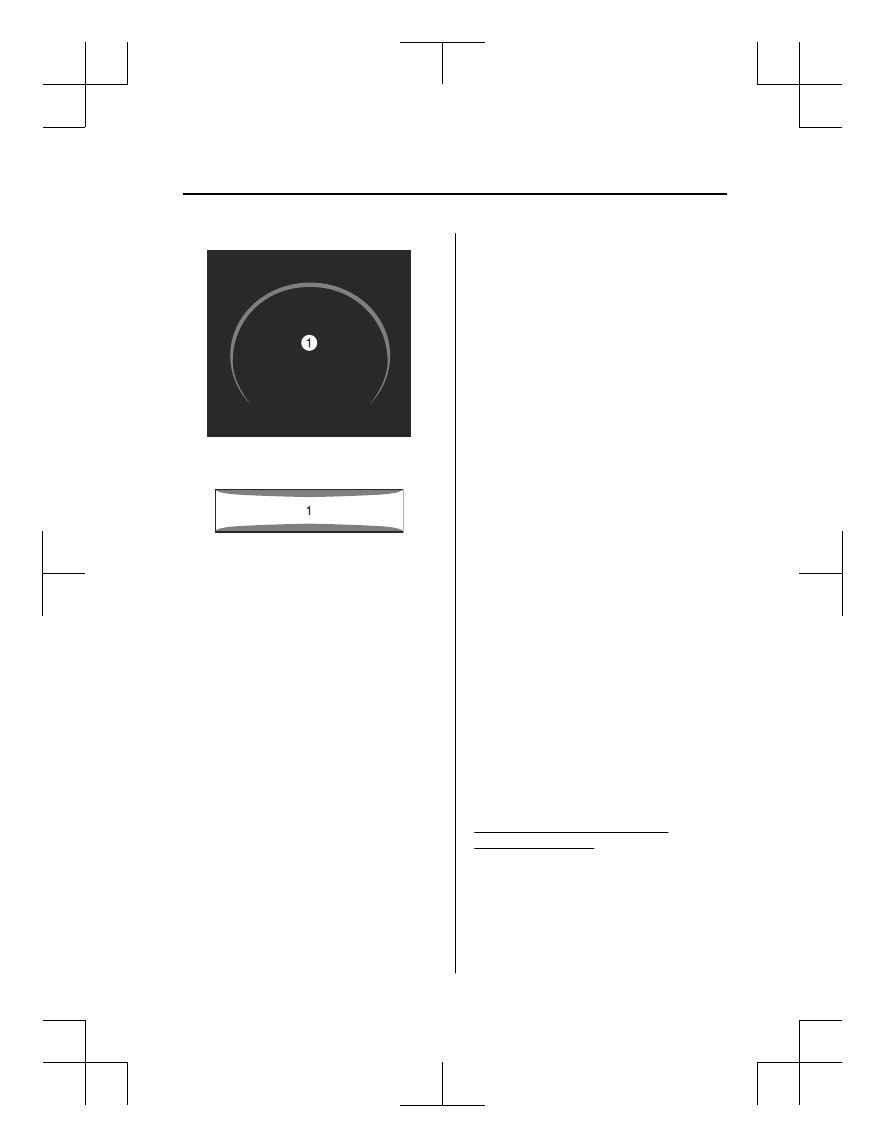
Instrument cluster

1. “BRAKE!”
 

Active driving display

1. “BRAKE!”

NOTE

If any of the following conditions is
met, the forward detection function
may not operate normally.

The Forward Sensing Camera (FSC)
cannot detect target objects.
Refer to Forward Sensing Camera
(FSC) on page 5-108.

The front radar sensor cannot
detect target objects.
Refer to Radar Sensors on page
5-112.

When there is the possibility of a
partial contact with a target object.

The driver deliberately performs
driving operations (accelerator pedal
operation, steering wheel operation,
selector lever/shift lever operation,
and turn signal lever operation).

If any of the following conditions is
met, the forward detection function
may operate.

An animal or object on the road is
detected.

Passing an approaching vehicle
while rounding a curve.

Vehicle is passing through a narrow
gate or a gate with a low ceiling.

There is a metal object, bump, or a
protruding object on the road.

(Vehicles with Driver Monitoring
(DM))

If the system determines that the
driver is not paying attention to the
road, it activates the collision
warning earlier than normal.

(Automatic transmission vehicle)

If the forward detection function
performs brake control and the
vehicle is stopped, the system will
continue to hold the brakes for a
brief time unless there is an
operation performed by the driver.

(Manual transmission vehicle)

When the forward detection
function performs brake control
and the vehicle is stopped, the
brakes are automatically released
after about 2 seconds if the driver
does not depress the brake pedal.

When the forward detection
function performs brake control
and the vehicle is stopped, the
engine stops if the driver does not
depress the clutch pedal.

The operation distance and volume
of the collision warning can be
changed.
Refer to the Settings section in the
Mazda Connect Owner's Manual.

When the rearward detection
function operates

*

The rearward detection function
operates when all of the following
conditions are met.

The vehicle speed is about 2 km/h
to 15 km/h (2 mph to 9.3 mph).

Driving

Smart Brake Support (SBS)

*Some models.

5-175

Mazda3_8LX5-EA-23E_Edition2_new

2023-4-17 20:22:43

The system determines that there is a
possibility of collision with an object
at the rear.

When the rearward detection function
operates, the screen display and
warning sound notify the driver of the
danger. Furthermore, if the possibility
of a collision increases, brake control is
performed.

Instrument cluster

1. “BRAKE!”
 

Active driving display

1. “BRAKE!”

NOTE

The rear ultrasonic sensors may not
be able to detect target objects
correctly, and the rearward detection
function may not operate normally.
Refer to Ultrasonic Sensors on page
5-116.

If any of the following conditions is
met, the rearward detection function
may operate.

There is a hanging curtain.

Vehicle is passing through a narrow
gate or a gate with a low ceiling.

There is a metal object, bump, or a
protruding object on the road.

(Automatic transmission vehicle)

If the rearward detection function
performs brake control and the
vehicle is stopped, the system will
continue to hold the brakes for a
brief time unless there is an
operation performed by the driver.

(Manual transmission vehicle)

When the rearward detection
function performs brake control
and the vehicle is stopped, the
brakes are automatically released
after about 2 seconds if the driver
does not depress the brake pedal.

When the rearward detection
function performs brake control
and the vehicle is stopped, the
engine stops if the driver does not
depress the clutch pedal.

When the Rear Crossing is operating

*

The Rear Crossing operates when all of
the following conditions are met.

The vehicle speed is about 15 km/h
(9.3 mph) or slower.

The system determines that there is a
possibility of a collision with a
vehicle approaching from a rear side.

When the Rear Crossing operates, the
screen display and warning sound
notify the driver is notified of the
danger. Furthermore, if the possibility
of a collision increases, brake control is
performed.

Driving

Smart Brake Support (SBS)

5-176

*Some models.

Mazda3_8LX5-EA-23E_Edition2_new

2023-4-17 20:22:43

Instrument cluster

1. “BRAKE!”
 

Active driving display

1. “BRAKE!”

NOTE

If any of the following conditions is
met, the Rear Crossing may not
operate normally.

The rear side radar sensors cannot
detect an object.
Refer to Radar Sensors on page
5-112.

A vehicle is approaching directly
from the rear of your vehicle.

A vehicle is approaching at an
angle from the rear of your vehicle.

A vehicle is approaching from a
direction at an acute angle.

If any of the following conditions is
met, the Rear Crossing may operate.

There is a hanging curtain.

Vehicle is passing through a narrow
gate or a gate with a low ceiling.

(Automatic transmission vehicle)

If the Rear Crossing performs brake
control and the vehicle is stopped,
the system will continue to hold the
brakes for a brief time unless there is
an operation performed by the
driver.

(Manual transmission vehicle)

When the Rear Crossing performs
brake control and the vehicle is
stopped, the brakes are
automatically released after about
2 seconds if the driver does not
depress the brake pedal.

When the Rear Crossing performs
brake control and the vehicle is
stopped, the engine stops if the
driver does not depress the clutch
pedal.

Turning off the SBS

The SBS can be turned off using the
Mazda Connect.
Refer to the Settings section in the
Mazda Connect Owner's Manual.
 
When the SBS is turned off, the SBS

OFF indicator 

 turns on.

Driving

Smart Brake Support (SBS)

5-177

Mazda3_8LX5-EA-23E_Edition2_new

2023-4-17 20:22:43

360° View Monitor

*

The 360° view monitor is a system which assists the driver in checking safety by
displaying the conditions around the vehicle on the center display when the vehicle
is driven at low speeds or when the vehicle is parked or stopped.

Top view

Displays an image of the vehicle as if it were viewed from directly above to assist in
checking the area around the vehicle when driving forward or in reverse.

Front view

Displays an image of the front of the vehicle together with the guide lines to assist in
checking the area at the front of the vehicle when driving forward, parking, or
stopping.

Driving

360° View Monitor

5-178

*Some models.

Mazda3_8LX5-EA-23E_Edition2_new

2023-4-17 20:22:43

Front wide view

Displays an image of the front of the vehicle (wide area) together with the guide
lines to assist in checking the area at the front of the vehicle when driving forward or
entering an intersection.

Side view

Displays an image of the front left and right sides of the vehicle together with the
guide lines to assist in checking the front left and right sides of the vehicle when
driving forward, parking, or stopping.

Driving

360° View Monitor

5-179

Mazda3_8LX5-EA-23E_Edition2_new

2023-4-17 20:22:43

Rear view

Displays an image of the rear of the vehicle together with the guide lines to assist in
checking the area at the rear of the vehicle when reversing, parking, or stopping.

Rear wide view

Displays an image of the rear of the vehicle (wide area) together with the guide lines
to assist in checking the area at the rear of the vehicle when reversing, parking, or
stopping.

Driving

360° View Monitor

5-180

Mazda3_8LX5-EA-23E_Edition2_new

2023-4-17 20:22:43

Warnings and Cautions for Using the 360° View

Monitor

WARNING

Always confirm the safety of the area around the vehicle visually when driving.

The 360° View Monitor is an auxiliary device which assists the driver in checking the
safety of the area around the vehicle.

Do not rely completely on the 360° View Monitor.

The shooting range of the cameras and detection range of the sensors are limited.
For example, the following locations displayed on the screen may be blind spots
and target objects may not be visible.

Areas in black on screen

Seams where each of camera images merge

Vehicle width extension lines and projected vehicle paths are only estimates.
Images displayed on the display may differ from the actual conditions.

CAUTION

Handle the cameras appropriately. If the cameras are handled incorrectly, images
may not be displayed normally.
Refer to Cameras on page 5-118.

Do not use the 360° view monitor in the following locations or conditions.

Bumpy roads

The vehicle is on a road incline.

Icy or snow-covered roads

Tire chains or a temporary spare tire is installed.

The doors are not fully closed.

The outside mirrors are retracted.

If the doors are not completely closed, images and guide lines may not be
displayed correctly.

Heed the following cautions to assure that the 360° view monitor operates
normally.

Do not modify the suspensions.

Always use wheels of the specified size for the front and rear wheels. Consult an
Authorized Mazda Dealer for tire replacement.

When the center display is cold, images may leave trails or the display might be
darker than usual, making it difficult to check the vehicle surroundings. Always
confirm the safety around the vehicle visually when driving.

Driving

360° View Monitor

5-181

Mazda3_8LX5-EA-23E_Edition2_new

2023-4-17 20:22:43

Recognizing images at night may be difficult because there are no lights in the
shooting range of the side camera. Always confirm the safety around the vehicle
visually when driving.

The method for parking/stopping the vehicle using the 360° View Monitor differs
depending on the road conditions and vehicle conditions. In addition, when and
how much you turn the steering wheel will differ depending on the situation,
therefore always check the vehicle surroundings directly with your eyes while using
the system.

Driving

360° View Monitor

5-182

Mazda3_8LX5-EA-23E_Edition2_new

2023-4-17 20:22:43

How to Use the 360° View Monitor

Displaying images of the vehicle front/sides

Images are displayed on the center display.

NOTE

When the shift lever/selector lever is in the R position, images of the front/sides
of the vehicle are not displayed.

If any of the following conditions are met, image display of the front/sides of the
vehicle ends.

Switches around the commander knob are pressed.

The vehicle is driven at less than 15 km/h (9.3 mph) for about 4 minutes and 30
seconds.

The vehicle speed is 15 km/h (9.3 mph) or faster.

The vehicle is driven at 15 km/h (9.3 mph) or faster for 8 seconds.

(Manual transmission vehicle)

The parking brake is applied.

(Automatic transmission vehicle)

The selector lever is shifted to the P position.

Displaying images of the vehicle rear

Shift the shift lever/selector lever to the R position.
Images are displayed on the center display.

Driving

360° View Monitor

5-183

Mazda3_8LX5-EA-23E_Edition2_new

2023-4-17 20:22:43

Switching the image

1. Turn the commander knob and move the cursor to the desired image.

1. Cursor

2. Press the commander knob to select the image to display.

Viewing the screen

NOTE

Because there might be a difference between the image displayed on the screen
and the actual conditions, always check the safety of the surrounding area directly
with your eyes when driving.

Images may be difficult to see due to the weather and surrounding environment,
however this does not indicate a problem.

The rear view and rear wide view images are reversed left and right.

The actual tires may appear in the top view.

Obstructions displayed in views other than the top view may not be displayed on
the top view.

The areas in black on the top view the seams where each of camera images merge
are blind spots.

The top view is displayed by processing the images taken by each camera.
Therefore, images may be displayed as follows.

Color or brightness displayed on the screen may appear differently than in
actuality.

If the vehicle tilts, the image may appear distorted.

Lines on the road may appear distorted at the seams where each of the camera
images merge.

Screen brightness and contrast can be adjusted.
Refer to the Settings section in the Mazda Connect Owner's Manual.
Refer to Mazda Connect Owner's Manual or consult an Authorized Mazda Dealer.

The parking sensor detection range has limitations. For details, refer to the parking
sensor entry.
Refer to Parking Sensor on page 5-203.

The screen display may differ from the actual display.

Driving

360° View Monitor

5-184

Mazda3_8LX5-EA-23E_Edition2_new

2023-4-17 20:22:43

Top view, front view

Indication

Content

1

Tire icon

Indicates the tire direction. Moves in conjunction with
the steering wheel operation.

2

Projected vehicle path lines (red/
yellow)

Indicates the approximate projected path of the vehicle.
Moves in conjunction with the steering wheel operation.
a) Indicates the path where the edge of the front bumper
is expected to travel.
b) Indicates the path where the inner side of the vehicle
is expected to travel.

3

Parking sensor detection indication Indicates the obstruction detection status.

4

Vehicle width guide lines (blue)

Indicates the approximate width of the vehicle.

5

Projected vehicle path distance
guide lines (red/yellow)

Indicates the distance (from front end of bumper) in
front of the vehicle.

The red line indicates the point about 50 cm (19 in)
from the front end of the bumper.

The yellow lines indicate the points about 1 m (39 in)
and 2 m (78 in) from the front end of the bumper.

6

View status icon

Indicates which image is selected.

7

Parking sensor status icon

Indicates that the parking sensor has a problem or it is
switched off.

Driving

360° View Monitor

5-185

Mazda3_8LX5-EA-23E_Edition2_new

2023-4-17 20:22:43

Top view, front wide view

Indication

Content

1

Tire icon

Indicates the tire direction. Moves in conjunction with
the steering wheel operation.

2

Projected vehicle path lines (red/
yellow)

Indicates the approximate projected path of the vehicle.
Moves in conjunction with the steering wheel operation.
a) Indicates the path where the edge of the front bumper
is expected to travel.
b) Indicates the path where the inner side of the vehicle
is expected to travel.

3

Parking sensor detection indication Indicates the obstruction detection status.

4

Extended vehicle width lines and
distance guide lines (red/blue)

Indicates the approximate width of the vehicle and the
distance (from front end of bumper) in front of the vehi-
cle.

The red line indicates the point about 50 cm (19 in)
from the front end of the bumper.

The blue lines indicate the points from about 50 cm
(19 in) and up to 2 m (78 in) from the front end of the
bumper.

5

View status icon

Indicates which image is selected.

6

Parking sensor status icon

Indicates that the parking sensor has a problem or it is
switched off.

NOTE

The front wide view displays the image in front of the vehicle at a wide angle and
corrects the image to help detect approaching obstructions from the side. Therefore,
it differs from the actual view.

Driving

360° View Monitor

5-186

Mazda3_8LX5-EA-23E_Edition2_new

2023-4-17 20:22:43

Side view

Indication

Content

1

Projected vehicle path lines (yellow)

Indicates the approximate projected path of the vehicle.
Moves in conjunction with the steering wheel operation.
The projected vehicle path lines (yellow) indicate the
path the inner side of the vehicle is expected to travel.

2

Vehicle parallel guide lines (blue)

Indicates the approximate vehicle width including the
outside mirrors.

3

Vehicle front end guide lines (blue)

Indicates the front edge of the vehicle (front edge of the
bumper).

4

Parking sensor detection indication Indicates the obstruction detection status.

5

View status icon

Indicates which image is selected.

6

Parking sensor status icon

Indicates that the parking sensor has a problem or it is
switched off.

CAUTION

Do not turn the steering wheel any more until the vehicle has passed the
obstruction, even if the obstruction is not visible on the side view image. If the
steering wheel is turned even more, the vehicle may contact the obstruction if it is
turned sharply.

Driving

360° View Monitor

5-187

Mazda3_8LX5-EA-23E_Edition2_new

2023-4-17 20:22:43

Top view, rear view

Indication

Content

1

Tire icon

Indicates the tire direction. Moves in conjunction with
the steering wheel operation.

2

Projected vehicle path lines (red/
yellow)

Indicates the approximate projected path of the vehicle.
Moves in conjunction with the steering wheel operation.
a) Indicates the path where the rear end of the rear
bumper passes as a reference.
b) Indicates the path where the outer side of the vehicle
is expected to travel.

3

Parking sensor detection indication Indicates the obstruction detection status.

4

Vehicle width guide lines (blue)

Indicates the approximate width of the vehicle.

5

Projected vehicle path distance
guide lines (red/yellow)

These guide lines indicate the approximate distance to a
point measured from the rear of the vehicle (from the
end of the bumper).

The red line indicates the point about 50 cm (19 in)
from the rear end of the rear bumper.

The yellow lines indicate the points about 1 m (39 in)
and 2 m (78 in) from the rear end of the rear bumper.

6

View status icon

Indicates which image is selected.

7

Parking sensor status icon

Indicates that the parking sensor has a problem or it is
switched off.

CAUTION

The front of the vehicle swings out wide when turning the steering wheel while
reversing. Maintain sufficient distance between the vehicle and an obstruction.

Driving

360° View Monitor

5-188

Mazda3_8LX5-EA-23E_Edition2_new

2023-4-17 20:22:43

NOTE

Even though the back end of the parking space (or garage) displayed on the screen
and distance guide lines appear parallel, they may not actually be parallel.

When parking in a space with a division line on only one side of the parking space,
even though the division line and the vehicle width guide line appear parallel, they
may not actually be parallel.

Top view, rear wide view

Indication

Content

1

Tire icon

Indicates the tire direction. Moves in conjunction with
the steering wheel operation.

2

Projected vehicle path lines (red/
yellow)

Indicates the approximate projected path of the vehicle.
Moves in conjunction with the steering wheel operation.
a) Indicates the path where the rear end of the rear
bumper passes as a reference.
b) Indicates the path where the outer side of the vehicle
is expected to travel.

3

Parking sensor detection indication Indicates the obstruction detection status.

4

Extended vehicle width lines and
distance guide lines (red/blue)

These guide lines indicate the approximate width of the
vehicle and distance to a point measured from the rear of
the vehicle (from the end of the bumper).

The red line indicates the point about 50 cm (19 in)
from the rear end of the rear bumper.

The blue lines indicate the points from about 50 cm
(19 in) and up to 2 m (78 in) from the rear end of the
bumper.

5

View status icon

Indicates which image is selected.

6

Parking sensor status icon

Indicates that the parking sensor has a problem or it is
switched off.

Driving

360° View Monitor

5-189

Mazda3_8LX5-EA-23E_Edition2_new

2023-4-17 20:22:43

NOTE

The rear wide view displays the image at the rear of the vehicle at a wide angle and
corrects the image to help detect approaching obstructions from the side. Therefore,
it differs from the actual view.

System problem indication

In the following cases, there might be a problem with the system. Have the vehicle
inspected by an Authorized Mazda Dealer.

"No camera signal." is displayed on the center display.

The display on the center display does not switch to the camera image even if the
selector lever is shifted to the R position.

The display on the center display does not switch to the camera image even if the
360° view monitor switch is pressed.

A portion of the display on the center display is black.

Driving

360° View Monitor

5-190

Mazda3_8LX5-EA-23E_Edition2_new

2023-4-17 20:22:43

Convenient Ways to Use

the 360° View Monitor

The 360° View Monitor settings can be
changed as follows.
Refer to the Settings section in the
Mazda Connect Owner's Manual.

Automatic display of the 360° View
Monitor when the vehicle power is
switched ON.

When the 360° view mode is
activated, the preferentially
displayed images can be selected.

Automatic display of the front view
when switching from reverse to
forward gear.

No display of the projected vehicle
path lines.

Driving

360° View Monitor

5-191

Mazda3_8LX5-EA-23E_Edition2_new

2023-4-17 20:22:43

Secondary Collision

Reduction

*

The Secondary Collision Reduction
reduces secondary damage by
decelerating the vehicle when it is
damaged in a collision to the extent
that the airbags are deployed while the
vehicle is stopped.
If a collision occurs to the extent that
the airbags are deployed while the
vehicle is stopped, the hazard warning
lights flash to alert surrounding vehicles
and the brakes are controlled to
reduce damage in the event of a
collision with an obstruction or other
object.

Warnings and Cautions

for Using the Secondary

Collision Reduction

WARNING

Do not rely completely on the
Secondary Collision Reduction.

The Secondary Collision Reduction
may not operate normally depending
on various conditions such as the
vehicle condition, component part
damage condition, target object
condition, weather conditions, or
traffic conditions. Do not rely
completely on the system and make
it your responsibility as a driver to
drive the vehicle.

The functions of the Secondary
Collision Reduction have limitations.
If you neglect to operate the brake
and accelerator pedals correctly, it
could result in serious injury.

Driving

Secondary Collision Reduction

5-192

*Some models.

Mazda3_8LX5-EA-23E_Edition2_new

2023-4-17 20:22:43

How to Use the

Secondary Collision

Reduction

When the Secondary Collision
Reduction operates

The Secondary Collision Reduction
operates if the vehicle is damaged in a
collision to the extent that the airbags
are deployed while the vehicle is
stopped.
 
When the Secondary Collision
Reduction operates, the system
controls and applies the brakes until
the vehicle stops. In addition, the
hazard warning lights continue to flash.
After the vehicle stops, the parking
brake is applied by the Electric Parking
Brake (EPB).

NOTE

The brake lights turn on while the
brakes are operating by the system
control.

If there is a malfunction with the
electric parking brake (EPB), the
brakes are released by the system
control after the vehicle is stopped.

The settings for the Secondary
Collision Reduction system differ
depending on the grade/
specification-separate equipment.

Secondary Collision Reduction is
disabled

If any of the following conditions is
met, the Secondary Collision
Reduction is canceled.

A certain period of time has passed
since the system operated.

After stopping the vehicle, the
accelerator pedal is strongly
depressed 3 times.

The parking brake is released after
the Electric Parking Brake (EPB)
operates.

NOTE

If the driver's brake pedal depression
force is stronger than the system's
brake control, the driver's brake
operation takes priority.

Flashing of the hazard warning lights
by the system control is canceled
when any of the following operations
is performed.

Hazard warning light switch is
pressed.

Vehicle power is switched OFF.

Driving

Secondary Collision Reduction

5-193

Mazda3_8LX5-EA-23E_Edition2_new

2023-4-17 20:22:43

Cruise Control

*

Cruise control reduces the load on the
driver by driving the vehicle at a
constant speed. The vehicle is driven at
the preset speed and maintaining a
constant vehicle speed without the
driver having to depress the accelerator
or brake pedal.

Warnings and Cautions

for Using the Cruise

Control

WARNING

Do not rely completely on the cruise
control.

The functions of the cruise control have
limitations. Always drive carefully by
checking the safety of your
surroundings and depressing the brake
or accelerator pedal.

Do not use the cruise control under
the following conditions. Otherwise,
it may result in an accident.

The vehicle is driven on roads other
than highways.

The vehicle is driven on roads with
sharp curves or with heavy traffic
where sufficient distances between
vehicles cannot be kept.

The vehicle is driven on slippery
roads such as icy or snow-covered
roads, and unpaved roads.

The vehicle is driven on a long
downslope.

The vehicle is driven on a steep
slope.

Turn off the cruise control when not in
use.

Leaving the cruise control turned on
when it is not in use is dangerous as it
could operate unexpectedly, resulting
in an accident.

CAUTION

Turn off the cruise control when
being towed or when towing
another vehicle.

Driving

Cruise Control

5-194

*Some models.

Mazda3_8LX5-EA-23E_Edition2_new

2023-4-17 20:22:43

Turn off the cruise control when the
vehicle is running on a chassis roller.

How to Use the Cruise

Control

Setting the cruise control

1. Press the cruise control switch to

turn the system on.

When the system is on, the cruise
control standby indication (white)

 is displayed.

2. Accelerate the vehicle to the

desired speed of 25 km/h (16
mph) or faster (minimum speed
setting is 30 km/h (19 mph)).

3. Set the vehicle speed by pressing

the RES switch up (SET+) or down
(SET-).

When the vehicle speed is set, the
set vehicle speed is displayed on
the displays and the cruise control

standby indication (white) 
changes to the cruise control set

indication (green) 

.

While the cruise control is operating,
the driver is notified of the operation
condition by the screen display.

Driving

Cruise Control

5-195

Mazda3_8LX5-EA-23E_Edition2_new

2023-4-17 20:22:43

Instrument cluster (i-ACTIVSENSE
display)

1. Set speed
 

Instrument cluster (Other than
i-ACTIVSENSE display)

1. Set speed
 

Active driving display

1. Set speed

NOTE

The accelerator pedal operation
takes priority during constant speed
driving. When you release your foot
from the accelerator pedal, the
vehicle returns to constant speed
driving at the set speed.

(Vehicles with Mazda Radar Cruise
Control with Stop & Go function
(MRCC with Stop & Go function))

If the distance between vehicles
control is disabled using the Mazda
Connect, the system switches to the
cruise control. At this time, the
MRCC switch functions as the cruise
control switch.
Refer to the Settings section in the
Mazda Connect Owner's Manual.
If the vehicle power is switched OFF
while the distance between vehicles
control is disabled, the distance
between vehicles control is enabled
automatically the next time the
vehicle power is switched ON.

The system may not be able to
maintain the set speed depending
on the road conditions such as steep
up or down slopes.

When the vehicle speed is less than
20 km/h (12 mph), the cruise
control is canceled. If you want to
use the cruise control again, reset the
cruise control.

The brake lights turn on while the
brakes are operating by the cruise
control.

(Automatic transmission vehicle)

The cruise control cannot be
canceled while driving in manual
shift mode (selector lever shifted
from the D to M position).
Therefore, engine braking does not
work even if you shift down to a
lower gear. If deceleration is
required, lower the set vehicle speed
or depress the brake pedal.

Changing the set vehicle speed

Changing the set vehicle speed using
the RES switch

Press the RES switch up (SET+) or
down (SET-) to the desired speed.

Press and release immediately: 1
km/h (1 mph)

Press and hold: 10 km/h (5 mph)

Driving

Cruise Control

5-196

Mazda3_8LX5-EA-23E_Edition2_new

2023-4-17 20:22:43

Changing the set vehicle speed using
the accelerator pedal

Depress the accelerator pedal until the
vehicle speed reaches the desired
speed, then press the RES switch up
(SET+) or down (SET-).

The cruise control is temporarily
canceled

The cruise control is temporarily
canceled when one of the following
conditions is met.

The brake pedal is depressed.

The CANCEL switch is pressed one
time.

The DSC has operated.

The Smart Brake Support (SBS) has
operated.

The frequency of the braking
operation by the cruise control is
high.

(Manual transmission vehicle)

The clutch pedal is depressed for a
certain period of time.

The shift lever is shifted to neutral
(N) for a certain period of time.

If the cruise control is temporarily
canceled, it operates at the previously
set speed by pressing the RES switch.

Turning off the cruise control

Press the cruise control switch.
The cruise control standby indication

(white) 

 /cruise control set

indication (green) 

 turns off and the

cruise control stops.

Driving

Cruise Control

5-197

Mazda3_8LX5-EA-23E_Edition2_new

2023-4-17 20:22:43

Rear View Monitor

*

The rear view monitor is a system which assists the driver in checking safety by
displaying the conditions behind the vehicle on the center display when the vehicle
is driven in reverse.

Driving

Rear View Monitor

5-198

*Some models.

Mazda3_8LX5-EA-23E_Edition2_new

2023-4-17 20:22:43

Warnings and Cautions for Using the Rear View

Monitor

WARNING

Always confirm the safety of the area around the vehicle visually when driving.

The rear view monitor is only designed to assist the driver while reversing. Images
displayed on the display may differ from the actual conditions. Do not rely
completely on the rear view monitor while reversing. Otherwise, the vehicle may
contact an obstruction and cause an accident.

CAUTION

Do not use the rear view monitor in the following locations/situations.

There is a bump on a road.

The vehicle is on a road incline.

Icy or snow-covered slippery roads.

Tire chains or a temporary spare tire is installed.

The liftgate is not fully closed.

When the center display is cold, images may leave trails or the display might be
darker than usual, making it difficult to check the vehicle surroundings. Always
confirm the safety around the vehicle visually when driving.

Driving

Rear View Monitor

5-199

Mazda3_8LX5-EA-23E_Edition2_new

2023-4-17 20:22:43

How to Use the Rear View Monitor

Displaying the rear view monitor

Shift the shift lever/selector lever to the R position.
Images are displayed on the center display.

Viewing the screen

NOTE

The images displayed on the center display are reversed left and right.

Screen brightness and contrast can be adjusted.
Refer to the Settings section in the Mazda Connect Owner's Manual.

Type A

When the parking sensor is ON

When the parking sensor is OFF

Indication

Content

1

Projected vehicle path lines (yellow)

Indicates the approximate projected path of the vehicle.
The projected vehicle path lines move in conjunction
with the steering wheel operation.

Driving

Rear View Monitor

5-200

Mazda3_8LX5-EA-23E_Edition2_new

2023-4-17 20:22:43

Indication

Content

2

Vehicle width guide lines (blue)

Indicates the approximate width of the vehicle.
Does not display when the steering wheel is operated in
a straight-ahead position.

3

Projected vehicle path distance
guide lines (red/yellow)

These guide lines indicate the approximate distance to a
point measured from the rear of the vehicle (from the
end of the bumper).

The center point of the red line indicates the point
about 50 cm (19 in) from the rear end of the rear
bumper.

The center points of the yellow lines indicate the
points about 1 m (39 in) and 2 m (78 in) from the rear
end of the rear bumper.

4

Parking sensor status icon

Indicates that the parking sensor has a problem or it is
switched off.

Type B

When the parking sensor is ON

When the parking sensor is OFF

Driving

Rear View Monitor

5-201

Mazda3_8LX5-EA-23E_Edition2_new

2023-4-17 20:22:43

Indication

Content

1

Vehicle width guide lines (yellow)

Indicates the approximate width of the vehicle.

2

Projected vehicle path distance
guide lines (red/yellow)

These guide lines indicate the approximate distance to a
point measured from the rear of the vehicle (from the
end of the bumper).

The red line indicates the point about 50 cm (19 in)
from the rear end of the rear bumper.

The yellow lines indicate the points about 1 m (39 in)
and 2 m (78 in) from the rear end of the rear bumper.

3

Parking sensor status icon

Indicates that the parking sensor has a problem or it is
switched off.

System problem indication

In the following cases, there might be a problem with the system. Have the vehicle
inspected by an Authorized Mazda Dealer.

"No camera signal." is displayed on the center display.

The display on the center display does not switch to the camera image even if the
selector lever is shifted to the R position.

A portion of the display on the center display is black.

Driving

Rear View Monitor

5-202

Mazda3_8LX5-EA-23E_Edition2_new

2023-4-17 20:22:43

Parking Sensor

*

The parking sensors are a system that
assists the driver in checking safety by
detecting obstructions around the
vehicle and notifying the driver while
parking. When an obstruction is
detected, a screen display and a
warning sound notify the driver of the
distance to the obstruction.

Warnings and Cautions

for Using the Parking

Sensor

WARNING

Always confirm the safety of the area
around the vehicle visually when
driving.

The parking sensors are only auxiliary
devices when driving forward or in
reverse. In addition, the detection
range of the sensors is limited, and
driving the vehicle relying on the
system completely may cause an
accident.

Driving

Parking Sensor

*Some models.

5-203

Mazda3_8LX5-EA-23E_Edition2_new

2023-4-17 20:22:43

How to Use the Parking Sensor

The parking sensors operate

When the system detects an obstruction, the driver is notified of the presence of the
obstruction by a screen display and a warning sound. The screen display and
warning sound change according to the distance from the obstruction.
In addition, if multiple obstructions are detected simultaneously, the warning sound
for the nearest obstruction is activated.

Front

*

, rear

Distance between vehicle and obstruc-

tion

Display

Warning sounds

Front

Rear

Vehicles without

360° View Moni-

tor

Vehicles with 360°

View Monitor

About 1 m to 60

cm (39 in to 24 in)

About 1 m 50 cm

to 60 cm (59 in to

24 in)

Green

Green

Slow, intermittent

sound

About 60 cm to 50

cm (24 in to 20 in)

About 60 cm to 50

cm (24 in to 20 in)

Yellow

Yellow

Intermittent sound

Driving

Parking Sensor

5-204

*Some models.

Mazda3_8LX5-EA-23E_Edition2_new

2023-4-17 20:22:43

Distance between vehicle and obstruc-

tion

Display

Warning sounds

Front

Rear

Vehicles without

360° View Moni-

tor

Vehicles with 360°

View Monitor

About 50 cm to 40

cm (20 in to 16 in)

About 50 cm to 40

cm (20 in to 16 in)

Amber

Amber

Fast intermittent

sound

Within about 40

cm (16 in)

Within about 40

cm (16 in)

Red

Red

Continuous sound

Corners

Distance between vehi-

cle and obstruction

Display

Warning sounds

Vehicles without 360°

View Monitor

Vehicles with 360° View

Monitor

About 50 cm to 40 cm

(20 in to 16 in)

Yellow

Yellow

Intermittent sound

Driving

Parking Sensor

5-205

Mazda3_8LX5-EA-23E_Edition2_new

2023-4-17 20:22:43

Distance between vehi-

cle and obstruction

Display

Warning sounds

Vehicles without 360°

View Monitor

Vehicles with 360° View

Monitor

About 40 cm to 30 cm

(16 in to 12 in)

Amber

Amber

Fast intermittent

sound

Within about 30 cm (12

in)

Red

Red

Continuous sound

NOTE

If ultrasound sensors cannot detect an object correctly, the system may not
operate normally.
Refer to Ultrasonic Sensors on page 5-116.

The screen display can be switched between display and non-display and the
volume of the warning sound can be changed.
Refer to the Settings section in the Mazda Connect Owner's Manual.

(Vehicles with 360° View Monitor)

When the screen display is set to be displayed, the display automatically switches
to the 360° View Monitor display when the sensor detects an obstruction. When
an obstruction is no longer detected, the display switches to the display before the
obstruction was detected. However, when the 360° View Monitor is displayed in
advance, it continues to be displayed no matter if an obstruction is detected or
not.

Driving

Parking Sensor

5-206

Mazda3_8LX5-EA-23E_Edition2_new

2023-4-17 20:22:43


Content      ..     8      9      10      11     ..