Lexus NX (2022 year). Manual in english - page 30
 

  Index      Manuals     Lexus NX (2022 year). Manual in english


Search            copyright infringement  


Content      ..     28      29      30      31     ..


Lexus NX (2022 year). Manual in english - page 30


WARNING

Where to safely charge the battery

Always charge the battery in an open area. Do not charge the battery in a garage or
closed room where there is insufficient ventilation.

Emergency measures regarding electrolyte

If electrolyte gets in your eyes, flush your eyes with clean water for at least 15 minutes
and get immediate medical attention. If possible, continue to apply water with a
sponge or cloth while traveling to the nearest medical facility.

If electrolyte gets on your skin, wash the affected area thoroughly. If you feel pain or
burning, get medical attention immediately.

If electrolyte gets on your clothes, it may soak through your clothing on to your skin.
Immediately take off the clothing and follow the procedure above if necessary.

If you accidentally swallow electrolyte, drink a large quantity of water or milk and get
emergency medical attention immediately.

When there is insufficient battery fluid

Do not use if there is insufficient fluid in the battery. There is a possible danger that the
battery may explode.

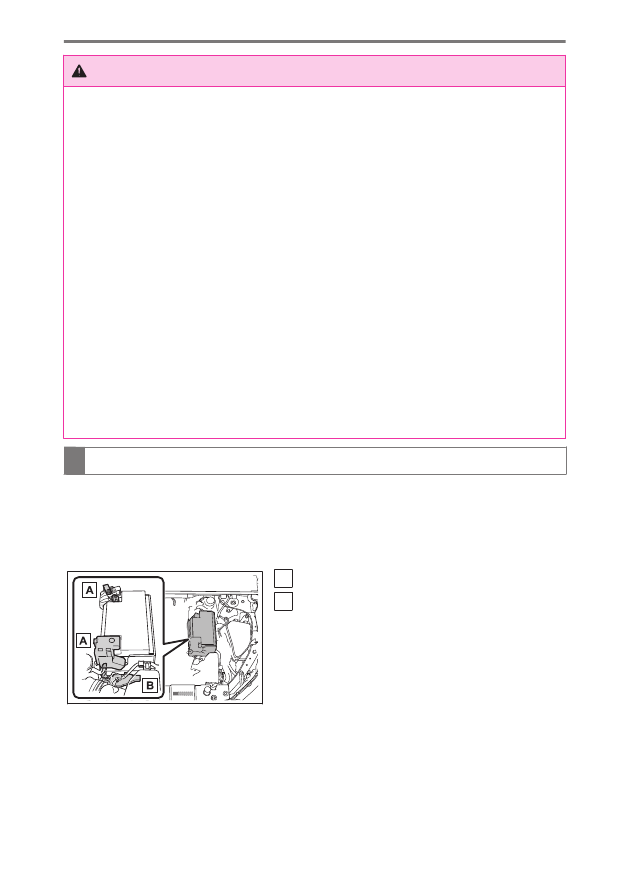
Checking the battery

Battery exterior

Make sure that the battery terminals are not corroded and that there are no loose
connections, cracks, or loose clamps.


▶ 

NX200/NX250

A

Terminals

B

Hold-down clamp

8-4. Inspection of consumables

490


▶ 

NX350

A

Terminals

B

Hold-down clamp

Before recharging

When recharging, the battery produces hydrogen gas which is flammable and
explosive. Therefore, observe the following precautions before recharging:

If recharging with the battery installed on the vehicle, be sure to disconnect the
ground cable.

Make sure the power switch on the charger is off when connecting and discon-
necting the charger cables to the battery.

NOTICE

When recharging the battery, make sure that the engine is not running and all accesso-
ries are off.

After recharging or reconnecting the battery(vehicles with the smart entry
& start system)

The engine may not start. Follow the procedure below to initialize the system.

1

Change the shift position to P.

2

Open and close any of the doors.

3

Restart the engine.

INFORMATION

Unlocking the doors using the smart entry & start system may not be possible
immediately after reconnecting the battery. If this happens, use the wireless
remote control or the mechanical key to lock/unlock the doors.

Start the engine with the engine switch in ACC. The engine may not start with
the engine switch turned off. However, the engine will operate normally from the
second attempt.

8-4. Inspection of consumables

491

8

Maintenance and car

e

The engine switch mode is recorded by the vehicle. If the battery is disconnected
and reconnected, the vehicle will return the engine switch mode to the status it
was in before the battery was disconnected. Make sure to turn off the engine
switch before disconnecting the battery. Take extra care when connecting the
battery if the engine switch mode prior to the battery being disconnected is
unknown.
If the system will not start even after multiple attempts at all the methods above,
contact any authorized Lexus retailer or Lexus authorized repairer, or any reliable
repairer.

Checking battery fluid

Check that the level is between the [UPPER LEVEL] and [LOWER LEVEL] lines.


▶ 

NX250

A

[UPPER LEVEL] line

B

[LOWER LEVEL] line
If the battery fluid level is at or below the
[LOWER LEVEL] line, add distilled water.


▶ 

NX350

A

[UPPER LEVEL] line

B

[LOWER LEVEL] line
If the battery fluid level is at or below the
[LOWER LEVEL] line, add distilled water.


▶ 

NX200

A

Blue: Good condition

B

Red: Charging is necessary.
Have the vehicle checked by any author-
ized Lexus retailer or Lexus authorized re-
pairer, or any reliable repairer.

C

Clear: Not working properly.
Not working properly. Add distilled water.

8-4. Inspection of consumables

492

Adding distilled water

NOTICE

When adding distilled water, avoid overfilling the battery. Spilled battery fluid may cause
corrosion.

1

Remove the vent plug.

2

Add distilled water.

If the [UPPER LEVEL] line cannot be seen, check the battery fluid level by looking
directly at the cell.


A

Low

B

O.K.

3

Put the vent plug back on and close it securely.

8-4. Inspection of consumables

493

8

Maintenance and car

e

Adding washer fluid

If washer fluid does not spray from any of the
washers or "Windshield Washer Fluid Low" is dis-
played on the multi-information display, the
washer fluid bottle may be empty. Add washer
fluid.

WARNING

Do not add washer fluid when the engine is hot or running.
As washer fluid contains alcohol, it may catch fire if spilled on the engine, etc.

NOTICE

Do not use any fluid other than washer fluid

Do not use soapy water or engine antifreeze instead of washer fluid. Doing so may cause
streaking on the vehicle’s painted surfaces, as well as damaging the pump leading to
problems of the washer fluid not spraying.

Diluting washer fluid

Dilute washer fluid with water as necessary. Refer to the freezing temperatures listed on
the label of the washer fluid bottle.

▶ 

NX200/NX250

▶ 

NX350

8-4. Inspection of consumables

494

Air conditioning filter maintenance

The air conditioning filter must be changed regularly to maintain air conditioning
efficiency.

Checking interval

Inspect and replace the air conditioning filter according to the maintenance sched-
ule. In dusty areas or areas with heavy traffic flow, early replacement may be
required.

If air flow from the vents decreases dramatically, the air conditioning filter may
be clogged. Check the filter and replace it if necessary.
(Except for Azerbaijan, Armenia and Russia: For scheduled maintenance in-
formation, please refer to the "Lexus Service Booklet" or "Lexus Warranty
Booklet".)

If air fresheners, etc. are used inside the vehicle, the service life of the deo-
dorizing function of the air conditioning filter with deodorizing function may
be reduced significantly. If odors from the air conditioning system become a
concern, replace the filter.

Replacing the air conditioning filter

NOTICE

Observe the following precautions when using the air conditioning system.
Make sure that a filter is always installed. Using the air conditioning system without a filter
may cause damage to the system.

1

Turn the engine switch off.

2

Open the glove box and disconnect the
damper stay from the pin.

8-4. Inspection of consumables

495

8

Maintenance and car

e

3

Push both the sides of the glove box inward
and disengage each claw on the upper side.
Then, pull the glove box to disengage the
claws on the lower side and remove the
glove box.

4

Unlock the filter cover (  ), pull the filter
cover out of the claws (  ), and remove the
filter cover.

5

Remove the filter case.

6

Remove the air conditioning filter from the
filter case and replace it with a new one.

The [

 UP] marks shown on the filter should be

pointing up.

8-4. Inspection of consumables

496

Tire maintenance

Tire maintenance

Replace or rotate tires in accordance with maintenance schedules and treadwear.

NOTICE

Take particular care when driving on uneven rough roads with cracks and potholes.
These conditions may cause loss of tire inflation pressure, reducing the cushioning ability
of the tires. Driving on rough roads may also cause damage to the tires themselves, as
well as the vehicle’s wheels and body.

8-5. Tire maintenance

497

8

Maintenance and car

e

Tire inspection items

WARNING

When inspecting or replacing the tires

Observe the following precautions.
Failure to do so may lead to damage to the drivetrain or unstable handling.

Do not mix tires of different makes, models or tread patterns. Also, do not mix tires of
remarkably different treadwear.

Do not use tire sizes other than those recommended by Lexus.

Do not mix differently constructed tires (radial, bias-belted or bias-ply tires).

Do not mix summer, all season and snow tires.

Do not use tires that have been used on another vehicle.
Do not use tires if you do not know how they were used previously.

Vehicles with a compact spare tire: Do not tow if your vehicle has a compact spare tire
installed.

NOTICE

If tire inflation pressure becomes low while driving, do not continue driving. Otherwise
the tire or wheel may be damaged.

Check if the treadwear indicators are showing on the tires. Also check the tires for
uneven wear, such as excessive wear on one side of the tread.
Check the spare tire condition and pressure if not rotated.


A

New tread

B

Worn tread

C

Treadwear indicator
The location of treadwear indicators is
shown by a [TWI] or 

 mark, etc., molded

into the sidewall of each tire.
Replace the tires if the treadwear indicators
are showing on a tire.

8-5. Tire maintenance

498

INFORMATION

When to replace your vehicle’s tires

Tires should be replaced if:

The treadwear indicators are showing on a tire.

You have tire damage such as cuts, splits, cracks deep enough to expose the fabric,
and bulges indicating internal damage.

A tire goes flat repeatedly or cannot be properly repaired due to the size or location of
a cut or other damage.
If you are not sure, consult with any authorized Lexus retailer or Lexus authorized
repairer, or any reliable repairer.

Tire life

Any tire over 6 years old must be checked by a qualified technician even if it has seldom
or never been used or damage is not obvious.

If the tread on snow tires wears down below 4 mm (0.16 in.)

The effectiveness of the tires as snow tires is lost.

8-5. Tire maintenance

499

8

Maintenance and car

e

Run-flat tire features

*

When run-flat tires are installed, the vehicle can be driven for a maximum of 80 km
(50 miles) at a speed below 80 km/h (50 mph) after any tire goes flat. (However,
the vehicle speed may not increase to near 80 km/h [50 mph] depending on
weather or driving conditions.)
Make sure to replace the flat tire before the vehicle has been driven for near 80
km (50 miles). Also, do not use a repaired tire.

A run-flat tire has a 

 mark on the side wall.

INFORMATION

Precautions for run-flat tires

The run-flat tires are for only this vehicle. Do not use the tires on other vehicles.

Do not mix run-flat tires and normal tires.

If non-genuine Lexus wheels are used, it may be impossible to sufficiently demonstrate
the performance of run-flat tires.

* : 

If equipped

8-5. Tire maintenance

500

Operation of the tire pressure warning system

Your vehicle is equipped with a tire pressure warning system that uses tire pressure
warning valves and transmitters to detect low tire inflation pressure before serious
problems arise.
The tire pressure warning system of this vehicle adopts a 2-type warning system.

▶ 

Multi-information display (vehicles without a head-up display)

▶ 

Multi-information display (vehicles with a head-up display)

▶ 

Center display

When "Adjust Pressure" is displayed (Normal Warning)
A warning with the tire pressure warning light and warning buzzer when there
is an unknown level of low tire pressure with the appearance of the tire due

8-5. Tire maintenance

501

8

Maintenance and car

e

to natural air leakage as well as the pressure lowering due to changes in the
pressure according to the outside temperature.

When "Immediately Check tyre when Safe" is displayed (Emergency Warning)
A warning with the tire pressure warning light and warning buzzer when there is
a known level of low tire pressure with the appearance of the tire due to pressure
suddenly lowering.
However, the system may not be able to detect sudden tire ruptures (bursting,
etc.).

The tire pressure detected by the tire pressure warning system can be displayed
on the center display.

INFORMATION

Routine tire inflation pressure checks

The tire pressure warning system does not replace routine tire inflation pressure checks.
Make sure to check tire inflation pressure as part of your routine of daily vehicle checks.

Tire inflation pressure

It may take a few minutes to display the tire inflation pressure after the engine switch is
turned to ON.
It may also take a few minutes to display the tire inflation pressure after inflation
pressure has been adjusted.

Tire inflation pressure changes with temperature. The displayed values may also be
different from the values measured using a tire pressure gauge.

Situations in which the tire pressure warning system may not operate properly

In the following cases, the tire pressure warning system may not operate properly.

If non-genuine Lexus wheels are used.

A tire has been replaced with a tire that is not an OE (Original Equipment) tire.

A tire has been replaced with a tire that is not of the specified size.

Tire chains, etc. are equipped.

If a window tint that affects the radio wave signals is installed.

If there is a lot of snow or ice on the vehicle, particularly around the wheels or wheel
housings

If the tire inflation pressure is extremely higher than the specified level.

If tires not equipped with tire pressure warning valves and transmitters are used.

8-5. Tire maintenance

502

If the ID code on the tire pressure warning valves and transmitters is not registered
in the tire pressure warning computer.

Performance may be affected in the following situations.

Near a TV tower, electric power plant, gas station, radio station, large display,
airport or other facility that generates strong radio waves or electrical noise.

When carrying a portable radio, cellular phone, cordless phone or other wireless
communication device.

If tire position information is not correctly displayed due to the radio wave conditions,
the display may be corrected by changing the location of the vehicle as the radio wave
conditions may change.

When the vehicle is parked, the time taken for the warning to start or go off could be
extended.

When tire inflation pressure declines rapidly for example when a tire has burst, the not
to able detect.

 Related Links 

Tire pressure(P. 307)
Tire pressure warning light (warning buzzer)(P. 531)

Installing tire pressure warning valves and transmitters

NOTICE

Repairing or replacing tires, wheels, tire pressure warning valves, transmitters and
tire valve caps

When removing or fitting the wheels, tires or the tire pressure warning valves and
transmitters, contact any authorized Lexus retailer or Lexus authorized repairer, or
any reliable repairer as the tire pressure warning valves and transmitters may be
damaged if not handled correctly.

Make sure to install the tire valve caps. If the tire valve caps are not installed, water
could enter the tire pressure warning valves, corrode the valve, and cause sticking and
air leaks.

When replacing tire valve caps, do not use tire valve caps other than those specified.
The cap may become stuck.

When replacing tires or wheels, tire pressure warning valves and transmitters must
also be installed.
When new tire pressure warning valves and transmitters are installed, new ID
codes must be registered in the tire pressure warning computer

8-5. Tire maintenance

503

8

Maintenance and car

e

INFORMATION

When replacing the tires and wheels

If the ID code of the tire pressure warning valve and transmitter is not registered, the tire
pressure warning system will not work properly.
In this case, after driving for about 10 minutes, the tire pressure warning light blinks for 1
minute and stays on to indicate a system malfunction.

Registration of the position of each wheel after performing a tire rota-
tion

It is necessary to register the position of each wheel after performing a tire
rotation.
Wheel position registration can be performed by oneself. Wheel position registra-
tion is performed by driving forward with moderate left and right turns. However,
depending on the driving conditions and driving environment, registration may
take some time to complete.

1

Park the vehicle in a safe place, turn the engine switch off and wait 15 minutes
or more.

2

Start the engine.

The wheel position registration procedure cannot be performed while the vehicle is
moving.

3

Select 

 on the center display.

4

Select [Vehicle customise].

5

Select [Tyre pressure].

6

Select [Tyre rotation].

7

Select [Continue].

A message indicating that wheel position registration is being performed will be
displayed on the multi-information display. "---" will be displayed for the tire inflation
pressure of each tire and wheel position registration will begin.

8

Drive straight (with occasional left and right turns) at approximately 40 km/h
(25 mph) or more for approximately 10 to 30 minutes.

When wheel position registration is complete, a message indicating that registration
has been completed and the inflation pressure of each tire will be displayed on the
multi-information display.

8-5. Tire maintenance

504

Even if it is not possible to drive continuously at approximately 40 km/h (25 mph) or
more, registration can be completed by driving for a long time. However, if registration
does not complete after driving for 1 hour or more, park the vehicle in a safe place and
leave it with the engine switch in ON for approximately 15 minutes or more, and then
perform the driving procedure again.

INFORMATION

When performing wheel position registration

Normally, wheel position registration can be completed within approximately 30
minutes.

Wheel position registration is performed while driving at a vehicle speed of
approximately 40 km/h (25 mph) or more.

Wheel position registration procedure

If the engine switch is turned off while registering the wheel position, the next time
the engine switch is turned to ON, the wheel position registration will resume and
it will not be necessary to restart the procedure.

While the position of each wheel is being determined and the inflation pressures
are not being displayed, if the inflation pressure of a tire drops, the tire pressure
warning light will come on.

If the wheel position cannot be registered easily

In the following situations, wheel position registration may take longer than usual
to be completed or may not be possible.

Vehicle is not driven at approximately 40 km/h (25 mph) or more

Vehicle is driven on unpaved roads

If wheel position registration does not complete after driving for 1 hour or
more, park the vehicle in a safe place for approximately 15 minutes and then
drive the vehicle again.

If the vehicle is reversed during wheel position registration, all data collected until
then will be cleared. Perform driving again.

Setting the tire pressure

In the following situations, it will be necessary to perform the tire inflation pressure
setting procedure of the tire pressure warning system.

When the specified tire inflation pressure has changed, such as due to carried
load, etc.

When the tire inflation pressure is changed such as when the tire size is
changed.

8-5. Tire maintenance

505

8

Maintenance and car

e


Content      ..     28      29      30      31     ..