Hyundai Elantra (2025 year). Manual in english - page 3
Driver assistance system
•
During Forward Collision-Avoidance
Assist operation, your vehicle may stop
Information
suddenly. Always wear your seat belt,
• When a collision is imminent, braking
check your passengers have their seat
may be assisted if you depress the
belts fastened and secure loose objects
brake pedal insufficiently.
that may become projectiles.
• The images and colors in the
•
When other system’s warning message
instrument cluster may differ
appears or audible warning is heard,
depending on the cluster type or theme
Forward Collision-Avoidance Assist
selected from the settings menu.
may not warn you.
•
You may not hear the audible warning
of Forward Collision-Avoidance Assist if
Forward Collision-Avoidance
the surrounding environment is too
Assist malfunction and
noisy.
limitations
Forward Collision-Avoidance Assist
WARNING
malfunction
•
Even if there is an issue with Forward
Collision-Avoidance Assist, the
vehicle’s braking system operates
normally.
•
During emergency braking, braking by
the Forward Collision-Avoidance Assist
automatically cancels if you depress
the accelerator pedal or sharply steer
your vehicle.
•
Depending on the characteristics of the
vehicle, pedestrian detected, and the
surroundings, the speed or detection
When Forward Collision-Avoidance Assist
ranges for Forward Collision-Avoidance
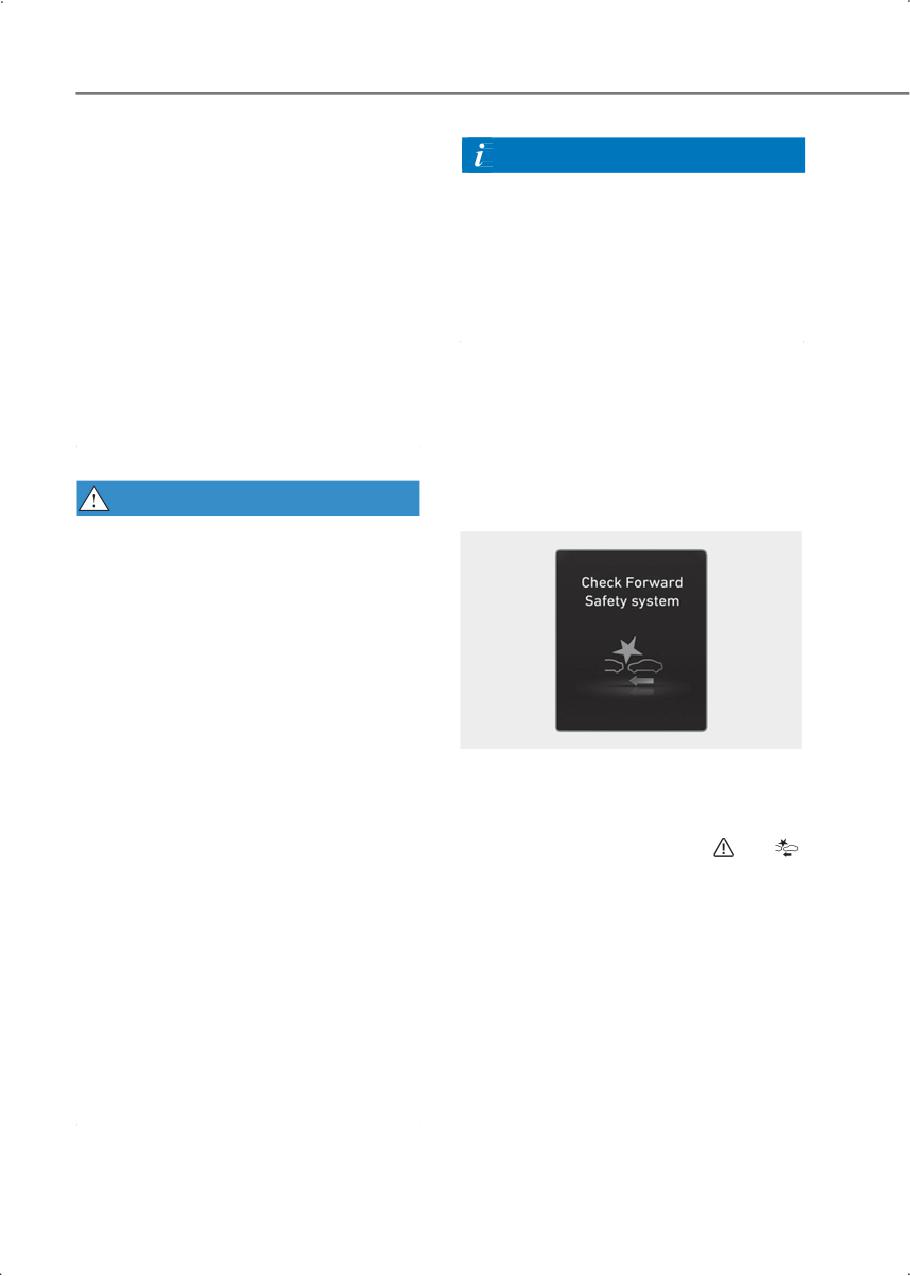
is not working properly, the "Check
Assist may be reduced. The function
Forward Safety system" warning
may not operate or be limited.
message may appear, and the
and
•
Forward Collision-Avoidance Assist
warning lights may illuminate on the
operates only under certain conditions
instrument cluster. Have the vehicle
that determines the risk level:
inspected by an authorized HYUNDAI
- Condition of other vehicles
dealer.
- The direction vehicles are driven
- Vehicle speed
- Surroundings
•
If your vehicle speed is too high or the
speed difference from the other vehicle
is too large, the function may be limited
or not operate.
7-8
7
Forward Collision-Avoidance Assist
WARNING
disabled
• Forward Collision-Avoidance Assist
may not operate properly even if there
is no warning message or warning light
on the instrument cluster.
• Forward Collision-Avoidance Assist
may not operate properly in open areas
where no objects are detected (e.g.
empty parking lot) or when the
detecting sensors are blocked right
after turning on the engine.
• Forward Collision-Avoidance Assist
maynot operate properly even after the
When the front view camera is covered or
engine has been restarted when the
blocked, Forward Collision-Avoidance
detecting sensors are blocked or there
Assist may be temporarily limited or
is a problem with the function.
disabled.
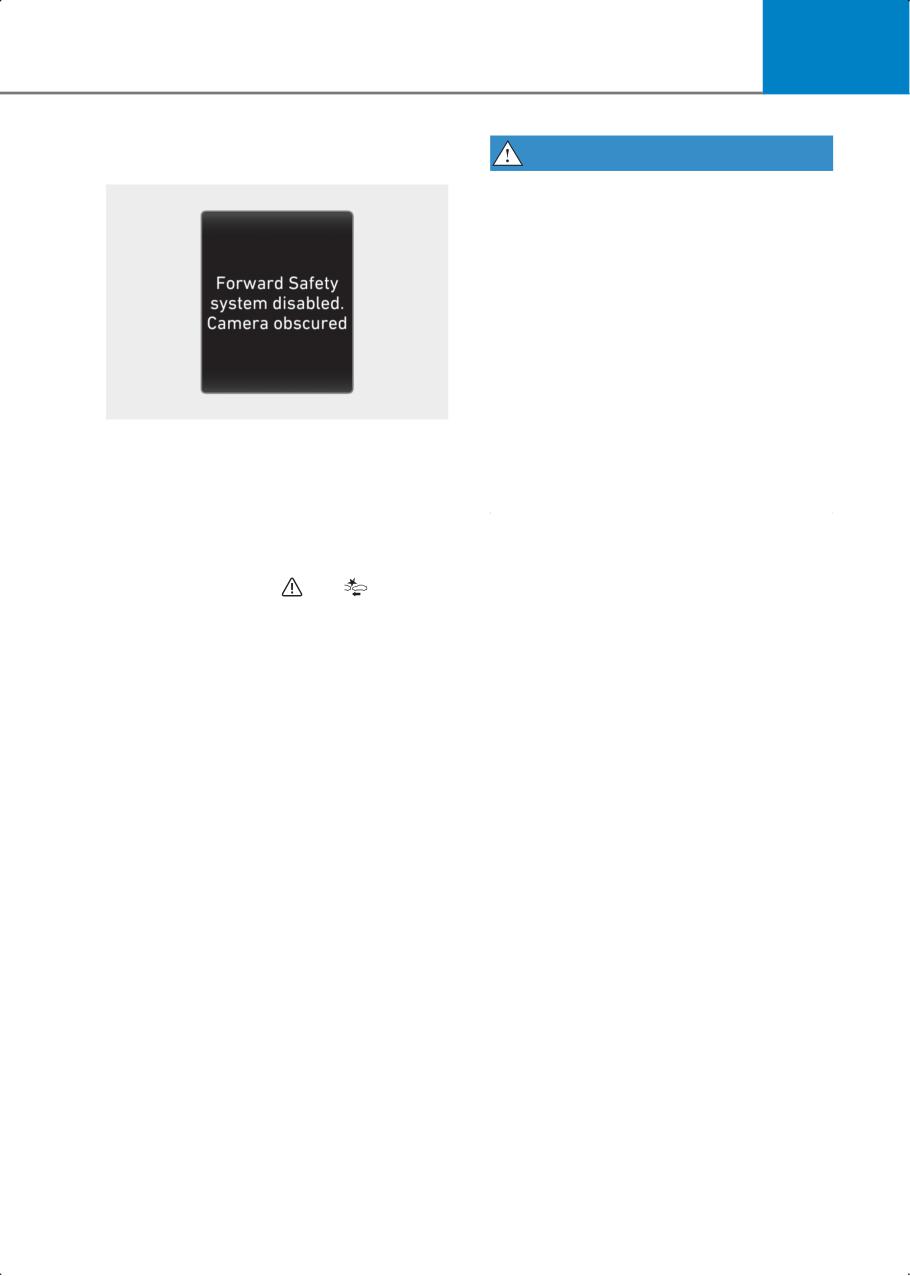
The "Forward Safety system disabled.
Limitations of Forward
Camera obscured" warning message
Collision-Avoidance Assist
may appear, and the
and
warning
Forward Collision-Avoidance Assist may
lights may illuminate on the instrument
not operate normally or may operate
cluster.
unexpectedly if:
The function operates normally when
• The detecting sensor or the
such foreign material is removed, and the
surroundings are contaminated or
engine is restarted.
damaged.
If Forward Collision-Avoidance Assist
• The temperature around the front view
does not operate normally after the
camera is high or low due to
sensor has been uncovered or unblocked,
surrounding environment.
have the vehicle inspected by an
authorized HYUNDAI dealer.
• The camera lens is contaminated due to
tinted, filmed or coated windshield,
damaged glass, or sticky foreign
material (sticker, bug, etc.) on the glass.
• Moisture is not removed or frozen on
the windshield.
• Washer fluid is continuously sprayed, or
the wiper is on.
• Driving in heavy rain or snow, or thick
fog.
• The field of view of the front view
camera is obstructed by sun glare.
• Street light or light from an oncoming
traffic is reflected on the wet road
surface, such as a puddle on the road.
• An object is placed on the dashboard.
7-9
Driver assistance system
•
Your vehicle is being towed.
•
The vehicle or powered two-wheeler in
front steers in the opposite direction of
•
The surrounding is very bright.
your vehicle to avoid a collision.
•
The surrounding is very dark, such as in
•
With a vehicle in front, your vehicle
a tunnel, etc.
changes lane at low speed.
•
The brightness changes suddenly, for
•
The vehicle in front is covered with
example when entering or exiting a
snow.
tunnel.
•
You are departing or returning to the
•
The brightness outside is low, and the
lane.
headlights are not on or are not bright.
•
Unstable driving.
•
Driving through steam, smoke or
shadow.
•
You are on a roundabout and the
vehicle in front is not detected.
•
Only part of the vehicle, powered
two-wheeler, pedestrian or cyclist is
•
You are continuously driving in a circle.
detected.
•
The vehicle or powered two-wheeler in
•
The vehicle in front is a bus, heavy
front has an unusual shape.
truck, truck with an unusually shaped
•
The vehicle or powered two-wheeler in
cargo, trailer, etc.
front is driving uphill or downhill.
•
The vehicle or powered two-wheeler in
•
The pedestrian or cyclist is not fully
front has no tail lights, tail lights are
detected, for example, if the pedestrian
located unusually, etc.
is leaning over or is not fully walking
•
The brightness outside is low, and the
upright.
tail lights are not on or are not bright.
•
The pedestrian or cyclist is wearing
•
The rear of the front vehicle is small or
clothing or equipment that makes it
the vehicle does not look normal, such
difficult to detect as a pedestrian or
as when the vehicle is tilted,
cyclist.
overturned, or the side of the vehicle is
visible, etc.
•
The front vehicle’s ground clearance is
low or high.
•
A vehicle, powered two-wheeler,
pedestrian or cyclist suddenly cuts in
front.
•
The vehicle or powered two-wheeler in
front is detected late.
•
The vehicle or powered two-wheeler in
front is suddenly blocked by an
obstacle.
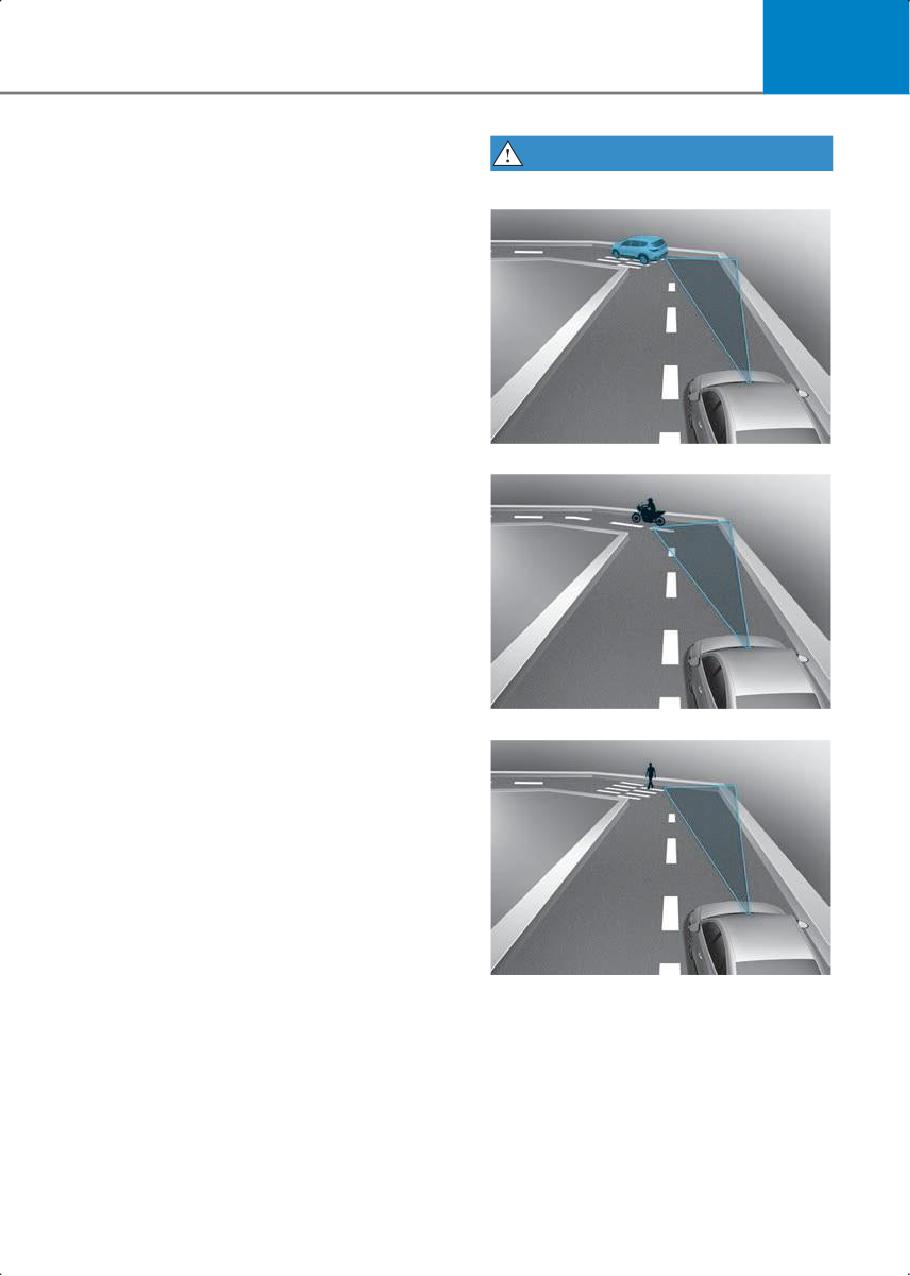
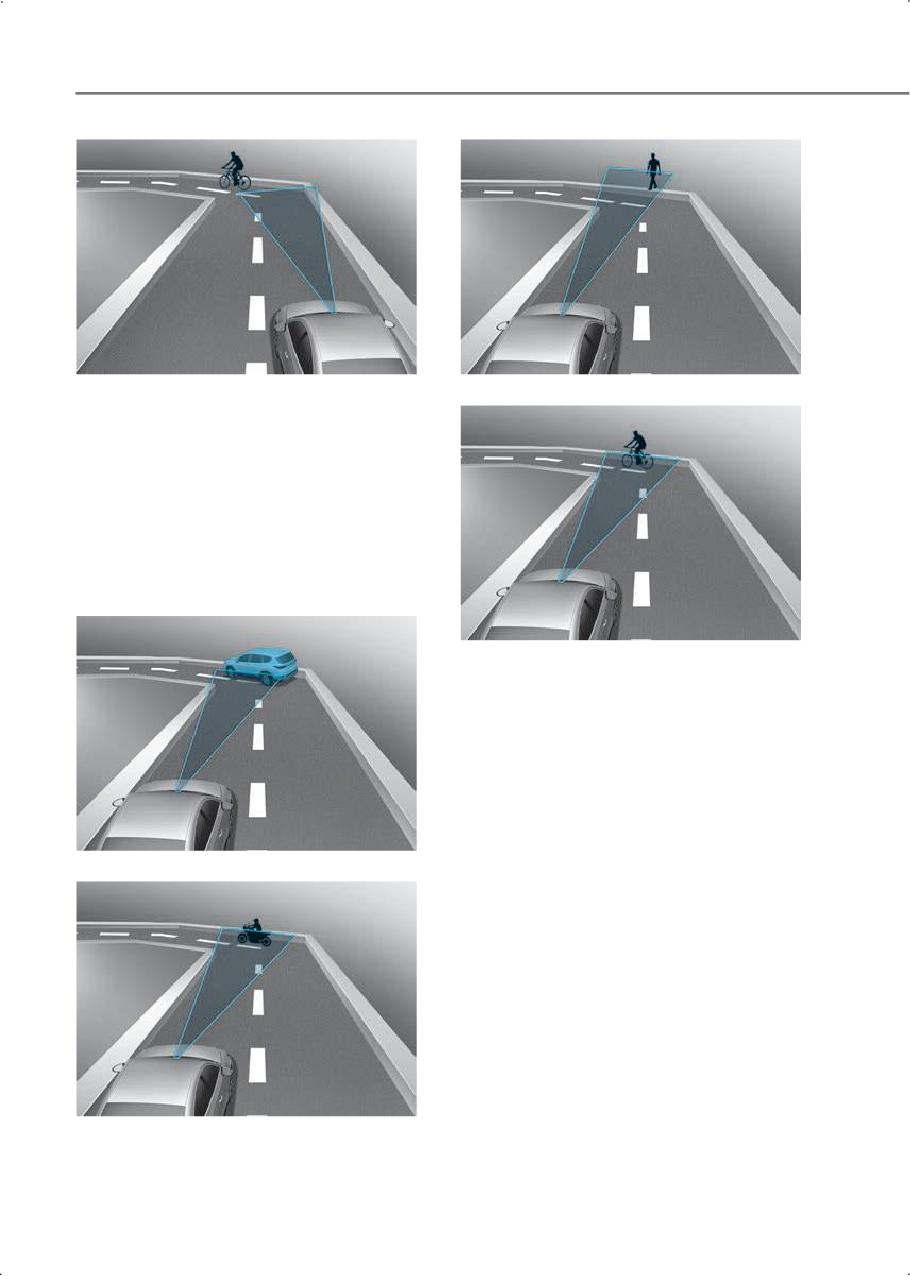
The illustration above shows the image
•
The vehicle or powered two-wheeler in
the front view camera is capable of
front suddenly changes lane or
detecting as a vehicle, powered
suddenly reduces speed.
two-wheeler, pedestrian and cyclist.
•
The vehicle or powered two-wheeler in
• The pedestrian or cyclist in front is
front is bent out of shape.
moving very quickly.
•
The front vehicle’s speed is fast or slow.
• The pedestrian or cyclist in front is short
or is posing a low posture.
7-10
7
•
The pedestrian or cyclist in front has
WARNING
impaired mobility.
•
The pedestrian or cyclist in front is
• Driving on a curved road
moving intersected with the driving
direction.
•
There is a group of pedestrians, cyclists
or a large crowd in front.
•
The pedestrian or cyclist is wearing
clothing that easily blends into the
background, making it difficult to
detect.
•
The pedestrian or cyclist is difficult to
distinguish from the similarly shaped
structure in the surroundings.
•
You are driving by a pedestrian, cyclist,
traffic signs, structures, etc., near the
intersection.
•
Driving in a parking lot.
•
Driving through a tollgate, construction
area, unpaved road, partial paved road,
uneven road, speed bumps, etc.
•
Driving on an incline road, curved road,
etc.
•
Driving through a roadside with trees or
streetlights.
•
The adverse road conditions cause
excessive vehicle vibrations while
driving.
•
Your vehicle height is low or high due to
heavy loads, abnormal tire pressure,
etc.
•
Driving through a narrow road where
trees or grass or overgrown.
•
There is interference by
electromagnetic waves, such as driving
in an area with strong radio waves or
electrical noise.
•
The vehicle is installed with a snow
chain, spare tire or different size wheel.
7-11
Driver assistance system
Forward Collision-Avoidance Assist
may not detect other vehicles, powered
two-wheeler, pedestrians or cyclists in
front of you when driving on a curve
and may not activate a warning or
brake your vehicle when needed.
When driving on a curved road, always
maintain a safe distance from others on
the road. Reduce your vehicle speed or
steer your vehicle as needed.
If a vehicle, powered two-wheeler,
pedestrian or cyclist is detected in the
next lane or outside the lane when
driving on a curved road, Forward
Collision-Avoidance Assist may warn
you and may brake your vehicle even
when not needed.
Always check road conditions, and if
necessary, take appropriate actions to
drive safely.
7-12
7
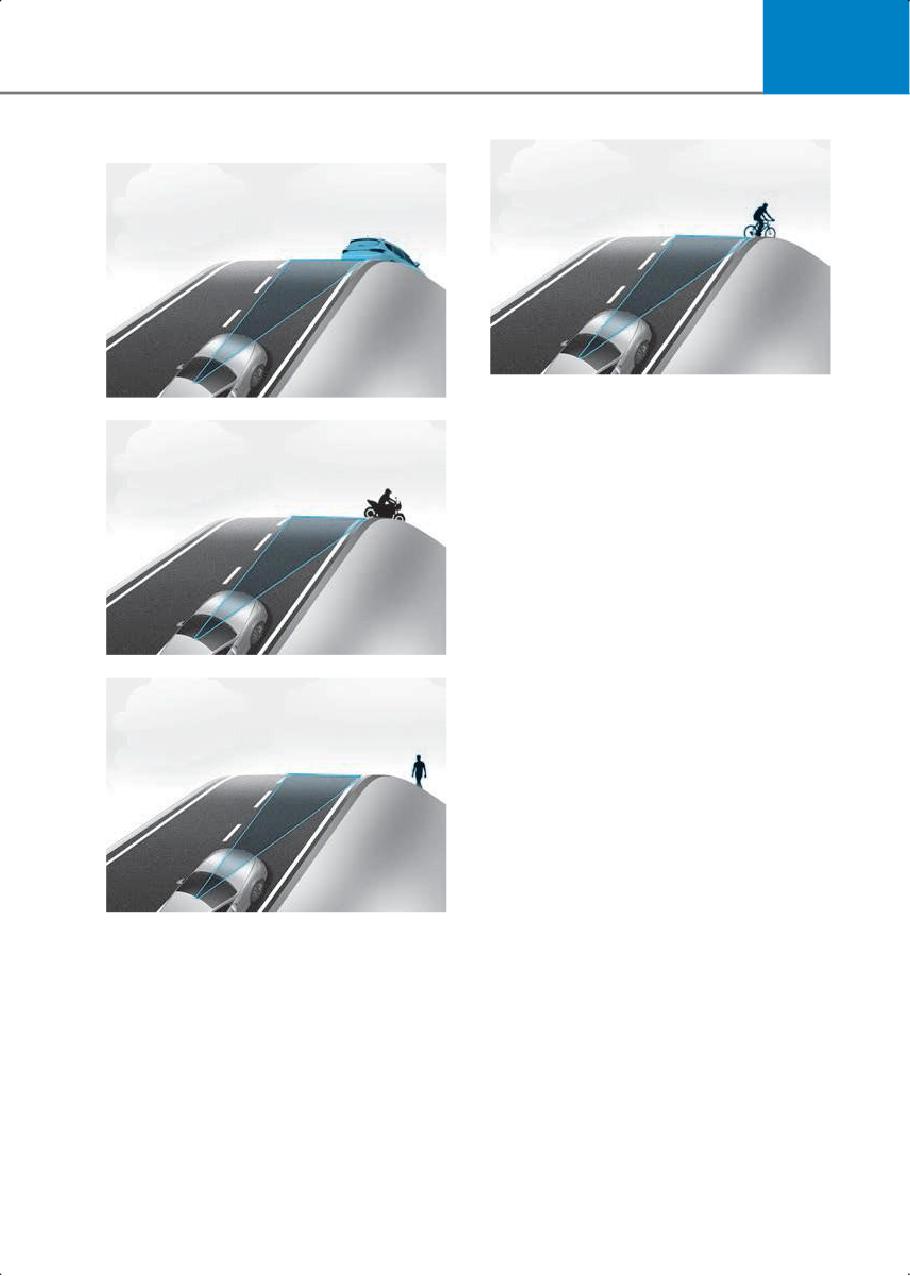
• Driving on an inclined road
Forward Collision-Avoidance Assist
may not detect other vehicles, powered
two-wheeler, pedestrians or cyclists in
front of you while driving uphill or
downhill.
This may result in unnecessary warning
or braking assist, or no warning or
braking assist when needed.
Also, vehicle speed may rapidly
decrease when a vehicle, powered
two-wheeler, pedestrian or cyclist
ahead is suddenly detected. Always
maintain a safe distance from the
others on the road. Adjust your vehicle
speed or steer your vehicle depending
on the road conditions.
7-13
Driver assistance system
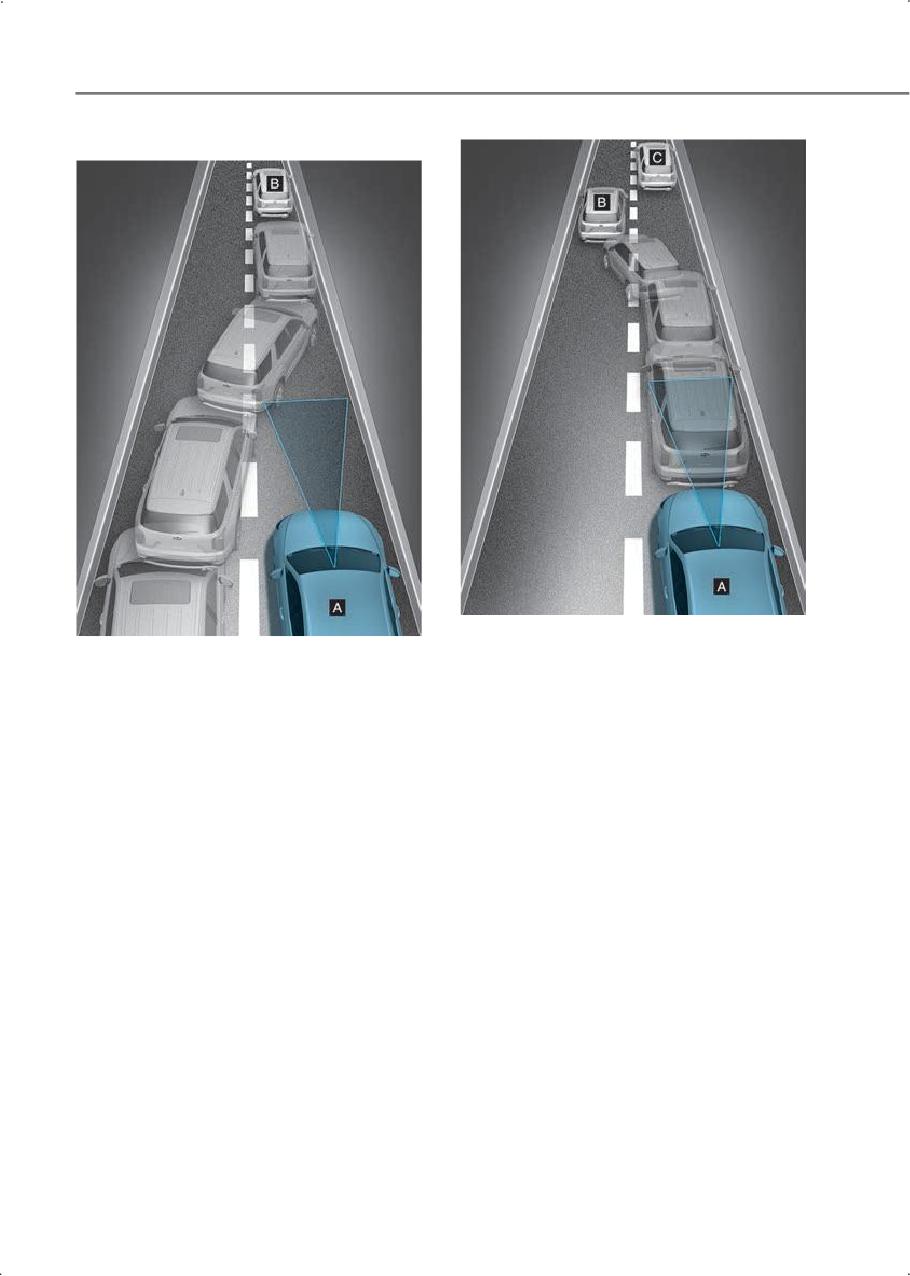
• Changing lanes
[A] Your vehicle
[B] Lane changing vehicle
[A] Your vehicle
[C] Same lane vehicle
[B] Lane changing vehicle
When a vehicle or powered
When a vehicle moves into your lane
two-wheeler in front of you merges out
from an adjacent lane, it cannot be
of the lane, Forward
detected by the sensor until it is in the
Collision-Avoidance Assist may not
sensor's detection range. Forward
immediately detect the vehicle that is
Collision-Avoidance Assist may not
now in front of you.
immediately detect the vehicle or
poweredtwo-wheeler when the vehicle
In this case, you must maintain a safe
changes lanes abruptly.
braking distance, and if necessary,
steer your vehicle and depress the
In this case, you must maintain a safe
brake pedal to reduce your driving
braking distance, and if necessary,
speed in order to maintain a safe
steer your vehicle and depress the
distance.
brake pedal to reduce your driving
speed in order to maintain a safe
distance.
7-14
7
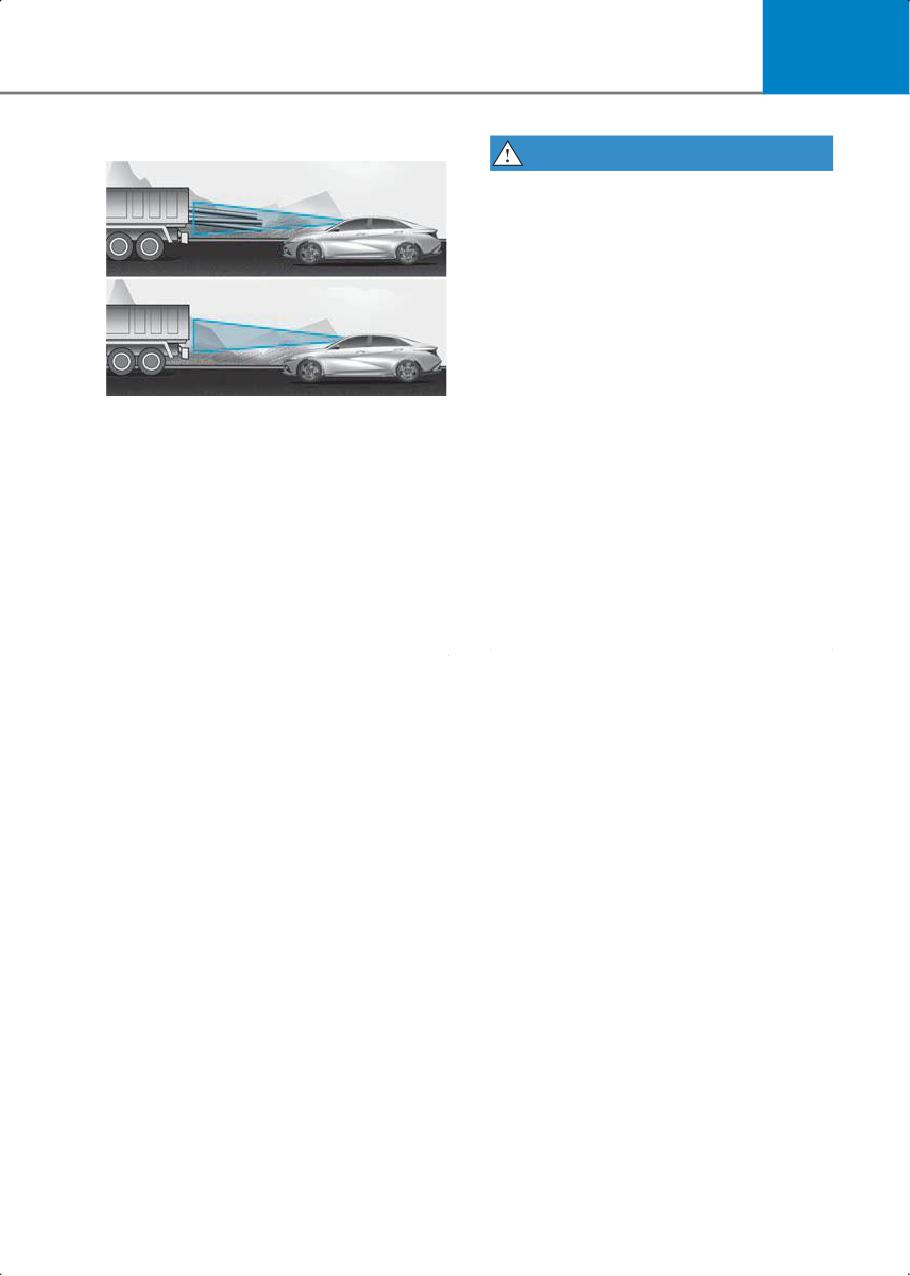
• Detecting a vehicle
WARNING
•
When you are towing a trailer or
another vehicle, turn off Forward
Collision-Avoidance Assist.
•
Forward Collision-Avoidance Assist
may operate if objects that are similar
in shape or characteristics to vehicles,
powered two-wheelers, pedestrians
are detected.
•
Forward Collision-Avoidance Assist
may not detect bicycles, motorcycles,
or smaller wheeled objects such as
Forward Collision-Avoidance Assist
luggage bags, shopping carts, or
may not be able to detect all potential
strollers.
hazards, like if the vehicle in front of
•
Forward Collision-Avoidance Assist
you has cargo that extends rearward
may not operate normally if there is
past the end of the vehicle or if the
interference from strong
vehicle in front of you has higher
electromagnetic waves.
ground clearance. Always maintain a
•
Forward Collision-Avoidance Assist
safe distance from the vehicles ahead.
may not operate for 15 seconds right
Adjust your vehicle speed or steer your
after your vehicle is started or when the
vehicle depending on the road
front view camera is initialized.
conditions.
7-15
Driver assistance system
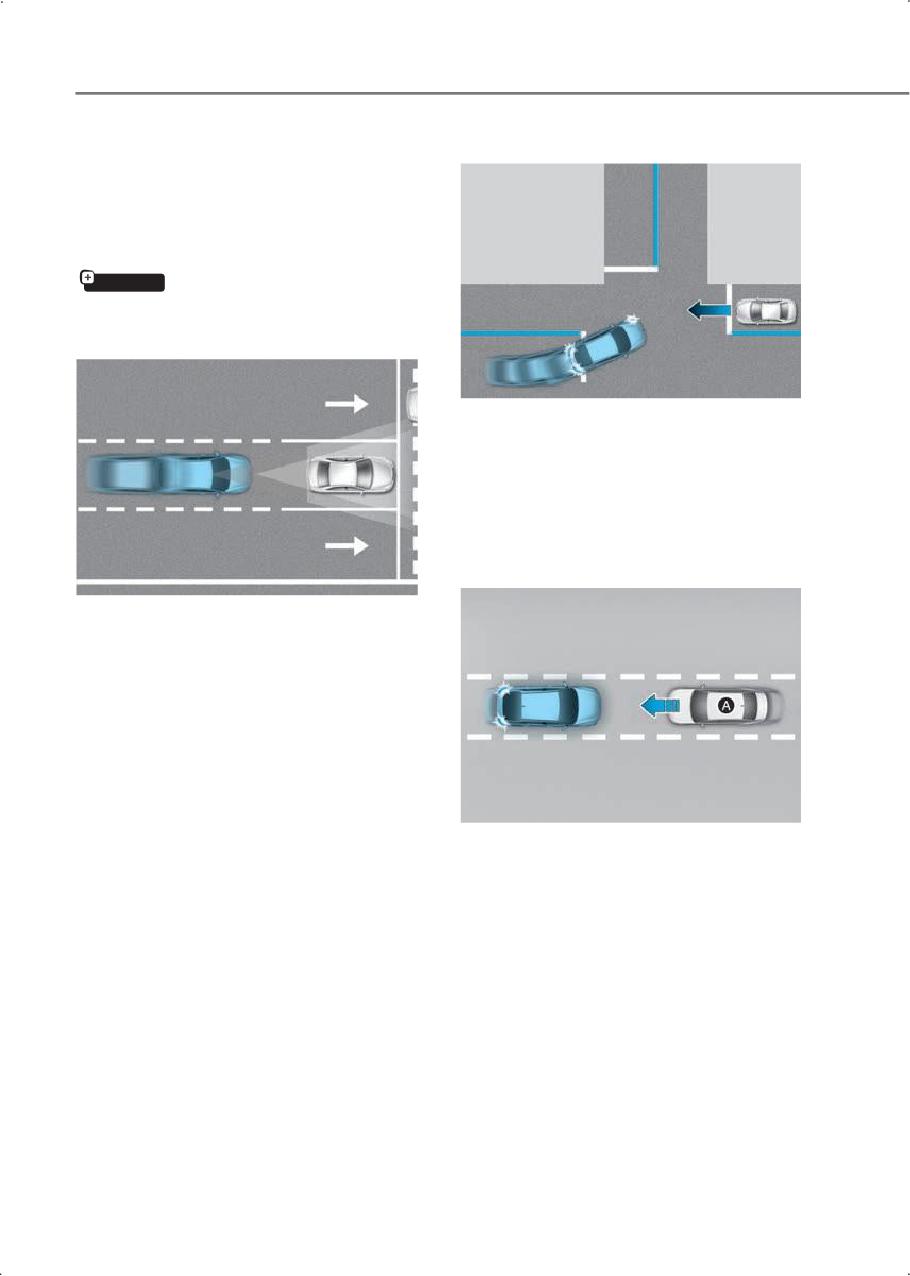
Junction Turning function
Forward
Collision-Avoidance
Assist (FCA) (Sensor
fusion)
if equipped
Basic function
Junction Turning function can help avoid
a collision with an oncoming vehicle in an
adjacent lane when turning left at a
crossroad with the turn signal on by
applying emergency braking.
Direct Oncoming function
Forward Collision-Avoidance Assist
detects a vehicle, a powered two-wheeler
a pedestrian, or a cyclist ahead on the
road and may warn you of a possible
collision with a warning message on the
instrument cluster and a warning sound.
Also, Forward Collision-Avoidance Assist
may assist with braking your vehicle to
help reduce collision speed or avoid a
collision.
[A] Oncoming vehicle
Direct Oncoming function helps reduce
the speed at the collision when a vehicle
approaching from the opposite side is
detected.
7-16
7
Information
WARNING
Forward Collision-Avoidance Assist
When the engine is restarted, Forward
(Sensor fusion) uses the following
Collision-Avoidance Assist will always
sensors:
turn on.
• Front view camera
However, if Forward Safety is
deselected, the driver should always be
• Front radar
aware of the surroundings and drive
Refer to the "Driver assistance system
safely.
sensors" section in this chapter for the
location.
CAUTION
Forward Collision-Avoidance
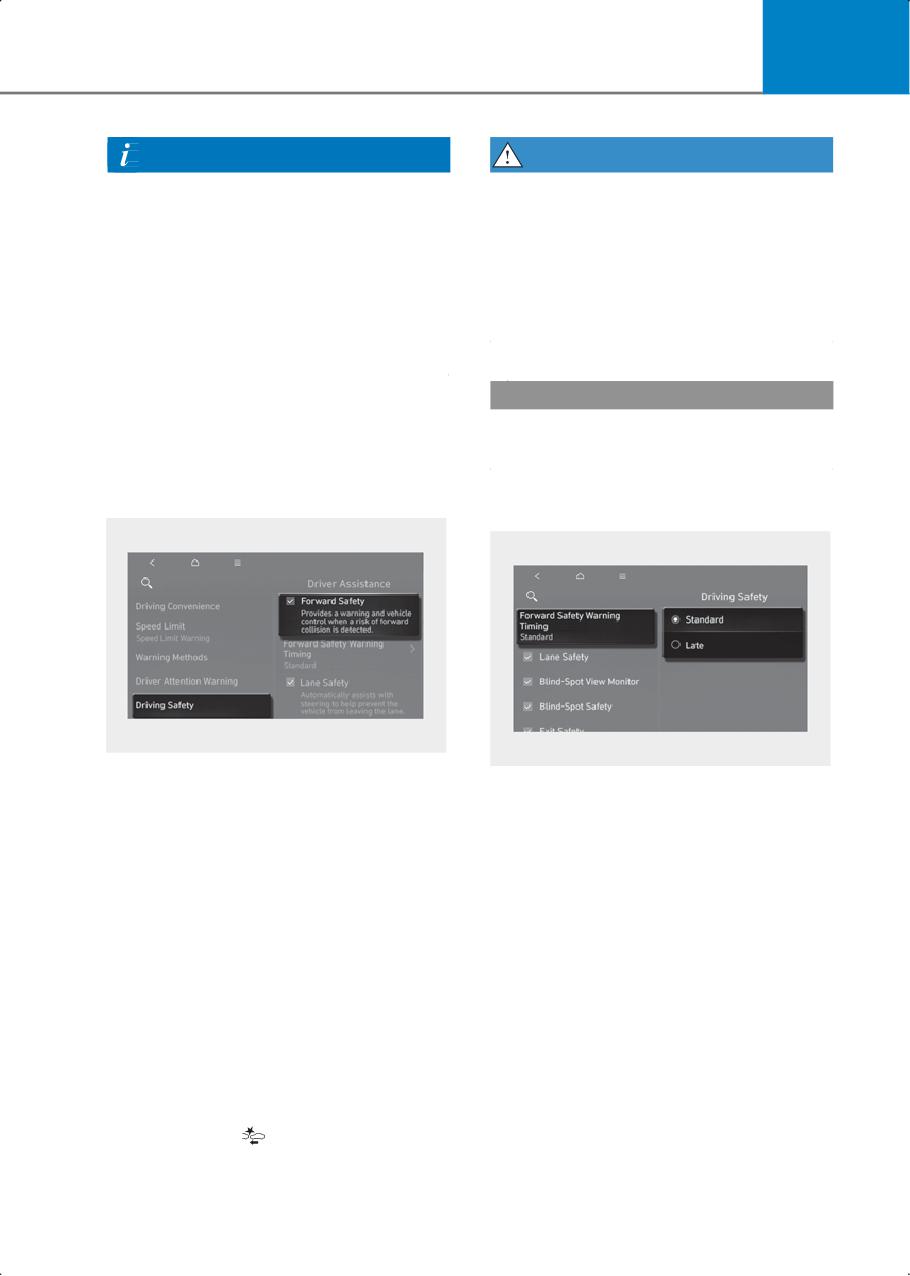
The setting for Forward Safety includes
Assist settings
‘Basic function’ and ‘Junction Turning’.
Forward Safety
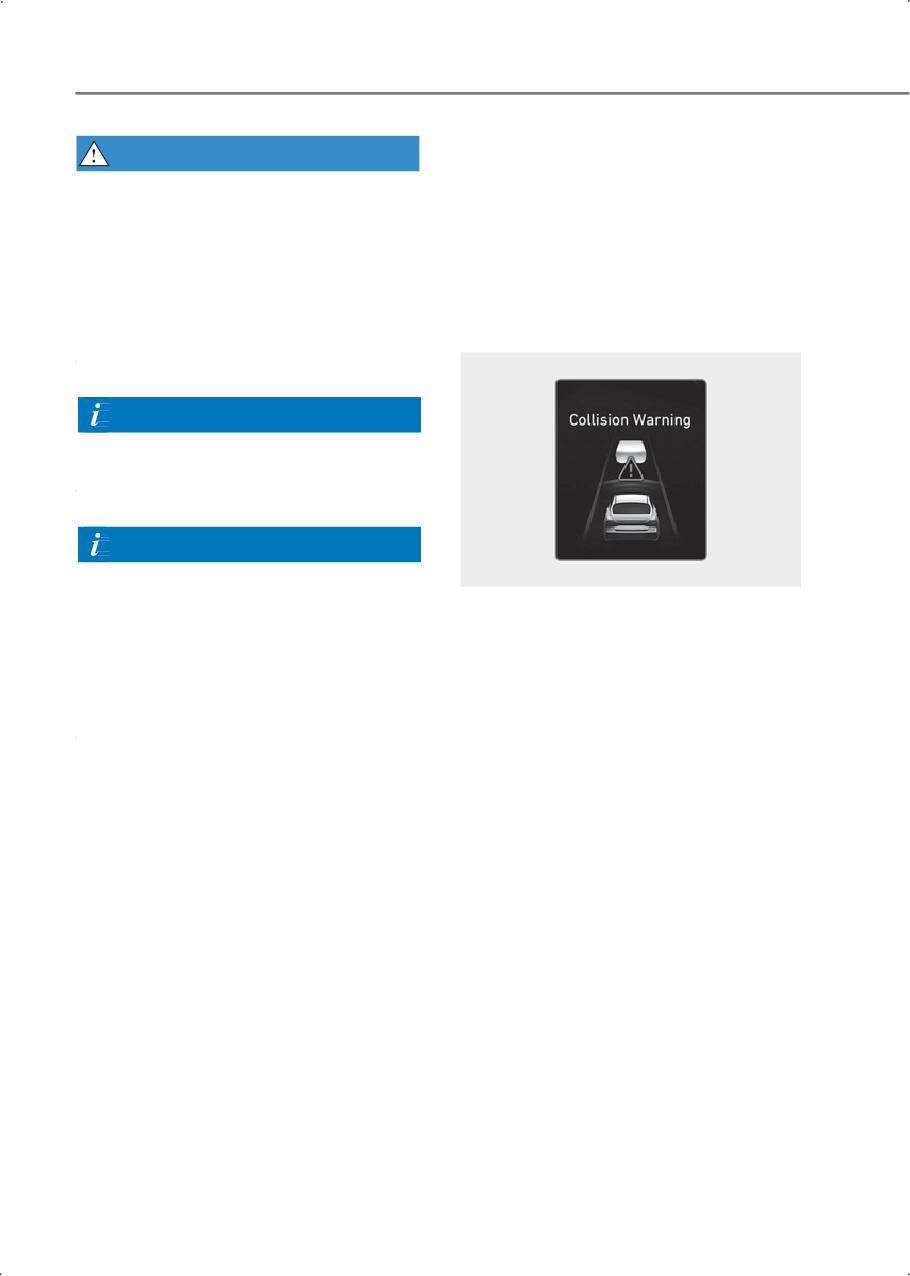
Forward Safety Warning Timing
With the ignition switch ON, go to User
With the ignition switch ON, go to User
Settings > Driver Assistance > Driving
Settings > Driver Assistance > Driving
Safety from the Settings menu in the
Safety > Forward Safety Warning
instrument cluster or Settings > Vehicle >
Timingfrom the settings menu in the
Driver Assistance > Driving Safety from
instrument cluster or Settings > Vehicle >
the settings menu in the infotainment
Driver Assistance > Driving Safety >
system to select the following:
Forward Safety Warning Timing settings
• If Forward Safety is selected, Forward
menu in the infotainment system to
Collision-Avoidance Assist will warn the
change the initial warning activation time.
driver with a warning message, an
Warning Timing is set to Standard at the
audible warning depending on the
factory.
collision risk levels. Braking assist will
be applied depending on the collision
risk levels.
If Forward Safety is deselected,
Forward Safety will turn off. The
warning light (
) will illuminate on the
instrument cluster.
7-17
Driver assistance system
Forward Collision-Avoidance
WARNING
Assist operation
• Even though Standard is selected for
Forward Safety Warning Timing if the
Basic function
vehicle ahead of you suddenly stops,
the initial warning activation time may
Forward Collision-Avoidance Assist may
not seem late.
warn and brake your vehicle depending
on the collision risk level.
• Select Late for Forward Safety Warning
Timing when traffic is light and your
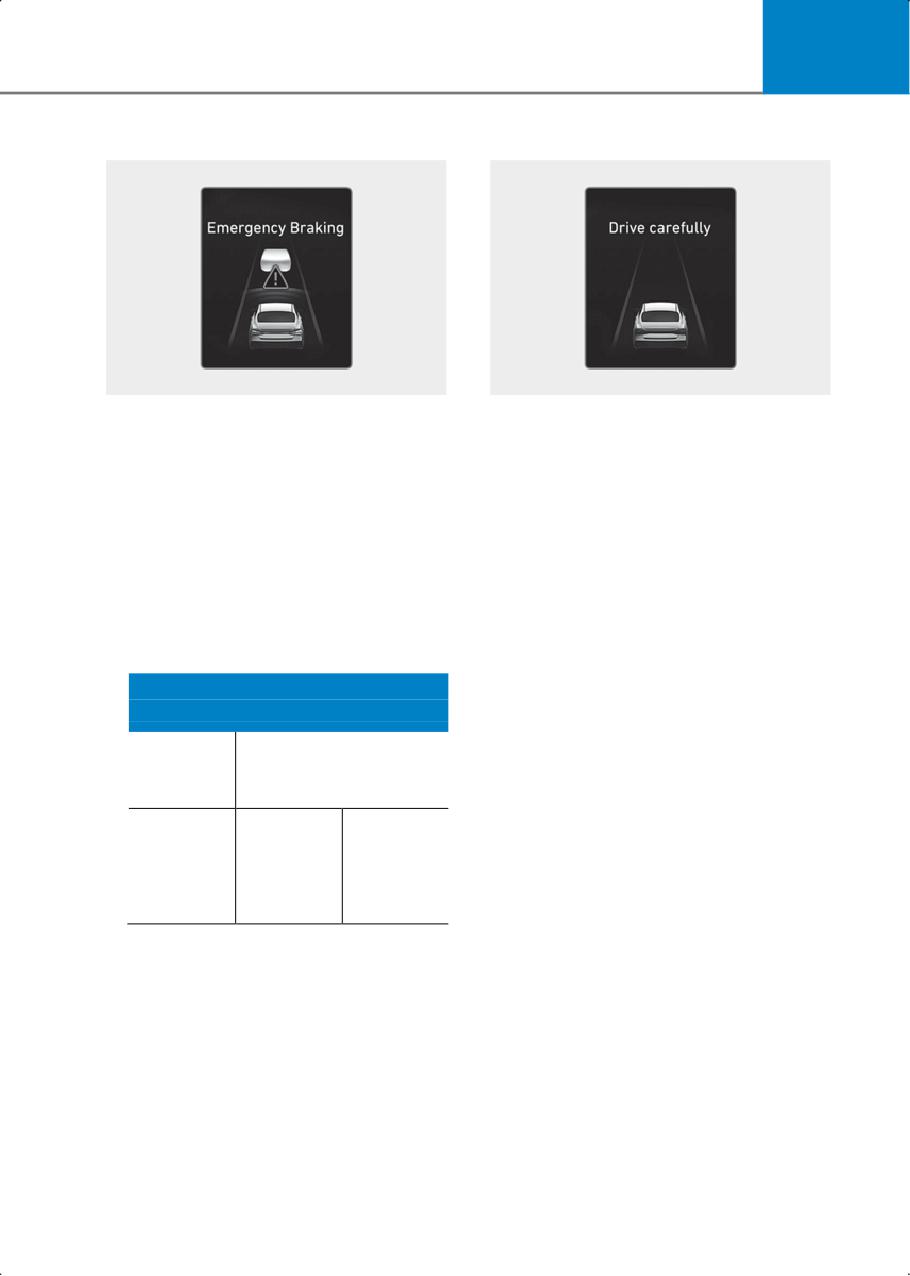
Collision Warning
vehicle speed is slow.
Information
When the engine is restarted, the
Warning Timing maintains its last setting.
Information
You can set the following Warning
Methods:
If Forward Collision-Avoidance Assist
• Warning Volume/Haptic
judges that a collision may occur, the
Warning/Driving Safety Priority
message may appear on the instrument
For more information, refer to the "Driver
cluster and an audible warning is heard
assistance system settings" section in this
and the steering wheel may vibrate when:
chapter.
• A vehicle or powered two-wheeler is
detected, and your vehicle speed is
about 6-125 mph (10-200 km/h).
• A pedestrian or cyclist is detected, and
your vehicle speed is about 6-53 mph
(10-85 km/h).
7-18
7
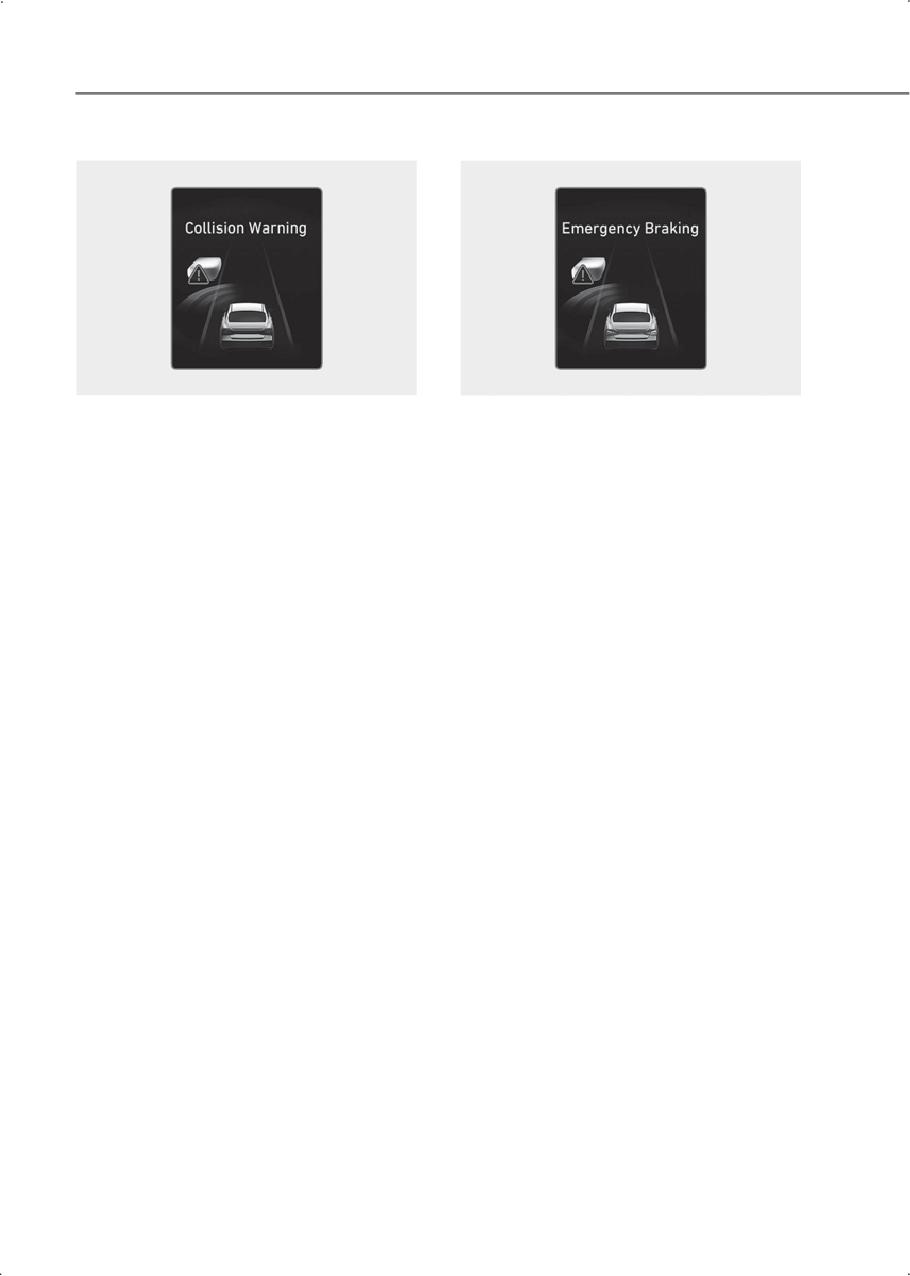
Emergency Braking
Stopping vehicle and ending brake control
If Forward Collision-Avoidance Assist
After your vehicle has stopped following
judges avoiding a collision may be
an Emergency Braking event, the "Drive
difficult, it applies higher brake force that
carefully" warning message may appear
may help avoid a collision with the
on the instrument cluster.
vehicle, pedestrian, or cyclist detected
Depress the brake pedal immediately and
ahead.
check the surroundings.
The warning message may appear on the
• Braking control ends about 2 seconds
instrument cluster and an audible
after your vehicle is stopped following
warning is heard and the steering wheel
an Emergency Braking event.
may vibrate when:
• Vehicle or powered two-wheeler:
Junction Turning function
Driving
Stopped
Junction Turning function will warn and
vehicle
vehicle
help control the vehicle depending on the
collision risk level: ‘Collision Warning’,
Weak
‘Emergency Braking’ and ‘Stopping
Approximately 6-125
braking
vehicle and ending brake control'.
mph (10-200 km/h)
power
Approxima
Approxima
Strong
tely 6-81
tely 6-47
braking
mph
mph (10-75
power
(10-130
km/h)
km/h)
• Pedestrian or cyclist:
The function will operate when your
vehicle speed is between
approximately 6-40 mph (10-65 km/h).
7-19
Driver assistance system
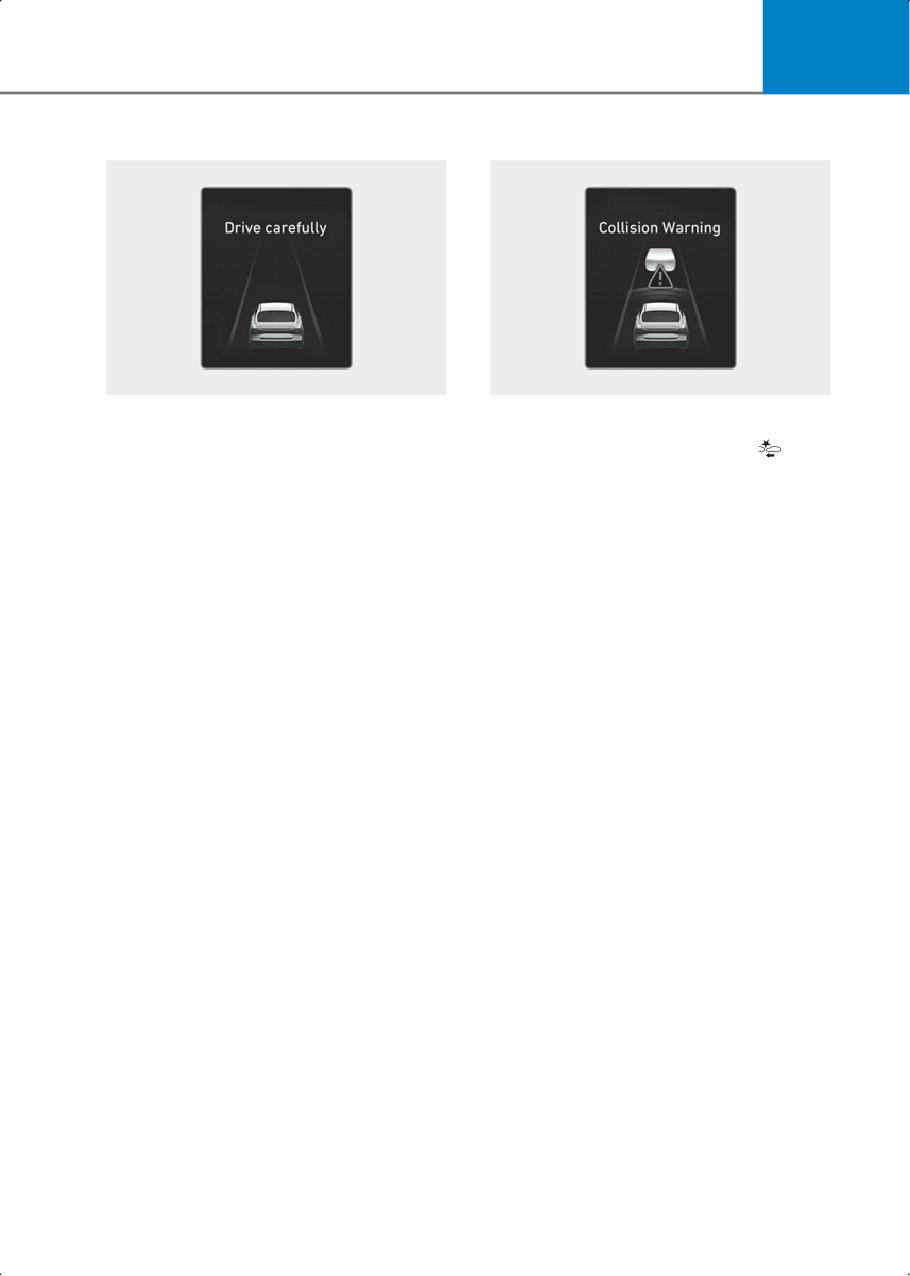
Collision Warning
Emergency Braking
If Forward Collision-Avoidance Assist
If Forward Collision-Avoidance Assist
judges that a collision may occur, the
judges avoiding a collision may be
message may appear on the instrument
difficult, it applies higher brake force that
cluster and an audible warning is heard
may help avoid a collision with the
and the steering wheel may vibrate when:
oncoming vehicle detected.
• Your vehicle speed is about 6-19 mph
The warning message may appear on the
(10-30 km/h) and the oncoming vehicle
instrument cluster and an audible
speed is about 19-44 mph (30-70
warning is heard and the steering wheel
km/h).
may vibrate when:
• Your vehicle speed is about 6-19 mph
(10-30 km/h) and the oncoming vehicle
speed is about 19-44 mph (30-70
km/h).
7-20
7
Stopping vehicle and ending brake control
Collision Warning
• After your vehicle has stopped
• To warn the driver of a collision,
following an Emergency Braking event,
Forward Safety warning light (
)
the "Drive carefully" warning message
blinking, the "Collision Warning"
may appear on the instrument cluster.
warning message will appear on the
instrument cluster, an audible warning
Depress the brake pedal immediately
will sound and the steering wheel may
and check the surroundings.
vibrate.
• Braking control ends about 2 seconds
• The function will operate when your
after your vehicle is stopped following
vehicle speed is between about 19-80
an Emergency Braking event.
mph (30-130 km/h) and the detected
oncoming vehicle speed is about above
Direct Oncoming function
6 mph (10 km/h) and the oncoming
Direct Oncoming function will warn and
vehicle speed is about above 6 mph (10
control the vehicle depending on the
km/h).
collision risk level: ‘Collision Warning’,
‘Emergency Braking’ and ‘Stopping
vehicle and ending brake control’.
7-21
Driver assistance system
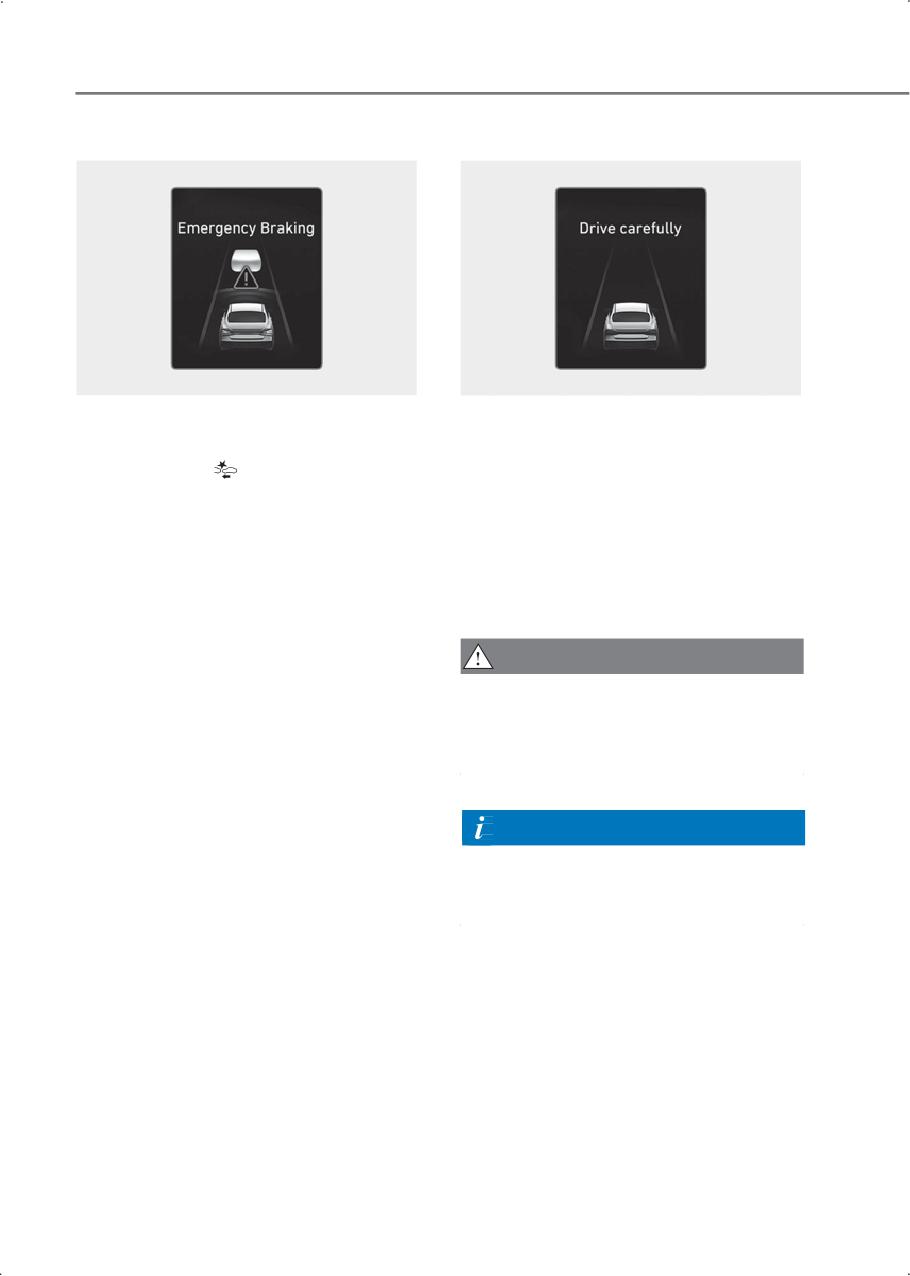
Emergency Braking
Stopping vehicle and ending brake control
• To warn the driver that emergency
• When the vehicle is stopped due to
braking will be assisted, Forward Safety
emergency braking, the "Drive
warning light (
) blinking, the
carefully" warning message will appear
"Emergency Braking" warning
on the instrument cluster. For your
message will appear on the instrument
safety, the driver should depress the
cluster, an audible warning will sound
brake pedal immediately and check the
and the steering wheel may vibrate.
surroundings.
• In emergency braking situation,
• Brake control will end after the vehicle
braking is assisted with strong braking
is stopped by emergency braking for
power by the function to help prevent
about 2 seconds.
collision with the oncoming vehicle.
CAUTION
• The function will operate when your
vehicle speed is between about 19-80
If your vehicle or the oncoming vehicle is
mph (30-130 km/h) and the detected
not driving straight, Direct Oncoming
oncoming vehicle speed is about above
function warning and control may be late
6 mph (10 km/h).
or may not operate.
Information
Press the hazard warning flasher to turn
off the audible warning of the collision
warning or emergency braking system.
7-22
7
•
During Forward Collision-Avoidance
WARNING
Assist operation, your vehicle may stop
suddenly. Always wear your seat belt,
Forward Collision-Avoidance Assist may
check your passengers have their seat
not operate in all situations and cannot
avoid all collisions.
belts fastened and secure loose objects
that may become projectiles.
To prevent serious injury or death:
•
When other system’s warning message
•
Only change the settings after parking
appears or audible warning is heard,
your vehicle at a safe location.
Forward Collision-Avoidance Assist
•
Control your vehicle at all times. Do not
may not warn you.
depend on Forward
•
You may not hear the audible warning
Collision-Avoidance Assist to avoid a
of Forward Collision-Avoidance Assist if
collision. Always maintain a safe
the surrounding environment is too
distance from the vehicles ahead and
noisy.
reduce your vehicle speed as needed.
•
Even if there is a problem with Forward
•
Forward Collision-Avoidance Assist
Collision-Avoidance Assist, the
may stop operating, or may not
vehicle’s basic braking will function
operate, or operate unnecessarily
normally.
depending on the road conditions and
•
During emergency braking, braking
surroundings.
control by Forward Collision-Avoidance
•
When Active Assist or Warning Only is
Assist will automatically cancel when
selected and ESC is turned off by
the driver excessively depresses the
pressing and holding the ESC OFF
accelerator pedal or sharply steers the
button, Forward Collision-Avoidance
vehicle.
Assist turns off automatically. Then the
Forward Collision-Avoidance Assist
settings cannot be changed using the
settings menu and the warning light
CAUTION
illuminates on the instrument cluster. If
• Depending on the condition of the
ESC is turned on again by pressing the
vehicle, powered two-wheeler,
ESC OFF button, Forward
pedestrian and cyclist in front and the
Collision-Avoidance Assist maintains its
surroundings, the speed range to
last setting.
operate Forward Collision-Avoidance
•
Never attempt to activate Forward
Assist may reduce. Forward
Collision-Avoidance Assist by
Collision-Avoidance Assist may only
intentionally driving toward people,
warn the driver, or it may not operate.
animals, objects, or other vehicles.
• Forward Collision-Avoidance Assist will
•
Forward Collision-Avoidance Assist
operate under certain conditions by
may not assist braking your vehicle if
judging the risk level based on the
you depress the brake pedal sufficiently
condition of the oncoming vehicle,
in response to the potential hazard
powered two-wheeler, driving
detected by the function to avoid all
direction, speed and surroundings.
collisions.
• Forward Collision-Avoidance Assist
may be limited or disabled if the vehicle
or powered two-wheeler speed is too
high or the distance to the vehicle
ahead is far.
7-23
Driver assistance system
Forward Collision-Avoidance Assist
Information
disabled
• In a situation collision is imminent,
braking may be assisted by Forward
Collision-Avoidance Assist when
braking is insufficient by the driver.
• The images and colors in the
instrument cluster may differ
depending on the cluster type or theme
selected from the instrument cluster.
Forward Collision-Avoidance
Assist malfunction and
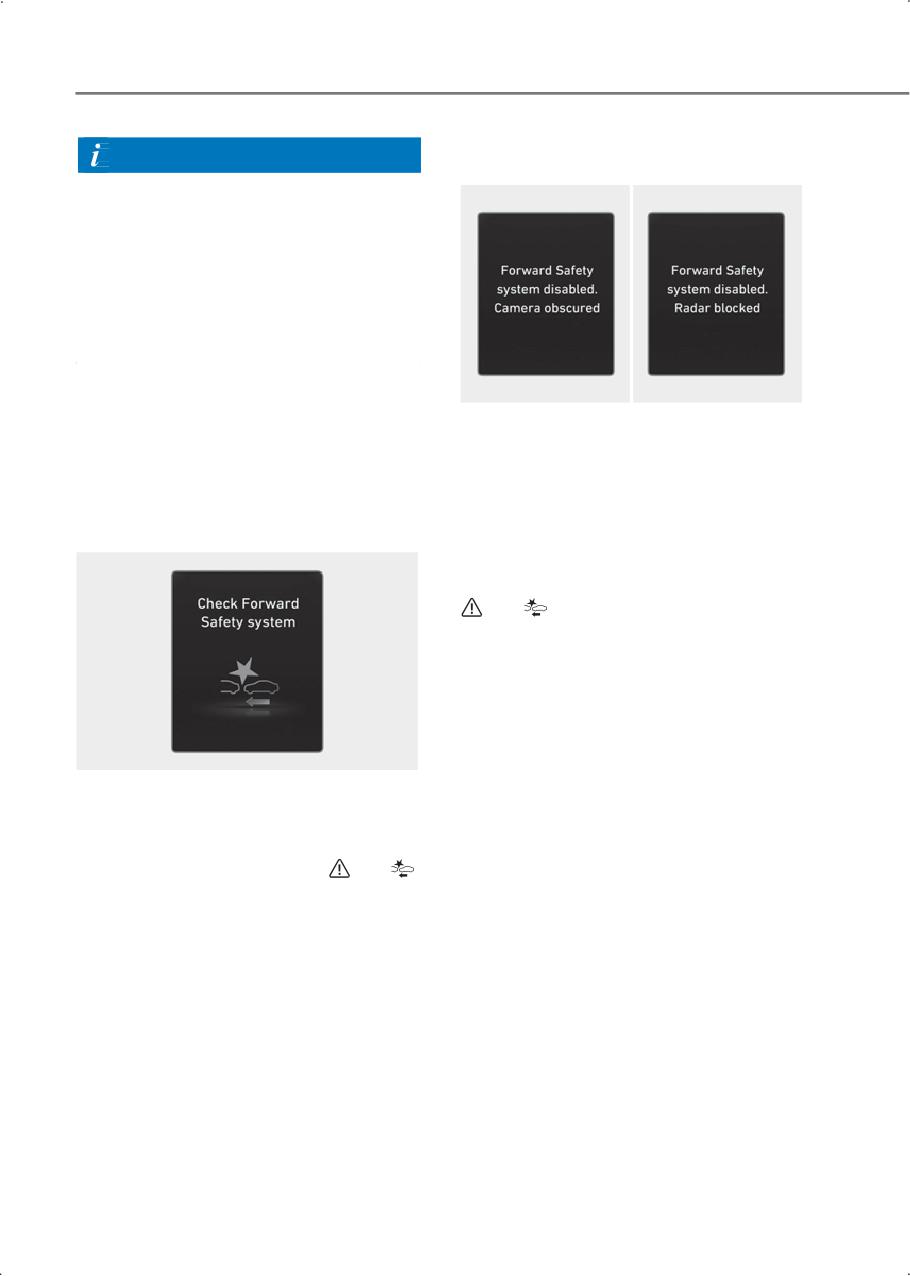
Whenthe front view camera or front radar
is covered or blocked, Forward
limitations
Collision-Avoidance Assist may be
temporarily limited or disabled.
Forward Collision-Avoidance Assist
The "Forward Safety system disabled.
malfunction
Camera obscured" and "Forward Safety
system disabled. Radar blocked"
warning messages may appear, and the
and
warning lights may illuminate
on the instrument cluster.
The function operates normally when
such foreign material is removed, and the
engine is restarted.
If Forward Collision-Avoidance Assist
does not operate normally after the
sensor has been uncovered or unblocked,
have the vehicle inspected by an
When Forward Collision-Avoidance Assist
authorized HYUNDAI dealer.
is not working properly, the "Check
Forward Safety system" warning
message may appear, and the
and
warning lights may illuminate on the
instrument cluster. Have the vehicle
inspected by an authorized HYUNDAI
dealer.
7-24
7
•
Your vehicle is being towed.
WARNING
•
The surrounding is very bright.
• Forward Collision-Avoidance Assist
•
The surrounding is very dark, such as in
may not operate properly even if there
a tunnel, etc.
is no warning message or warning light
•
The brightness changes suddenly, for
on the instrument cluster.
example when entering or exiting a
• Forward Collision-Avoidance Assist
tunnel.
may not operate properly in open areas
•
The brightness outside is low, and the
where no objects are detected (e.g.
headlamps are not on or are not bright.
empty parking lot) or when the
detecting sensors are blocked right
•
Driving through steam, smoke or
after turning on the engine.
shadow.
• Forward Collision-Avoidance Assist
•
Only part of the vehicle, powered
may not operate properly even after the
two-wheeler, pedestrian or cyclist is
engine has been restarted when the
detected.
detecting sensors are blocked or there
•
The vehicle in front is a bus, heavy
is a problem with the function.
truck, truck with an unusually shaped
cargo, trailer, etc.
•
The vehicle or powered two-wheeler in
Limitations of Forward
front has no tail lights, tail lights are
Collision-Avoidance Assist
located unusually, etc.
Forward Collision-Avoidance Assist may
•
The brightness outside is low, and the
not operate normally or may operate
tail lamps are not on or are not bright.
unexpectedly if:
•
The rear of the front vehicle is small or
• The detecting sensor or the
the vehicle does not look normal, such
surroundings are contaminated or
as when the vehicle is tilted,
damaged.
overturned, or the side of the vehicle is
• The temperature around the front view
visible, etc.
camera is high or low due to
•
The front vehicle’s ground clearance is
surrounding environment.
low or high.
• The camera lens is contaminated due to
•
A vehicle, powered two-wheeler,
tinted, filmed or coated windshield,
pedestrian or cyclist suddenly cuts in
damaged glass, or sticky foreign
front.
material (sticker, bug, etc.) on the glass.
•
The bumper around the front radar is
• Moisture is not removed or frozen on
impacted, damaged or the front radar is
the windshield.
out of position.
• Washer fluid is continuously sprayed, or
•
The temperature around the front radar
the wiper is on.
is high or low.
• Driving in heavy rain or snow, or thick
•
Driving through a tunnel or iron bridge.
fog.
•
Driving in vast areas where there are
• The field of view of the front view
few vehicles or structures. (for
camera is obstructed by sun glare.
example, desert, meadow, suburb, etc.)
• Street light or light from an oncoming
•
Driving near areas containing metal
traffic is reflected on the wet road
substances, such as a construction
surface, such as a puddle on the road.
zone, railroad, etc.
• An object is placed on the dashboard.
7-25
Driver assistance system
•
A material is near that reflects very well
on the front radar, such as a guardrail,
nearby vehicle, etc.
•
The cyclist in front is on a bicycle made
of material that does not reflect on the
front radar.
•
The vehicle or powered two-wheeler in
front is detected late.
•
The vehicle or powered two-wheeler in
front is suddenly blocked by an
obstacle.
•
The vehicle or powered two-wheeler in
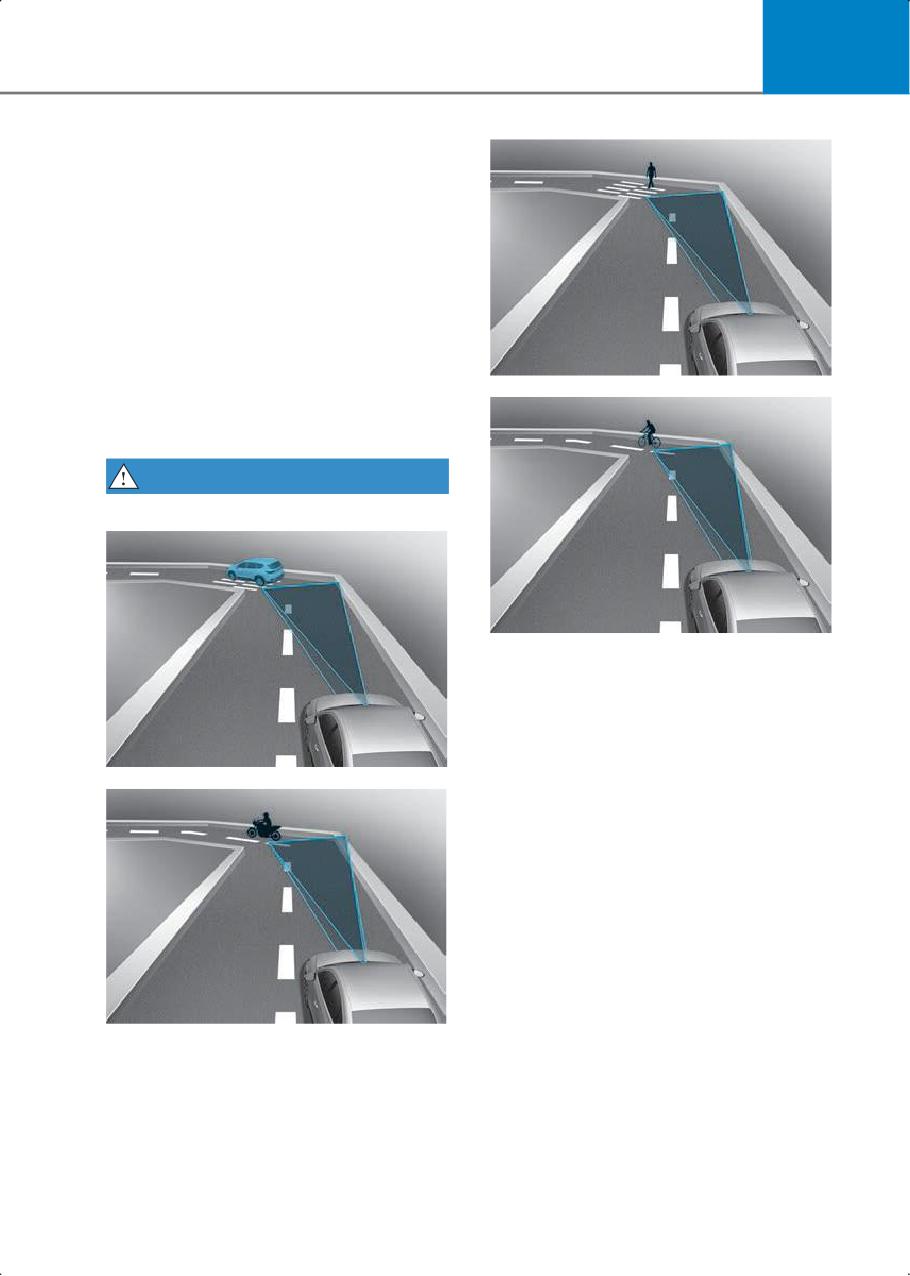
The illustration above shows the image
front suddenly changes lane or
the front view camera and front radar are
suddenly reduces speed.
capable of detecting as a vehicle,
•
The vehicle or powered two-wheeler in
powered two-wheeler, pedestrian and
front is bent out of shape.
cyclist.
•
The front vehicle or powered
•
The pedestrian or cyclist in front is
two-wheeler speed is fast or slow.
moving very quickly.
•
The vehicle in front steers in the
•
The pedestrian or cyclist in front is short
opposite direction of your vehicle to
or is posing a low posture.
avoid a collision.
•
The pedestrian or cyclist in front has
•
With a vehicle in front, your vehicle
impaired mobility.
changes lane at low speed.
•
The pedestrian or cyclist in front is
•
The vehicle or powered two-wheeler in
moving intersected with the driving
front is covered with snow.
direction.
•
You are departing or returning to the
•
There is a group of pedestrians, cyclists
lane.
or a large crowd in front.
•
Unstable driving.
•
The pedestrian or cyclist is wearing
•
You are on a roundabout and the
clothing that easily blends into the
vehicle in front is not detected.
background, making it difficult to
detect.
•
You are continuously driving in a circle.
•
The pedestrian or cyclist is difficult to
•
The vehicle or powered two-wheeler in
distinguish from the similarly shaped
front has an unusual shape.
structure in the surroundings.
•
The vehicle or powered two-wheeler in
•
You are driving by a pedestrian, cyclist,
front is driving uphill or downhill.
traffic signs, structures, etc. near the
•
The pedestrian or cyclist is not fully
intersection.
detected, for example, if the pedestrian
•
Driving in a parking lot.
is leaning over or is not fully walking
upright.
•
Driving through a tollgate, construction
area, unpaved road, partial paved road,
•
The pedestrian or cyclist is wearing
uneven road, speed bumps, etc.
clothing or equipment that makes it
difficult to detect.
•
Driving on an incline road, curved road,
etc.
•
Driving through a roadside with trees or
streetlights.
7-26
7
• The adverse road conditions cause
excessive vehicle vibrations while
driving.
• Your vehicle height is low or high due to
heavy loads, abnormal tire pressure,
etc.
• Driving through a narrow road where
trees or grass or overgrown.
• There is interference by
electromagnetic waves, such as driving
in an area with strong radio waves or
electrical noise.
• The vehicle is installed with a snow
chain, spare tire or different size wheel.
WARNING
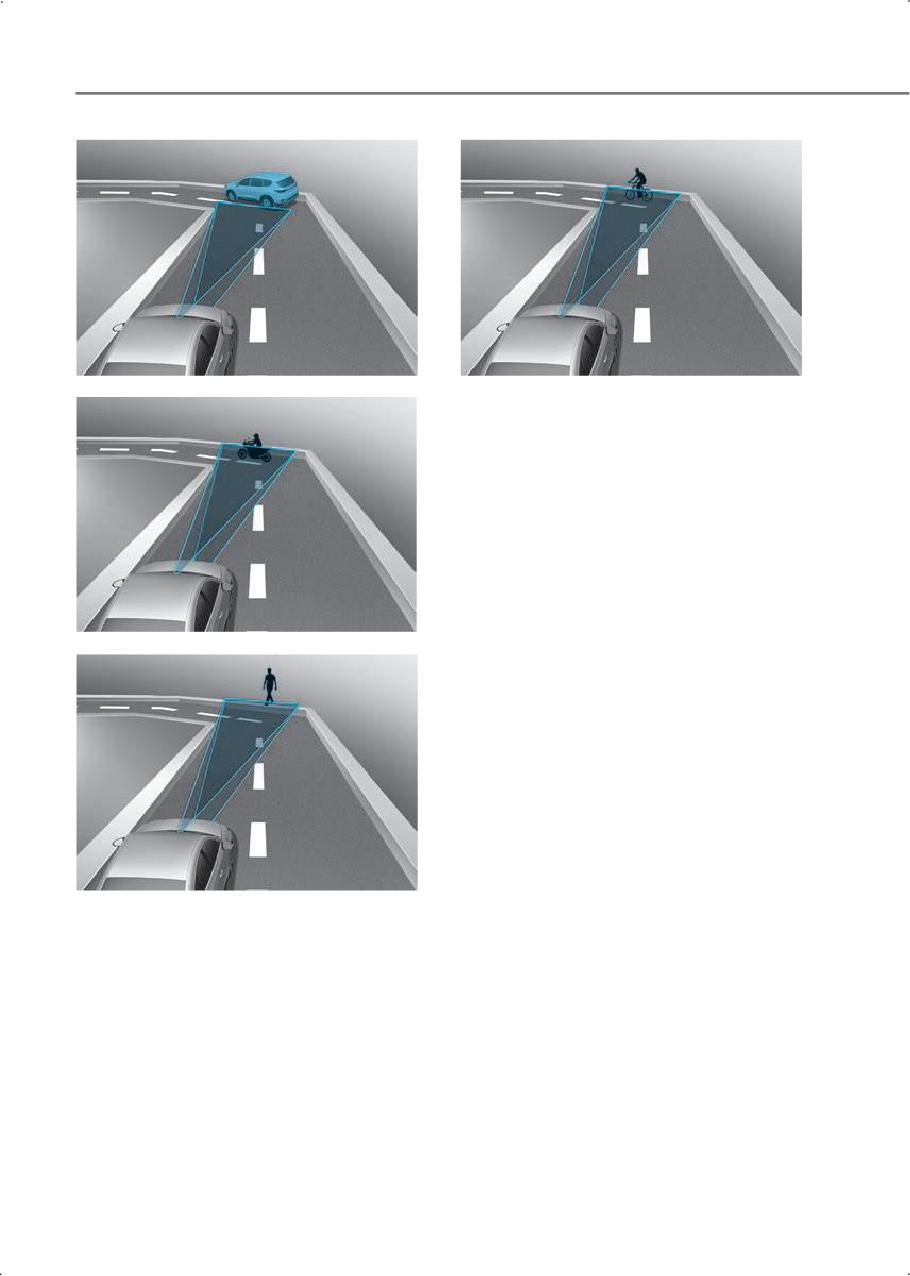
• Driving on a curved road
Forward Collision-Avoidance Assist
may not detect other vehicles, powered
two-wheelers, pedestrians or cyclists in
front of you when driving on a curved
roads adversely affecting the
performance of the sensors. This may
result in no warning, braking assist
when necessary.
When driving on a curved road, always
maintain a safe distance from others on
the road. Reduce your vehicle speed or
steer your vehicle as needed.
7-27
Driver assistance system
Forward Collision-Avoidance Assist
may detect a vehicle, powered
two-wheeler, pedestrian or cyclist in
the next lane or outside the lane when
driving on a curved road.
Always check road conditions, and if
necessary, take appropriate actions to
drive safely.
7-28
7
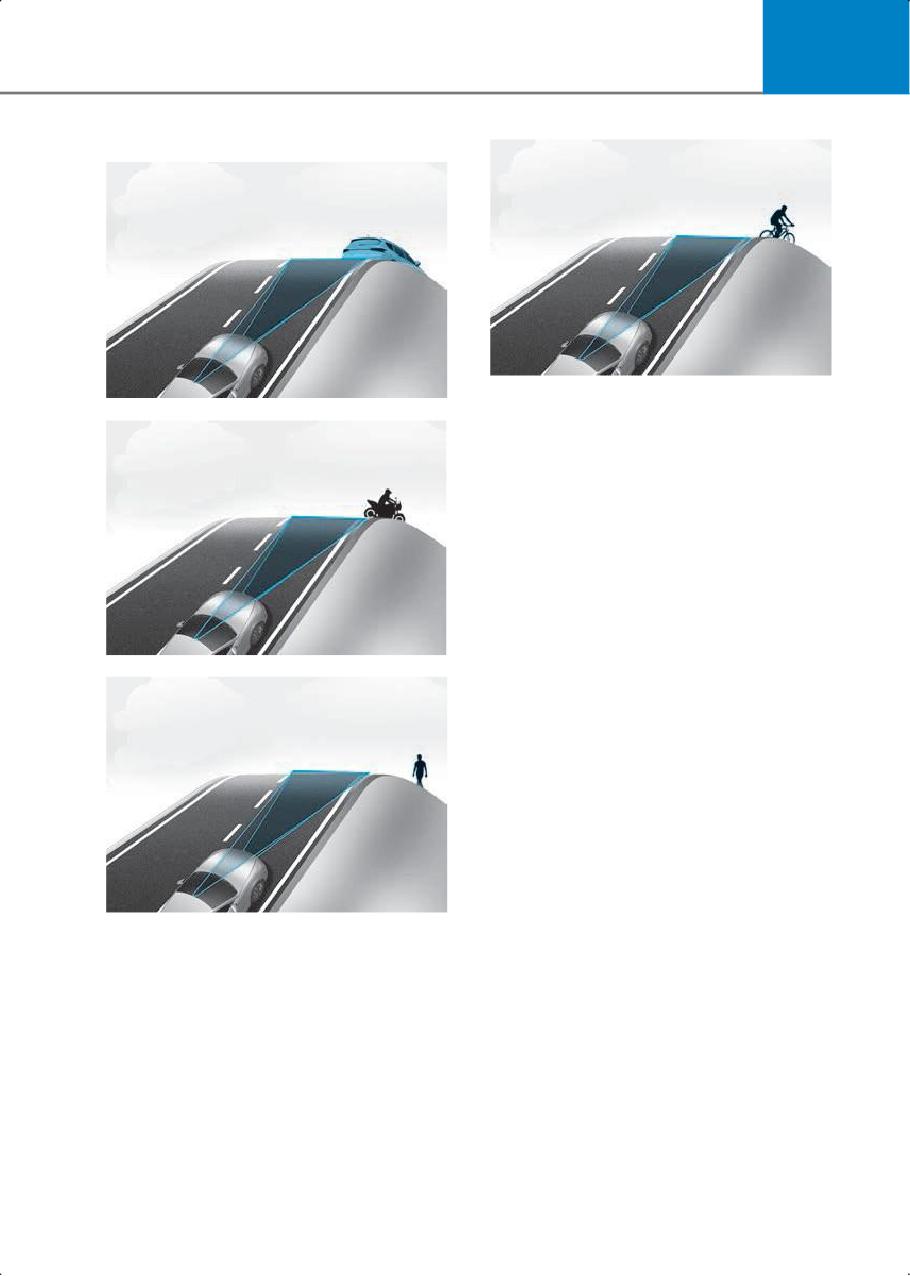
• Driving on an inclined road
Forward Collision-Avoidance Assist
may not detect other vehicles, powered
two-wheelers, pedestrians or cyclists in
front of you while driving uphill or
downhill adversely affecting the
performance of the sensors.
This may result in unnecessary warning
or braking assist, or no warning or
braking assist when needed.
Also, vehicle speed may rapidly
decrease when a vehicle, powered
two-wheeler, pedestrian or cyclist
ahead is suddenly detected. Always
maintain a safe distance from the
others on the road. Adjust your vehicle
speed or steer your vehicle depending
on the road conditions.
7-29
Driver assistance system
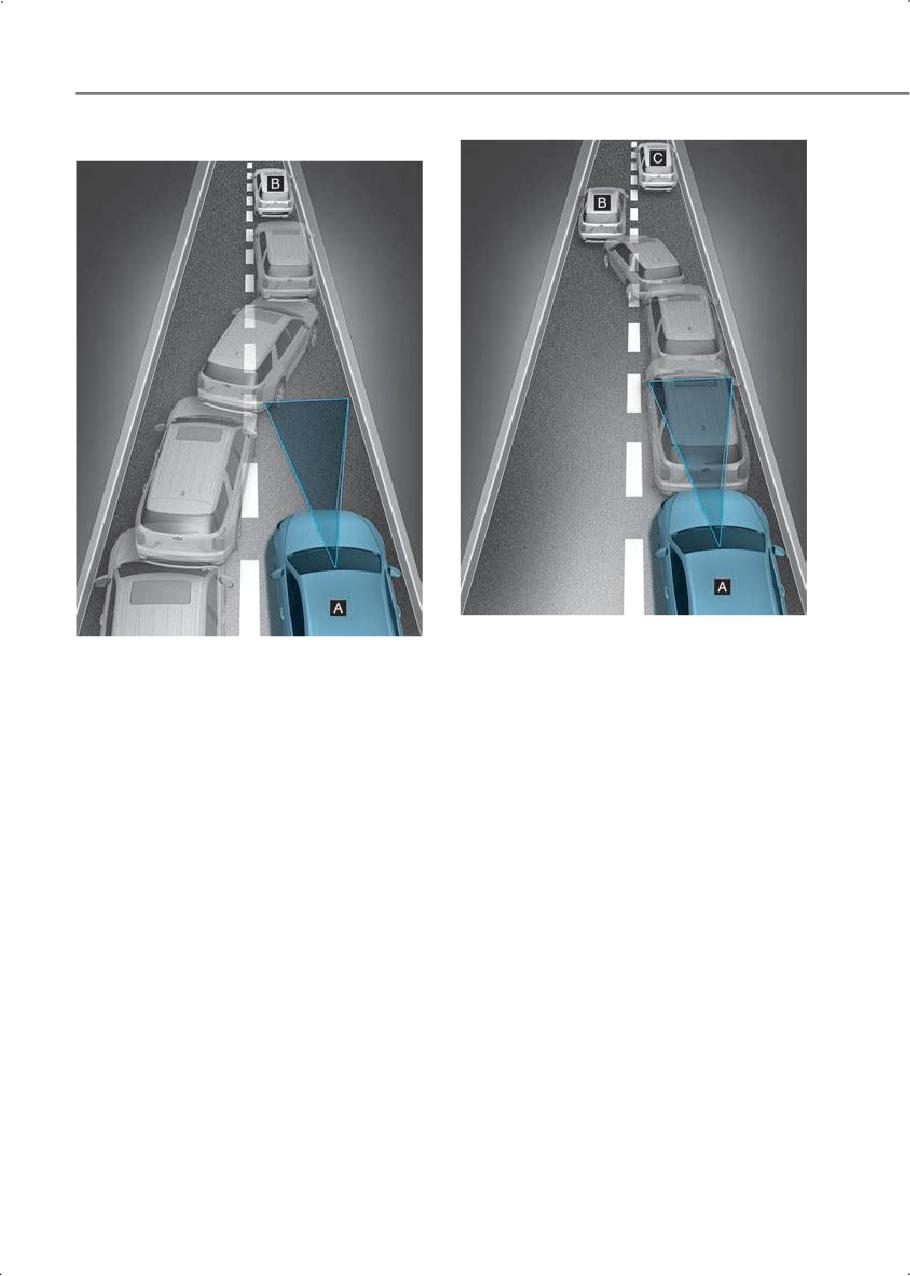
• Changing lanes
[A] Your vehicle
[B] Lane changing vehicle
[A] Your vehicle
[C] Same lane vehicle
[B] Lane changing vehicle
When a vehicle in front of you departs
When a vehicle moves into your lane
the lane, Forward Collision-Avoidance
from an adjacent lane, it cannot be
Assist may not immediately detect
detected by the sensor until it is within
another vehicle in your lane of travel.
the sensor's detection range. Forward
Collision-Avoidance Assist may not
Always maintain a safe distance from
immediately detect the vehicle when
the vehicles ahead. Adjust your vehicle
the vehicle changes lanes suddenly.
speed or steer your vehicle depending
on the road conditions.
Always maintain a safe distance from
the vehicles ahead. Adjust your vehicle
speed or steer your vehicle depending
on the road conditions.
7-30
7
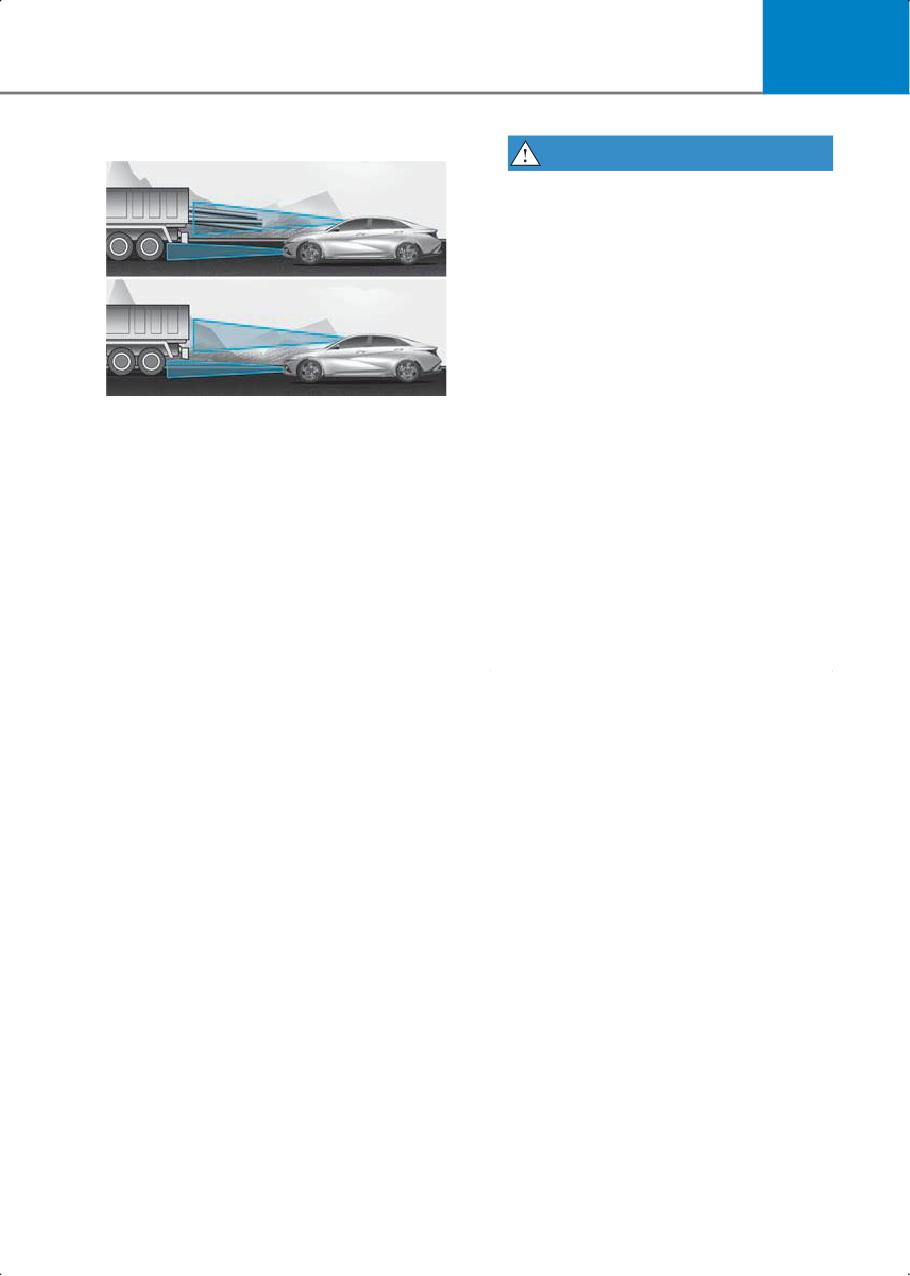
• Detecting a vehicle
WARNING
- When you are towing a trailer or
another vehicle, turn off Forward
Collision-Avoidance Assist.
- Forward Collision-Avoidance Assist
may operate if objects that are similar
in shape or characteristics to
vehicles, powered two-wheeler,
pedestrians and cyclists are
detected.
- Forward Collision-Avoidance Assist
may not detect bicycles,
Forward Collision-Avoidance Assist
motorcycles, or smaller wheeled
may not be able to detect all potential
objects such as luggage bags,
hazards, like if the vehicle in front of
shopping carts, or strollers.
you has cargo that extends rearward
- Forward Collision-Avoidance Assist
past the end of the vehicle or if the
may not operate normally if there is
vehicle in front of you has higher
interference from strong
ground clearance. Always maintain a
electromagnetic waves.
safe distance from the vehicles ahead.
- Forward Collision-Avoidance Assist
Adjust your vehicle speed or steer your
may not operate for 15 seconds right
vehicle depending on the road
after your vehicle is started or when
conditions.
the front view camera is initialized.
7-31
Driver assistance system
Lane Keeping Assist (LKA)
Lane Keeping Assist settings
Lane Keeping Assist uses the front view
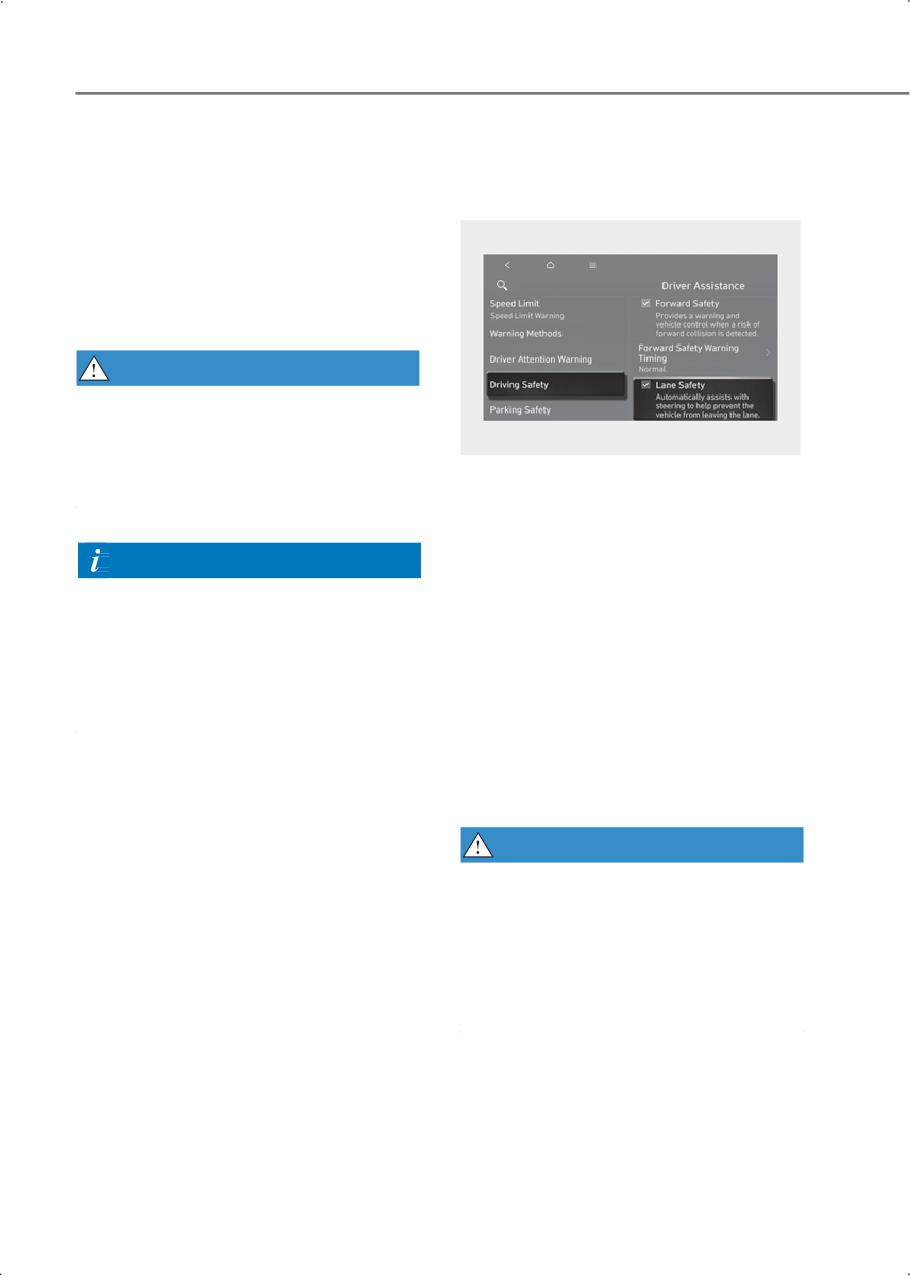
Lane Safety
camera to help detect lane markings (or
road edges) while driving over a certain
speed. Lane Keeping Assist may warn you
if your vehicle leaves the lane without
using the turn signal and may steer the
vehicle to help prevent it from departing
its travel lane.
WARNING
Always monitor your vehicle speed and
the distance to vehicles ahead on the
road. Lane Keeping Assist is not a
substitute for safe driving practices, but a
supplemental function only.
With the ignition switch ON, go to User
Settings > Driver Assistance > Driving
Safety > Lane Safety from the settings
menu in the instrument cluster or
Information
Settings > Vehicle > Driver Assistance >
Lane Keeping Assist uses the following
Driving Safety > Lane Safety from the
sensor:
settings menu in the infotainment system
to select the following:
• Front view camera
If Lane Safety is selected, Lane Keeping
Refer to the "Driver assistance system
Assist will automatically assist the driver’s
sensors" section in this chapter for the
steering when lane departure is detected
location.
to help prevent the vehicle from moving
out of its lane. If Lane Safety is
deselected, Lane keeping Assist will turn
off and the indicator light will turn off the
cluster.
WARNING
• Lane Keeping Assist does not control
the steering wheel when the vehicle is
driven in the middle of the lane.
• The driver should always be aware of
the surroundings. If Lane Safety is
deselected, Lane Keeping assist cannot
assist you.
7-32
7
Warning and control
Information
Left
You can set the following Warning
Methods:
• Warning Volume/Haptic Warning/Lane
Safety Audible Warning Off/Driving
Safety Priority
For more information, refer to the "Driver
assistance system settings" section in this
chapter.
Lane Keeping Assist operation
Right
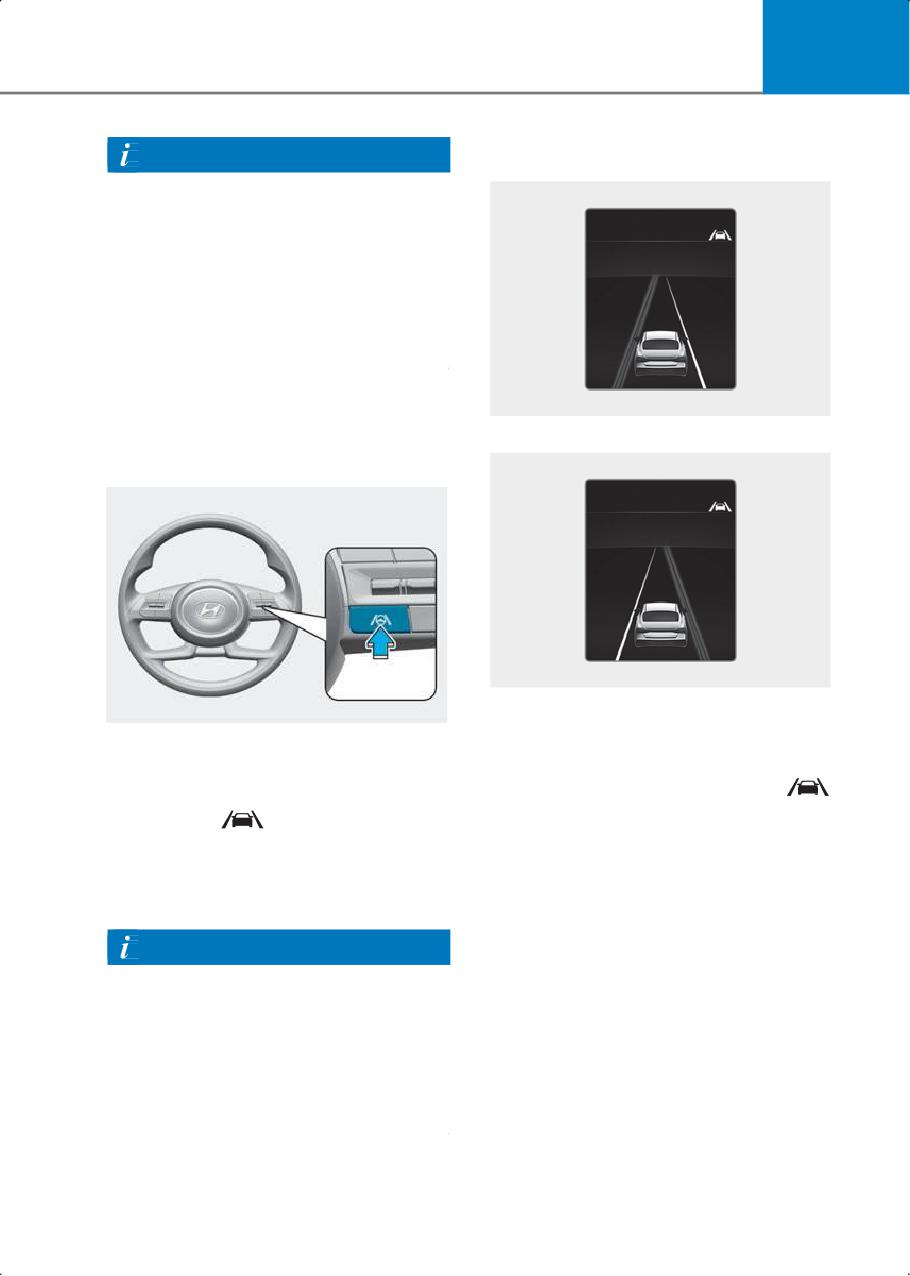
Turning Lane Keeping Assist On/Off
Lane Departure Warning
With the engine ON, press and hold the
If the vehicle detects it is departing from
Driving Assist button located on the
the projected lane ahead, the green
steering wheel to turn on and off. The
indicator light and the lane line blink on
grey or green
indicator light
the instrument cluster depending on
illuminates on the instrument cluster
which direction your vehicle is veering,
when the function is on.
and an audible warning sounds.
Press and hold the button again to turn off
• Lane Keeping Assist operates when
the function.
your vehicle speed is about 40-120 mph
(60-200 km/h).
Information
• When the engine is restarted, Lane
Keeping Assist maintains its last
setting.
• When Lane Keeping Assist is turned off
by pressing the Lane Driving Assist
button, the Lane Safety setting is
changed to Off.
7-33
Driver assistance system
Lane Keeping Assist
WARNING
If your vehicle detects it is departing from
the projected lane ahead, the green
Lane Keeping Assist may not operate in all
indicator light blinks on the instrument
situations and cannot avoid all collisions.
cluster, and the steering wheel makes
To prevent serious injury or death:
adjustments to keep your vehicle inside
•
Always steer your vehicle. Lane
its travel lane.
Keeping Assist is not an autonomous
• Lane Departure Warning operates
driving system and does not steer your
when your vehicle speed is about
vehicle at all times.
40-120 mph (60-200 km/h).
•
Lane Keeping Assist may not steer if the
steering wheel is held too tightly, or the
Hands-off warning
steering wheel is turned too far left or
right.
•
If the steering wheel is held very
loosely, the hands-off warning
message may appear because the Lane
Keeping Assist may not recognize that
you have your hands on the steering
wheel.
•
The hands-off warning message may
appear late or not at all depending on
the road condition.
•
If you attach objects to the steering
wheel, the hands-off warning may not
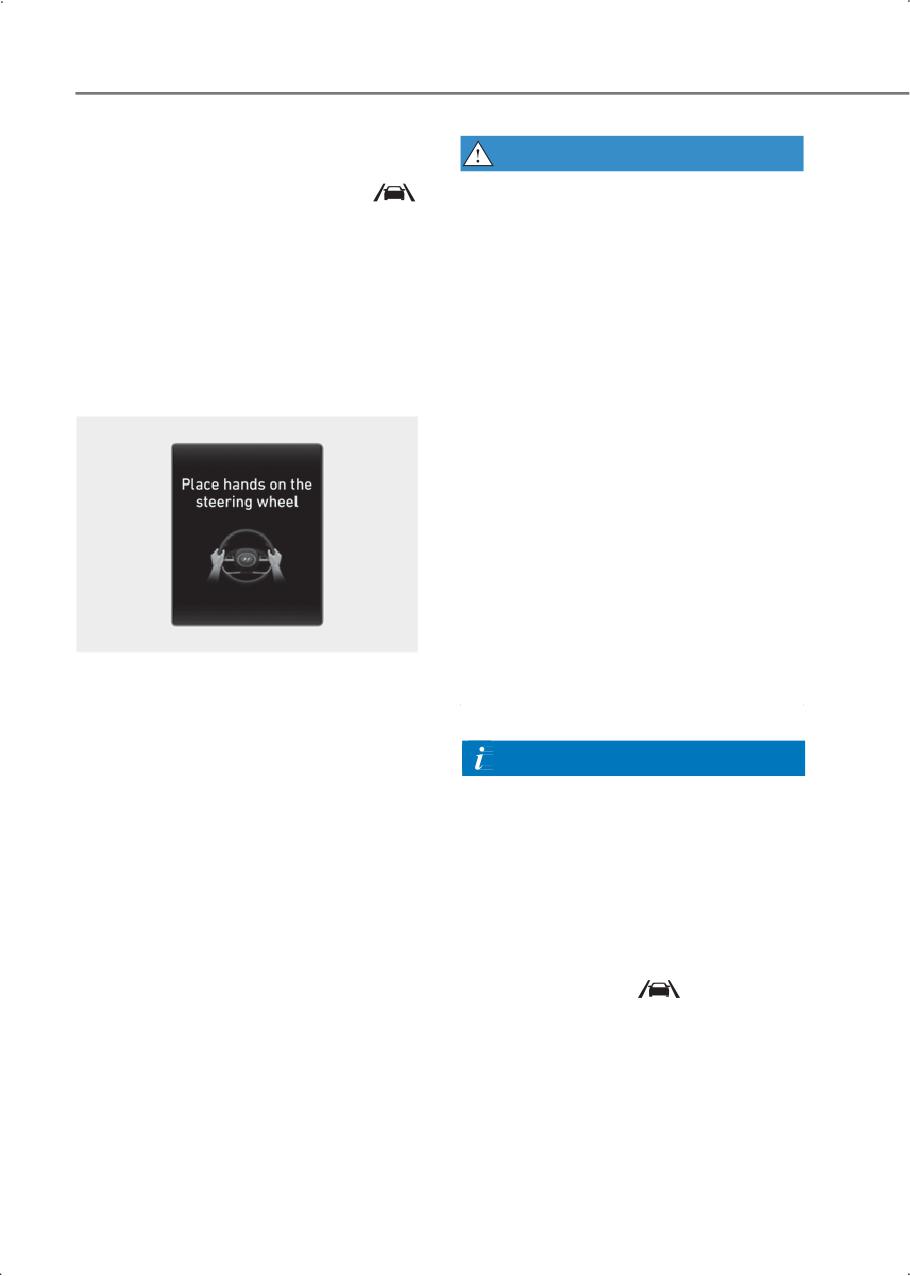
If you take your hands off the steering
work properly.
wheel for several seconds, the "Place
hands on steering wheel" warning
message may appear on the instrument
cluster, and an audible warning may
Information
sound in successive stages.
•
The status of the Lane Keeping Assist
operation appears in Driving Assist
mode on the instrument cluster. Refer
to the "View modes" section in chapter
4.
•
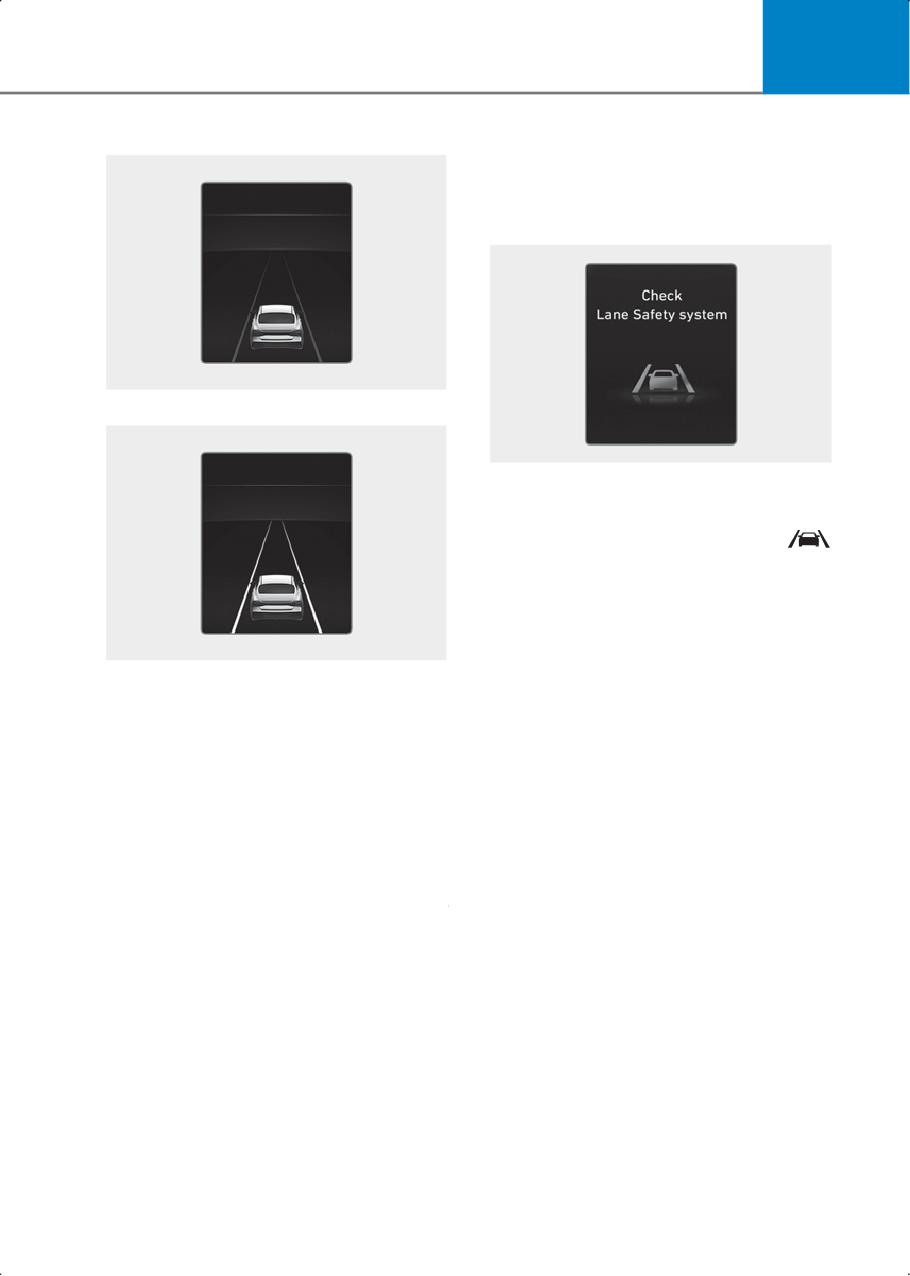
When lane markings (or road edges) are
detected, the lane lines on the
instrument cluster changes from gray
to white. When Lane Keeping Assist is
enabled, the green
indicator light
illuminates.
7-34
7
Lane undetected
Lane Keeping Assist
malfunction and limitations
Lane Keeping Assist malfunction
Lane detected
When Lane Keeping Assist is not working
properly, the "Check Lane Safety system"
message may appear and the yellow
indicator light may illuminate on the
instrument cluster. Have the vehicle
inspected by an authorized HYUNDAI
dealer.
Limitations of Lane Keeping Assist
•
The images and colors in the
Lane Keeping Assist may not operate
instrument cluster may differ
normally or may operate unexpectedly if:
depending on the cluster type or theme
selected from the settings menu.
• The lane is difficult to distinguish
because:
•
You can steer your vehicle even when
steering is assisted by Lane Keeping
- The lane markings (or road edge) are
Assist.
damaged or covered with rain, snow,
dirt, oil, etc.
•
It may require more or less force to turn
the steering wheel when Lane Keeping
- The color of the lane marking (or road
Assist is providing steering assistance.
edge) is not distinguishable from the
road.
- There are markings (or road edges)
on the road or near the lane that looks
similar to the lane markings (or road
edge).
• The lane markings are covered by the
shadow of objects around the road,
such as median strip, guardrails, noise
barriers, and trees.
• There are more than two lane markings
(or road edges) on the road.
7-35
Driver assistance system
• The lane number increases or
•
You may not hear the audible warning
decreases, or the lane markings (or
of Lane Keeping Assist if the
road edges) are crossing.
surrounding environment is too noisy.
• The lane markings (or road edges) are
•
Lane Keeping Assist may not operate
complicated or a structure substitutes
for 15 seconds right after your vehicle is
for the lines, such as a construction
started or when the front view camera
area or tollbooth area.
is initialized.
• There are road markings, such as zigzag
•
Lane Keeping Assist does not operate
lanes, crosswalk markings and road
when:
signs.
- Either the turn signal or hazard
• The lane suddenly disappears, such as
warning flasher is turned on.
at the intersection.
- Your vehicle is not driven in the
• The lane (or road width) is very wide or
center of the lane after turning on
narrow.
Lane Keeping Assist or after changing
lanes.
• There is a road edge without a lane.
- ESC (Electronic Stability Control) or
• There is a boundary structure on the
VSM (Vehicle Stability Management)
road, such as sidewalk or curb.
is controlling the brake force to the
• The distance to the front vehicle is
wheels.
extremely short or the vehicle in front is
- Your vehicle is driven on sharp
covering the lane marking (or road
curves.
edge).
- Driving below 35 mph (55 km/h) or
Information
above 130 mph (210 km/h).
For more information on limitations of the
- Your vehicle makes sharp lane
front view camera, refer to the "Forward
changes.
Collision-Avoidance Assist (FCA) (Sensor
- Your vehicle brakes suddenly.
fusion)" section in this chapter.
•
Loading in excess of the maximum load
allowance or concentrated loading at
one point in the cargo compartment
can reduce the vehicle's driving
WARNING
stability, which can in turn reduce the
• Lane Keeping Assist may be canceled
effectiveness of Lane Keeping Assist.
or may not work properly depending on
the road conditions and the
surroundings.
• When you are towing a trailer or
another vehicle, turn off Lane Keeping
Assist.
• If your vehicle is driven at high speeds,
Lane Keeping Assist may not steer the
vehicle.
• When other system’s warning message
appears or audible warning is heard,
Lane Keeping Assist may not warn you.
7-36
7
Blind-Spot
Collision-Avoidance
Assist (BCA)
if equipped
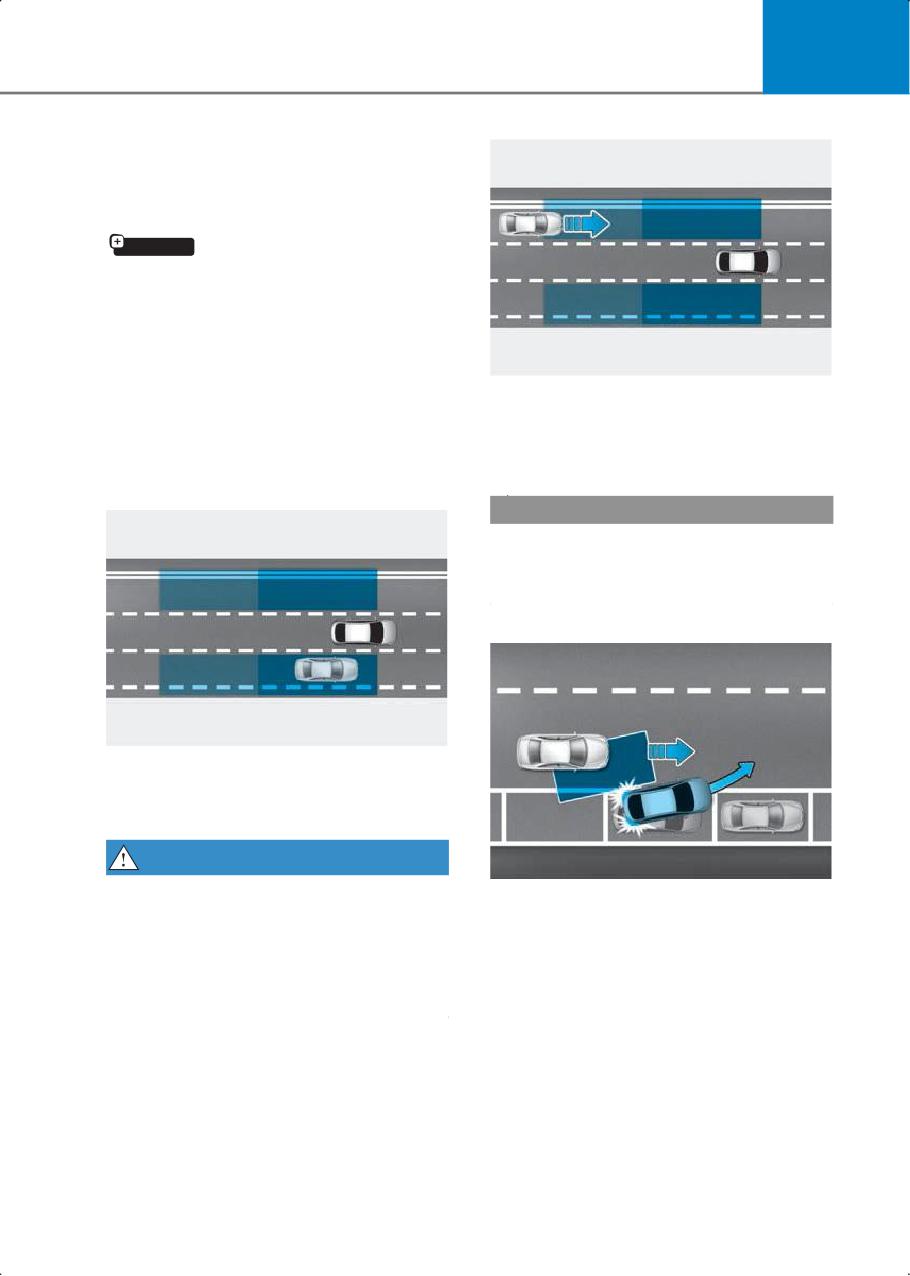
Blind-Spot Collision-Avoidance Assist
uses the front view camera and the rear
corner radar to help detect approaching
vehicles in the driver’s blind spot areas
and warn you of a possible collision with a
warning message and audible warning.
If there is a collision risk when driving
Blind-Spot Collision-Avoidance Assist
forward out of a parking space,
helps detect and warns you that a vehicle
Blind-Spot Collision-Avoidance Assist
is approaching at high speed from the
may brake your vehicle to help avoid a
blind spot area.
collision.
CAUTION
The warning timing may differ depending
on the speed of the vehicle approaching
you at high speed.
Blind-Spot Collision-Avoidance Assist
helps detect and warns you that a vehicle
is in the blind spot area.
WARNING
The detecting range may differ
depending on the speed of your vehicle.
Blind-Spot Collision-Avoidance Assist
Vehicles in the blind spot area may not be
may brake your vehicle if there is a
detected by Blind-Spot
detected collision risk when driving
Collision-Avoidance Assist when you pass
forward out of a parking space.
other vehicles at high speeds.
7-37
Driver assistance system
Information
Blind-Spot Collision-Avoidance Assist
uses the following sensors:
• Rear corner radars
Refer to the "Driver assistance system
sensors" section in this chapter for the
location.
Blind-Spot
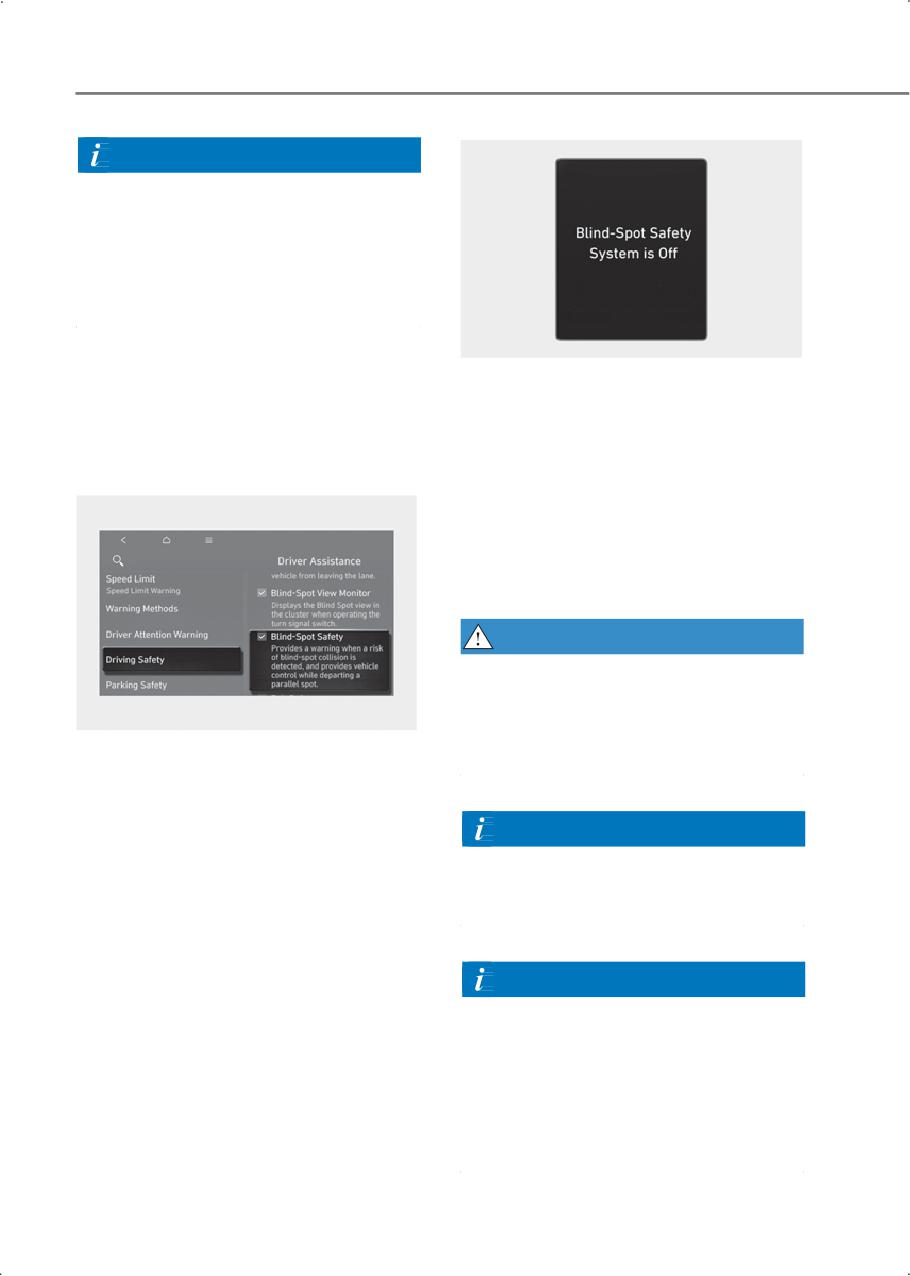
When the engine is restarted with
Collision-Avoidance Assist
Blind-Spot Collision-Avoidance Assist off,
settings
the "Blind-Spot Safety System is Off"
message will appear on the instrument
Blind-Spot Safety
cluster. If you select Blind-Spot Safety,
warning light on the side view mirror will
blink for three seconds. In addition, if the
vehicle is turned on, when Blind-Spot
Safety is selected, the warning light on
the side view mirror will blink for three
seconds.
WARNING
The driver should always be aware of the
surroundings and drive safely. If
Blind-Spot Safety is deselected,
Blind-Spot Collision-Avoidance Assist
cannot assist you.
With the ignition switch ON, go to User
settings > Driver Assistance > Driving
Safety > Blind-Spot Safety from the
settings menu in the instrument cluster or
Information
Settings > Vehicle > Driver Assistance >
Driving Safety > Blind-Spot Safety from
When the engine is restarted, Blind-Spot
the settings menu in the infotainment
Collision-Avoidance Assist maintains its
system to select the following:
last setting.
If Blind-Spot Safety is selected,
Blind-Spot Collision-Avoidance Assist will
warn the driver with a warning message,
Information
an audible warning depending on the
You can set the Warning Timing and
collision risk.
following Warning Methods:
• Warning Volume/Haptic
Warning/Driving Safety Priority
For more information, refer to the "Driver
assistance system settings" section in this
chapter.
7-38
7
Blind-Spot
WARNING
Collision-Avoidance Assist
• The detection range of the rear corner
operation
radar is determined by a standard road
width. On narrow roads, the function
Driving-Warning
may detect other vehicles in the next
lane and warn you. On wide roads, the
function may not be able to detect a
vehicle driving in the next lane and may
not warn you.
• When the hazard warning flasher is on,
the collision warning initiated by
activating the turn signal may not
operate.
Collision-avoidance assist (while
parallel parking exit)
Vehicle detection
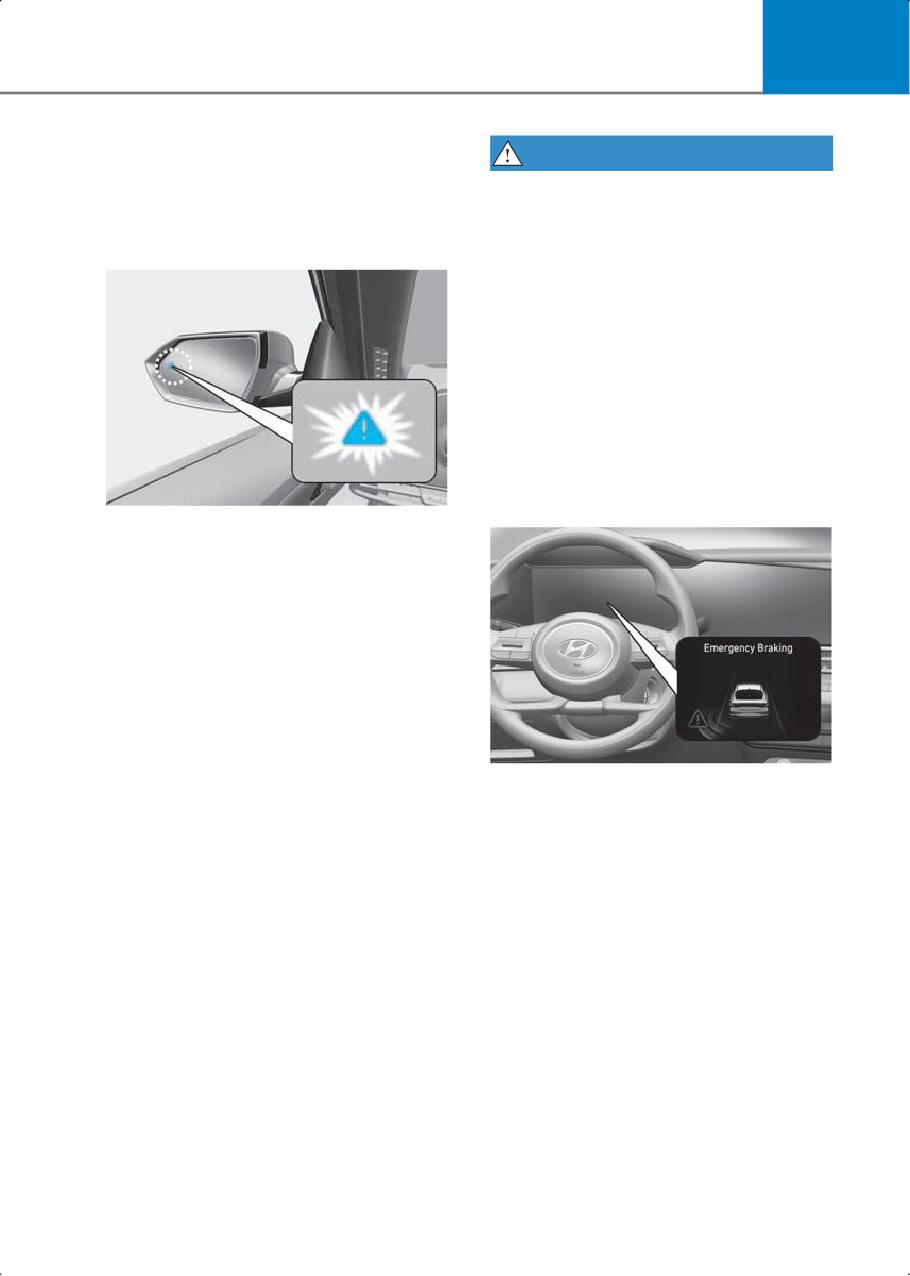
When a vehicle is detected in a blind spot,
the warning light on the side view mirror
illuminates.
• Vehicle detection operates when your
vehicle speed is above 12 mph (20
km/h) and the speed of the vehicle in
the blind spot area is above 6 mph (10
km/h).
Collision warning
Collision warning may operate when the
To warn you of a potential collision, the
turn signal is turned on in the direction of
warning light on the side view mirror may
a detected vehicle.
blink, a warning message may appear on
• To warn you of a potential collision, the
the instrument cluster, and an audible
warning light on the side view mirror
warning may sound and the steering
may blink and an audible warning may
wheel may vibrate.
sound and the steering wheel may
• Blind-Spot Collision-Avoidance Assist
vibrate.
operates when your vehicle speed is
• When the turn signal is turned off or you
below 2 mph (3 km/h) and the speed of
move away from the vehicle in the blind
the vehicle in the blind spot area is
spot, the function returns to vehicle
above 3 mph (5 km/h).
detection state.
• Blind-Spot Collision-Avoidance Assist
• Collision warning may warn when your
may assist with braking your vehicle to
vehicle speed is above 25 mph (40
avoid a collision.
km/h) and the speed of the vehicle in
the blind spot area is above 6 mph (10
km/h).
7-39
Driver assistance system
• Even if there is a problem with
Blind-Spot Collision-Avoidance Assist,
your vehicle’s braking system operates
normally.
• Control your vehicle at all times. Always
maintain a safe distance from the
vehicles ahead and adjust your vehicle
speed depending on the road
conditions.
• Never attempt to activate Blind-Spot
Collision-Avoidance Assist by
intentionally driving toward people,
After your vehicle is stopped following an
animals, objects, or other vehicles.
Emergency Braking event, the "Drive
• When other system’s warning message
carefully" warning message may appear
appears or audible warning is heard,
on the instrument cluster.
Blind-Spot Collision-Avoidance Assist
Depress the brake pedal immediately and
may not warn you.
check the surroundings.
• You may not hear the audible warning
• Braking control ends about 2 seconds
of Blind-Spot Collision-Avoidance
after your vehicle is stopped following
Assist if the surrounding environment is
an Emergency Braking event.
too noisy.
WARNING
Blind-Spot Collision-Avoidance Assist
WARNING
may not operate in all situations and
Braking is not assisted and only a warning
cannot avoid all collisions.
is provided when:
To prevent serious injury or death:
• The ESC (Electronic Stability Control)
• Only change the settings after parking
warning light is on.
your vehicle at a safe Location.
• ESC (Electronic Stability Control) is
• Blind-Spot Collision-Avoidance Assist
controlling the brake force to the
may not operate if the function
wheels.
determines you have depressed the
brake pedal sufficiently in response to
the potential hazard detected by the
function.
Information
• If Blind-Spot Collision-Avoidance Assist
The images and colors in the instrument
is assisting to brake your vehicle and
cluster may differ depending on the
you excessively depress the accelerator
cluster type or theme selected from the
pedal or sharply steer your vehicle, it
settings menu.
stops assisted braking.
• During Blind-Spot Collision-Avoidance
Assist operation, your vehicle may stop
suddenly. Always wear your seat belt,
check your passengers have their seat
belts fastened and secure loose objects
that may become projectiles.
7-40
7
Blind-Spot
Blind-Spot Collision-Avoidance
Assist disabled
Collision-Avoidance Assist
malfunction and limitations
Blind-Spot Collision-Avoidance
Assist malfunction
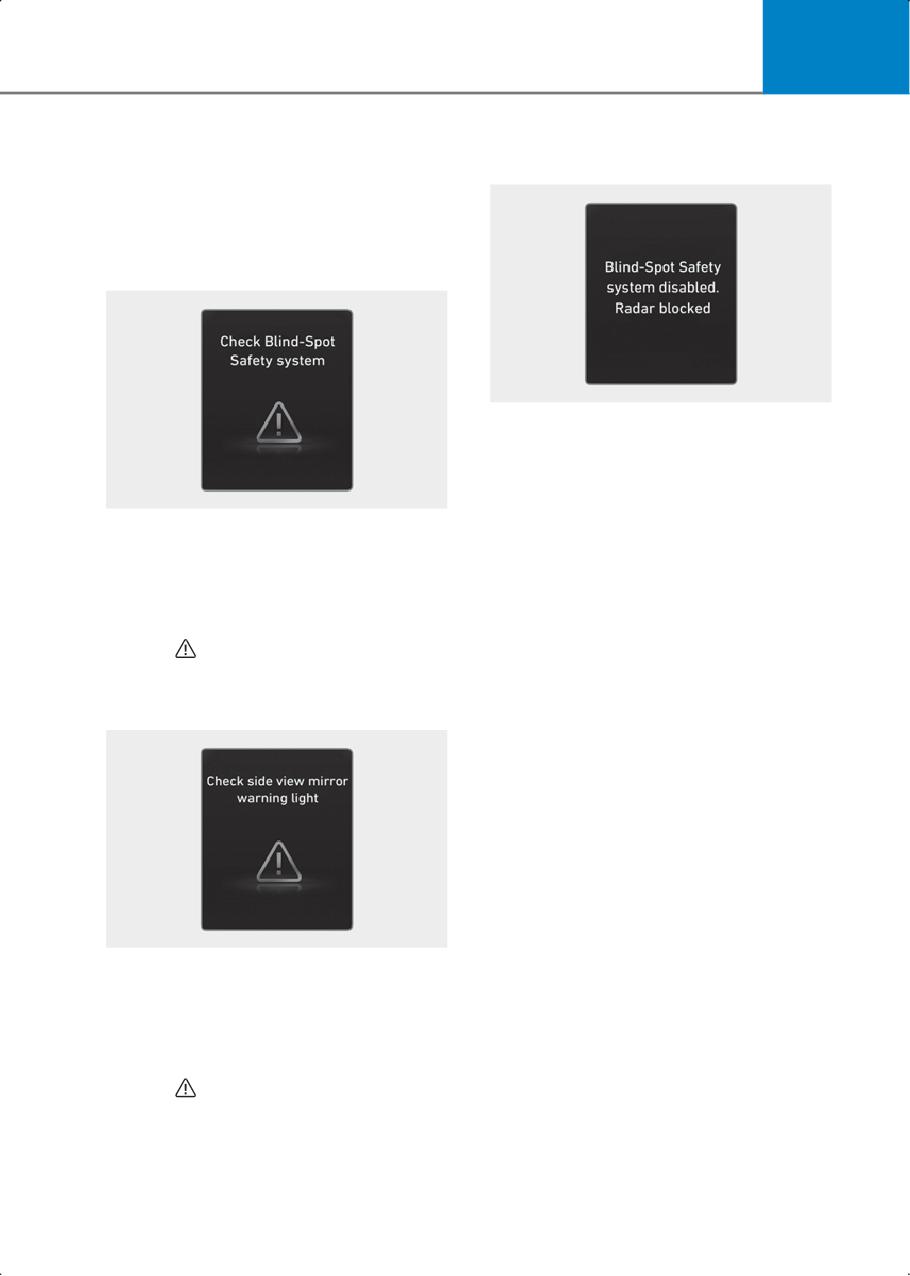
If the rear corner radar is blocked or
covered, or when the rear bumper around
the rear corner radar or sensor is covered
by any foreign material, such as snow,
rain, or dirt, or when a trailer or hitch
When Blind-Spot Collision-Avoidance
mounted carrier is installed, the detecting
Assist is not working properly, the "Check
performance may decrease and
Blind-Spot Safety system" warning
temporarily limit or disable Blind-Spot
message will appear on the instrument
Collision-Avoidance Assist.
cluster for several seconds, and the
The "Blind-Spot Safety system disabled.
master ( ) warning light will appear on
Radar blocked" warning message may
the instrument cluster. Have the vehicle
appear on the instrument cluster.
be inspected by an authorized HYUNDAI
The function operates normally when
dealer.
such foreign material, trailer, or carrier is
removed, and the engine is restarted.
If the function does not operate normally
after anything covering or blocking the
sensors is removed, have the vehicle
inspected by an authorized HYUNDAI
dealer.
When the side view mirror warning light is
not working properly, the "Check side
view mirror warning light" warning
message will appear on the instrument
cluster for several seconds, and the
master (
) warning light will illuminate
on the instrument cluster. Have the
vehicle inspected by an authorized
HYUNDAI dealer.
7-41
Driver assistance system
•
You are driving in large, open areas
WARNING
where there are few vehicles or
• Blind-Spot Collision-Avoidance Assist
structures (e.g. desert, meadow, empty
may not operate properly even if there
parking lot).
is no warning message or warning light
•
You are driving on a wet road.
on the instrument cluster.
•
The other vehicle drives very close
• Blind-Spot Collision-Avoidance Assist
behind your vehicle, or passes by your
may not operate properly in open areas
vehicle in close proximity.
where no objects are detected (e.g.
•
The speed of the other vehicle is so fast
empty parking lot) or when the
that it passes by your vehicle in a short
detecting sensors are blocked right
time.
after turning on the engine.
Your vehicle passes another vehicle.
•
• Always turn off Blind-Spot
•
Your vehicle changes lanes.
Collision-Avoidance Assist when
towing a trailer or using a hitch
•
Your vehicle has started at the same
mounted carrier.
time as the vehicle next to you and has
accelerated.
•
The vehicle in the next lane moves two
Limitations of Blind-Spot
lanes away from you, or the vehicle
Collision-Avoidance Assist
moves two lanes away to the next lane.
Blind-Spot Collision-Avoidance Assist
•
A trailer or hitch mounted carrier is
may not operate normally or the function
installed and it blocks the rear corner
may operate unexpectedly if:
radar.
• There is inclement weather, such as
•
The area near the rear corner radar is
heavy snow, heavy rain, etc.
covered with objects, such as bumper
• The rear corner radar or the area near
sticker, bumper guard, bike rack, etc.
the rear corner radar is covered by
•
The bumper around the rear corner
snow, water, or dirt.
radar has been damaged or modified,
• The rear corner radar or the area near
and the radar is out of position.
the rear corner radar is blocked by a
•
Your vehicle height is lower or higher
vehicle, wall, or pillar.
than normal due to heavy loads,
• The temperature near the rear corner
abnormal tire pressure, etc.
radar is very hot or cold.
Blind-Spot Collision-Avoidance Assist
• You are driving on a highway access
may not operate normally or may operate
road or through a tollbooth.
unexpectedly when the following objects
• The road pavement (or the ground near
are detected:
your vehicle) contains metallic
• A motorcycle or bicycle
components (i.e. possibly due to
• A vehicle such as flat trailer
subway construction).
• A big vehicle such as bus or truck
• There is a fixed object near your
• A moving obstacle such as pedestrian,
vehicle, such as sound barriers,
animal, shopping cart, or baby stroller
guardrails, central dividers, entry
barriers, streetlights, signs, tunnels,
• A vehicle with lower height, such as
walls, etc.
sports car
• You are driving on a narrow road where
trees or grass are overgrown.
7-42
7
Blind-Spot Collision-Avoidance Assist
may not assist braking when:
• Your vehicle severely vibrates while
driving over a bumpy road, uneven
road, or concrete patch.
• You are driving on a slippery surface
due to snow, water puddle, ice, etc.
• The tire pressure is low or any tire is
damaged.
• There is an issue with the braking
system.
• Your vehicle makes abrupt lane
Blind-Spot Collision-Avoidance Assist
changes.
may detect a vehicle in the same lane
when driving on a curved road and
WARNING
activate a warning or brake your
vehicle.
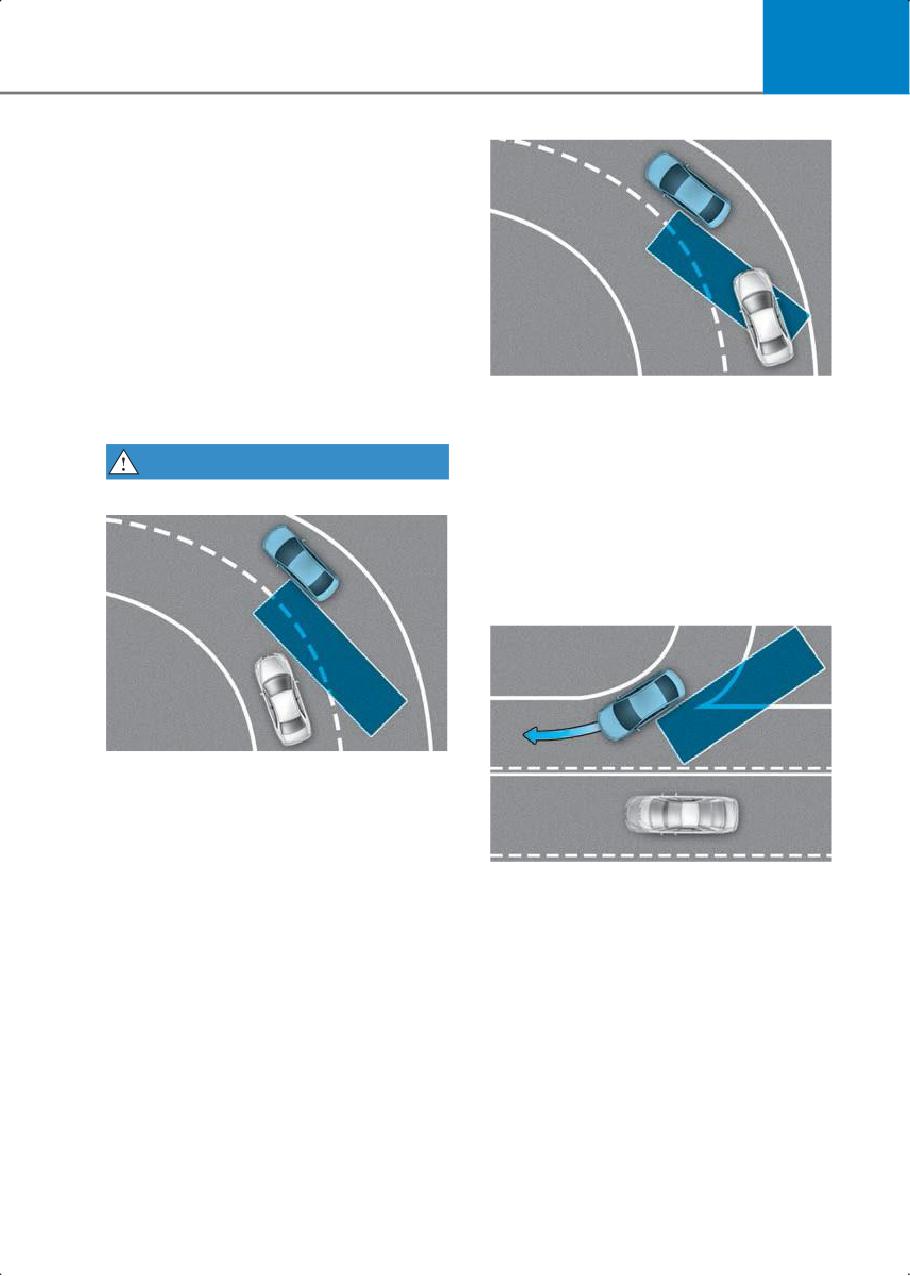
• Driving on a curved road
Always check road conditions, and if
necessary, take appropriate actions to
drive safely.
• Driving where the road is
merging/dividing
Blind-Spot Collision-Avoidance Assist
may not detect a vehicle in an adjacent
lane when driving on a curved road and
may not activate a warning or brake
your vehicle.
Always check road conditions, and if
Blind-Spot Collision-Avoidance Assist
necessary, take appropriate actions to
may not detect a vehicle in an adjacent
drive safely.
lane when the road merges or divides
and may not activate a warning or
brake your vehicle.
Always check road conditions, and if
necessary, take appropriate actions to
drive safely.
7-43
Driver assistance system
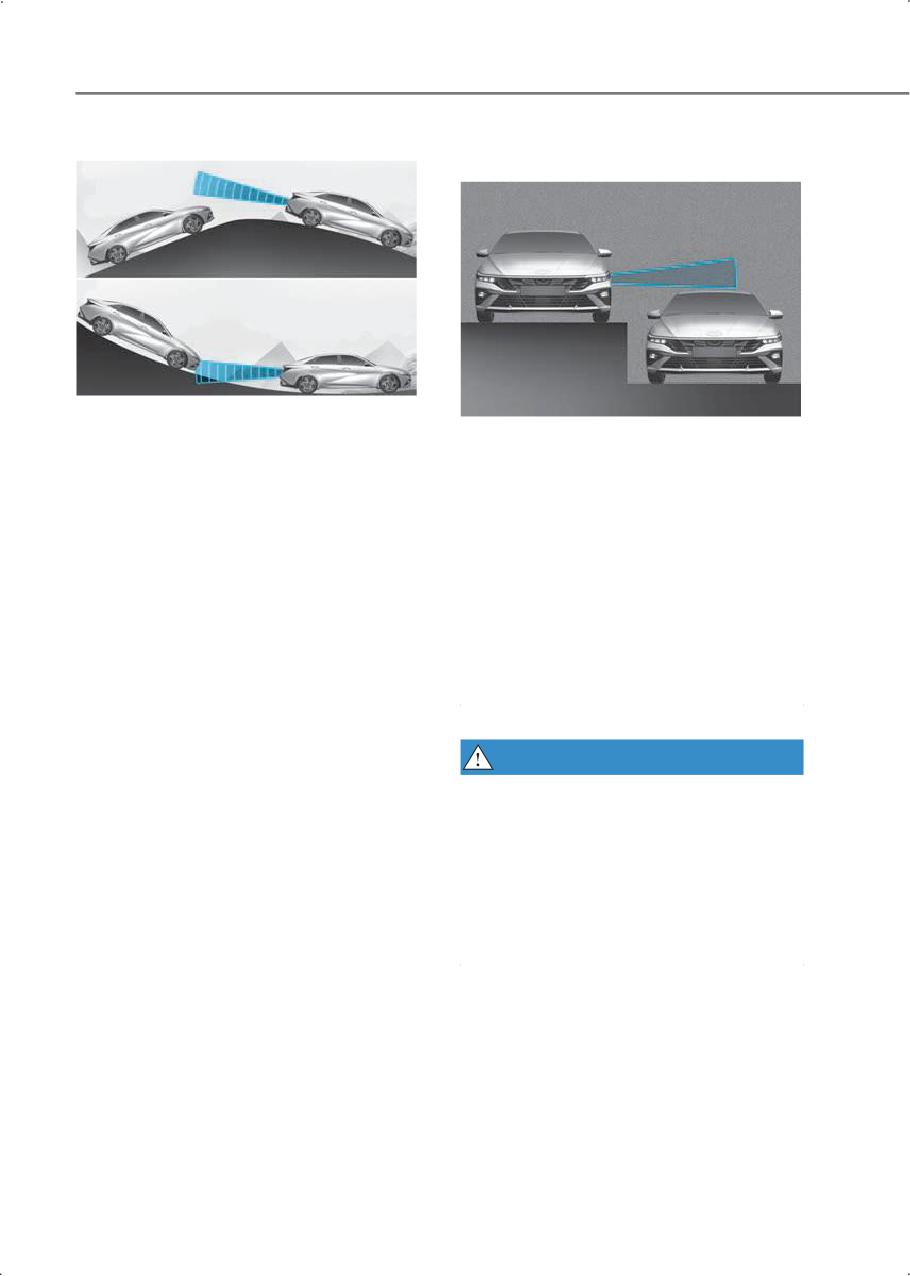
• Driving on hills
• Driving where the heights of the lanes
are different
Blind-Spot Collision-Avoidance Assist
may not detect a vehicle in an adjacent
Blind-Spot Collision-Avoidance Assist
lane or may incorrectly detect the
may not operate properly when driving
ground or another object when driving
where the heights of the lanes are
on hills and activate a warning or brake
different. The function may not detect a
your vehicle.
vehicle on a road with a different lane
height (underpass joining section,
Always check road conditions, and if
grade separated intersections, etc.)
necessary, take appropriate actions to
and not activate a warning or brake
drive safely.
your vehicle.
Always check road conditions, and if
necessary, take appropriate actions to
drive safely.
WARNING
• Blind-Spot Collision-Avoidance Assist
may not operate normally if there is
interference from strong
electromagnetic waves.
• Blind-Spot Collision-Avoidance Assist
may not operate right after your vehicle
is started or when the rear corner radars
are initialized.
7-44
7
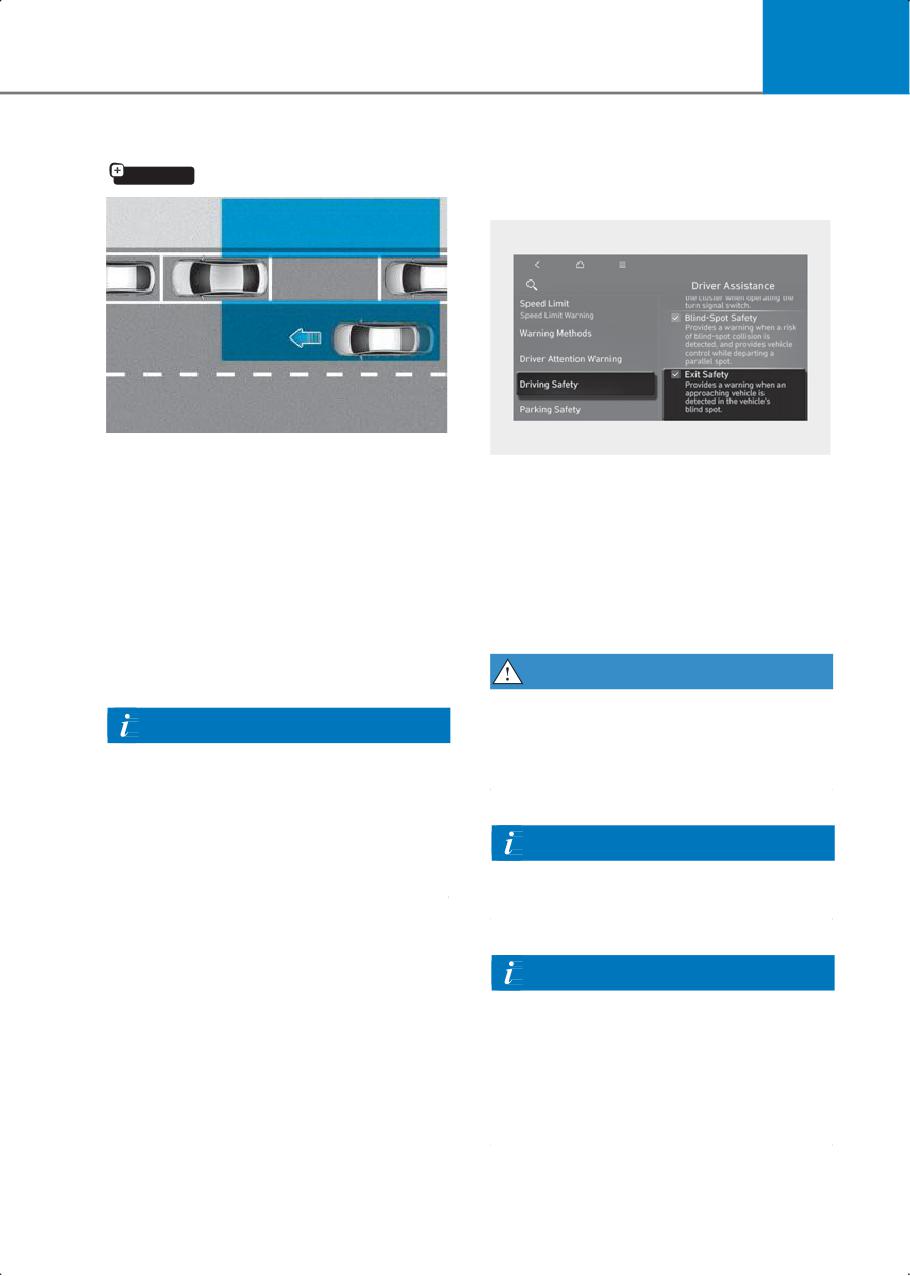
Safe Exit Warning (SEW)
Safe Exit Warning settings
if equipped
Exit Warning
Safe Exit Warning uses the rear corner
radars to help detect a vehicle
With the ignition switch ON, go to User
approaching the rear of your vehicle, after
settings > Driver Assistance > Driving
the vehicle is stopped and a passenger
Safety > Exit Safety from the settings
opens a door.
menu in the instrument cluster or
If Safe Exit Warning is activated, an
Settings > Vehicle > Driver Assistance >
audible warning sounds and a warning
Driving Safety > Exit Safety from the
message may appear on the instrument
Settings menu in the infotainment system
cluster.
to turn this function on and off.
The warning timing may differ depending
WARNING
on the speed of the detected vehicle.
The driver should always be aware of
Information
unexpected and sudden situations from
occurring. If Exit Safety is deselected,
Safe Exit Warning uses the following
Safe Exit Warning cannot assist you.
sensor:
• Rear corner radars
Refer to the "Driver assistance system
Information
sensors" section in this chapter for the
location.
When the engine is restarted, Safe Exit
Warning maintains the last setting.
Information
You can set the following Warning
Methods:
• Warning Volume/Driving Safety Priority
For more information, refer to the "Driver
assistance system settings" section in this
chapter.
7-45
Driver assistance system
Safe Exit Warning operation
WARNING
Safe Exit Warning may not operate in all
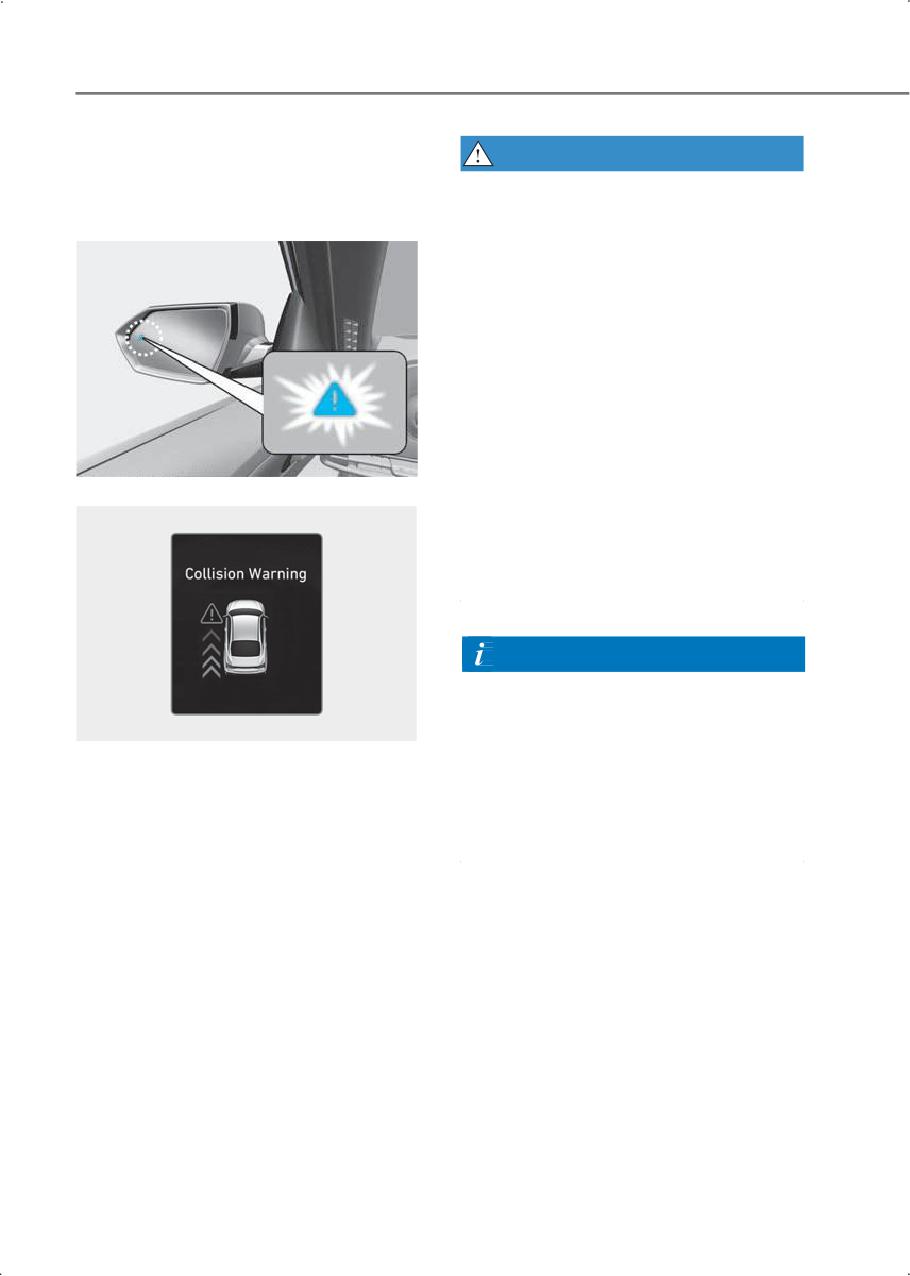
Collision warning when exiting your
situations and cannot avoid all collisions.
vehicle
To prevent serious injury or death:
•
Always check the surroundings before
you or your passengers exit your
vehicle.
•
Only change the settings after parking
your vehicle at a safe location.
•
When other system’s warning message
appears or audible warning is heard,
Safe Exit Warning may not warn you.
•
You may not hear the audible warning
of Safe Exit Warning if the surrounding
environment is too noisy.
•
Safe Exit Warning may stop operating,
or may not operate, or operate
unnecessarily depending on the road
conditions and surroundings.
Information
•
After the engine is turned off, Safe Exit
Warning may detect approaching
vehicles for up to 10 minutes, but does
not function after the doors are locked.
When an approaching vehicle from the
•
The images and colors in the
rear is detected while a door is being
instrument cluster may differ
opened, the warning light on the side
depending on the cluster type or theme
view mirror may blink, a warning message
selected from the settings menu.
may appear on the instrument cluster,
and an audible warning may sound.
• Safe Exit Warning may warn you when
your vehicle speed is below 2 mph (3
km/h), and the speed of the vehicle
approaching the rear of your vehicle is
above 4 mph (6 km/h).
7-46
7
Safe Exit Warningmalfunction
Safe Exit Warning disabled
and limitations
Safe Exit Warning malfunction
If the rear corner radar is blocked or
covered, or when the rear bumper around
the rear corner radar or sensor is covered
by any foreign material, such as snow,
When Safe Exit Warning is not working
rain, or dirt, or when a trailer or hitch
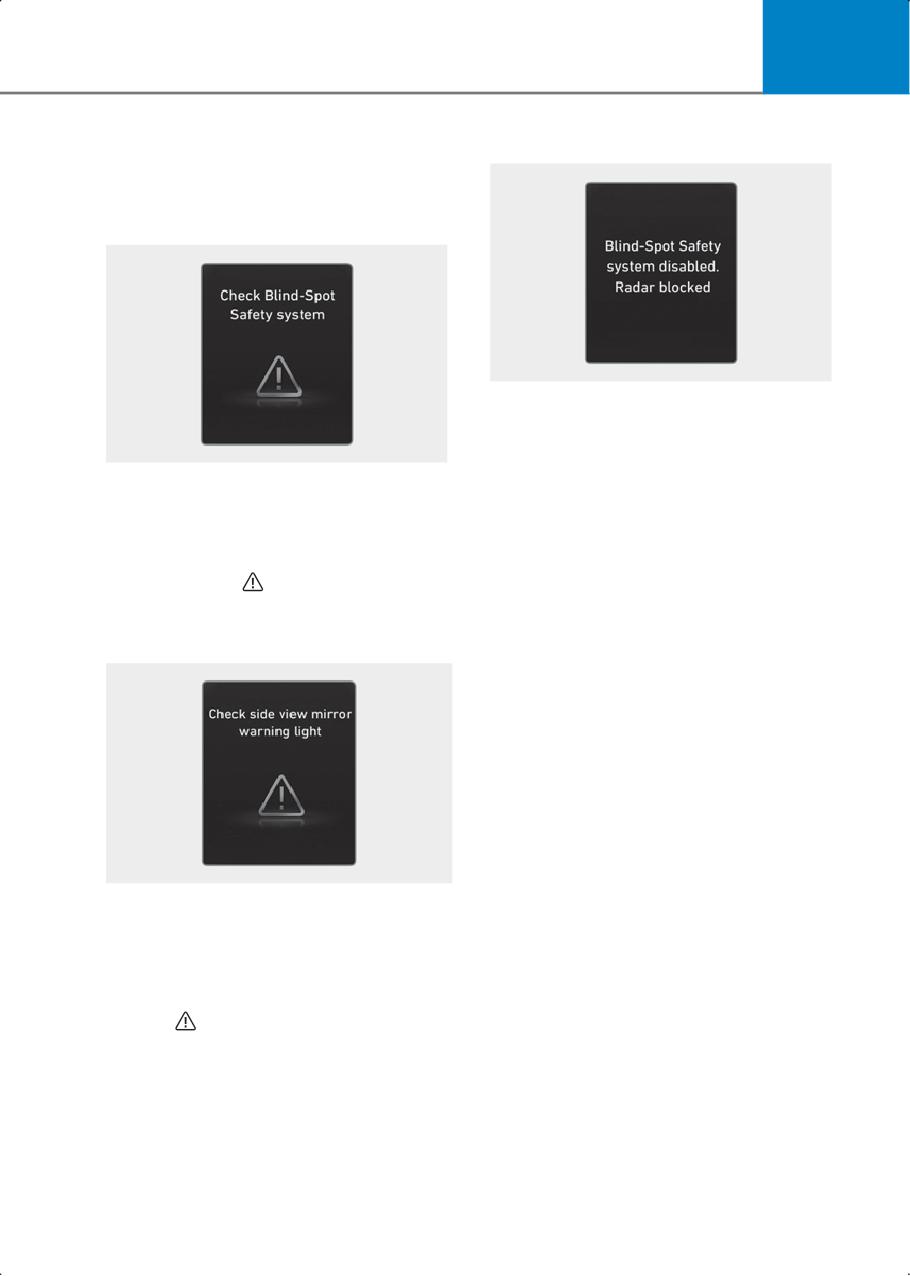
properly, the "Check Blind-Spot Safety
mounted carrier is installed, the detecting
system" warning message will appear on
performance may decrease and
the instrument cluster for several second,
temporarily limit or disable Safe Exit
and the master (
) warning light will
Warning.
appear on the instrument cluster. Have
The "Blind-Spot Safety system disabled.
the vehicle inspected by an authorized
Radar blocked" warning message may
HYUNDAI dealer.
appear on the instrument cluster.
The function operates normally when
such foreign material, trailer, or carrier is
removed, and the engine is restarted.
If the function does not operate normally
after anything covering or blocking the
sensors is removed, have the vehicle
inspected by an authorized HYUNDAI
dealer.
When the side view mirror warning light is
not working properly, the "Check side
view mirror warning light" warning
message will appear on the instrument
cluster for several seconds, and the
master (
) warning light will illuminate
on the instrument cluster. Have the
vehicle inspected by an authorized
HYUNDAI dealer.
7-47
Driver assistance system
Limitations of Safe Exit Warning
WARNING
Safe Exit Warning may not operate
•
Safe Exit Warning may not operate
normally, or may operate unexpectedly if:
properly even if there is no warning
• Trees or grass near your vehicle are
message or warning light on the
overgrown.
instrument cluster.
•
The road is wet.
•
Safe Exit Warning may not operate
• The approaching vehicle is very fast or
properly in open areas where no
slow.
objects are detected (e.g. empty
parking lot) or when the detecting
sensors are blocked right after turning
Information
on the engine.
For more information on the limitations
•
Turn off Safe Exit Warning when towing
on the rear corner radar, refer to the
a trailer or using a hitch mounted
"Blind-Spot Collision-Avoidance Assist
carrier.
(BCA)" section in this chapter.
WARNING
• Safe Exit Warning may not operate if
there is interference from strong
electromagnetic waves.
• Safe Exit Warning may not operate for 3
seconds right after your vehicle is
started or when the rear corner radars
are initialized.
• Safe Exit Warning may not operate
properly even after the engine has been
restarted when the detecting sensors
are blocked or there is a problem with
the function.
7-48
7
Manual Speed Limit
Manual Speed Limit Assist
operation
Assist (MSLA)
Setting speed limit
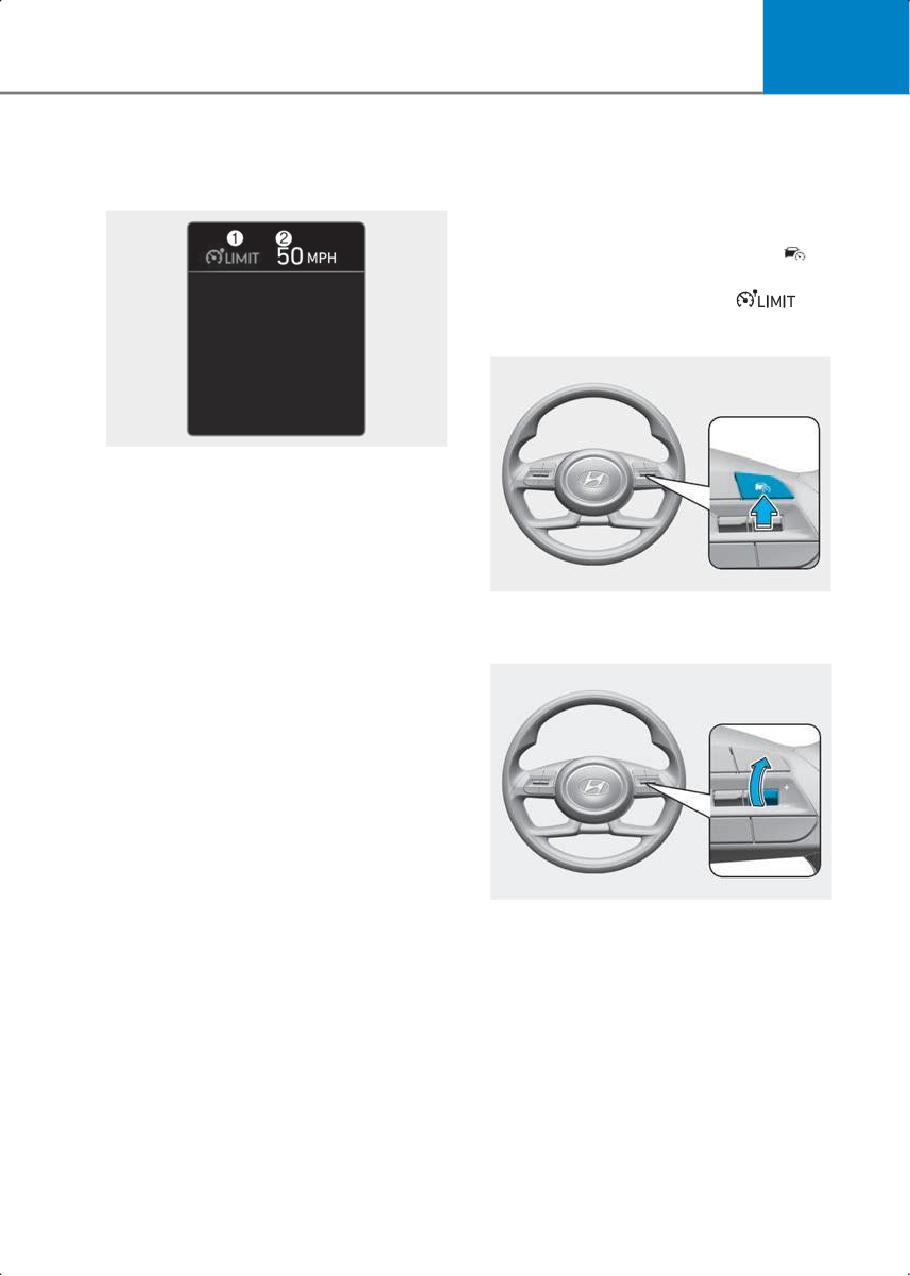
1. Press and hold the Driving Assist (
)
button at the desired speed. The
Manual Speed Limit Assist (
)
indicator light illuminates on the
instrument cluster.
(1) Manual Speed Limit Assist enabled
indicator
(2) Set speed
Manual Speed Limit Assist allows you to
set a self-imposed maximum speed limit.
If you drive over the set speed, Manual
Speed Limit Assist blinks and chimes until
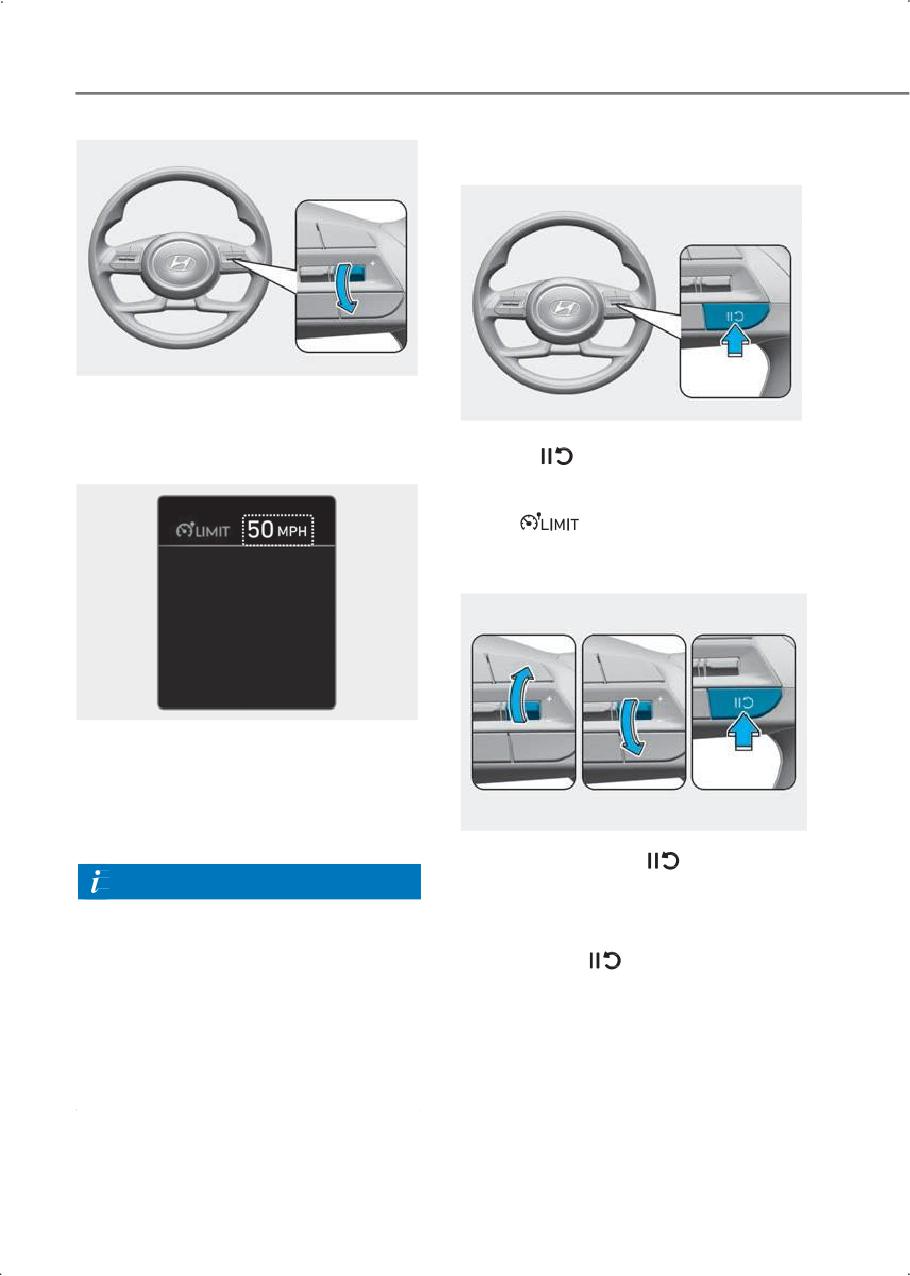
2. Push the + switch up or - switch down
your vehicle speed decreases below the
to change the set speed.
set speed.
7-49
Driver assistance system
Temporarily pausing Manual Speed
Limit Assist
Push and hold to increase or decrease
to the nearest multiple of five (multiple
of ten in km/h), and then increase or
Press the
button to temporarily
decrease by 5 mph (10 km/h).
cancel the set speed limit. The set speed
turns off, but the Manual Speed Limit
Assist (
) indicator light stays on.
Resuming Manual Speed Limit Assist
3. Check the set speed limit on the
instrument cluster.
The set speed limit blinks and chime
sounds until your vehicle speed
decreases below the set speed limit.
Push the +/- switch or
button.
Information
If you push the + switch up or - switch
down, the set speed is set to the current
• When the accelerator pedal is not
speed.
depressed beyond the pressure point,
vehicle speed will maintain within the
If you press the
button, the set speed
speed limit.
resumes to the previously set speed limit.
• The maximum setting speed varies
depending on the vehicle
specifications. The set speed cannot be
increased beyond the maximum set
speed.
7-50
7
Turning off Manual Speed Limit
Intelligent Speed Limit
Assist
Assist (ISLA)
if equipped
Intelligent Speed Limit Assist uses
information of road signs detected from
the front view camera and uses the
navigation system data to inform you of
the speed limit and help maintain within
the speed limit on the road.
WARNING
• Intelligent Speed Limit Assist may not
display the correct speed limit or may
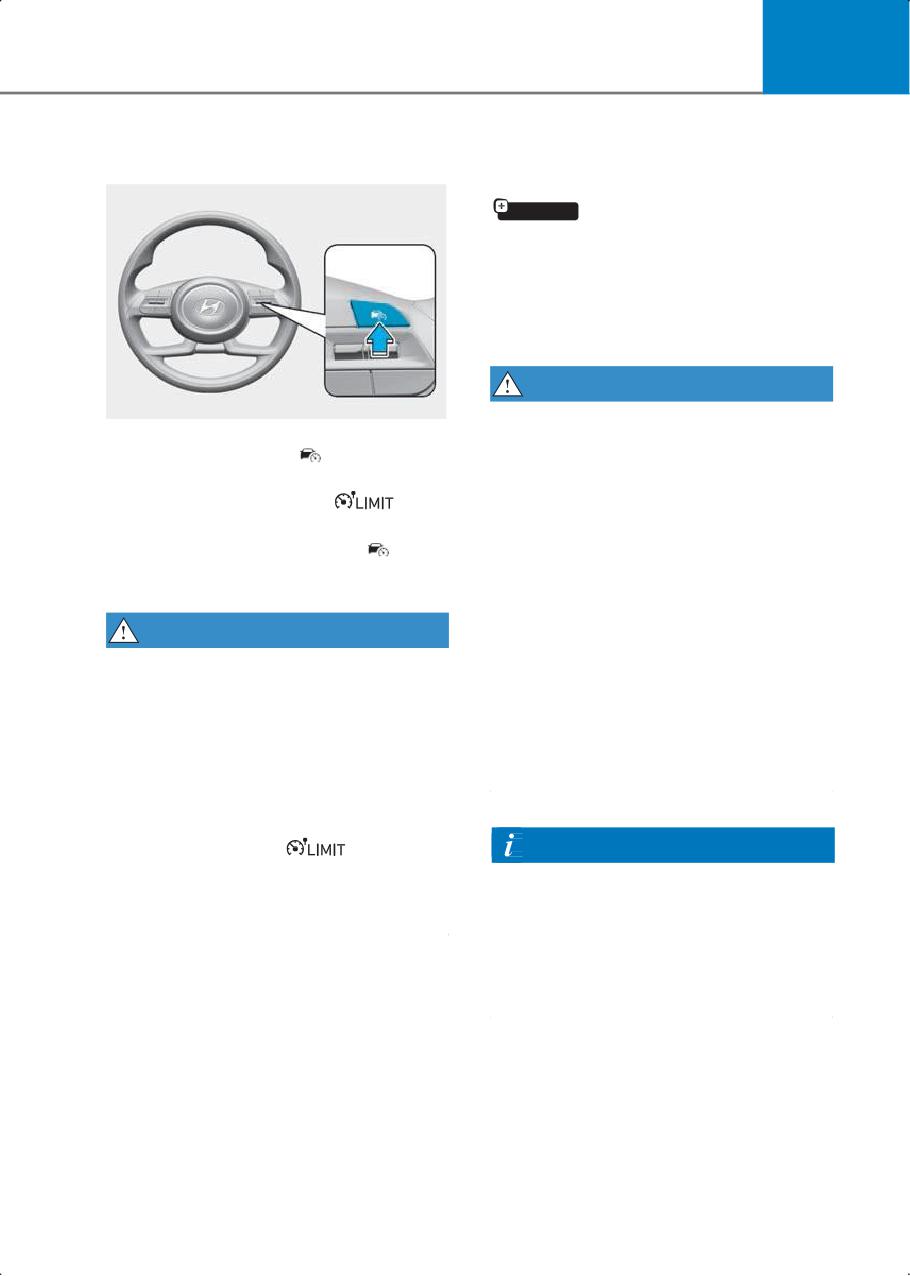
Press the Driving Assist (
) button to turn
not properly control the driving speed
off Manual Speed Limit Assist off. The
because it is a supplemental function to
Manual Speed Limit Assist (
)
inform you of the speed limit on the
indicator light turns off.
road.
Always press the Driving Assist (
)
• Set your vehicle speed to the speed
button to turn off Manual Speed Limit
limit for the road and use the
Assist when not in use.
appropriate unit (mph or km/h) for your
country.
WARNING
• Intelligent Speed Limit Assist may not
operate properly if used in other
To prevent serious injury or death:
countries.
• Set your vehicle speed to the speed
• Intelligent Speed Limit Assist may not
limit for the road and use the
operate properly if the navigation
appropriate unit (mph or km/h) for your
system is not updated regularly. (for
country.
navigation applied vehicles)
• Keep Manual Speed Limit Assist off
when not in use, to avoid inadvertently
setting a speed. Check that the Manual
Speed Limit Assist (
) indicator
Information
light is off.
Intelligent Speed Limit Assist uses the
• Always drive defensively and pay
following sensor:
attention to the driving task.
• Front view camera
Refer to the "Driver assistance system
sensors" section in this chapter for the
location.
7-51
Driver assistance system
Intelligent Speed Limit Assist
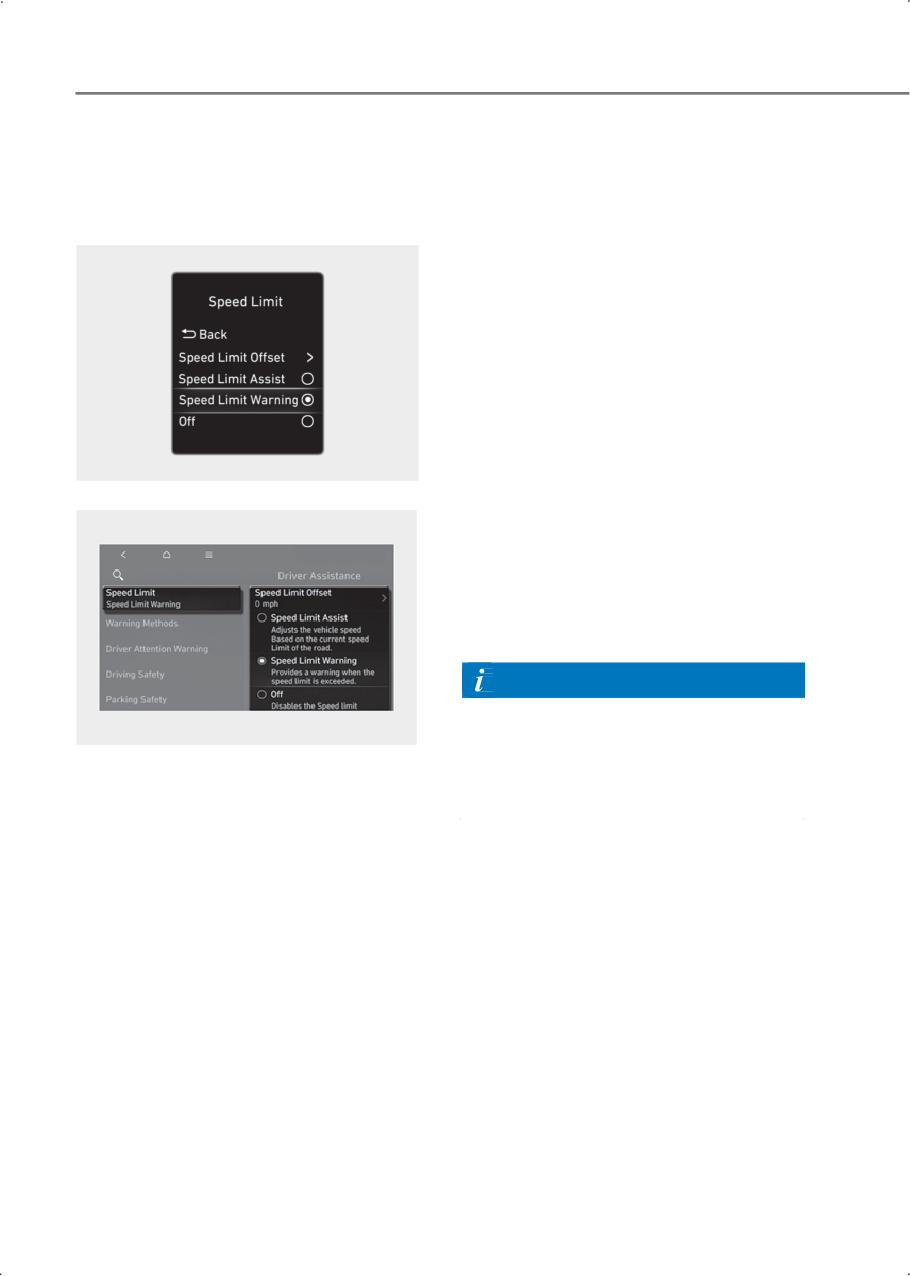
• Speed Limit Assist: Intelligent Speed
Limit Assist will inform the driver of
settings
speed limit and additional road signs. In
addition, Intelligent Speed Limit Assist
Speed Limit
will inform the driver to change set
speed of Manual Speed Limit Assist
and/or Smart Cruise Control to help the
driver stay within the speed limit.
• Speed Limit Warning: Intelligent Speed
Limit Assist will inform the driver of
speed limit. In addition, Intelligent
Speed Limit Assist will warn the driver
when the vehicle is driven faster than
the speed limit.
• Off: Intelligent Speed Limit Assist will
turn off.
Intelligent Speed Limit Assist
operation
Intelligent Speed Limit Assist may warn
and control your vehicle by "Displaying
speed limit", "Warning overspeed", and
"Changing set speed".
Information
Intelligent Speed Limit operation is
described based on the offset adjusted to
"0". For more information on setting the
With the ignition switch ON, select or
offset, refer to "Intelligent Speed Limit
deselect User Settings > Driver
Assist settings" in this section.
Assistance > Speed Limit from the User
Settings menu in the instrument cluster or
Settings > Vehicle > Driver Assistance >
Speed Limit from the Settings menu in
the infotainment system to set whether to
use each function.
• Select Country: When the navigation
system is not available, you can
manually select the country to set the
speed limit from the User Settings
menu in the instrument cluster.
7-52
7
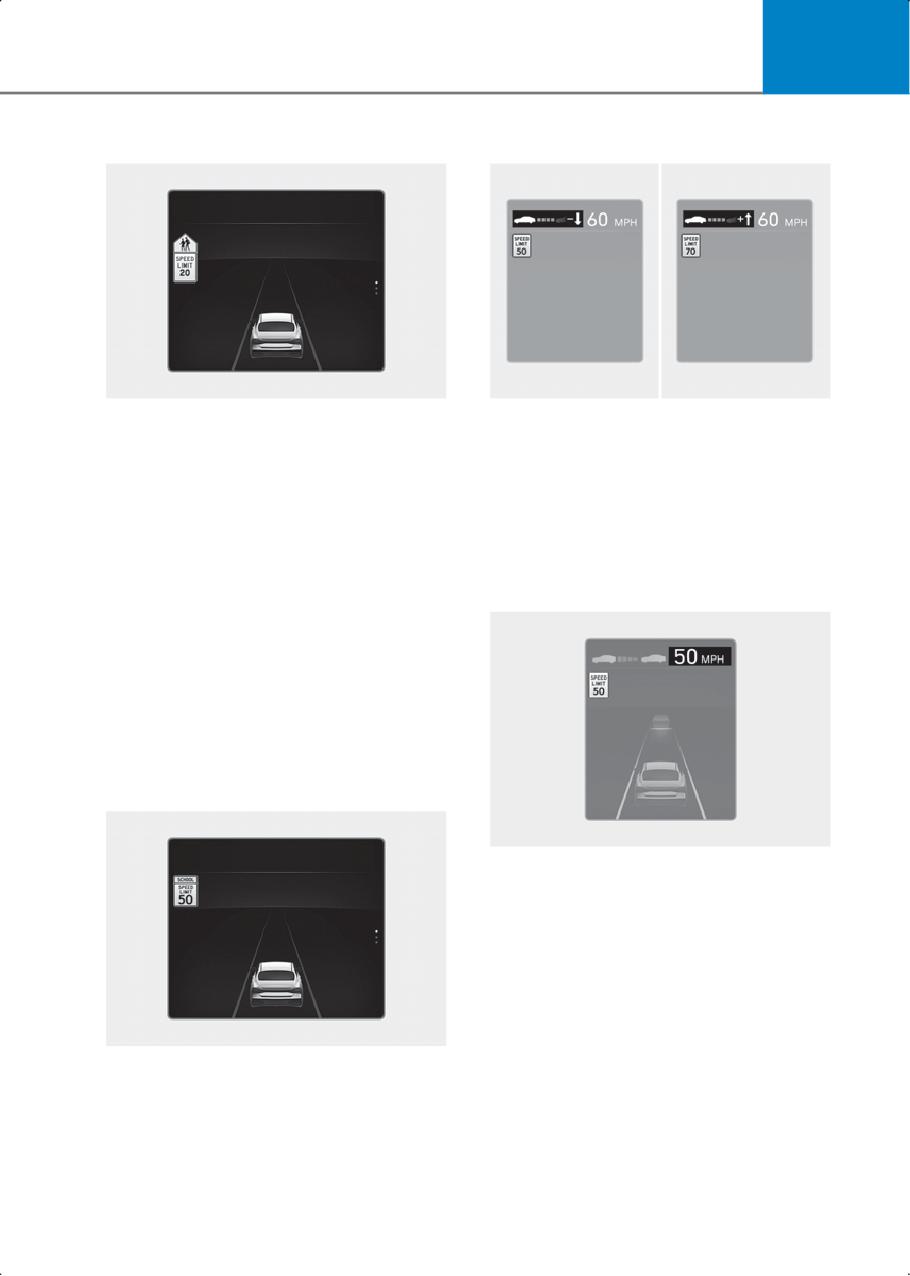
Displaying speed limit
Changing set speed
Speed limit information appears on the
If the speed limit changes when using
instrument cluster.
Manual Speed Limit Assist or Smart
Cruise Control, an arrow in the direction
• If the speed limit information of the
of up or down appears to inform you to
road cannot be recognized, "---"
change the set speed by pushing the + or
appears.
- switch.
• Intelligent Speed Limit Assist provides
additional road sign information in
Set Speed Auto Change (Navigation
addition to speed limit information.
equipped)
Additional road sign information
provided may differ depending on your
country.
• The images and colors in the
instrument cluster may differ
depending on the cluster type or theme
selected from the settings menu.
Warning overspeed
Manual Speed Limit Assist or Smart
Cruise Control assists the vehicle to
adjust its speed according to the speed
limit. When the cruising speed is set as
same as the speed limit, the vehicle
automatically adjusts its speed if the
speed limit changes. The function
operates on the road which has a speed
limit of 44 mph (70 km/h) or higher. When
the function is active, the cruising speed
When driving at a speed higher than the
on the instrument cluster appears in
displayed speed limit, the speed limit
green.
appears in red.
7-53
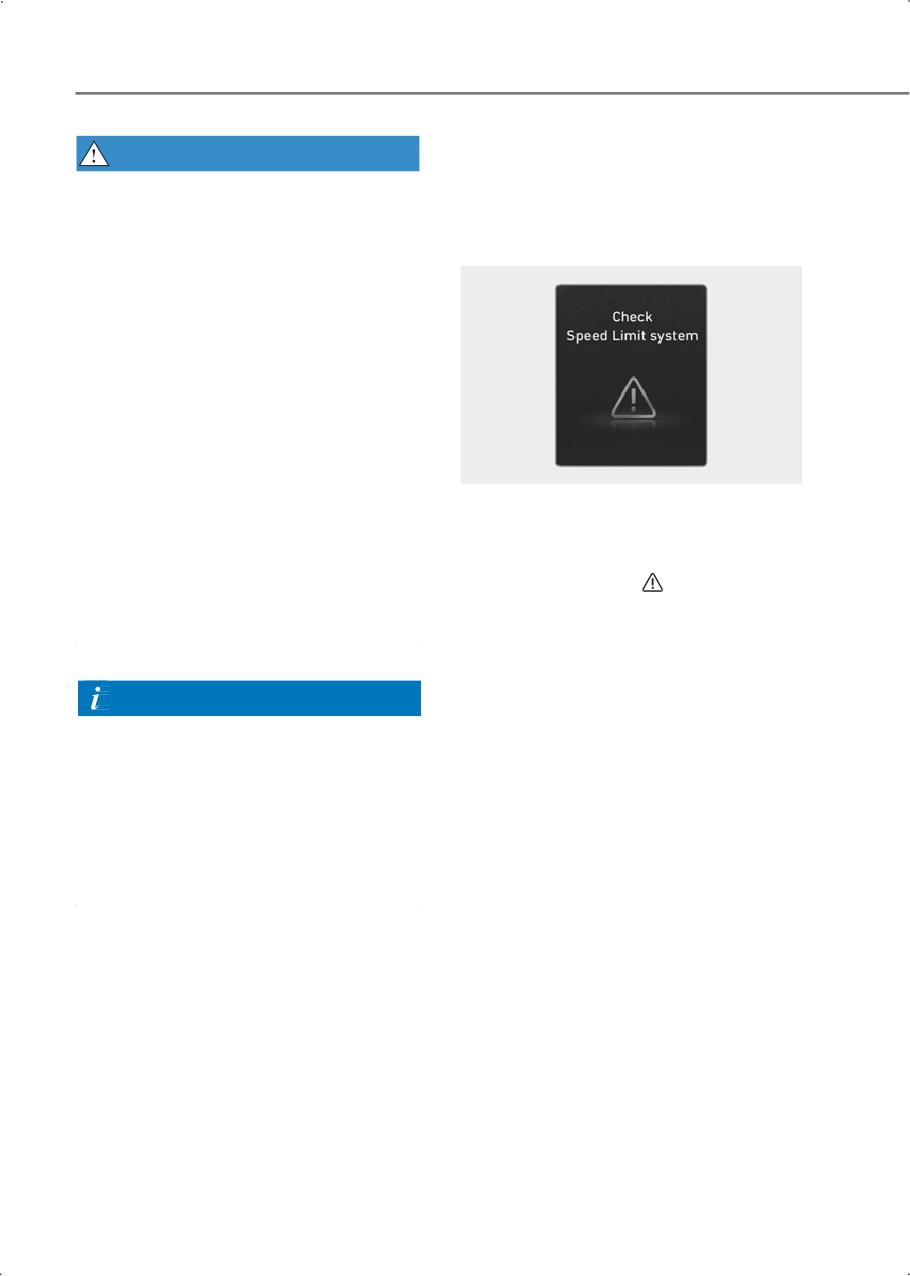
Driver assistance system
Intelligent Speed Limit Assist
WARNING
malfunction and limitations
•
If you want to drive below the speed
limit, set the Speed Limit Offset under
Intelligent Speed Limit Assist
"0" or use the - switch on the steering
malfunction
wheel to lower the set speed. If the
Speed Limit Offset is set over "0", the
set speed changes to a speed higher
than the limit for the road.
•
If necessary, reduce your driving speed
as needed. Even after changing the set
speed according to the speed limit for
the road, your vehicle can still be driven
over the speed limit.
•
If the speed limit for the road is under
20 mph (30 km/h), the set speed
changing function does not work.
•
Intelligent Speed Limit Assist operates
When Intelligent Speed Limit Assist is not
using the speed unit set by you from the
working properly, the "Check Speed
settings menu. If the speed unit is set to
Limit Assist System" warning message
a unit other than the speed unit used in
may appear, and the (
) warning light
your country, Intelligent Speed Limit
may illuminate on the instrument cluster.
Assist may not operate properly.
Have the vehicle inspected by an
authorized HYUNDAI dealer.
Information
•
For more information on Manual Speed
Limit Assist operation, refer to the
"Manual Speed Limit Assist (MSLA)"
section in this chapter.
•
For more information on Smart Cruise
Control operation, refer to the "Smart
Cruise Control (SCC)" section in this
chapter.
7-54
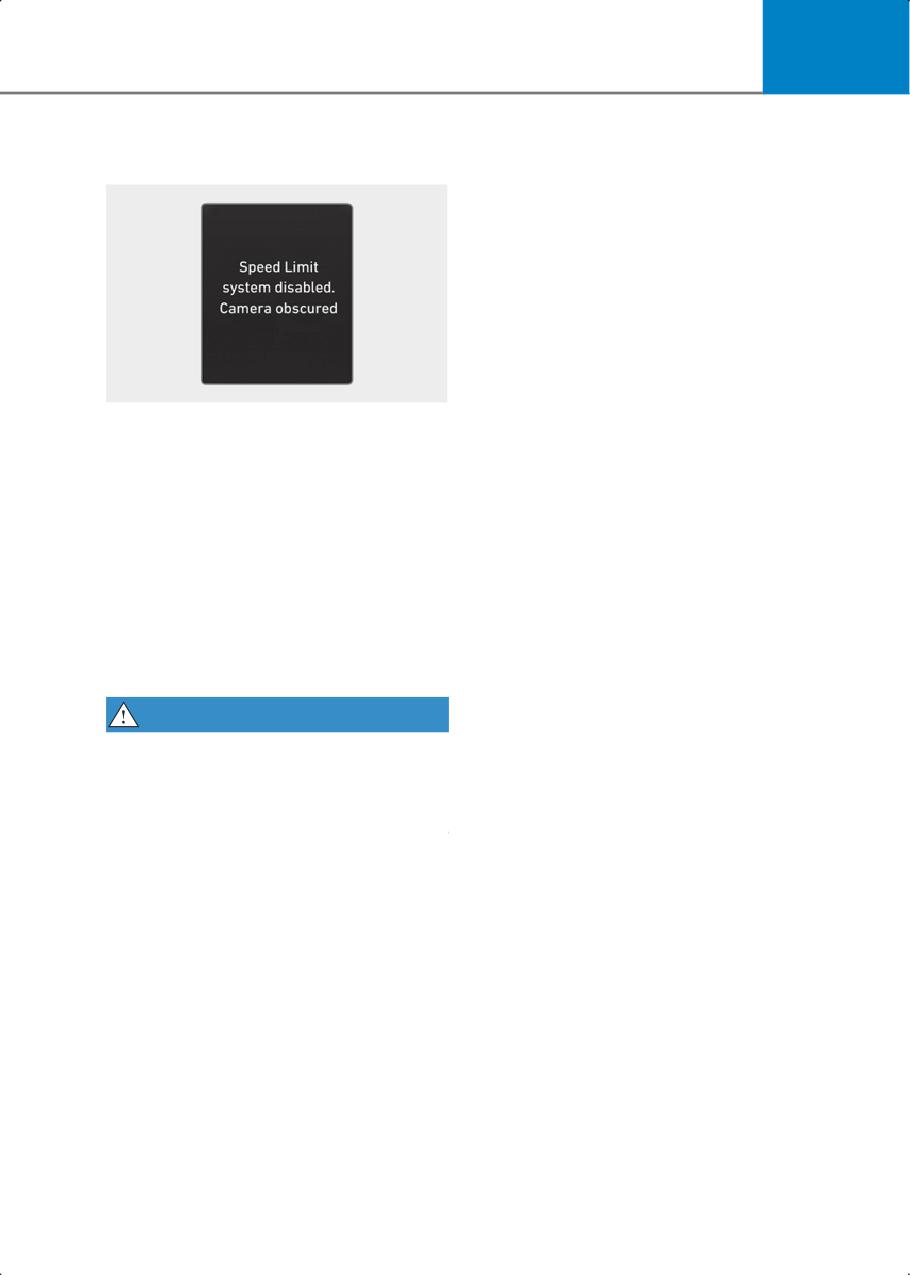
7
Intelligent Speed Limit Assist
Limitations of Intelligent Speed
disabled
Limit Assist
Intelligent Speed Limit Assist may not
operate or may be limited if:
•
The road sign is damaged, difficult to
see due to rain, snow, fog, dirt, sand,
oil, etc., or obscured by surrounding
objects or shadows.
•
The road signs do not conform to the
standard designs in your country.
- The text or picture on the road sign is
different from the standard designs
in your country.
If the front view camera is covered or
- The road sign is installed between the
blocked, its detecting performance is
main road and exit road or between
reduced, and Intelligent Speed Limit
diverging roads.
Assist is temporarily limited or disabled.
- A sign is attached to another vehicle.
The "Speed Limit Assist system disabled.
Camera obscured" warning message
•
The distance between the driving lane
and road sign is far.
may appear on the instrument cluster.
•
There are LED road signs.
If Intelligent Speed Limit Assist does not
operate normally after the sensor has
•
The numbers or pictures in the road
been uncovered or unblocked, have the
sign is incorrectly recognized as the
vehicle inspected by an authorized
speed limit.
HYUNDAI dealer.
•
Road signs on adjacent roads are
incorrectly recognized as road signs
WARNING
you are driving on.
Intelligent Speed Limit Assist may not
•
Multiple signs are installed close
operate properly even if there is no
together.
warning message or warning light on the
•
Supplementary road signs or
instrument cluster.
signboards are installed near the road
sign.
•
A minimum speed limit sign is
incorrectly recognized as the maximum
speed limit sign.
•
The brightness changes suddenly, for
example when entering or exiting a
tunnel or passing under a bridge.
•
Headlights are not used, or the
brightness of the headlights are weak at
night or in the tunnel.
•
Road signs are difficult to recognize
due to the reflection of sunlight,
streetlights, or oncoming vehicles.
•
The front view camera’s field of view is
obstructed by glare from the sun.
7-55
Driver assistance system
• You are driving on a road that is sharply
Driver Attention Warning
curved or continuously curved.
(DAW)
• You are driving through speed bumps,
or driving up and down, or left to right
on steep inclines.
Inattentive Driving Warning
• Your vehicle is shaking heavily.
function
• There is an error in the navigation map
Driver Attention Warning uses the front
data or GPS data.
view camera to help monitor your driving
• You are not driving your vehicle based
pattern and uses the driving time to
on the route guidance.
recommend a break.
• You are driving your vehicle on a newly
opened road.
Leading Vehicle Departure Alert
• The navigation system is updated while
function
driving or restarts.
Leading Vehicle Departure Alert function
informs you when a detected vehicle in
Information
front departs from a stop.
For more information on the limitations of
Information
the front view camera, refer to the
"Forward Collision-Avoidance Assist
Driver Attention Warning uses the
(FCA) (Front view camera only)" section in
following sensor:
this chapter.
• Front view camera
Refer to the "Driver assistance system
sensors" section in this chapter for the
location.
Driver Attention Warning
settings
With the ignition switch ON, go to User
Settings > Driver Assistance > Driver
Attention Warning from the settings
menu in the instrument cluster or
Settings > Vehicle > Driver Assistance >
Driver Attention Warning from the
settings menu in the infotainment system
to set the following:
7-56
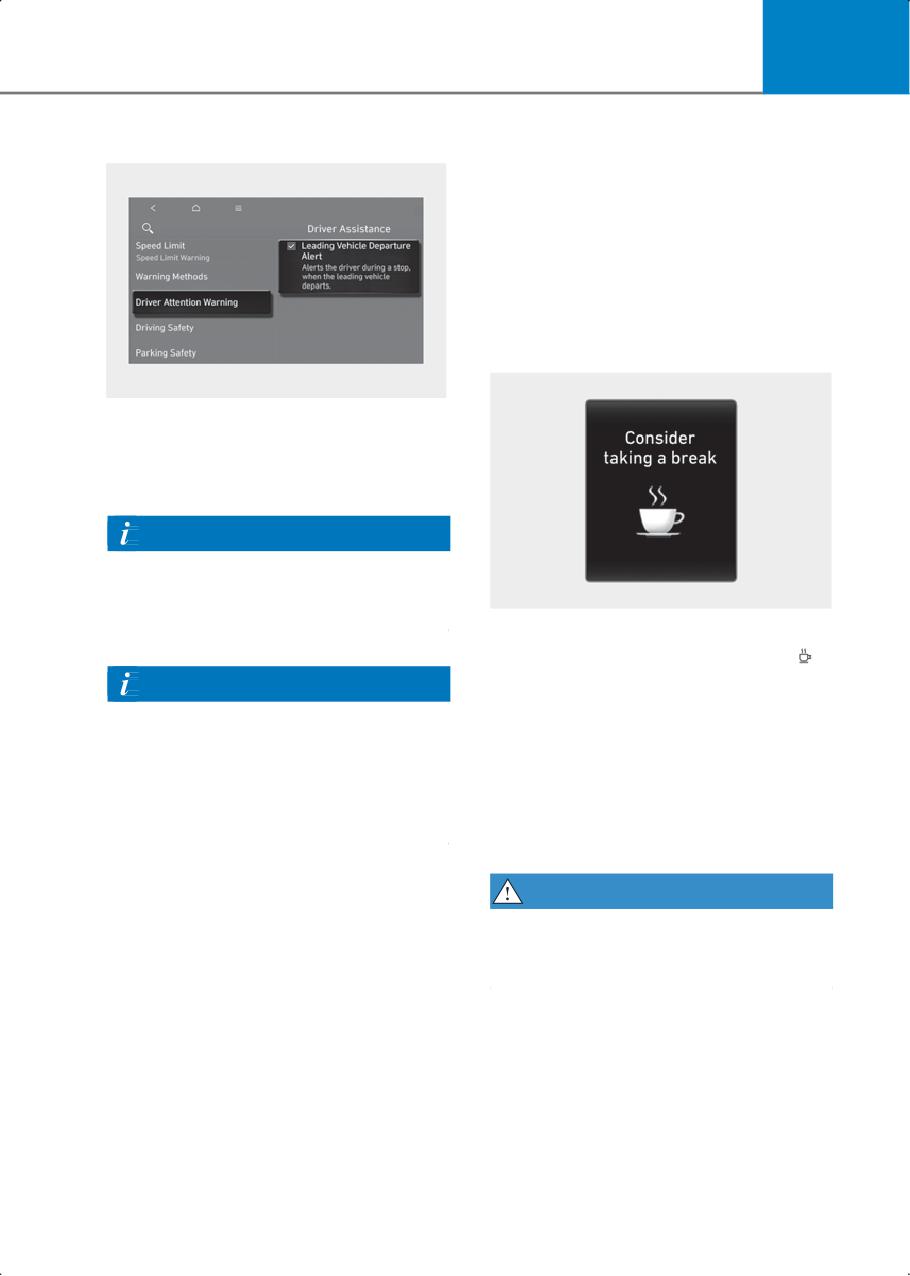
7
Leading Vehicle Departure Alert
Driver Attention Warning
operation
Inattentive Driving Warning
function
The basic function of Driver Attention
Warning is to warn the driver "Consider
taking a break".
Taking a break
If Leading Vehicle Departure Alert is
selected, the function informs you when a
detected vehicle in front departs from a
stop.
Information
When the engine is restarted, Driver
Attention Warning maintains the last
setting.
• The "Consider taking a break" message
and Driver Attention Warning light (
)
will appear on the cluster and an
Information
audible warning will sound to suggest
You can change the Warning Timing
that the driver take a break, when the
settings or select Driving Safety Priority
driver’s attention level is below 1.
for Driver Attention Warning from the
• Driver Attention Warning will not
Settings menu. For more information,
suggest a break when the total driving
refer to the "Driver assistance system
time is shorter than 4 minutes or 4
settings" section in this chapter.
minutes has not passed after the last
break was suggested.
WARNING
For your safety, only change the Settings
after parking the vehicle at a safe
location.
7-57
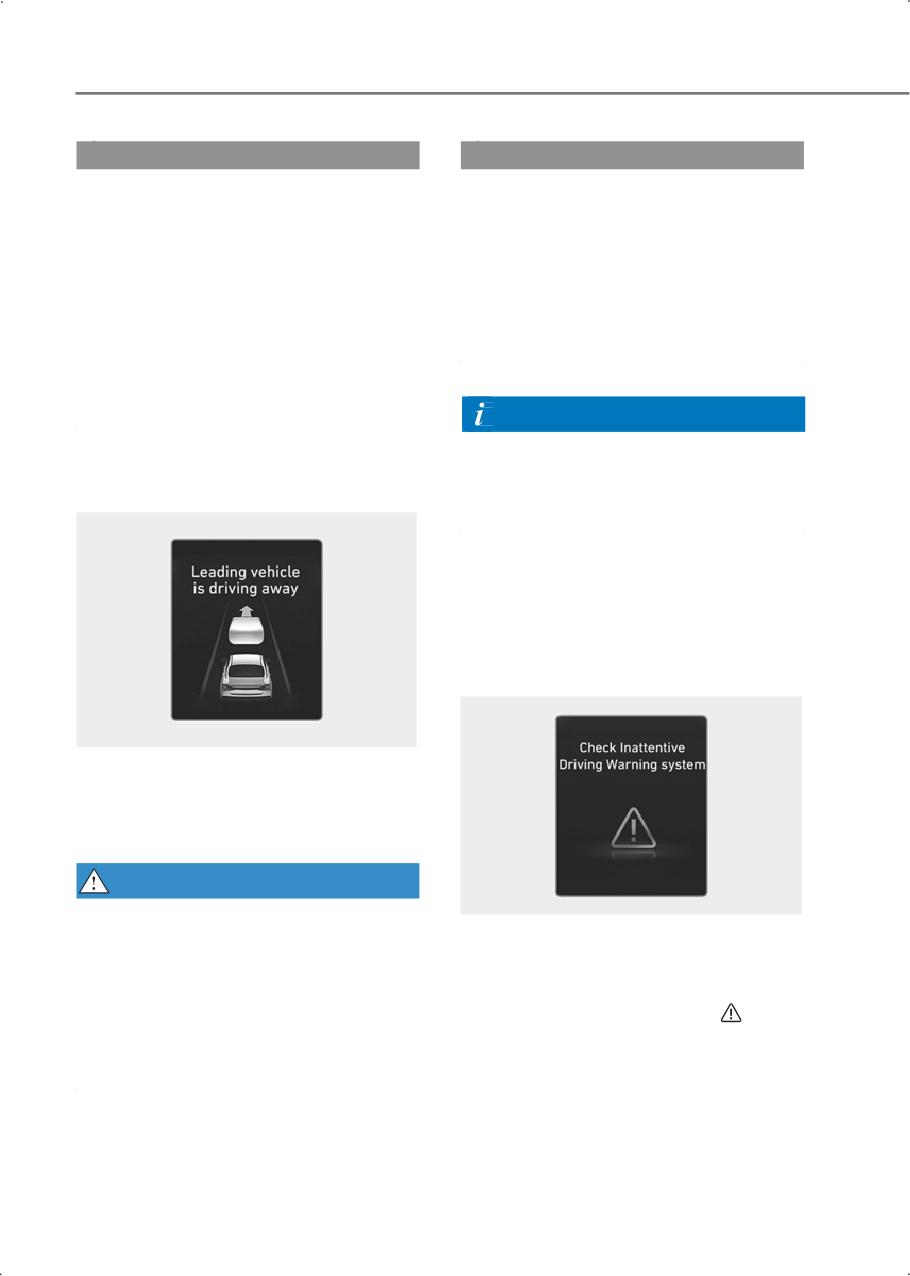
Driver assistance system
CAUTION
CAUTION
• Driver Attention Warning may suggest
• Leading Vehicle Departure Alert is a
a break depending on your driving
supplemental function and may not
pattern or habit, even if you do not feel
alert you whenever the front vehicle
fatigued.
departs from a stop.
• Driver Attention Warning is a
• Always check if it is safe to proceed
supplemental function only and does
before driving even if the function
not determine if you are paying
alerts you that the front vehicle has
attention to the driving task.
departed.
• If you feel fatigued or want to take a
break, do so as needed at a safe
location.
Information
The images and colors in the instrument
Leading Vehicle Departure Alert
cluster may differ depending on the
function
cluster type or theme selected from the
settings menu.
Driver Attention Warning
malfunction and limitations
Driver Attention Warning
malfunction
Departure Alert displays the "Leading
vehicle is driving away" message on the
instrument cluster and an audible
warning sounds.
WARNING
• When other system’s warning message
appears or audible warning is heard,
When Driver Attention Warning is not
Leading Vehicle Departure Alert may
working properly, the "Check inattentive
not alert you.
Driving Warning system" warning
• Always check road conditions, and if
message may appear, and the (
)
necessary, take appropriate actions to
warning light may illuminate on the
drive safely. It is your responsibility to
instrument cluster. Have the vehicle
operate your vehicle in a safe manner.
inspected by an authorized HYUNDAI
dealer.
7-58
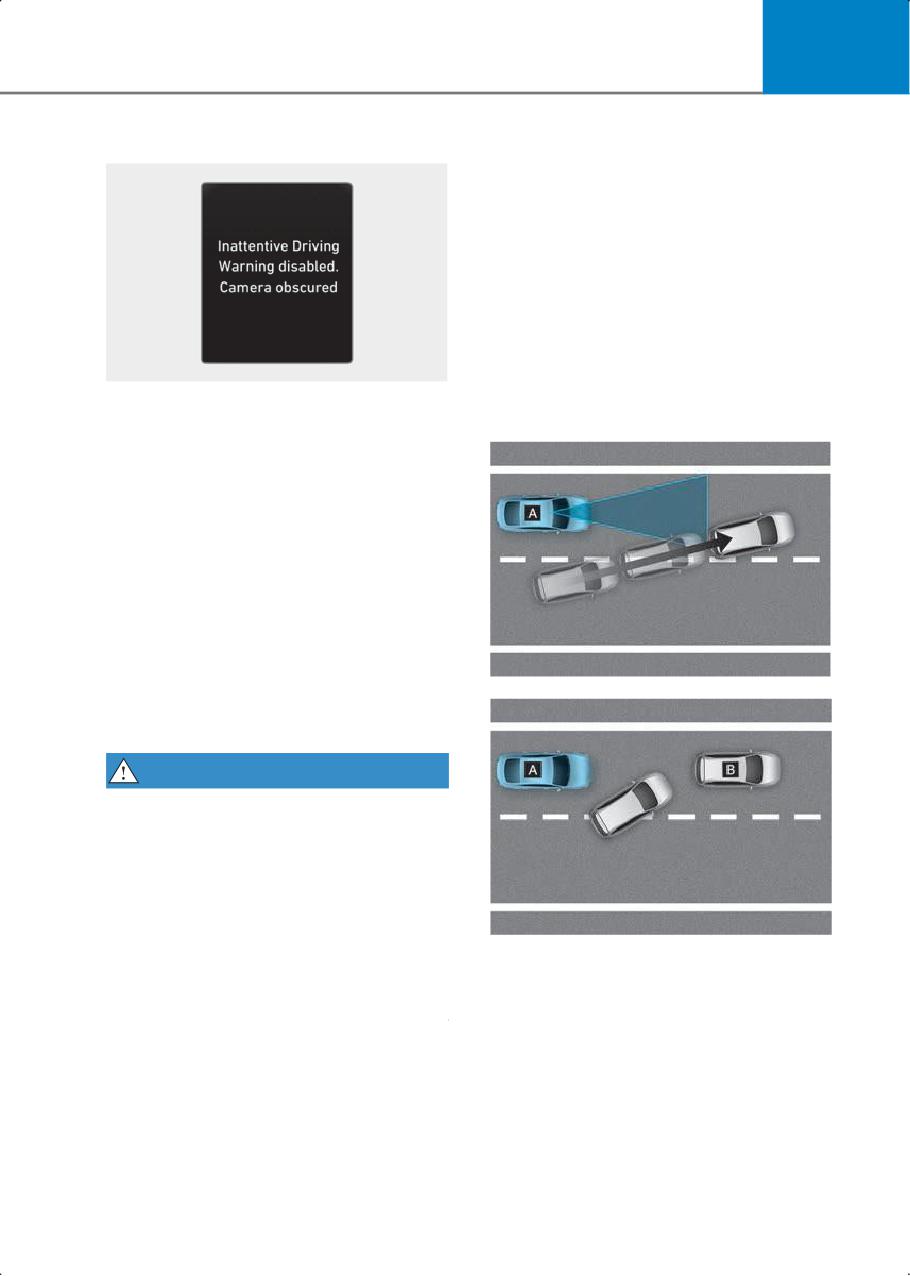
7
Driver Attention Warning disabled
Limitations of Driver Attention
Warning
Driver Attention Warning may not work
properly in the following situations:
• The vehicle is driven violently
• The vehicle intentionally crosses over
lanes frequently
• The vehicle is controlled by Driver
Assistance system, such as Lane
Keeping Assist
Leading Vehicle Departure Alert feature
When the front windshield where the
• When the vehicle cuts in
front view camera is located is covered
with foreign material, such as snow or
rain, it can reduce the detecting
performance and temporarily limit or
disable Driver Attention Warning. If this
occurs, the "Inattentive Driving Warning
disabled. Camera obscured" warning
message will appear on the instrument
cluster. Driver Attention Warning will
operate properly when snow, rain or
foreign material is removed.
If Driver Attention Warning does not
operate properly after it is removed, have
the vehicle inspected by an authorized
HYUNDAI dealer.
WARNING
• Driver Attention Warning may not
properly operate in an area (e.g. open
terrain) where any objects are not
detected right after turning ON the
engine.
• If the engine is turned off and restarted
while the camera is blocked or
malfunctioned, the condition is
[A] Your vehicle
[B] Front vehicle
maintained. Therefore, Driver Attention
If a vehicle cuts in front of your vehicle,
Warning may not operate properly.
Leading Departure Alert may not
operate properly.
7-59
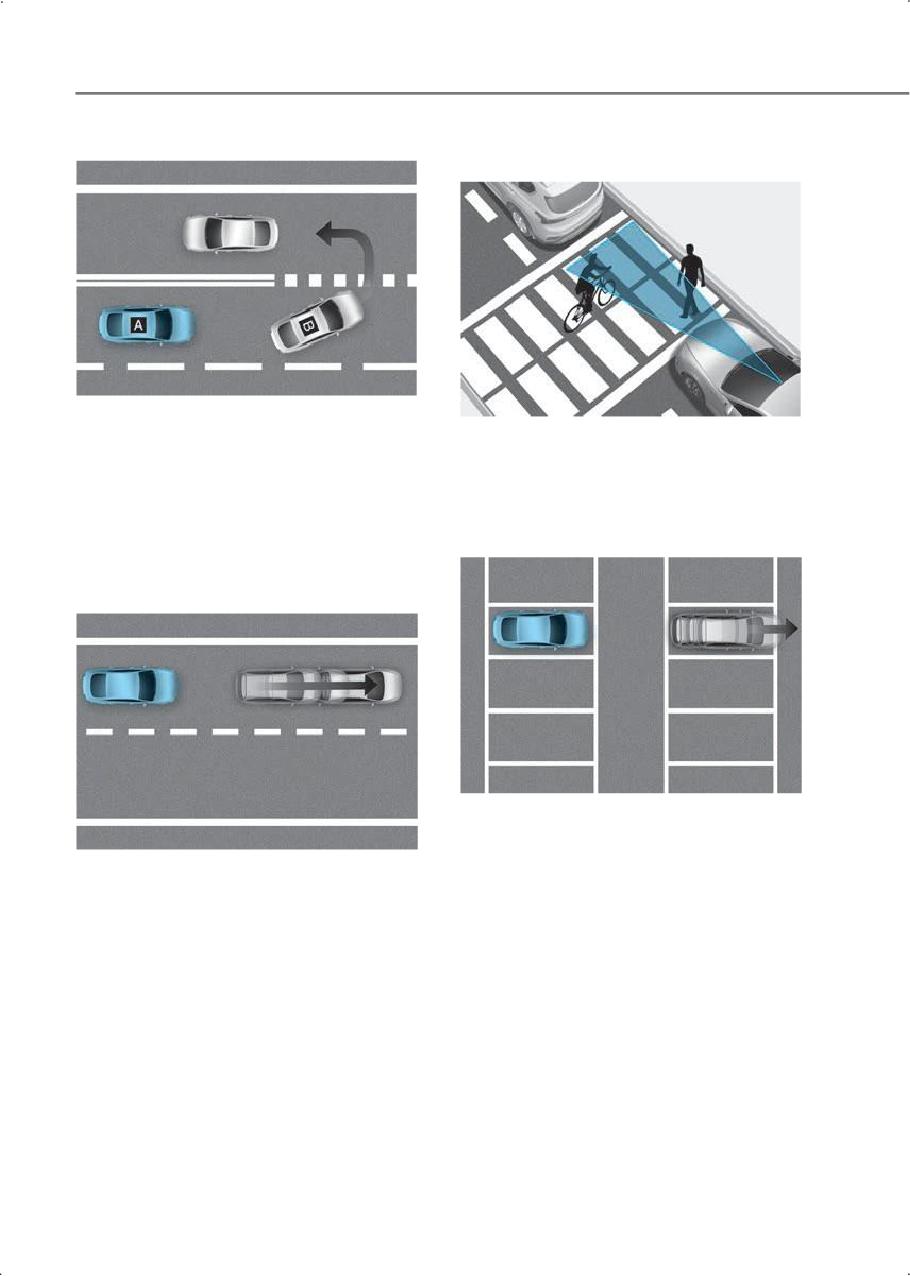
Driver assistance system
• When the vehicle ahead sharply steers
• When a pedestrian or bicycle is
between you and the vehicle ahead
[A] Your vehicle
[B] Front vehicle
If there is a pedestrian(s) or bicycle(s) in
If the vehicle in front makes a sharp
between you and the vehicle in front,
turn, such as to turn left or right or make
Leading Vehicle Departure Alert may
a Uturn, etc., Leading Vehicle
not operate properly.
Departure Alert may not operate
• When in a parking lot
properly.
• When the vehicle ahead abruptly
departures
If a vehicle parked in front drives away
from you, Leading Vehicle Departure
Alert may alert you that the parked
If the vehicle in front abruptly
vehicle is driving away.
departures, Leading Vehicle Departure
Alert may not operate properly.
7-60
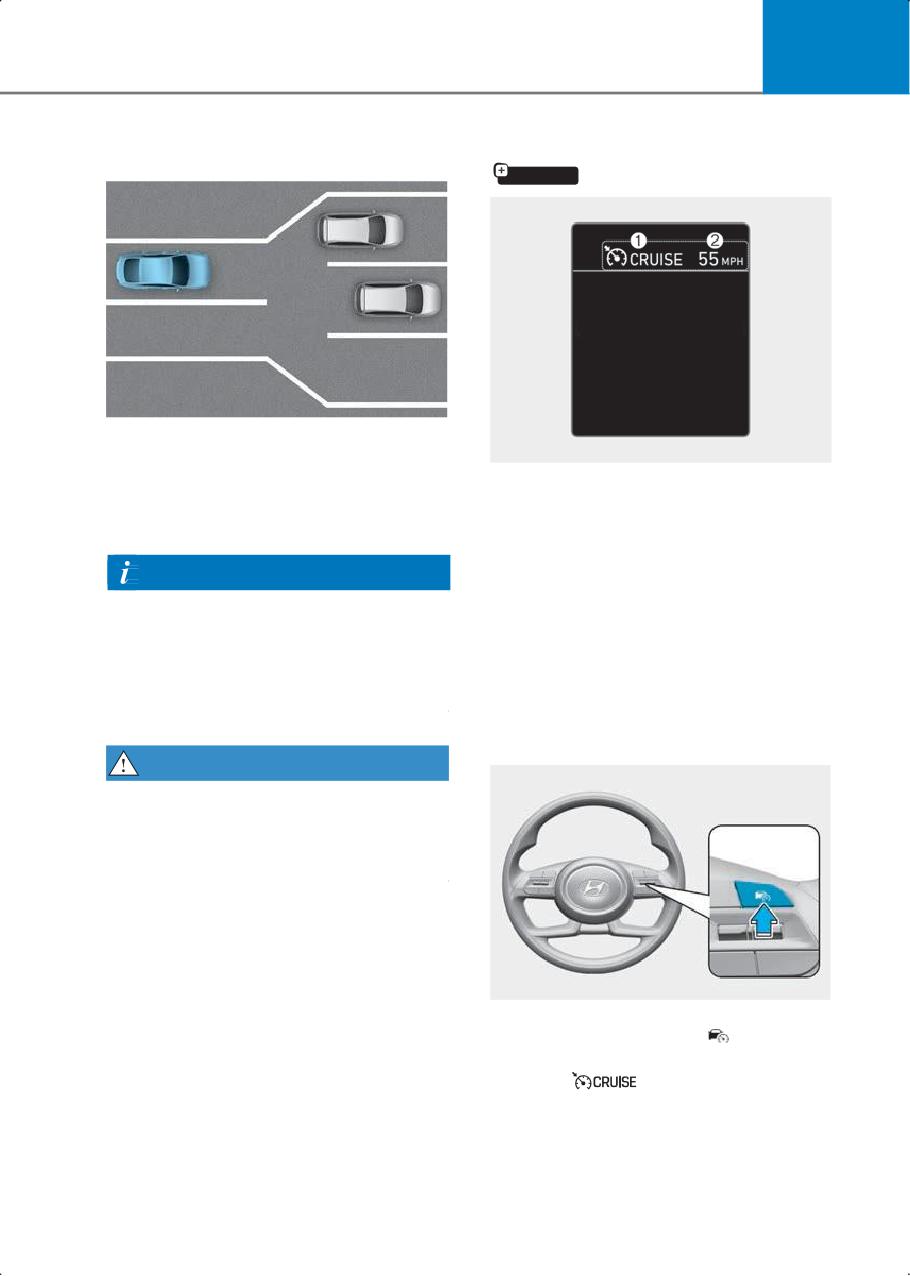
7
• When driving at a tollgate or
Cruise Control (CC)
intersection, etc.
if equipped
If you pass a tollgate or intersection
with lots of vehicles or you drive where
lanes are merged or divided frequently,
(1) Cruise indicator light
Leading Vehicle Departure Alert may
(2) Set speed
not operate properly.
Cruise Control allows you to drive at
speeds above 20 mph (30 km/h) without
Information
depressing the accelerator pedal.
For more information on the precautions
of the front view camera, refer to the
"Forward Collision-Avoidance Assist
Cruise Control operation
(FCA) (Sensor fusion)" section in this
chapter.
Setting set speed
1. Accelerate to the desired speed, which
must be more than 20 mph (30 km/h).
WARNING
Driver Attention Warning may not operate
for 15 seconds right after your vehicle is
started or when the front view camera is
initialized.
2. Press the Driving Assist (
) button at
the desired speed. The set speed and
Cruise (
) indicator light
illuminates on the instrument cluster.
7-61
Driver assistance system
3. Release the accelerator pedal.
Accelerating temporarily
Vehicle speed maintains the set speed
If you want to accelerate temporarily
even when the accelerator pedal is not
when Cruise Control is on, depress the
depressed.
accelerator pedal.
To return to the set speed, take your foot
Information
off the accelerator pedal.
The vehicle speed may slow down or
If you push the + switch up or - switch
speed up while driving uphill or downhill.
down at a higher speed, the cruising
speed is set to the higher speed.
Increasing set speed
Decreasing set speed
• Push the + switch up and release it
• Push the - switch down and release it
immediately to increase the cruising
immediately to decrease the cruising
speed by 1 mph (1 km/h).
speed by 1 mph (1 km/h).
• Push and hold the + switch up to
• Push and hold the - switch down to
increase to the nearest multiple of 5
decrease to the nearest multiple of 5
mph (or multiple of 10 km/h) at first,
mph (or multiple of 10 km/h) at first,
and then increase by an additional 5
and then decrease by 5 mph (10 km/h)
mph (10 km/h) each time.
each time
Information
WARNING
The set speed may differ depending on
If you need to slow down quickly to avoid
the vehicle specifications. You may not
a collision, depress the brake pedal as
increase the set speed above the
needed.
maximum set speed.
7-62
7
Temporarily pausing Cruise Control
• Push the +/- switch or
button.
If you push the +/- switch up or down,
your vehicle speed is set to the current
speed on the instrument cluster.
• If you press the
button, your
vehicle speed resumes the previously
set speed.
• Your vehicle speed must be above 20
mph (30 km/h) for the function to
resume.
WARNING
Cruise Control cancels when:
Your vehicle speed may rapidly increase
• Depressing the brake pedal
or decrease when you press the
button.
• Pressing the
button
• Shifting the gear to N (Neutral)
Turning off Cruise Control
• Decreasing vehicle speed to less than
16 mph (25 km/h)
• Operating ESC (Electronic Stability
Control)
• Accelerating the vehicle speed above
118 mph (190 km/h)
The set speed turns off but the Cruise
(
) indicator light will stay on.
NOTICE
If Cruise Control cancels during a
situation not listed above, have the
vehicle inspected by an authorized
Press the Driving Assist (
) button to turn
HYUNDAI dealer.
off Cruise Control. The Cruise (
)
indicator light goes off.
Resuming Cruise Control
Always press the Driving Assist (
)
button to turn off Cruise Control when not
in use.
Information
If your vehicle is equipped with Manual
Speed Limit Assist, press and hold the
Driving Assist (
) button to turn off
Cruise Control and turn on Manual Speed
Limit Assist.
7-63
Driver assistance system
Smart Cruise Control
WARNING
To prevent serious injury or death:
(SCC)
•
Keep Cruise Control off when not in
if equipped
use, to avoid inadvertently setting a
speed. Check that the Cruise Control
Basic function
(
) indicator light is off.
Smart Cruise Control uses the front view
•
Always drive defensively and pay
camera and front radar to help detect a
attention to the driving task.
vehicle ahead and maintain the desired
•
Set your vehicle speed to the speed
speed and distance between your vehicle
limit for the road and use the
and the vehicle ahead.
appropriate unit (mph or km/h) for your
country.
Overtaking Acceleration Assist
•
Do not use Cruise Control when it may
While Smart Cruise Control is operating, if
be unsafe to keep your vehicle at a
the function judges you are attempting to
constant speed including when driving:
overtake a vehicle in front, Smart Cruise
- in heavy traffic, or when traffic
Control accelerates your vehicle to assist
conditions make it difficult to drive at
you with this maneuver.
a constant speed
- on rainy, icy, or snow-covered roads
WARNING
- on hilly or windy roads
Always monitor your vehicle speed and
- with limited visibility such as fog,
the distance to vehicles ahead on the
snow, rain, and sandstorm
road. Smart Cruise Control is not a
substitute for safe driving practices, but a
•
Do not shift the gear to N (Neutral)
supplemental function only.
while the cruise control is activating
without clutch pedal depressed.
Information
Smart Cruise Control uses the following
sensors:
• Front view camera
• Front radar
Refer to the "Driver assistance system
sensors" section in this chapter for the
location.
7-64
7
Smart Cruise Control settings
Smart Cruise Control
operation
Smart Cruise Control
Operating conditions
Basic function
Smart Cruise Control operates when the
following conditions are met:
• The gear is in D (Drive).
• Your vehicle speed is within the
operating speed range.
- 5-112 mph (10-180 km/h): When there
is no vehicle in front
-
0-112 mph (0-180 km/h): When there
With the ignition switch ON, go to User
is a vehicle in front
settings > Driver Assistance > Smart
• ESC (Electronic Stability Control) or
Cruise Control from the settings menu on
ABS is enabled.
the instrument cluster or Settings >
Smart Cruise Control does not operate
Vehicle > Driver Assistance > Driving
when:
Convenience > Smart Cruise Control in
• The driver’s door is opened.
the infotainment system to change
Distance, Acceleration, Reaction Speed
• Engine RPM is high.
manually.
• Parking brake is applied.
• ESC (Electronic Stability Control) or
Information
ABS (Anti-Lock Braking System) is
You can set the following Warning
controlling your vehicle.
Methods:
• Forward Collision-Avoidance Assist
• Warning Volume/Haptic
braking control is operating (if
Warning/Driving Safety Priority
equipped).
For more information, refer to the "Driver
assistance system settings" section in this
Information
chapter.
If stopped behind another vehicle, you
have to depress the brake pedal to turn on
Smart Cruise Control.
7-65
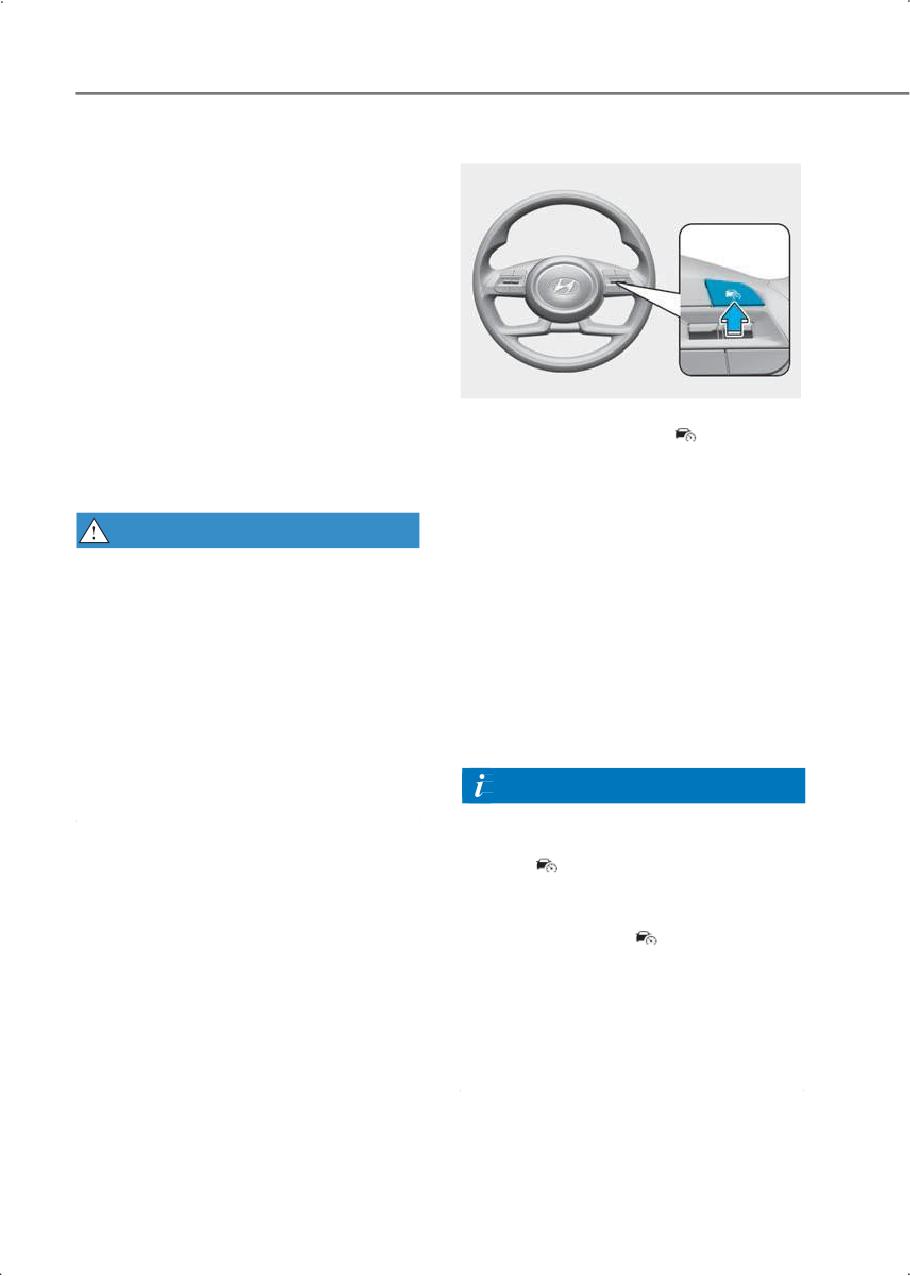
Driver assistance system
Operating conditions for Acceleration
Turning on Smart Cruise Control
Assist
Overtaking Acceleration Assist operates
when the turn signal indicator is turned on
to the left while Smart Cruise Control is
operating, and the following conditions
are satisfied:
• Your vehicle speed is above 40 mph (60
km/h).
• A vehicle is detected in front of your
vehicle.
Overtaking Acceleration Assist does not
operate when:
•
Press the Driving Assist (
) button. The
• The hazard warning flasher is on.
speed is set to the current speed on the
• Deceleration is needed to maintain the
instrument cluster.
distance from the vehicle in front.
•
If there is no vehicle in front of you, the
set speed is maintained.
WARNING
•
If there is a vehicle in front of you, your
• When the turn signal indicator is turned
vehicle speed may be adjusted to
on to the left while there is a vehicle
maintain the distance from the vehicle
ahead, the vehicle may accelerate
ahead.
temporarily. Pay attention to the road
•
If the vehicle ahead accelerates and the
conditions at all times.
distance between vehicles increase,
• Regardless of the driving direction in
your vehicle accelerates to the set
your country, Overtaking Acceleration
speed, and then travels at a constant
Assist will operate when the conditions
speed after your vehicle reaches the set
are satisfied. When using the function
distance.
in countries with different driving
direction, always check the road
Information
conditions at all times.
•
If your vehicle speed is 0-20 mph (0-30
km/h) when you press the Driving
Assist (
) button, the Smart Cruise
Control speed is set to 20 mph (30
km/h).
•
The Driving Assist (
) button symbol
may differ depending on your vehicle
option.
•
If you shift from a higher gear to a lower
gear using the manual shift mode or
paddle shifter, the vehicle speed may
not accelerate to the set speed.
7-66
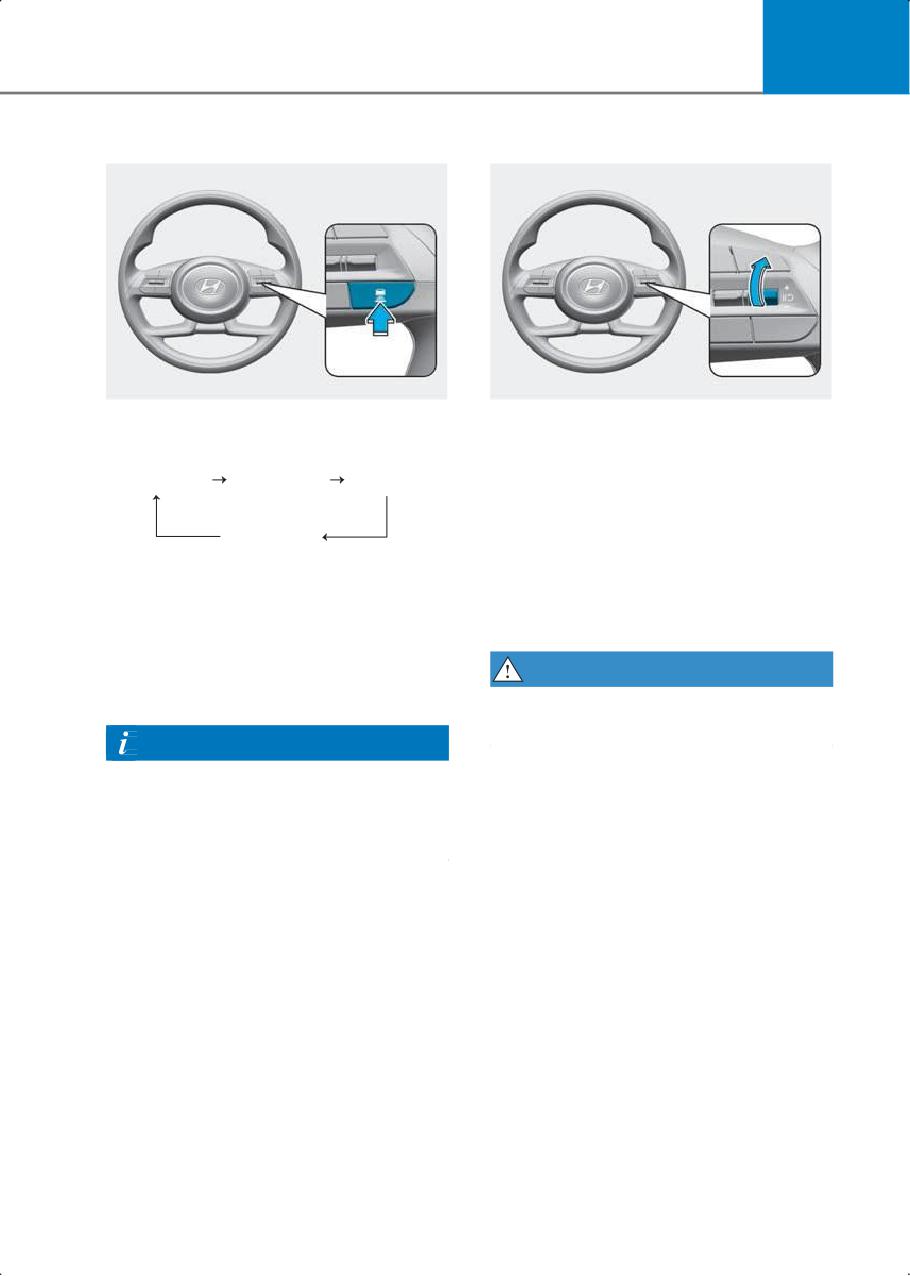
7
Setting vehicle distance
Increasing set speed
Each time the button is pressed, the
• Push the + switch up and release it
vehicle distance changes as follows:
immediately to increase the cruising
speed by 1 mph (1 km/h).
Distance 4
Distance 3
Distance 2
• Push and hold the + switch up to
increase to the nearest multiple of 5
Distance 1
mph (or multiple of 10 km/h) at first,
and then increase by an additional 5
If you drive at 56 mph (90 km/h), the
mph (10 km/h) each time.
distance is maintained as follows:
• The vehicle speed can be set to a
Distance 4 - about 172 ft. (52.5 m)
maximum of 112 mph (180 km/h).
Distance 3 - about 130 ft. (40 m)
WARNING
Distance 2 - about 106 ft. (32.5 m)
Distance 1 - about 82 ft. (25 m)
Your vehicle speed may rapidly increase
when you push and hold the + switch.
Information
When the engine is restarted or Smart
Cruise Control is temporarily canceled,
the following distance maintains the last
setting.
7-67
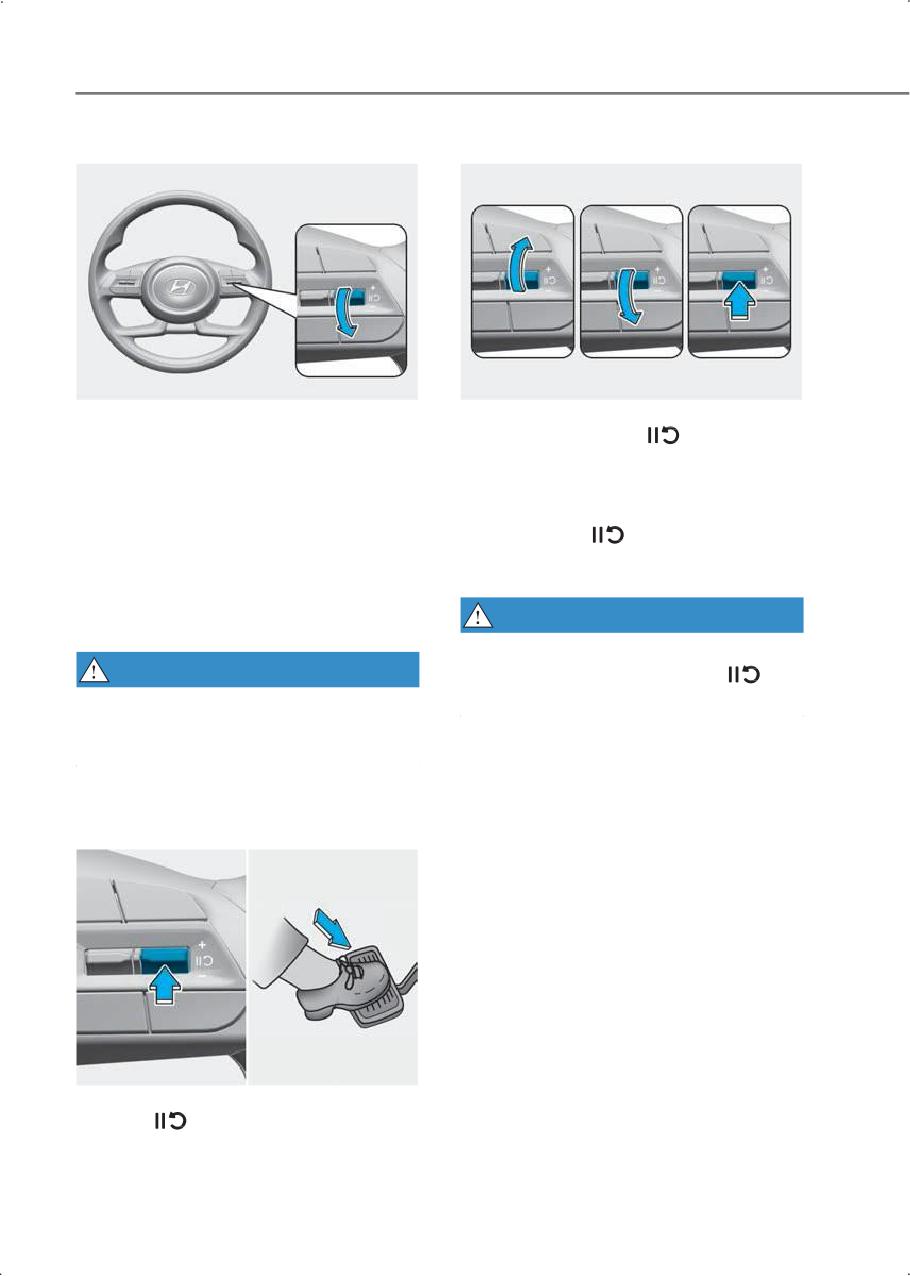
Driver assistance system
Decreasing set speed
Resuming Smart Cruise Control
• Push the - switch down and release it
Push the +/- switch or
button.
immediately to decrease the cruising
If you push the +/- switch up or down,
speed by 1 mph (1 km/h).
your vehicle speed is set to the current
• Push and hold the - switch down to
speed on the instrument cluster.
decrease to the nearest multiple of 5
If you press the
button, your vehicle
mph (or multiple of 10 km/h) at first,
speed resumes to the previously set
and then decrease by 5 mph (10 km/h)
speed.
each time.
• The vehicle speed can be set to a
WARNING
minimum of 20 mph (30 km/h).
Your vehicle speed may rapidly increase
WARNING
or decrease when you press the
button.
If you need to slow down quickly to avoid
a collision, depress the brake pedal as
needed.
Temporarily cancelling Smart Cruise
Control
Press the
button or depress the brake
pedal to temporarily cancel Smart Cruise
Control.
7-68
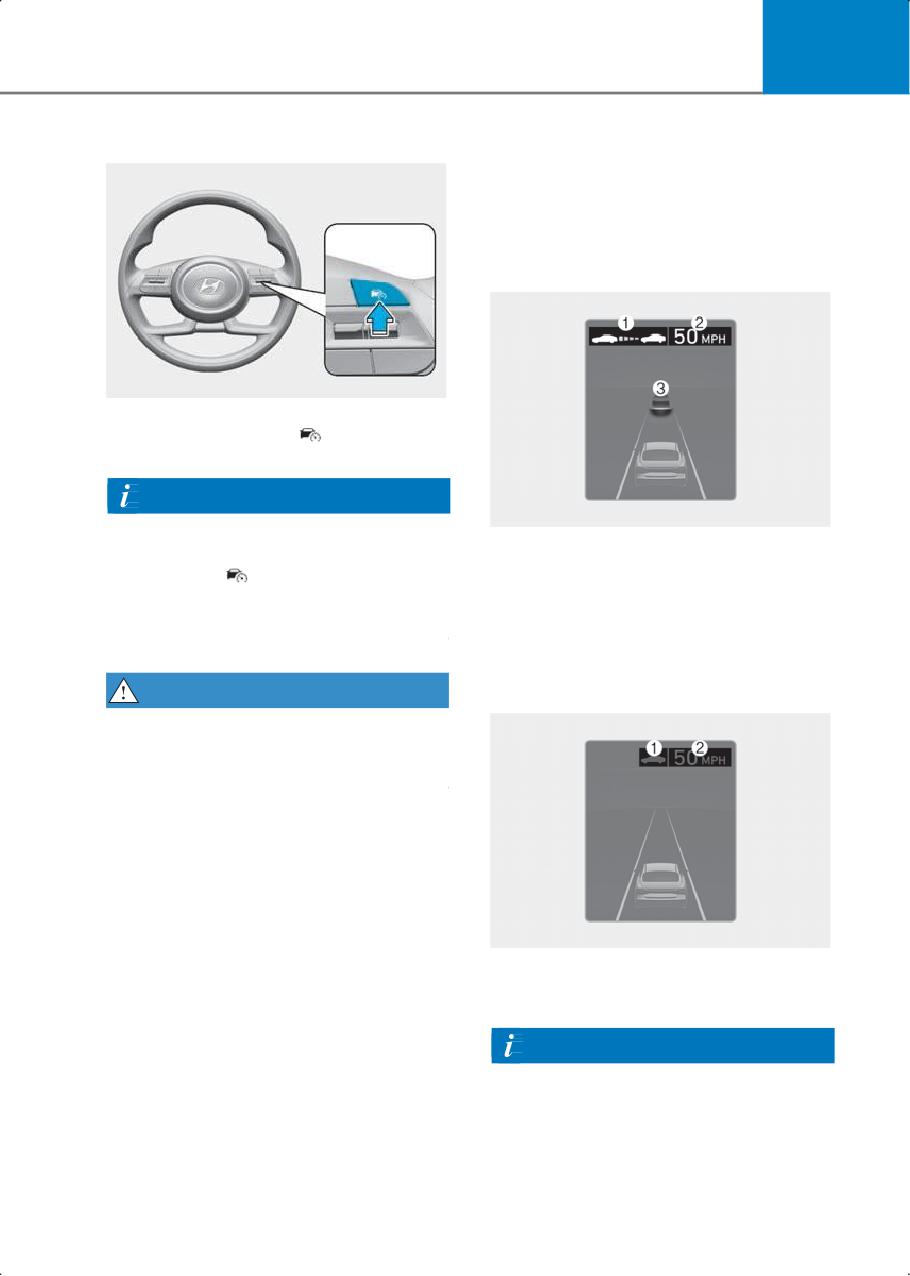
7
Turning off Smart Cruise Control
Display and control
The status of the Smart Cruise Control
operation appears in Driving Assist mode
on the instrument cluster. Refer to the
"View modes" section in chapter 4.
When operating
Press the Driving Assist (
) button to turn
off Smart Cruise Control.
Information
If your vehicle is equipped with Manual
Speed Limit Assist, press and hold the
(1) Whether there is a vehicle ahead and
Driving Assist (
) button to turn off
the selected distance level appears.
Cruise Control and turn on Manual Speed
(2) Set speed appears.
Limit Assist.
(3) Whether there is a vehicle ahead and
the target vehicle distance appears.
WARNING
When temporarily canceled
Do not operate multiple buttons or
switches simultaneously. Smart Cruise
Control may not operate properly.
(1) Your vehicle (grey)
(2) Previous set speed (grey)
Information
• The distance from the front vehicle on
the instrument cluster appears
according to the actual distance
between your vehicle and the vehicle
ahead.
7-69
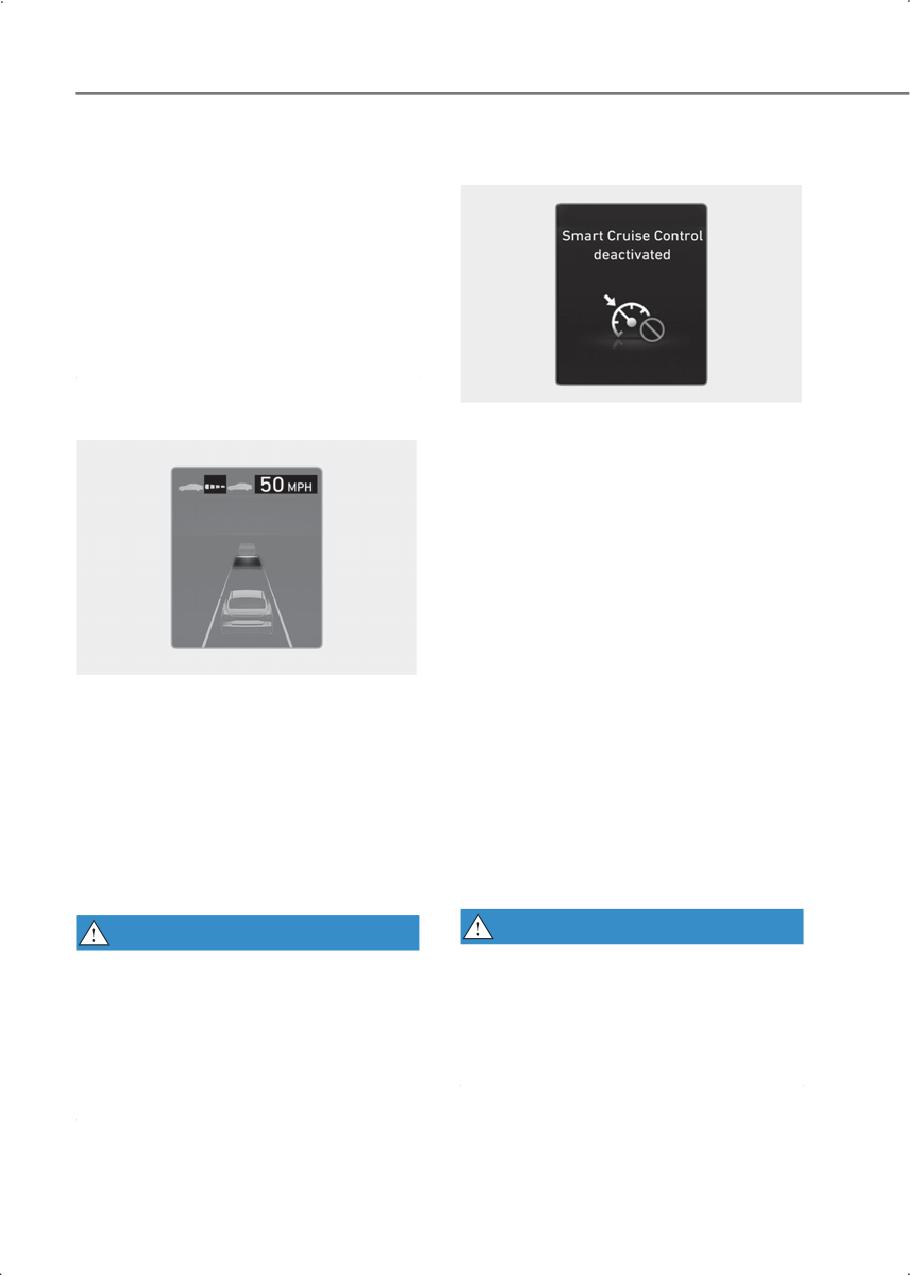
Driver assistance system
• The target distance may differ
Temporarily cancelling Smart Cruise
depending on the vehicle speed and
Control
the set distance level. If the vehicle
speed is low, even though the vehicle
distance have changed, the change of
the target vehicle distance may be
small.
• The images and colors in the
instrument cluster may differ
depending on the cluster type or theme
selected from the settings menu.
Accelerating temporarily
Smart Cruise Control is temporarily
canceled automatically when:
• Your vehicle speed is over 120 mph (190
km/h).
• Your vehicle is stopped for a certain
period of time.
• Your accelerator pedal is continuously
depressed for a certain period of time.
• The conditions for the Smart Cruise
Control to operate are not met.
If Smart Cruise Control is temporarily
canceled automatically, the "Smart
If you depress the accelerator pedal
Cruise Control deactivated" warning
above a certain speed while Smart Cruise
message may appear on the instrument
Control is operating, your vehicle can
cluster, and an audible warning sounds to
speed up temporarily without changing
warn you.
the set speed. The set speed, distance
If Smart Cruise Control is temporarily
level, and target distance blink on the
canceled while your vehicle is at a
instrument cluster while depressing the
standstill with the function activated, the
accelerator pedal. Your vehicle speed
Electronic Parking Brake (EPB) may be
may decrease if the accelerator pedal is
applied.
not depressed far enough.
WARNING
WARNING
Always maintain a safe distance from the
Be careful when accelerating temporarily,
vehicles ahead and adjust your vehicle
because Smart Cruise Control is not
speed to the road conditions. When
controlling the speed and distance even if
Smart Cruise Control is temporarily
there is a vehicle in front of you.
canceled, it is not controlling the speed
Always maintain a safe distance from the
and distance from the vehicle ahead.
vehicles ahead and adjust your vehicle
speed depending on the road conditions.
7-70
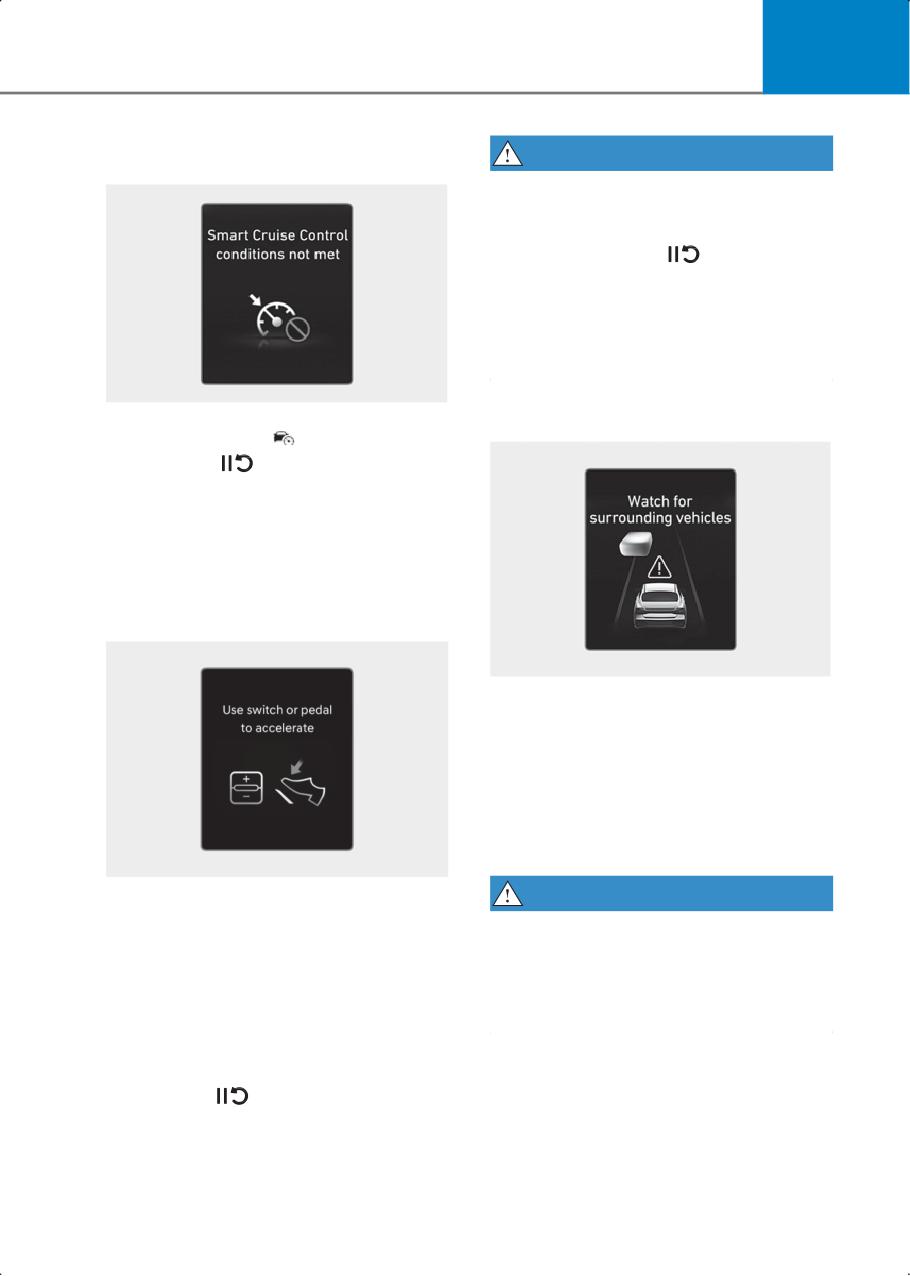
7
Smart Cruise Control conditions not
WARNING
satisfied
While the message appears on the
instrument cluster, if there is no vehicle in
front or the vehicle is far away from you,
and the +/- switch or
button is
pushed, Smart Cruise Control is
automatically canceled and EPB is
applied. If the accelerator pedal is
depressed, EPB is not applied even
though the function is canceled.
Warning road conditions ahead
If the Driving Assist (
) button, the +/-
switch, or the
button is pushed when
Smart Cruise Control’s operating
conditions are not met, the "Smart Cruise
Control conditions not met" message
appears on the instrument cluster, and an
audible warning sounds.
In traffic situation
The "Watch for surrounding vehicles"
warning message may appear on the
instrument cluster, and an audible
warning sounds if the vehicle in front
disappears when Smart Cruise Control is
maintaining the distance from the vehicle
ahead while driving below a certain
speed.
WARNING
In traffic, your vehicle stops if the vehicle
ahead of you stops. Also, if the vehicle
Always pay attention to vehicles or
ahead of you starts moving, your vehicle
objects that may suddenly appear in front
starts moving as well. In addition, after
of you. Always maintain a safe distance
your vehicle has stopped and a certain
from the vehicles ahead and adjust your
amount of time has passed, the "Use
vehicle speed to the road conditions.
switch or pedal to accelerate" message
appears on the instrument cluster.
Depress the accelerator pedal or push the
+/- switch or
button to start driving.
7-71
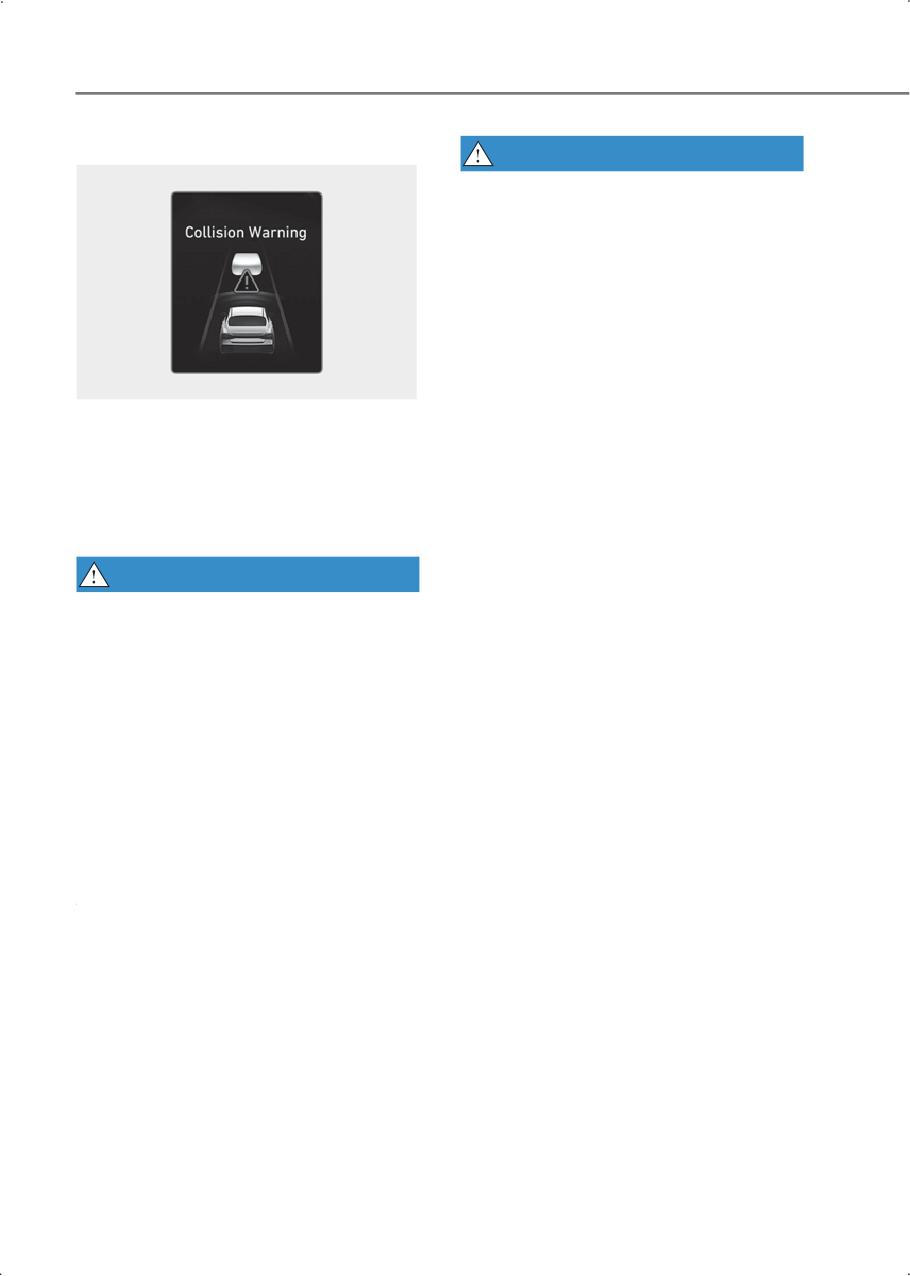
Driver assistance system
Collision Warning
WARNING
Smart Cruise Control is not a substitute
for proper and safe driving.
To prevent serious injury or death:
•
Always maintain a safe distance from
the vehicles ahead and adjust your
vehicle speed to the road conditions.
Smart Cruise Control may not
recognize unexpected and sudden
situations or complex driving
situations.
•
Keep Smart Cruise Control off when not
While Smart Cruise Control is operating
in use to avoid inadvertently setting the
and the collision risk of the vehicle ahead
speed.
is high, the "Collision Warning" warning
•
Do not open the door or leave your
message may appear on the instrument
vehicle when Smart Cruise Control is
cluster, and an audible alert sounds and
operating, even if your vehicle is
the steering wheel may vibrate.
stopped.
WARNING
•
Always check the vehicle speed and
distance to the front vehicle that have
Smart Cruise Control may not warn you of
been selected.
a collision if:
•
Keep a safe distance depending on the
• The distance to the vehicle ahead is
road condition and vehicle speed. If the
close, or the speed of the vehicle ahead
distance to the front vehicle is too close
is faster or similar to your vehicle.
while driving at high speeds, it may
• The speed of the vehicle ahead is very
cause a serious collision.
slow or the vehicle is stopped.
•
When maintaining distance from the
• The accelerator pedal is depressed
vehicle ahead, if the front vehicle is no
right after Smart Cruise Control is
longer detected, Smart Cruise Control
turned on.
may suddenly accelerate to the set
speed.
Always maintain a safe distance from the
vehicles ahead and adjust your vehicle
•
The vehicle speed may slow down or
speed to the road conditions.
speed up while driving uphill or
downhill.
•
Always be aware of situations such as
when a vehicle cuts in suddenly.
•
When you are towing a trailer or
another vehicle, turn off Smart Cruise
Control.
•
Turn off Smart Cruise Control when
your vehicle is being towed.
•
Smart Cruise Control may not operate
normally if there is interference from
strong electromagnetic waves.
7-72
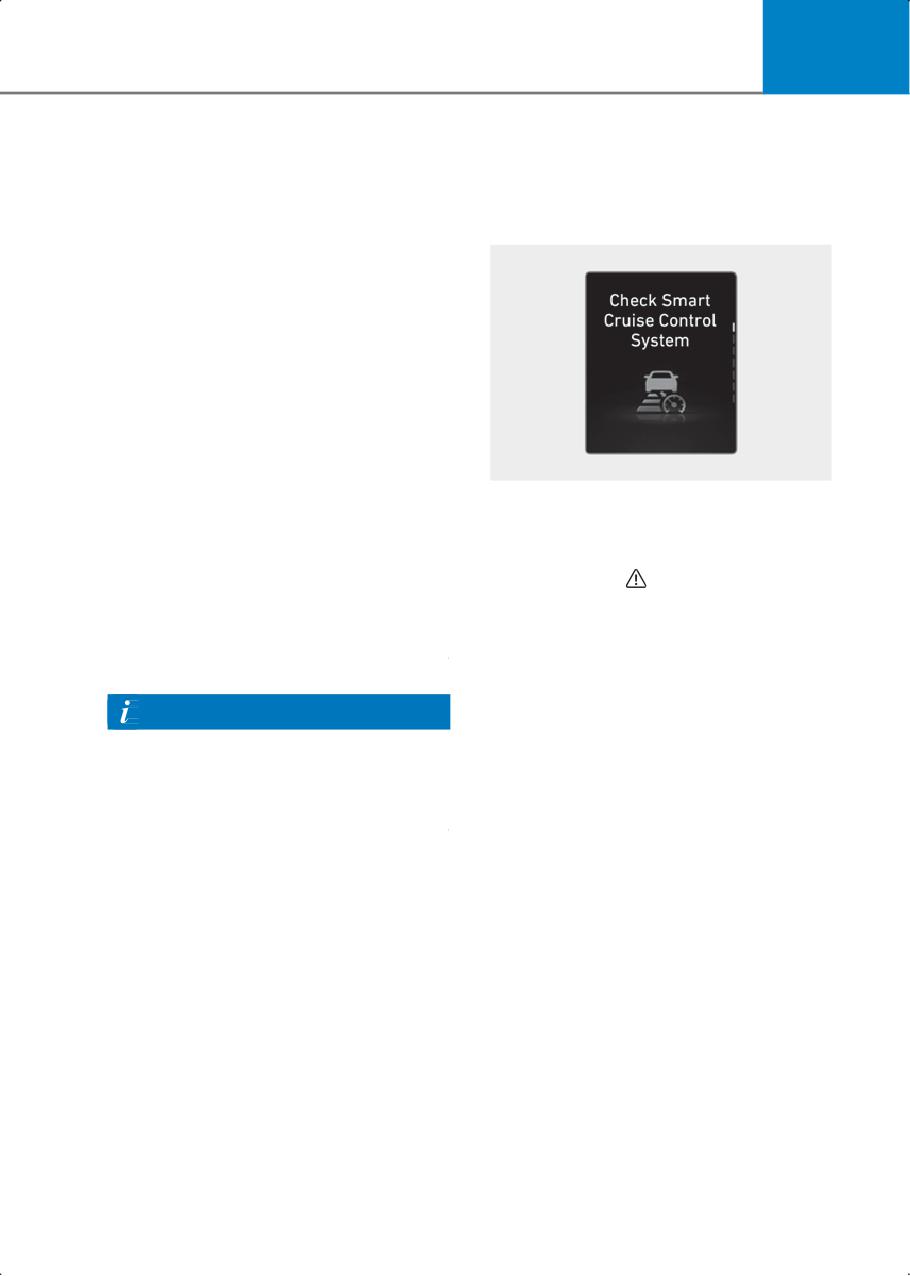
7
•
Smart Cruise Control may not detect
Smart Cruise Control
obstacles in front and cause a collision.
malfunction and limitations
•
Vehicles frequently changing lanes may
cause a delay or may cause Smart
Smart Cruise Control malfunction
Cruise Control to react to a vehicle in an
adjacent lane.
•
When other system’s warning message
appears or audible warning is heard,
Smart Cruise Control may not warn you.
•
You may not hear the audible warning
of Smart Cruise Control if the
surrounding environment is too noisy.
•
The vehicle manufacturer is not
responsible for any traffic violation or
collisions caused by you.
•
Set your vehicle speed to the speed
limit for the road and use the
When Smart Cruise Control is not working
appropriate unit (mph or km/h) for your
properly, the "Check Smart Cruise
country.
Control system" warning message may
•
Smart Cruise Control may not operate
appear, and the
warning light may
for 15 seconds right after your vehicle is
illuminate on the instrument cluster. Have
started or when the front view camera
the vehicle inspected by an authorized
and front radar are initialized.
HYUNDAI dealer.
Information
You may hear sounds when Smart Cruise
Control is braking your vehicle. This is
normal and does not indicate a
malfunction.
7-73
Driver assistance system
Smart Cruise Control disabled
Limitations of Smart Cruise Control
Smart Cruise Control may not operate
normally or may operate unexpectedly if:
•
The sensor or the area near the sensor is
blocked, covered, or damaged.
•
The temperature near the front view
camera is very hot or cold.
•
The camera lens is covered or blocked
by windshield tint, the windshield is
damaged, or a sticky material (sticker,
bug, etc.) is on the glass.
•
Moisture is not removed or is frozen on
If the front radar is covered or blocked, its
the windshield.
detecting performance is reduced, and
•
Washer fluid is sprayed continuously, or
Smart Cruise Control is temporarily
the wiper is on.
limited or disabled.
•
You are driving in heavy rain, snow, or
The "Smart Cruise Control disabled.
thick fog.
Radar blocked" warning message may
appear on the instrument cluster.
•
The front view camera’s field of view is
obstructed by glare from the sun.
If Smart Cruise Control does not operate
normally after the sensor has been
•
Sunlight, streetlight, or light from an
uncovered or unblocked, have the vehicle
oncoming vehicle is reflected on the
inspected by an authorized HYUNDAI
wet road surface such as a puddle on
dealer.
the road.
•
An object is placed on the dashboard.
WARNING
•
The surrounding is very bright or very
• Smart Cruise Control may not operate
dark (nighttime, tunnel, etc.).
properly even if there is no warning
•
The brightness changes suddenly, for
message or warning light on the
example when entering or exiting a
instrument cluster.
tunnel.
• Smart Cruise Control may not operate
•
The brightness outside is low, and the
properly in open areas where no
headlights of the front vehicle are
objects are detected (e.g. empty
turned off or are not bright.
parking lot) or when the detecting
•
A front vehicle is partially visible.
sensors are blocked right after turning
on the engine.
•
The vehicle in front has no tail lights or
tail lights are located in an unusual
location.
•
In low light conditions, the tail lights of
the front vehicle are turned off or not
bright.
•
The rear of the front vehicle is small or
the vehicle does not look normal, such
as when your vehicle is tilted,
overturned, or the side of your vehicle
is visible.
7-74
7
•
The front vehicle’s ground clearance is
•
You are driving through a tollbooth,
so low or high.
construction area, unpaved road,
partial paved road, uneven road, speed
•
Your vehicle is being towed.
bumps, etc.
•
A vehicle suddenly cuts in front.
•
You are driving through roads with
•
The bumper around the front radar has
railroad tracks or other embedded
been damaged or modified, and the
metal objects.
radar is out of position.
•
You are driving on an inclined road or a
•
A material is near that reflects very well
curved road.
on the front radar, such as guardrail,
•
You are driving on a sharply curved
nearby vehicle, etc.
road.
•
The temperature near the front radar is
•
You are driving through a roadside with
very hot or cold.
trees or streetlights.
•
The vehicle in front is made of a
•
You are driving on a narrow road where
material that does not reflect on the
trees or grass are overgrown.
front radar well.
•
You are driving on a slippery surface
•
The vehicle in front is detected late.
due to snow, water puddle, ice, etc.
•
The vehicle in front is suddenly blocked
•
You are driving in an area with strong
by an obstacle.
radio waves or electrical noise
•
The vehicle in front suddenly changes
interference.
lanes or reduces the speed.
•
The angle of the vehicle in front is out of
the detection range.
•
Your vehicle changes lanes at a low
speed with a vehicle in front.
•
The vehicle in front is covered with
snow.
•
You are on a curved road or roundabout
and the vehicle in front is not detected.
•
You are continuously driving in a circle.
•
Your vehicle moves unstably or vibrates
excessively.
•
Your vehicle height is low or high due to
heavy loads, abnormal tire pressure,
etc.
•
You are driving through steam, smoke,
or shadow.
•
You are driving through a tunnel or an
iron bridge.
•
You are driving in large, open areas
where there are few vehicles or
structures (e.g. desert, meadow, empty
suburb).
•
You are driving in a parking lot.
7-75
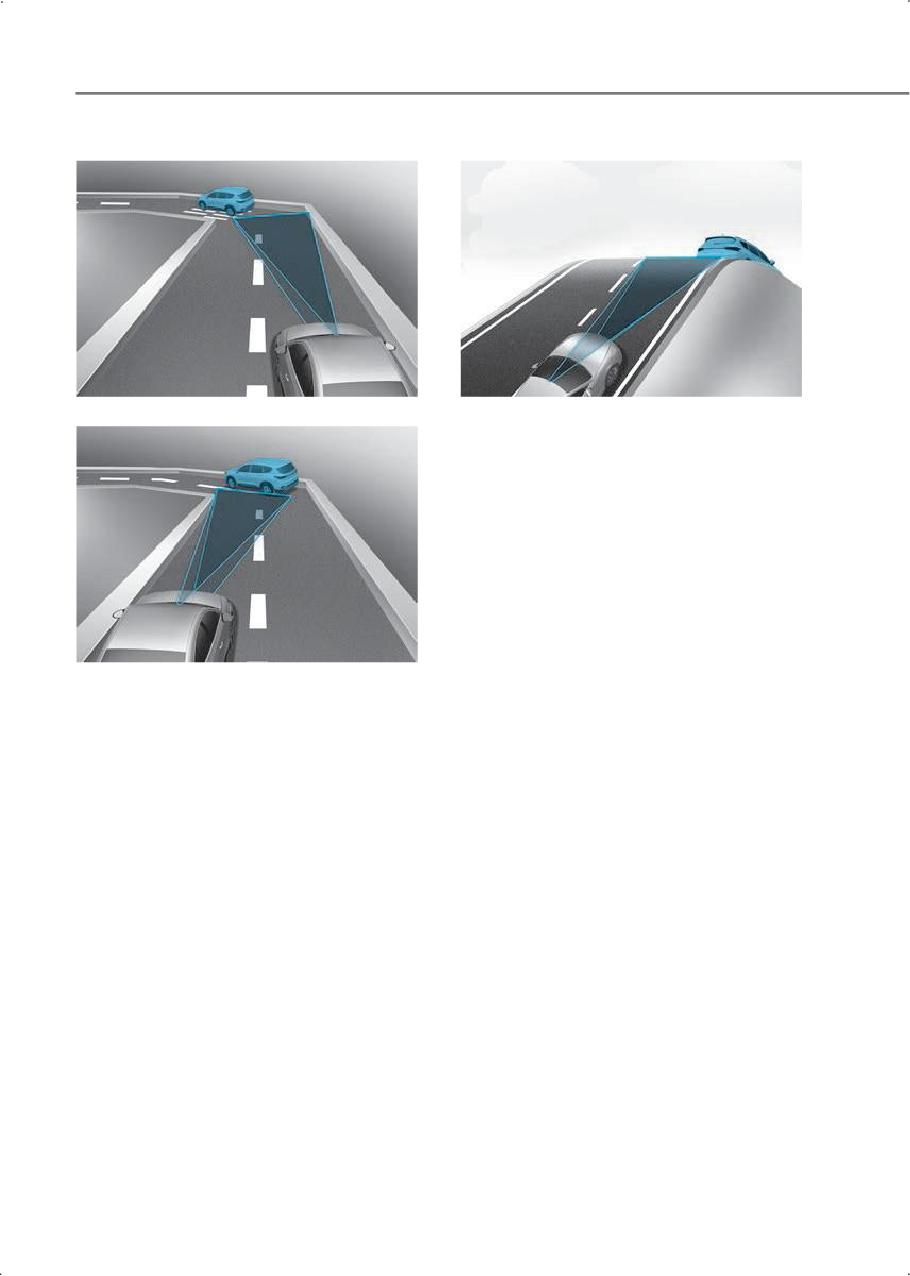
Driver assistance system
• Driving on a curved road
• Driving on an inclined road
During uphill or downhill driving, Smart
Cruise Control may not detect a moving
vehicle in your lane, and cause your
vehicle to accelerate to the set speed.
Also, your vehicle speed rapidly
decreases when a vehicle ahead is
detected suddenly.
Select an appropriate set speed on
inclines and apply the brake pedal or
accelerator pedal depending on the
road and driving conditions.
On a curved road, Smart Cruise Control
may not detect a vehicle in the same
lane, and may accelerate to the set
speed. Your vehicle speed may be
reduced if a vehicle is detected in an
adjacent lane and your vehicle speed
may rapidly decrease when a vehicle
ahead is detected suddenly.
Select an appropriate set speed for a
curved road and apply the brake pedal
or accelerator pedal depending on the
road and driving conditions.
7-76
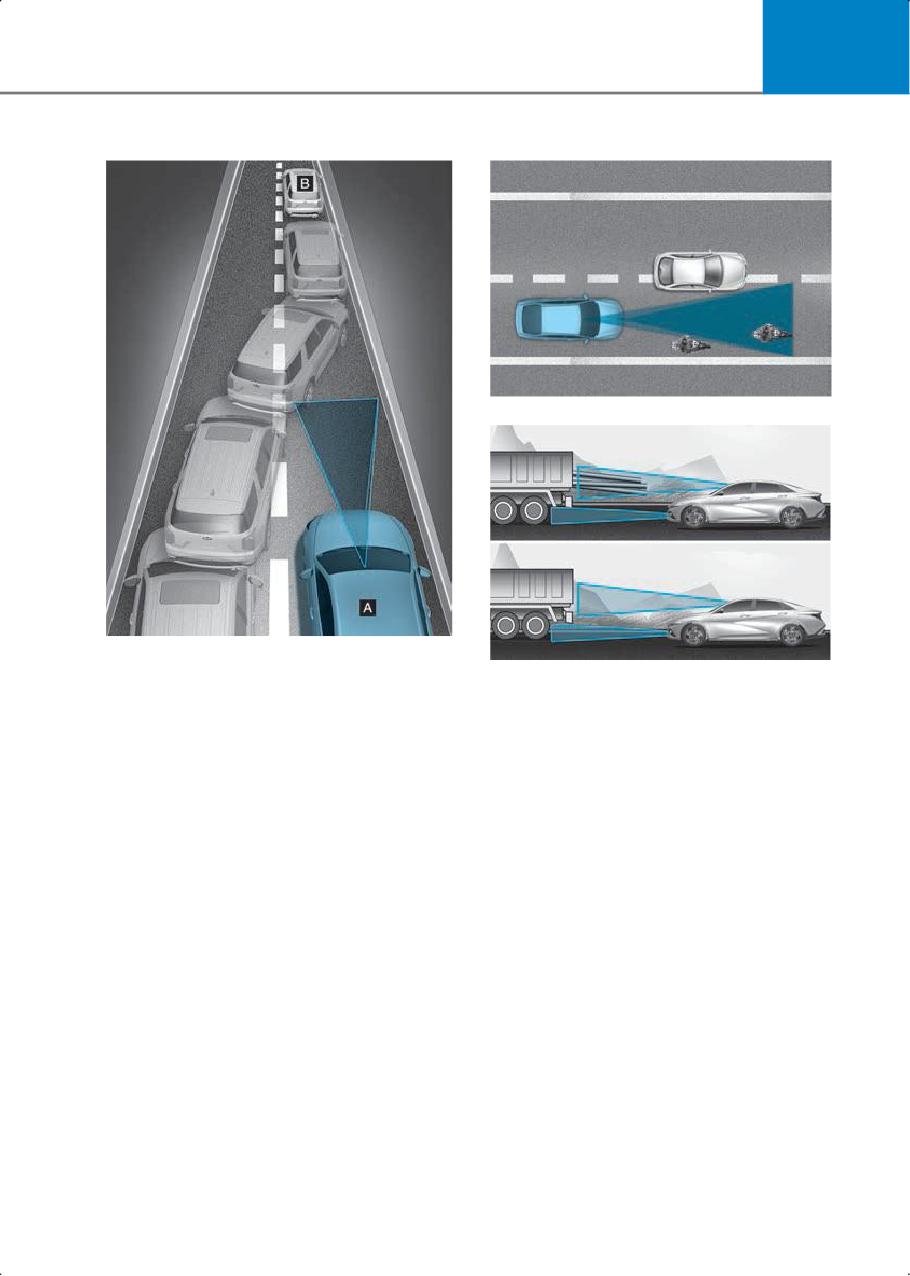
7
• Changing lanes
• Situations when detecting are limited
[A] Your vehicle
[B] Lane changing vehicle
Some vehicles in your lane or in be
When a vehicle moves into your lane
detected by the sensor:
from an adjacent lane, it cannot be
detected by the sensor until it is in the
- Vehicles offset to one side
sensor's detection range. Smart Cruise
- Slow-moving vehicles or
Control may not immediately detect
sudden-decelerating vehicles
the vehicle when your vehicle changes
- Vehicles with higher ground
lanes abruptly. Brake as needed to
clearance or vehicles carrying loads
reduce your driving speed.
that extend past the end of the
vehicle
- Vehicles that have the front tilted due
to heavy loads
- Oncoming vehicles
- Stopped vehicles
- Vehicles with small rear profile, such
as trailers
- Narrow vehicles, such as
motorcycles or bicycles
- Vehicles with low (e.g., sports car) or
high (e.g. large truck, bus) ground
clearance
- Animals and pedestrians
7-77
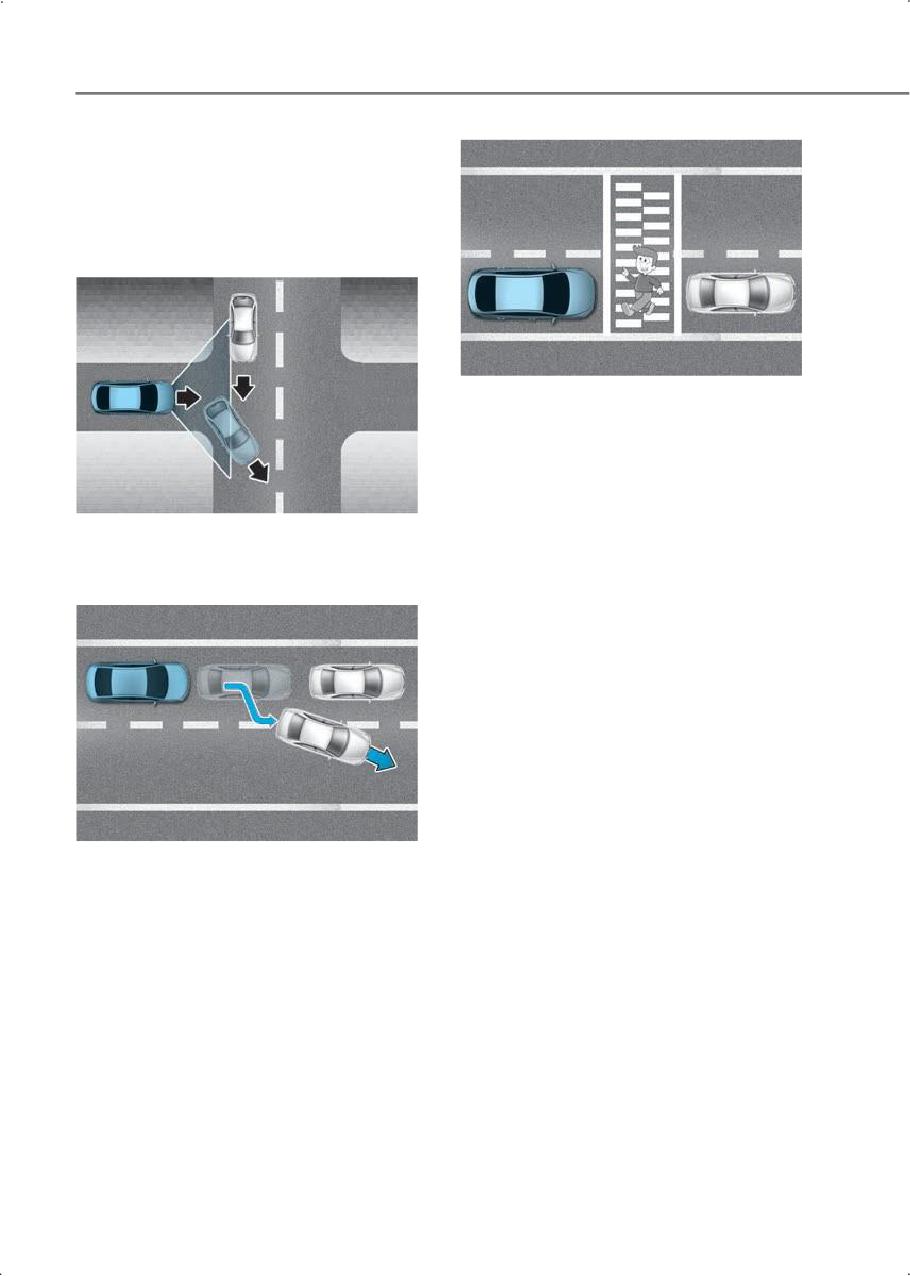
Driver assistance system
- Making sharp steering inputs when
driving
- Driving on narrow or sharply curved
roads
Brake as needed to reduce your driving
speed.
• Always look out for pedestrians when
your vehicle is maintaining a distance
with the vehicle ahead.
• When a vehicle ahead turns at an
intersection and is no longer detected,
your vehicle may accelerate.
• When a vehicle in front of you merges
out of the lane, Smart Cruise Control
may not immediately detect a new
vehicle that is now in front of your
vehicle.
7-78
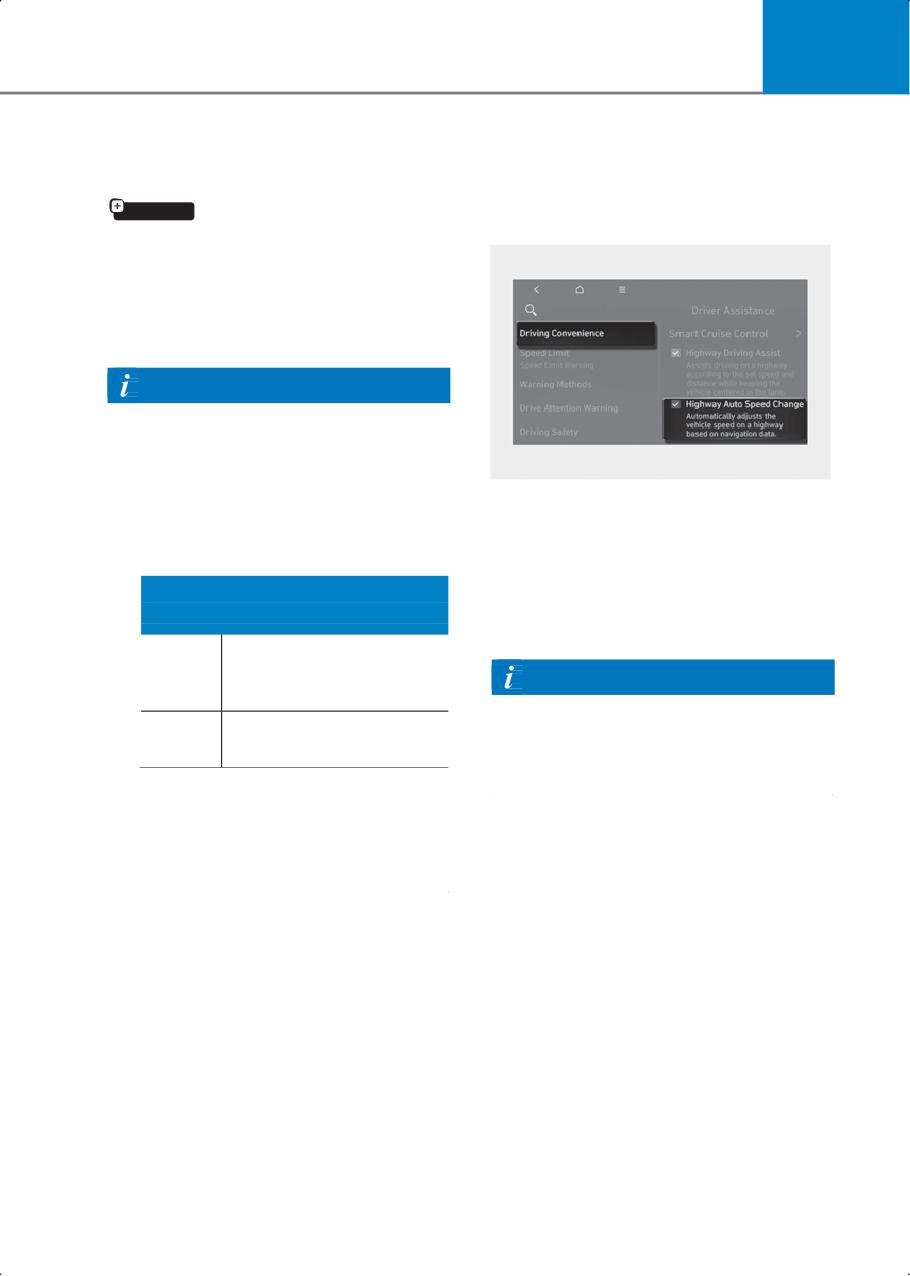
7
Navigation-based Smart
Navigation-based Smart
Cruise Control settings
Cruise Control (NSCC)
if equipped
Highway Auto Speed Change
Navigation-based Smart Cruise Control
helps maintain the speed depending on
the road conditions when driving on
highways by using information from the
navigation system while Smart Cruise
Control is operating.
Information
• Navigation-based Smart Cruise Control
is available only on controlled access
roads.
- Controlled access roads are roads
with limited entrances and exits that
With the ignition switch ON, go to
allow uninterrupted high speed
Settings > Vehicle > Driver Assistance >
traffic flow.
Driving Convenience > Highway Auto
Speed Change from the Settings menu to
Available highway
turn on Navigation-based Smart Cruise
(Controlled access road)
Control and deselect to turn off the
function.
Select Interstate Highway
USA
and U.S. (Federal) and
Information
State Highways
When there is a problem with
Select Provincial and
Canada
Navigation-based Smart Cruise Control,
Territorial Highways
the function cannot be set from the
settings menu.
• Additional highways may be available
in future navigation system updates.
• Navigation-based Smart Cruise Control
does not operate on interchanges or
junctions.
Highway Curve Zone Auto
Slowdown
If the vehicle speed is high, Highway
Curve Zone Auto Slowdown temporarily
slows your vehicle in curved sections,
based on the curve information in the
navigation system.
7-79
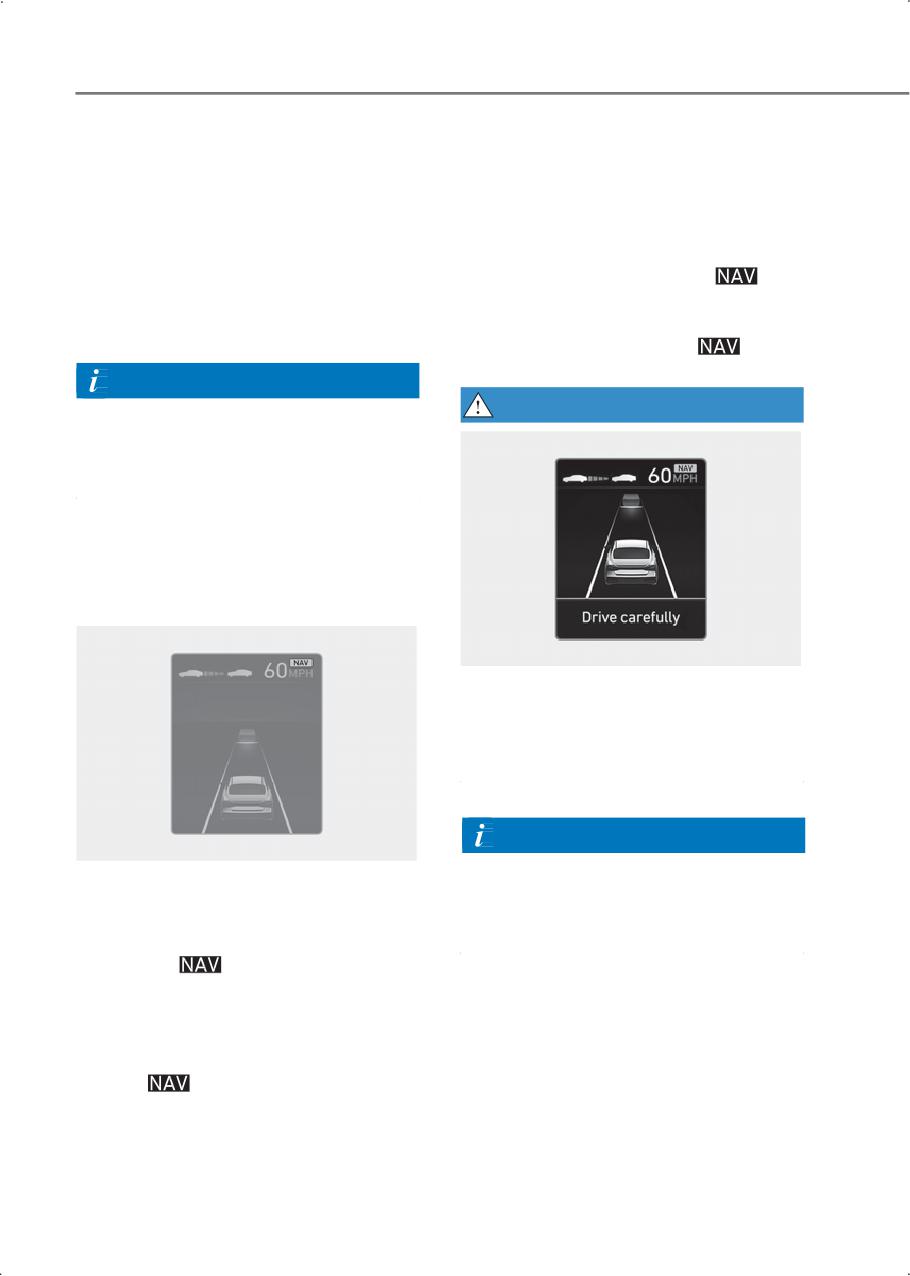
Driver assistance system
Navigation-based Smart
Temporarily canceled or interrupted
by the driver
Cruise Control operation
If Navigation-based Smart Cruise Control
Navigation-based Smart Cruise Control
cannot control the vehicle, such as when
may be available when:
Smart Cruise Control is temporarily
• Highway Auto Speed Change is
canceled or the navigation system is
selected from the settings menu.
searching for a route, the gray
• Smart Cruise Control is operating.
indicator light illuminates.
• Driving on main roads of highways (or
When the driver depresses the
motorways).
accelerator pedal, the white
indicator light blinks.
Information
WARNING
For more information on how to operate
Smart Cruise Control, refer to the "Smart
Cruise Control (SCC)" section in this
chapter.
Navigation-based Smart Cruise
Control display and control
The following may appear on the
instrument cluster:
The "Drive carefully" warning message
appears if Navigation-based Smart Cruise
Control is not able to slow down your
vehicle.
Information
The images and colors in the instrument
• Navigation-based Smart Cruise
cluster may differ depending on the
Control standby
cluster type or theme selected from the
settings menu.
If the operating conditions are satisfied,
the green
indicator light
illuminates.
• Navigation-based Smart Cruise
Control operating
While the speed is being controlled, the
green
indicator light blinks.
7-80
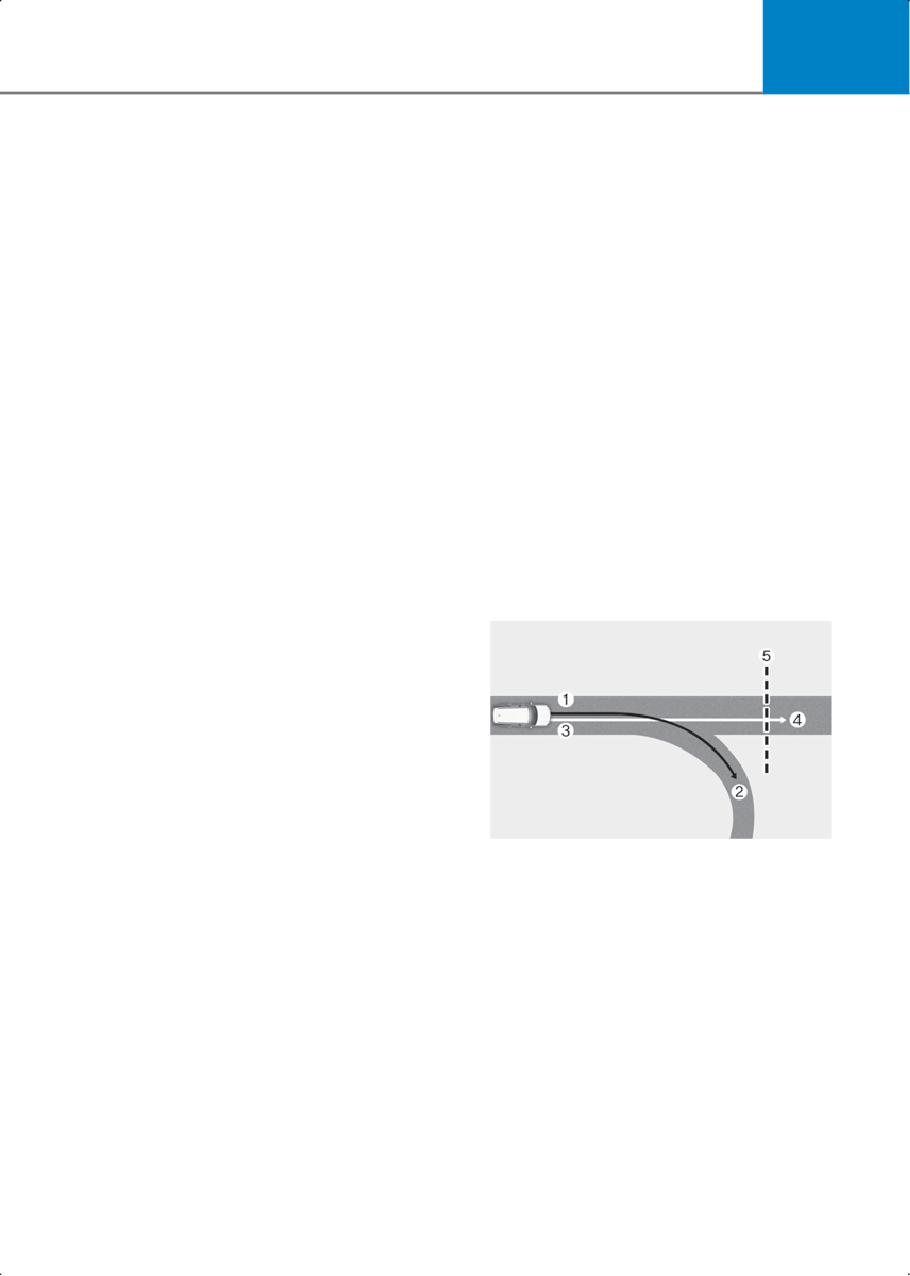
7
Highway Auto Curve Slowdown
•
The navigation system cannot detect
the current vehicle position (e.g.
• Depending on the curve ahead on the
elevated roads including overpass
highway (or motorway), your vehicle
adjacent to general roads or nearby
decelerates, and after passing the
roads exist in a parallel way).
curve, your vehicle accelerates to
Smart Cruise Control's set speed.
•
The navigation system is updated while
driving or restarts.
• Vehicle deceleration time may differ
depending on your vehicle speed and
•
The speed limits of some sections have
the degree of the curve on the road. The
changed according to the road
higher the driving speed, deceleration
situations (e.g. construction zone).
starts earlier.
•
You are driving on a road that is under
facility construction.
•
You are driving in lane-restricted
Limitations of
driving situations.
Navigation-based Smart
•
There is inclement weather, such as
Cruise Control
heavy rain or heavy snow.
Navigation-based Smart Cruise Control
•
You are driving on a road with sharp
may not operate normally if:
curves.
•
The navigation system is not working
•
Driving on roads with intersections,
properly.
roundabouts, straight entrances and
•
Map information is not transmitted due
exits, etc.
to an issue with the infotainment
system.
•
Speed limit and road information in the
navigation system has not been
updated.
•
The map information differs from the
actual road conditions because of
real-time GPS data or map information
error.
•
The navigation system is searching for a
route while driving.
•
GPS signals are blocked in an area such
(1) Set route
as tunnel.
(2) Branch line
•
A road is divided into two or more roads
(3) Driving route
and they join again.
(4) Main road
•
You go off the route set in the
(5) Curved road section
navigation system.
• When there is a difference between the
•
The route to the destination is changed
navigation set route (branch line) and
or canceled by resetting the navigation
the driving route (main road), Highway
system.
Curve Zone Auto Slowdown function
may not operate until the driving route
•
Your vehicle enters a service station or
is recognized as the main road.
rest area.
•
Android Auto or Car Play is operating.
7-81
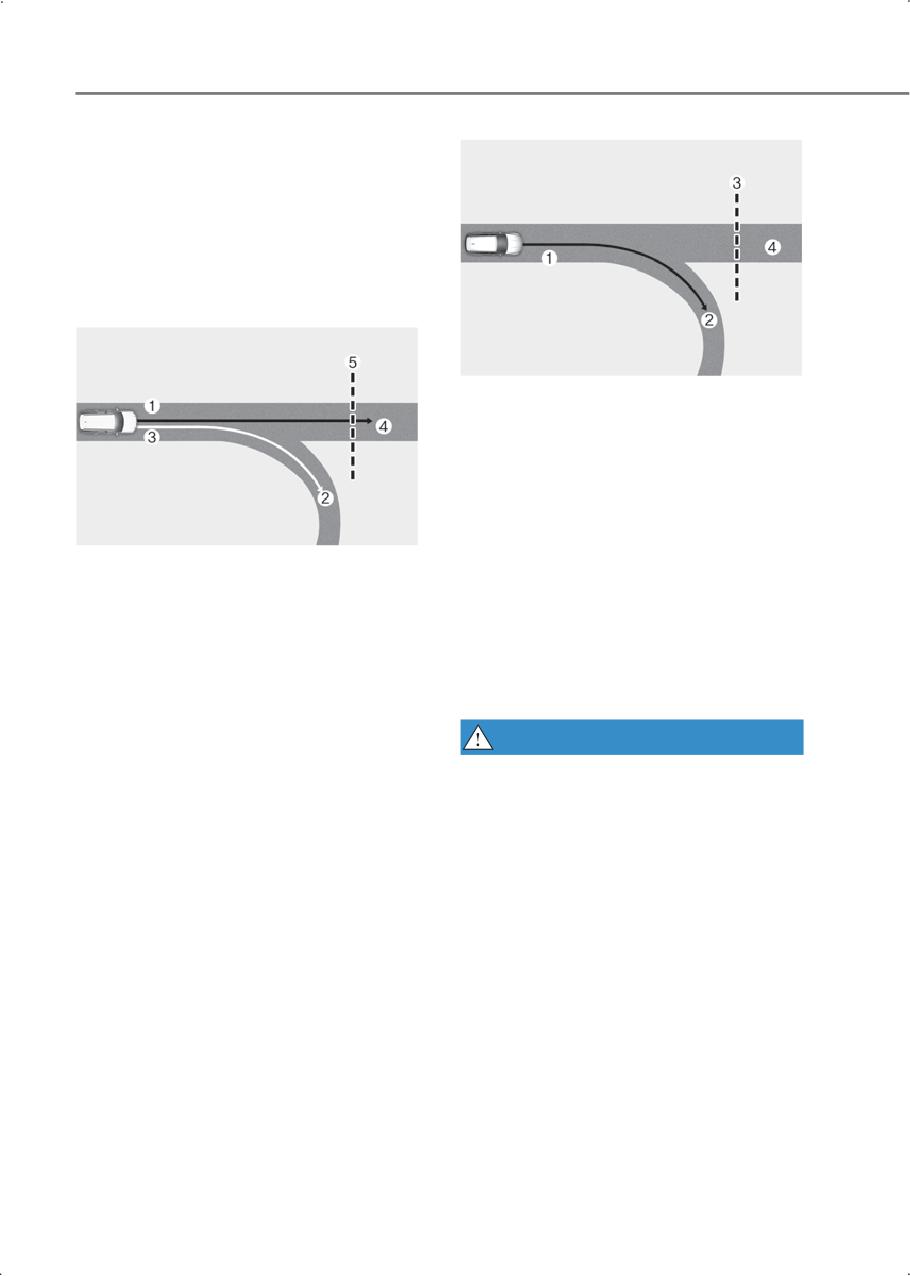
Driver assistance system
• When the vehicle's driving route is
recognized as the main road by
maintaining the main road instead of
the navigation set route, Highway
Curve Zone Auto Slowdown function
will operate. Depending on the distance
to the curve and the current vehicle
speed, vehicle deceleration may not be
sufficient or may decelerate rapidly.
(1) Driving route
(2) Branch line
(3) Curved road section
(4) Main road
• If there is no destination set on the
navigation, Highway Auto Curve
Slowdown operates based on the curve
information for the controlled access
(1) Set route
road in the navigation system.
(2) Branch line
• Even if you depart from the main road,
(3) Driving route
Highway Curve Zone Auto Slowdown
(4) Main road
function may temporarily operate due
(5) Curved road section
to navigation information of the
• When there is a difference between the
highway curve section.
navigation route (main road) and the
driving route (branch line), Highway
WARNING
Curve Zone Auto Slowdown function
Always have your eyes on the road. It is
will operate based on the curve
your responsibility to avoid violating
information on the main road.
traffic laws. Navigation-based Smart
• When it is judged that you are driving
Cruise Control is not a substitute for safe
out of the route by entering the
driving practices, but a supplemental
highway interchange or junction,
function only.
Highway Curve Zone Auto Slowdown
To prevent serious injury or death:
function will not operate.
• Always check the speed limit while
driving. The navigation’s speed limit
information may differ from the actual
speed limit on the road.
• Navigation-based Smart Cruise Control
is automatically canceled when you
leave the highway and enter a general
road, interchange, junction, or rest
area.
7-82
7
•
Navigation-based Smart Cruise Control
may not operate depending on the
Information
configuration of vehicles detected
•
There may be a gap in time between the
ahead on the road.
navigation system’s guidance and
•
When you are towing a trailer or
when the Navigation-based Smart
another vehicle, turn off
Cruise Control operation starts and
Navigation-based Smart Cruise
ends.
Control.
•
The speed information on the
•
After you pass through a tollbooth on a
instrument cluster may differ from the
highway, Navigation-based Smart
navigation system.
Cruise Control operates based on the
•
Even if you are driving at a speed lower
outermost lane. If you enter one of the
than the Smart Cruise Control's set
other lanes, Navigation-based Smart
speed, acceleration may be limited by
Cruise Control may not operate
the curves ahead on the road.
properly.
•
If Navigation-based Smart Cruise
•
Your vehicle accelerates if you depress
Control is operating while leaving the
the accelerator pedal while
highway and entering an interchange,
Navigation-based Smart Cruise Control
junction, or rest area, the function may
is operating. If the accelerator pedal is
continue to operate for a while.
not depressed far enough, your vehicle
•
Deceleration by Navigation-based
may decelerate.
Smart Cruise Control may not feel
•
If you accelerate and release the
sufficient due to the road conditions
accelerator pedal while
such as uneven road surfaces or narrow
Navigation-based Smart Cruise Control
lanes.
is operating, your vehicle may not
decelerate sufficiently or may rapidly
decelerate.
•
If the curve is too sharp or if it is a slight
curve, Navigation-based Smart Cruise
Control may not operate.
7-83
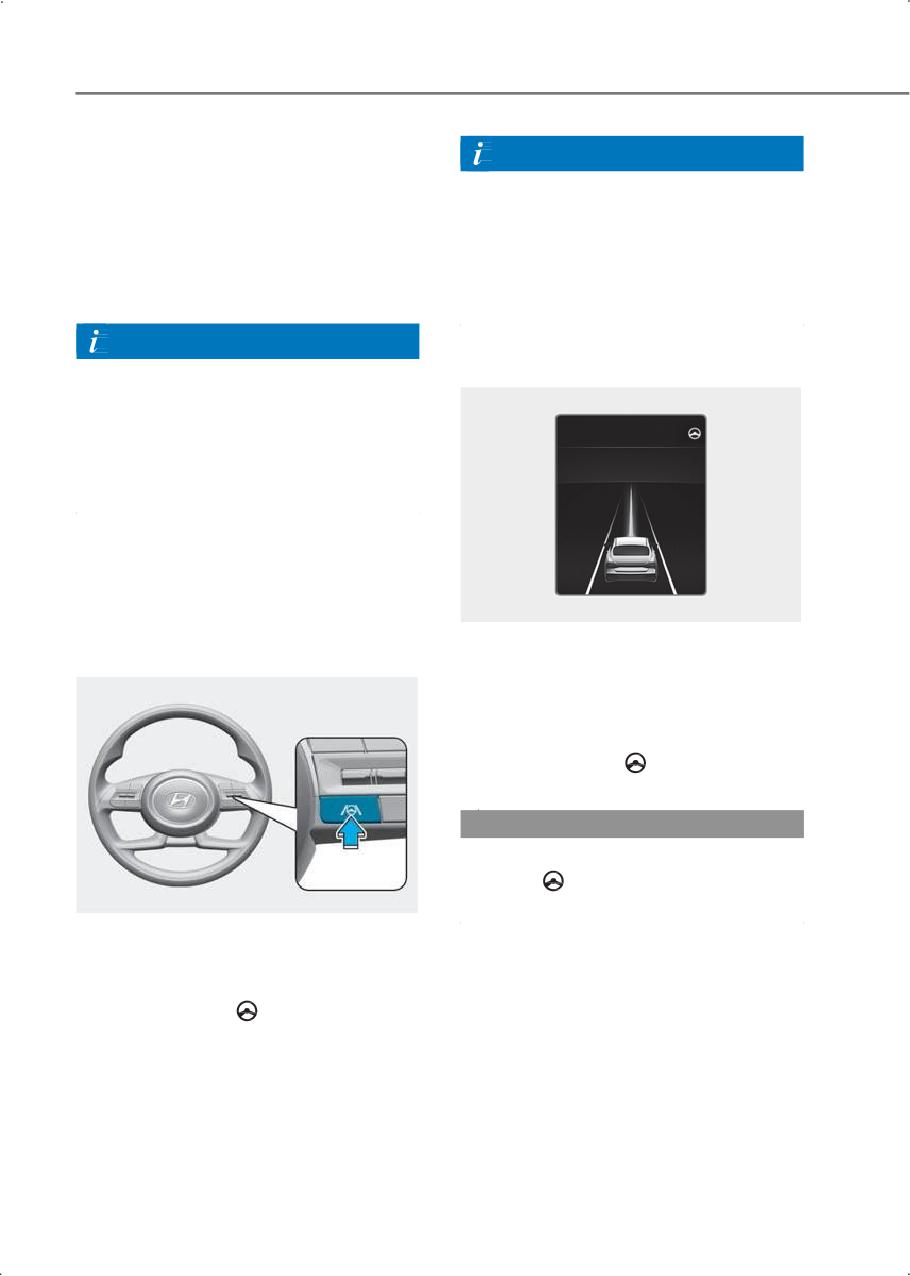
Driver assistance system
Lane Following Assist
Information
(LFA)
You can set the following Warning
Methods:
Lane Following Assist uses the front view
• Warning Volume/Driving Safety Priority
camera to help detect lane markings
and/or vehicles on the road, and to
For more information, refer to the "Driver
provide steering assist to center the
assistance system settings" section in this
vehicle in the lane.
chapter.
Information
Lane Following Assist
Lane Following Assist uses the following
sensor:
• Front view camera
Refer to the "Driver assistance system
sensors" section in this chapter for the
location.
Lane Following Assist
operation
Turning Lane Following Assist
On/Off
If both the lane markings and/or the
vehicle ahead are detected and your
vehicle speed is below 120 mph (200
km/h), Lane Following Assist helps center
your vehicle in the lane by assisting with
steering. The green
indicator light
illuminates on the instrument cluster.
CAUTION
When the steering wheel is not assisted,
the white
indicator light blinks and
changes to grey.
With the ignition switch ON, press the
Lane Driving Assist button on the steering
wheel to turn on Lane Following Assist.
The white or green
indicator light
illuminates on the instrument cluster.
Press the button again to turn off the
function.
7-84
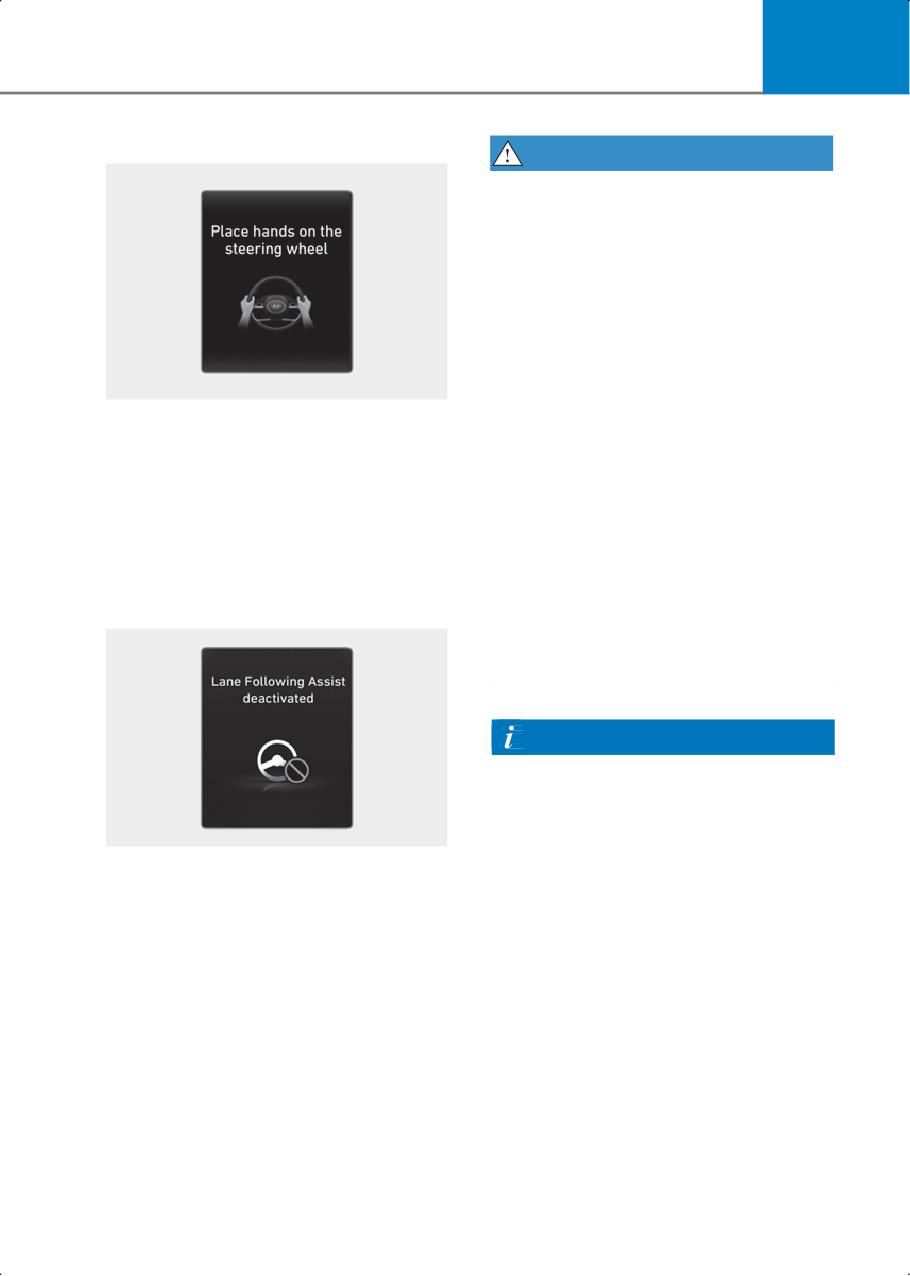
7
Hands-off warning
WARNING
Always safely steer your vehicle and
maintain the position of your vehicle in its
lane.
To prevent serious injury or death:
•
Always have your hands on the steering
wheel while driving.
•
Lane Following Assist may not steer if
the steering wheel is held too tightly, or
the steering wheel is turned too far left
or right.
•
If the steering wheel is held very
If you take your hands off the steering
loosely, the hands-off warning
wheel for several seconds, the "Place
message may appear because the Lane
hands on the steering wheel" warning
Following Assist may not recognize that
message may appear on the instrument
you have your hands on the steering
cluster, and an audible warning sounds in
wheel.
successive stages.
•
The hands-off warning message may
First stage: Warning message
appear late or not at all depending on
Second stage: Warning message (red
the road condition.
steering wheel) and audible warning
•
If you attach objects to the steering
wheel, the hands-off warning may not
work properly.
Information
•
The status of the Lane Following Assist
operation appears in Driving Assist
mode on the instrument cluster. Refer
to the "View modes" section in chapter
4.
If you do not have your hands on the
•
When lane markings are detected, the
steering wheel after the hands-off
lane lines on the instrument cluster
warning, the "Lane Following Assist
change from gray to white.
deactivated" warning message may
appear and Lane Following Assist is
automatically canceled.
7-85
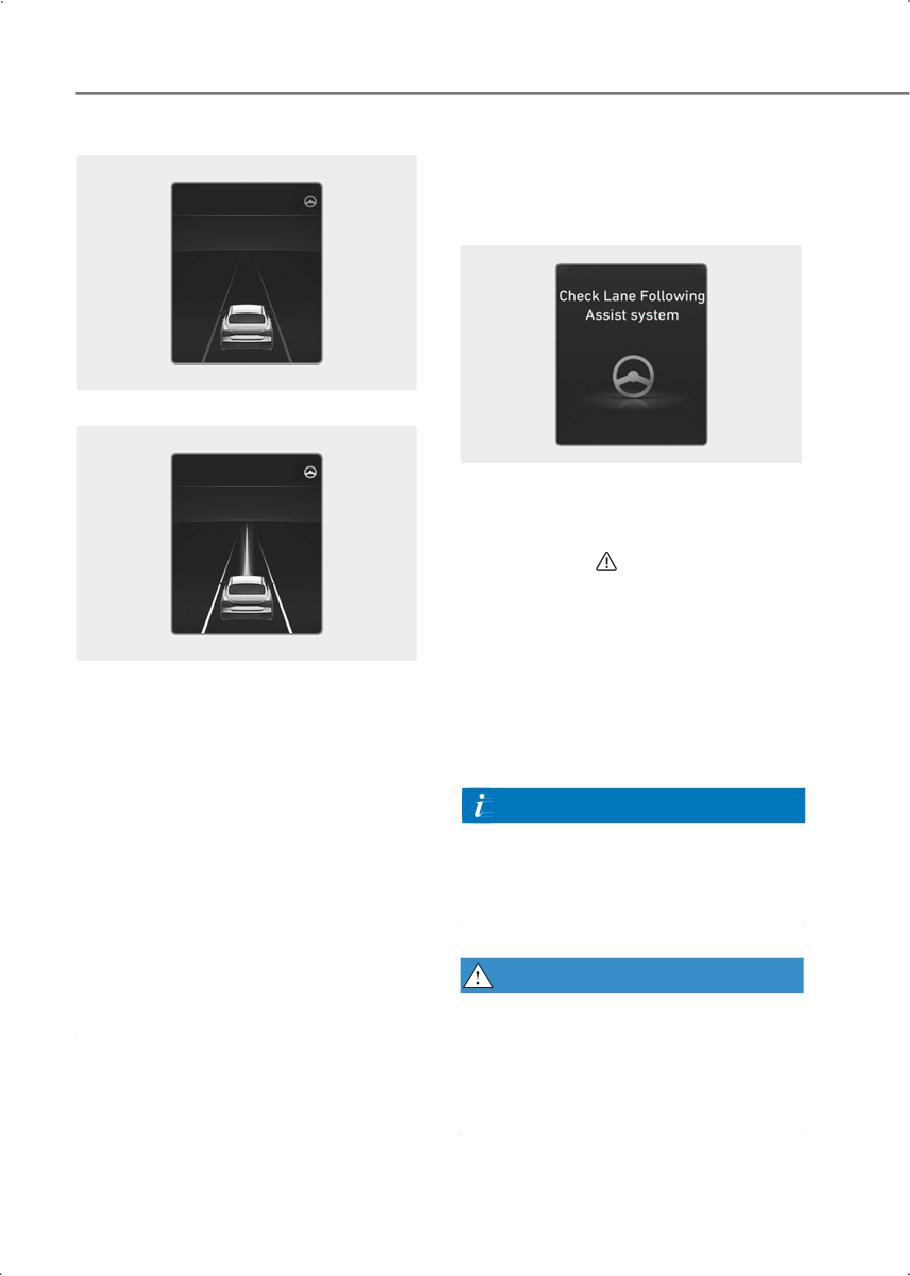
Driver assistance system
Lane undetected
Lane Following Assist
malfunction and limitations
Lane Following Assist malfunction
Lane detected
When Lane Following Assist is not
working properly, the "Check Lane
Following Assist system" message may
appear, and the
warning light may
illuminate on the instrument cluster. Have
the vehicle inspected by an authorized
HYUNDAI dealer.
Limitations of Lane Following Assist
•
The images and colors in the
instrument cluster may differ
For more information on Lane Following
depending on the cluster type or theme
Assist's limitations, refer to the "Lane
selected from the settings menu.
Keeping Assist (LKA)" section in this
chapter.
•
If lane markings are not detected,
steering wheel control by Lane
Information
Following Assist can be limited
depending on the vehicle in front or
For more information on "Warnings"
driving condition.
when using Lane Following Assist, refer to
•
You can steer your vehicle even when
the "Lane Keeping Assist (LKA)" section in
steering is assisted by Lane Following
this chapter.
Assist.
•
It may require more or less force to turn
the steering wheel when Lane
WARNING
Following Assist is providing steering
Loading in excess of the maximum load
assistance.
allowance or concentrated loading at one
point in the cargo compartment can
reduce the vehicle's driving stability,
which can in turn reduce the
effectiveness of Lane Following Assist.
7-86
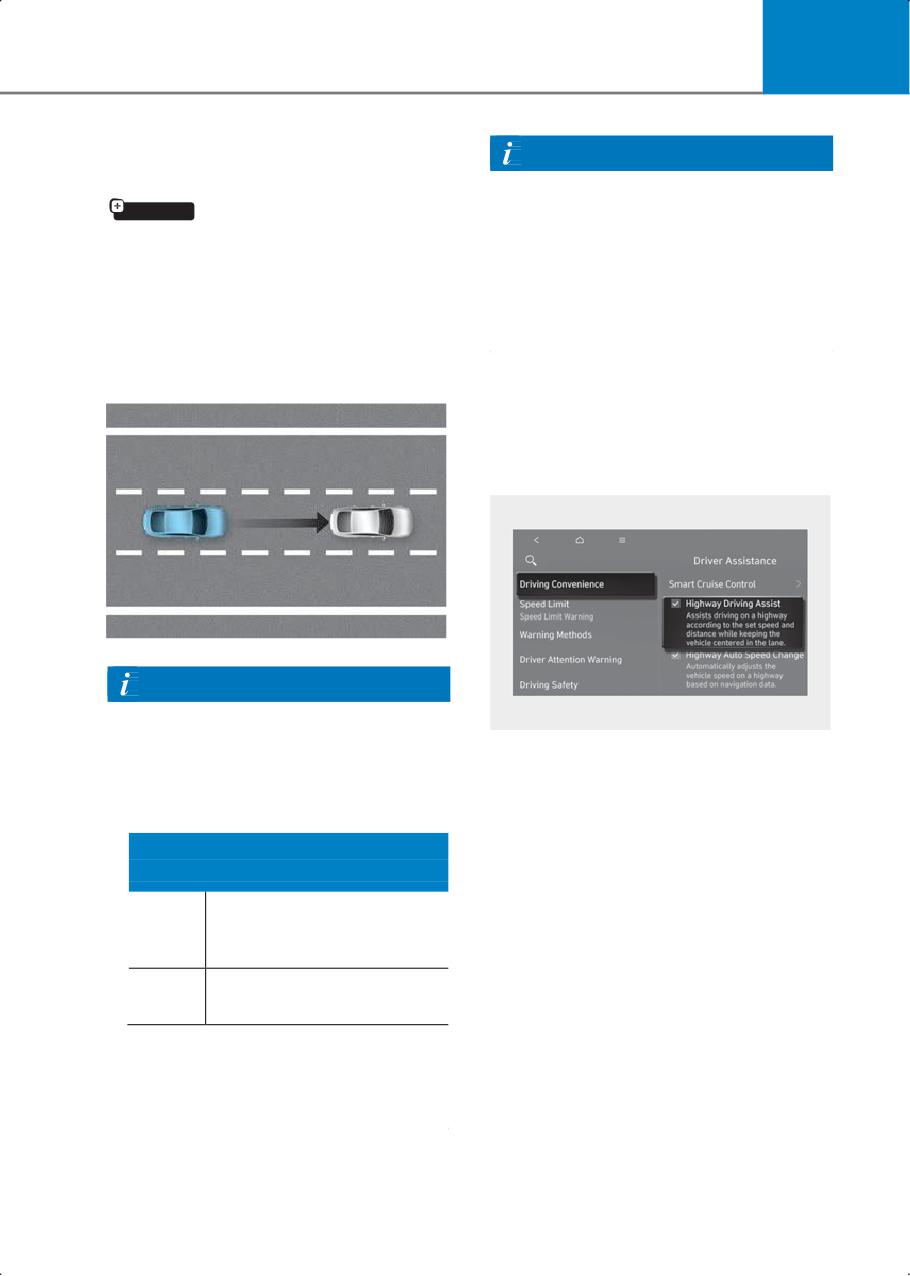
7
Highway Driving Assist
Information
(HDA)
Highway Driving Assist uses the following
if equipped
sensors:
• Front view camera
Highway Driving Assist uses the front
view camera and front radar to:
• Front radar
• Help detect vehicles and lanes ahead.
Refer to the "Driver assistance system
sensors" section in this chapter for the
• Help maintain the distance from the
location.
vehicle ahead and the set speed.
• Help center your vehicle in the lane
while driving on the highway.
Highway Driving Assist
settings
Highway Driving Assist
Information
• Highway Driving Assist is available only
on controlled access roads.
• Controlled access roads are roads with
With the ignition switch ON, go to User
limited entrances and exits that allow
Settings > Driver Assistance > Driving
uninterrupted high speed traffic flow.
Convenience from the settings menu in
the instrument cluster or Settings >
Available highway (Controlled access
Vehicle > Driver Assistance > Driving
road)
Convenience from the settings menu in
the infotainment system to set whether to
Select Interstate Highway
use each function.
USA
and U.S. (Federal) and State
• If Highway Driving Assist is selected,
Highways
the function helps maintain distance
Select Provincial and
from the vehicle ahead, maintain the
Canada
Territorial Highways
set speed, and help center your vehicle
in the lane while driving on the
• Additional highways may be available
highway.
in future navigation system updates.
• Highway Driving Assist does not
operate on interchanges or junctions.
7-87
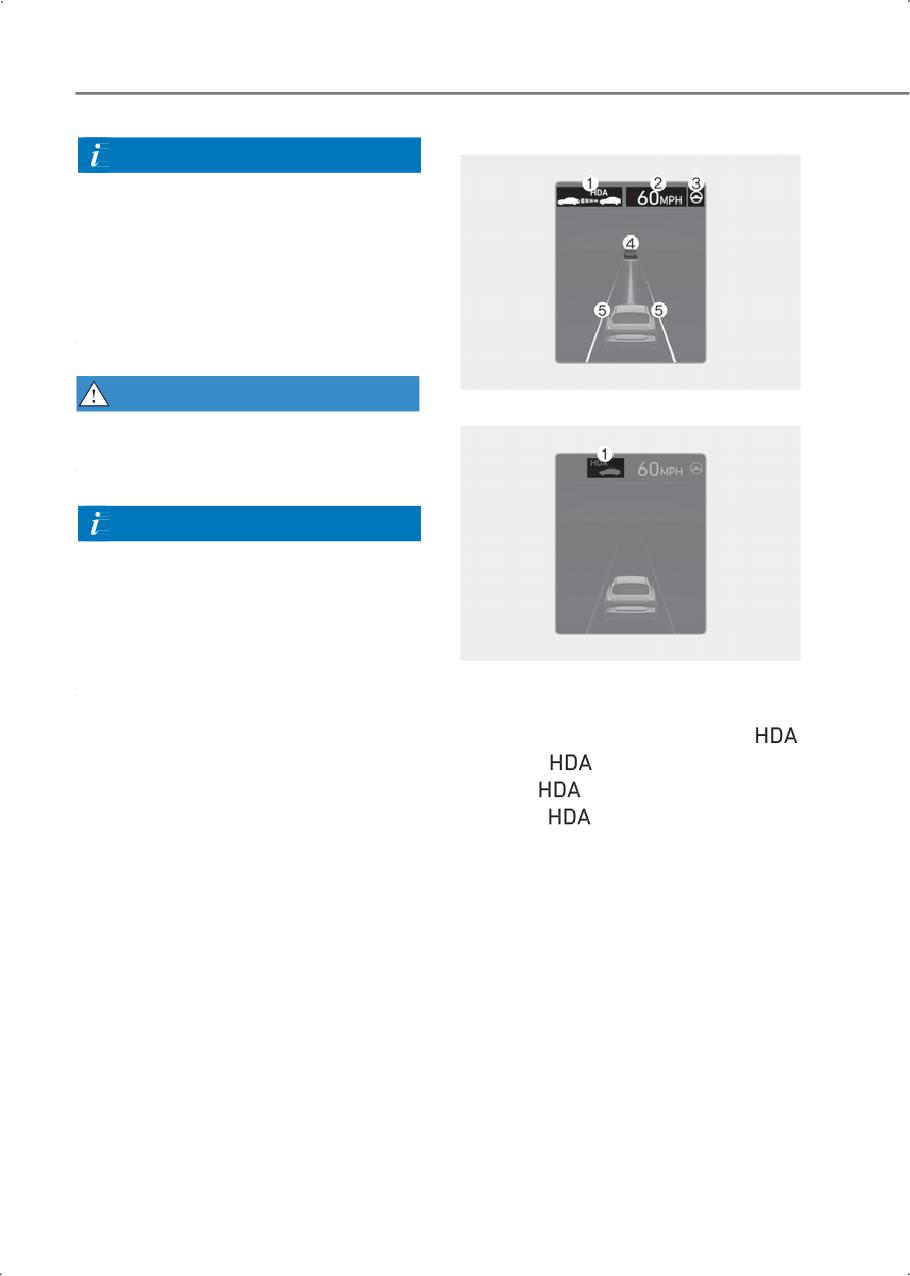
Driver assistance system
Operating state
Information
• When there is a problem with Highway
Driving Assist, the function cannot be
set from the Settings menu. Have the
vehicle inspected by an authorized
HYUNDAI dealer.
• When the engine is restarted, the
function maintains the last setting.
WARNING
Standby state
Only change the settings after parking
your vehicle at a safe location.
Information
You can set the following Warning
Methods:
• Warning Volume/Driving Safety Priority
For more information, refer to the "Driver
assistance system settings" section in this
chapter.
1. Indicates if there is a vehicle ahead and
the selected distance level appears.
Highway Driving Assist indicator (
)
Highway Driving Assist
• Green
: Operating state
operation
• Grey
: Standby state
Highway Driving Assist display
• White
: Accelerator depressed
state
The status of the Highway Driving Assist
operation appears in Driving Assist mode
2. Set speed
on the instrument cluster. Refer to the
3. Lane Following Assist indicator
"View modes" section in chapter 4.
4. Whether there is a vehicle ahead and
the selected headway
5. Whether the lane is detected or not
7-88
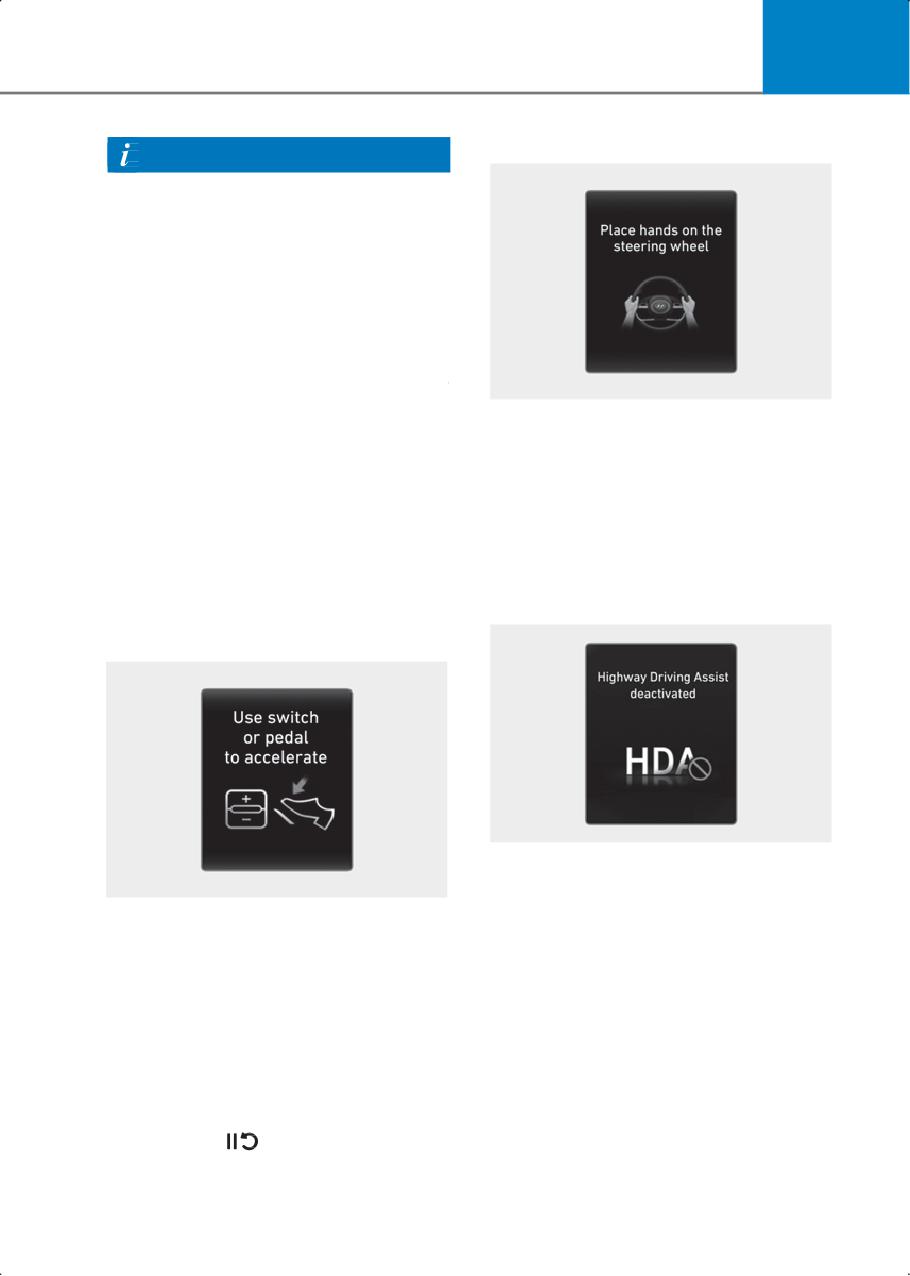
7
Hands-off warning
Information
• For more information on Smart Cruise
Control and Lane Following Assist, refer
to the "Smart Cruise Control (SCC)" and
"Lane Following Assist (LFA)" sections
in this chapter.
• The images and colors in the
instrument cluster may differ
depending on the cluster type or theme
selected from the settings menu.
Highway Driving Assist operating
If you take your hands off the steering
Highway Driving Assist operates when:
wheel for several seconds, the "Place
hands on the steering wheel" warning
• You have pressed the Driving Assist
message may appear on the instrument
button after entering or driving on
cluster, and an audible warning sounds in
controlled access roads.
successive stages.
• Entering or driving on controlled access
First stage: Warning message
roads with both Lane Following Assist
and Smart Cruise Control operating.
Second stage: Warning message (red
steering wheel) and audible warning
Restarting after stopping
If the driver still does not have their hands
on the steering wheel after the hands-off
warning, the "Highway Driving Assist
When Highway Driving Assist is
deactivated" warning message may
operating, your vehicle stops if the
appear and Highway Driving Assist is
vehicle ahead of you stops. Also, if the
automatically canceled.
vehicle ahead of you starts moving within
30 seconds after the stop, your vehicle
starts as well. If your vehicle has stopped
and 30 seconds have passed, the "Use
switch or pedal to accelerate" message
appears on the instrument cluster.
Depress the accelerator pedal or operate
the +/- switch
button to accelerate.
7-89
Driver assistance system
Highway Driving Assist
•
Highway Driving Assist turns off
automatically under the following
malfunction and limitations
situations:
- You are driving on roads that
Highway Driving Assist malfunction
Highway Driving Assist does not
operate, such as rest area,
intersection, junction, etc.
- The navigation does not operate
properly such as when the navigation
system is updating or restarting.
•
Highway Driving Assist may
inadvertently operate or turn off
depending on the road conditions
(based on the navigation system
information) and surroundings.
•
Lane Following Assist may be
temporarily disabled when the front
When Highway Driving Assist is not
view camera cannot detect lanes
working properly, the "Check Highway
properly or the hands-off warning is on.
Driving Assist (HDA) system" warning
•
The hands-off warning message may
message may appear, and the warning
appear early or late depending on how
light may illuminate on the instrument
the steering wheel is held or road
cluster. Have the vehicle inspected by an
conditions.
authorized HYUNDAI dealer.
•
You may not hear the audible warning
WARNING
of Highway Driving Assist if the
surrounding environment is too noisy.
Always check road conditions, and if
•
When your vehicle is driven at high
necessary, take appropriate actions to
speeds through a curve, your vehicle
drive safely. Highway Driving Assist is a
may depart from your driving lane if you
supplemental function only and it is not a
do not maintain control.
self driving or autonomous driving
system.
•
When you are towing a trailer or
another vehicle, turn off Highway
To prevent serious injury or death:
Driving Assist.
• Always have your hands on the steering
•
Highway Driving Assist may not
wheel while driving.
operate right after the engine is started
• Always have your eyes on the road and
or when the sensors or navigation
pay attention. It is your responsibility to
system is initialized.
avoid violating traffic laws.
• Highway Driving Assist may not be able
to recognize all traffic situations and
may not detect possible collision
hazards. Obstacles such as vehicles,
motorcycles, bicycles, pedestrians, or
unspecified objects or structures (e.g.
guardrails and tollbooth) may not be
detected.
7-90
7
Limitations of Highway Driving
Rear View Monitor (RVM)
Assist
if equipped
Highway Driving Assist may not operate
Rear View Monitor uses the wide-rear
normally or may not operate if:
view camera to display the area behind
• The map information differs from the
your vehicle to assist you when parking.
actual road conditions because the
navigation system has not been
Information
updated, or there is a real-time GPS
data or map information error.
If display audio is applied, the description
of the Rear View Monitor may differ from
• The infotainment system is overloaded
the owner's manual. For more
by simultaneously performing
functions such as route search, video
information, scan the QR code in the
separately supplied simple manual.
playback, voice recognition, etc.
• GPS signals are blocked in an area such
as tunnel.
• You depart from the navigation route or
Information
the route to the destination is changed
Rear View Monitor uses the following
or canceled.
sensor:
• Your vehicle enters a service station or
• Wide-rear view camera
rest area.
Refer to the "Driver assistance system
• Android Auto or Car Play is operating.
sensors" section in this chapter for the
• The navigation system cannot detect
location.
the current vehicle position (e.g.
elevated roads including overpass
adjacent to general roads or nearby
roads exist in a parallel way).
• A trailer or hitch mounted carrier is
connected to your vehicle.
Information
For more information on the limitations of
the front view camera and front radar,
refer to the "Forward Collision-Avoidance
Assist (FCA) (Sensor fusion)" section in
this chapter.
7-91
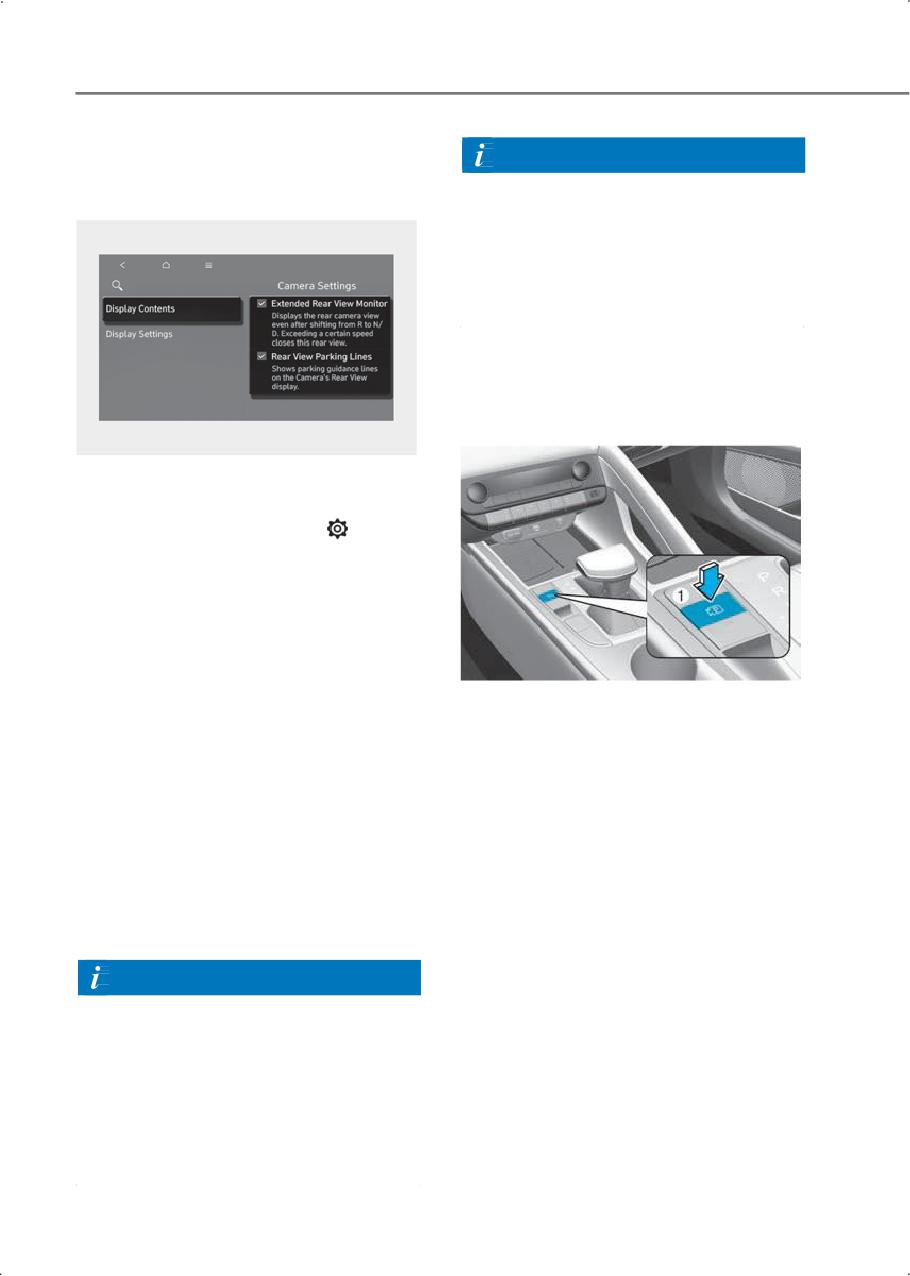
Driver assistance system
Rear View Monitor settings
Information
You can set the following Warning
Camera settings
Methods:
• Parking Safety Priority
For more information, refer to the "Driver
assistance system settings" section in this
chapter.
Rear View Monitor operation
Parking/View button
To change the settings of Rear View
Monitor's Display Contents or Display
Settings, press the setup icon (
) on the
screen while Rear View Monitor is
operating, or go to Settings > Vehicle >
Driver Assistance > Parking Safety >
Camera Settings from the Settings menu
in the infotainment system when the
engine is on.
Extended Rear View Monitor
Press the Parking/View button (1) while
Keeps displaying the rear view when
the gear is in P (Park) to turn on Rear View
shifting from R (Reverse) to N (Neutral) or
Monitor.
D (Drive). When exceeding a certain
speed, the rear view stops displaying.
Rear view with parking guidance
Rear View Parking Guide Lines
The rear view with parking guidance
If Rear View Parking Lines (Rear view
appears on the screen when parking.
reference lines) is selected, the rear view
Turns on if:
parking guide lines and rear top view
• You shift the gear to R (Reverse).
guide lines will be displayed at the left
side of the infotainment system.
• You press the Parking/View button (1)
while the gear is in P (Park). However,
parking guidance is not displayed.
Information
• The horizontal guideline of the Rear
Turns off if:
View Parking Guidance shows the
• You press the Parking/View button (1)
distance of 20 in. (0.5 m), 40 in. (1 m)
again while the gear is in P (Park) with
and 91 in. (2.3 m) from the vehicle.
the rear view on the screen.
• The horizontal guideline of the Rear Top
• You shift the gear from R (Reverse) to P
View Parking Guidance shows the
(Park).
distance of 20 in. (0.5 m) and 60 in. (1.5
m) from the vehicle.
7-92
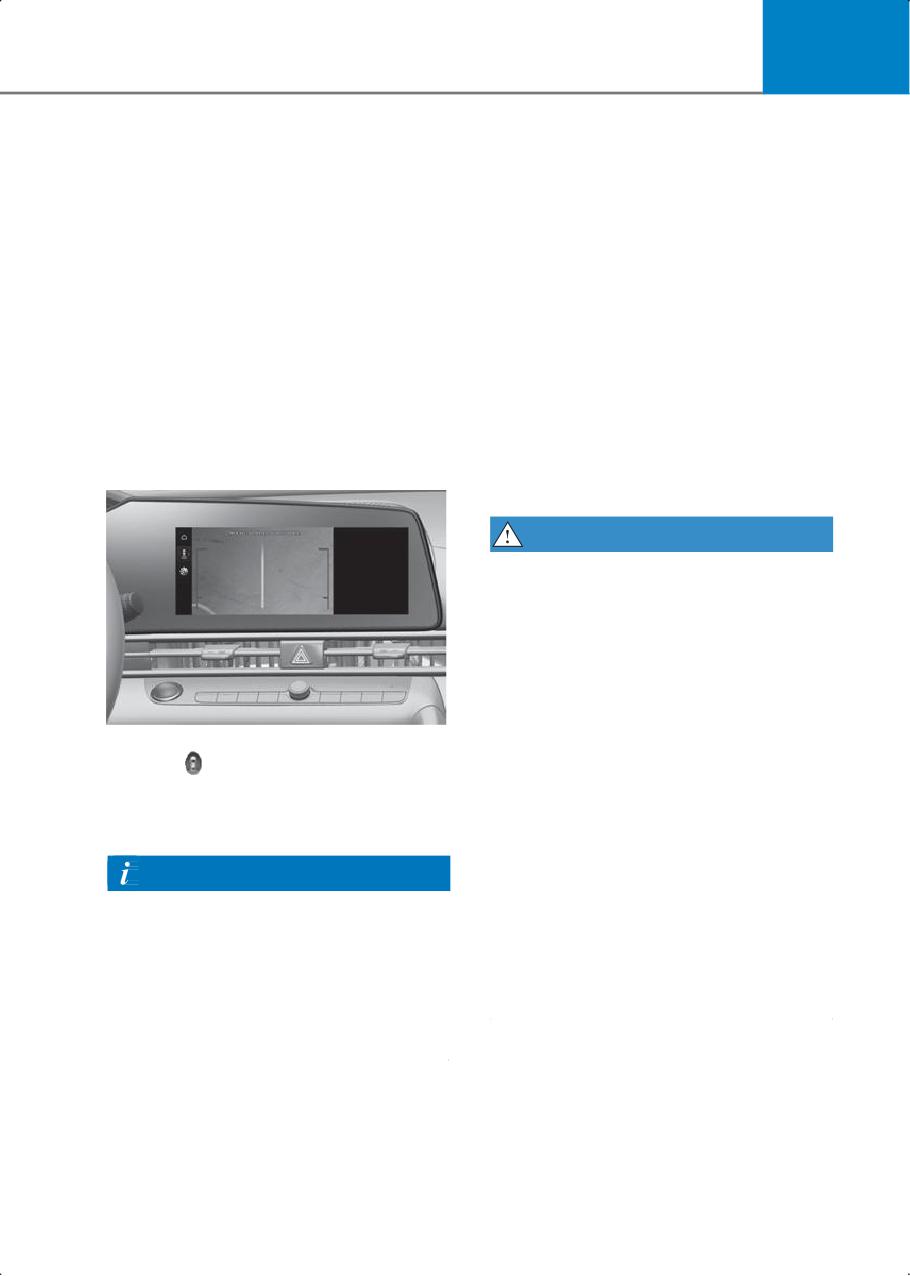
7
Maintaining rear view
Rear View Monitor
The rear view will maintain showing on
malfunction and limitations
the screen to help you when parking.
However, parking guidance is not
Rear View Monitor malfunction
displayed.
When Rear View Monitor is not working
Turns on if:
properly, or the screen flickers, or the
You shift the gear from R (Reverse) to N
camera image does not display normally,
(Neutral) or D (Drive).
have the vehicle inspected by an
authorized HYUNDAI dealer.
Turns off if:
• When vehicle speed is above 6 mph (10
km/h), the rear view will turn off.
Limitations of Rear View Monitor
When your vehicle is stopped for a long
• You shift the gear to P (Park).
time in winter or when your vehicle is
parked in an indoor parking lot, the
Rear top view
exhaust fumes may temporarily blur the
image.
WARNING
• Always turn your head to check blind
spots. The rear view camera does not
cover the entire area behind your
vehicle.
• The distance to the object shown on the
screen may differ from the actual
distance. This is because the image
shown on Rear View Monitor is
displayed by calibrating the image from
Press the icon.
the wide-rear view camera. When the
vehicle is tilted by cargo loading, rear
The top view appears on the screen and
parking guidelines may not be correct.
the distance from the vehicle appears in
Make sure to directly check the
the back of your vehicle.
vehicle's surroundings for safety.
Information
• Always keep the rear view camera lens
clean. If the lens is blocked or covered,
• The rear view cannot be turned off
the Rear View Monitor may not operate
when the gear is in R (Reverse).
normally. Do not clean with strong
• When the Rear View Monitor is turned
chemicals containing high alkaline or
on, the last displayed view mode
volatile organic solvents (e.g. gasoline,
appears on the screen. If the gear is in R
acetone).
(Reverse), the rear view appears on the
screen.
7-93
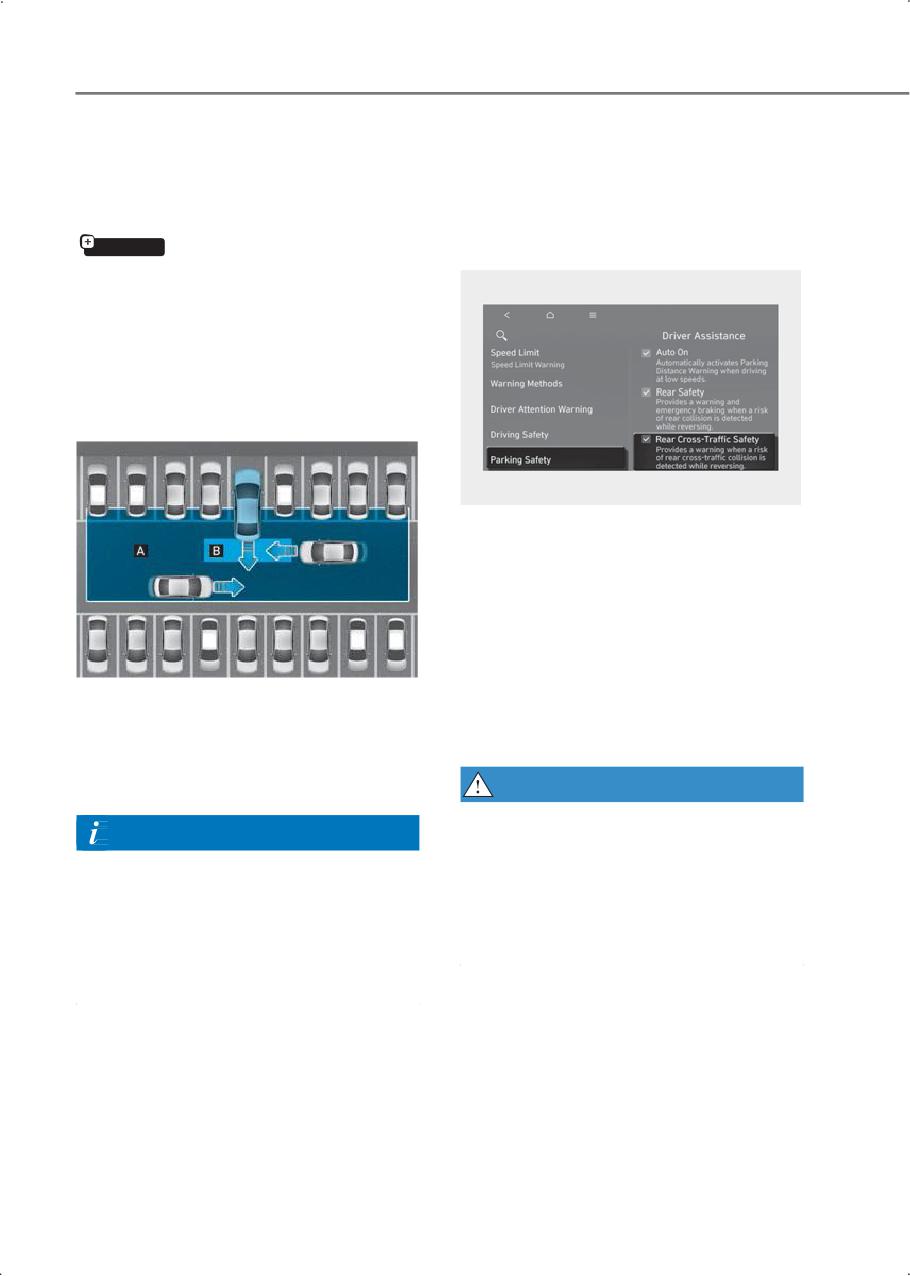
Driver assistance system
Rear Cross-Traffic
Rear Cross-Traffic
Collision-Avoidance Assist
Collision-Avoidance
settings
Assist (RCCA)
if equipped
Rear Cross-Traffic Safety
Rear Cross-Traffic Collision-Avoidance
Assist uses the rear corner radars to help
detect vehicles approaching from the left
or right while your vehicle is reversing,
and to warn you that a collision is
imminent with a warning message and an
audible warning. Braking may also be
assisted to avoid a collision.
With the ignition switch ON, go to User
settings > Driver Assistance > Parking
Safety > Rear Cross-Traffic Safety from
the settings menu in the instrument
cluster or Settings > Vehicle > Parking
Safety > Rear Cross-Traffic Safety from
the settings menu in the infotainment
system to turn on Rear Cross-Traffic
[A] Rear Cross-Traffic Collision Warning operating
Collision-Avoidance Assist and deselect
range
to turn Rear Cross-Traffic
[B] Rear Cross-Traffic Collision-Avoidance Assist
operating range
Collision-Avoidance Assist on and off.
The time of warning may vary depending
WARNING
on the speed of the approaching vehicle.
When the engine is restarted, the Rear
Information
Cross-Traffic Collision-Avoidance Assist
turns on. If Rear Cross-Traffic Safety is
Rear Cross-Traffic Collision-Avoidance
selected after the engine is restarted,
Assist uses the following sensor:
Rear Cross-Traffic Collision-Avoidance
• Rear corner radars
Assist does not function until the next
Refer to the "Driver assistance system
time your vehicle is started.
sensors" section in this chapter for the
location.
7-94
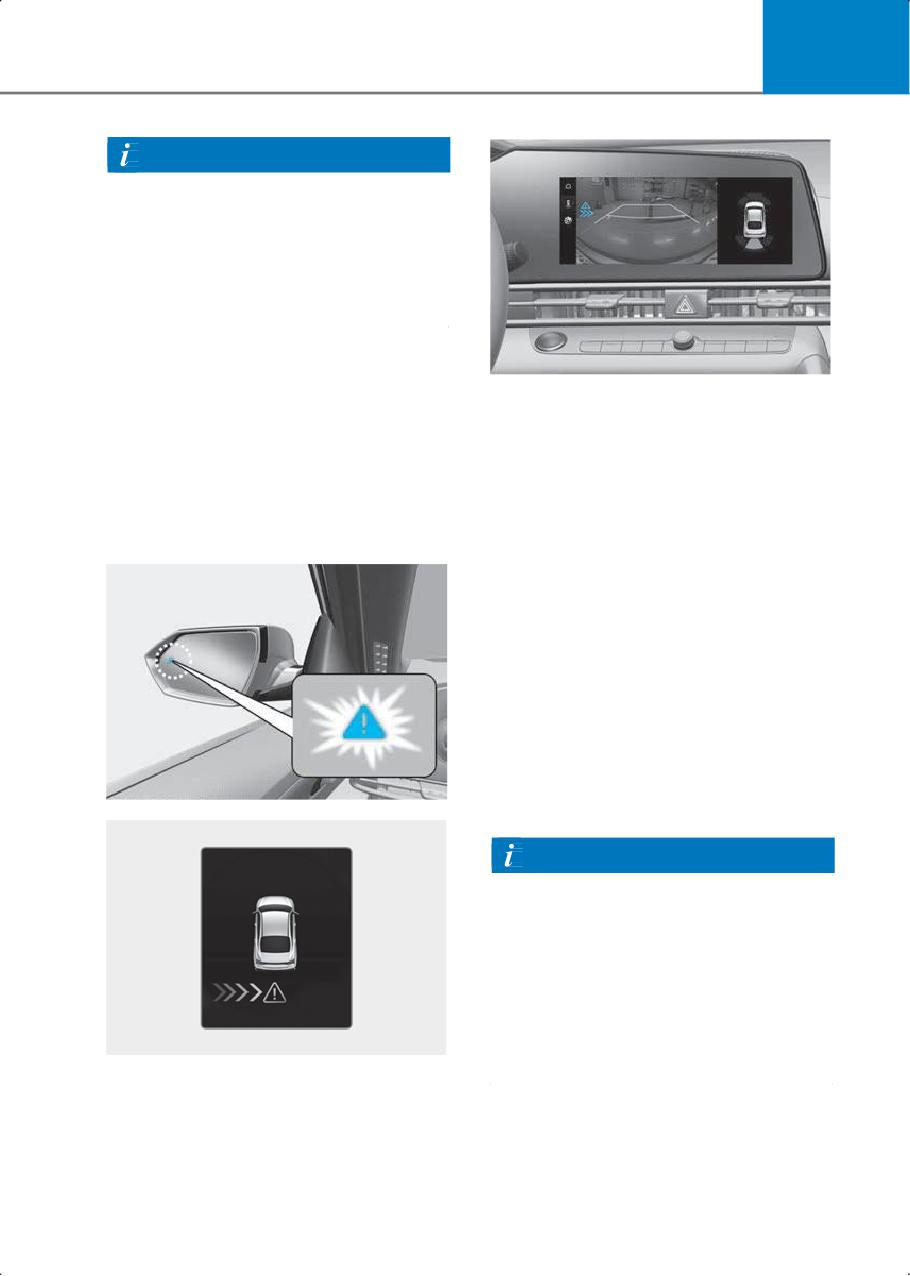
7
Information
You can set the Warning Timing and
following Warning Methods:
• Warning Volume/Haptic Warning
For more information, refer to the "Driver
assistance system settings" section in this
chapter.
Rear Cross-Traffic
Collision-Avoidance Assist
To warn you of an approaching vehicle
operation
from the rear left or right of your vehicle,
Rear Cross-Traffic Collision-Avoidance
the warning light on the side view mirror
Assist may warn and control your vehicle
may blink, a warning message may
depending on the collision risk level.
appear on the instrument cluster, and an
audible warning may sound and the
steering wheel may vibrate.
Collision Warning
When Rear View Monitor is operating, a
warning may appear on the infotainment
system screen.
Collision warning may operate if:
• The gear is shifted to R (Reverse).
• Vehicle speed is below 5 mph (8 km/h).
• The approaching vehicle is within
approximately 82 ft. (25 m) from the left
and right side of your vehicle.
• The speed of the vehicle approaching
from the left or right is above 3 mph (5
km/h).
Information
• If the operating conditions are met, a
warning is provided whenever your
vehicle approaches from the left or
right even though your vehicle speed is
0 mph (0 km/h).
• The images and colors in the
instrument cluster may differ
depending on the cluster type or theme
selected from the settings menu.
7-95
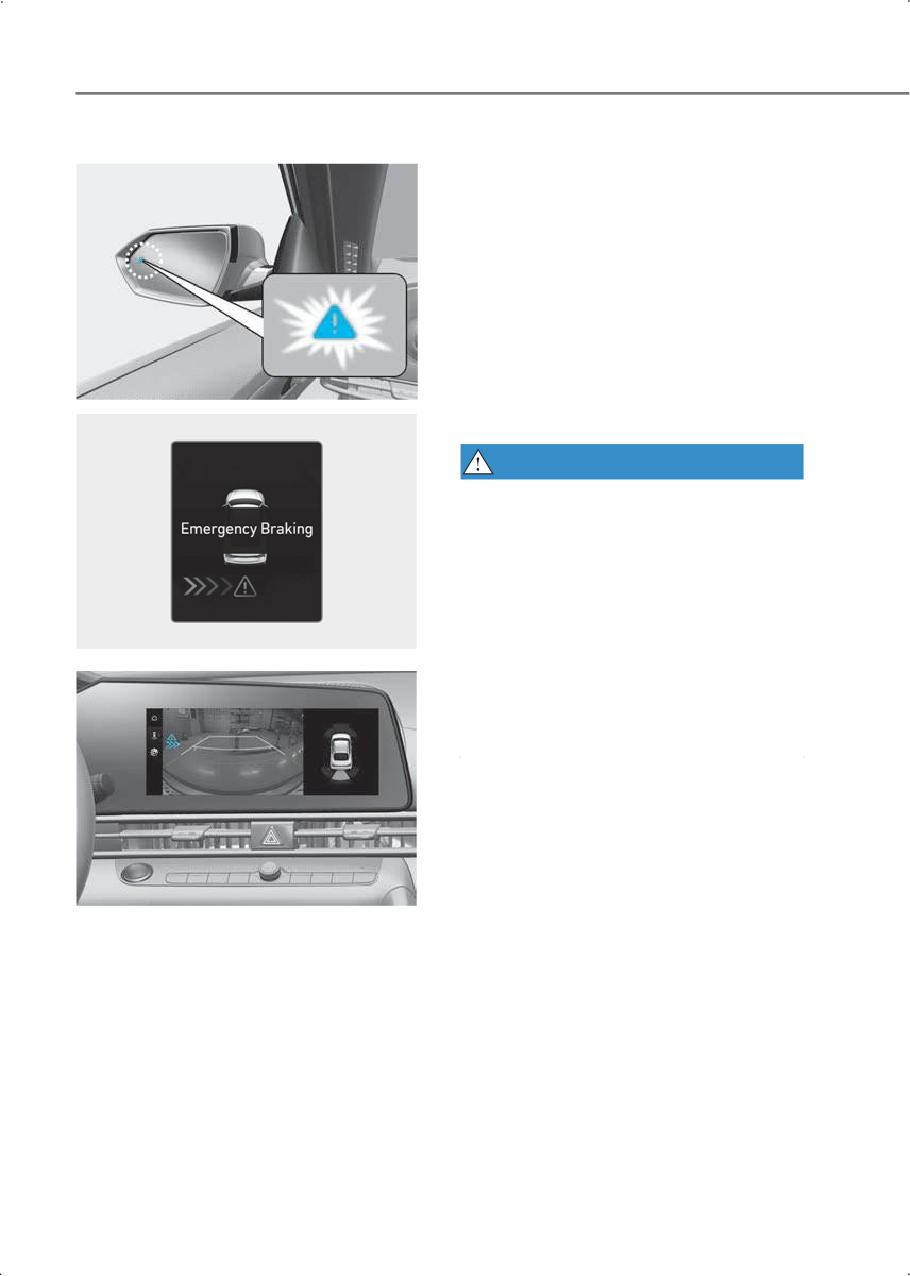
Driver assistance system
Emergency Braking
If a collision is imminent, emergency
braking is assisted to help prevent
collision with approaching vehicles from
the left and right side or your vehicle.
Emergency braking may operate if:
• The gear is shifted to R (Reverse).
• Vehicle speed is below 5 mph (8 km/h).
• The approaching vehicle is within
approximately 5 ft. (1.5 m) from the left
and right side of your vehicle.
• The speed of the vehicle approaching
from the left and right is above 3 mph (5
km/h).
WARNING
Braking control ends when:
• The approaching vehicle is out of the
detection range.
• The approaching vehicle passes behind
your vehicle.
• The approaching vehicle does not
continue to drive toward your vehicle.
• The approaching vehicle speed slows
down.
• The driver depresses the brake pedal
with sufficient power.
To warn you of an approaching vehicle
from the rear left or right of your vehicle,
the warning light on the side view mirror
may blink, a warning message may
appear on the instrument cluster, and an
audible warning may sound and the
steering wheel may vibrate.
When Rear View Monitor is operating, a
warning may appear on the infotainment
system screen.
7-96
7
Stopping vehicle and ending brake
•
You may not hear the audible warning
control
of Rear Cross-Traffic
Collision-Avoidance Assist if the
surrounding environment is too noisy.
•
During Rear Cross-Traffic
Collision-Avoidance Assist operation,
your vehicle may stop suddenly. Always
wear your seat belt, check your
occupants have their seat belts
fastened and secure loose objects that
may become projectiles.
•
Rear Cross-Traffic Collision-Avoidance
Assist may not operate if you apply the
brake pedal with sufficient force in
• After your vehicle is stopped following
response to the potential hazard
detected by the system.
an Emergency Braking event, the "Drive
carefully" warning message may
•
Even if there is an issue with Rear
appear on the instrument cluster.
Cross-Traffic Collision-Avoidance
Assist, the vehicle’s braking system
• Depress the brake pedal immediately
and check the surroundings.
operates normally.
•
When Rear Cross-Traffic
• Braking control ends about 2 seconds
Collision-Avoidance Assist is operating,
after your vehicle is stopped.
braking assist is automatically canceled
• During Emergency Braking, braking
when you depress the accelerator
control by Rear Cross-Traffic
pedal with sufficient force.
Collision-Avoidance Assist may be
•
Rear Cross-Traffic Collision-Avoidance
automatically canceled when you
depress the brake pedal with sufficient
Assist may warn you late or may not
warn you depending on the road and
force.
driving conditions.
WARNING
•
Control your vehicle at all times. It is
your responsibility to operate your
Rear Cross-Traffic Collision-Avoidance
vehicle in a safe manner. Do not solely
Assist may not operate in all situations
rely on the Rear Cross-Traffic
and cannot avoid all collisions.
Collision-Avoidance Assist to avoid a
To prevent serious injury or death:
collision. Rather, maintain a safe
• Only change the settings after parking
braking distance, and If needed, reduce
the vehicle at a safe location.
your vehicle speed or depress the brake
pedal to reduce the driving speed or to
• Always look over your shoulder for
stop your vehicle.
possible hazards and make sure it is
safe to back up.
•
Never attempt to activate Rear
Cross-Traffic Collision-Avoidance
• When other system’s warning message
Assist by intentionally driving toward
appears or audible warning is heard,
people, animals, objects, or other
Rear Cross-Traffic Collision-Avoidance
vehicles.
Assist may not warn you.
7-97
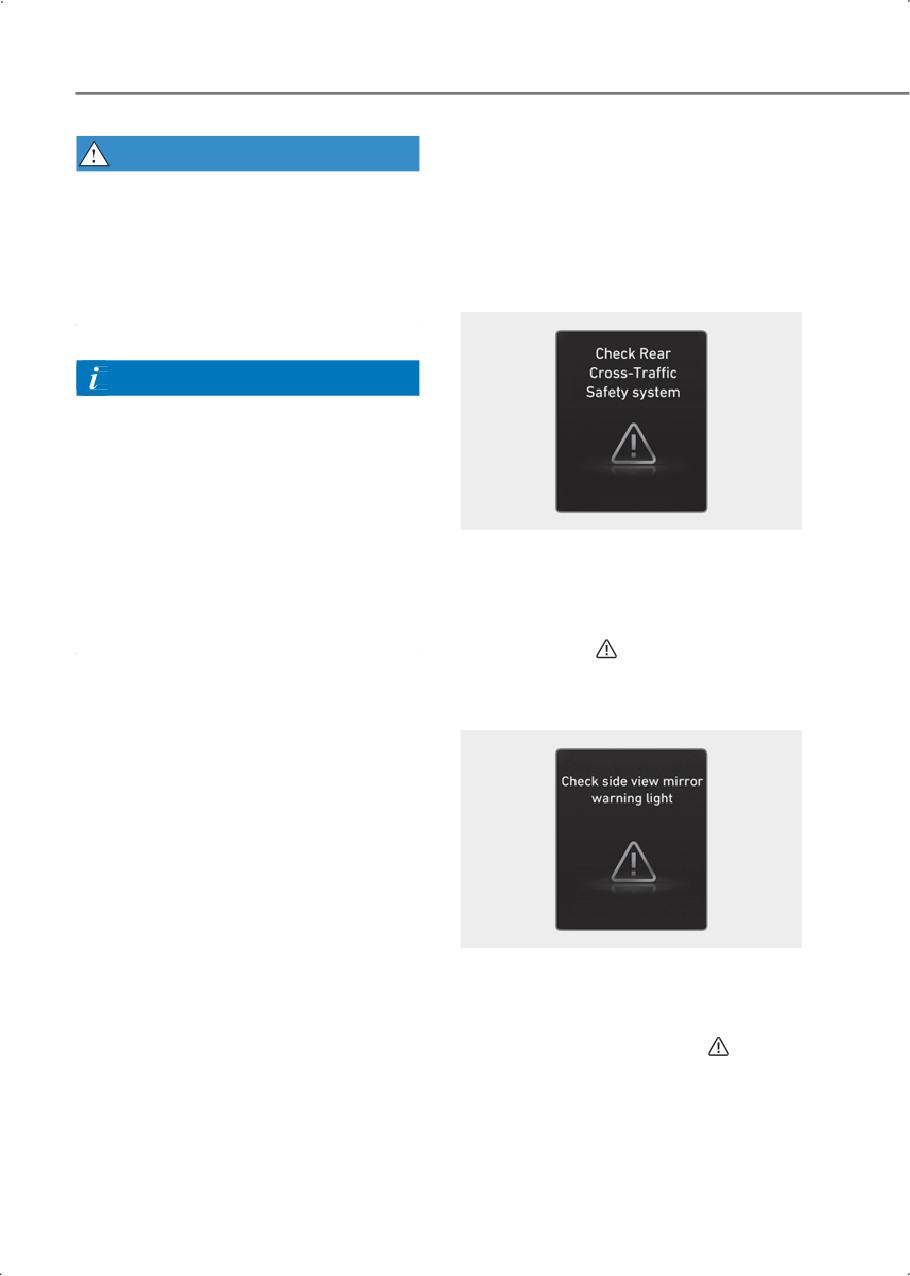
Driver assistance system
Rear Cross-Traffic
WARNING
Collision-Avoidance Assist
Braking is not assisted and only a warning
malfunction and limitations
is provided when:
• The ESC (Electronic Stability Control)
Rear Cross-Traffic
warning light is on.
Collision-Avoidance Assist
• ESC (Electronic Stability Control) is
malfunction
engaged in a different function.
Information
If the braking is assisted by Rear
Cross-Traffic Collision-Avoidance Assist,
the driver must immediately depress the
brake pedal and check vehicle
surroundings.
• Brake control will end when the driver
depresses the brake pedal with
sufficient power.
When the Rear Cross-Traffic
Collision-Avoidance Assist is not working
• After shifting the gear to R (Reverse),
properly, the "Check Rear Cross-Traffic
braking control will operate once for
Safety system" warning message may
left and right vehicle approach.
appear, and the
warning light may
illuminate on the instrument cluster. Have
the vehicle inspected by an authorized
HYUNDAI dealer.
When the side view mirror warning light is
not working properly, the "Check side
view mirror warning light" warning
message may appear, and the warning
light may illuminate on the instrument
cluster. Have the vehicle inspected by an
authorized HYUNDAI dealer.
7-98
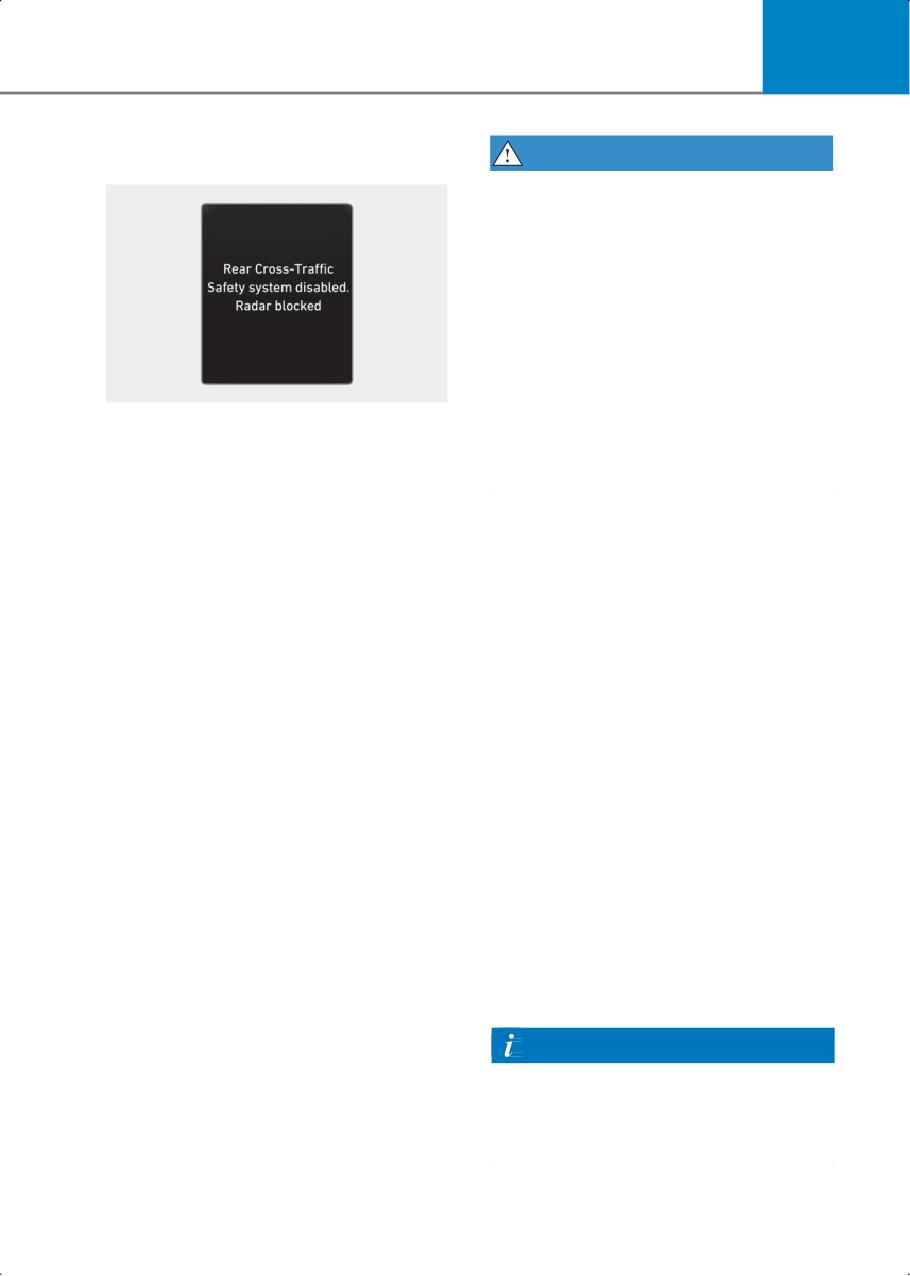
7
Rear Cross-Traffic
WARNING
Collision-Avoidance Assist disabled
• Rear Cross-Traffic Collision-Avoidance
Assist may not operate properly even if
there is no warning message or warning
light on the instrument cluster.
• Rear Cross-Traffic Collision-Avoidance
Assist may not operate properly in open
areas where no objects are detected
(e.g. empty parking lot) or when the
detecting sensors are blocked right
after turning on the engine.
• Always turn off Rear Cross-Traffic
If the rear corner radar is blocked or
Collision-Avoidance Assist when
covered, or when the rear bumper around
towing a trailer or using a hitch
the rear corner radar or sensor is covered
mounted carrier.
by any foreign material, such as snow,
rain, or dirt, or when a trailer or hitch
mounted carrier is installed, the detecting
Limitations of Rear Cross-Traffic
performance may reduce and temporarily
Collision-Avoidance Assist
limit or disable Rear Cross-Traffic
Rear Cross-Traffic Collision-Avoidance
Collision-Avoidance Assist.
Assist may not operate normally, or may
operate unexpectedly if:
The "Rear Cross-Traffic Safety system
disabled. Radar blocked" warning
• Departing from where trees or grass are
message may appear on the instrument
overgrown.
cluster.
• Departing from where roads are wet.
The function operates normally when
• Speed of the approaching vehicle is fast
such foreign material, trailer, or carrier is
or slow.
removed, and the engine is restarted.
Braking may not be assisted if:
If the function does not operate normally
• Your vehicle severely vibrates while
after anything covering or blocking the
driving over a bumpy road, uneven
sensors is removed, have the vehicle
road, or concrete patch.
inspected by an authorized HYUNDAI
dealer.
• You are driving on a slippery surface
due to snow, water puddle, ice, etc.
• The tire pressure is low or any tire is
damaged.
• The braking system is adjusted
differently from the factory default
settings.
Information
For more information on the limitations of
the rear corner radar, refer to the
"Blind-Spot Collision-Avoidance Assist
(BCA)" section in this chapter.
7-99
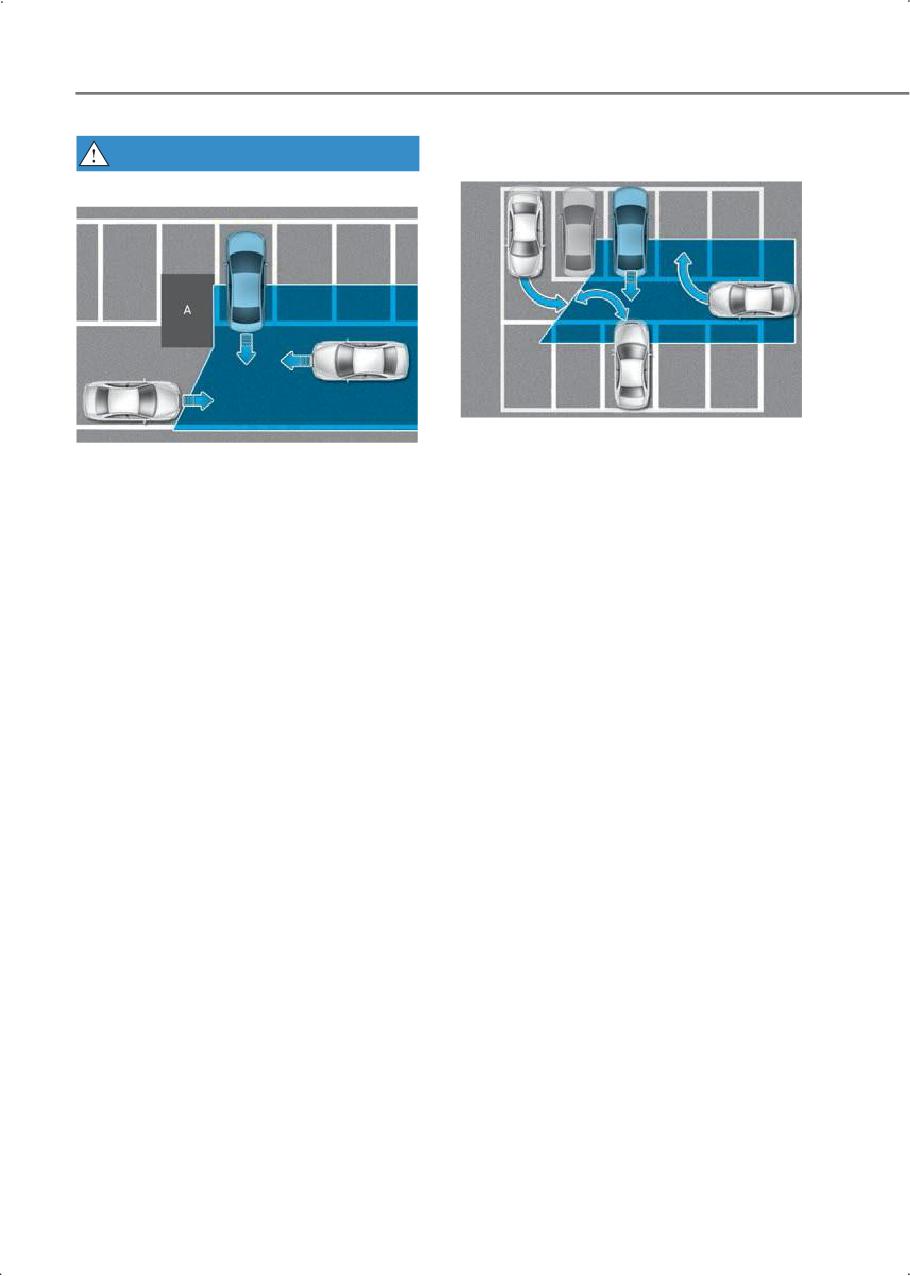
Driver assistance system
• When your vehicle is in a complex
WARNING
parking environment
• Driving near a vehicle or structure
Rear Cross-Traffic Collision-Avoidance
[A] Structure
Assist may detect vehicles that are
Rear Cross-Traffic Collision-Avoidance
parking or pulling out near your vehicle
Assist may be limited when driving near
(e.g. leaving beside your vehicle,
another vehicle or a structure, and it
parking or pulling out behind your
may not detect the vehicle approaching
vehicle, approaching your vehicle
from the left or right. The function may
making a turn). If this occurs, the
not activate a warning or brake your
function may activate a warning and
vehicle
brake your vehicle even when not
needed.
Always check your surroundings while
backing up.
Always check your surroundings while
backing up.
7-100
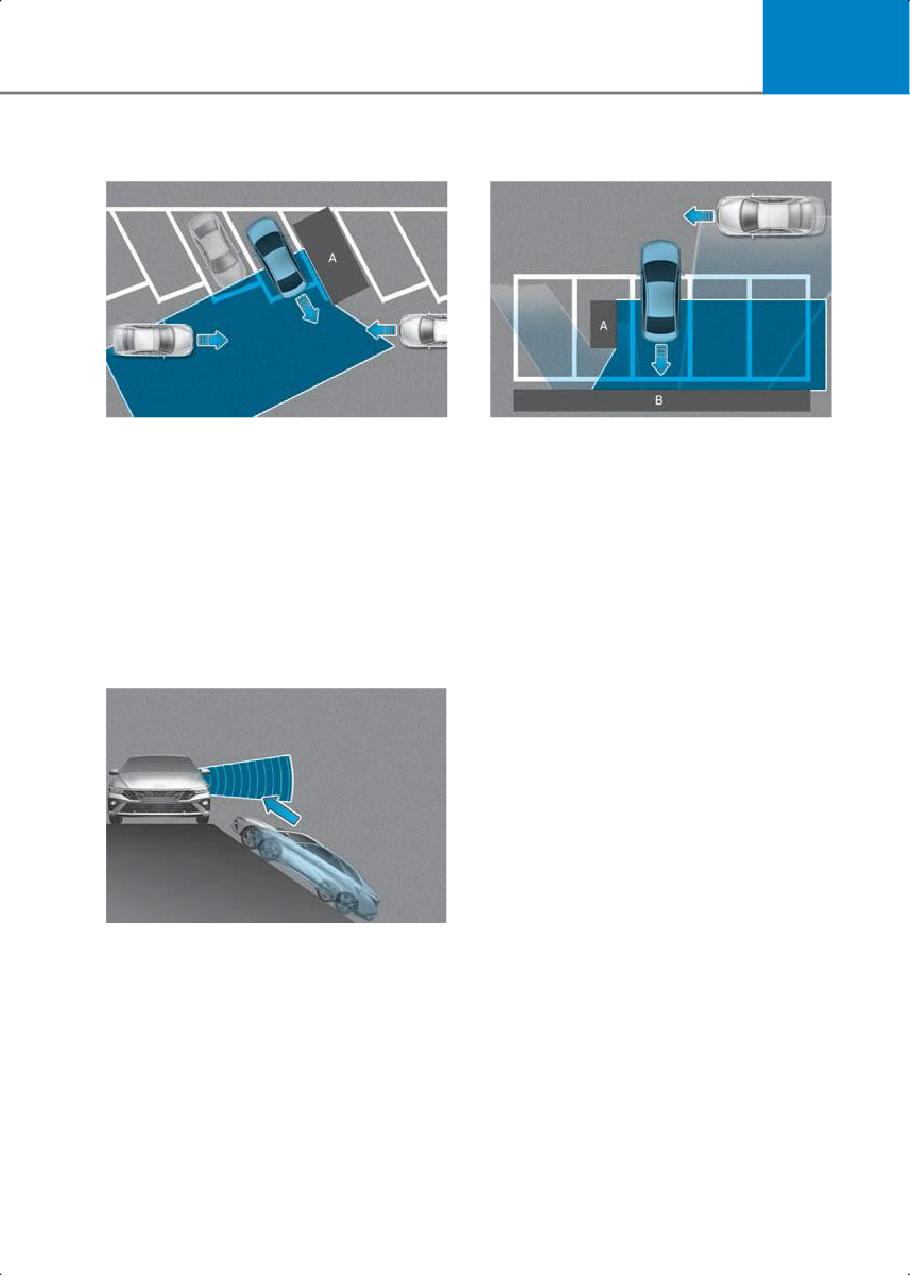
7
• When your vehicle is parked
• Pulling into the parking space where
diagonally
there is a structure
[A] Vehicle
[A] Structure
[B] Wall
Rear Cross-Traffic Collision-Avoidance
Rear Cross-Traffic Collision-Avoidance
Assist may be limited when backing up
Assist may detect vehicles passing by in
diagonally, and may not detect any
front of you when parking in reverse
vehicle approaching from the left or
into a parking space with a wall or
right. If this occurs, the function may
structure in the rear or side area. If this
not activate a warning or brake your
occurs, the function may activate a
vehicle.
warning or brake your vehicle.
Always check your surroundings while
Always check your surroundings while
backing up.
backing up.
• When your vehicle is on or near a slope
Rear Cross-Traffic Collision-Avoidance
Assist may be limited when your vehicle
is on a uphill or downhill slope, and may
not detect any vehicle approaching
from the left or right. If this occurs, the
function may activate a warning and
brake your vehicle even when not
needed.
Always check your surroundings while
backing up.
7-101
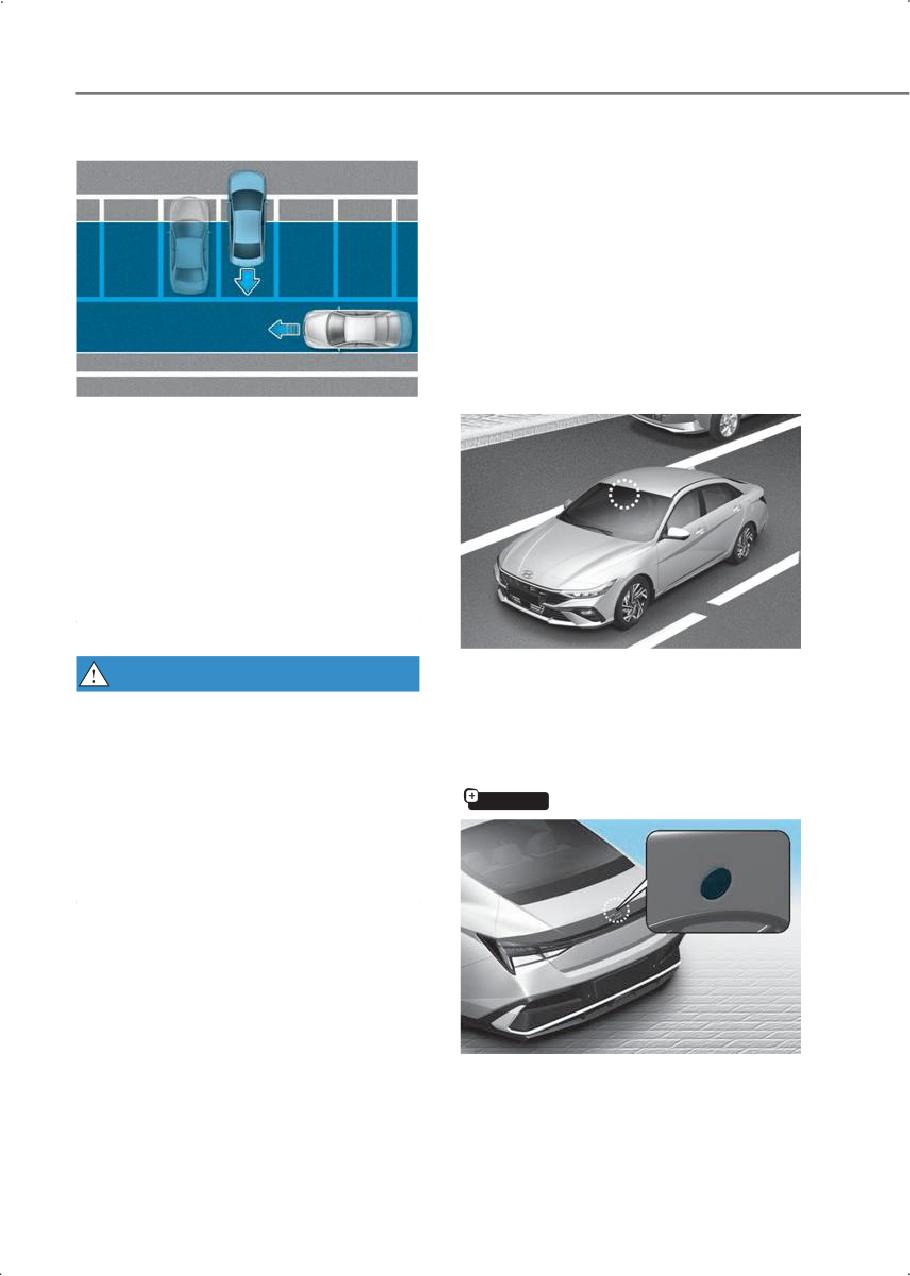
Driver assistance system
•
When your vehicle is parked rearward
Driver assistance system
sensors
The Driver Assistance system on your
vehicle uses cameras and sensors to
detect potential hazards in the vicinity of
your vehicle.
Cameras
Front view camera
Rear Cross-Traffic Collision-Avoidance
Assist may detect vehicles passing by
behind you when parking in reverse
into a parking space. If this occurs, the
function may activate a warning and
brake your vehicle even when not
needed.
Always check your surroundings while
backing up.
WARNING
The front view camera is mounted near
the top of the windshield inside your
•
Rear Cross-Traffic Collision-Avoidance
vehicle.
Assist may not operate normally if there
is interference from strong
electromagnetic waves.
Wide-rear view camera
•
Rear Cross-Traffic Collision-Avoidance
if equipped
Assist may not operate for 3 seconds
right after your vehicle is started or
when the rear corner radars are
initialized.
The wide-rear view camera is mounted
above the license plate holder outside
your vehicle.
7-102
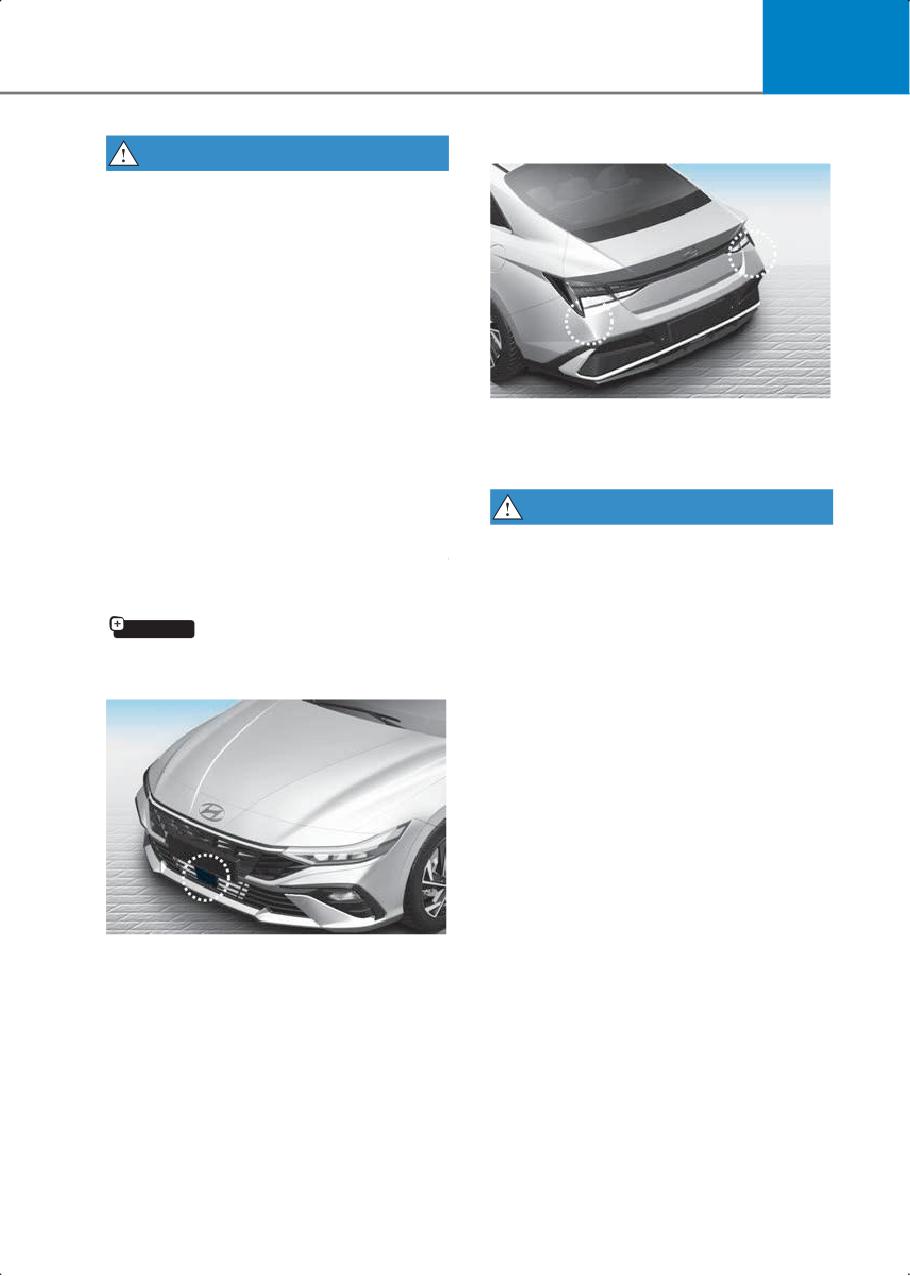
7
Rear corner radar
WARNING
To prevent serious injury or death:
• Never disassemble the camera sensors
or camera sensor assemblies.
• Only have the detecting sensor
replaced or repaired by an authorized
HYUNDAI dealer.
• Never install any accessories, stickers,
or tint the front windshield.
• Always keep the camera dry.
• Never place any reflective objects (e.g.
white paper, mirror) on the dashboard.
The rear corner radars are mounted near
the rear corners of your vehicle above the
• Do not use any cleanser containing acid
bumper.
or alkaline detergents when cleaning
the camera lenses. Use only a mild soap
WARNING
or neutral detergent, and rinse
thoroughly with water.
To prevent serious injury or death:
•
Never disassemble the radar or radar
assembly, and never apply any impact
Radars
on it.
if equipped
•
If there is impact on or near the radar,
the sensors may be damaged or not be
Front radar
properly aligned near the radar, even
though a warning message does not
appear on the instrument cluster,
Driver Assistance system may not
operate properly. Have the vehicle
inspected by an authorized HYUNDAI
dealer.
•
If the radars have been replaced or
repaired, have the vehicle inspected by
an authorized HYUNDAI dealer.
•
Use only genuine HYUNDAI parts to
repair the bumper where the radar is
located.
The front radar is mounted behind the
•
Do not install a license plate frame or
front grill.
other objects such as bumper sticker,
film, bumper guard, or bumper wrap
near the radar.
•
Driver Assistance system may not work
properly if the bumper has been
replaced, or the surroundings of the
radar has been damaged or painted.
7-103
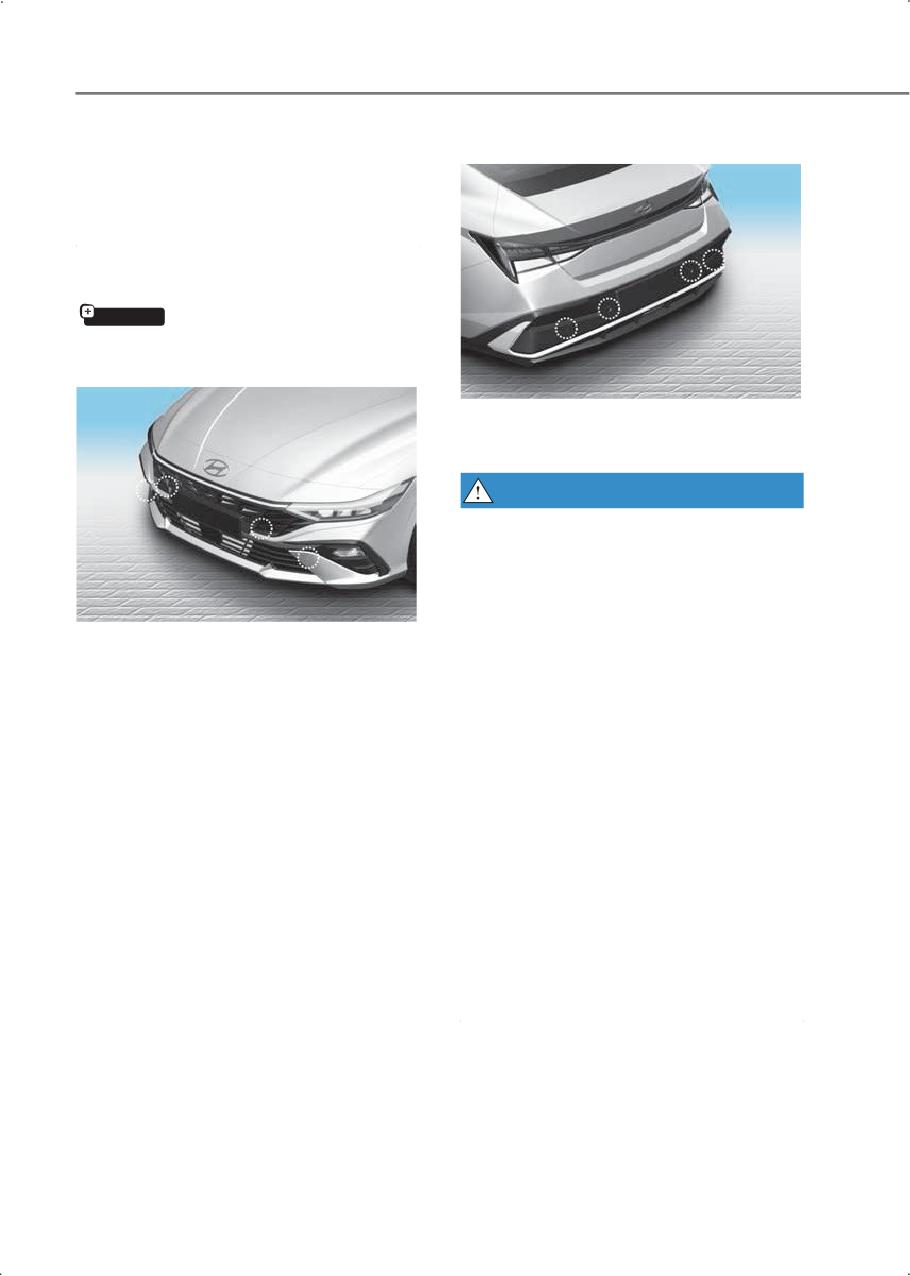
Driver assistance system
• If a trailer or hitch mounted carrier is
Rear ultrasonic sensors
attached, it may adversely affect the
performance of the rear corner radar or
Driver Assistance system may not
operate.
Ultrasonic sensors
if equipped
Front ultrasonic sensors
These ultrasonic sensors are mounted to
the rear bumper outside your vehicle.
WARNING
To prevent serious injury or death:
• Always keep the ultrasonic sensors
clean.
• Do not spray the ultrasonic sensors or
the surrounding area directly with high
pressure water.
These ultrasonic sensors are mounted to
the front bumper outside your vehicle.
• Do not apply objects such as bumper
sticker or bumper guard, near the
ultrasonic sensors or never apply paint
to the bumper or other locations.
• Never disassemble or strike the
ultrasonic sensors components.
• Do not modify the vehicle bumper
height or ultrasonic sensor installations.
Any non-factory installed equipment or
accessories may also interfere with the
sensor performance.
• If the ultrasonic sensors have been
forcibly moved out of proper alignment
or are damaged, have the vehicle
inspected by an authorized HYUNDAI
dealer.
7-104
8. Emergency situations
Hazard warning flasher
Jump starting
Tire Pressure Monitoring System (TPMS)
Check tire pressure
Tire pressure monitoring system
Low tire pressure warning light
Low tire pressure position and tire pressure telltale
TPMS malfunction indicator
Changing a tire with TPMS
If you have a flat tire (with spare tire)
Jack and tools
Jack label
Changing tires
If you have a flat tire (with Tire Mobility Kit)
Introduction
Notes on the safe use of the Tire Mobility Kit
Components of the Tire Mobility Kit
Using the Tire Mobility Kit When a tire is flat
How to adjust tire pressure
8
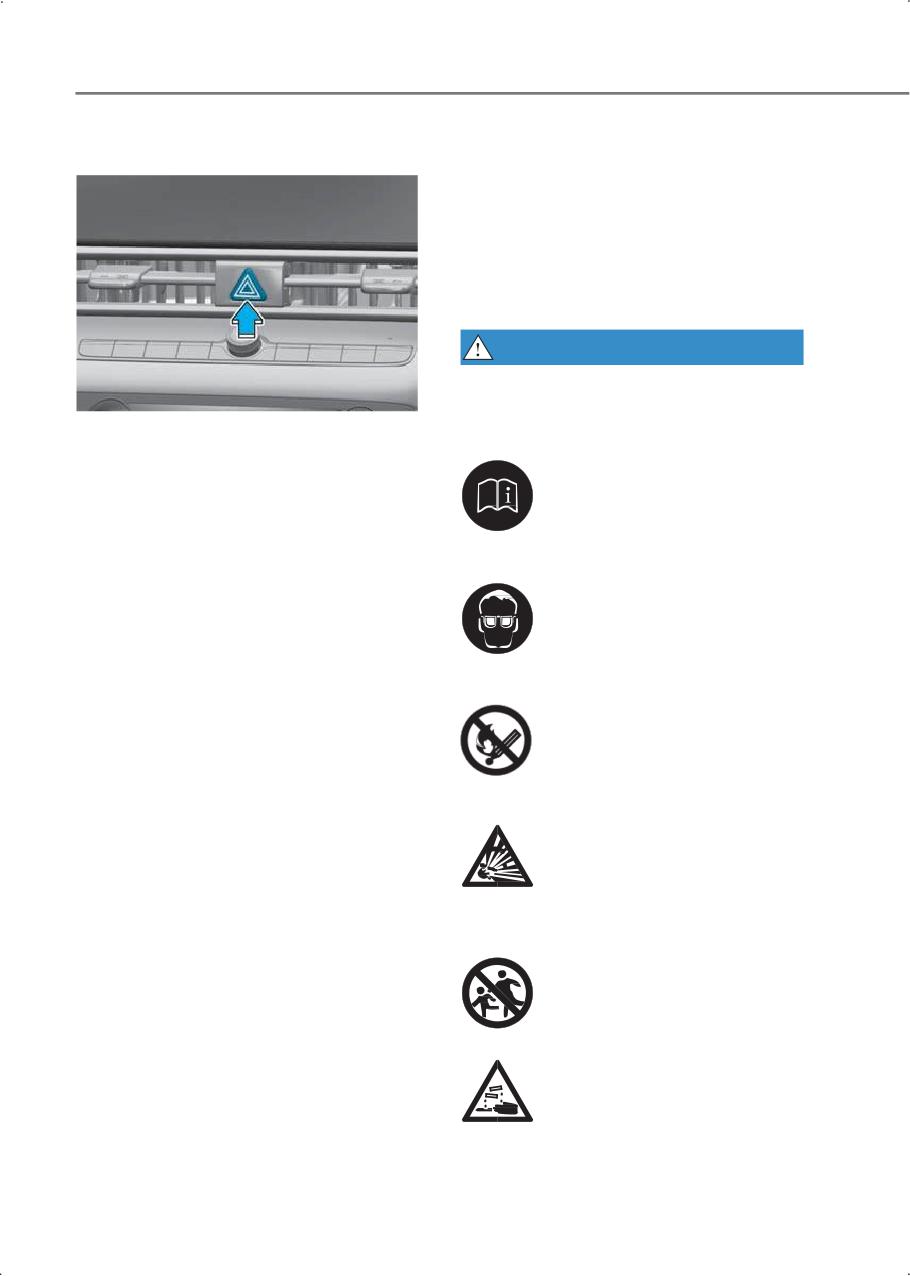
Emergency situations
Hazard warning flasher
Jump starting
Jump starting can be dangerous if done
incorrectly. Follow the jump starting
procedure in this section to avoid serious
injury or damage to your vehicle. If in
doubt about how to properly jump start
your vehicle, have a service technician or
towing service do it for you.
WARNING
To prevent SERIOUS INJURY or DEATH to
you or bystanders, always follow these
precautions when working near or
The hazard warning flashers warn other
handling the battery:
drivers to exercise extreme caution when
approaching, overtaking, or passing your
vehicle.
It should be used whenever making
Always read and follow instructions
emergency repairs or when stopped near
carefully when handling a battery.
the edge of a roadway.
To turn on or off the hazard warning
flasher, press the hazard warning flasher
button with the ignition switch in any
position. The hazard warning flasher
Wear eye protection designed to protect
button is located in the center fascia
the eyes from acid splashes.
panel. All turn signal lights flash
simultaneously.
• The hazard warning flasher operates
whether your vehicle is running or not.
Keep all flames, sparks, or smoking
• The turn signals do not work when the
materials away from the battery.
hazard flasher is on.
Hydrogen is always present in battery
cells, is highly combustible, and may
explode if ignited.
Keep batteries out of reach of children.
Batteries contain sulfuric acid that is
highly corrosive. Do not allow acid to
contact your eyes, skin, or clothing.
8-2
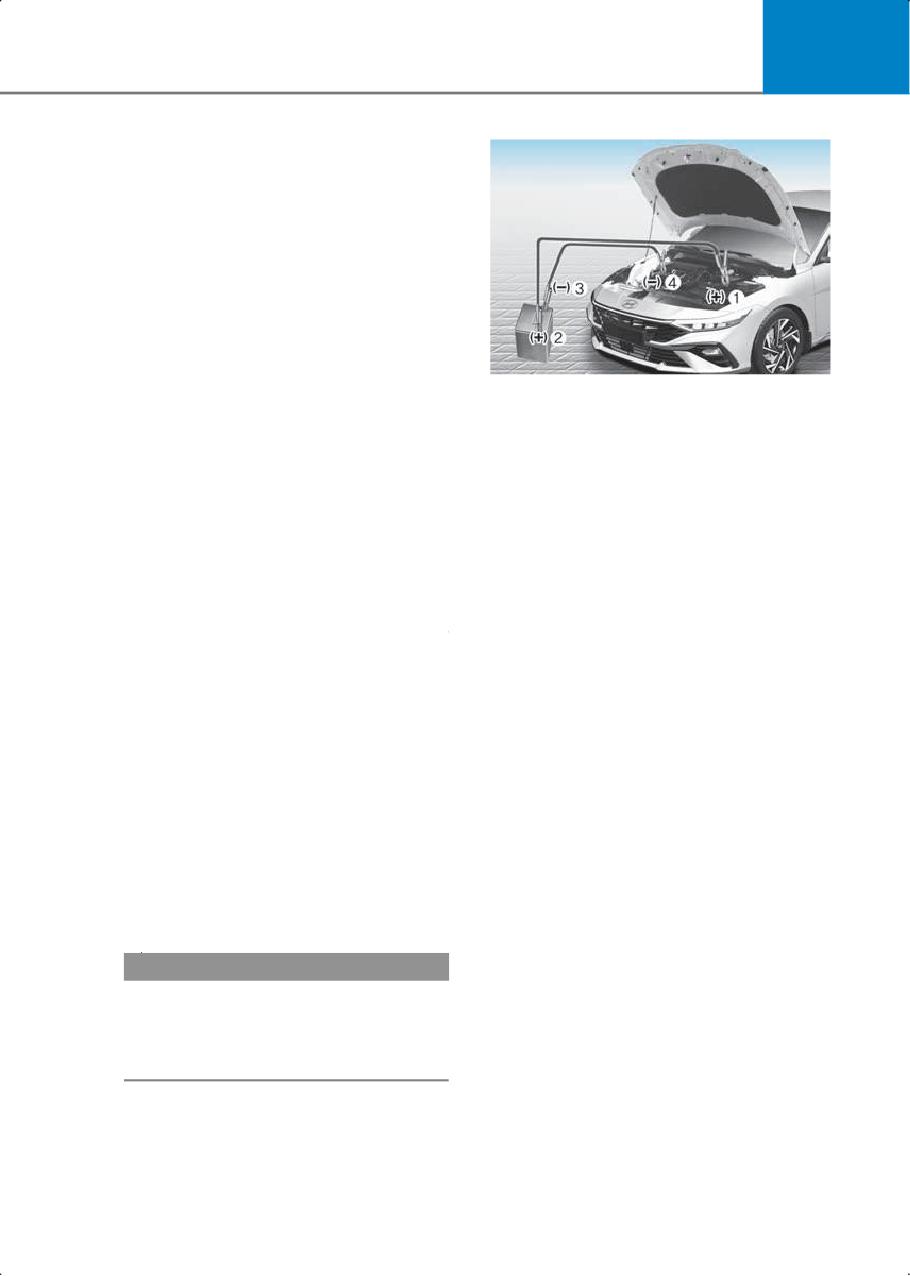
8
If acid gets into your eyes, flush your eyes
with clean water for at least 15 minutes
and get immediate medical attention. If
acid gets on your skin, thoroughly wash
the area. If you feel pain or a burning
sensation, get medical attention
immediately.
• When lifting a plastic-cased battery,
excessive pressure on the case may
cause battery acid to leak. Lift with a
battery carrier or with your hands on
opposite corners.
• Do not attempt to jump start your
5. Connect the jumper cables in the exact
vehicle if your battery is frozen.
sequence shown in the illustration. First
• NEVER attempt to recharge the battery
connect one jumper cable to the red,
when the vehicle’s battery cables are
positive (+) battery terminal of your
connected to the battery.
vehicle (1).
• The electrical ignition system works
6. Connect the other end of the jumper
with high voltage.
cable to the red, positive (+)
battery/jumper terminal of the
NEVER touch these components with
assisting vehicle (2).
the engine running or when the ignition
switch is in the ON position.
7. Connect the second jumper cable to
the black, negative (-) battery/jumper
terminal of the assisting vehicle (3).
Jump starting procedure
8. Connect the other end of the second
1. Position the vehicles close enough that
jumper cable to the chassis ground of
the jumper cables can reach. Do not
your vehicle (4).
allow the vehicles to touch.
Do not allow the jumper cables to
2. Avoid fans or any moving parts in the
contact anything except the correct
engine compartment at all times, even
battery or jumper terminals or the
when the vehicles are turned off.
correct ground. Do not lean over the
battery when making connections.
3. Turn off all electrical devices such as
radios, lights, air conditioning, etc. Put
9. Start the engine of the assisting vehicle
the vehicles in P (Park) and apply the
and let it run at approximately 2,000
parking brake. Turn both vehicles OFF.
RPM for a few minutes. Then start your
vehicle.
4. Open the engine hood.
10. Keep your vehicle operating for at least
CAUTION
30 minutes at idle or driving to make
sure your battery receives enough
Before jump starting, make sure to
charge to be able to start on its own
correctly identify the positive (+) and
after the vehicle is shut off. A
negative (-) terminals to avoid reverse
completely discharged battery may
polarity connections.
require as long as 60 minutes runtime
to fully recharge. If the vehicle is run for
less, the vehicle may not restart.
8-3