Hyundai Palisade (2024 year). Manual in english - page 4
 

  Index      Manuals     Hyundai Palisade (2024 year). Manual in english


Search            copyright infringement  


Content      ..     2      3      4      5     ..


Hyundai Palisade (2024 year). Manual in english - page 4


3

3-63

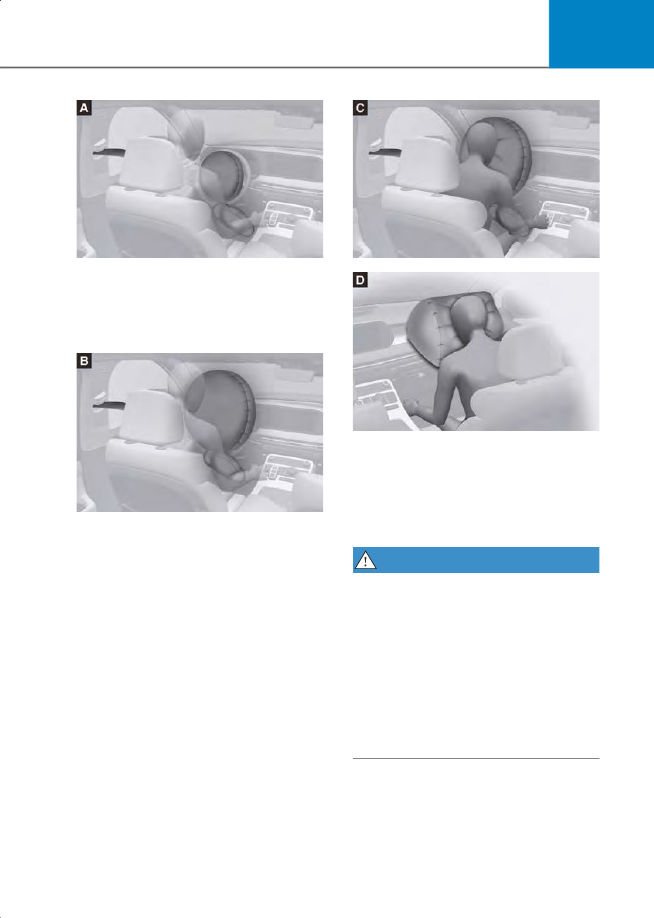
B0074EE04

[A] : Driver’s front air bag (1)

When the SRSCM detects a sufficiently 

severe impact to the front of the vehicle, 

it will automatically deploy the front air 

bags.

B0074EE05

[B] : Driver’s front air bag (2)

Upon deployment, tear seam molded 

directly into the pad cover will separate 

under pressure from the expansion of the 

air bags. Further opening of the covers 

allows full inflation of the air bags.
A fully inflated air bag, in combination 

with a properly worn seat belt, slows the 

driver’s or the front passenger’s forward 

motion, reducing the risk of head and 

chest injury.

B0074EE06

B0074EE07

[C] : Driver’s front air bag (3)

[D] : Passenger’s front air bag

After complete inflation, the air bag 

immediately starts deflating, enabling the 

driver to maintain forward visibility and 

the ability to steer or operate other 

controls.


WARNING


To prevent objects from becoming 

dangerous projectiles when the 

passenger’s air bag inflates:
• Do not install or place any objects (drink 

holder, CD holder, stickers, etc.) on the 

front passenger’s panel above the 

glove box where the passenger’s air 

bag is located.

• Do not install a container of liquid air 

freshener near the instrument cluster or 

on the instrument panel surface.


CarManuals2.com

Seats & Safety System

3-64

What to Expect After an Air 

Bag Inflates

After a frontal or side air bag inflates, it 

will deflate very quickly. Air bag inflation 

will not prevent the driver from seeing out 

of the windshield or being able to steer. 

Curtain air bags may remain partially 

inflated for some time after they deploy.


WARNING


After an air bag inflates, take the following 

precautions:
• Open your windows and doors as soon 

as possible after impact to reduce 

prolonged exposure to the smoke and 

powder released by the inflating air 

bag.

• Do not touch the air bag storage area’s 

internal components immediately after 

an air bag has inflated. The parts that 

come into contact with an inflating air 

bag may be very hot.

• Always wash exposed skin areas 

thoroughly with cold water and mild 

soap.

• Always have an authorized HYUNDAI 

dealer replace the air bag immediately 

after deployment. Air bags are 

designed to be used only once.


Noise and smoke from inflating air 

bag

When the air bags inflate, they make a 

loud noise and may produce smoke and 

powder in the air inside of the vehicle. 

This is normal and is a result of the 

ignition of the air bag inflator. After the air 

bag inflates, you may feel substantial 

discomfort in breathing because of the 

contact of your chest with both the seat 

belt and the air bag, as well as from 

breathing the smoke and powder. The 

powder may aggravate asthma for some 

people. If you experience breathing 

problems after an air bag deployment, 

seek medical attention immediately.
Though the smoke and powder are 

nontoxic, they may cause irritation to the 

skin, eyes, nose, throat, etc. If this is the 

case, wash and rinse with cold water 

immediately and seek medical attention if 

the symptoms persist.

CarManuals2.com

3

3-65

Occupant Classification 

System (OCS)

B0073EU01

Your vehicle is equipped with an 

Occupant Classification System (OCS) in 

the front passenger’s seat.

Main components of the Occupant 

Classification System

• A detection device located within the 

front passenger seat cushion.

• Electronic system to determine 

whether the passenger air bag systems 

should be activated or deactivated.

• An indicator light located on the 

overhead console which illuminates the 

words “PASSENGER AIR BAG OFF” 

indicating the front passenger air bag 

system is deactivated.

• The overhead console air bag indicator 

light is interconnected with the OCS.

The OCS is designed to help detect the 

presence of a properly-seated front 

passenger and determine if the 

passenger’s front air bag should be 

enabled (may inflate) or not.
The purpose is to help reduce the risk of 

injury or death from an inflating air bag to 

certain front passenger seat occupants, 

such as children, by requiring the air bag 

to be automatically turned OFF.
For example, if a child restraint of the type 

specified in the regulations is on the seat, 

the occupant classification sensor can 

detect it and cause the air bag to turn 

OFF.

Front passenger seat adult occupants 

who are properly seated and wearing the 

seat belt properly, should not cause the 

passenger air bag to be automatically 

turned OFF. For smaller adults it may turn 

OFF, however, if the occupant does not 

sit in the seat properly (for example, by 

not sitting upright, by sitting on the edge 

of the seat, or by otherwise being out of 

position), this could cause the sensor to 

turn the air bag OFF.
You will find the “PASSENGER AIR BAG 

OFF” indicator on the overhead console 

panel. This system detects the conditions 

1-4 in the following table and activates or 

deactivates the front passenger air bag 

based on these conditions.
Always be sure that you and all vehicle 

occupants are seated properly and 

wearing the seat belt properly for the 

most effective protection by the air bag 

and the seat belt.
The OCS may not function properly if the 

passenger takes actions which can affect 

the classification system. These include:
• Failing to sit in an upright position.
• Leaning against the door or center 

console.

• Sitting towards the sides of the front of 

the seat.

• Putting their legs on the dashboard or 

resting them on other locations which 

reduce the passenger weight on the 

front seat.

• Wearing the seat belt improperly.
• Reclining the seatback.
• Wearing thick clothes like ski wear or 

hip protection wear.

• Putting an additional thick cushion on 

the seat.

• Putting electrical devices (for example, 

notebook, satellite radio) on the seat 

with inverter charging.

CarManuals2.com

Seats & Safety System

3-66

Condition and operation in the front passenger Occupant Classification System

*1 The system judges a person of adult size as an adult. When a smaller adult sits in the front passenger seat, the 

system may recognize him/her as a child depending on his/her physique and posture.

*2 Do not allow children to ride in the front passenger seat. When a larger child who has outgrown a child restraint 

system sits in the front passenger seat, the system may recognize him/her as an adult depending upon his/her 

physique or sitting position.

*3 Never install a child restraint system on the front passenger seat.
*4 The PASSENGER AIR BAG “OFF” indicator may turn on or off when a child above 12 months to 12 years old (with 

or without child restraint system) sits in the front passenger seat. This is a normal condition.

Condition detected by the 

occupant classification system

Indicator/Warning light

Devices

“PASSENGER AIR 

BAG OFF” 

indicator light

SRS warning 

light

Front passenger 

air bag

1. Adult 

*1

Off

Off

Activated

2. Infant 

*2

 or child restraint system 

with 12 months old 

*3


*4

On

Off

Deactivated

3. Unoccupied

On

Off

Deactivated

4. Malfunction in the system

Off

On

Activated

CarManuals2.com

3

3-67


WARNING


Riding in an improper position or placing 

weight on the front passenger’s seat 

when it is unoccupied by a passenger 

adversely affects the OCS. To reduce the 

risk of serious injury or death:
• NEVER put a heavy load in the front 

seat or seatback pocket, or hang any 

items on the front passenger seat.

B0073KO04

• NEVER place your feet on the front 

passenger seatback.

B0073KO13

• NEVER sit with your hips shifted 

towards the front of the seat.

B0073KO05

• NEVER ride with the seatback reclined 

when the vehicle is moving.

B0073KO07

• NEVER place your feet or legs on the 

dashboard.

B0073KO06

• NEVER lean on the door or center 

console or sit on one side of the front 

passenger seat.

B0073KO08

CarManuals2.com

Seats & Safety System

3-68

• Do not sit on the passenger seat 

wearing heavily padded clothes such as 

ski wear and hip protector.

B0073KO09

• Do not use car seat accessories such as 

thick blankets and cushions which 

cover up the car seat surface.

B0073KO11

• Do not place electronic devices such as 

laptops, DVD player, or conductive 

materials such as water bottles on the 

passenger seat.

• Do not use electronic devices such as 

laptops and satellite radios which use 

inverter chargers.

B0073KO10

• If large quantity of liquid has been 

spilled on the passenger seat, the air 

bag warning light may illuminate or 

malfunction.
Therefore, make sure the seat has been 

completely dried before driving the 

vehicle.

B0073KO12

• Do not place sharp objects on the front 

passenger seat. These may damage the 

occupant detection system, if they 

puncture the seat cushion.

• Do not place any items under the front 

passenger seat.

• When changing or replacing the seat or 

seat cover, use original items only. The 

OCS has been developed based on 

using original HYUNDAI car seats only. 

Altering or changing the authentic parts 

may result in system malfunction and 

increase risk of injury when in collision. 

Any of the above could interfere with 

the proper operation of the OCS sensor 

thereby increasing the risk of an injury 

in an accident.


CarManuals2.com

3

3-69

B0073KO03

Proper seated position for OCS

If the “PASSENGER AIR BAG OFF” 

indicator is on when an adult is seated in 

the front passenger seat, place the 

ignition switch in the OFF position and ask 

the passenger to sit properly (sitting 

upright with the seat back in an upright 

position, centered on the seat cushion 

with their seat belt on, legs comfortably 

extended and their feet on the floor). 

Restart the engine and have the person 

remain in that position. This will allow the 

system to detect the person and to enable 

the passenger air bag. If the “PASSENGER 

AIR BAG OFF” indicator is still on, ask the 

passenger to move to the rear seat.


WARNING


NEVER allow an adult passenger to ride in 

the front passenger seat when the 

“PASSENGER AIR BAG OFF” indicator is 

illuminated. During a collision, the air bag 

will not inflate if the indicator is 

illuminated. Have your passenger 

reposition themselves in the seat. If the 

“PASSENGER AIR BAG OFF” indicator 

remains illuminated after the passenger 

repositions themselves properly and the 

vehicle is restarted, have the passenger 

move to the rear seat because the air bag 

will not inflate.


NOTICE


The “PASSENGER AIR BAG OFF” indicator 

generally illuminates for approximately 4 

seconds after the ignition switch is in the 

ON or START position. But, if the ignition 

switch is placed to the ON or START 

position within 3 minutes after the engine 

is turned OFF, the indicator does not 

illuminate. If the front passenger seat is 

occupied, the OCS will then classify the 

front passenger after several more 

seconds.


Do not install a Child Restraint 

System on the Front Passenger's 

Seat

Type A

B0073EU02

Type B

OHI038169L

Even though your vehicle is equipped 

with the OCS, never install a child 

restraint in the front passenger’s seat. An 

inflating air bag can forcefully strike a 

child or child restraint resulting in serious 

or fatal injury.

CarManuals2.com

Seats & Safety System

3-70


WARNING


• NEVER place a rearward-facing or 

forward-facing child restraint in the 

front passenger's seat of the vehicle.

• An inflating frontal air bag could 

forcefully strike a child resulting in 

serious injury or death.

• Always properly restrain children in an 

appropriate child restraint in the rear 

seat of the vehicle.


Why Didn’t My Air Bag Go Off 

in a Collision?

There are certain types of accidents in 

which the air bag would not be expected 

to provide additional protection. These 

include rear impacts, second or third 

collisions in multiple impact accidents, as 

well as low speed impacts. Damage to the 

vehicle indicates a collision energy 

absorption, and is not an indicator of 

whether or not an air bag should have 

inflated.

Air bag collision sensors


WARNING


To reduce the risk of an air bag deploying 

unexpectedly and causing serious injury 

or death:
• Do not hit or allow any objects to 

impact the locations where air bags or 

sensors are installed.

• Do not perform maintenance on or 

around the air bag sensors. If the 

location or angle of the sensors is 

altered, the air bags may deploy when 

they should not or may not deploy 

when they should.

• Do not install bumper guards or replace 

the bumper with a non-genuine 

HYUNDAI parts. This may adversely 

affect the collision and air bag 

deployment performance.

• Place the ignition switch in the 

LOCK/OFF or ACC position when the 

vehicle is being towed to prevent 

inadvertent air bag deployment.

• Have all air bag repairs be conducted 

by an authorized HYUNDAI dealer.


CarManuals2.com

3

3-71

A0076EU02

[A] SRS control module / Rollover sensor

[B] Front impact sensor

[C] Side impact sensor (Pressure)

[D] Side impact sensor (Acceleration)

[E] Side impact sensor (Acceleration)

CarManuals2.com

Seats & Safety System

3-72

Air bag inflation conditions

B0076EU02

Front air bags

Front air bags are designed to inflate in a 

frontal collision depending on the 

severity of impact of the front collision.

B0076EU03

B0076EU04

Side and curtain air bags

Side and curtain air bags are designed to 

inflate when an impact is detected by side 

collision sensors depending on the 

severity of impact resulting from a side 

impact collision.
Although the driver’s and front 

passenger’s air bags are designed to 

inflate in frontal collisions, they also may 

inflate in other types of collisions if the 

front impact sensors detect a sufficient 

impact. Side and curtain air bags and 

front center air bag are designed to inflate 

in side impact collisions, but they may 

inflate in other collisions if the side impact 

sensors detect a sufficient impact.
Also, the side and curtain air bags bag are 

designed to inflate when a rollover is 

detected by a rollover sensor.
If the vehicle chassis is impacted by 

bumps or objects on unimproved roads, 

the air bags may deploy. Drive carefully 

on unimproved roads or on surfaces not 

designed for vehicle traffic to prevent 

unintended air bag deployment.

CarManuals2.com

3

3-73

Air bag non-inflation conditions

B0076EU02

In certain low-speed collisions the air 

bags may not deploy. The air bags are 

designed not to deploy in such cases 

because they may not provide benefits 

beyond the protection of the seat belts.

B0076EU05

Front air bags are not designed to inflate 

in rear collisions, because occupants are 

moved backward by the force of the 

impact. In this case, inflated air bags 

would not provide any additional benefit.

B0076EU06

Front air bags may not inflate in side 

impact collisions, because occupants 

move in the direction of the collision, and 

thus in side impacts, front air bag 

deployment would not provide additional 

occupant protection.
However, side and curtain air bags and 

front center air bag may inflate 

depending on the severity of impact.

CarManuals2.com

Seats & Safety System

3-74

B0076KO08

In an angled collision, the force of impact 

may direct the occupants in a direction 

where the air bags would not be able to 

provide any additional benefit, and thus 

the sensors may not deploy any air bags.

B0076EU07

Just before impact, drivers often brake 

heavily. Such heavy braking lowers the 

front portion of the vehicle causing it to 

“ride” under a vehicle with a higher 

ground clearance. Air bags may not 

inflate in this “underride” situation 

because deceleration forces that are 

detected by sensors may be significantly 

reduced by such “underride” collisions.

B0076KO10

Front air bags may not inflate in rollover 

accidents because front air bag 

deployment would not provide additional 

occupant protection.
However, the side and curtain air bags 

and front center air bag may inflate in a 

rollover situation, when it is detected by 

the rollover sensor.

B0076EU08

Air bags may not inflate if the vehicle 

collides with objects such as utility poles 

or trees, where the point of impact is 

concentrated and the collision energy is 

absorbed by the vehicle structure.

CarManuals2.com

3

3-75

SRS Care

The SRS is virtually maintenance-free and 

there are no parts you can safely service 

by yourself. If the SRS air bag warning 

light does not illuminate when the 

ignition switch is in the ON position, or 

continuously remains on, have your 

vehicle immediately inspected by an 

authorized HYUNDAI dealer.
Any work on the SRS system, such as 

removing, installing, repairing, or any 

work on the steering wheel, the front 

passenger’s panel, front seats and roof 

rails must be performed by an authorized 

HYUNDAI dealer. Improper handling of 

the SRS system may result in serious 

personal injury.


WARNING


To reduce the risk of serious injury or 

death, take the following precautions:
• Do not attempt to modify or disconnect 

the SRS components or wiring, 

including the addition of any kind of 

badges to the pad covers or 

modifications to the body structure.

• Do not place objects over or near the air 

bag modules on the steering wheel, 

instrument panel, or the front 

passenger’s panel above the glove box.

• Clean the air bag pad covers with a soft 

cloth moistened with plain water. 

Solvents or cleaners could adversely 

affect the air bag covers and proper 

deployment of the system.

• Always have inflated air bags replaced 

by an authorized HYUNDAI dealer.

• If components of the air bag system 

must be discarded, or if the vehicle 

must be scrapped, certain safety 

precautions must be observed. Consult 

an authorized HYUNDAI dealer for the 

necessary information. Failure to follow 

these precautions could increase the 

risk of personal injury.


Additional Safety Precautions

Passengers should not move out of or 

change seats while the vehicle is 

moving.

 A passenger who is not wearing 

a seat belt during a crash or emergency 

stop can be thrown against the inside of 

the vehicle, against other occupants, or 

be ejected from the vehicle.

Do not use any accessories on seat belts.


Devices claiming to improve occupant 

comfort or reposition the seat belt can 

reduce the protection provided by the 

seat belt and increase the chance of 

serious injury in a crash.

Do not modify the front seats.


Modification of the front seats could 

interfere with the operation of the 

supplemental restraint system sensing 

components or side air bags.

Do not place items under the front seats.


Placing items under the front seats could 

interfere with the operation of the 

supplemental restraint system sensing 

components and wiring harnesses.

Do not cause impact to the doors.


Impact to the doors when the ignition 

switch is in the ON or START position may 

cause the air bags to inflate.

Modifications to accommodate 

disabilities.

 If you require modification to 

your vehicle to accommodate a disability, 

contact the HYUNDAI Customer Connect 

Center at 800-633-5151.

Adding equipment to or modifying 

your air bag equipped vehicle

If you modify your vehicle by changing 

your vehicle’s frame, bumper system, 

front end or side sheet metal or ride 

height, this may affect the operation of 

your vehicle’s air bag system.

CarManuals2.com

Seats & Safety System

3-76

Air Bag Warning Labels

B0078EU01

Air bag warning labels, required by the 

U.S. National Highway Traffic Safety 

Administration (NHTSA), are attached to 

alert the driver and passengers of 

potential risks of the air bag system. Be 

sure to read all of the information about 

the air bags that are installed on your 

vehicle in this Owners Manual.

CarManuals2.com

4

4.  Instrument Cluster

Instrument Cluster...........................................................................................................4-2

Instrument Cluster Control .........................................................................................4-3
Gauges and Meters......................................................................................................4-4
Transmission Shift Indicator .......................................................................................4-8
Warning and Indicator Lights......................................................................................4-9
LCD Display Messages ...............................................................................................4-21

LCD Display....................................................................................................................4-26

LCD Display Control...................................................................................................4-26
View Modes ................................................................................................................ 4-27
Trip Computer (Type A) .............................................................................................4-30
Trip Computer (Type B) .............................................................................................4-32

Vehicle Settings (infotainment System) ......................................................................4-34

Setting Your Vehicle ..................................................................................................4-35

CarManuals2.com

Instrument Cluster

4-2

Instrument Cluster

A0084EU01

A0084EU03

The actual cluster in the vehicle may differ from the illustration.

For more information, refer to “Gauges and Meters” section in this chapter.

1. Tachometer
2. Speedometer
3. Engine coolant temperature gauge
4. Fuel gauge
5. Warning and indicator lights
6.LCD display

CarManuals2.com

4

4-3

Instrument Cluster Control

Instrument panel illumination

B0085EE01

OCN7040019L

if equipped

Control switch

When the vehicle’s position lights or 

headlights are on, press the illumination 

control switch to adjust the brightness of 

the instrument panel illumination. When 

pressing the illumination control switch, 

the interior switch illumination intensity is 

also adjusted. The brightness of the 

instrument panel illumination is displayed 

on the cluster LCD display. If the 

brightness reaches the maximum or 

minimum level, a chime will sound.

if equipped

Infotainment system

You can adjust he brightness of the 

instrument panel illumination from the 

Settings menu in the infotainment system 

screen. Select:

Setup

 > 

Vehicle

 > 

Cluster

 > 

Illumination


WARNING


Never adjust the instrument cluster while 

driving. This could result in loss of control 

and lead to an accident that may cause 

death, serious injury, or vehicle damage.


 Information


• For safety reasons, the brightness of 

the instrument cluster lighting cannot 

not be adjusted below a certain level.

• The infotainment system may change 

after software updates. For more 

information, refer to the user's manual 

provided in the infotainment system 

and the quick reference guide.


CarManuals2.com

Instrument Cluster

4-4

Gauges and Meters

Speedometer

B0086EU01

B0086EU02

The speedometer indicates the speed of 

the vehicle and is calibrated in miles per 

hour (MPH) and/or kilometers per hour 

(km/h).

Tachometer

B0086EU03

B0086EU05

The tachometer indicates the 

approximate number of engine 

revolutions per minute (RPM).
Use the tachometer to select the correct 

shift points and to help prevent lugging 

and/or over-revving the engine.

NOTICE


Do not operate the engine within the 

tachometer's RED ZONE. This may cause 

severe engine damage.


CarManuals2.com

4

4-5

Engine coolant temperature gauge

B0086EU07

B0086EU08

This gauge indicates the temperature of 

the engine coolant when the ignition 

switch is in the ON position.

NOTICE


If the gauge pointer moves beyond the 

normal range area toward the “H (Hot)” 

position, it indicates overheating that 

may damage the engine.
Do not continue driving with an 

overheated engine. If your vehicle 

overheats, refer to “If The Engine 

Overheats” section in chapter 8.


WARNING


Never remove the engine coolant 

reservoir cap when the engine is hot. The 

engine coolant is under pressure and 

could cause severe burn. Wait until the 

engine is cool before adding coolant to 

the reservoir.


Fuel gauge

B0086EU09

B0086EU10

This gauge indicates the approximate 

amount of fuel remaining in the fuel tank.

 Information


• The fuel tank capacity is given in 

chapter 2.

• The fuel gauge is supplemented by a 

low fuel warning light, which will 

illuminate when the fuel tank is nearly 

empty.

• On inclines or curves, the fuel gauge 

pointer may fluctuate or the low fuel 

warning light may come on earlier than 

usual due to the movement of fuel in 

the tank.


CarManuals2.com

Instrument Cluster

4-6


WARNING


Running out of fuel can expose vehicle 

occupants to danger.
You must stop and obtain additional fuel 

as soon as possible after the warning light 

comes on or when the gauge indicator 

comes close to the “E (Empty)” level.


NOTICE


Avoid driving with an extremely low fuel 

level. Running out of fuel could cause the 

engine to misfire damaging the catalytic 

converter.


Outside temperature gauge

B0086EU11

B0086EU12

This gauge indicates the current outside 

air temperatures by increments of 1 °F (1 

°C).
Note that the temperature indicated on 

the LCD display may not change as 

quickly as the outside temperature (there 

may be a slight delay before the 

temperature changes.)
You can change the temperature unit 

from the Settings menu in the 

infotainment system screen. Select:

Setup

 > 

General

 > 

Units

 > 

Temperature Unit

 > 

°F/°C

Both the temperature unit on the cluster 

LCD display and climate control screen 

will change.

 Information


The infotainment system may change 

after software updates. For more 

information, refer to the user's manual 

provided in the infotainment system and 

the quick reference guide.


CarManuals2.com

4

4-7

Odometer

B0086EU15

B0086EU19

The odometer indicates the total distance 

that the vehicle has been driven and 

should be used to determine when 

periodic maintenance should be 

performed.

Distance to empty

B0086EU20

B0086EU21

• The distance to empty is the estimated 

distance the vehicle can be driven with 

the remaining fuel.

• If the estimated distance is below 1 mi. 

(1 km), the trip computer will display 

“---” as distance to empty.

 Information


• If the vehicle is not on level ground or 

the battery power has been 

interrupted, the distance to empty 

function may not operate correctly.

• The distance to empty may differ from 

the actual driving distance as it is an 

estimate of the available driving 

distance.

• The trip computer may not register 

additional fuel if less than 2.4 gallons (9 

liters) of fuel are added to the vehicle.

• The distance to empty may vary 

significantly based on driving 

conditions, driving habits, and 

condition of the vehicle.


CarManuals2.com

Instrument Cluster

4-8

Fuel economy (for type B cluster)

B0086EU22

The average fuel economy (1) and instant 

fuel economy (2) is displayed at the 

bottom of the cluster.

Automatic reset

To automatically reset the average fuel 

economy, select between “After Ignition” 

or “After Refueling” from the Settings 

menu in the infotainment system screen.

 Information


The infotainment system may change 

after software updates. For more 

information, refer to the user's manual 

provided in the infotainment system and 

the quick reference guide.


Transmission Shift Indicator

Automatic transmission shift 

indicator

B0086EU13

B0086EU14

This indicator informs the current gear 

engaged.

CarManuals2.com

4

4-9

Warning and Indicator Lights

 Information


Make sure that all warning lights are OFF 

after starting the engine. If any light is still 

ON, this indicates a situation that needs 

attention.


Seat belt warning light

C0087KO01

This warning light informs the driver that 

the seat belt is not fastened.
For more details, refer to “Seat Belts” 

section in chapter 3.

Air bag warning light

C0087KO02

This warning light illuminates:

• When you set the ignition switch to the 

ON position.
- The air bag warning light illuminates 

for about 6 seconds and then turns 

off when all checks have been 

performed.

• The air bag warning light will remain 

illuminated if there is a malfunction 

with the Safety Restraint System (SRS) 

air bag operation.
If this occurs, have the vehicle 

inspected by an authorized HYUNDAI 

dealer.

Parking brake & Brake fluid warning 

light

C0087KO03

This warning light illuminates:

• When you set the ignition switch to the 

ON position.
- The parking brake & brake fluid 

warning light illuminates for about 3 

seconds and will then turn off once 

the parking brake is released.

• Whenever the parking brake is applied.
• Whenever the brake fluid level in the 

reservoir is low.
- If the warning light illuminates with 

the parking brake released, it 

indicates the brake fluid level in the 

reservoir is low.

If the brake fluid level in the reservoir is 

low:

1. Drive carefully to the nearest safe 

location and stop your vehicle.

2. With the engine stopped, check the 

brake fluid level immediately and add 

fluid as required (For more details, refer 

to “Checking the Brake Fluid Level” 

section in chapter 9). After adding 

brake fluid, check all brake 

components for fluid leaks. If a brake 

fluid leak is found, or if the warning light 

remains on, or if the brakes do not 

operate properly, do not drive the 

vehicle. Have the vehicle inspected by 

an authorized HYUNDAI dealer.

CarManuals2.com

Instrument Cluster

4-10

Dual-diagonal braking system

Your vehicle is equipped with 

dual-diagonal braking system. This 

means you still have braking on two 

wheels even if one of the dual systems 

should fail.
With only one of the dual systems 

working, more than normal pedal travel 

and greater pedal pressure is required to 

stop the vehicle.
Also, the vehicle will not stop in as short a 

distance with only a portion of the brake 

system working.
If the brakes fail while you are driving, 

shift to a lower gear for additional engine 

braking and stop the vehicle as soon as it 

is safe to do so.


WARNING


Parking Brake & Brake Fluid Warning Light
Driving the vehicle with a warning light 

ON is dangerous. If the Parking Brake & 

Brake Fluid Warning Light illuminates 

with the parking brake released, it 

indicates that the brake fluid level is low.
In this case, have the vehicle inspected by 

an authorized HYUNDAI dealer.


Anti-lock Brake System (ABS) 

warning light

C0087KO04

This warning light illuminates:

• When you set the ignition switch to the 

ON position.
- The ABS warning light illuminates for 

about 3 seconds and then goes off.

• Whenever there is a malfunction with 

the ABS. Note that the hydraulic 

braking system will still be operational 

even if there is a malfunction with the 

ABS. If the ABS warning light remains 

illuminated while driving, have the 

vehicle inspected by an authorized 

HYUNDAI dealer.

CarManuals2.com

4

4-11

Electronic Brake Force Distribution 

(EBD) System Warning Light

C0087KO04

C0087KO03

These two warning lights illuminate at the 

same time while driving:

When the ABS and regular brake system 

may not work normally.
In this case, have the vehicle inspected by 

an authorized HYUNDAI dealer.


WARNING


Electronic Brake Force Distribution (EBD) 

System Warning Light
When both ABS and Parking Brake & 

Brake Fluid Warning Lights are on, the 

brake system will not work normally and 

you may experience an unexpected and 

dangerous situation during sudden 

braking.
In this case, avoid high speed driving and 

abrupt braking.
Have the vehicle inspected by an 

authorized HYUNDAI dealer as soon as 

possible.


 Information


Electronic Brake Force Distribution 

(EBD) System Warning Light

When the ABS Warning Light is on or both 

ABS and Parking Brake & Brake Fluid 

Warning Lights are on, the speedometer, 

odometer, or tripmeter may not work. 

Also, the MDPS Warning Light may 

illuminate and the steering effort may 

increase or decrease.
In this case, have the vehicle inspected by 

an authorized HYUNDAI dealer as soon as 

possible.


Motor Driven Power Steering 

(MDPS) warning light

C0087KO05

This warning light illuminates:

• When you set the ignition switch to the 

ON position.
- The motor driven power steering 

warning light illuminates for about 3 

seconds and then goes off.

• Whenever there is a malfunction with 

the motor driven power steering.

If this occurs, have the vehicle inspected 

by an authorized HYUNDAI dealer.

CarManuals2.com

Instrument Cluster

4-12

Charging system warning light

btn_W2-08

This warning light illuminates:

When there is a malfunction with either 

the alternator or electrical charging 

system.

If there is a malfunction with either the 

alternator or electrical charging system:

1. Drive carefully to the nearest safe 

location and stop your vehicle.

2. Turn the engine off and check the 

alternator drive belt for looseness or 

breakage.
If the belt is adjusted properly, there 

may be a problem in the electrical 

charging system.
If this occurs, have the vehicle 

inspected by an authorized HYUNDAI 

dealer.

Engine Oil Pressure Warning Light

C0087KO07

This warning light illuminates:

When the engine oil pressure is low.

If the engine oil pressure is low:

1. Drive carefully to the nearest safe 

location and stop your vehicle.

2. Turn the engine off and check the 

engine oil level (For more information, 

refer to “Engine Oil” in chapter 9). If the 

level is low, add oil as required.
If the warning light remains on after 

adding oil or if oil is not available, have 

the vehicle inspected by an authorized 

HYUNDAI dealer as soon as possible. 

Continued driving with the warning 

light on may cause engine failure.

NOTICE


If the engine is not stopped immediately 

after the Engine Oil Pressure warning light 

is illuminated, severe damage could 

result.


CarManuals2.com

4

4-13

Engine coolant temperature 

if equipped

warning light

btn_WSA-92

The warning light illuminates:

When the temperature of the engine 

coolant is extremely high.
Do not continue driving with an 

overheated engine. If your vehicle 

overheats, refer to “If The Engine 

Overheats” section in chapter 8.

NOTICE


If the Engine Coolant Temperature 

warning light illuminates, it indicates 

overheating that may damage the engine.


Low fuel level warning light

C0087KO06

This warning light illuminates:

When the fuel tank is nearly empty.
Add fuel as soon as possible.

NOTICE


Driving with the Low Fuel Level warning 

light on or with the fuel level below “E 

(Empty)” can cause the engine to misfire 

and damage the catalytic converter.


Malfunction Indicator Lamp (MIL)

C0087KO08

This indicator light illuminates:

• When you set the ignition switch to the 

ON position.
- The malfunction indicator light 

illuminates for about 3 seconds and 

then goes off.

• Whenever there is a malfunction with 

either the emission control system or 

the engine or the vehicle powertrain.
If this occurs, have the vehicle 

inspected by an authorized HYUNDAI 

dealer.

NOTICE


Driving with the Malfunction Indicator 

Lamp (MIL) on may cause damage to the 

emission control system which could 

affect drivability and/or fuel economy.


NOTICE


If the Malfunction Indicator Lamp (MIL) 

illuminates, potential catalytic converter 

damage is possible which could result in 

loss of engine power.
If this occurs, have the vehicle inspected 

by an authorized HYUNDAI dealer.


CarManuals2.com

Instrument Cluster

4-14

Master warning light

C0087KO16

This warning light illuminates:

When there is a malfunction in operation 

in any of the following systems:
• Forward Collision-Avoidance Assist 

malfunction

• Forward Collision-Avoidance Assist 

radar blocked

• Blind-spot Collision Warning 

malfunction (if equipped)

• Blind-spot Collision Warning radar 

blocked (if equipped)

• LED headlight malfunction (if 

equipped)

• High Beam Assist malfunction (if 

equipped)

• Smart Cruise Control malfunction (if 

equipped)

• Smart Cruise Control radar blocked (if 

equipped)

• Tire Pressure Monitoring System 

(TPMS) malfunction

• Electronic Limited Slip Differential 

(e-LSD) malfunction (if equipped)

To identify the details of the warning, look 

at the LCD display.

Electronic Parking Brake (EPB) 

warning light

C0087KO12

This warning light illuminates:

• When you set the ignition switch to the 

ON position.
- The EPB warning light illuminates for 

about 3 seconds and then goes off.

• Whenever there is a malfunction with 

EPB.
If this occurs, have the vehicle 

inspected by an authorized HYUNDAI 

dealer.

 Information


The Electronic Parking Brake (EPB) 

warning light may illuminate when the 

Electronic Stability Control (ESC) 

indicator light comes on to indicate that 

ESC is not working properly. This does not 

indicate malfunction of EPB.


CarManuals2.com

4

4-15

Low tire pressure warning light

C0087KO11

This warning light illuminates:

• When you set the ignition switch to the 

ON position.
- The low tire pressure warning light 

illuminates for approximately 3 

seconds and then goes off.

• When one or more of your tires are 

significantly under inflated. (The 

location of the under inflated tires are 

displayed on the LCD display.)

For more details, refer to “Tire Pressure 

Monitoring System (TPMS))” section in 

chapter 8.

This warning light remains ON after 

blinking for approximately 60 seconds, or 

repeatedly blinks ON and OFF in 3 second 

intervals:

When there is a malfunction with the 

TPMS.
If this occurs, have the vehicle inspected 

by an authorized HYUNDAI dealer as soon 

as possible.
For more details, refer to “Tire Pressure 

Monitoring System (TPMS)” section in 

chapter 8.


WARNING


Safe Stopping
• The TPMS cannot alert you to severe 

and sudden tire damage caused by 

external factors.

• If you notice any vehicle instability, 

immediately take your foot off the 

accelerator pedal, apply the brakes 

gradually with light force, and slowly 

move to a safe position off the road.


Forward Safety warning light

C0087KO14

This warning light illuminates:

• When you set the ignition switch to the 

ON position.
- The Forward Safety warning light 

illuminates for approximately 3 

seconds and then goes off.

• [Continuously Yellow] When Forward 

safety/Forward cross-traffic safety of 

Forward Collision-Avoidance Assist is 

Off/Disabled/Malfunction.

• [Blinking Red] When Forward 

safety/Forward cross-traffic safety of 

Forward Collision-Avoidance Assist is 

operating

If this occurs, have the vehicle inspected 

by an authorized HYUNDAI dealer as soon 

as possible.
For more details, refer to “Forward 

Collision-Avoidance Assist (FCA)” section 

in chapter 7.

CarManuals2.com

Instrument Cluster

4-16

Emergency Steering warning light

C0801EU01

This warning light illuminates:

• When you set the ignition switch to the 

ON position.
- The steering safety warning light 

illuminates for approximately 3 

seconds and then goes off.

• [Continuously Yellow] When 

Forward/side safety of Forward 

Collision-Avoidance Assist is 

Off/Disabled/Malfunction.

• [Blinking Red] When Forward/side 

safety of Forward Collision-Avoidance 

Assist is operating

If this occurs, have the vehicle inspected 

by an authorized HYUNDAI dealer as soon 

as possible.
For more details, refer to “Forward 

Collision-Avoidance Assist (FCA)” section 

in chapter 7.

Lane Safety indicator light

C0087KO15

This indicator light illuminates:

• [Green] When Lane Keeping Assist 

operating conditions are satisfied.

• [Grey] When Lane Keeping Assist 

operating conditions are not satisfied.

• [Yellow] Whenever there is a 

malfunction with Lane Keeping Assist.

If this occurs, have the vehicle inspected 

by an authorized HYUNDAI dealer as soon 

as possible.
For more details, refer to “Lane Keeping 

Assist (LKA)” section in chapter 7.

if equipped

All Wheel Drive (AWD) warning light

C0087KO20

This warning light illuminates:

Whenever there is a malfunction with the 

AWD system.
If this occurs, have the vehicle inspected 

by an authorized HYUNDAI dealer as soon 

as possible.
For more details, refer to “All Wheel Drive 

(AWD)” section in chapter 6.

if equipped

LED headlight warning light

C0087KO19

This warning light illuminates:

• When you set the ignition switch to the 

ON position.
- The LED headlight warning light 

illuminates for approximately 3 

seconds and then goes off.

• Whenever there is a malfunction with 

the LED headlight.

If this occurs, have the vehicle inspected 

by an authorized HYUNDAI dealer as soon 

as possible.

This warning light blinks:

Whenever there is a malfunction with a 

LED headlight related part.
If this occurs, have the vehicle inspected 

by an authorized HYUNDAI dealer as soon 

as possible.

CarManuals2.com

4

4-17

NOTICE


Continuous driving with the LED 

Headlight warning light on or blinking can 

reduce LED headlight life.


if equipped

Icy road warning light

C0087KO17

This warning light is to warn the driver the 

road may be icy.
When the temperature on the outside 

temperature gauge is approximately 

below 40 °F (4 °C), the Icy Road warning 

light and Outside Temperature Gauge 

blinks and then illuminates. Also, the 

warning chime sounds 1 time.
You can activate or deactivate the Icy 

Road Warning function from the Settings 

menu in the infotainment system. Select:

Setup

 > 

Vehicle

 > 

Cluster

 > 

Content 

Selection

 > 

Icy Road Warning

 Information


• If the Icy Road warning light appears 

while driving, you should drive more 

attentively and safely refraining from 

over-speeding, rapid acceleration, 

sudden braking or sharp turning, etc.

• The infotainment system may change 

after software updates. For more 

information, refer to the user's manual 

provided in the infotainment system 

and the quick reference guide.


Electronic Stability Control (ESC) 

indicator light

C0087KO26

This indicator light illuminates:

• When you set the ignition switch to the 

ON position.
- The Electronic Stability Control 

indicator light illuminates for about 3 

seconds and then goes off.

• Whenever there is a malfunction with 

ESC system.
If this occurs, have the vehicle 

inspected by an authorized HYUNDAI 

dealer as soon as possible.

This indicator light blinks:

While ESC is operating.
For more details, refer to “Electronic 

Stability Control (ESC)” section in chapter 

6.

Electronic Stability Control (ESC) 

OFF indicator light

C0087KO27

This indicator light illuminates:

• When you set the ignition switch to the 

ON position.
- The ESC OFF indicator light 

illuminates for approximately 3 

seconds and then goes off.

• When you deactivate ESC system by 

pressing the ESC OFF button.

For more details, refer to “Electronic 

Stability Control (ESC)” section in chapter 

6.

CarManuals2.com

Instrument Cluster

4-18

Immobilizer indicator light

C0087KO29

This indicator light illuminates for up to 30 

seconds:

When the vehicle detects the smart key in 

the vehicle with the ignition switch in the 

ACC or ON position.
• Once the smart key is detected, you can 

start the engine.

• The indicator light goes off after 

starting the engine.

This indicator light blinks for a few 

seconds:

When the smart key is not in the vehicle.
• If the smart key is not detected, you 

cannot start the engine.

This indicator light illuminates for 2 

seconds and goes off:

If the smart key is in the vehicle and the 

ignition switch is ON, but the vehicle 

cannot detect the smart key.
If this occurs, have the vehicle inspected 

by an authorized HYUNDAI dealer as soon 

as possible.

This indicator light blinks:

Whenever there is a malfunction with the 

immobilizer system.
If this occurs, have the vehicle inspected 

by an authorized HYUNDAI dealer as soon 

as possible.

Downhill Brake Control (DBC) 

if equipped

indicator light

C0087KO24

This indicator light illuminates:

• When you set the ignition switch to the 

ON position.
- The downhill brake control indicator 

light illuminates for about 3 seconds 

and then goes off.

• When you activate the system by 

pressing the DBC button.

This indicator light blinks:

When Downhill Brake Control system is 

operating.

This indicator light illuminates yellow:

Whenever there is a malfunction with 

Downhill Brake Control system.
If this occurs, have the vehicle inspected 

by an authorized HYUNDAI dealer as soon 

as possible.
For more details, refer to “Downhill Brake 

Control (DBC)” section in chapter 6.

CarManuals2.com


Content      ..     2      3      4      5     ..