Honda Accord (2022 year). Manual in english - page 27
 

  Index      Manuals     Honda Accord (2022 year). Manual in english


Search            copyright infringement  


Content      ..     25      26      27      28     ..


Honda Accord (2022 year). Manual in english - page 27


uu

When Driving

u

Shifting

430

Driving

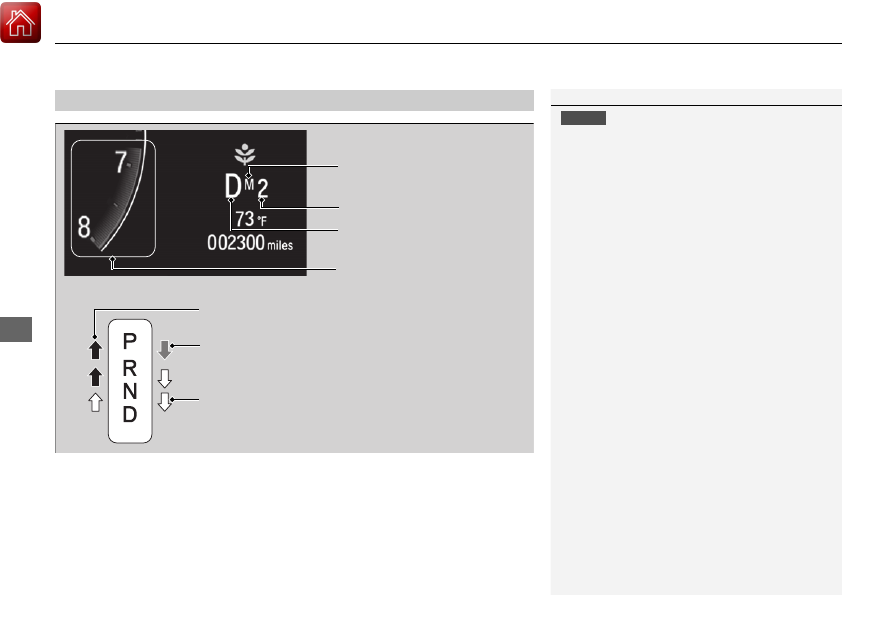
Shift Lever Operation

1

Shift Lever Operation

NOTICE

When you change the shift position from 

(

D

 to 

(

R


and vice versa, come to a complete stop and keep the 
brake pedal depressed.
Operating the shift lever before the vehicle has come 
to a complete standstill can damage the transmission.

Use the shift position indicator to check the lever 
position before pulling away.

If the transmission system indicator blinks when 
driving, in any shift position, there is a problem with 
the transmission.
Avoid sudden acceleration and have the transmission 
checked by a dealer as soon as possible.

The fuel supply may be cut off if you drive at engine 
speeds in or over the tachometer’s red zone (engine 
speed limit). If this happens, you may experience a 
slight jolt.

It may not be possible to operate the shift lever if the 
brake pedal is applied while the shift lever release 
button is held down.
Depress the brake pedal first.

When shifting positions in extremely low 
temperatures (-22°F/-30°C), there may be a short 
delay before the shift position is displayed. Always 
confirm you are in the correct shift position before 
driving.

Depress the brake pedal and press the shift lever release 
button to shift.

Shift without pressing the shift lever release button.

Press the shift lever release button and shift.

Shift Position Indicator 
(Transmission System Indicator)

Tachometer’s red zone

M

 (7-Speed Manual Shift Mode) 

Indicator

Gear Selection Indicator 

Continued

431

uu

When Driving

u

Shifting

Driving

Use the paddle shifters to change between 1st and 7th speeds without releasing 
your hands from the steering wheel. The transmission switches to the 7-speed 
manual shift mode when you pull a paddle shifter while driving. This mode is useful 
when engine braking is needed.

When the transmission is in 

(

D

:

The shift mode goes into the 7-speed manual shift mode temporarily, and the 
number is displayed in the gear selection indicator.
The 7-speed manual shift mode is canceled automatically if you drive at constant 
speed or accelerate, and the number in the gear selection indicator goes off.
You can cancel this mode by pulling the 

(

+

 paddle shifter for a few seconds.

The 7-speed manual shift mode is especially useful when reducing the vehicle speed 
temporarily before making a turn.

When the transmission is in 

(

D

 with SPORT mode:

The shift mode goes into the 7-speed manual shift mode. The 

M

 indicator and the 

speed number are displayed in the gear selection indicator. As the vehicle speed 
slows down, the transmission automatically shifts down accordingly. When the 
vehicle comes to a stop, it automatically shifts down into 1st.

If the vehicle speed increases and the engine speed reaches near the tachometer’s 
red zone, the transmission automatically shifts up.

You can only pull away in 1st speed.

When canceling the 7-speed manual shift mode, pressing the 

SPORT

 button. When 

the 7-speed manual shift mode is canceled, the 

M

 indicator and gear selection 

indicator go off.

7-Speed Manual Shift Mode

1

7-Speed Manual Shift Mode

In the 7-speed manual shift mode, the transmission 
shifts up or down by operating either paddle shifter 
under the following conditions:
Shift Up: The engine speed reaches the lowest 
threshold of the higher speed position.
Shift Down: The engine speed reaches the highest 
threshold of the lower speed position.

When the engine speed reaches near the 
tachometer’s red zone, the transmission shifts up 
automatically.
When the engine speed reaches the lowest threshold 
of the selected speed position, the transmission shifts 
down automatically.

Operating the paddle shifters on slippery surfaces 
may cause the tires to lock up. In this case, the 7-
speed manual shift mode is canceled and goes back 
to the normal 

(

D

 driving mode.

uu

When Driving

u

Shifting

432

Driving

7-Speed Manual Shift Mode Operation

1

7-Speed Manual Shift Mode Operation

Each paddle shift operation makes a single speed 
change.
To change continuously, release the paddle shifter 
before pulling it again for the next speed.

The gear selection indicator blinks when you cannot 
shift up or down. It indicates that your vehicle speed 
is not in its allowable shifting range.
Slightly accelerate to shift up and decelerate to shift 
down while the indicator is blinking.

(

-

 Paddle Shifter 

(Shift down)

(

+

 Paddle Shifter 

(Shift up)

Downshifting when pulling 
the 

(

-

 paddle shifter. 

(Changes to lower speed 
number)

Upshifting when pulling 
the 

(

+

 paddle shifter. 

(Changes to higher speed 
number)

433

uu

When Driving

u

SPORT Mode

*

Driving

SPORT Mode

*

To turn the SPORT mode on and off, press the 

SPORT

 button.

The SPORT mode increases engine performance, transmission and handling

*

.

This mode is suitable for driving on hills or through curves on mountain roads.

The SPORT mode is turned off every time you start the engine, even if you turned it 
on the last time you drove the vehicle.

The ambient meter color changes to a constant red and the turbo meter appears on 
the driver information interface.

SPORT

 Button

SPORT

 Mode Indicator

Models with adaptive 
damper system

Models without adaptive 
damper system

* Not available on all models

434

uu

When Driving

u

ECON Mode

Driving

ECON Mode

The 

ECON

 button turns the ECON mode on and off.

The ECON mode helps you improve your fuel economy by adjusting the 
performance of the engine, transmission and climate control system.

*1 : Models without the adaptive damper system
*2 : Models with the adaptive damper system
*3 : Models without SPORT mode
*4 : Models with SPORT mode

1

ECON Mode

While in ECON mode, the climate control system has 
greater temperature fluctuation.

*1

*2

*3

*4

ECON

 Button

ECON Mode Indicator

435

uu

When Driving

u

Auto Idle Stop

*

Continued

Driving

Auto Idle Stop

*

To help maximize fuel economy, the engine automatically stops when the vehicle 
comes to a stop, depending on environmental and vehicle operating conditions. The 
indicator (green) comes on at this time.

The environmental and vehicle conditions that 
impact Auto Idle Stop system operation are 
varied.

2

Auto Idle Stop Activates When:

 P. 437

The engine then restarts once the vehicle is 
about to move again, and the indicator 
(green) goes off.

2

The Engine Automatically Restarts When:


P. 439

If the driver’s door is opened while the 
indicator (green) comes on, a buzzer sounds 
to notify you that the Auto Idle Stop function 
is in operation.

1

Auto Idle Stop

*

The 12-volt battery installed in this vehicle is 
specifically designed for a model with Auto Idle Stop. 
Using a 12-volt battery other than this specified type 
may shorten the 12-volt battery life, and prevent 
Auto Idle Stop from activating. If you need to replace 
the 12-volt battery, make sure to select the specified 
type. Ask a dealer for more details.

The duration of the Auto Idle Stop operation:

Increase in the ECON mode, compared to when the 
ECON mode is off, with climate control in use.

2

ECON Mode

 P. 434

Auto Idle Stop 
Indicator (Green)

* Not available on all models

uu

When Driving

u

Auto Idle Stop

*

436

Driving

To turn the Auto Idle Stop system off, press 
this button. The Auto Idle Stop system stops.

u

Auto Idle Stop system will stop and the 
indicator (amber) will come on.

The Auto Idle Stop system is turned on every 
time you start the engine, even if you turned it 
off the last time you drove the vehicle.

Auto Idle Stop System ON/OFF

1

Auto Idle Stop System ON/OFF

If you turn off the Auto Idle Stop system while it is 
activated, the engine will restart.

Auto Idle Stop 

OFF

 Button

Auto Idle Stop System 
Indicator (Amber)

Continued

437

uu

When Driving

u

Auto Idle Stop

*

Driving

The vehicle stops with the shift position in 

(

D

 and the brake pedal depressed.

When you shift into 

(

P

 quickly with depressing the brake pedal, the Auto Idle Stop 

continues to operate, even if the brake pedal is released.

u

If you move the shift lever slowly, the engine may automatically restart.

Auto Idle Stop does not activate when:

The Auto Idle Stop 

OFF

 button is pressed.

The driver’s seat belt is not fastened.

The engine is not adequately warmed up or coolant temperature is high.

The engine is started with the hood open.

u

Turn off the engine. Close the hood before you restart the engine to activate 
Auto Idle Stop.

The battery charge is low.

The internal temperature of the battery is 41°F (5°C) or less.

The transmission fluid temperature is low or high.

The transmission is in a position other than 

(

D

.

The vehicle comes to a stop again before the vehicle speed reaches 3 mph (5 km/h) 
after the engine starts.

The vehicle is stopped on a steep incline.

 is on (indicator on).

The climate control system is in use, and the temperature is set to 

Hi

 or 

Lo

.

The climate control system is in use, and the outside temperature is below -4°F 
(-20°C) or over 104°F (40°C).

The SPORT mode is on.

Auto Idle Stop Activates When:

1

Auto Idle Stop Activates When:

Do not open the hood while the Auto Idle Stop 
function is activated.
If the hood is opened, the engine will not restart 
automatically.

In this case, restart the engine with the 

ENGINE 

START/STOP

 button.

2

Starting the Engine

 P. 412

When ACC with Low Speed Follow is in operation, 
the vehicle stops without depressing the brake pedal 
and Auto Idle Stop may activate.
In such cases, the engine may restart if you change 
the shift position other than 

(

D

.

Pressing the 

ENGINE START/STOP

 button causes 

the engine to no longer restarts automatically. Follow 
the standard procedure to start the engine.

2

Starting the Engine

 P. 412

Models with SPORT mode

438

uu

When Driving

u

Auto Idle Stop

*

Driving

Auto Idle Stop may not activate when:

The steering wheel is operated.

Altitude is high.

The vehicle is stopped by braking suddenly.

The vehicle is repeatedly accelerated and decelerated at a low speed.

The fan speed is high.

The climate control system is in use, and there is a significant difference between 
the set temperature and the actual interior temperature.

The climate control system is in use, and humidity in the interior is high.

439

uu

When Driving

u

Auto Idle Stop

*

Driving

The brake pedal is released (without the automatic brake hold system activated).

The accelerator pedal is depressed (with the automatic brake hold system activated).

2

Automatic Brake Hold

 P. 513

The engine restarts even if the brake pedal is depressed

*1

 when:

The Auto Idle Stop 

OFF

 button is pressed.

A steering wheel is operated.

The transmission is put into 

(

R

(

S

*

, and 

(

L

*

, or when it is set from 

(

N

 to 

(

D

.

u

If you put the transmission into 

(

P

 after the Auto Idle Stop activates, the Auto 

Idle Stop continues to operate. In this case, the engine restarts when you move 
the shift lever other than 

(

P

. When operating the shift lever, the brake pedal 

must be firmly depressed.

The pressure on the brake pedal is reduced and the vehicle starts moving while 
stopped on an incline.

The brake pedal is released slightly during a stop.

The battery charge becomes low.

The accelerator pedal is depressed.

The driver’s seat belt is unlatched.

 is on (indicator on).

The climate control system is in use, and the difference between the set 
temperature and actual interior temperature becomes significant.

The climate control system is being used to dehumidify the interior.

The vehicle ahead of you starts again when your vehicle stops automatically with 
ACC with Low Speed Follow.

The SPORT mode is changed to on.

Briefly keeps the brake applied after releasing the brake pedal to restart the engine. 
This can keep your vehicle from unexpectedly moving while on an incline.

The Engine Automatically Restarts When:

Starting Assist Brake Function

1

The Engine Automatically Restarts When:

If you are using an electronic device during Auto Idle 
Stop, the device may temporarily be turned off when 
the engine restarts. 

1

The engine restarts even if the brake pedal is depressed

*1

 when:

*1: With the automatic brake hold system activated, 
you can release the brake pedal while Auto Idle Stop 
is in operation.

If the automatic brake hold system has been turned 
off, or if there is a problem with the system, the 
engine will restart automatically when you release 
the brake pedal.

2

Automatic Brake Hold

 P. 513

Models with SPORT mode

* Not available on all models

440

uu

When Driving

u

Adaptive Damper System

*

Driving

Adaptive Damper System

*

Constantly controls your vehicle’s front and rear dampers according to current road 
conditions, vehicle speed and steering operation.

You can change handling response by turning the SPORT mode on.

2

SPORT Mode

*

 P. 433

* Not available on all models

441

uu

When Driving

u

Vehicle Stability Assist

TM

 (VSA

®

), aka Electronic Stability Control (ESC), System

Continued

Driving

Vehicle Stability Assist

TM

 (VSA

®

), aka Electronic 

Stability Control (ESC), System

VSA

®

 helps stabilize the vehicle during cornering if the vehicle turns more or less 

than what was intended. It also assists in maintaining traction on slippery surfaces. 
It does so by regulating engine output and selectively applying the brakes.

When VSA

®

 activates, you may notice that the 

engine does not respond to the accelerator. 
You may also notice some noise from the 
hydraulic brake system. You will also see the 
indicator blink.

VSA

®

 Operation

1

Vehicle Stability Assist

TM

 (VSA

®

), aka Electronic Stability Control 

(ESC), System

The VSA

®

 may not function properly if tire type and 

size are mixed. Make sure to use the same size and 
type of tire, and the air pressures as specified.

When the VSA

®

 system indicator comes on and stays 

on while driving, there may be a problem with the 
system. While this may not interfere with normal 
driving, have your vehicle checked by a dealer 
immediately.

VSA

®

 cannot enhance stability in all driving situations 

and does not control the entire braking system. You 
still need to drive and corner at speeds appropriate 
for the conditions and always leave a sufficient 
margin of safety.

The main function of the VSA

®

 system is generally 

known as Electronic Stability Control (ESC). The 
system also includes a traction control function.

The Vehicle Stability Assist

TM

 (VSA

®

) system, Vehicle 

Stability Assist

TM

 (VSA

®

OFF

, adaptive cruise control 

(ACC) with Low Speed Follow, safety support and 
low tire pressure/TPMS indicators may come on in 
amber along with a message in the driver information 
interface when you set the power mode to ON after 
reconnecting the battery.
Drive a short distance at more than 12 mph (20 km/h).
Each indicator should go off. If any do not, have your 
vehicle checked by a dealer.

VSA

®

 System 

Indicator

uu

When Driving

u

Vehicle Stability Assist

TM

 (VSA

®

), aka Electronic Stability Control (ESC), System

442

Driving

This button is on the driver side control panel. 
To partially disable VSA

®

 functionality/features, 

press and hold it until you hear a beep.

Your vehicle will have normal braking and 
cornering ability, but traction control function 
will be less effective.

To restore VSA

®

 functionality/features, press 

the  

(VSA

®


OFF

) button until you hear a 

beep.

VSA

®

 is turned on every time you start the 

engine, even if you turned it off the last time 
you drove the vehicle.

VSA

®

 On and Off

1

Vehicle Stability Assist

TM

 (VSA

®

), aka Electronic Stability Control 

(ESC), System

In certain unusual conditions when your vehicle gets 
stuck in shallow mud or fresh snow, it may be easier 
to free it with the VSA

®

 temporarily switched off.

When the 

 button is pressed, the traction control 

function becomes less effective. This allows for the 
wheels to spin more freely at low speed. You should 
only attempt to free your vehicle with the VSA

®

 off if 

you are not able to free it when the VSA

®

 is on.

Immediately after freeing your vehicle, be sure to 
switch VSA

®

 on again. We do not recommend driving 

your vehicle with the VSA

®

 system switched off.

You may hear a motor sound coming from the 
engine compartment while system checks are being 
performed immediately after starting the engine or 
while driving. This is normal.

VSA

®


OFF

 Indicator

443

uu

When Driving

u

Agile Handling Assist

Driving

Agile Handling Assist

Lightly brakes the front wheels, as needed, when you turn the steering wheel, and 
helps support the vehicle’s stability and performance during cornering.

1

Agile Handling Assist

The agile handling assist cannot enhance stability in 
all driving situations. You still need to drive and 
corner at speeds appropriate for the conditions and 
always leave a sufficient margin of safety.

When the VSA

®

 system indicator comes on and stays 

on while driving, the agile handling assist does not 
activate.

You may hear a sound coming from the engine 
compartment while the agile handling assist is 
activated. This is normal.

444

uu

When Driving

u

Tire Pressure Monitoring System (TPMS)

Driving

Tire Pressure Monitoring System (TPMS)

Instead of directly measuring the pressure in each tire, the TPMS on this vehicle 
monitors and compares the rolling radius and rotational characteristics of each 
wheel and tire while you are driving to determine if one or more tires are 
significantly under-inflated.

This will cause the low tire pressure/TPMS 
indicator to come on and a message to appear 
on the driver information interface.

1

Tire Pressure Monitoring System (TPMS)

The system does not monitor the tires when driving 
at low speed.

Conditions such as low ambient temperature and 
altitude change directly affect tire pressure and can 
trigger the low tire pressure/TPMS indicator to come on.

Tire pressure checked and inflated in:

Warm weather can become under-inflated in 
colder weather.

Cold weather can become overinflated in warmer 
weather.

The low tire pressure/TPMS indicator will not come 
on as a result of overinflation.

The TPMS may not function properly if tire type and 
size are mixed. Make sure to use the same size and 
type of tire.

2

Checking and Maintaining Tires

 P. 575

The low tire pressure/TPMS indicator may come on 
with a delay or may not come on at all when:

You rapidly accelerate, decelerate, or turn the 
steering wheel.

You drive on snowy or slippery roads.

Tire chains

*

 are used.

Low Tire Pressure/
TPMS Indicator

* Not available on all models

Continued

445

uu

When Driving

u

Tire Pressure Monitoring System (TPMS)

Driving

1

Tire Pressure Monitoring System (TPMS)

The low tire pressure/TPMS indicator may come on 
under the following conditions:

A compact spare tire is used.

There is a heavier and uneven load on the tires, 
such as when towing a trailer

*

, than the condition 

at calibration.

Tire chains

*

 are used.

The Vehicle Stability Assist

TM

 (VSA

®

) system, Vehicle 

Stability Assist

TM

 (VSA

®

OFF

, adaptive cruise control 

(ACC) with Low Speed Follow, safety support and 
low tire pressure/TPMS indicators may come on in 
amber along with a message in the driver information 
interface when you set the power mode to ON after 
reconnecting the battery.
Drive a short distance at more than 12 mph (20 km/h).
Each indicator should go off. If any do not, have your 
vehicle checked by a dealer.

* Not available on all models


Content      ..     25      26      27      28     ..