Honda HR-V eHEV (2022 year). Manual in english - page 25
 

  Index      Manuals     Honda HR-V eHEV (2022 year). Manual in english


Search            copyright infringement  


Content      ..     23      24      25      26     ..


Honda HR-V eHEV (2022 year). Manual in english - page 25


401

uu

When Driving

u

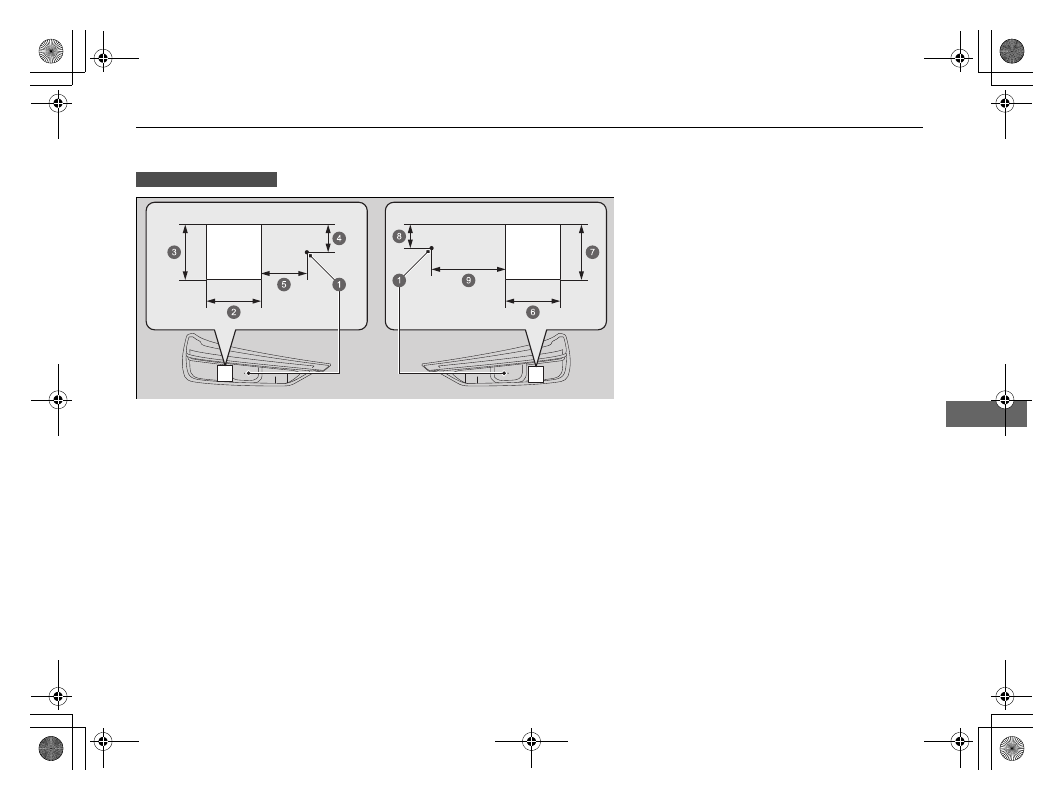
Adjusting Headlight Distribution

Driving

1.

Prepare for two pieces of masking tape as shown.

u

Use masking tape that can shut out light, such as seal type waterproof vinyl.

2.

Affix the tape to the lens as shown.

Right-hand drive models

a

Centre Point

b

53 mm

c

45 mm

d

23 mm

e

42 mm

f

44 mm

g

45 mm

h

23 mm

i

72 mm

402

Driving

Honda Sensing

Honda Sensing is a driver support system which employs the use of two distinctly 
different kinds of sensors, a front wide view camera mounted to the interior side of 
the windscreen, behind the rearview mirror, and the sonar sensors located in the 
front and rear bumpers.

Honda Sensing has following functions.

The functions which do not require switch operations to activate

Collision Mitigation Braking System (CMBS) 

2

 P. 405

Low Speed Braking Control 

2

 P. 417

Road Departure Mitigation System 

2

 P. 453

Traffic Sign Recognition System 

2

 P. 461

The functions which require switch operations to activate

Adaptive Cruise Control (ACC) with Low Speed Follow 

2

 P. 423

Lane Keeping Assist System (LKAS) 

2

 P. 441

403

uu

Honda Sensing

u

Continued

Driving

Operation Switches for the Adaptive Cruise Control (ACC) with 
Low Speed Follow/Lane Keeping Assist System (LKAS)

a

 Button

Press to activate standby mode for ACC 
with Low Speed Follow. Or press to cancel 
the system.

b

LKAS Button

Press to activate standby mode for LKAS. 
Or press to cancel the system.

c

RES/+ and SET/− Buttons

Press to set or resume the ACC with Low 
Speed Follow or to adjust the vehicle 
speed.

d

Interval Button

Press to change the ACC with Low Speed 
Follow following-interval.

e

CANCEL Button

Press to cancel ACC with Low Speed 
Follow.

404

uu

Honda Sensing

u

Driving

You can see the current state of Adaptive 
Cruise Control (ACC) with Low Speed Follow 
and Lane Keeping Assist System (LKAS).

Gauge Content

a

Indicates that ACC with Low Speed Follow 
is ready to be activated.

White: The system is standby.

Green: The system is on.

Amber: There is a problem with the system.

b

Indicates that LKAS is ready to be activated.

White: The system is standby.

Green: The system is on.

Amber: There is a problem with the system.

c

Indicates that LKAS is activated and 
whether or not traffic lane lines are 
detected.

White Lines: Traffic lane lines are 
detected.

Green Lines: The system is on.

Amber Lines: Lane departure is detected.

d

Indicates whether or not ACC with Low 
Speed Follow detected the vehicle ahead.

e

Indicates that ACC with Low Speed Follow 
shows the set vehicle speed.

White: Set Vehicle Speed

Gray: Prior Set Speed

f

Indicates that ACC with Low Speed Follow 
shows the set vehicle interval.

405

uu

Honda Sensing

u

Collision Mitigation Braking System (CMBS)

Continued

Driving

Collision Mitigation Braking System (CMBS)

The system can assist you when it determines there is a possibility of your vehicle 
colliding with a vehicle (including motorcycles) ahead from behind, an oncoming 
vehicle in front, a pedestrian, or someone riding a bicycle (moving bicycle).
The CMBS is designed to alert you when the potential for a collision is determined, 
as well as assist in reducing speed, avoiding collisions, and reducing collision 
severity.

1

Collision Mitigation Braking System (CMBS)

Important Safety Reminder

The CMBS is designed to reduce the severity of an 
unavoidable collision. It does not prevent collision nor 
stop the vehicle automatically. It is still your 
responsibility to operate the brake pedal and steering 
wheel appropriately according to the driving 
conditions.

The CMBS may not activate or may not detect a 
vehicle in front of your vehicle under certain 
conditions:

2

CMBS Conditions and Limitations

 P. 410

You can read about handling information for the 
front wide view camera equipped with this system.

2

Front Wide View Camera

 P. 468

When the CMBS is activated, it will continue to 
operate even if the accelerator pedal is partially 
depressed. However, it will be cancelled if the 
accelerator pedal is fully depressed.

uu

Honda Sensing

u

Collision Mitigation Braking System (CMBS)

406

Driving

How the system works

The system starts monitoring the roadway ahead when your vehicle speed is about 
5 km/h (3 mph) or above and will search for a vehicle, pedestrian, or moving bicycle 
in front of you.

The CMBS activates when:

The speed difference between your vehicle and a vehicle, pedestrian, or moving 
bicycle detected in front of you becomes about 5 km/h (3 mph) and over with a 
chance of a collision.

Your vehicle drives at about 30 km/h (18 mph) or less and there is a chance of in 
frontal collision with oncoming a detected vehicle when you turn left

*1

/right

*2

 at 

an intersection.

Your vehicle speed is about 100 km/h (62 mph) or less and the system determines 
there is a chance of a collision with:

-

An oncoming or stationary vehicle detected in front of you.

-

A pedestrian or moving bicycle detected in front of you.

*1: Left-hand Drive Type
*2: Right-hand Drive Type

1

How the system works

The front wide view camera in the CMBS is also 
designed to detect pedestrians.
However, this pedestrian detection feature may not 
activate or may not detect a pedestrian in front of 
your vehicle under certain conditions.
Refer to the ones indicating the pedestrian detection 
limitations from the list.

2

CMBS Conditions and Limitations

 P. 410

a

The front wide view camera is located behind the rearview mirror.

407

uu

Honda Sensing

u

Collision Mitigation Braking System (CMBS)

Continued

Driving

The CMBS will be cancelled when your vehicle stops or the system determines there 
no longer is the potential for a collision.
The CMBS may also be cancelled when a driver operates the steering wheel and the 
brake or accelerator pedal to avoid a collision.

When the system activates

The system provides visual and audible alerts 
of a possible collision, and stops if the collision 
is avoided.

u

Take appropriate action to prevent a 
collision (apply the brakes, change lanes, 
etc.)

You can change the distance (

Far

/

Normal

/

Near

) between vehicles at which the 

system’s earliest collision alert will come on through the audio/information screen 
setting options.

2

Customized Features

 P. 305

a

Visual Alerts

b

Audible Alert

408

uu

Honda Sensing

u

Collision Mitigation Braking System (CMBS)

Driving

The system has three alert stages for a possible collision. However, depending on circumstances, the CMBS may not go through all of the 
stages before initiating the last stage.

Collision Alert Stages

Distance between vehicles

CMBS

The sensors detect a 

vehicle

Audible & Visual WARNINGS

Braking

Stage one

There is a risk of a collision 
with the vehicle ahead of 
you.

When in 

Far

, visual and audible alerts come on 

at a longer distance from a vehicle ahead than 
in 

Normal

 setting, and in 

Near

, at a shorter 

distance than in 

Normal

.

Stage two

The risk of a collision has 
increased, time to 
respond is reduced.

Visual and audible alerts.

Lightly applied

Stage three

The CMBS determines 
that a collision is 
unavoidable.

Forcefully 

applied

a

Your Vehicle

b

Vehicle Ahead

c

Far

d

Normal

e

Near

Continued

409

uu

Honda Sensing

u

Collision Mitigation Braking System (CMBS)

Driving

When you turn the CMBS on and off, do the 
following.

1.

Press the safety support switch.

2.

Roll the left selector wheel to the 


symbol and push it.

u

A message appears on the driver 
information interface when the system 
turns on or off.

u

A check mark appears in the box and the 
colour of the 

 symbol changes to 

green when the system is on. The check 
mark disappear and the colour of the 


symbol changes to gray when the system 
is off.

The CMBS is turned on every time you turn 
the power system on, even if you turned it off 
the last time you drove the vehicle.

CMBS On and Off

1

Collision Mitigation Braking System (CMBS)

You cannot turn the CMBS off while driving.

The CMBS may automatically shut off, and the safety 
support indicator (amber) will come and stay on 
under certain conditions.

2

CMBS Conditions and Limitations

 P. 410

The CMBS is not activated for about 15 seconds after 
the power system is turned on.

You can also select the safety support content from 
the driver information interface.

2

Driver Information Interface

 P. 135

The adaptive cruise control (ACC) with low speed 
follow (amber), vehicle stability assist (VSA) system, 
vehicle stability assist (VSA) OFF, low tyre pressure/
deflation warning system, and safety support (amber) 
indicators may come on in amber along with a 
message in the gauge when you set the power mode 
to ON after reconnecting the 12-volt battery. Drive a 
short distance at more than 20 km/h (12 mph). Each 
indicator should go off. If any do not, have your 
vehicle checked by a dealer.

Have your vehicle checked by a dealer if you find any 
unusual behaviour of the system (e.g. the warning 
message appears too frequently).

a

Safety Support Switch

b

Left Selector Wheel

410

uu

Honda Sensing

u

Collision Mitigation Braking System (CMBS)

Driving

The system may automatically shut off and the safety support indicator (amber) will 
come on under certain conditions. Some examples of these conditions are listed 
below. Other conditions may reduce some of the CMBS functions.

2

Front Wide View Camera

 P. 468

Environmental conditions

Driving in bad weather (rain, fog, snow, etc.).

Sudden changes between light and dark, such as the entrance or exit of a tunnel 
or the shadows of trees, buildings, etc.

Driving into low sunlight (e.g., at dawn or dusk).

Strong light is reflected onto vehicles, pedestrians, moving bicycles, or road 
surfaces.

Water is sprayed by or snow blown from a vehicle ahead.

Driving at night or in a dark place such as a tunnel (due to low-light conditions, 
vehicles, pedestrians, or moving bicycles may not be illuminated).

Roadway conditions

Driving on curvy, winding, undulating, or sloping roads.

There is a film of water or puddles on the road surface.

Driving on rutted roads (snowy or unpaved roads, etc.).

Your vehicle is strongly shaken on uneven road surfaces.

CMBS Conditions and Limitations

411

uu

Honda Sensing

u

Collision Mitigation Braking System (CMBS)

Continued

Driving

Vehicle conditions

The vehicle is tilted due to heavy luggage in the luggage area or rear seats.

Tyre chains are installed.

Driving at night or in a dark place (e.g., a tunnel) with the headlights off.

The front of the front wide view camera is covered by dirt, fog, rain, mud, wet 
snow, seals, accessories, stickers, or film on the windscreen.

There is residue on the windscreen from the windscreen wipers.

When lighting is weak due to dirt covering the headlight lenses, or there is poor 
visibility in a dark place due to the headlights being improperly adjusted.

Abnormal tyre or wheel condition (incorrect sizes, varied sizes or construction, 
improperly inflated, etc.).

The suspension has been modified.

uu

Honda Sensing

u

Collision Mitigation Braking System (CMBS)

412

Driving

Examples of limitations on the correct detection of the front wide view 
camera due to the condition of the vehicle ahead of you, oncoming 
vehicles, pedestrians, or moving bicycles

The distance between your vehicle and the vehicle ahead of you, oncoming 
vehicle, pedestrian, or moving bicycle ahead of you is too short.

The vehicle ahead of you, oncoming vehicle, pedestrian, or moving bicycle 
suddenly cuts in front of or jumps out in front of you.

The bicycle is stopped.

The oncoming vehicle or vehicle ahead of you is sideways.

When the vehicle ahead of you, oncoming vehicle, pedestrian, or moving bicycle 
blends in with the background, preventing the system from recognising them.

When several pedestrians or bicycles are moving ahead of you in a group.

When a pedestrian or moving bicycle crosses the road too quickly.

A pedestrian or moving bicycle approaches from the opposite direction.

The headlights of the vehicle ahead of you or oncoming vehicle are lit on one side 
or not lit on either side in a dark place.

When part of a pedestrian (heads, limbs, etc.) is hidden by luggage.

When a pedestrian is bent over or squatting, when their hands are raised, or they 
are running.

When the pedestrian is shorter than about 1 metre (3.3 feet) or taller than about 
2 metres (6.6 feet) in height.

When the pedestrian is pushing a stroller or bicycle.

1

Collision Mitigation Braking System (CMBS)

Make sure that all the tyres are of the same specified 
size, type and brand, and that they are evenly worn.
If you use tyres of different sizes, types, brands, or 
degree of wear, the system may not work properly.

Do not modify the suspension. Altering the height of 
the vehicle may prevent the system from working 
properly.

413

uu

Honda Sensing

u

Collision Mitigation Braking System (CMBS)

Continued

Driving

Examples of other limitations on detection or system operation

When the vehicle ahead of you is a small motorcycle, motorcycle with a sidecar, 
wheelchair, or other specially shaped vehicle.

When a vehicle is lower in the rear than the front such as lorries that are not 
carrying a load, or a narrow vehicle.

When the vehicle ahead of you, oncoming vehicle, pedestrian or moving bicycle 
is not in front of the vehicle.

The speed difference between your vehicle and the vehicle ahead of you, 
oncoming vehicle, pedestrian or moving bicycle is significantly large.

When the vehicle or moving bicycle in front of you slows suddenly.

When the driver operates the brake pedal and steering wheel to avoid a collision.

When you approach the vehicle ahead of you, oncoming vehicle, pedestrians or 
moving bicycles while accelerating rapidly or operating the steering wheel (except 
when turning left

*1

/right

*2

 at an intersection etc.)

*3

.

When the moving bicycle is a child-sized bicycle, folding bicycle, three-wheeler or 
other bicycle with small tyres, or a long bicycle like a tandem bicycle.

When the front wide view camera cannot correctly identify the shape of the 
vehicle ahead of you, oncoming vehicle, pedestrian, or moving bicycle.

When the minimum ground clearance of a vehicle ahead of you is extremely high.

*1: Left-hand Drive Type
*2: Right-hand Drive Type
*3: When there is a possibility of a frontal collision with the oncoming vehicle while turning 
left

*1

/right

*2

, the CMBS is activated. However, it may not be activated if you suddenly turn the 

steering wheel.

414

uu

Honda Sensing

u

Collision Mitigation Braking System (CMBS)

Driving

Automatic shutoff

The CMBS may automatically shut itself off and the safety support indicator (amber) 
comes and stays on when:

You drive off-road or on a mountain road, or curved and winding road for an 
extended period.

Driving in bad weather (rain, fog, snow, etc.).

Driving with the parking brake applied.

The front wide view camera temperature gets too high.

The front of the front wide view camera is covered by dirt, fog, rain, mud, wet 
snow, seals, accessories, stickers, or film on the windscreen.

An abnormal tyre condition is detected (incorrect tyre size, flat tyre, etc.).

Once the conditions that caused the CMBS to shut off improve or are addressed 
(e.g., cleaning), the system comes back on.

415

uu

Honda Sensing

u

Collision Mitigation Braking System (CMBS)

Continued

Driving

Even if there is little chance of a collision, the CMBS may activate under the 
following conditions:

Your vehicle approaches or passes another vehicle that is making a left or right 
turn.

Your vehicle approaches another vehicle ahead of you and you change lanes to 
pass.

Your vehicle approaches another vehicle at an intersection, etc.

With Little Chance of a Collision

416

uu

Honda Sensing

u

Collision Mitigation Braking System (CMBS)

Driving

When passing through a low or narrow gate at a speed well over the speed limit.

When there are traffic signs or structures such as guard rails are beside the road 
along a curve.

When driving through curves, your vehicle comes to a point where the oncoming 
vehicle is right in front of you.

When approaching stationary vehicles or walls, such as when parking.


Content      ..     23      24      25      26     ..