Honda CR-V (2022 year). Manual in english - page 32
 

  Index      Manuals     Honda CR-V (2022 year). Manual in english


Search            copyright infringement  


Content      ..     30      31      32      33     ..


Honda CR-V (2022 year). Manual in english - page 32


510

Driving

When Driving

Starting the Engine

1.

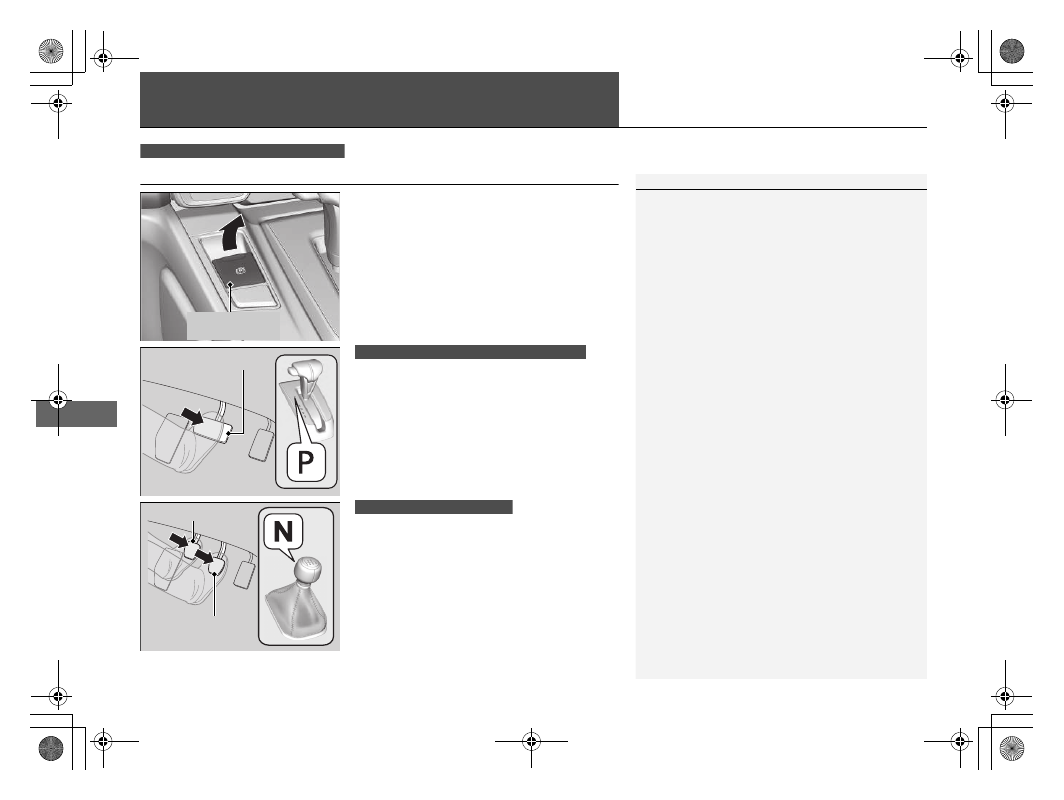
Make sure the parking brake is applied.

u

The parking brake and brake system 
indicator (red) comes on for 15 seconds 
when you pull up the electric parking 
brake switch.

2.

Check that the shift lever is in 

(

P

, then 

depress the brake pedal.

u

Although it is possible to start the vehicle 
in 

(

N

, it is safer to start it in 

(

P

.

2.

Check that the shift lever is in 

(

N

. Then 

depress the brake pedal with your right 
foot, and the clutch pedal with your left 
foot.

u

The clutch pedal must be fully depressed 
to start the engine.

Models without keyless access system

1

Starting the Engine

Keep your foot firmly on the brake pedal when 
starting the engine.

The engine is harder to start in cold weather and in 
thinner air found at altitudes above 2,400 metres 
(8,000 feet).

When starting the engine in cold weather, turn off all 
electrical accessories such as the lights, climate 
control system, and rear demister in order to reduce 
battery drain.

If the exhaust system sounds abnormal or you can 
smell exhaust gas inside the vehicle, have your vehicle 
checked by a dealer. There may be a problem with 
the engine or exhaust system.

Electric Parking 
Brake Switch

Brake Pedal

Continuously variable transmission models

Clutch Pedal

Brake Pedal

Manual transmission models

Continued

511

uu

When Driving

u

Starting the Engine

Driving

3.

Turn the ignition switch to START 

(

e


without depressing the accelerator pedal.

1

Starting the Engine

Do not hold the key in START 

(

e

 for more than 10 

seconds.

If the engine does not start right away, wait for at 
least 30 seconds before trying again.

If the engine starts, but then immediately stops, 
wait at least 30 seconds before repeating step 3 
while gently depressing the accelerator pedal. 
Release the accelerator pedal once the engine 
starts.

The immobilizer system protects your vehicle from 
theft. If an improperly coded device is used, the 
engine’s fuel system is disabled.

2

Immobilizer System

 P. 200

All models

uu

When Driving

u

Starting the Engine

512

Driving

1.

Keeping your right foot on the brake pedal, put the shift lever in 

(

D

. Select 

(

R


when reversing.

2.

With the parking brake applied, release the brake pedal and gently depress the 
accelerator pedal.

u

Make sure the parking brake and brake system indicator (red) goes off.

2

Parking Brake

 P. 626

Hill start assist system

Hill start assist keeps the brake engaged briefly to help to prevent the vehicle from 
rolling on inclines as you move your foot from the brake pedal to the accelerator.

Put the transmission into 

(

D

 or 

(

S

 when facing uphill, or 

(

R

 when facing downhill, 

then release the brake pedal.

Depress the clutch pedal, and shift to one of the forward gears when facing uphill, 
or 

(

R

 when facing downhill, then release the brake pedal.

Starting to Drive

1

Starting to Drive

If the engine stalls, fully depress the clutch pedal 
within three seconds. The engine may automatically 
restart under certain conditions. Otherwise, follow 
the standard procedure.

2

Starting the Engine

 P. 510

You can also release the parking brake by pressing 
the electric parking brake switch while depressing the 
brake pedal. When facing downhill, you can start 
your vehicle more smoothly by manually releasing it 
with the electric parking brake switch than by 
releasing it with the accelerator pedal.

Manual transmission models

Continuously variable transmission models

1

Hill start assist system

Hill start assist may not prevent the vehicle from 
rolling downhill on a very steep or slippery slope, and 
will not operate on small inclines.

Hill start assist is not a replacement for the parking 
brake.

Hill start assist will operate even when VSA is 
switched off.

Continuously variable transmission models

Manual transmission models

513

uu

When Driving

u

Starting the Engine

Continued

Driving

Starting the Engine

1.

Make sure the parking brake is applied.

u

The parking brake and brake system 
indicator (red) comes on for 15 seconds 
when you pull up the electric parking 
brake switch.

2.

Check that the transmission is in 

(

P

, then 

depress the brake pedal.

u

Although it is possible to start the vehicle 
in 

(

N

, it is safer to start it in 

(

P

.

2.

Check that the shift lever is in 

(

N

. Then 

depress the brake pedal with your right 
foot, and the clutch pedal with your left 
foot.

u

The clutch pedal must be fully depressed 
to start the engine.

Models with keyless access system

1

Starting the Engine

Keep your foot firmly on the brake pedal when 
starting the engine.

The engine is harder to start in cold weather and in 
thinner air found at altitudes above 2,400 metres 
(8,000 feet).

When starting the engine in cold weather, turn off all 
electrical accessories such as the lights, climate 
control system, and rear demister in order to reduce 
battery drain.

If the exhaust system sounds abnormal or you can 
smell exhaust gas inside the vehicle, have your vehicle 
checked by a dealer. There may be a problem with 
the engine or exhaust system.

Bring the keyless remote close to the 

ENGINE 

START/STOP

 button if the battery in the keyless 

remote is weak.

2

If the Keyless Remote Battery is Weak


P. 742

The engine may not start if the keyless remote is 
subjected to strong radio waves.

Electric Parking 
Brake Switch

Brake Pedal

Continuously variable transmission models

Clutch Pedal

Brake Pedal

Manual transmission models

uu

When Driving

u

Starting the Engine

514

Driving

3.

Press the 

ENGINE START/STOP

 button 

without depressing the accelerator pedal.

You can turn the engine off when the vehicle is completely stopped.

1.

Put the transmission into 

(

P

.

2.

Press the 

ENGINE START/STOP

 button.

If the shift lever is in 

(

N

, press the 

ENGINE START/STOP

 button.

If the shift lever is in any gear other than 

(

N

, depress the clutch pedal, then press 

the 

ENGINE START/STOP

 button.

1

Starting the Engine

Do not hold the 

ENGINE START/STOP

 button to 

start the engine.
If the engine does not start, wait at least 30 seconds 
before trying again.

The immobilizer system protects your vehicle from 
theft. If an improperly coded device is used, the 
engine’s fuel system is disabled.

2

Immobilizer System

 P. 200

All models

Stopping the Engine

Continuously variable transmission models

Manual transmission models

515

uu

When Driving

u

Starting the Engine

Driving

1.

Keeping your right foot on the brake pedal, put the shift lever in 

(

D

. Select 

(

R


when reversing.

2.

With the parking brake is applied, release the brake pedal and gently depress the 
accelerator pedal.

u

Make sure the parking brake and brake system indicator (red) goes off.

2

Parking Brake

 P. 626

Hill start assist system

Hill start assist keeps the brake engaged briefly to help to prevent the vehicle from 
rolling on inclines as you move your foot from the brake pedal to the accelerator.

Put the transmission into 

(

D

 or 

(

S

 when facing uphill, or 

(

R

 when facing downhill, 

then release the brake pedal.

Depress the clutch pedal, and shift to one of the forward gears when facing uphill, 
or 

(

R

 when facing downhill, then release the brake pedal.

Starting to Drive

1

Starting to Drive

If the engine stalls, fully depress the clutch pedal 
within three seconds. The engine may automatically 
restart under certain conditions. Otherwise, follow 
the standard procedure.

2

Starting the Engine

 P. 513

You can also release the parking brake by pressing 
the electric parking brake switch while depressing the 
brake pedal. When facing downhill, you can start 
your vehicle more smoothly by manually releasing it 
with the electric parking brake switch than by 
releasing it with the accelerator pedal.

Manual transmission models

Continuously variable transmission models

1

Hill start assist system

Hill start assist may not prevent the vehicle from 
rolling downhill on a very steep or slippery slope, and 
will not operate on small inclines.

Hill start assist is not a replacement for the parking 
brake.

Hill start assist will operate even when VSA is 
switched off.

Continuously variable transmission models

Manual transmission models

516

uu

When Driving

u

Precautions While Driving

Driving

Precautions While Driving

Utility vehicles have a significantly higher rollover rate than other types of vehicles. 
To prevent rollovers or loss of control:

Take corners at slower speeds than you would with a passenger vehicle.

Avoid sharp turns and abrupt manoeuvres whenever possible.

Do not modify your vehicle in any way that you would raise the centre of gravity.

Do not carry heavy luggage on the roof.

Visibility becomes low when it is foggy. When you drive, turn on the low beam 
headlights even during the daytime. Slow down, using the road line in the centre, 
guard rails, and the taillights of the vehicle ahead of you as your driving guide.

If a strong side wind drifts your vehicle while driving, hold the steering wheel tight. 
Slowly decelerate your vehicle and keep your vehicle in the middle of the road. Be 
careful with wind gusts especially when your vehicle is exiting a tunnel, driving on a 
bridge or river bank, and driving through an open area like a quarry, and when a 
large lorry is passing by.

Driving Guidelines for Your Utility Vehicle

In a Fog

In a Strong Wind

1

Precautions While Driving

CAUTION: 

Do not drive on the road where water is 

deep. Driving through deep water will cause damage 
to the engine and electrical equipment and the 
vehicle will break down.

NOTICE

Do not operate the shift lever while pressing the 
accelerator pedal. You could damage the 
transmission.

NOTICE

If you repeatedly turn the steering wheel at an 
extremely low speed, or hold the steering wheel in 
the full left or right position for a while, the electric 
power steering (EPS) system heats up. The system 
goes into a protective mode, and limits its 
performance. The steering wheel becomes harder 
and harder to operate. Once the system cools down, 
the EPS system is restored.
Repeated operation under these conditions can 
eventually damage the system.

If the ignition switch is turned to ACCESSORY 

(

q

*1


while driving, the engine will shut down and all 
steering and brake power assist functions will stop, 
making it difficult to control the vehicle.

Do not put the shift lever in 

(

N

, as you will lose 

engine braking (and acceleration) performance.

*1: Models with the keyless access system have an 

ENGINE 

START/STOP

 button instead of an ignition switch.

517

uu

When Driving

u

Precautions While Driving

Driving

The road is slippery when raining. Avoid hard braking, rapid acceleration, and 
abrupt steering and be more cautious when driving. It is likely to experience 
hydroplaning phenomenon if you are driving on a rutted road with puddles. Do not 
driving in deep water and on flooded roads. This can damage the engine or 
driveline, or cause electrical component failure.

If there is a strong impact with something under the vehicle, stop in a safe location. 
Check the underside of the vehicle for damage or any fluid leaks.

In Rain

Other Precautions

1

Precautions While Driving

During the first 1,000 km (625 miles) of operation, 
avoid sudden acceleration or full throttle operation so 
as not to damage the engine or powertrain.

Avoid hard braking for the first 300 km (200 miles).
You should also follow this when the brake pads are 
replaced.

1

Driving Guidelines for Your Utility Vehicle

Failure to operate your vehicle correctly might result 
in a crash or a rollover.

2

Important Handling Information

 P. 40

2

Precautions While Driving

 P. 516

1

In Rain

Be careful when hydroplaning phenomenon occurs. 
When you drive on a road covered with water at 
excessive speed, a layer of water builds between the 
tyres and the road surface. If this occurs, the vehicle 
cannot respond to control inputs such as steering, 
and braking.

Slowly decelerate when you shift down. If the road is 
slippery, sudden engine braking can cause the tyres 
to skid.

518

uu

When Driving

u

Continuously Variable Transmission

*

Driving

Continuously Variable Transmission

*

The engine runs at a higher idle speed and creeping increases.
Keep the brake pedal firmly depressed when stopped.

Quickly depressing the accelerator pedal while driving uphill may cause the 
transmission to drop to a lower ratio, unexpectedly increasing vehicle speed. 
Depress the accelerator pedal carefully, especially on slippery roads and curves.

Creeping

Kickdown

* Not available on all models

519

uu

When Driving

u

Shifting

Continued

Driving

Shifting

Change the shift position in accordance with your driving needs.

Shift lever positions

Continuously variable transmission models

1

Shifting

You cannot turn the ignition switch to LOCK 

(

0

*1


and remove the key unless the shift lever is in 

(

P

.

The vehicle may move very slightly even in 

(

N

 while 

the engine is cold.
Depress the brake pedal firmly and, when necessary, 
apply the parking brake.

*1: Models with the keyless access system have an 

ENGINE START/STOP

 button instead of an ignition 

switch.

Drive

Used:

For normal driving

When temporarily driving in the 7-speed 
manual shift mode

Park

Used when parking or starting the engine

Reverse

Used when reversing

Neutral

Transmission is not locked

Drive (S)

Used:

For better acceleration

To increase engine braking

When going up or down hills

When driving in the 7-speed manual 
shift mode

Release Button

uu

When Driving

u

Shifting

520

Driving

Shift Lever Operation

1

Shift Lever Operation

NOTICE

When you change the shift lever from 

(

D

 to 

(

R

 and 

vice versa, come to a complete stop and keep the 
brake pedal depressed.
Operating the shift lever before the vehicle has come 
to a complete standstill can damage the transmission.

Use the shift lever position indicator to check the 
lever position before pulling away.

Whichever position the shift lever is in when driving, 
blinking transmission system indicator indicates a 
transmission problem.
Avoid sudden acceleration and have the transmission 
checked by a dealer as soon as possible.

The fuel supply may be cut off if you drive at engine 
speeds in or over the tachometer’s red zone (engine 
speed limit). If this happens, you may experience a 
slight jolt.

It may not be possible to operate the shift lever if the 
brake pedal is applied while the shift lever release 
button is held down.
Depress the brake pedal first.

Tachometer’s red zone

Shift Indicator

Depress the brake pedal and press the 
shift lever release button to shift.

Shift without pressing the shift lever 
release button.

Press the shift lever release button 
and shift.

M

 (7-Speed Manual Shift Mode) 

Indicator

Shift Lever Position Indicator 
(Transmission System Indicator)

Continued

521

uu

When Driving

u

Shifting

Driving

Use the paddle shifters to change between 1st and 7th speeds without releasing 
your hands from the steering wheel. The transmission switches to the 7-speed 
manual shift mode when you pull a paddle shifter while driving. This mode is useful 
when engine braking is needed.

When the shift lever is in 

(

D

:

The shift mode goes into the 7-speed manual shift mode temporarily, and the 
number is displayed in the shift indicator.
The 7-speed manual shift mode is cancelled automatically if you drive at constant 
speed, and the number in the shift indicator goes off.
You can cancel this mode by pulling the 

(

+

 paddle shifter for a few seconds.

The 7-speed manual shift mode is especially useful when reducing the vehicle speed 
temporarily before making a turn.

When the shift lever is in 

(

S

:

The shift mode goes into the 7-speed manual shift mode. The 

M

 indicator and the 

speed number are displayed in the shift indicator. As the vehicle speed slows down, 
the transmission automatically shifts down accordingly. When the vehicle comes to 
a stop, it automatically shifts down into 1st.
You can cancel this mode by pulling the 

(

+

 paddle shifter for a few seconds.

If the vehicle speed increases and the engine speed reaches near the tachometer’s 
red zone, the transmission automatically shifts up.

You can only pull away in 1st speed.

When cancelling the 7-speed manual shift mode, move the shift lever from 

(

S

 to 

(

D

. When the 7-speed manual shift mode is cancelled, the 

M

 indicator and shift 

indicator will turn off.

7-Speed Manual Shift Mode

1

7-Speed Manual Shift Mode

To improve fuel economy, the transmission may shift 
up to a higher speed than the seventh under certain 
circumstances. In this case, the number in the shift 
indicator remains as 

7

.

In the 7-speed manual shift mode, the transmission 
shifts up or down by operating either paddle shifter 
under the following conditions:
Shift Up: The engine speed reaches the lowest 
threshold of the higher speed position.
Shift Down: The engine speed reaches the highest 
threshold of the lower speed position.

When the engine speed reaches near the 
tachometer’s red zone, the transmission shifts up 
automatically.
When the engine speed reaches the lowest threshold 
of the selected speed position, the transmission shifts 
down automatically.

Operating the paddle shifters on slippery surfaces 
may cause the tyres to lock up. In this case, the 7-
speed manual shift mode is cancelled and goes back 
to the normal 

(

D

 driving mode.

uu

When Driving

u

Shifting

522

Driving

7-Speed Manual Shift Mode Operation

1

7-Speed Manual Shift Mode Operation

Each paddle shift operation makes a single speed 
change.
To change continuously, release the paddle shifter 
before pulling it again for the next speed.

The shift indicator blinks when you cannot shift up or 
down. It indicates that your vehicle speed is not in its 
allowable shifting range.
Slightly accelerate to shift up and decelerate to shift 
down while the indicator is blinking.

Downshifting when 
pulling the 

(

-

 paddle 

shifter
(Changes to a lower 
speed number)

Upshifting when 
pulling the 

(

+

 paddle 

shifter
(Changes to a higher 
speed number)

(

-

 Paddle Shifter 

(Shift down)

(

+

 Paddle Shifter 

(Shift up)

523

uu

When Driving

u

Shifting

Driving

Comes on while the vehicle is in the 7-speed 
manual shift mode to indicate when shifting is 
appropriate to maintain the most fuel efficient 
driving style.

The shift up indicator: Comes on when 
upshifting is recommended.

Shift Up Indicator

1

Shift Up Indicator

This indicator will not prompt you to downshift to 
increase engine braking. It is up to you to downshift 
to increase engine braking when driving downhill.

Always shift down at the appropriate vehicle speed.

Ambient meter colour may change if you do not shift 
up or down when a shift indicator illuminates. This 
can result in a change in fuel economy.

Road and traffic conditions may require you to shift 
at times other than those indicated.

3

WARNING

The shift indicator is only a guide to help 
you achieve better fuel economy.
Never refer to the Shift Indicators when 
road and traffic conditions are unsuitable 
or when it may distract you.

524

uu

When Driving

u

Shifting

Driving

Shifting

Fully depress the clutch pedal to operate the shift lever and change gears, then 
slowly release the pedal.

Depress the clutch pedal, and pause for a few seconds before shifting into 

(

R

, or 

shift into one of the forward gears for a moment. This stops the gears so they do not 
“grind.”

When you are not shifting, do not rest your 
foot on the clutch pedal. This can cause your 
clutch to wear out faster.

Shift Lever Operation

Manual transmission models

1

Shifting

NOTICE

Do not shift to 

(

R

 before the vehicle comes to a 

complete stop.
Shifting to 

(

R

 before stopping can damage the 

transmission.

NOTICE

Before downshifting, make sure the engine will not 
go into the tachometer’s red zone. Should this occur, 
it can severely damage your engine.

There is a metallic part on the shift lever. If you leave 
the vehicle parked outside for a long time on a hot 
day, be careful before moving the shift lever. Because 
of heat, the shift lever may be extremely hot. If the 
outside temperature is low, the shift lever may feel 
cold.

If you exceed the maximum speed for the gear you 
are in, the engine speed will enter into the 
tachometer’s red zone. When this happens, you may 
experience a slight jolt.

Continued

525

uu

When Driving

u

Shifting

Driving

Come on to notify you that a gear change is 
recommended in order to maintain fuel 
efficient driving or to prevent the engine from 
stalling.

The shift up indicator: Comes on when 
upshifting is recommended.

The shift down indicator: Comes on when 
downshifting is recommended.

Shift Up/Down Indicators

1

Shift Up/Down Indicators

This indicator will not prompt you to downshift to 
increase engine braking. It is up to you to downshift 
to increase engine braking when driving downhill.

Always shift down at the appropriate vehicle speed.

The shift down indicator does not come on when 
downshifting from 

(

2

 to 

(

1

.

Ambient meter colour may change if you do not 
change gears when a shift indicator illuminates. This 
can result in a change in fuel economy.

Road and traffic conditions may require you to shift 
at times other than those indicated.

3

WARNING

The shift indicator is a guide to help you 
achieve better fuel economy.
Never refer to the Shift Indicators when 
road and traffic conditions are 
unsuitable or when it may distract you.


Content      ..     30      31      32      33     ..