Harley Davidson Electra Glide. Service manual (1959 to 1969) - page 7
3. Taper holes enlarged as a result of having been
taken apart several times. Replace wheel seating deepest.
4. Cracked flywheel at tapered hole. Replace flywheel.
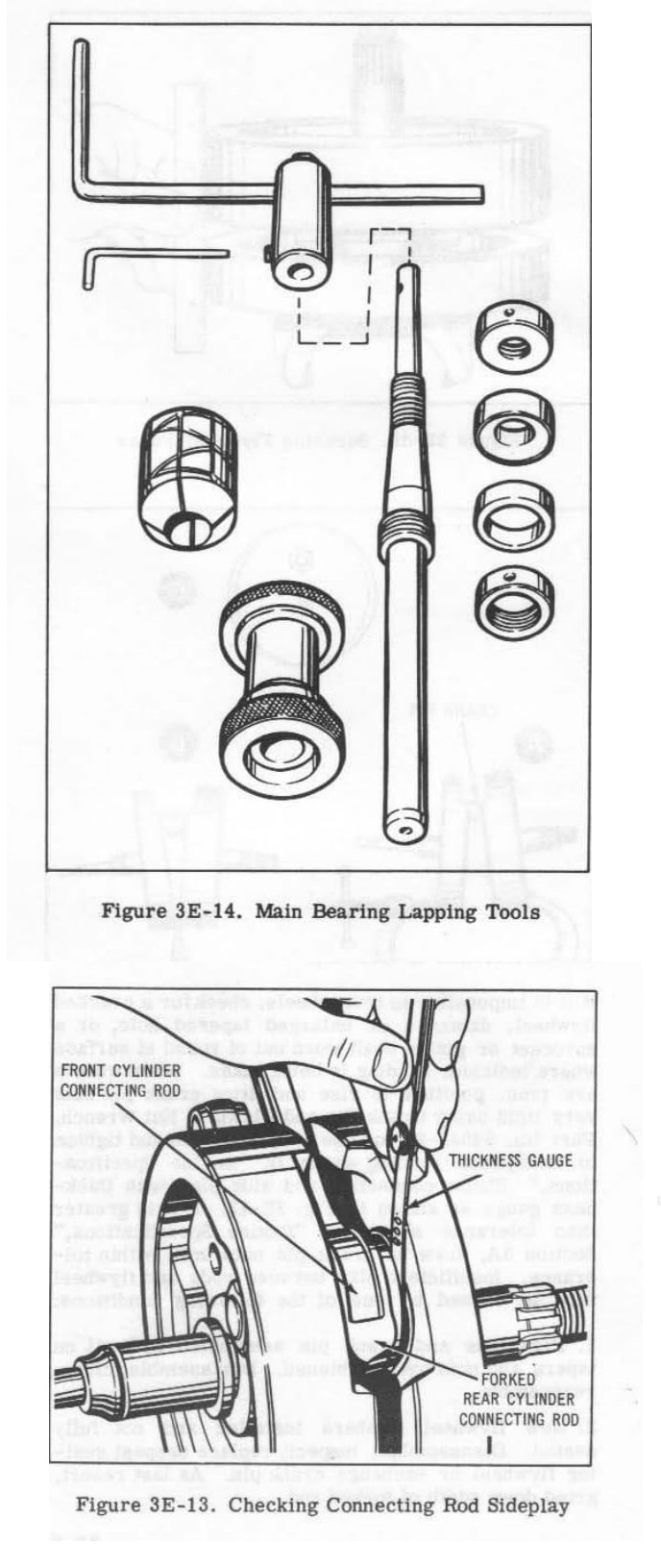
If sides of forked rod are ground to get desired clearance, backs of
bearing retainers must be ground down to remain narrower than width of
female rod.
After rod sideplay is checked and adjusted, crank pin nut pulled very
tight and lock plate and screw installed, again recheck wheel trueness
on truing device. Correct any run-out as above.
TRUING AND SIZING PINION SHAFT MAIN BEARING
Before fitting new pinion shaft main bearings, lap bearing race in
crankcase to true it and remove traces of wear shoulder at sides of
roller paths. Using Crankcase Main Bearing Lap, Part No. 96710-40,
consisting of lapping shaft, handle, lapping arbor and guide sleeve
(Fig. 3F-14).
A race that is worn beyond limits of oversize bearings must be replaced.
To remove worn bearing race, remove two bearing race lock screws (17,
Fig. 3E-2) from inside of case. Heat case to 275 - 300 degrees F.
Heating expands case and makes it possible to remove bearing race using
less force. Press worn race (18, Fig. 3E-2) out and new race in. New
race must be lapped slightly to true and align with left case bearing,
and to attain a size compatible with roller sizes available.
LAPPING ENGINE MAIN BEARINGS (Fig. 3E-15). Secure right and left
crankcase halves with three crankcase stud bolts (top center and bottom
left and right). The sprocket shaft bearing outer races and large spacer
must be installed in left crankcase.
Assemble lapping arbor to lapping handle and
assemble guide sleeve to sprocket shaft bearing bushing. Sleeves for use
with tapered bearing, are assembled to case with bearings and small
spacer collar. Turn sleeve parts finger tight.
Insert lap shaft with arbor assembled through pinion bearing bushing and
into guide sleeve. Tighten arbor expansion collars using a length of
5/32 in. rod as spanner until arbor begins to drag. Do not adjust arbor
snug in bushing or bushing will "bell," a condition were hole is
larger at ends than it is in the center
Withdraw arbor far enough to coat lightly with fine lapping compound. Do
not apply a heavy coat. Reposition lap in bushing and turn handle at
moderate hand speed. Work lap back and forth in bushing as it is
revolved to avoid grooving and tapering.
At frequent intervals, remove lap from crankcase, wash and inspect
bushing. Lapping is completed when entire bushing surface has a dull,
satin finish rather than a glossy, smooth appearance. If necessary,
flush off lap in cleaning solvent, air dry and apply fresh, light coat
of fine lapping compound.