Ford Galaxy / Ford S-MAX. Manual - part 531
 

  Index      Ford     Ford Galaxy / Ford S-MAX - service repair manual 2006 year


Search            


Content   ..  529  530  531  532   ..


Ford Galaxy / Ford S-MAX. Manual - part 531


The gear wheel of the 4th/6th gear drives not only the gear wheel of the 4th gear but also 
of the 6th gear. 

The 6th gear wheel is positively connected to the 5th/6th/reverse gear output shaft by the 
5th/6th gear synchroniser assembly. 

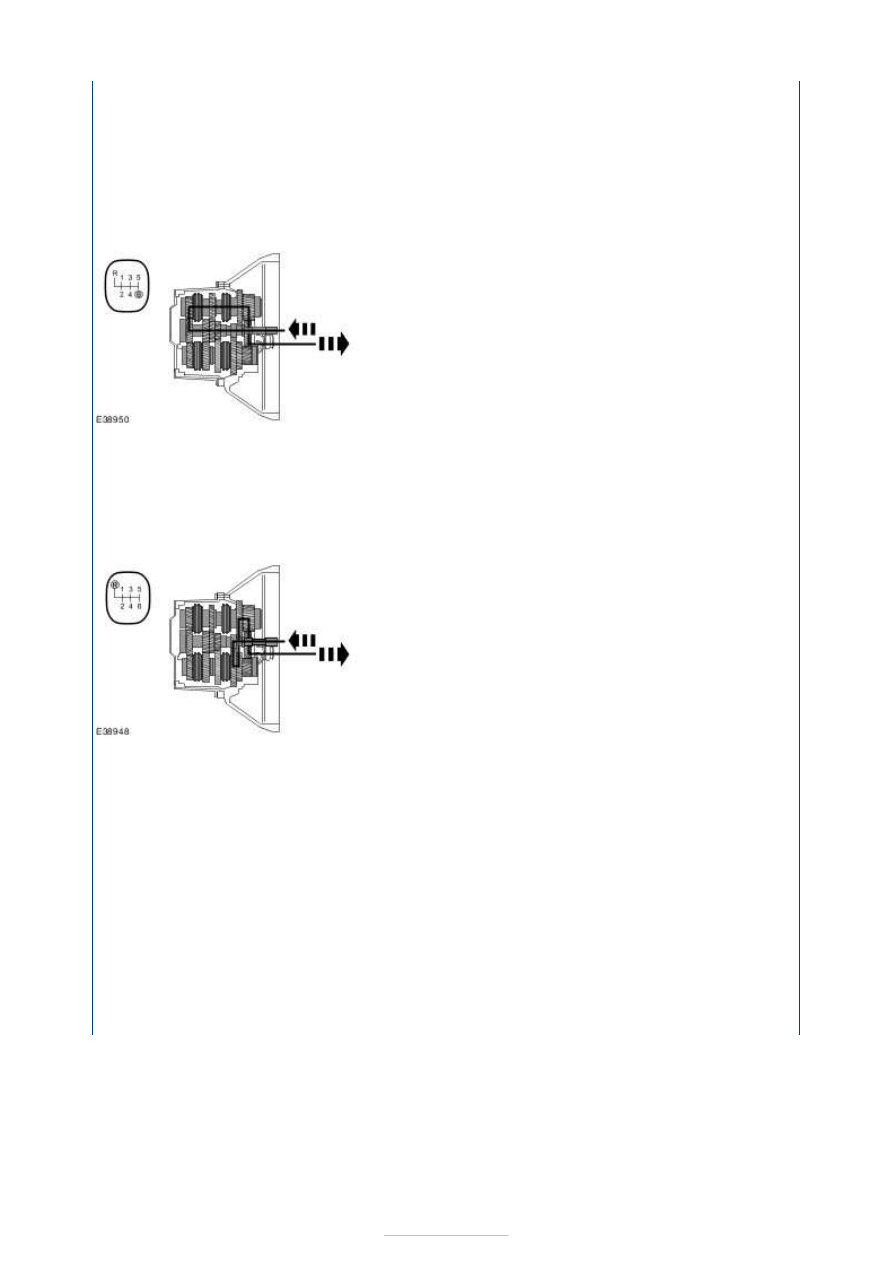
Power transmission route in reverse gear 

The reverse gear idler is welded to the 1st gear wheel. It is constantly engaged with the 
reverse gear wheel (shown separated for clarity). 

The reverse gear wheel is positively connected to the 5th/6th/reverse gear output shaft by 
the reverse gear synchroniser assembly. 

Internal shift mechanism 


Description 

Counterbalance 

Reverse gear switch 

Selector shaft 

Selector gate 

Internal shift mechanism 

The internal shift mechanism has been newly developed for this transmission. 

The reverse gear switch is located on the housing cover of the internal shift mechanism. 

The counterbalance improves the smoothness of the gear shifting. Due to its mass, the 
synchronization shift resistances that can be felt during shifting are reduced. The gear 
shifting process becomes smoother. 

The internal shift mechanism can only be changed as a complete unit in service. 

Item

1

2

3

4


Part Number

-

-

-

-

Manual Transmission/Transaxle - Vehicles 
With: 6-Speed Manual Transaxle - MMT6 - 
Manual Transaxle—Vehicles With: Manual 
Transaxle

S-MAX/Galaxy 2006.5 (02/2006-)


Print


Diagnosis and Testing 

REFER to: 

Manual Transaxle and Clutch

 (308-00 Manual Transmission/Transaxle and Clutch 

- General Information, Diagnosis and Testing). 

Manual Transmission/Transaxle - Vehicles 
With: 6-Speed Manual Transaxle - MMT6 - 
Bearing Check

S-MAX/Galaxy 2006.5 (02/2006-)


Print


General Procedures 

1.

NOTE: Establish the cause of the damage 
and resolve it. 

Check whether the bearing cage is 
damaged at the top, side or at the 
openings due to unprofessional use of a 
special tool or use of the wrong tool. 
Install a new bearing if necessary. 

2.   

Check whether the ends of the taper 
rollers are discolored as a result of 
inadequate lubrication or overheating, 
possibly through excessive pre-load. 
Install a new bearing and new seals if 
necessary. 
Check the bearing is correctly lubricated. 

3.   

Check whether the ends of the taper 
rollers are worn away due to incorrect 
installation, excessive pre-load or faulty 
bearing seating. 
Install a new bearing and new seals if 
necessary. 
Check the bearing is correctly lubricated. 

4.   

Check whether the bearing surfaces are 
gray or gray/black with deposits between 
the rollers. 
Install a new bearing and new seals if 
necessary. 
Check the bearing is correctly lubricated. 

5.   

Check whether the bearing ring surfaces 
are grooved caused by static impact. 
Install a new bearing if its surface is 
rough, or if it is noisy. 


Content   ..  529  530  531  532   ..