Ford Galaxy / Ford S-MAX. Manual - part 471
 

  Index      Ford     Ford Galaxy / Ford S-MAX - service repair manual 2006 year


Search            


Content   ..  469  470  471  472   ..


Ford Galaxy / Ford S-MAX. Manual - part 471


Electronic Engine Controls - 1.8L 
Duratorq-TDCi (74kW/100PS) - 
Lynx/1.8L Duratorq-TDCi (92kW/125PS) 
- Lynx - Electronic Engine Controls

S-MAX/Galaxy 2006.5 (02/2006-)


Print


Description and Operation 

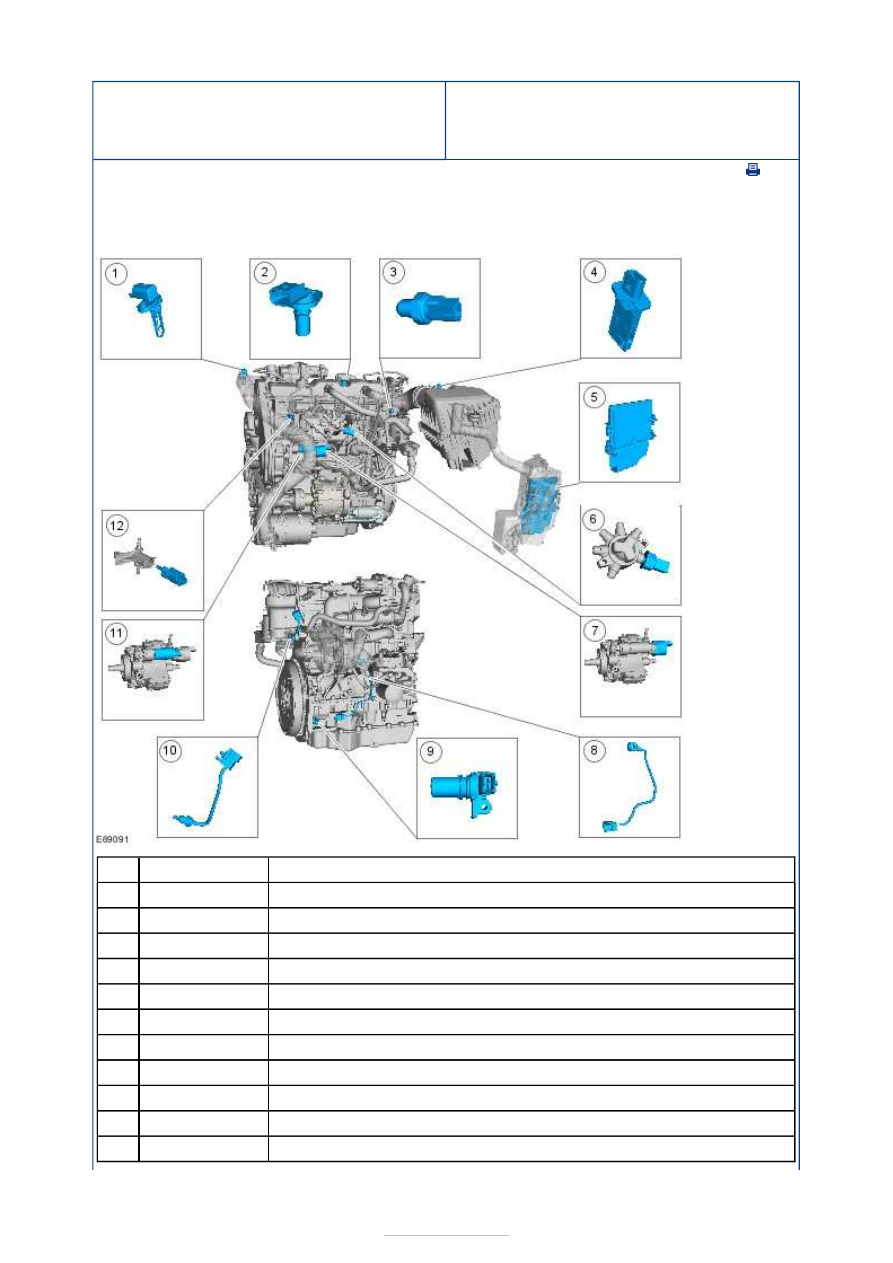
General overview 


Description 

Intake air temperature (IAT) sensor 

Camshaft position (CMP) sensor 

Engine oil pressure (EOP) sensor 

Mass air flow (MAF) sensor 

Powertrain control module (PCM) 

Fuel rail pressure (FRP) sensor 

Fuel pressure regulator 

Knock sensor (KS) 

Crankshaft position (CKP) sensor 

Cylinder head temperature (CHT) sensor 

Fuel metering valve 

Item

1

2

3

4

5

6

7

8

9

10

11


Part Number

-

-

-

-

-

-

-

-

-

-

-

-

Fuel temperature sensor 

Components 

IAT sensor 

The IAT sensor is a temperature dependent resistor which has a negative temperature 
coefficient, therefore its temperature changes inversely with respect to ambient 
temperature. The IAT sensor is supplied with a reference voltage by the PCM. When the 
intake air changes temperature, the resistance of the IAT sensor changes therefore 
changing the output voltage. The output voltage is assigned to a corresponding intake air 
temperature by the PCM. 

The signal from the IAT sensor is used as a correction variable for calculating the fuel 
injection quantity. 

CMP sensor 

The CMP sensor uses the Hall effect principle and is supplied with a reference voltage of 5 
volts. 

During starting, the CKP sensor and the CMP sensor are synchronized. If both signals are 
present, the engine will be started. 

If the signal from the CMP sensor fails while the engine is running, the engine continues to 
run using the signals from the CKP sensor. 

If the CMP signal is missing at the next starting operation, it will not be possible to start the 
engine. 

EOP sensor 

12

-


The EOP sensor is located in the cylinder head. The EOP is connected to the instrument 
cluster and is not directly part of the electronic engine control system. The EOP sensor 
registers engine oil pressure. The sensor opens when a defined oil pressure is reached and 
the engine oil pressure warning light is illuminated on the instrument cluster. 

MAF sensor 

The MAF sensor measures the mass of air entering the intake system, the measurement 
being based on the constant temperature hot wire principle. Suspended in a bypass duct 
are a hot wire probe and an air temperature probe. The PCM makes sure that the hot wire 
probe is always 200ºC hotter than the air temperature probe. The hot wire probe is cooled 
by the air flowing through the intake system and the PCM varies the heating current to 
maintain the 200ºC temperature difference. The change in heating current is measured as a 
voltage drop across a precision resistor and is assigned to a corresponding mass air flow 
calculation by the PCM. 

PCM 

The PCM is attached to the windshield washer reservoir and has 3 electrical connectors with 
a total of 128 pins. 

The PCM monitors and processes the signals from the sensors. The fuel injectors, the fuel 
metering valve and the fuel pressure regulator are also controlled by the PCM. 

The PCM can be diagnosed through the data link connector (DLC) using the Worldwide 
Diagnostic System (WDS). 

FRP sensor 

The FRP sensor is located in the fuel rail and measures the fuel pressure within the fuel 
system. 


The fuel pressure sensor consists of a piezoelectric element that sends a variable voltage 
signal to the PCM, as a function of fuel pressure. 

The PCM uses this signal to calculate how long the fuel injectors are to be actuated for and 
to regulate the fuel pressure by means of the fuel pressure regulator. 

Fuel pressure regulator 

The fuel pressure regulator is screwed directly onto the high-pressure outlet of the fuel 
pump. 

The fuel pressure regulator regulates the fuel pressure at the high-pressure outlet and 
thereby the fuel pressure to the fuel rail. 

In addition, the fuel pressure regulator dampens fuel pressure fluctuations which arise 
when the fuel pump is supplying fuel and as a result of the fuel injection process. 

KS 

In conjunction with the PCM, the KS monitors the combustion process and regulates the 
injection period so that predetermined volumes of fuel are injected into the cylinders at 
every operating cycle. 

By constantly measuring the amount of knock present and adjusting the injection period, 
the emission values of the engine remain stable. 

CKP sensor 

The CKP sensor is an inductive pulse generator which scans 36-1 cast protrusions on the 
flywheel. Minus one means that one of the cast protrusions is missing and this gap is 
located at 90 degrees before top dead centre. This gap is used by the PCM as a reference 
for crankshaft position. 


Content   ..  469  470  471  472   ..