Ford Galaxy / Ford S-MAX. Manual - part 1018


  Index      Ford     Ford Galaxy / Ford S-MAX - service repair manual 2006 year


Search            


Content   ..  1016  1017  1018  1019   ..


Ford Galaxy / Ford S-MAX. Manual - part 1018


The weld bead must only be worked once it has fully cooled down. 

Plastic adhesive bonding 

Adhesive bonding of plastics has some advantages over welding methods: 

Within the group of thermoelastic plastics, all semi-rigid ancillary components (such as 
bumpers, front grilles, etc.) can be repaired without identification.  
A two-component polyurethane based adhesive is used for all thermoplastic parts.  
Reinforcement strips can be attached behind splits (split length up to max. 100mm) and 
openings to ensure the original strength properties. 

Tools and equipment also familiar from paint repairs can be used in making adhesive 
repairs to thermoplastic components. 

Angle grinders and belt sanders can be used to grind out scratches and splits. Orbital 
sanders with extractors are used for fine sanding. 

The infrared heater is used to provide fast and certain drying throughout. 

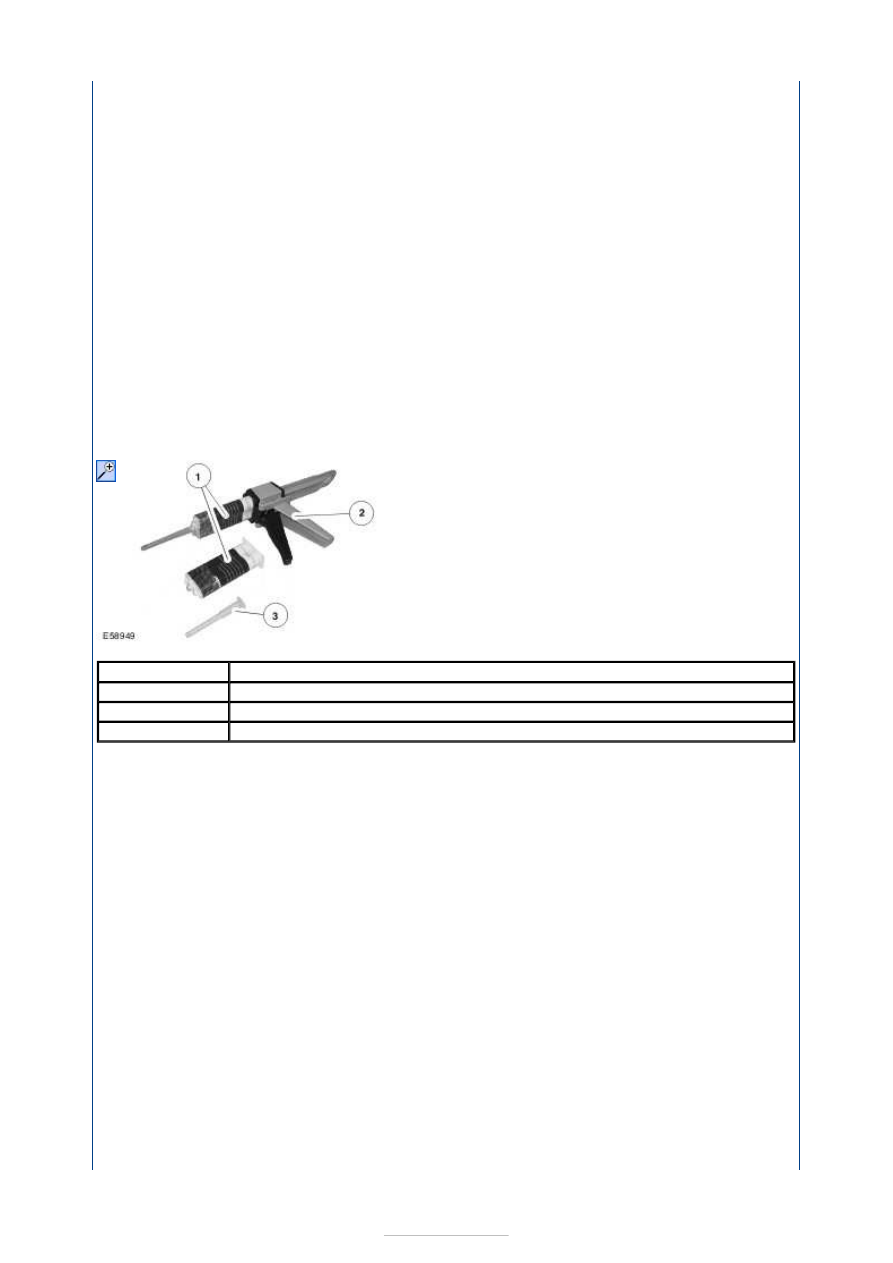
Plastic adhesive set 

Apart from the components shown, other materials may be needed to bond plastics, 
depending on the repair position. 

For large scale repairs, it may be necessary to insert reinforcement panel strips and 
reinforcement matting as fixing aids. 

Repair sequence during plastic adhesive bonding: 

NOTE: Follow the manufacturer's guidelines when using adhesives.  

Prepare the location of the bond. Remove paint residues and sand the area to be bonded. 
Drill out the ends of the split to stop it spreading further. Prepare the bond location into a 
V-shape and clean it with plastic cleaner.  
Apply the adhesive. The two-component adhesive is applied to the cleaned and primed 
repair location using a hand gun. Spread and smooth the adhesive using a flexible plastic 
spatula.  
Rework the bond location. After cooling, sand the raised adhesive. Clean the sanded 
repair surface using plastic cleaner. Apply plastic primer thinly to the repair surface. 
Apply paint. 

GRP repairs 

GRP material is hard and brittle in its strength properties. Because of these material 
properties, splits and openings often result in cases of serious damage. 

Item

Description

1

2-component adhesive

2

Cartridge gun

3

Mixing tube


The stability of GRP parts is impaired if the glass fiber reinforcement is cracked. The 
component must be replaced in cases of serious damage that affect the structure. 

Minor damage (such as abrasion, splits up to 80mm, holes up to approx. 60mm diameter, 
etc.) can be repaired to a technically and visually perfect standard, provided that the 
damage does not occur in heavily used or hard-to-reach areas. 

To ensure perfect repair results, observe the following points: 

The room temperature should be at least 15°C and the air should be as dry as possible.  
The repair location must be thoroughly dry and clean.  
Before the repair, the GRP part being repaired must be dried using an infrared heater or 
in a drying oven.  
In cases of large splits and fractures, the strength of the outer skin can be re-established 
by backing with a reinforcement material. 

Tools and equipment from the paint shop can be used to carry out repairs to GRP parts. 
Angle grinders and belt sanders can be used to grind out scratches and splits. Orbital 
sanders with extractors are used for fine sanding. 

GRP repair set 

Scissors, paintbrush and cleaning materials are other materials which will be needed to 
perform a GRP repair.  

NOTE: Follow the manufacturer's instructions when using the repair materials.  

The repair process for a GRP repair is as follows: 

Prepare the repair location. Remove paint residues and sand the repair area.  
Drill out the ends of the split to stop it spreading further.  
The repair location must be sanded by hand. If machine working is attempted, the resin 
will be heated so much that the surface structure will be changed. The result is 
inadequate adhesion.  
Perform the GRP repair. Apply polyester resin thinly to the repair location. Lay the glass 
fiber mat in place and apply polyester resin over it again.  
Rework the location of the repair. Sand away any polyester resin which stands proud 
after it has hardened.  
Clean the sanded repair surface using plastic cleaner. Apply plastic primer thinly to the 
repair surface and after it has dried apply the paint finish. 

Item

Description

1

Polyester resin

2

Glass fiber mats

3

Hardener


Body Repairs - General Information - 
Special Repair Techniques

S-MAX/Galaxy 2006.5 (02/2006-)


Print


Description and Operation 

Cabriolet vehicles 

The body of a cabriolet vehicle is different to the self-supporting body of a saloon car 
because of the special roof construction (folding top). The stability requirements must 
therefore be ensured by construction changes within the body structure.  

These are for instance: 

Longitudinal and torsional reinforcing components which compensate for the lack of the 
roof.  
Reinforcements to the floor assembly, particularly in the rocker panel area.  
Reinforcements in the pillar areas.  
High-strength and ultra-high-strength steel panels with single panel thicknesses of up to 
2.5 mm, which in combination can become up to 6mm thick (e.g. reinforcements in the 
floor area, rocker panels).  

If deformation to load carrying components occurs, the stability of the whole body shell can 
be adversely affected. 

On a cabriolet, accident damage repair to the components mentioned above is considerably 
different in certain aspects compared with the usual repairs (closed body construction): 

A model specific alignment angle system must always be used during straightening and 
repair work, securing using clamps at the rocker panel area is not always adequate for 
the cabriolet.  
To avoid damage to the doors, they must always be open during straightening work. In 
the case of more severe damage, additional tension and compression spindles must be 
used to stabilize the door cut-outs (between the A- and B-pillars).  
In load bearing areas such as the rocker panels, side members and floor pan, increased 
straightening forces are necessary due to the additional reinforcements.  

NOTE: Additional information on welding can be found in the section Welding 
Equipment and Joining Techniques.  

High-power welding equipment for panel thicknesses in overall combination of up to 6 
mm total material thickness.  
The fitting accuracy and longitudinal rigidity of the affected component is especially 
important to ensure that the doors, door windows and the roof fit and close correctly.  

Liquefied gas vehicles 

Alternative fuel vehicles often require special handling in the workshop area. Above all, 


assembly operations to some extent require particular knowledge when dealing with the 
special technology and the safety regulations.  

NOTE: Only fully trained personnel are permitted to work on alternative fuel vehicles. 

These special requirements must be understood and taken into account in the body shop as 
well. 

CAUTION: Danger of fire and explosion. The safety instructions must always be 

followed when performing service work on fuel/gas systems. Failure to follow these 
instructions may result in personal injury. 
NOTE: You will find further information about working on liquefied gas vehicles in the 
section Health and Safety Information. 

Refrigerated conversion vehicles 

Apart from the special materials used in building the structure of the refrigerated 
compartment, such vehicles have special energy and refrigeration systems which require 
special handling during repair.  

CAUTION: Danger of injury. Work on the 230<SP>volt system of the refrigeration 

equipment must only be carried out by trained specialist personnel. 
NOTE: Work on the refrigerant circuit may only be performed by persons who have a 
relevant certificate of competence. 

Vehicles with a refrigerated compartment are often used to transport foodstuffs. For this 
reason, additional hygiene regulations must be complied with during repair work. 

Aluminum and plastic are used to construct the two different types of compartment found 
on refrigerated vehicles.  

The aluminum conversion is a very stable and technically perfect variant. However, against 
this the relatively high production costs and a lower payload must be taken into account, 
because of the weight of the aluminum conversion itself. 

NOTE: Basic and in-depth training is offered on the following topics. You will find an 
overview of the complete range listed in the Training brochure published by the Ford 
Service Organization. 

The plastic conversion has developed into a light, clean and economical alternative because 
of constant further development of materials and working techniques. 

NOTE: The material combinations, the workmanship and the working methods must 
comply with the current food hygiene regulations. For this reason, service and repair work 
on the refrigerated conversion may only be performed by authorized and specially trained 
technicians. 

Refrigerated compartment constructions are often made using both materials. The floor pan 
is made of structured, slip-proof aluminum panels and the wall and ceiling cladding is made 
of smooth surfaced plastic elements.  

CAUTION: PUR hard foam is flammable. If PUR hard foam is overheated, it will burn 

on its own with a brilliant yellowish flame. It produces unpleasant choking and toxic 
fumes. Special measures must be taken when welding the vehicle body. 

Polyurethane wall and ceiling elements are manufactured using a sandwich principle. An 
insulating polyurethane core is coated with food grade ABS plastic on one side. 

PUR hard foam does not decompose, is rot resistant and is odorless. These properties make 
it suitable for use as insulation. 

Because of its closed cell structure, water uptake by PUR hard foam is for the most part 
only a problem at edges. Cut edges or other mechanically worked surfaces must however 
be sealed with the greatest care. 

The conversion to a refrigerated vehicle is performed as made-to-order production. The 


Content   ..  1016  1017  1018  1019   ..