Ford Galaxy / Ford S-MAX. Manual - part 1017


  Index      Ford     Ford Galaxy / Ford S-MAX - service repair manual 2006 year


Search            


Content   ..  1015  1016  1017  1018   ..


Ford Galaxy / Ford S-MAX. Manual - part 1017
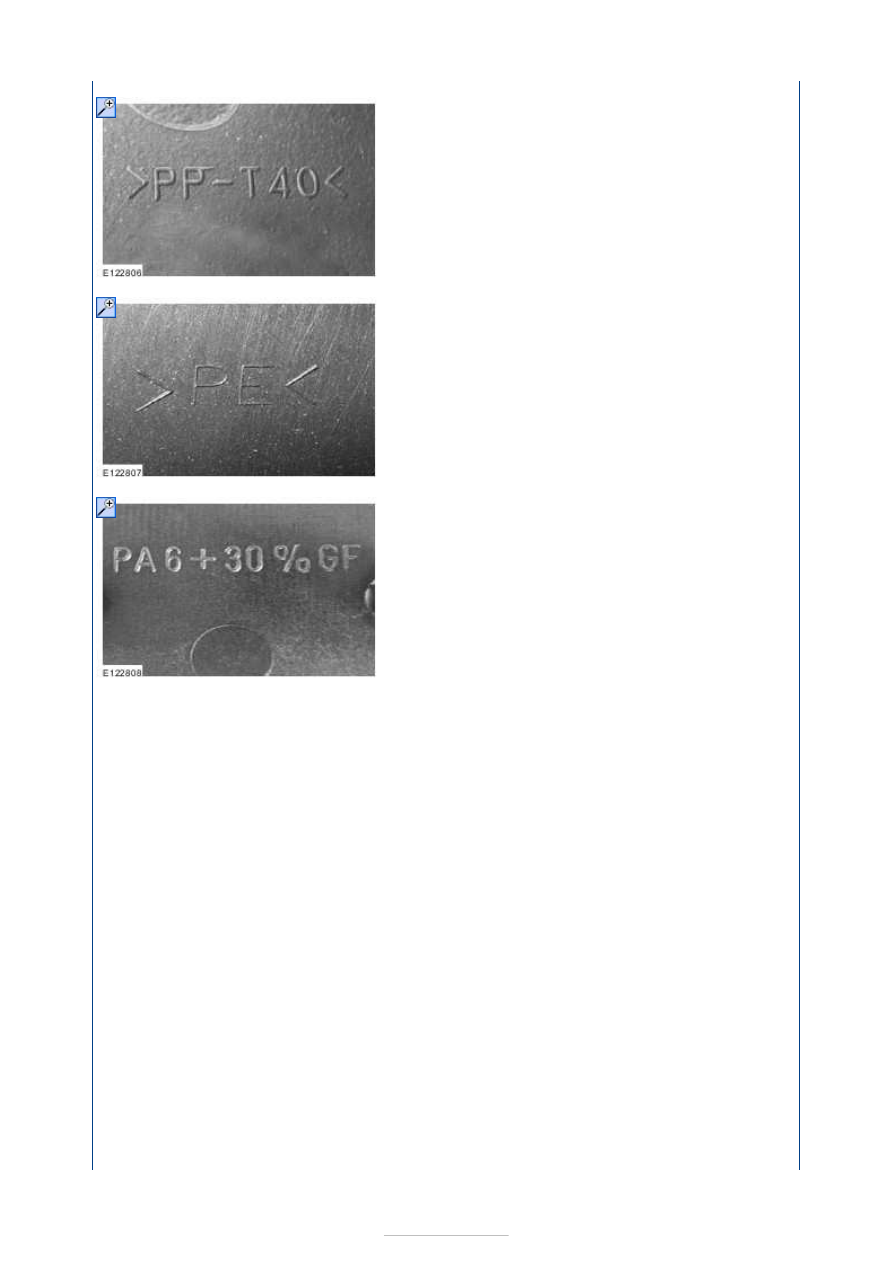


NOTE: The identification of the type of plastic is necessary for the plastic welding process 
in order to determine the correct welding rod (welding material) to use. 

If an identifier is missing or cannot be made out, the following easy to perform tests will 
help: 

Visual Inspection 

Visual inspections mainly serve to identify PUR and GRP materials. Thermoplastic 
components are often painted and are therefore difficult to identify. 

Identification characteristics: 

When PUR cracks or similar damage occurs, pores of foam can be seen.  
GRP can be recognized by the glass fiber structure on the inside. 

Mechanical test: 

The plastic group can be determined by a sound test: 

Degree of hardness - the higher-pitched the sound, the harder the plastic.  
Elasticity - the more muffled the sound, the higher the elasticity of the plastic. 

Sanding test 

In this a place is chosen which will not be visible later, and the finger belt sander is used to 
sand the plastic.  


The plastic group can be determined using the pattern of the dust: 

Thermosets produce a white dust.  
Thermoplastics smear and do not produce dust. 

Float test in water: 

Take a small piece of plastic from the component to be repaired and test whether it floats 
on water (PP-EPDM, HD-PE, PP) or sinks (PVC/U, PVC/P, ABC, PC). 

Nature of the surface 

The surface of plastics can be categorized as rigid (PVC-U, PVC-P) and waxy (PP/EPDM, 
HD/PE, PP). 

Adherence test using welding rod 

Heat a welding rod that is identified with the type of material and the plastic component 
using the hot air gun. Press the welding rod onto the plastic component to be welded. When 
the welding rod cools down, if it remains stuck to the component or can only be removed 
with great difficulty, then it can be assumed that the two are made of the same plastic. 
When pulling away from PP/EPDM, HD/PE and PP, this can lead to strings. 

CAUTION: Danger of poisoning! When burned, most plastics release vapors harmful 

to health. Ventilate the room well and use respiratory protection. Where possible work 
using an extraction system. 

Burning test 

Every plastic has a characteristic behavior and smell when burned. Using a knife, cut off a 
small piece from the component to be repaired, remove any dirt and paint residues and set 
light to the small chip. Now observe the burning behavior. Compare the color, type and 
smell of the smoke with the results from the following table. 

Safety instructions 

In addition to the general safety instructions, the relevant regulations and accident 
prevention legislation must be observed. 

NOTE: Without exception, before starting work you must read the safety and warning 
instructions in the chapter "Safety Instructions". In addition, pay attention to the warning 
instructions of the particular equipment manufacturer.  

Information sheets, safety notices and guidelines for the processing of adhesives containing 
isocyanate, polyester resin, adhesives, solvent and thinners provide more details on their 
use. 

The following instructions must always be followed: 

Polyester resin, adhesive, solvents and thinners are inflammable and must not be used 

Short description

Plastic recognition using a burning test 

ABS

Blackish smoke, the material drips like a candle when burning and smells 

like wax. 

PA

No smoke, draws filaments, smells like burnt horn.

PC

Yellowish, sooty smoke. Smells sweetish.

PP

No smoke, the material drips like a candle when burning and smells like 

burnt oil. 

PP/EDM

No smoke, the material drips like a candle when burning and smells like 

burnt oil. 

PC/PBT

Hard and shiny, burns yellow, fluffy soot. 

Hard PVC / soft 

PVC

Blackish smoke and acrid smell.

near naked fire or flames.  
Sawing and grinding operations must only be carried out in rooms equipped with 
extraction systems.  
If no rooms with extraction systems are available, only use tools with extraction 
equipment.  
Protective equipment such as gloves, protective goggles, aprons and breathing masks are 
essential. 

Because of the various compositions of plastics, repair work to plastic parts involves a 
variety of repair methods. 

The following methods are used: 

Thermoplastic straightening.  
Plastic welding.  
Plastic adhesive bonding.  
Plastic lamination techniques. 

Thermoplastic straightening 

Damage to thermoplastics can be rectified by heating using the hot air gun (temperature 
about 100°C) while the deformation is pressed out until the shape is regained.  

Plastic welding 

Splits formed in plastic bumpers are typical possible plastic repairs. 

NOTE: Do not carry out plastic welding in the area of fixed foam backing. The foam 
backing will usually be destroyed and the function of the component is then no longer 
guaranteed.  

If repair using adhesive methods is not possible because of unfavorable conditions at the 
rear of the repair location, plastic welding is a possible repair process. 

There are two methods of welding: hot air draw welding and hot air fanning welding. 

Plastic welding set 

In addition to the components listed, plastic welding requires tools already found in the 
workshop such as scrapers, sanders, face cutters etc. 

As with all other welding processes, only certain material combinations can be joined 
together using plastic welding.  

NOTE: Basic and in-depth training is offered on the following topics. You will find an 
overview of the complete range listed in the Training brochure published by the Ford 

Item

Description

1

Various welding rods

2

Scraper (heart-shaped)

3

Hot air blower (approx. 1500 W)

4

Clamps

5

Welding nozzles


Service Organization. 
NOTE: The manufacturer's data must be taken into account when choosing welding 
materials and the correct temperature setting of the hot air gun. 

Repair sequence during plastic welding: 

To prepare the location for welding, remove paint residues and sand the weld area.  
If parts of the material have been pushed in by an impact, the damaged area can be 
brought back to shape by heating.  
Drill out the ends of the split to stop it spreading further. Machine the location of the weld 
into a 90° V-shaped groove, to accept the welding rod.  
Lay the welding rod in the groove.  
Perform the welding. Hot air draw welding or hot air fanning welding.  
Rework the weld seam. After cooling, sand the raised weld seam.  
Clean the sanded repair surface using plastic cleaner. Apply plastic primer thinly to the 
repair surface and paint it. 

Despite good preparation and the correct choice of welding materials, weld faults may 
occur.  

The following points must be noted when welding plastic: 

Weld together like with like: 

With very few exceptions, only the same materials can be welded together, e.g. PP with 

PP.  
Correct temperature: 

The correct choice of temperature is important for the success of the repair. The plastic 

must be warmed until it plasticizes (dough-like, soft). 

Guideline values for welding temperature: 

Even pressure: 

When rod welding, the pressure is applied by pressing on the welding rod.  

Steady speed: 

To achieve a good weld, care must be taken that the working speed is steady. 

Possible causes of weld faults: 

Deformation caused by overheating of the repair area or tensions in the material while 
welding the component.  
Plastic material too thin.  
Poor weld joint because the weld temperature was too low or the welding speed was too 
fast.  
Welding different materials together.  
Weld seam dropped because the split gap was too wide or the welding temperature was 
too high. 

A good weld is recognized by a slightly raised, smooth and even weld bead on the surface 
of the component. 

-

-

Brief description

Plastic

Temperature

ABS

Acrylonitrile butadiene styrene copolymer

360°

PA

Polyamide

400°

PC

Polycarbonate

370°

PP

Polypropylene

280°

PP/EPDM

Polypropylene/ethylene propylene diene copolymer

280°

PUR

Polyurethane

300°

Hard PVC

Polyvinylchloride

340°

Soft PVC

Polyvinylchloride

370°

-

-


Content   ..  1015  1016  1017  1018   ..