Ford Galaxy / Ford S-MAX. Manual - part 1016


  Index      Ford     Ford Galaxy / Ford S-MAX - service repair manual 2006 year


Search            


Content   ..  1014  1015  1016  1017   ..


Ford Galaxy / Ford S-MAX. Manual - part 1016


This means: 

Thorough cleaning of the surfaces to be brazed.  
Close contact of the panels at the brazing position.  
Use the soldering iron to warm the location of the seam to be joined.  
The liquid brazing material is drawn between the panels through capillary action. 

Rivets 

With riveting, two or more panels are joined together using a joining element (rivet). In 
body construction, pop rivets and punched rivets are used. 

Advantages of riveted connections: 

Metallic and non-metallic materials can be joined together.  
Different thicknesses of materials can be used.  
The material does not have to be heated, and therefore does not warp.  
Low level of preparation required. 

NOTE: For detailed instructions on the procedure, please refer to the equipment 
manufacturer's operating manual. 

Disadvantage: 

During dismantling procedures, swarf/rivet remains can fall into inaccessible cavities, 
which can lead to rattling and rusting. 

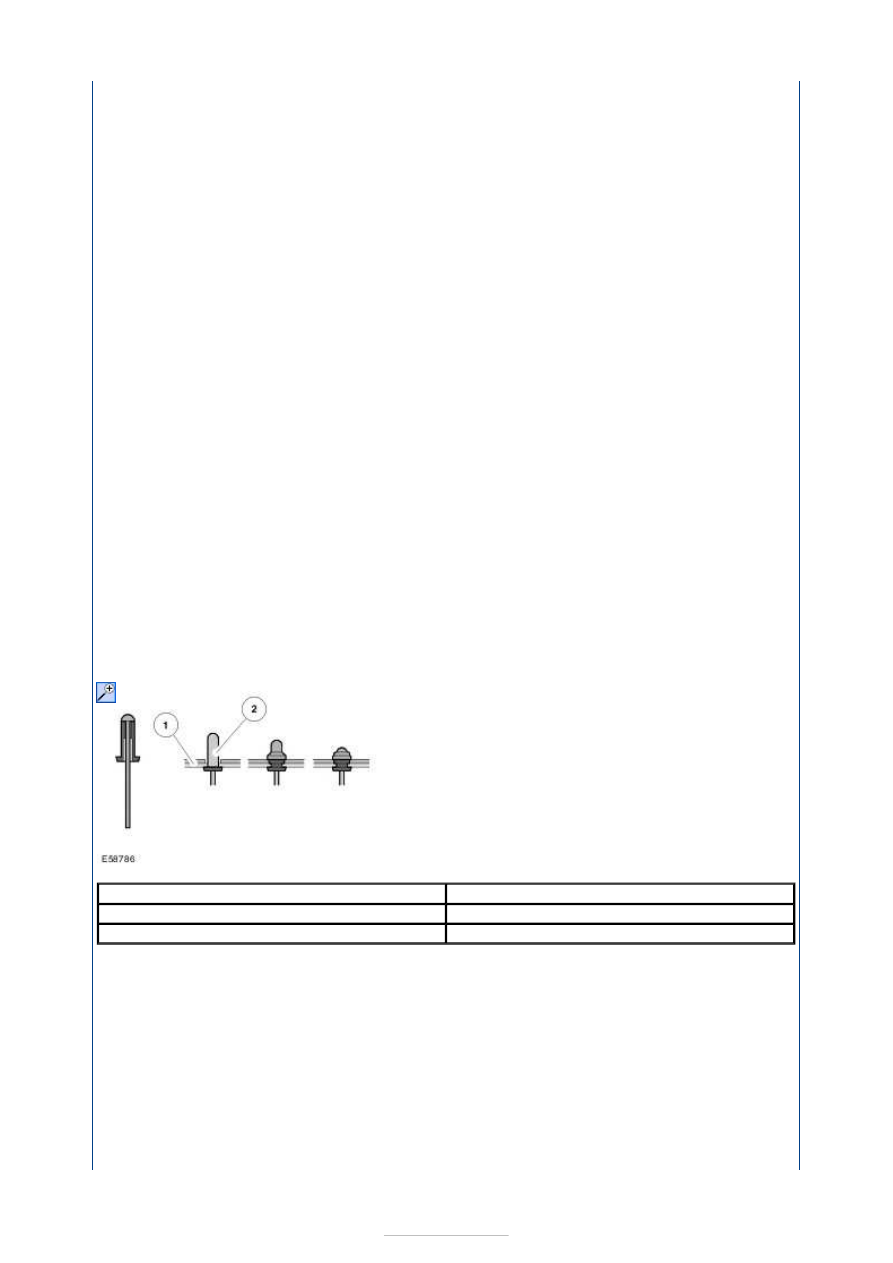
Pop rivets are used if only one side of the panel is accessible. In this process, overlapping 
panels are drilled and connected with a pop rivet. 

Pop rivets can be inserted pneumatically, hydraulically or manually with rivet guns. 

Bonding 

Description

Description

1

Panels

2

Pop rivet


Bonded connections are used more and more in modern body designs. Here, a distinction is 
made between bonds for stabilization purposes and bonds for adhesive strength. Bonds for 
stabilization purposes are found on clinched flanges and on cross beams in doors or on the 
roof. 

WARNING: Risk of poisoning! Adhesive can be harmful to health. Ventilate rooms 

well and use breathing protection. Where possible, work with an extraction unit. 
NOTE: Adhesives are chemical products and are subject to the safety regulations of the 
manufacturer. 

Please refer to the specifications in the general part of the particular manual for information 
on the repair adhesive which is to be used. 

Advantages of glued joints: 

They are air and watertight.  
High corrosion protection  
Different materials can be connected.  
Bonding can be combined with resistance spot welding. 

NOTE: The quality of the bonded connection is largely dependent on the care taken 
during preparatory work. When gluing bodywork parts, follow the work instructions from 
the adhesive manufacturer. 

Bonding and welding 

On some vehicle models, (such as the Ford Ka), bonding is combined with resistance spot 
welding. This connection technique has the following advantages: 

Tight, anti-corrosion connection seam.  
High strength due to additional resistance weld spots. 

Please note the following points during the repair work: 

Description

Description

1

Butt joints

2

Bonded connection


Only use adhesive suitable for welding (conductive).  
Carry out resistance spot welding on the connection flanges before the adhesive 
hardening process.  
Carry out test welding with the adhesive applied.  
If MIG welding is carried out during a sectional repair on a connection flange with 
adhesive material, the adhesive material must be applied at a distance of approx. 10 mm 
from the weld spot. 

Bonding and riveting 

As with welding, bonding can also be combined with riveting. This connection technique has 
additional advantages. These are: 

Metallic and non-metallic materials can be joined together.  
Different thicknesses of materials can be used.  
The material does not have to be heated, and therefore does not warp.  
The rivet connection stabilizes the connected components during the adhesive hardening 
phase. 

Body Repairs - General Information - 
Plastic Repairs

S-MAX/Galaxy 2006.5 (02/2006-)


Print


Description and Operation 

General 

The proportion of plastics used in vehicle construction continues to rise. Up to now 
damaged plastic components often had to be replaced. These days, plastic repairs are 
becoming more and more widely accepted because of the increasing cost of spare parts. 

NOTE: Plastic adhesives are chemical products and are subject to the safety instructions 
of the manufacturer.  

In repair work, the material properties of plastics are highly significant. There are two main 
groups: 

Thermoplastics.  
Thermosets. 

NOTE: Elastomers make up a third group of plastics. These are not mentioned below 
because they have no plastics repair applications. 

Thermoplastics 

Heat causes thermoplastics (also called TP polymers) to transform from the solid state into 
the thermoelastic state and then into the thermoplastic state. When thermoplastics are 
cooled, they return to solid state. 

Thermosets 

Thermosets (also called TS polymers) are much harder and more brittle than 
thermoplastics. Their strength remains largely unchanged when they are heated. 
Thermosets are destroyed when heated above the critical temperature. Also, the original 
state will no longer be restored on cooling. 

Plastic identification 

Normally the appropriate identifier is marked on the plastic components used in vehicle 
construction. 

The capital letter sequences used for this are standardized in DIN EN ISO 1043-1 and DIN 
ISO 1629 (for rubber) and can be looked up in the tables which they contain. In addition 
the string of characters provides information about the exact mixture ratio and the 
proportion of certain fillers. 

Examples of the identification of plastics 

Brief description

Plastic

ABS

Acrylonitrile butadiene styrene copolymer

PA

Polyamide

PC

Polycarbonate

PP

Polypropylene

PP/EPDM

Polypropylene/ethylene propylene diene copolymer

PC/PBT

Polycarbonate/polybutylene terephthalate

Hard PVC / soft PVC

Polyvinylchloride

Brief description

Plastic

GRP

Glass reinforced plastic

PUR

Close-meshed cross-linked polyurethane

PUR

Wide-meshed cross-linked polyurethane


Content   ..  1014  1015  1016  1017   ..