Ford Galaxy / Ford S-MAX. Manual - part 1008


  Index      Ford     Ford Galaxy / Ford S-MAX - service repair manual 2006 year


Search            


Content   ..  1006  1007  1008  1009   ..


Ford Galaxy / Ford S-MAX. Manual - part 1008


Body Repairs - General Information - 
Straightening

S-MAX/Galaxy 2006.5 (02/2006-)


Print


Description and Operation 

General 

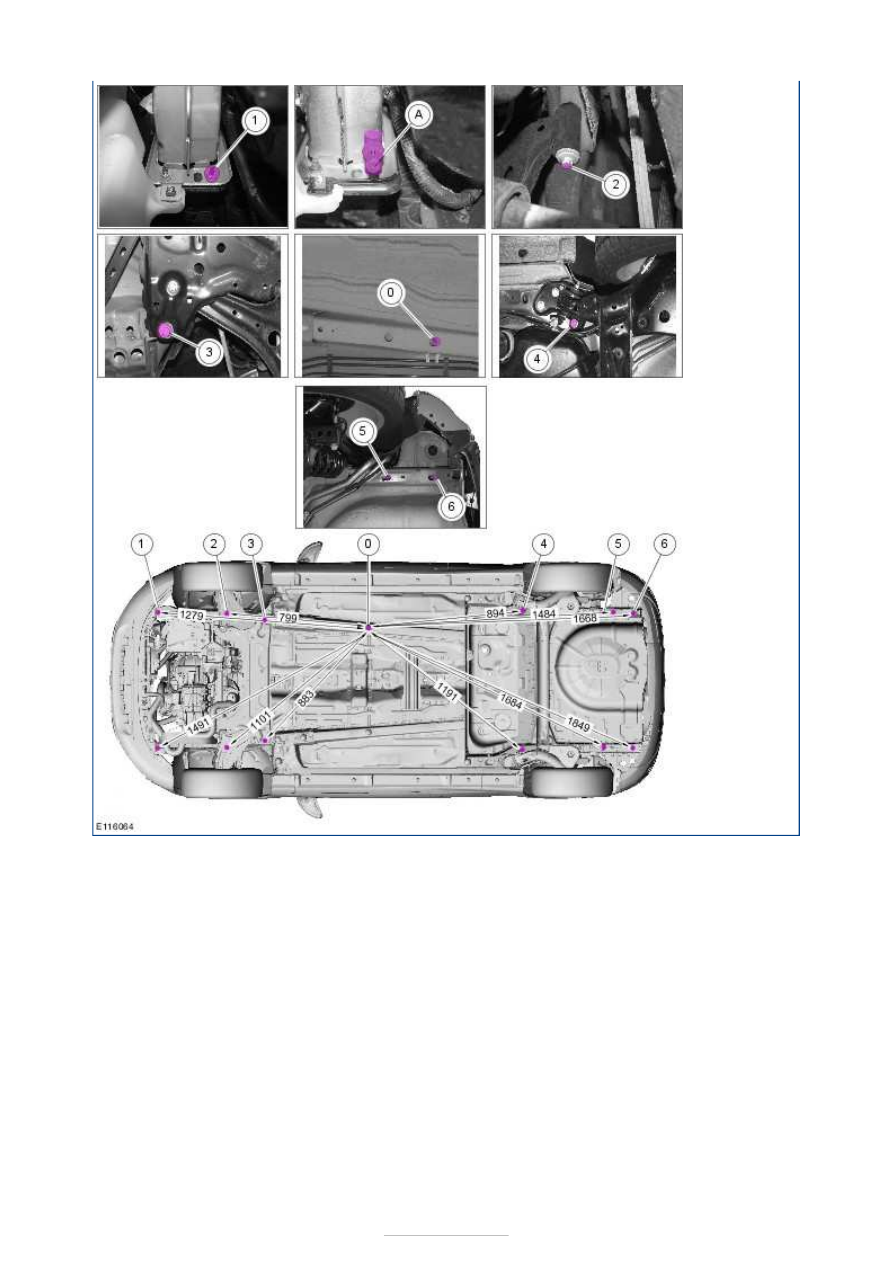
Straightening repairs are often required to restore the original body shape. To do this, the 
vehicle must be placed on a straightening jig so that a pulling device can be used. 

NOTE: Basic and advanced training courses are offered for the following contents. For an 
overview of all training courses offered, please refer to the Ford Service Organisation 
training course brochure. 

Straightening is considered as the process of pulling out the deformed body parts, up to 
cutting out the parts that need replacing. If distorted components remain on the vehicle, 
then the term alignment work is used. 

Body straightening requires practice and experience. Before starting body straightening, the 
exact direction of impact must be determined. The straightening force must be applied in 
the opposite direction to that of the impact. Only in this way can it be guaranteed that the 
original shape will be achieved again. 

Note the following points during the process of body straightening:  

Secure the pulling unit with a safety cable.  
Do not remove bonded glass prior to straightening.  
Never apply heat during straightening.  
If necessary, open doors or hoods/lids/liftgates during straightening.  
Check dimensions and gaps continuously during straightening.  
High-strength steel panels have a stronger tendency to retain their deformed shape.  
During the straightening repairs, monitor the attachment of the pulling unit to the 
vehicle.  
Carry out the straightening work in several stages, never in one pulling process. This 
prevents the risk of overstretching and of joints tearing out.  
During individual straightening steps (under a pulling load), relieve tension by striking 
the deformed areas with an aluminum hammer while they are still under tension. 

Special features of non-monocoque bodywork 

Straightening is different to monocoque body construction because of separate 
straightening for bodywork and chassis.  

If only the body is damaged in an accident, light straightening repairs can be carried out 
while still mounted on the chassis. 

NOTE: With strong straightening forces, these bolted connections may be damaged 
(bodywork to chassis frame). Monitor the bolted connections continuously during the 
straightening work. Holding clamps or alignment angles must be attached directly to the 
chassis frame. 

Straightening of chassis frames 

NOTE: High-strength steels must not be heated. 

If the body and chassis frame have to be straightened, they must first be separated from 
each other. 

The following conditions must be met: 

The repair must be economically justified.  
The production quality and stability of a frame must be achieved again after carrying out 
the repair.  
In principle, the driving and operating safety of the vehicle is paramount.  
Cold straightening of deformed areas with sharp edged folds cannot be carried out.  

Straightening with the application of heat (welding torch) requires much experience and 
accurate knowledge of the behavior of steel panels when heated.  
The temperature and duration of application of the heat are to be considered in 
particular.  
Individual components of the frame, such as cross members, brackets, etc. can be 
replaced. 

Body Repairs - General Information - 
Complete Panel Replacement/Partial 
Replacement

S-MAX/Galaxy 2006.5 (02/2006-)


Print


Description and Operation 

NOTE: Basic and advanced training is offered for the following contents. For an overview 
of all training courses offered, please refer to the Ford Service Organisation's training 
course brochure. 

Repairs always mean intervention in the body shell structure and thus also intervention in 
the vehicle's passive security system. 

NOTE: From an economic perspective, the possibility of a partial replacement (sectional 
repair) must be considered when assessing an accident-damaged vehicle. 

Partial Replacement 

Decision criteria 

The following are always crucial for the decision: 

How economical the repair is.  
Retention of the original join. 

In addition, Ford must have given its approval for a sectional replacement solution in the 
damaged area. For those partial replacements approved by the factory and described in the 
model-specific body workshop literature/technician's information, some spare parts (service 
parts) specially prepared for partial replacements are offered through the spare parts sales 
department. 

Sectional replacement (sectional repair) means the replacement of a section of the body 
shell structure. Sectional repairs fulfill their purpose above all if the replacement of a 
complete part is too time-consuming and thus not economical. Approved sectional repairs 
are clearly defined in the model-specific body literature. These requirements must be 
complied with. 

Depending on the damaged areas, further facts are to be taken into account when deciding 
for or against partial replacement: 

Severance cuts should be as short as possible.  
The effort for follow-on work on the connections must not be too great.  
It must be possible to reproduce the optical path of visible edges on door openings.  
Inner reinforcement panels must not limit the straightening work.  
Inner reinforcement profiles in the pillar areas must allow for separation.  
The Ford regulations for partial replacements on structural frame sections must be taken 
into account.  
The large surface welding seams at the connections must be restored. 

Item

Description

1

Join area

2

Original welding


Content   ..  1006  1007  1008  1009   ..