Ford Ranger EV. Electric Manual - part 36
 

  Index      Ford     Ford Ranger EV - Electric manual 1998 year


Search            


Content   ..  34  35  36  37   ..


Ford Ranger EV. Electric Manual - part 36


LESSON 4: SPECIAL SERVICE TOOLS AND PROCEDURES

4-17

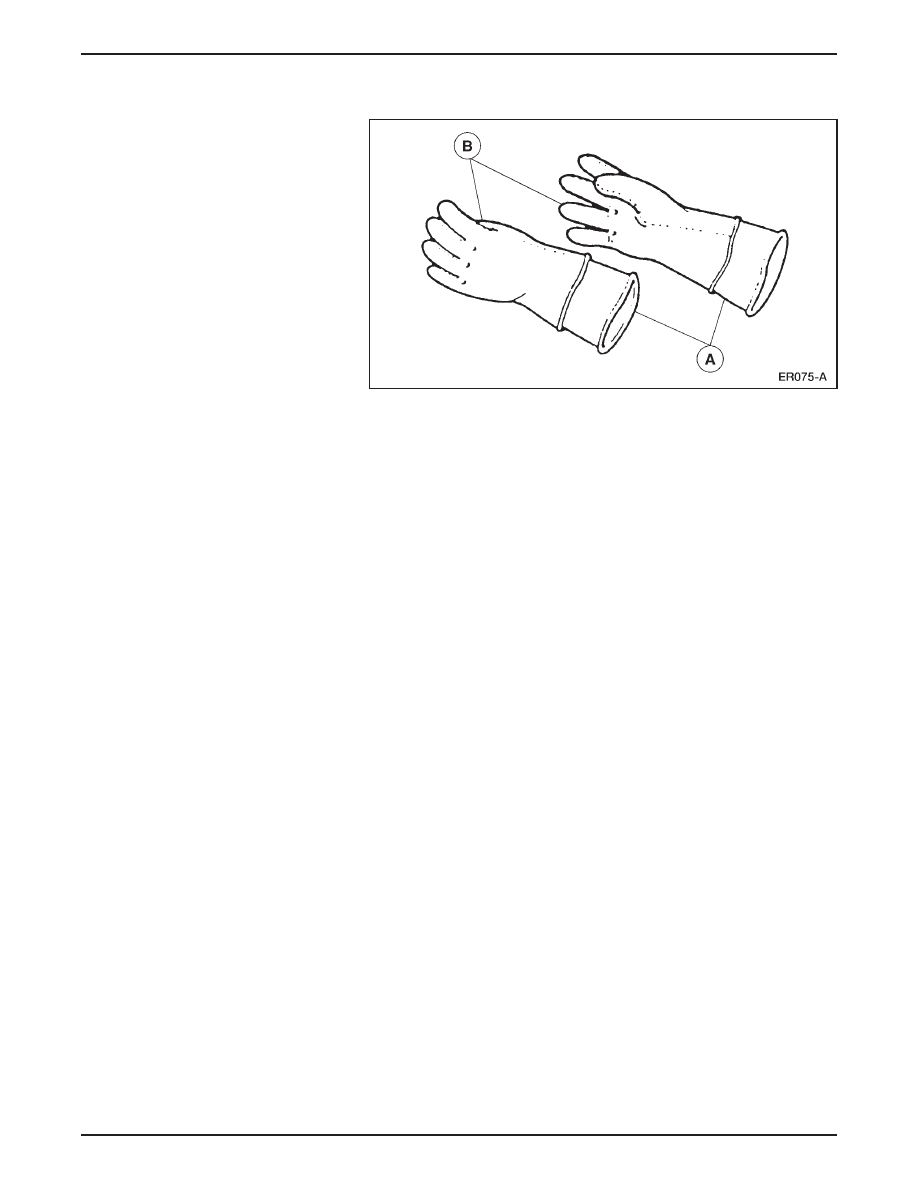
High Voltage Insulated Safety Gloves

High Voltage Insulated Safety Gloves

When working around high voltage circuits, High-Voltage

Insulated Safety Gloves (A) must be worn.

The gloves specified for the Ranger EV are Class “O” rubber

gloves.

– These gloves are designed for working around equipment rated

up to 1,000 volts

Rubber insulated safety gloves are protected by durable leather

gloves (B) that serve as an outer shell.

Before putting on High Voltage Insulated Safety Gloves, inspect

them to ensure that there are no holes or breakage.

– Even a pinhole leak is enough to allow current to pass through.

Inspect the gloves by rolling them up from their open end and

making sure that they retain air pressure with no leakage.

If the gloves show any sign of wear and tear, the gloves should not

be used.

– Replacement gloves must meet all American Safety Testing

Materials Standards.

High Voltage Insulated Safety Gloves must be recertified every

six months.

Protective leather gloves must always be worn over the High

Voltage Insulated Safety Gloves.

Chemicals can break down the rubber of the gloves. Never wash

them with chemicals or use them for washing parts.

Never use the protective leather gloves without the High Voltage

Insulated Safety Gloves. Oil that may be on your hands can

contaminate the protective leather gloves and then be transferred

onto the High Voltage Insulated Safety Gloves.

LESSON 4: SPECIAL SERVICE TOOLS AND PROCEDURES

4-18

Face Shield

Face Shield

When working with energized high-voltage equipment, to protect

your face and eyes from the possibility of an electrical arc, debris,

or spark that could be generated from a short circuit, a non-

conductive, OSHA-approved face shield must be worn.

LESSON 4: SPECIAL SERVICE TOOLS AND PROCEDURES

4-19

HIGH VOLTAGE DIAGNOSTIC AND
SERVICE PROCEDURES

High voltage diagnostic and service procedures on the Ranger EV

require caution and strict adherence to service publication

warnings. It is essential that extra care be used when working with

high voltage equipment. The following pages provide you with

information that will aid you when diagnosing and servicing the

Ranger EV.

High Voltage Components

The components that operate on high voltage are:

ER072-A

1

2

4

3

5

6

7

8

9

11

10

12

High Voltage Components

Item

Description

1

Positive Temperature Coefficient (PTC) heater
(inside of chamber assembly-heater plenum)

2

Traction Inverter Module (TIM)

3

Motor/Transaxle

4

DC/DC Converter

5

Battery Pack Assembly

6

Battery Charger

7

A/C Compressor

8

Power Steering Controller Assembly

9

Charge Inlet

10

A/C Inverter Motor Controller

11

PTC Switching Module

12

High Voltage Power Distribution Box (HVPDB)

LESSON 4: SPECIAL SERVICE TOOLS AND PROCEDURES

4-20

High Voltage Wiring

High Voltage Wiring

ER073-A

A

C

B

E

F

G

H

I

K

D

J

Wiring that distributes high voltage to components that operate on

high voltage are connected as follows:

A. From the battery charger to the high voltage power distribution

box (HVPDB)

B. From the TIM to the motor/transaxle

C. From the traction battery to the TIM

D. From the HVPDB to the DC/DC converter

E. From the traction battery to the HVPDB

F. From the HVPDB to the power steering assembly

G. From the A/C inverter motor controller to the A/C compressor

H. From the charge inlet to the traction battery charger

I.

From the HPVDB to the A/C inverter motor controller

J.

From the HPVDB to the PTC switching module

K. From the PTC switching module to the PTC heater


Content   ..  34  35  36  37   ..