Ford Focus Electric (2018 year). Manual - part 31
 

  Index      Ford     Ford Focus Electric - service manual 2018 year in english


Search            


Content   ..  29  30  31  32   ..


Ford Focus Electric (2018 year). Manual - part 31


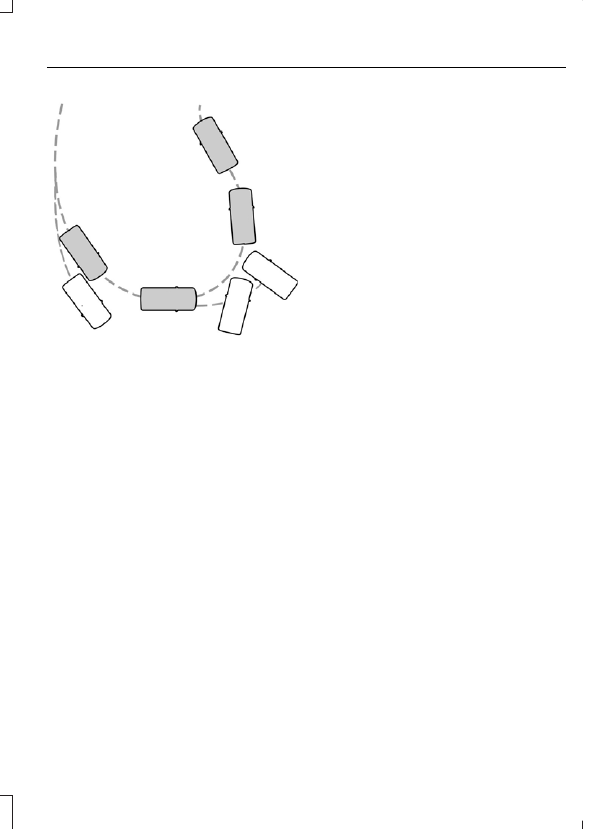
E72903

A

A

A

B

B

B

B

Vehicle without stability control
skidding off its intended route.

A

Vehicle with stability control
maintaining control on a slippery
surface.

B

USING STABILITY CONTROL

The system automatically turns on each
time you switch the ignition on.

You cannot switch the stability control
system off, but when you shift into reverse
(R), the system deactivates.

You can switch the traction control system
off or on.  See Using Traction Control
(page 123).

PRINCIPLE OF OPERATION

WARNINGS

To help avoid personal injury, always
use caution when in reverse (R) and
when using the sensing system.

The system may not detect objects
with surfaces that absorb reflection.
Always drive with due care and

attention. Failure to take care may result
in a crash.

Traffic control systems, inclement
weather, air brakes, external motors
and fans may affect the correct

operation of the sensing system.This may
cause reduced performance or false alerts.

The system may not detect small or
moving objects, particularly those
close to the ground.

Note: If your vehicle is equipped with
MyKey™, the sensing system cannot be
turned off when a MyKey™ is present. See
Principle of Operation (page 48).

Note: Keep the sensors, located on the
bumper or fascia, free from snow, ice and
large accumulations of dirt. If the sensors
are covered, the system’s accuracy can be
affected. Do not clean the sensors with
sharp objects.

Note: If your vehicle sustains damage to
the bumper or fascia, leaving it misaligned
or bent, the sensing zone may be altered
causing inaccurate measurement of
obstacles or false alerts.

Note: Certain add-on devices installed
around the bumper or fascia may create
false alerts. For example, large trailer
hitches, bike or surfboard racks, license plate
brackets, bumper covers or any other device
that may block the normal detection zone
of the system. Remove the add-on device
to prevent false alerts.

Note: When a trailer is connected to your
vehicle, the rear parking aid may detect the
trailer and therefore provide an alert. Disable
the rear parking aid when a trailer is
connected to prevent the alert.

The sensing system warns the driver of
obstacles within a certain range of your
vehicle. The system turns on automatically
whenever you switch the ignition on.

The system can be switched off through
the information display menu or from the
pop-up message that appears once you
shift the transmission into reverse (R).  See
General Information (page 80).

If a fault is present in the system, a warning
message appears in the information
display.  See Information Messages
(page 87).

REAR PARKING AID

The rear sensors are only active when the
transmission is in reverse (R). As your
vehicle moves closer to the obstacle, the
rate of the audible warning increases.
When the obstacle is less than 12 in
(30 cm) away, the warning sounds
continuously. If the system detects a
stationary or receding object farther than
12 in (30 cm) from the corners of the
bumper, the tone sounds for only three
seconds. Once the system detects an
object approaching, the warning sounds
again.

E130178

Coverage area of up to 6 ft (1.8 m) from
the rear bumper. There may be decreased
coverage area at the outer corners of the
bumper.

The system detects certain objects while
the transmission is in reverse (R) :

Your vehicle is moving toward a
stationary object at a speed of 3 mph
(5 km/h) or less.

Your vehicle is not moving, but a
moving object is approaching the rear
of your vehicle at a speed of 3 mph
(5 km/h) or less.

Your vehicle is moving at a speed of
less than 3 mph (5 km/h) and a moving
object is approaching the rear of your
vehicle at a speed of less than 3 mph
(5 km/h).

The system provides audio warnings only
when your vehicle is moving or when your
vehicle is stationary and the detected
obstacle is less than 12 in (30 cm) away
from the bumper.

Obstacle Distance Indicator

 (If

Equipped)

The system provides obstacle distance
indication through the information display.
The distance indicator displays when the
transmission is in reverse (R).

The indicator displays:

As the distance to the obstacle
decreases the indicator blocks
illuminate and move towards the
vehicle icon.

If there is no obstacle detected, the
distance indicator blocks are grayed
out.

REAR VIEW CAMERA

 (If Equipped)

WARNINGS

The rear view camera system is a
reverse aid supplement device that
still requires the driver to use it in

conjunction with the interior and exterior
mirrors for maximum coverage.

Objects that are close to either
corner of the bumper or under the
bumper, might not be seen on the

screen due to the limited coverage of the
camera system.

Reverse your vehicle slowly. Failure
to follow this instruction could result
in the loss of control of your vehicle,

personal injury or death.

Use caution when the liftgate is ajar.
If the liftgate is ajar, the camera will
be out of position and the video

image may be incorrect. All guidelines
disappear when the liftgate is ajar. Failure
to follow this instruction could result in
personal injury.

Use caution when turning camera
features on or off when the
transmission is not in park (P). Make

sure your vehicle is not moving.

The rear view camera system provides a
video image of the area behind your
vehicle.

During operation, lines appear in the
display which represent your vehicle’s path
and proximity to objects behind your
vehicle.

E147796

The camera is on the liftgate.

Using the Rear View Camera
System

The rear view camera system displays
what is behind your vehicle when you place
the transmission in reverse (R).

The system uses three types of guides to
help you see what is behind your vehicle:

Active guidelines: Show the intended
path of your vehicle when reversing.

Fixed guidelines: Show the actual path
your vehicle is moving in while reversing
in a straight line. This can be helpful
when backing into a parking space or
aligning your vehicle with another
object behind you.

Centerline: Helps align the center of
your vehicle with an object (for
example, a trailer).

Note: If the image comes on while the
transmission is not in reverse (R), have the
system checked as soon as possible.

Note: When towing, the camera only sees
what is being towed behind your vehicle.
This might not provide adequate coverage
as it usually provides in normal operation
and some objects might not be seen. In
some vehicles, the guidelines may disappear
once the trailer tow connector is engaged.

Note: The camera may not operate
correctly under the following conditions:

Nighttime or dark areas if one or both
reverse lamps are not operating.

The camera's view is obstructed by
mud, water or debris.  Clean the lens
with a soft, lint-free cloth and
non-abrasive cleaner.

The rear of your vehicle is hit or
damaged, causing the camera to
become misaligned.

Access the rear view camera system
settings through the information display.
See General Information (page 80).

After changing a system setting, the
display screen shows a preview of the
selected features.

Camera Guidelines

Note: Dynamic guidelines are only available
when the transmission is in reverse (R).


Content   ..  29  30  31  32   ..