Ford Focus (2017 year). Manual - part 53
 

  Index      Ford     Ford Focus - service manual 2017 year in english


Search            


Content   ..  51  52  53  54   ..


Ford Focus (2017 year). Manual - part 53


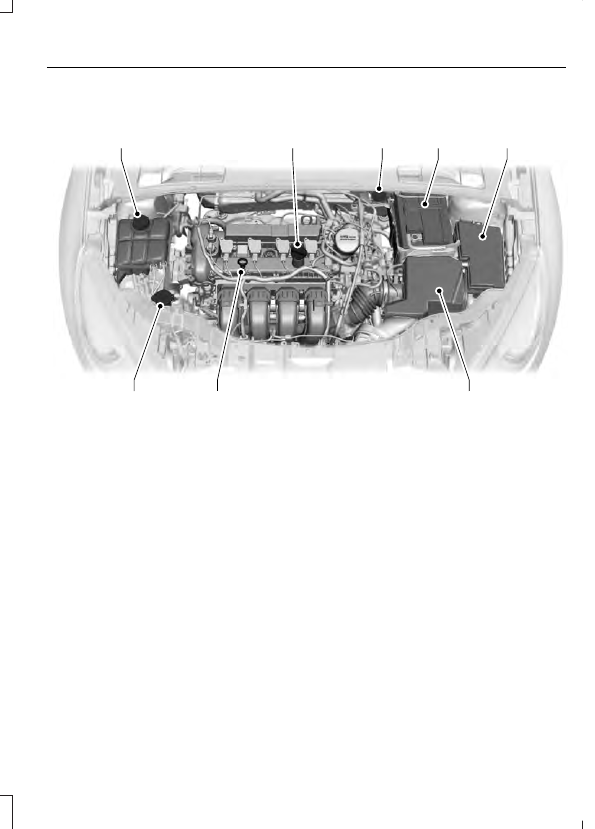
UNDER HOOD OVERVIEW - 2.0L

A

B

C

F

G

H

D

E

E212129

Engine coolant reservoir.  See Engine Coolant Check (page 218).

A

Engine oil filler cap.  See Engine Oil Check (page 216).

B

Brake and clutch fluid reservoir.  See Clutch Fluid Check (page 222).

C

Battery.  See Changing the 12V Battery (page 223).

D

Engine compartment fuse box.  See Fuses (page 201).

E

Air filter assembly.  See Changing the Engine Air Filter (page 235).

F

Engine oil dipstick.  See Engine Oil Check (page 216).

G

Windshield washer fluid reservoir.  See Washer Fluid Check (page 223).

H

ENGINE OIL DIPSTICK - 1.0L
ECOBOOST™

E141337

A

B

Minimum.

A

Maximum.

B

ENGINE OIL DIPSTICK - 2.0L

E191425

A

B

Minimum.

A

Maximum.

B

ENGINE OIL CHECK

WARNING

Do not work on a hot engine.

To check the engine oil level consistently
and accurately, do the following:

1.

Make sure the parking brake is on. Make
sure the transmission is in park (P) or
neutral (N).

2. Run the engine until it reaches normal

operating temperature.

3. Make sure that your vehicle is on level

ground.

4. Switch the engine off and wait 15

minutes for the oil to drain into the oil
pan.  Checking the engine oil level too
soon after you switch the engine off
may result in an inaccurate reading.

5. Open the hood.  See Opening and

Closing the Hood (page 212).

6. Remove the dipstick and wipe it with

a clean, lint-free cloth.  See Under
Hood Overview (page 214).

7.

Replace the dipstick and remove it
again to check the oil level.  See
Engine Oil Dipstick (page 216).

8. Make sure that the oil level is between

the maximum and minimum marks. If
the oil level is at the minimum mark,
add oil immediately.  See Capacities
and Specifications (page 275).

9. If the oil level is correct, replace the

dipstick and make sure it is fully seated.

Note: Do not remove the dipstick when the
engine is running.

Note:  If the oil level is between the
maximum and minimum marks, the oil level
is acceptable.  Do not add oil.

Note: The oil consumption of new engines
reaches its normal level after approximately
3,000 mi (5,000 km).

Adding Engine Oil

WARNINGS

Do not add engine oil when the
engine is hot. Hot engine oil can burn
you badly.

Do not remove the filler cap when
the engine is running.

Do not use supplemental engine oil
additives because they are unnecessary
and could lead to engine damage that may
not be covered by the vehicle Warranty.

E142732

Only use oils certified for gasoline engines
by the American Petroleum Institute (API).
An oil with this trademark symbol
conforms to the current engine and
emission system protection standards and
fuel economy requirements of the
International Lubricants Specification
Advisory Committee (ILSAC).

To top up the engine oil level do the
following:

1.

Clean the area surrounding the engine
oil filler cap before you remove it.

2. Remove the engine oil filler cap.  See

Under Hood Overview (page 214).
Turn it counterclockwise and remove
it.

3. Add engine oil that meets Ford

specifications.  See Capacities and
Specifications (page 275).  Y
ou may
have to use a funnel to pour the engine
oil into the opening.

4. Recheck the oil level.

5. If the oil level is correct, replace the

dipstick and make sure it is fully seated.

6. Replace the engine oil filler cap.  Turn

it clockwise until you feel a strong
resistance.

Note:  Do not add oil further than the
maximum mark.  Oil levels above the
maximum mark may cause engine damage.

Note: Make sure you install the oil filler cap
correctly.

Note: Soak up any spillage with an
absorbent cloth immediately.

OIL CHANGE INDICATOR
RESET

 (If Equipped)

Resetting the Oil Life Monitoring
System

Only reset the oil life monitoring system
after changing the engine oil and oil filter.

1.

Switch the ignition on. Do not start the
engine. For vehicles with push-button
start, press and hold the start button
for two seconds without pressing the
brake pedal. Do not start the engine.

2. Press the accelerator and brake pedals

at the same time.

3. Keep the accelerator and brake pedals

fully pressed.

4. After three seconds, a message

confirming that the reset is in progress
will be displayed.

5. After 25 seconds, a message

confirming that the reset is complete
will be displayed.

6. Release the accelerator and brake

pedals.

7.

The message confirming that the reset
is complete will no longer be displayed.

8. Switch the ignition off. For vehicles with

push-button start, press the start
button to switch the ignition off.

ENGINE COOLING FAN

WARNING

Keep your hands and clothing clear
of the engine cooling fan.

Under certain conditions, the engine
cooling fan may continue to run for several
minutes after you switch your vehicle off.

ENGINE COOLANT CHECK

WARNINGS

Do not add engine coolant when the
engine is hot. Steam and scalding
liquids released from a hot cooling

system can burn you badly. Also, spilling
coolant on hot engine parts can burn you.

Do not put engine coolant in the
windshield washer fluid container. If
sprayed on the windshield, engine

coolant could make it difficult to see
through the windshield.

To reduce the risk of personal injury,
make sure the engine is cool before
unscrewing the coolant pressure

relief cap. The cooling system is under
pressure. Steam and hot liquid can come
out forcefully when you loosen the cap
slightly.

Do not add coolant further than the
MAX mark.

When the engine is cold, check the
concentration and level of the coolant at
the intervals listed in the scheduled
maintenance information.  See Scheduled
Maintenance (page 409).

Note: Make sure that the coolant level is
between the MIN and MAX marks on the
coolant reservoir.

Note:  Coolant expands when it is hot.  The
level may extend beyond the MAX mark.

Maintain coolant concentration within
48% to 50%, which equates to a freeze
point between -30°F (-34°C) and -34°F
(-37°C). Coolant concentration should be
checked using a refractometer. We do not
recommend the use of hydrometers or
coolant test strips for measuring coolant
concentration.

Adding Coolant

WARNING

Never remove the coolant reservoir
cap when the engine is running or
hot.

Note: Automotive fluids are not
interchangeable. Do not use coolant or
windshield washer fluid outside of its
specified function and vehicle location.

Note:  Do not use stop leak pellets, cooling
system sealants, or non-specified additives
as they can cause damage to the engine
cooling or heating systems.  Resulting
component damage may not be covered by
the vehicle Warranty.

It is very important to use prediluted
coolant approved to the correct
specification in order to avoid plugging the
small passageways in the engine cooling
system.  See Capacities and
Specifications (page 275). 
 Do not mix
different colors or types of coolant in your
vehicle. Mixing of engine coolants or using
an incorrect coolant may harm the engine
or cooling system components and may
not be covered by the vehicle Warranty.

Note: If prediluted coolant is not available,
use the approved concentrated coolant
diluting it to 50/50 with distilled water.  See
Capacities and Specifications (page 275).
Using water that has not been deionised
may contribute to deposit formation,
corrosion and plugging of the small cooling
system passageways.


Content   ..  51  52  53  54   ..