Ford C-MAX Hybrid / Energi (2017 year). Manual - part 39
 

  Index      Ford     Ford C-MAX Hybrid / Energi - service manual 2017 year in english


Search            


Content   ..  37  38  39  40   ..


Ford C-MAX Hybrid / Energi (2017 year). Manual - part 39


AUTOMATIC TRANSMISSION

WARNINGS

Always apply the parking brake fully
and make sure you shift into park (P).
Switch the ignition off and remove

the key whenever you leave your vehicle.

Do not apply the brake pedal and
accelerator pedal simultaneously.
Applying both pedals simultaneously

for more than a few seconds will limit
engine performance, which may result in
difficulty maintaining speed in traffic and
could lead to serious injury.

Note: Do not leave your vehicle with the
transmission in neutral (N). Leaving your
vehicle with the transmission in neutral (N)
will drain the battery and you may not be
able to start your vehicle.

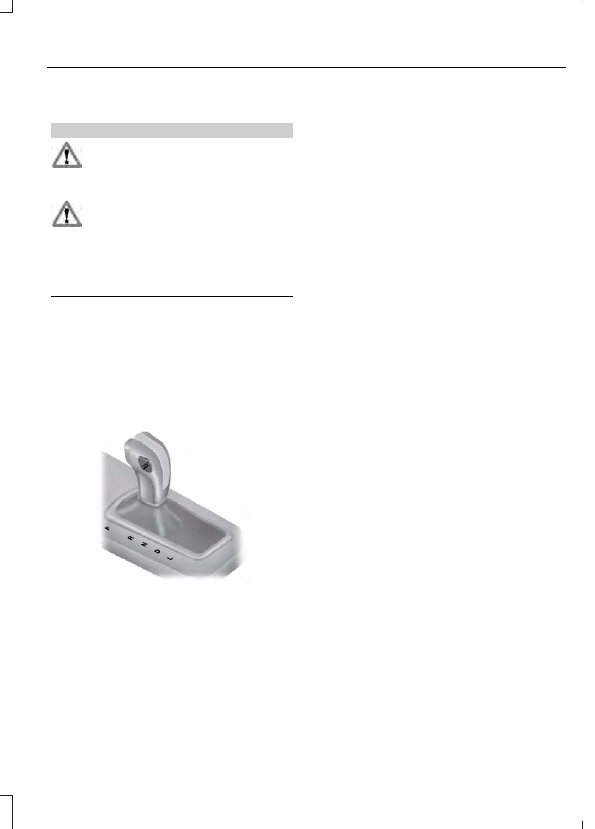
Understanding the Shift Positions
of your Automatic Transmission

E241455

1.

Fully press down the brake pedal.

2. Move the gearshift lever to the desired

gear.

3. Come to a complete stop.

4. Move the gearshift lever and securely

latch it in park (P).

Park (P)

This position locks the transmission and
prevents the front wheels from turning.
Come to a complete stop before putting
your vehicle into and out of park (P).

Reverse (R)

With the gearshift lever in reverse (R), your
vehicle will move backward. Always come
to a complete stop before shifting into and
out of reverse (R).

Neutral (N)

With the gearshift lever in neutral (N), your
vehicle can be started and is free to roll.
Hold the brake pedal down while in this
position.

Drive (D)

Drive (D) is the normal driving position for
the best fuel economy.

Low (L)

Provides maximum engine braking.

The transmission may be shifted into
low (L) at any vehicle speed.

Is not intended for use under extended
or normal driving conditions and results
in lower fuel economy.

Grade assist:

Press the transmission control switch on
the side of the gearshift lever to activate
grade assist.

E146092

Provides additional grade braking with
a combination of engine motoring and
high-voltage battery charging to help
maintain vehicle speed when
descending a grade.

As your vehicle determines the amount
of engine motoring and high-voltage
battery charging, you may notice the
engine speed increasing and
decreasing to help maintain your
vehicle speed when descending a
grade.

The grade assist lamp in the instrument
cluster is illuminated.

E144523

The grade assist lamp will
appear in the instrument cluster
when grade assist is turned on.

Press the transmission control switch
again to return to normal drive (D).

Brake-Shift Interlock

WARNINGS

Do not drive your vehicle until you
verify that the brake lamps are
working.

WARNINGS

When doing this procedure, you need
to take the transmission out of park
(P) which means your vehicle can

roll freely. To avoid unwanted vehicle
movement, always fully apply the parking
brake prior to doing this procedure. Use
wheels chocks if appropriate.

If the parking brake is fully released,
but the brake warning lamp remains
illuminated, the brakes may not be

working properly. Have your vehicle
checked as soon as possible.

Note: See your authorized dealer as soon
as possible if this procedure is used.

Note: For some markets this feature will be
disabled.

Use the brake shift interlock lever to move
the gearshift lever from the park position
in the event of an electrical malfunction or
if your vehicle has a dead battery.

Apply the parking brake and turn the
ignition off before performing this
procedure.

E223576

1.

Remove the shifter boot using a
suitable tool

E223577

2. Using a screwdriver or similar tool,

depress the brake shift interlock
override until the blocker moves.

3. Move the transmission selector from

park (P) to neutral (N).

4. Install the shifter boot.

5. Apply the brake pedal, start the vehicle

and release the parking brake.

If Your Vehicle Gets Stuck In Mud
or Snow

Note: Do not rock your vehicle if the engine
is not at normal operating temperature or
damage to the transmission may occur.

Note: Do not rock your vehicle for more
than a minute or damage to the
transmission and tires may occur, or the
engine may overheat.

If your vehicle gets stuck in mud or snow,
it may be rocked out by shifting between
forward and reverse gears, stopping
between shifts in a steady pattern. Press
lightly on the accelerator in each gear.

GENERAL INFORMATION

Note: Occasional brake noise is normal. If
a metal-to-metal, continuous grinding or
continuous squeal sound is present, the
brake linings may be worn-out. Have the
system checked by an authorized dealer. If
the vehicle has continuous vibration or
shudder in the steering wheel while braking,
have it checked by an authorized dealer.

Note: Brake dust may accumulate on the
wheels, even under normal driving
conditions. Some dust is inevitable as the
brakes wear and does not contribute to
brake noise.  See Cleaning the Wheels
(page 252).

E144522

See Warning Lamps and
Indicators (page 87).

Wet brakes result in reduced braking
efficiency. Gently press the brake pedal a
few times when driving from a car wash or
standing water to dry the brakes.

Brake Over Accelerator

In the event the accelerator pedal
becomes stuck or entrapped, apply steady
and firm pressure to the brake pedal to
slow the vehicle and reduce engine power.
If you experience this condition, apply the
brakes and bring your vehicle to a safe
stop. Move the transmission to park (P),
switch the engine off and apply the parking
brake. Inspect the accelerator pedal for
any interference. If none are found and the
condition persists, have your vehicle towed
to the nearest authorized dealer.

Brake Assist

Brake assist detects when you brake
heavily by measuring the rate at which you
press the brake pedal. It provides
maximum braking efficiency as long as you
press the pedal. Brake assist can reduce
stopping distances in critical situations.

Anti-lock Brake System

This system helps you maintain steering
control during emergency stops by keeping
the brakes from locking.

This lamp momentarily
illuminates when you turn the
ignition on. If the light does not

illuminate during start up, remains on or
flashes, the system may be disabled. Have
the system checked by an authorized
dealer. If the anti-lock brake system is
disabled, normal braking is still effective.

E144522

If the brake warning lamp
illuminates when you release the
parking brake, have the system

checked by an authorized dealer.

Regenerative Braking System

This feature is used to simulate the engine
braking of an internal combustion engine
and assist the standard brake system while
recovering some of the energy of motion
and storing it in the battery to improve the
range of your vehicle. The standard brake
system is designed to fully stop the car if
regenerative braking is not available.
During regenerative braking, the motor is
spun as a generator to create electrical
current. This recharges the battery and
slows the vehicle. In effect, once the
accelerator pedal is released, the motor
changes from an energy user to an energy
producer.

When the accelerator pedal is released or
the brake pedal is applied, the brake
controller automatically detects the
amount of deceleration requested and
optimizes how much of the deceleration
will be produced by regenerative braking.
The remaining portion is generated by


Content   ..  37  38  39  40   ..