Fiat Qubo (2021 year). Manual in english - page 12
 

  Index      Manuals     Fiat Qubo (2021 year). Manual in english


Search            copyright infringement  


Content      ..     10      11      12      13     ..


Fiat Qubo (2021 year). Manual in english - page 12


187

AIR CLEANER/

POLLEN FILTER

Have the air cleaner or the pollen filter

replaced by a Fiat Dealership.

WINDSCREEN

WIPER/REAR

WINDOW WIPER

(for versions/markets, where provided)

WIPER BLADES

Periodically clean the rubber part

using special products; PETRONAS

DURANCE SC 35 is recommended.
Replace the blades if the rubber

edge is deformed or worn. In any

case, it is advisable to replace them

approximately once a year.
A few simple precautions can reduce

the possibility of damage to the blades:

if the temperature falls below zero,

make sure that ice has not frozen the

rubber to the glass. Use a de-icing

product to release it if required;

remove any snow from the glass:

in addition to protecting the blades,

this prevents effort on the motor and

overheating;

do not operate the windscreen and

rear window wipers on dry glass.

160)

Replacing the

windscreen wiper

blades

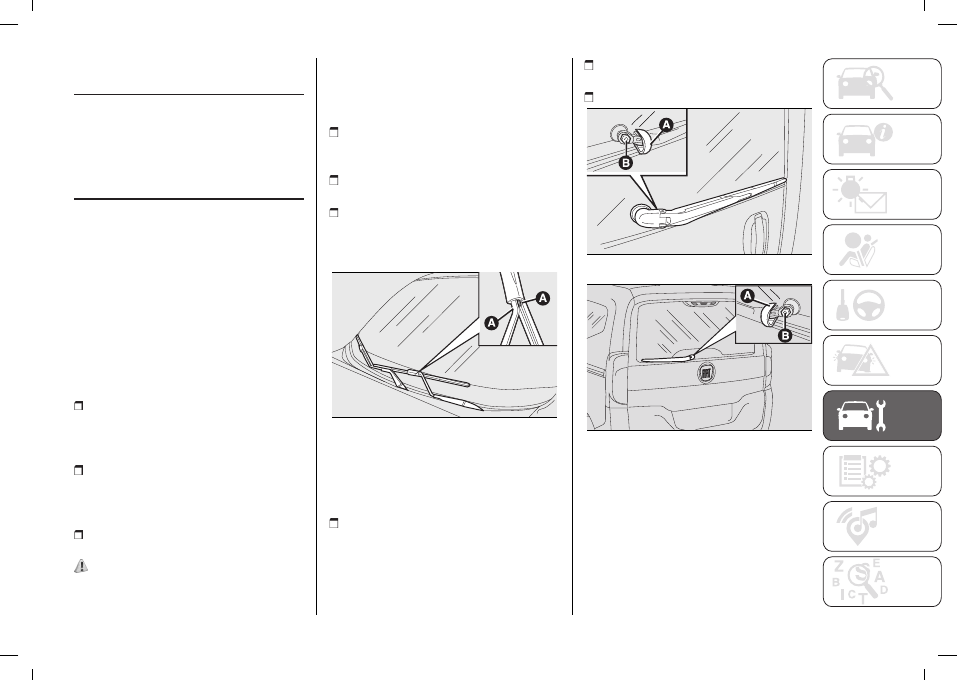
Proceed as follows:

lift up the windscreen wiper arm and

position the blade so that it forms a 90

°

angle with the arm;

press tabs (A) fig. 239 and remove

the blade from the arm;

install the new blade by inserting the

straps into the supplied housings of the

arm. Make sure that the new blade is

secured in position.

239

F0T0087

Replacing the rear

window wiper blade

(for versions/markets, where provided)
Proceed as follows:

raise the cover (A) fig. 240 (Fiorino

versions) or fig. 240 (Qubo versions)

and remove the arm from the vehicle,

undoing the nut (B) which fixes it to the

pivot pin;

correctly position the new arm and

tighten the nut fully;

lower the cover.

240

F0T0088

241

F0T0213

NOZZLES

If the jet is not coming out, firstly check

that there is fluid in the windscreen/rear

window reservoir (for versions/markets

where provided) (see “Checking levels”

in this section).
Then check that the nozzle holes are

not clogged; use a needle to unblock

them if necessary.

-------------------------------------------------------------------------------------------------------------------------------------------------------------

 SERVICING AND MAINTENANCE

188

Windscreen (washer)

The window washer nozzles are fixed.

The nozzle holders are located under

the bonnet (see fig. 242).

242

F0T0090

Rear window (washer)

The rear window washer jets are fixed.

The nozzle holder is located above the

rear window fig. 243 (Fiorino versions)

or fig. 244 (Qubo versions).

243

F0T0089

244

F0T0214

160)

Driving with worn windscreen wiper

blades is a serious hazard, because

visibility is reduced in bad weather

conditions.

PROLONGED

VEHICLE INACTIVITY

If the vehicle needs to be off the

road for longer than one month, the

following precautions must be taken:

park the vehicle indoors in a dry and,

if possible, well-ventilated place;

engage a gear and check that the

handbrake is not engaged;

disconnect the battery negative

terminal and check the charge (see

“Battery” in the “Maintenance and

care”);

clean and protect the painted parts

using protective wax;

clean and protect the shiny metal

parts using special compounds

available commercially;

sprinkle talcum powder on the

windscreen and rear window wiper

rubber blades and lift them off the

glass;

slightly open the windows;

cover the vehicle with a piece of

fabric or perforated plastic sheet. Do

not use compact plastic tarpaulins,

which prevent humidity from

evaporating from the surface of the

vehicle;

inflate tyres to +0.5 bar above the

standard specified pressure and check

it at intervals;

-------------------------------------------------------------------------------------------------------------------------------------------------------------

189

do not drain the engine cooling

system.

LIFTING THE

VEHICLE

If the vehicle needs to be lifted, go to a

Fiat Dealership which is equipped with

the arm hoist or workshop lift.

WHEELS AND TYRES

Check the pressure of each tyre,

including the space-saver spare wheel,

approximately every two weeks and

before long journeys: the pressure

should be checked with the tyre rested

and cold.

It is normal for the pressure to increase

when the vehicle is used; for the

correct tyre inflation pressure, see the

"Wheels" paragraph in the "Technical

specifications" chapter.

Incorrect pressure causes abnormal

tyre wear fig. 245:

A

normal pressure: tread evenly worn;

B

low pressure: tread particularly worn

at the edges;

C

high pressure: tread particularly worn

in the centre.

The tyres must be replaced when the

tread is less than 1.6 mm thick. In any

case, follow the laws in force in the

country where you are driving.

245

F0T0013

IMPORTANT NOTES

As far as possible, avoid sharp

braking, screech starts and violent

shocks against pavements, potholes or

other hard obstacles.

Driving for long stretches over uneven

roads can damage the tyres;

periodically check that the tyres have

no cuts in the side wall, abnormal

swelling or irregular tyre tread wear. Go

to a Fiat Dealership if required;

avoid overloading the car when

travelling: this may cause serious

damage to the wheels and tyres;

if a tyre is punctured, stop

immediately and replace it to

avoid damage to the tyre, the rim,

suspension and steering system;

tyres age even if they are not used

much. Cracks in the tread and on

the sidewalls are a sign of ageing. In

any event, have the tyres checked by

specialised technicians if they have

been fitted for longer than 6 years.

Remember to check the spare wheel

very carefully;

in the case of replacement, always fit

new tyres, avoiding those of unknown

origin;

if a tyre is changed, also change the

inflation valve;

to allow even wear between the front

and rear tyres, it is advisable to change

them over every 10

15 thousand

kilometres, keeping them on the same

side of the vehicle so as not to reverse

the direction of rotation.

161) 162) 163) 164)

SNOW TYRES

The Fiat Dealership will be happy to

provide advice concerning the most

suitable type of tyre for the customer's

requirements.
For the type of tyre to be used, inflation

pressures and the specifications of

snow tyres, follow the instructions

given in the "Wheels" paragraph in the

"Technical specifications" chapter.
The winter features of these tyres

are reduced considerably when the

tread depth is below 4 mm. Replace

them in this case. Due to the specific

characteristics of snow tyres, in

normal weather conditions or on long

motorway journeys, the performance

of these tyres is lower than that of

-------------------------------------------------------------------------------------------------------------------------------------------------------------

 SERVICING AND MAINTENANCE

190

standard tyres. Their usage should

therefore be restricted in accordance

with their type approval.

165)

Note

When using snow tyres with a

maximum speed index below the one

that can be reached by the vehicle

(increased by 5%), place a notice in

the passenger compartment, plainly in

view, which states the maximum speed

allowed by the snow tyres (as per

EC Directive). All four tyres should be

the same (brand and track) to ensure

greater safety when driving and braking

as well as a good manoeuvrability.

Remember that you should not change

the rotation direction of the tyres.

SNOW CHAINS

The use of snow chains should be in

compliance with local regulations of

each country. The snow chains may be

applied only onto the front wheel (drive

wheels).
Check the tension of the snow chains

after the first few metres have been

driven.

166)

161)

Remember that the road holding

qualities of your vehicle also depend on

the correct inflation pressure of the tyres.

162)

If tyre pressure is too low, the tyre

may overheat and be severely damaged as

a result.

163)

Do not switch tyres from the

right­hand side of the vehicle to the

left­hand side, and vice versa.

164)

Never submit alloy rims to

repainting treatments requiring the use

of temperatures exceeding 150

°

C. The

mechanical properties of the wheels could

be impaired.

165)

You must not exceed 160 km/h on

snow tyres with a “Q” mark; in any case,

make sure you stick to the rules of the

highway code.

166)

Keep the vehicle's speed down when

snow chains are fitted; never exceed 50

km/h. Avoid potholes, do not drive over

steps or pavements, and do not drive long

distances over roads without snow, to

avoid damaging both your vehicle and the

road surface.

RUBBER HOSES

As far as the maintenance of the brake

system and fuel supply system rubber

hoses is concerned, follow the "Service

Schedule" in this chapter carefully.

Ozone, high temperatures and

prolonged lack of fluid in the system

may cause hardening and cracking of

the hoses, with possible leaks. Careful

checking is therefore necessary.

BODYWORK

PROTECTION AGAINST

ATMOSPHERIC AGENTS

The main causes of corrosion are the

following:

atmospheric pollution;

salty air and humidity (coastal areas,

or hot humid climates);

seasonal environmental conditions.

The abrasive action of wind-borne

atmospheric dust and sand, as well as

mud and gravel raised by other cars is

also not to be underestimated.
On your vehicle, Fiat has implemented

the best manufacturing technologies

to effectively protect the bodywork

against corrosion.
These include:

painting products and systems which

give the vehicle particular resistance to

corrosion and abrasion;

-------------------------------------------------------------------------------------------------------------------------------------------------------------

191

use of galvanised (or pretreated)

sheet metal, with high resistance to

corrosion;

spraying the underbody, engine

compartment, wheelhouse internal

parts and other parts with highly

protective wax products;

spraying of plastic parts, with a

protective function in the more exposed

points: underdoor, inner wing, edges,

etc.;

use of “open” boxed sections to

prevent condensation and pockets of

moisture from triggering rust inside.

VEHICLE BODY AND

UNDERBODY WARRANTY

Your vehicle is covered by warranty

against perforation due to corrosion of

any original element of the structure or

body.
For the general terms of this warranty,

refer to the Warranty Booklet.

ADVICE FOR

PRESERVING THE

BODYWORK

Paintwork

Paintwork does not only serve an

aesthetic purpose, but also protects

the underlying sheet metal.
You are advised to touch up abrasions

and scratches immediately to prevent

rust formation. Use only original

paint products for touch-ups (see

“Bodywork paint identification plate” in

the “Technical specifications” section).
Normal maintenance of paintwork

consists in washing the vehicle: the

frequency depends on the conditions

and environment where the vehicle is

used.
For example, it is advisable to wash the

vehicle more often in areas with high

levels of environmental pollution or on

roads spread with salt.
To correctly wash the vehicle, proceed

as follows:

wash the bodywork using a low

pressure jet of water;

wipe a sponge with a slightly soapy

solution over the bodywork, frequently

rinsing the sponge;

rinse well with water and dry with a

jet of air or a chamois leather.
If you put the vehicle through a car

wash, follow these recommendations:

remove the aerial from the roof so it

does not get damaged;

the vehicle should be washed with

water added to a soapy solution;

rinse thoroughly to avoid soap marks

remaining on the bodywork or less

visible parts.

40) 41)

Dry the less visible parts, such as the

door frames, bonnet and the headlight

frames with special care, as in these

areas water may stagnate more easily.

It is a good idea to leave the vehicle

outdoors for a while after washing it to

give the water time to evaporate.
Do not wash the vehicle after it has

been left in the sun or with the bonnet

hot: this may alter the shine of the

paintwork.
Exterior plastic parts should be cleaned

in the same way as the rest of the

vehicle.

WARNING Where possible, do not park

the vehicle under trees; the resinous

substances released by many species

give the paint a dull appearance and

increase the possibility of corrosion.

WARNING Bird droppings must be

washed off immediately and thoroughly

as the acid they contain is particularly

aggressive.

6)

Windows

To clean glasses, use specific cleaning

products. Use clean cloths to avoid

scratching the glass or altering the

transparency.

WARNING Wipe the rear window

inside gently with a cloth following

the direction of the filaments to avoid

damaging the heating device.

-------------------------------------------------------------------------------------------------------------------------------------------------------------

 SERVICING AND MAINTENANCE

192

Engine compartment

At the end of each winter, thoroughly

wash the engine compartment, taking

care to avoid spraying the water jet

directly onto the electronic control

units and the relay/fuse box on the

left side of the engine compartment

(driving direction). Have this operation

performed at a specialised workshop.

WARNING The washing should take

place with the engine cold and the

ignition key in the STOP position. After

the washing operation, make sure that

the various protections (e.g. rubber

caps and guards) have not been

removed or damaged.

Headlights

WARNING Never use aromatic

substances (e.g. petrol) or ketones (e.g.

acetone) for cleaning the plastic lenses

of the headlights.

40)

Some automatic systems equipped

with old generation blades and/or with a

poor maintenance can damage the paint,

promoting the creation of microscoring

which give an opaque/coated appearance

to the paint, especially on dark colours. In

this case, just lightly polish with specific

products.

41)

Abrasive products and/or polishes

should not be used for cleaning the car.

Bird droppings must be washed off

immediately and thoroughly as the acid

they contain is particularly aggressive.

Avoid parking the vehicle under trees

(unless it is absolutely necessary). Remove

any resinous plant matter immediately

because, once it has dried, it may require

the use of abrasive and/or polishing

products to be removed, which are

strongly discouraged as they could

potentially alter the characteristics

of the paintwork. Do not use pure

windscreen washer fluid for cleaning

the front windscreen and rear window;

dilute it min. 50% with water. Only use

pure screen washer fluid when strictly

necessary due to outside temperature

conditions. Do not use chemicals/acids to

defrost windows/vehicle glass as they can

damage the paint.

6)

Detergents pollute the water. The

vehicle should be washed in areas

equipped for collecting and purifying the

liquid used in the washing process.

INTERIOR

Regularly check that water is not

trapped under the mats (due to water

dripping off shoes, umbrellas, etc.), as

this could cause oxidation of the sheet

metal.

167) 168)

FABRIC SEATS AND

PARTS

Remove dust with a soft brush or a

vacuum cleaner.
It is advisable to use a moist brush on

velvet upholstery.
Rub the seats with a sponge

moistened with a solution of water and

neutral detergent.

PLASTIC PARTS

It is advisable to clean interior plastic

parts with a moist cloth and a solution

of water and non-abrasive mild soap.

Use specific products for cleaning

plastic, without solvents and specifically

designed to prevent damage to the

appearance and colour of the treated

parts, to remove grease and tough

stains.

WARNING Never use alcohol or

petroleum to clean the instrument

panel.

-------------------------------------------------------------------------------------------------------------------------------------------------------------

193

LEATHER STEERING

WHEEL/GEAR LEVER

KNOB/HANDBRAKE

(for versions/markets, where provided)
These components must be cleaned

with mild soap and water only. Never

use alcohol or alcohol-based products.
Read the product label carefully before

using specific products for cleaning the

interiors: make sure that the product

does not contain spirits or alcohol-

based substances.
If, when cleaning the windscreen

with special products, window

cleaner accidentally drips onto the

leather of the steering wheel/gear

lever knob/handbrake, wipe away

immediately and then wash the

affected area with mild soap and water.

WARNING Be careful when using a

steering wheel lock device, where

applicable, to avoid damaging the

leather upholstery by rubbing.

167)

Never use flammable products,

such as petroleum ether or modified

petrol, to clean the inside of the car. The

electrostatic charges which are generated

by rubbing during the cleaning operation

may cause a fire.

168)

Do not keep aerosol cans in the

vehicle: they might explode. Aerosol cans

must not be exposed to temperatures

higher than 50

°

C. Temperatures may

greatly exceed this value inside a vehicle

exposed to direct sunlight.

-------------------------------------------------------------------------------------------------------------------------------------------------------------

 TECHNICAL SPECIFICATIONS

194

TECHNICAL SPECIFICATIONS

Everything you may find useful for

understanding how your vehicle is

made and works is contained in this

chapter and illustrated with data, tables

and graphics. For the enthusiasts and

the technician, but also just for those

who want to know every detail of their

vehicle.

IDENTIFICATION DATA ............... 195
ENGINE CODES - BODYWORK

VERSION .................................. 198
ENGINE .................................... 200
POWER SUPPLY ....................... 202
TRANSMISSION ........................ 203
BRAKES ................................... 204
SUSPENSION............................ 205
STEERING ................................ 206
WHEELS................................... 207
DIMENSIONS ............................ 212
PERFORMANCE ........................ 216
WEIGHTS AND LOADS............... 217
REFUELLING............................. 220
FLUIDS AND LUBRICANTS ......... 222
FUEL CONSUMPTION AND

CO2 EMISSIONS ....................... 225

RADIO FREQUENCY REMOTE

CONTROL: OFFICIAL TYPE

APPROVALS ............................. 226
PRESCRIPTIONS FOR

HANDLING THE VEHICLE AT

THE END OF ITS LIFE................. 227

-------------------------------------------------------------------------------------------------------------------------------------------------------------

195

IDENTIFICATION

DATA

It is advisable to take note of the

identification codes. The identification

data are printed on labels in the

following positions fig. 246:

246

F0T0175

A

Vehicle summary identification and

paintwork plate

B

Chassis marking

C

Engine marking

VEHICLE SUMMARY

IDENTIFICATION AND

PAINTWORK PLATE

This is stuck on the driver's door pillar

and shows the following data fig. 247:

VERSIONE-VERSION

N° PER RICAMBI
N° FOR SPARES

MADE IN TURKEY

MOTORE-ENGINE CODICE COLORE/PAINT

2 -

1 -

Kg

Kg

Kg

Kg

247

F0V0725

A

Name of manufacturer

B

Type-approval number

C

Vehicle type identification code

D

Maximum permitted weight of fully

laden vehicle

E

Maximum permitted weight of vehicle

when fully laden plus trailer

F

Maximum permitted weight on first

axle (front)

G

Maximum permitted weight on

second axle (rear)

H

Engine type

I

Bodywork version code

L

Spare part reference number

M

Bodywork colour code

N

Correct fume coefficient value

IDENTIFICATION DATA

(For versions/markets, where provided)
The identification data are printed on

labels in the following positions fig. 248:

248

F0T0320

A

Vehicle identification number (VIN)

plate

B

Chassis marking

C

Bodywork paint identification plate

D

Engine marking

VEHICLE

IDENTIFICATION

NUMBER (VIN) PLATE

This is applied on the rear part of the

vehicle and contains the following data

fig. 249:

249

F0T0011

A

Name of manufacturer

-------------------------------------------------------------------------------------------------------------------------------------------------------------

 TECHNICAL SPECIFICATIONS

196

B

Type-approval number

C

Vehicle type identification code

D

Chassis manufacture serial number

E

Maximum permitted weight of fully

laden vehicle

F

Maximum authorised weight of

vehicle when fully laden plus trailer.

G

Maximum permitted weight on first

(front) axle

H

Maximum permitted weight on

second axle (rear)

I

Engine type

L

Bodywork version code

M

Spare part number

N

Smoke opacity index (for diesel

engines)

CHASSIS MARKING

This is printed on the passenger

compartment floor, near the right front

seat.

250

F0T0084

Slide the hatch (A) fig. 250 forward to

access.

The marking includes:

type of vehicle;

chassis serial number.

BODYWORK PAINT

IDENTIFICATION PLATE

(For versions/markets, where provided)
This plate is applied inside the bonnet

and shows the following data fig. 251:
A Paint manufacturer
B Name
C Fiat colour code
D Respray and touch up code

251

F0T0012

MOTOR MARKING

It is stamped on the cylinder block and

includes the type and the engine serial

number.

METHANE SYSTEM

(NATURAL POWER)

WARNING If the vehicle has been

registered in a country other than Italy,

the certification data, identification

and inspection procedures for the

methane cylinders should conform to

the legislation in that country. In any

case, it should be remembered that

the life of the cylinders is 20 years from

the production date as set out in ECE

Regulation no. 110.

Cylinder marking

Each methane cylinder is identified in

the plant by information stamped on

the cylinder cone fig. 252.

252

F0T0361

This stamp contains:

CNG ONLY

(type of gas which it is

designed for: compressed natural gas

only);

DO NOT USE AFTER

XX - XXXX

(cylinder expiry date: month - year);

FABER

(the name of the cylinder

manufacturer);
XX / XXXX / XXX (serial number of the

cylinder);

-------------------------------------------------------------------------------------------------------------------------------------------------------------

197

XX

L

(rated capacity of the cylinder in

litres);
XX

KG

(weight of the cylinder in kg:

specific to each cylinder);

20.0 MPa 15

°

C

(operating pressure at

15

°

C);

30.0 MPa

(tested pressure of cylinder);

E

X

110R

-XXXXXX (ECE approval

number);

ECE R 110

(manufacturing regulation);

CNG-1

(type of cylinder);

XX / XXXX (cylinder manufacturing

commissioning date: month/year);

USE ONLY FABER-APPROVED

PRD

(PRD safety device warning);

(

N)

(ENI punching).

The other plates (provided with the

vehicle documentation) contain the

date for the first inspection of the

cylinders.

SYSTEM INSPECTION

The cylinders must be inspected, in

accordance with ECE Regulation

Procedure no. 110, every 4 years from

the vehicle registration date or in

accordance with specific regulations in

individual countries.

-------------------------------------------------------------------------------------------------------------------------------------------------------------

 TECHNICAL SPECIFICATIONS

198

ENGINE CODES - BODYWORK VERSION

Model

Engine code

1.4 Euro 6/Euro 6d/ Euro 6d Final

350A1000

1.3 16V Multijet 80 HP Euro 6/Euro 6d

225A2000

1.3 16V Multijet 80 HP Euro 6d Final

46345266

1.3 16V Multijet 95 HP Euro 6/Euro 6d

330A1000

1.3 16V Multijet 95 HP Euro 6d Final

46345266

-------------------------------------------------------------------------------------------------------------------------------------------------------------

199

The following body version code and

key are an example that may be

applied to all body version codes.

Example:

225 B XB 1A AX

Key:

225

Model

C

Body

M

Engine

1

Traction

A

Transmission

AX

Version

MODEL

225

Fiorino

300

Qubo

BODYWORK

A

Combi M1 (5 seats)

B

Cargo (2 seats)

C

Combi N1 (4 seats)

F

Trekking N1

G

Panorama N1

L

Panel version

ENGINES

B

1.4 petrol Euro 6

C

1.4 Natural Power Euro 6

J

1.3 16V Multijet 80 HP Euro 6d

K

1.3 16V Multijet 95 HP Euro 6d

L

1.3 16V Multijet 80 HP Euro 6d Final

M

1.3 16V Multijet 95 HP Euro 6d Final

N

1.4 petrol Euro 6d

P

1.4 Natural Power Euro 6d

R

1.3 16V Multijet 80 HP Euro 6

S

1.3 16V Multijet 95 HP Euro 6

T

1.4 petrol Euro 6d Final

TRACTION

1

Front

TRANSMISSION

A

Mechanical gearbox

-------------------------------------------------------------------------------------------------------------------------------------------------------------

 TECHNICAL SPECIFICATIONS

200

ENGINE

General information

1.4 Euro 6/Euro

6d/Euro 6d Final

1.4 Natural Power

Engine code

350A1000

350A1000

Cycle

Otto

Otto

Number and position of cylinders

4 in line

4 in line

Piston bore and stroke (mm)

72 x 84

72 x 84

Total displacement (cm³)

1368

1368

Compression ratio

11.1

±

0.2:1

11.1

±

0.2:1

Methane

Petrol

Maximum power (CEE) (kW)

57

51

57

Maximum power (CEE) (HP)

77

70

77

Corresponding engine speed (rpm)

6000

6000

6000

Maximum torque (CEE) (Nm)

115

104

115

Maximum torque (CEE) (kgm)

11.7

10.6

11.7

Corresponding engine speed (rpm)

3000

3000

3000

Spark plugs

NGK ZKR7A-10

NGKZKR7A-10

Fuel

Unleaded petrol 95

R.O.N. (EN228

specifications)

Methane for motor

vehicles

Unleaded petrol 95

R.O.N. (EN228

specifications)

-------------------------------------------------------------------------------------------------------------------------------------------------------------

201

General information

1.3 Multijet 80 HP Euro 6/Euro

6d/ Euro 6d Final

1.3 Multijet 95 HP Euro 6/Euro 6d/

Euro 6d Final

Engine code

225A2000/ 46345266(*)

330A1000/ 46345266(*)

Cycle

Diesel

Diesel

Number and position of cylinders

4 in line

4 in line

Piston bore and stroke (mm)

69.6 x 82

69.6 x 82

Total displacement (cm³)

1248

1248

Compression ratio

16.8:1/ 16.2

±

0.2:1 (*)

16.8 :1/ 16.2

±

0.2 :1 (*)

Maximum power (CEE) (kW)

59

70

Maximum power (CEE) (HP)

80

95

Corresponding engine speed (rpm)

3750

3750

Maximum torque (CEE) (Nm)

200

200

Maximum torque (CEE) (kgm)

20.4

20.4

Corresponding engine speed (rpm)

1500

1500

Spark plugs

Fuel

Automotive Diesel

(EN590 specifications)

Automotive Diesel

(EN590 specifications)

-------------------------------------------------------------------------------------------------------------------------------------------------------------

 TECHNICAL SPECIFICATIONS

202

POWER SUPPLY

169)

Versions

Intake system

1.4 Euro 6/Euro 6d/Euro 6d Final

Multipoint sequential timed electronic injection, returnless system

1.4 Natural Power

Multipoint sequential phased electronic injection especially designed for methane.

Injection pressure: approx. 6 bar.

Stoichiometric metering of the air/methane gas mixture.

The methane injection system is controlled by the dedicated control unit using the sensors already

on the vehicle, including the oxygen sensor for controlling the fuel metering.

1.3 16V Multijet Euro 6/Euro

6d/Euro 6d Final

Electronically controlled Common Rail Multijet direct injection with turbo and intercooler

Ignition

: Static advance, electronic, integrated with the injection.

169)

Modifications or repairs to the fuel supply system that are not carried out properly or do not take the system’s technical specifications

into account can cause malfunctions leading to the risk of fire.

-------------------------------------------------------------------------------------------------------------------------------------------------------------


Content      ..     10      11      12      13     ..