Dodge Ram Truck 1500-2500-3500. Manual - part 555
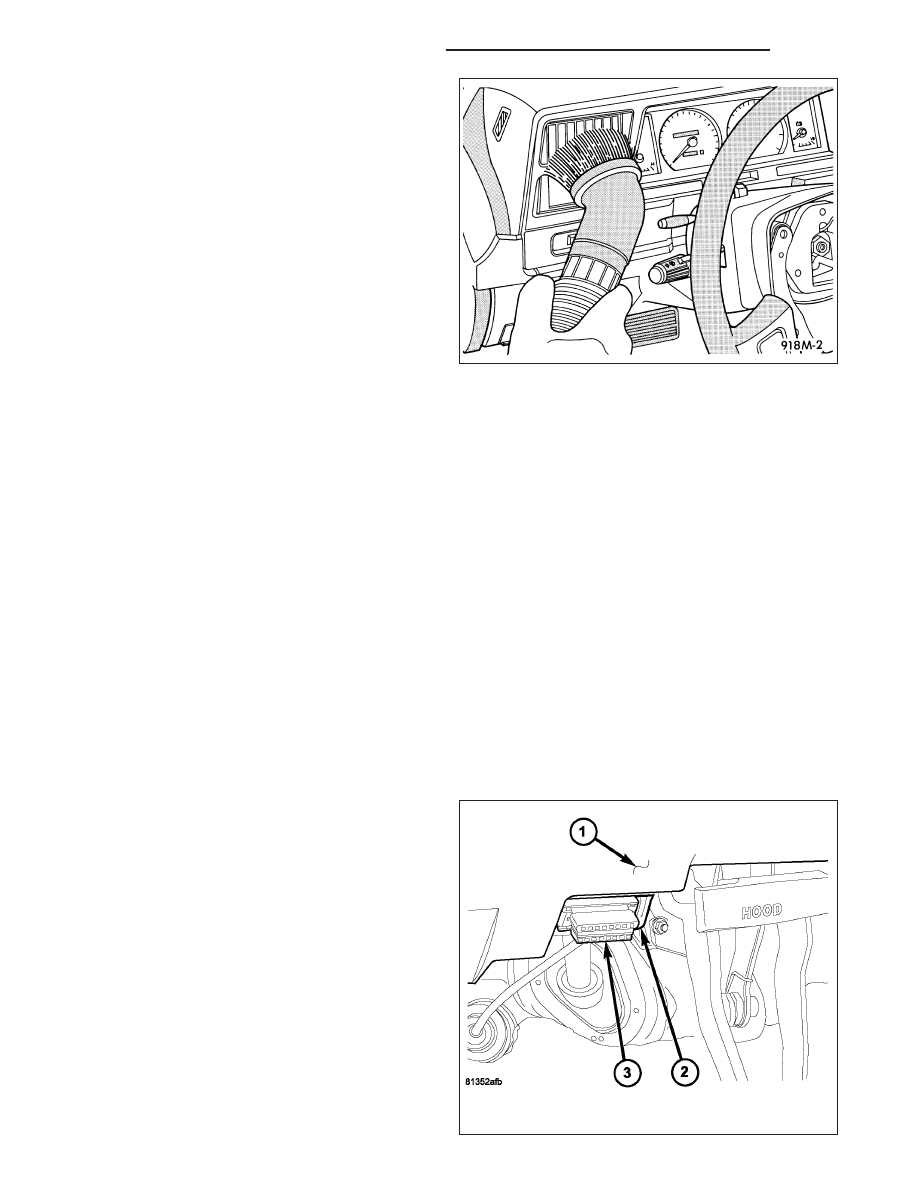
1. Begin the cleanup by using a vacuum cleaner to
remove any residual powder from the vehicle inte-
rior. Clean from outside the vehicle and work your
way inside, so that you avoid kneeling or sitting on
a non-cleaned area.
2. Be certain to vacuum the heater and air condition-
ing outlets as well. Run the heater and air condi-
tioner blower on the lowest speed setting and
vacuum any powder expelled from the outlets.
CAUTION: Deployed front airbags having two initi-
ators (squibs) in the airbag inflator may or may
not have live pyrotechnic material within the infla-
tor. Do not dispose of these airbags unless you
are sure of complete deployment. Refer to AIRBAG
SQUIB STATUS . All damaged, faulty, or non-de-
ployed supplemental restraints which are replaced on vehicles are to be handled and disposed of properly.
If an airbag or seat belt tensioner unit is faulty or damaged and non-deployed, refer to the Hazardous Sub-
stance Control System for proper disposal. Be certain to dispose of all non-deployed and deployed supple-
mental restraints in a manner consistent with state, provincial, local and federal regulations.
3. Next, remove the deployed supplemental restraints from the vehicle. Refer to the appropriate service removal
procedures.
4. You may need to vacuum the interior of the vehicle a second time to recover all of the powder.
SUPPLEMENTAL RESTRAINTS VERIFICATION TEST
NOTE: The following procedure should be performed using a diagnostic scan tool to verify proper supple-
mental restraint system operation following the service or replacement of any supplemental restraint sys-
tem component.
WARNING: To avoid personal injury or death, on vehicles equipped with airbags, disable the supplemental
restraint system before attempting any steering wheel, steering column, airbag, seat belt tensioner, impact
sensor, or instrument panel component diagnosis or service. Disconnect and isolate the battery negative
(ground) cable, then wait two minutes for the system capacitor to discharge before performing further diag-
nosis or service. This is the only sure way to disable the supplemental restraint system. Failure to take the
proper precautions could result in accidental airbag deployment.
1. During the following test, the battery negative cable
remains disconnected and isolated, as it was dur-
ing the supplemental restraint system component
removal and installation procedures.
2. Be certain that the diagnostic scan tool contains
the latest version of the proper diagnostic software.
Connect the scan tool to the 16-way Data Link
Connector (DLC) (1). The DLC is located on the
driver side lower edge of the instrument panel (2),
outboard of the steering column.
3. Turn the ignition switch to the On position and exit
the vehicle with the scan tool.
4. Check to be certain that nobody is in the vehicle,
then reconnect the battery negative cable.
5. Using the scan tool, read and record the active
(current) Diagnostic Trouble Code (DTC) data.
6. Next, use the scan tool to read and record any
stored (historical) DTC data.
8O - 254
RESTRAINTS - SERVICE INFORMATION
DR/DH